Atrophic acne scars: Best 3 Treatments 2025
Why Understanding Atrophic Acne Scars Changes Everything
Atrophic acne scars are the most common type of scarring that develops after inflammatory acne heals. Unlike raised scars, these create depressions in the skin due to a loss of collagen during the healing process. Acne affects up to 80% of adolescents, and scarring can impact as many as 95% of those with the condition, often affecting confidence and quality of life.
Quick Answer: What You Need to Know
- What they are: Indented scars caused by insufficient collagen during wound healing.
- Three main types: Ice pick (deep, narrow), boxcar (wider, defined edges), and rolling (broad, wave-like).
- Can they fade naturally? Very small scars may improve, but most require professional treatment.
- Best treatments: Combination approaches using lasers, microneedling, chemical peels, subcision, and fillers.
- Prevention: Early acne treatment and not picking at blemishes.
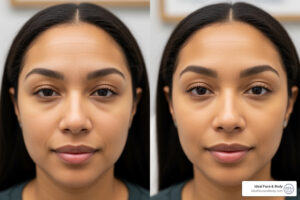
The challenge with atrophic acne scars is that they’re not all the same. Each type forms differently and responds to different treatments. Understanding these differences is the first step toward choosing the right approach. As Dr. Sarah Yovino, a double board-certified master injector specializing in non-surgical medical aesthetics, I’ve helped countless patients steer atrophic acne scars using advanced treatments. My goal is to create natural-looking results that restore your confidence.
Understanding Atrophic Acne Scars: From Formation to Classification
When you look at atrophic acne scars, you’re seeing the result of your body’s attempt to heal from deep inflammation. These indented scars are the most common type of acne scarring, and they happen when your skin can’t produce enough collagen during the healing process.
Severe acne, especially deep cysts, damages collagen and fat in the deeper skin layers. Your body tries to repair this, but produces too little new collagen to fill the space, resulting in a sunken, pitted appearance. This abnormal healing is driven by enzymes that break down collagen faster than it can be replaced. Once formed, these scars don’t typically improve on their own.
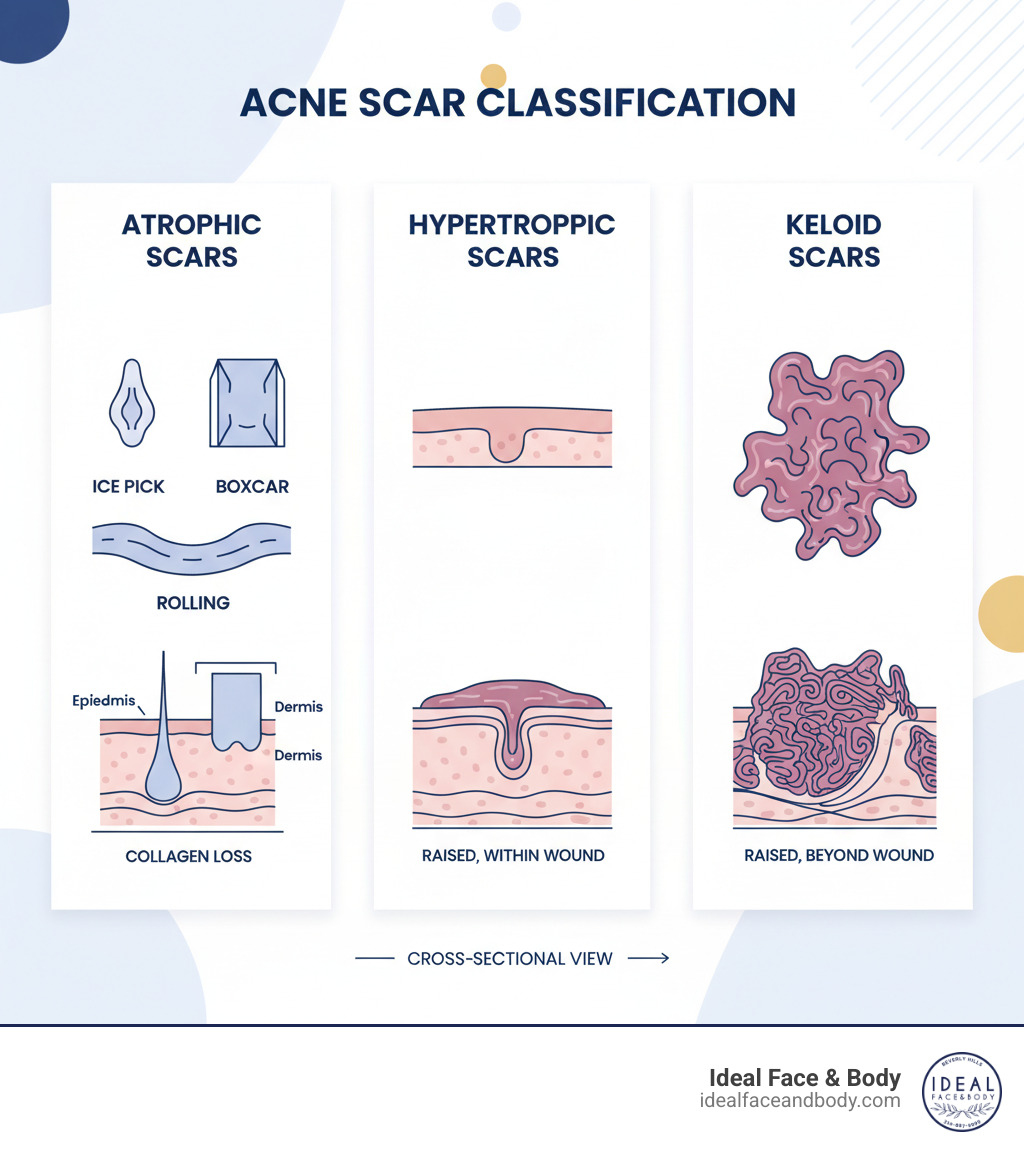
While all atrophic acne scars stem from tissue loss, they look different. Classifying them is crucial for effective treatment, as what works for one type may not work for another. We classify them into three main subtypes: ice pick, boxcar, and rolling scars.

Ice Pick Scars
These look like small, deep holes poked in the skin. They are narrow (under 2 mm), V-shaped, and extend deep into the dermis. Because they are so deep, they are among the most difficult to treat with simple resurfacing methods. They account for 60-70% of all atrophic acne scars.
Boxcar Scars
Wider than ice pick scars (1.5 to 4 mm), these have a U-shaped or rectangular appearance with sharp, vertical edges, similar to a chickenpox scar. They can be shallow or deep and are often found on the cheeks and temples. Their well-defined edges make them good candidates for treatments that lift the scar base or resurface the surrounding skin.
Rolling Scars
These create a wave-like texture on the skin. They are broad depressions (wider than 4 mm) with sloping edges. Rolling scars are caused by fibrous bands of tissue that form under the skin, pulling the surface down. These underlying tethers are the primary target for effective treatment, which must release them to allow the skin to lift back to an even level.
The Natural Course of Scars: Can They Fade on Their Own?
It might be surprising, but atrophic acne scars aren’t always permanent. Your skin is constantly remodeling itself, and this natural process can sometimes lead to spontaneous regression—meaning some scars can fade on their own. However, this is highly dependent on the scar’s size.
A study on scar regression tracked scars over 12 weeks and found a clear pattern: the smaller the scar, the better its chance of fading.
The Critical Role of Scar Size
The research revealed that 47% of the smallest scars (0.5-0.9 mm) resolved completely. However, the odds dropped dramatically with size: only 11% of medium scars (1.0-1.5 mm) and 3% of larger scars (over 1.5 mm) improved.
Most importantly, no scars over 1.5 mm regressed at all. Each 0.5 mm increase in size made a scar nearly ten times less likely to resolve naturally. This highlights why early acne treatment is so critical—it prevents the formation of larger, more stubborn scars that won’t go away on their own.
Other Influencing Factors
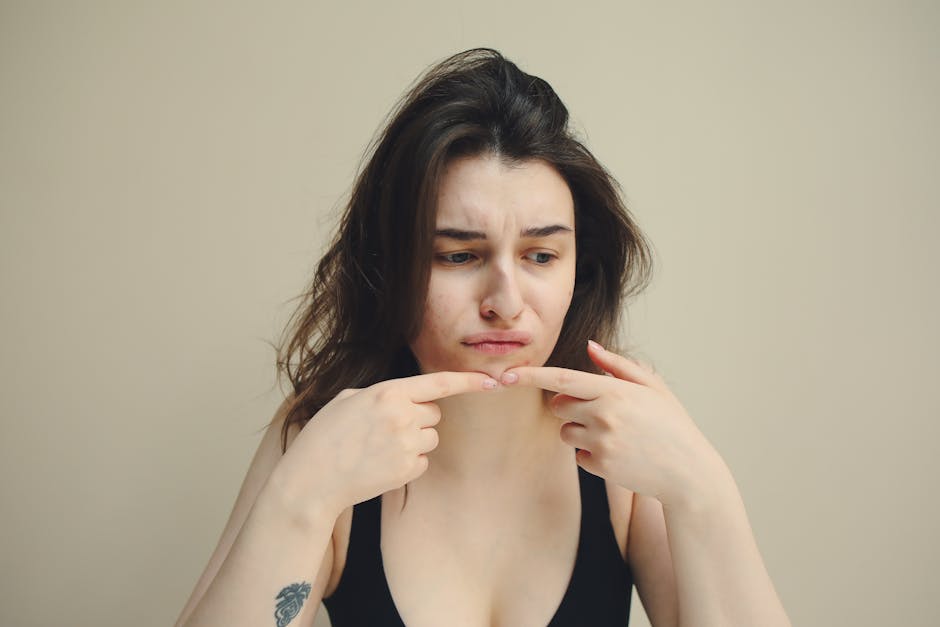
Beyond size, other factors influence how scars heal. Younger skin has more robust regenerative abilities. Genetics also play a role; if your family has prominent scars, you may be more prone to them. Sun exposure is a major factor, as UV rays can darken scars and make them more noticeable. Daily use of a broad-spectrum sunscreen (SPF 30+) is non-negotiable. Finally, the golden rule: stop picking at your skin. Picking and squeezing blemishes increases inflammation and dramatically raises your risk of developing deep, permanent scars—the kind that won’t fade naturally. For most noticeable atrophic acne scars, professional intervention is necessary to achieve significant improvement.
A Comprehensive Guide to Treating Atrophic Acne Scars
Here’s the truth about treating atrophic acne scars: there’s no magic wand, no single treatment that works for everyone. What works beautifully for your friend’s rolling scars might not address your ice pick scars at all. That’s because effective scar treatment requires precision and personalization—understanding your unique scar types, your skin’s characteristics, and your goals.
At Ideal Face & Body in Beverly Hills, we approach atrophic acne scars with a clear philosophy: stimulate your skin’s natural healing process through controlled wound healing and collagen production. We’re essentially teaching your skin to rebuild and resurface itself, gently coaxing it back to a smoother, more even texture.
We know these scars can affect how you see yourself and how you move through the world. That’s why we’ve invested in a comprehensive range of advanced treatments, often combining multiple approaches to give you the best possible results.
Resurfacing Treatments: Lasers and Chemical Peels
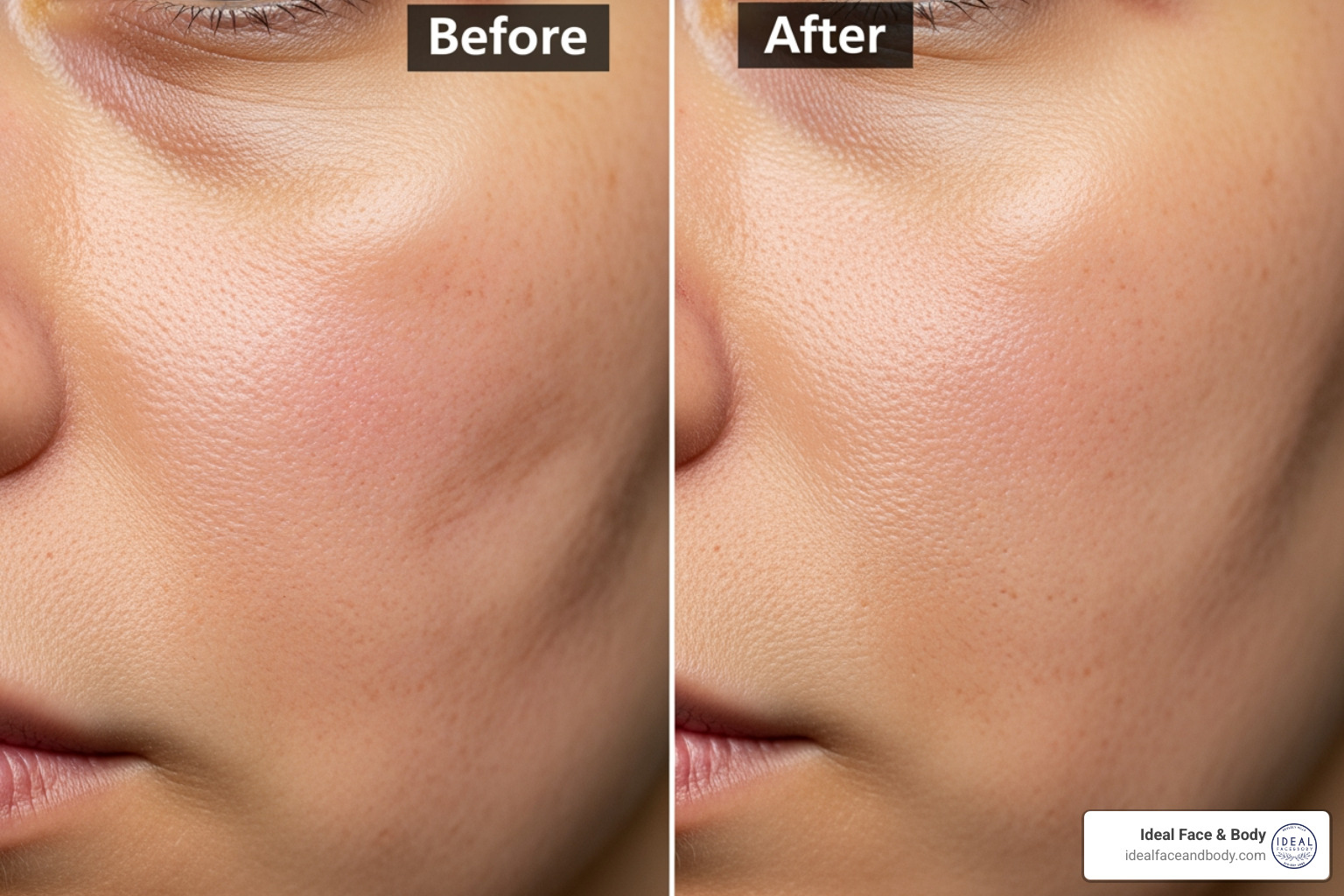
Resurfacing treatments give your skin a fresh start by removing damaged outer layers or creating controlled micro-injuries to trigger your body’s natural healing response. When your skin heals, it produces fresh collagen, which helps fill in those depressions and smooth out texture.
-
Laser Treatments: Lasers are a cornerstone of scar treatment. Ablative lasers (CO2, Er:YAG) vaporize damaged skin for dramatic collagen remodeling but require more downtime. Non-ablative lasers (Nd:YAG) heat the deeper dermis with less downtime, requiring more sessions for gradual results. Fractional laser therapy is a game-changer, treating skin in microscopic columns for faster healing and less downtime. It works well for boxcar, ice pick, and rolling scars. For more details, visit our page on laser treatments.
-
Chemical Peels: These use a chemical solution to exfoliate damaged layers. Superficial peels with glycolic or salicylic acid improve overall texture and mild scarring. For deep ice pick or narrow boxcar scars, the TCA CROSS technique is a highly effective, targeted approach. It uses high-concentration trichloroacetic acid to stimulate collagen from the bottom up, with studies showing 50-70% improvement.
Collagen-Inducing Therapies: Microneedling and Radiofrequency
These treatments tap into your skin’s innate ability to heal itself. By creating controlled micro-injuries, we trigger your body’s natural healing cascade, encouraging fresh collagen and elastin production that gradually improves scar texture and depth.
-
Microneedling: Also known as collagen induction therapy, this uses fine needles to create tiny punctures in the skin. This process breaks down old scar tissue while stimulating new collagen. It’s safe for all skin types with minimal risk of pigmentation issues, making it effective for rolling and superficial boxcar scars. For more information, visit our dedicated microneedling services page.
-
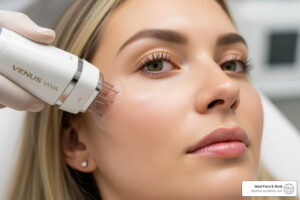
Radiofrequency (RF) Microneedling: This improves traditional microneedling by delivering RF energy through the needles into the dermis. The controlled heat provides an extra boost to collagen production, improving skin tightening and scar remodeling, especially for rolling and boxcar scars.
Surgical & Injectable Solutions for Deeper Atrophic Acne Scars
For deeper or more stubborn scars, a more direct approach may be needed to physically alter the scar or restore lost volume.
-
Subcision: This is highly effective for rolling scars. A special needle or cannula is used to break the fibrous bands that tether the skin down, allowing the surface to lift. This can lead to 50-60% improvement.
-
Punch Techniques: For deep ice pick and narrow boxcar scars, punch excision removes the scar tissue, which is then closed with a tiny stitch, trading a pit for a less noticeable line. Punch grafting fills the excised area with a small skin graft, while punch elevation lifts the base of a boxcar scar to be level with the surrounding skin.
-
Dermal Fillers: These offer immediate results by restoring lost volume. Hyaluronic acid (HA) fillers are excellent for plumping up rolling and other depressed scars. Other biostimulatory fillers like Poly-L-lactic acid (PLLA) and Calcium hydroxylapatite (CaHA) encourage your body to produce its own collagen for gradual, long-lasting improvement.
The Power of Combination Therapy and Future Innovations
Here’s something I’ve learned after years of treating atrophic acne scars: the magic rarely happens with just one approach. Think of it this way—if you’re baking a cake, you wouldn’t expect flour alone to give you something delicious. You need eggs, sugar, butter, and heat working together to create something wonderful. The same principle applies to scar treatment.
When we use a multi-modal approach at Ideal Face & Body, we’re able to address the complex, layered nature of acne scarring in a way that single treatments simply can’t match. Each therapy targets different aspects of your scars—maybe one breaks up the fibrous bands pulling your skin down, while another stimulates fresh collagen production, and yet another resurfaces the texture. Together, they create synergistic effects that go beyond what any individual treatment could achieve.
The research backs this up beautifully. As one comprehensive review of acne scar treatments confirms, combining interventions consistently delivers superior results compared to relying on a single method. It’s not just our clinical observation—it’s science.
Why One Treatment is Often Not Enough
Most people dealing with atrophic acne scars don’t have just one type of scar sitting neatly in one spot. You might have a few deep ice pick scars on your cheeks, some rolling scars creating that wave-like texture, and perhaps a couple of boxcar scars thrown in for good measure. Each of these responds best to different techniques, which is why trying to fix everything with a single approach is a bit like trying to repair your entire house with only a screwdriver.
At Ideal Face & Body, we create strategic plans that might include:
- Subcision with fillers for rolling scars, to release tethers and provide instant volume.
- TCA CROSS followed by fractional laser resurfacing for deep ice pick scars, to rebuild from the bottom up and then smooth the surface.
- Microneedling with PRP (Platelet-Rich Plasma), where growth factors from your own blood boost the healing response and accelerate collagen production.
On the Horizon: Emerging Treatments for Acne Scars
The field of aesthetic medicine is constantly evolving, with regenerative medicine showing exciting promise for atrophic acne scars. Emerging treatments focus on using your body’s own healing intelligence. Stem cell therapy, using cells derived from your own fat tissue, shows potential to accelerate wound healing and regenerate skin. Similarly, Platelet-Rich Plasma (PRP) and Platelet-Rich Fibrin (PRF) use concentrated growth factors from your blood to stimulate collagen synthesis and tissue repair. While some of these are still in early clinical stages, they represent a future where we can more profoundly activate your skin’s natural regenerative capacity for even better, more natural-looking results.
Frequently Asked Questions about Atrophic Acne Scars
When it comes to atrophic acne scars, we hear similar questions from nearly every patient who walks through our doors at Ideal Face & Body. These concerns are completely understandable—after all, you’re looking for real solutions to something that’s been affecting your confidence. Let’s address the most common questions we receive.
What is the best single treatment for atrophic acne scars?
Here’s the honest answer: there isn’t a single “best” treatment that works for everyone. The optimal approach for your atrophic acne scars depends entirely on your unique situation—the specific types of scars you have (ice pick, boxcar, rolling, or a combination), your skin type and tone, your lifestyle, and your personal goals. The most effective strategy almost always involves a combination of therapies personalized to your specific needs.
How can I prevent atrophic acne scars from forming?
Prevention is always easier than correction, and when it comes to atrophic acne scars, the best defense is a good offense. The single most effective preventive measure is to treat acne early and consistently. Don’t wait for it to get worse or hope it will just go away on its own. The longer inflammatory acne persists, the more damage it can do to your skin’s collagen structure.
Avoid picking, squeezing, or popping your blemishes—I cannot stress this enough. Manipulating acne lesions significantly increases inflammation and dramatically raises your risk of developing permanent scars.
Another crucial preventive step is sun protection. While UV exposure doesn’t directly cause scars, it can worsen post-inflammatory hyperpigmentation and make existing scars more noticeable. Use a broad-spectrum sunscreen with SPF 30 or higher daily, even on cloudy days.
How long does it take to see results from acne scar treatments?
Patience is key when treating atrophic acne scars, and the timeline varies significantly depending on which treatment or combination of treatments we use.
- Dermal fillers offer the most immediate gratification. You’ll see volume restoration and smoother skin contours right after your appointment.
- Collagen-stimulating treatments like microneedling, laser resurfacing, and chemical peels work differently. You’ll typically start noticing gradual improvements around three to six months after treatment as new collagen develops and remodels. Most patients require multiple sessions spaced several weeks apart to achieve optimal results.
- Surgical procedures like subcision or punch excision also show progressive improvement over several months as the skin heals and remodels.
Conclusion
Your journey to smoother, more confident skin starts with understanding what you’re dealing with—and now you have that knowledge. We’ve explored how atrophic acne scars form, why they look so different from one another, and most importantly, what can actually be done about them. From the deep, narrow channels of ice pick scars to the wave-like undulations of rolling scars and the sharp-edged depressions of boxcar scars, each type tells a different story and requires its own thoughtful approach.
The truth is, while your body is remarkably good at healing itself, most atrophic acne scars won’t fade on their own. But here’s the encouraging part: modern aesthetic medicine has given us an impressive toolkit. Lasers can resurface and remodel. Microneedling can rebuild collagen from within. Subcision can release those stubborn tethers. Fillers can restore lost volume instantly. And when we combine these treatments strategically? That’s when the real magic happens.
The most important thing to remember is this: there’s no cookie-cutter solution. Your scars are as unique as you are, and they deserve a treatment plan that reflects that individuality. A professional evaluation is so valuable—it takes the guesswork out of the equation and puts you on a clear path forward.
At Ideal Face & Body in Beverly Hills, we understand that atrophic acne scars affect more than just your skin. Dr. Sarah Yovino and our entire team are passionate about creating customized treatment strategies that address not only the physical scars but also help restore the confidence that may have been diminished along the way. You don’t have to steer this alone.
Schedule your consultation today and let’s start writing your next chapter—one with smoother skin, renewed confidence, and the freedom to feel truly comfortable in your own face.