Botox vs. Dysport: Which Neurotoxin Is Right for You?
Dysport vs Botox are both FDA-approved botulinum toxin type A treatments that relax facial muscles to smooth dynamic wrinkles — but they’re not identical. Here’s a quick side-by-side to help you decide:
| Feature | Botox | Dysport |
|---|---|---|
| Active ingredient | OnabotulinumtoxinA | AbobotulinumtoxinA |
| Onset | 3-7 days | 1-3 days |
| Duration | 3-4 months | 3-4 months |
| Diffusion | More localized | Spreads more widely |
| Best for | Precise, smaller areas (crow’s feet, frown lines) | Larger areas (broad forehead, glabellar lines) |
| Unit conversion | 1 unit Botox | ~2.5-3 units Dysport |
Both are safe, effective, and produce natural-looking results when administered by a skilled injector. The right choice depends on your anatomy, treatment goals, and how quickly you want to see results.
If you’re weighing your options and want to feel confident in your choice, you’re in the right place. Whether you’re treating your first forehead lines or refining a long-term maintenance routine, understanding the real differences between these two treatments makes all the difference.
I’m Dr. Sarah Yovino, MD, a double board-certified master injector and the lead nonsurgical specialist at Ideal Face & Body in Beverly Hills, CA. I’ve performed countless dysport vs botox treatments and use my background in pain management and facial anatomy to guide every patient toward their most natural, refreshed result.
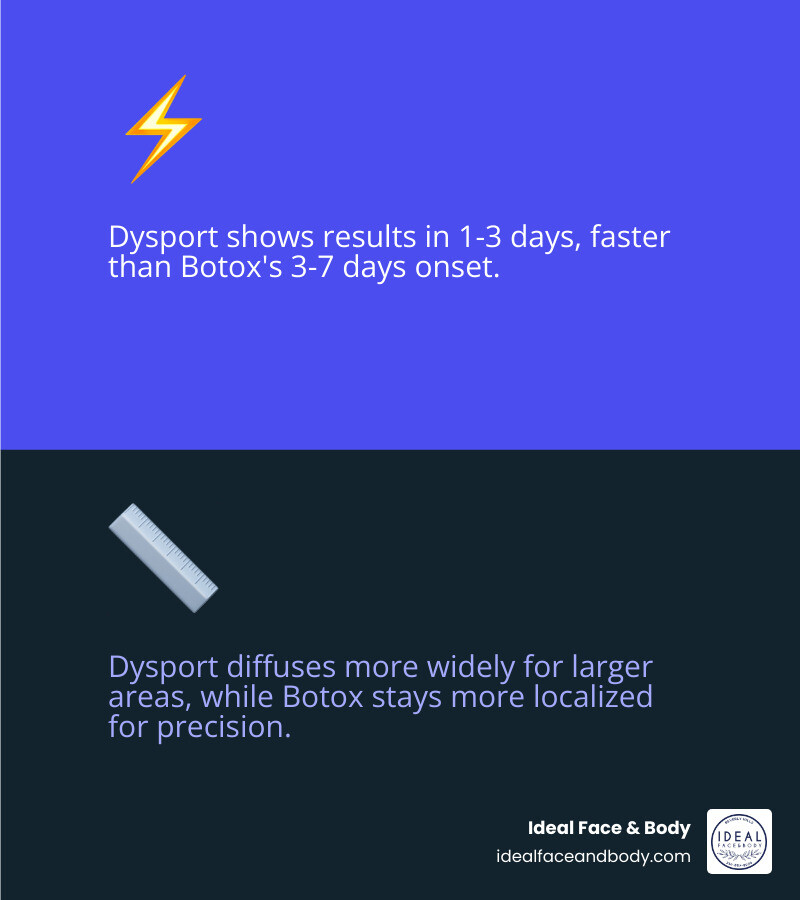
Quick look at dysport vs botox:
Understanding the Science: Dysport vs Botox
To the naked eye, a syringe of Botox looks exactly like a syringe of Dysport. However, when we dive into the molecular level, we find two distinct products with unique “personalities.” Both are derived from Clostridium botulinum, the bacterium responsible for producing botulinum toxin type A. According to Scientific research on abobotulinumtoxinA and onabotulinumtoxinA, these neuromodulators work by blocking acetylcholine—the chemical messenger that tells your muscles to contract. When the muscle relaxes, the skin above it smooths out.
At Ideal Face & Body, we often explain that What Makes Botox Injections Effective? is the precision with which they target the “dynamic” muscles—those responsible for squinting, frowning, and raising your eyebrows. While they share the same core toxin, their manufacturing processes result in different molecular weights and protein structures.
Key Differences in Formulation
The primary difference lies in the “accessory proteins” that surround the active toxin molecule. Botox (onabotulinumtoxinA) is formulated with a specific set of protective proteins that make the molecule relatively large and uniform. Dysport (abobotulinumtoxinA) uses a different purification method, resulting in smaller molecules and a slightly different protein load.
As noted in the FDA Access Data on Botox, these distinctions mean the two products are not bioequivalent. You cannot simply swap one for the other milligram for milligram. Think of it like different brands of laundry detergent: they both clean your clothes, but you might need a different capful size for each to get the same level of “freshness.”
Diffusion and Spread Patterns
One of the most significant practical differences in the dysport vs botox debate is the “diffusion radius.” Because Dysport has smaller molecules and a different protein structure, it tends to spread, or diffuse, a bit further from the initial injection site than Botox.
A Scientific study on Dysport diffusion highlights that this wider spread can be a massive advantage when treating broad areas like a large forehead. It allows for a softer, more blended transition between treated and untreated areas. On the flip side, Botox is known for staying exactly where we put it. This “stay-put” quality makes Botox the gold standard for high-precision areas, such as the delicate muscles around the eyes (crow’s feet) or the “lip flip,” where we don’t want the toxin migrating to nearby muscles that control your smile.
Comparing Results: Onset and Duration
When patients visit us in Beverly Hills, the two most common questions are: “How fast will it work?” and “How long will it last?” While both products generally fall into the same ballpark, there are subtle timing differences that might influence your choice.
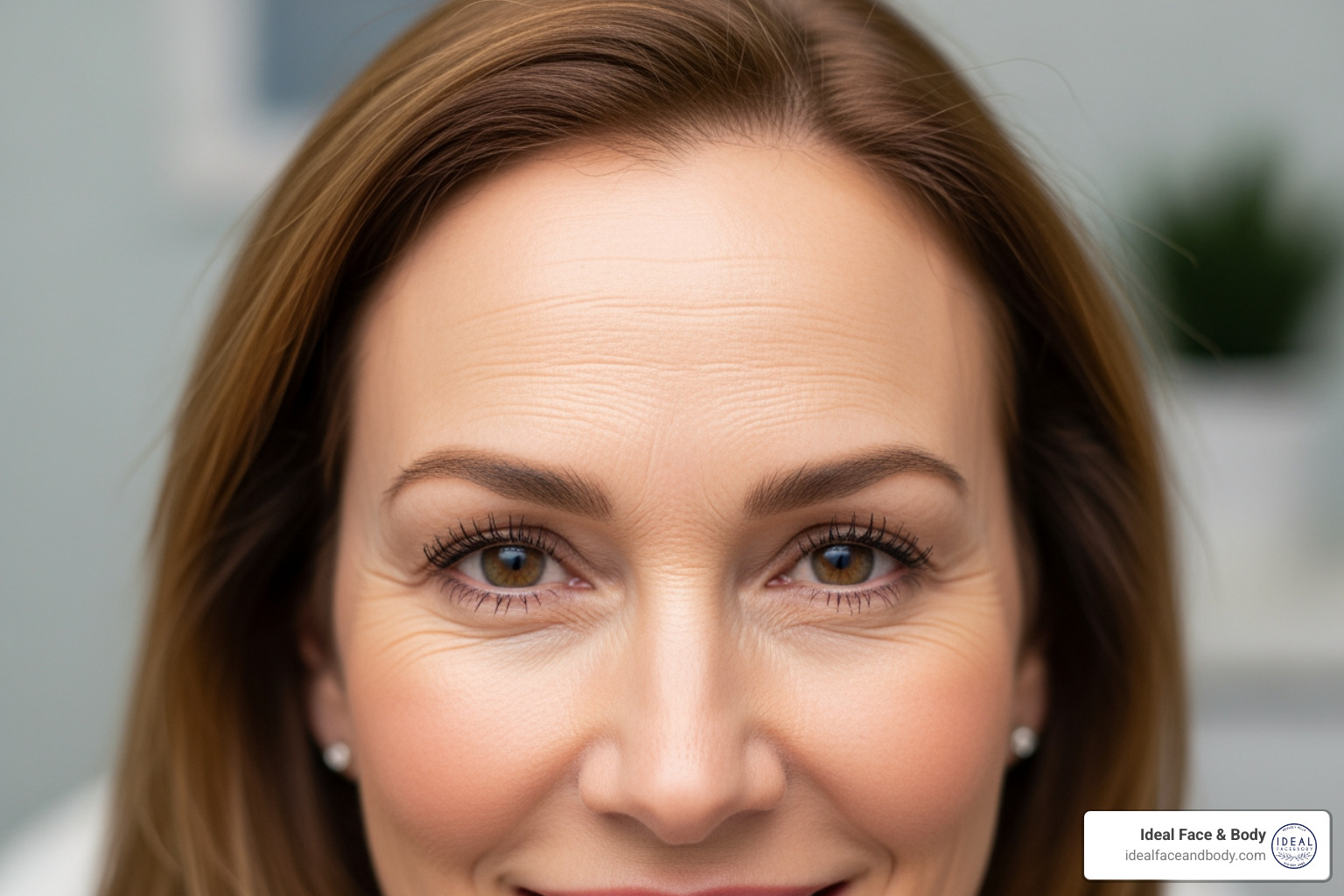
Speed of Results for Dysport vs Botox
If you have a red-carpet event or a wedding in three days and you just realized your “eleven lines” are looking a bit deep, Dysport is likely your best friend. Cleveland Clinic on onset timing reports that Dysport results are typically visible within 24 to 72 hours. Many of our patients report feeling the “tightening” sensation as early as the next day.
Botox, by comparison, is a bit more of a “slow and steady” performer. You will start to see changes in 3 to 7 days, but it usually takes the full 14 days to see the final, polished result. If you aren’t in a rush, this doesn’t matter much, but for those last-minute “glow-ups,” the speed of dysport vs botox definitely leans in Dysport’s favor.
How Long Do Results Last?
In terms of longevity, both products are remarkably similar. On average, you can expect your results to last between 3 to 4 months. However, real-world duration depends heavily on your metabolism, the strength of your facial muscles, and how much product was used.
We offer a variety of options, including Dysport, Botox, Xeomin, Juveu, Letybo, and we’ve found that some patients simply “respond” better to one over the other. Clinical data suggests that in certain areas, such as the glabellar lines (frown lines), Dysport might show a slightly higher satisfaction rate at the three-month mark. At Ideal Face & Body, we focus on creating a customized maintenance schedule so you never have to see those lines return to their full depth.
Treatment Areas and Dosing Requirements
Understanding where to inject is just as important as choosing the right product. Facial anatomy is a complex map of muscles that pull in different directions. To achieve a balanced, natural look, we have to consider the specific “pull” of your muscles.
Unit Conversions for Dysport vs Botox
This is the part that trips most people up. Dysport vs Botox units are not a 1:1 swap. Because Dysport is more “diluted” in terms of its unit measurement, it takes more units of Dysport to achieve the same muscle-relaxing power as one unit of Botox.
Dermatology research on unit conversion generally suggests a ratio of 2.5 to 3 units of Dysport for every 1 unit of Botox. For example, if we typically use 20 units of Botox for your frown lines, we would likely use 50 to 60 units of Dysport for the same area. It’s important to remember that “more units” doesn’t mean “more toxin”—it’s just a different way of measuring the same effective dose.
Choosing the Right Product for Specific Areas
When we Target Unwanted Lines & Wrinkles with Botox in Beverly Hills, we select the product based on the landscape of your face:
- The Forehead: If you have a broad forehead with horizontal lines, we often prefer Dysport. Its ability to diffuse ensures we don’t end up with “Spock brows” or patchy areas where some muscles are frozen and others are still moving.
- The Glabellar Lines (Frown Lines): Both work exceptionally well here. Dysport is specifically FDA-approved for moderate to severe glabellar lines and is a powerhouse for “heavy” frowners.
- Crow’s Feet: Because we want to avoid the toxin spreading toward the muscles that control your eyelid or your upper lip, we often reach for Botox. Its precision is unmatched in this delicate area.
- Masseter Reduction: For jaw slimming or treating TMJ, Dysport’s spread can be beneficial in covering the large masseter muscle more efficiently.
By understanding How You Could Reverse Signs of Aging with Botox in Beverly Hills, we can even use a “cocktail” approach, using Botox in one area and Dysport in another during the same session to get the best of both worlds.
Safety, Side Effects, and Candidacy
Both Botox and Dysport have stellar safety profiles and have been used for decades both cosmetically and medically. According to MedlinePlus Health Information, the most common side effects are mild and temporary. These include:
- Redness or swelling at the injection site (usually gone within 20 minutes).
- Minor bruising (we use specialized techniques to minimize this).
- A temporary headache.
- Localized muscle weakness.
Rare but serious risks involve the toxin spreading too far, which can cause drooping eyelids (ptosis) or difficulty swallowing. This is why choosing an expert like Dr. Sarah Yovino or Dr. Justin Yovino is critical—precision placement is the best defense against side effects.
Who is a Good Candidate?
Most adults who are bothered by dynamic wrinkles are excellent candidates. We often get asked, What is the Right Age to Get Botox Treatments? The answer is: as soon as you start to see “etched” lines that remain even when your face is at rest. Starting in your late 20s or early 30s can actually prevent these deep wrinkles from forming in the first place.
However, you should avoid these treatments if you:
- Are pregnant or breastfeeding.
- Have a known allergy to botulinum toxin or cow’s milk protein (Dysport contains trace amounts of lactose).
- Have a neuromuscular disorder like ALS or Myasthenia Gravis.
- Have an active infection at the injection site.
When discussing the Botox Cost Per Unit, while the price per unit of Dysport is often lower, you need three times as many units. The total price for treating a specific area tends to be very similar between the two products.
Frequently Asked Questions about Neurotoxins
Can I switch between Botox and Dysport?
Absolutely! In fact, we often encourage patients to try both at different times to see which their body prefers. Some people find they developed a slight “resistance” to one brand after years of use, and switching to the other “reboots” their results. Just make sure your previous treatment has completely worn off before switching.
Is one treatment more painful than the other?
In our experience at Ideal Face & Body, the sensation is nearly identical—a tiny “pinch” that lasts for a split second. We specialize in “painless” techniques and can provide topical numbing or ice to ensure you are completely comfortable. Most patients say the anticipation is much worse than the actual needle!
Does one look more natural than the other?
Both can look incredibly natural or “frozen” depending entirely on the skill of the injector. Dysport’s diffusion can sometimes lead to a slightly “softer” look on the forehead, while Botox’s precision allows for very specific muscle tailoring. Dr. Sarah Yovino’s philosophy is always “less is more”—we want you to look like a refreshed version of yourself, not a different person.
Conclusion
At Ideal Face & Body in Beverly Hills, we don’t believe in a one-size-fits-all approach to beauty. Whether the winner of the dysport vs botox debate for you is the fast-acting Dysport or the ultra-precise Botox, our goal is to provide a result that makes you feel confident every time you look in the mirror.
Under the expert guidance of Dr. Sarah Yovino and Dr. Justin Yovino, your treatment will be tailored to your unique facial structure and aesthetic goals. We invite you to experience the difference that Beverly Hills expertise can make.
Ready to smooth away those unwanted lines? Schedule your consultation with us today and let’s find your perfect fit.