
How to get rid of dowager’s hump: Ultimate Relief 2025
Understanding What a Dowager’s Hump Really Means for Your Health
How to get rid of dowager’s hump depends on what’s causing it. Here are the most effective methods:
- Targeted exercises – Chin tucks, scapular squeezes, and doorway stretches performed daily
- Posture correction – Ergonomic workstation setup and mindful device use
- Physical therapy – Professional assessment and personalized treatment plans
- Lifestyle changes – Strengthening exercises, proper sleeping positions, and regular breaks from screens
- Professional treatment – For fat-based humps, minimally invasive cosmetic procedures may be appropriate
Have you noticed a rounded bump at the base of your neck? You’re not alone. Experts estimate that dowager’s hump affects 2 out of 5 people over 55, but it’s increasingly appearing in younger adults due to modern lifestyle habits like prolonged phone and computer use.
The good news is that this condition is often treatable and sometimes reversible.
A dowager’s hump appears as a visible curve or protrusion in the upper back or neck area. It typically develops from one of two causes: chronic poor posture weakening the muscles around your thoracic spine, or osteoporosis leading to compression fractures in the vertebrae.
Women are particularly susceptible to this condition. Hormone changes during menopause increase the risk of osteoporosis, which can contribute to spinal curvature. But regardless of the cause, addressing a dowager’s hump early offers the best chance for improvement.
Left untreated, this condition can lead to chronic neck and shoulder pain, headaches, reduced mobility, and in severe cases, even breathing difficulties. The curve can also affect your confidence and how you carry yourself.
But here’s the important part: depending on the cause and severity, many people can improve or even reverse their dowager’s hump with consistent effort. For postural humps, exercises and lifestyle changes can make a significant difference. For fat-based humps, cosmetic solutions offer effective results.
As Dr. Sarah Yovino, a double board-certified specialist in non-surgical medical aesthetics at Ideal Face & Body in Beverly Hills, I’ve helped many patients address concerns related to how to get rid of dowager’s hump, particularly those caused by fat deposits in the neck area. Whether your concern is postural or cosmetic, understanding the root cause is the first step toward finding the right solution.
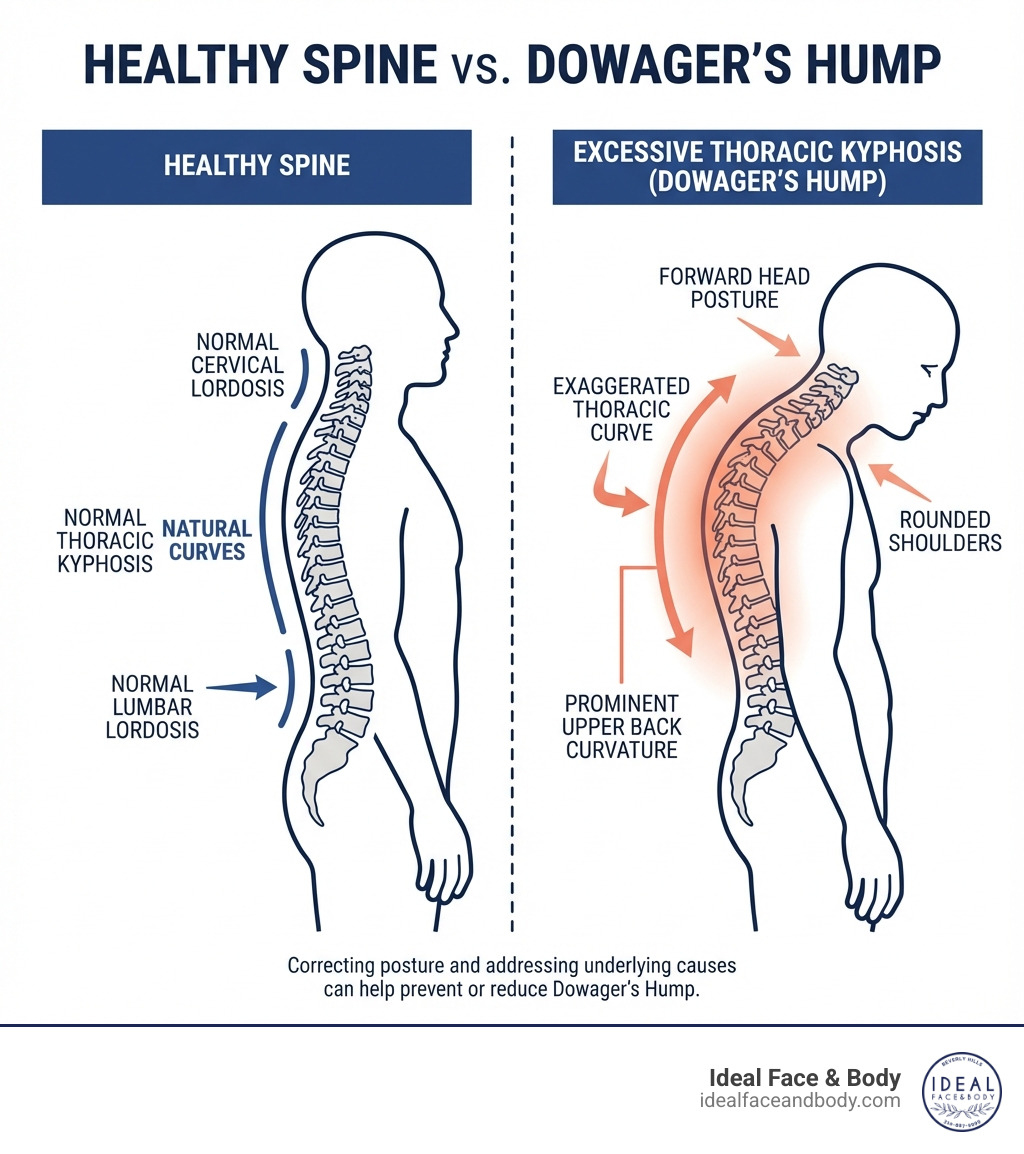
Understanding the Hump: Dowager’s vs. Buffalo Hump
The term “dowager’s hump” is often used broadly, but it’s important to understand that there are distinct differences between a true dowager’s hump and a buffalo hump. While both manifest as a bulge at the base of the neck or upper back, their underlying causes and compositions are quite different, which directly impacts the approach to treatment. Knowing which type of hump you have is the first step in figuring out how to get rid of dowager’s hump (or a buffalo hump, as the case may be).
What is a Dowager’s Hump?
A dowager’s hump is primarily a spinal condition, medically known as kyphosis. Specifically, it refers to an excessive forward curve of the upper spine, affecting the thoracic vertebrae. This chronic forward-leaning posture can lead to a visible rounded hump in the upper back, often accompanied by a forward head posture where your head juts forward beyond your shoulders.
This condition results from changes in the strength of the muscles surrounding the thoracic vertebrae, leading to compensation, overuse, strain, and a change in overall posture. Over time, the spine adapts to this poor alignment, creating the characteristic rounded back. You might notice your head in a forward-leaning position, seeing a physical hump at the top of your back near your neck. In severe cases, this can lead to difficulty looking up, neck and upper back pain, reduced mobility, and even headaches.
What is a Buffalo Hump?
In contrast, a buffalo hump is not primarily a spinal deformity but rather an accumulation of excess fat tissue at the base of the neck, specifically in the cervicodorsal fat pad area. While it can occur alongside a dowager’s hump, it’s distinct in its composition. Oftentimes, a dowager’s hump is mistaken for a buffalo hump because they look similar.
A buffalo hump is typically a symptom of an underlying medical condition, such as Cushing’s disease, where the body produces excess cortisol, leading to increased fat production and redistribution. It can also be associated with certain medications or significant weight gain.
Because a buffalo hump is fundamentally a fat deposit, its treatment often involves different strategies than those for a postural or skeletal dowager’s hump. We offer various advanced cosmetic solutions here at Ideal Face & Body in Beverly Hills for addressing unwanted fat accumulations. You can learn more about these options at our pages, such as Buffalo Hump Removal and What Can Be Done About My Buffalo Hump?.
| Feature | Dowager’s Hump (Kyphosis) | Buffalo Hump (Lipodystrophy) |
|---|---|---|
| Primary Cause | Spinal curvature due to poor posture, osteoporosis, etc. | Excess fat accumulation, often due to underlying conditions |
| Composition | Bone and muscle misalignment | Fatty tissue |
| Appearance | Rounded hunch in upper back, forward head posture | Localized fat pad at base of neck |
| Typical Treatment | Exercises, physical therapy, posture correction, medication | Fat removal procedures (e.g., liposuction), addressing underlying medical cause |
Primary Causes and Health Risks of a Dowager’s Hump
Understanding the root causes of a dowager’s hump is crucial for effective prevention and treatment. While it’s often associated with aging, several factors contribute to its development, impacting people of various ages. If left unaddressed, it can lead to significant health consequences.
The Role of Posture and Lifestyle
The most common culprit behind a dowager’s hump is chronic poor posture, often exacerbated by modern lifestyles. It’s typically caused by a combination of weak upper back and neck muscles and tightness in the neck and chest.
- Sedentary Lifestyle and Desk Work: Spending long hours sitting at a desk, especially with a slumped posture, can gradually lead to an abnormal curve of your upper vertebrae. This chronic forward-leaning posture stretches the muscles and ligaments that support your neck and spine, eventually pulling the vertebrae out of their normal position.
- “Text Neck” and Device Use: The continuous habit of looking down at smartphones, tablets, or computer screens puts immense strain on the neck. The human head weighs around 11 lbs on average, and leaning it forward significantly increases the load on your cervical spine. This “text neck” phenomenon is a significant contributor to dowager’s hump development in younger individuals.

- Muscle Imbalance: Poor posture creates a vicious cycle: weak upper back and neck muscles struggle to hold your head upright, while tight chest and shoulder muscles pull your shoulders forward, further rounding your upper back. This imbalance is a key factor in how the hump forms.
Maintaining good posture is the best way to prevent a dowager’s hump. As we always emphasize at Ideal Face & Body, good posture isn’t just about looking better; it’s about spinal health.
Medical Conditions: Osteoporosis and More
Beyond lifestyle, several medical conditions can directly contribute to the development of a dowager’s hump:
- Osteoporosis: This condition, characterized by thinning and weakening bones, is a primary cause, especially in older adults. When bones become brittle, even minor stresses can lead to compression fractures in the vertebrae. These fractures cause the spine to collapse forward, creating an increased forward curve (kyphosis). Because osteoporosis is more common in women, so is dowager’s hump. Women are particularly susceptible as hormone changes during menopause can increase their risk of osteoporosis. We believe in empowering our patients with knowledge about their health, which is why we stress the importance of bone health.
- Scheuermann’s Kyphosis: This condition typically affects teenagers during growth spurts. Instead of developing a normal rectangular shape, their vertebrae can develop a wedge shape, leading to an excessive spinal curve.
- Congenital Factors: In some rare cases, individuals are born with spinal deformities that can lead to kyphosis due to improper spinal development.
- Other Conditions: Degenerative changes in the spine, arthritis, tumors, and infections can also contribute to the development of kyphosis.
If a dowager’s hump is left untreated, patients may experience pain through the neck and shoulders, possibly extending into the arms. Besides aesthetic concerns, many people suffer from chronic headaches and discomfort. More severe cases can lead to impaired lung function, reduced functional capacity, digestive issues, and an increased risk of falls due to changes in body weight distribution.
How to Get Rid of Dowager’s Hump with At-Home Strategies
The good news is that for many cases of dowager’s hump, particularly those stemming from poor posture, significant improvement is possible through consistent at-home strategies. The key is dedication and understanding that it can take a long time to correct itself — months even. We encourage our patients to accept a holistic approach to their well-being.
Effective Exercises and Stretches
Targeted exercises and stretches are fundamental to correcting a postural dowager’s hump. They work by strengthening the weak muscles of the upper back and neck while stretching the tight muscles in the chest and shoulders that pull you into a hunched position.
Here are some of the most effective exercises:
- Chin Tucks: This simple yet powerful exercise strengthens the deep neck flexors and helps restore proper head alignment.
- Sit or stand tall, looking straight ahead.
- Gently pull your chin straight back, as if making a double chin, keeping your head level. You should feel a stretch at the base of your skull and engagement in the front of your neck.
- Hold for 5-6 seconds.
- Repeat 12-15 times, aiming for three sets daily.

-
Scapular Squeezes (Shoulder Blade Squeezes): These strengthen the muscles between your shoulder blades, which are crucial for maintaining an upright posture.
- Sit or stand tall with your arms relaxed at your sides.
- Gently squeeze your shoulder blades together, as if trying to hold a pencil between them. Avoid shrugging your shoulders up.
- Hold for 5-6 seconds.
- Repeat 12-15 times, aiming for three sets daily.
-
Doorway Pectoral Stretch: This stretch helps release tightness in the chest muscles that contribute to rounded shoulders and a forward posture.
- Stand in a doorway with your arms raised to shoulder height, forearms resting on the doorframe (like a goalpost).
- Step gently forward with one foot until you feel a stretch across your chest. Keep your core engaged and avoid arching your lower back.
- Hold for 20-30 seconds.
- Repeat 2-3 times daily.
-
Wall Angels: This exercise improves shoulder mobility and strengthens the upper back while engaging core muscles.
- Stand with your back flat against a wall, heels about 6 inches away.
- Keep your head, shoulders, and lower back pressed against the wall.
- Bring your arms up into a “goalpost” position, with the backs of your hands and elbows touching the wall.
- Slowly slide your arms up the wall, keeping contact, as high as you can, then slide them back down.
- Repeat 10-15 times.
-
Thoracic Spine Extensions: These help counteract the forward curve of the upper back.
- Lie on your back with a foam roller placed horizontally beneath your upper back (just below your shoulder blades).
- Interlace your fingers behind your head for support, keeping your elbows wide.
- Gently arch your upper back over the foam roller, allowing your head to drop back slightly.
- Hold for a few seconds, then return to the starting position.
- Roll the foam roller up or down your thoracic spine a few inches and repeat.
Consistency is paramount with these exercises. Performing them daily will yield the best results for how to get rid of dowager’s hump.
Ergonomic and Lifestyle Adjustments for Prevention
Beyond exercises, making conscious changes to your daily habits and environment can significantly prevent and improve a dowager’s hump.
- Workstation Setup: If you spend hours at a desk, proper ergonomics are non-negotiable.
- Eye-Level Screen: Position your computer monitor so the top of the screen is at eye level. This prevents you from constantly looking down and hunching forward. Use a monitor stand or risers if necessary.
- Lumbar Support: Ensure your chair provides good lumbar support to maintain the natural curve of your lower back, which in turn supports your upper spine.
- Upright Posture: Sit up straight, with your ears stacked over your shoulders and your shoulders pulled down and back. Your feet should be flat on the floor, and your knees at a 90-degree angle.
- Mindful Phone Use: Hold your cell phone at eye level instead of bending your neck to look down. This simple change can drastically reduce the strain on your cervical spine.
- Regular Breaks: Take frequent breaks from sitting and device use. Stand up, stretch, and walk around every 30-60 minutes to reset your posture and relieve muscle tension.
- Sleeping Position: Your sleeping posture can also influence your spinal alignment.
- Back Sleepers: Aim to sleep on your back with a thin pillow or a cervical pillow that supports the natural curve of your neck without propping your head too high.
- Side Sleepers: Use a pillow that keeps your head and neck aligned with your spine, filling the gap between your shoulder and head.
- Avoid Stomach Sleeping: This position forces your neck to twist for prolonged periods, which is detrimental to spinal health.
By integrating these adjustments into your daily routine, you’re actively working towards preventing and reversing the forward-leaning posture associated with a dowager’s hump.
When to Consider Professional Treatment
While at-home exercises and lifestyle changes are powerful tools, there are times when professional medical intervention is necessary. Knowing when to seek expert help is a crucial part of understanding how to get rid of dowager’s hump effectively and safely.
You should consider seeking professional medical help for a dowager’s hump if you experience:
- Persistent or Worsening Pain: If you have chronic neck, shoulder, or upper back pain that doesn’t improve with at-home remedies, or if the pain intensifies.
- Progressive Curvature: If the hump appears to be growing larger or the forward spinal curve is becoming more pronounced.
- Neurological Symptoms: Tingling, numbness, weakness in your arms or hands, or difficulty with balance could indicate nerve compression, which requires immediate medical attention.
- Difficulty with Daily Activities: If the hump significantly limits your mobility, makes it hard to look up, or interferes with your ability to perform everyday tasks.
- Underlying Medical Conditions: If you suspect an underlying condition like osteoporosis is contributing to the hump, a medical professional can diagnose and manage it.
A healthcare provider can help determine the exact cause of your hump, whether it’s primarily postural, related to osteoporosis, or another medical condition. This diagnosis is essential for tailoring the most effective treatment plan.
How Physiotherapy Can Correct Posture
For dowager’s humps caused by postural issues, physiotherapy (physical therapy) is often a cornerstone of treatment. A physical therapist can offer a comprehensive and personalized approach that goes beyond what you can achieve with self-guided exercises.
- Postural Assessment: A physiotherapist will conduct a thorough assessment of your posture, movement patterns, and muscle imbalances to identify the specific factors contributing to your hump.
- Manual Therapy: This can include techniques like massage, mobilization, and myofascial release to address tight muscles and stiff joints in your neck, shoulders, and upper back. This helps improve joint mobility and reduce pain.
- Corrective Strengthening: They will guide you through exercises specifically designed to strengthen your weak upper back, neck flexors, and shoulder stabilizer muscles, ensuring you perform them with correct form to maximize effectiveness.
- Personalized Exercise Plan: A physical therapist will create a custom exercise program for you, progressing as your strength and flexibility improve. This ensures you’re doing the right exercises for your specific needs.
- Ergonomic and Postural Education: They will provide invaluable advice on ergonomic adjustments for your workspace and daily activities, helping you integrate good posture into every aspect of your life. They can teach you how to consciously check and correct your posture throughout the day.
Working with a physical therapist can be highly effective, as they can provide hands-on treatment and expert guidance that accelerates your progress in correcting postural imbalances.
Cosmetic Solutions for Fat-Based Humps
For individuals whose neck hump is primarily a buffalo hump – an accumulation of excess fatty tissue – the approach to how to get rid of dowager’s hump takes a cosmetic direction. At Ideal Face & Body in Beverly Hills, we specialize in advanced cosmetic procedures that can effectively address these fat deposits.
Our expertise lies in precision body sculpting, offering solutions that are minimally invasive and custom to each patient’s unique needs. For fat-based humps, procedures like liposuction are highly effective.
- Liposuction: This procedure precisely removes localized fat deposits. Our state-of-the-art techniques, including Precision Sculpt awake liposuction, allow for targeted fat removal with minimal downtime. This can significantly reduce the size and prominence of a buffalo hump, restoring a smoother contour to the neck and upper back. We understand that considering any procedure comes with questions, which is why we provide detailed information on topics like Buffalo Hump Surgery: Everything You Need to Know and address concerns such as Is Liposuction of the Buffalo Hump Dangerous?.
Our philosophy at Ideal Face & Body is to provide solutions that not only improve your appearance but also boost your confidence and overall well-being. If you suspect your hump is due to fat accumulation, we encourage you to explore our specialized options.
Frequently Asked Questions about Dowager’s Hump
We often hear many questions from our patients and those seeking information about dowager’s hump. Here are some of the most common inquiries.
Can a dowager’s hump be completely reversed?
The reversibility of a dowager’s hump largely depends on its underlying cause and how long it has been present.
- Postural Humps: If the hump is primarily due to chronic poor posture and muscle imbalances, it is often significantly correctable and, in many cases, can be completely reversed with consistent effort. This involves dedicated exercises, stretches, and strict adherence to ergonomic and lifestyle adjustments. Improvement can take several months of diligent work.
- Skeletal Changes (Osteoporosis, Scheuermann’s): If the hump involves structural changes to the vertebrae, such as those caused by osteoporosis (compression fractures) or Scheuermann’s kyphosis, complete reversal of the skeletal deformity may not be possible. However, even in these cases, significant improvement in posture, reduction in pain, and prevention of further progression can be achieved through medical management, physical therapy, and targeted exercises. The goal shifts from complete reversal to effective management and improving quality of life.
- Fat-Based Humps (Buffalo Humps): If the hump is a fat deposit, cosmetic procedures like liposuction can effectively remove the excess fat, leading to a dramatic improvement in contour.
While some dowager’s humps can be entirely eliminated, others can be greatly improved and managed to minimize symptoms and prevent worsening.
Is a dowager’s hump dangerous?
While a dowager’s hump is typically not immediately dangerous, it can lead to a variety of health issues if left unaddressed.
- Chronic Pain and Stiffness: The most common consequence is persistent pain and stiffness in the neck, shoulders, and upper back. This can severely impact daily comfort and mobility.
- Headaches: Muscle tension and nerve compression associated with poor posture can frequently lead to chronic headaches or migraines.
- Reduced Mobility: The spinal curvature can limit your range of motion, making it difficult to turn your head, reach overhead, or even stand upright comfortably.
- Impaired Organ Function: In severe cases of kyphosis (extreme spinal curve), the forward collapse of the chest cavity can restrict lung function, leading to breathing difficulties. It can also place pressure on abdominal organs, potentially causing digestive issues or urinary incontinence.
- Increased Fall Risk: The altered center of gravity from a pronounced hump can affect balance, increasing the risk of falls, especially in older adults.
Therefore, while not usually an immediate life-threatening condition, it’s important to address the underlying cause and seek treatment to alleviate symptoms and prevent long-term complications.
What is the best sleeping position for a dowager’s hump?
Choosing the right sleeping position and using appropriate pillow support can significantly aid in managing and preventing a dowager’s hump by promoting healthy spinal alignment.
- Sleeping on Your Back: This is generally considered the best position for spinal alignment. Use a relatively thin pillow or a specialized cervical pillow that supports the natural curve of your neck without propping your head too high. The goal is to keep your head and neck in a neutral position, in line with your spine. Some people find placing a small rolled towel under their neck (in addition to a flat pillow for the head) helpful.
- Sleeping on Your Side: If you prefer sleeping on your side, ensure your pillow is thick enough to fill the gap between your ear and your shoulder, keeping your head and neck aligned with the rest of your spine. Avoid tucking your chin too far into your chest or letting your head drop too low.
- Avoid Stomach Sleeping: This position is generally discouraged for anyone with spinal issues, including a dowager’s hump. It forces your neck to twist to one side for extended periods, putting undue stress on your cervical spine and exacerbating forward head posture.
Using a supportive mattress that maintains spinal alignment is also beneficial. The goal is to keep your spine as straight and neutral as possible throughout the night, reducing strain and allowing your muscles to relax in a healthy position.
Take the First Step Towards a Healthier Spine
We understand that dealing with a dowager’s hump can be a source of discomfort and self-consciousness. But as we’ve explored, whether your hump is primarily postural, skeletal, or a fat deposit, there are effective strategies and treatments available. The journey to a healthier, more upright posture is one of empowerment and commitment.
Consistency with exercises and lifestyle changes is key for postural humps, often yielding noticeable improvement over several months. Addressing underlying medical conditions like osteoporosis is vital for skeletal causes.
At Ideal Face & Body in Beverly Hills, we specialize in addressing cosmetic concerns like fat-based neck humps. Our Precision Sculpt awake liposuction offers a targeted and effective solution for those looking to remove unwanted fat and achieve a smoother, more refined contour. We believe that when you look good, you feel good, and we are dedicated to helping you achieve both.
Don’t let a dowager’s hump hold you back. Take the first step toward better posture, improved mobility, and a healthier spine.
View our gallery of Buffalo Hump Removal results to see how we’ve helped others. We’re here to guide you on your journey to feeling and looking your best.