What Are Laser Tattoo Removal Prices? A Quick Answer
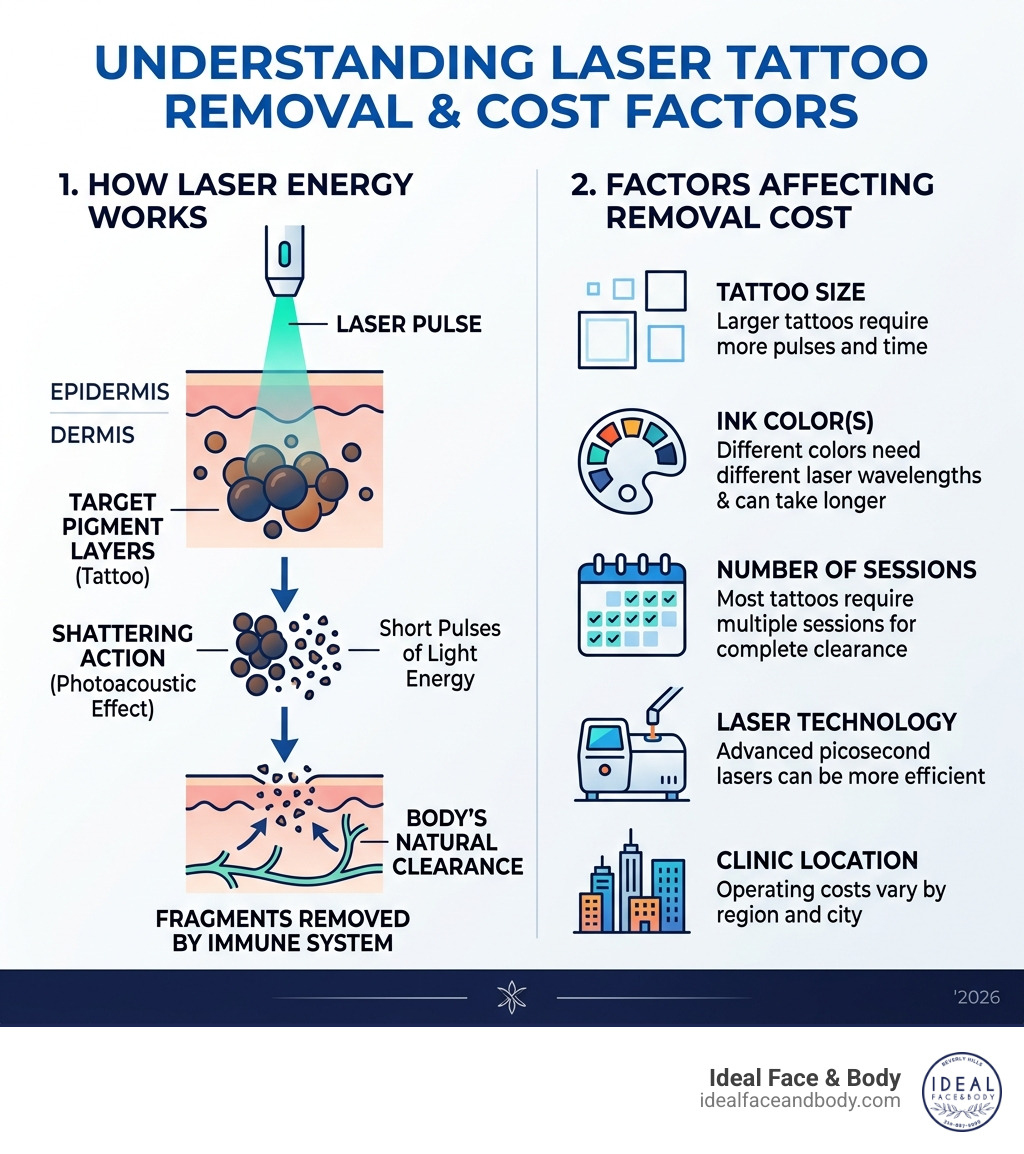
Laser tattoo removal prices vary widely depending on several key factors — but here’s a fast breakdown to set your expectations:
| Factor | Impact on Price |
|---|---|
| Tattoo size | Larger = higher cost per session |
| Ink color | Multi-color tattoos cost more to treat |
| Number of sessions | More sessions = higher total investment |
| Laser technology | Advanced picosecond lasers may carry a premium |
| Clinic location | Urban areas like Beverly Hills tend to cost more |
The bottom line: Per-session costs and total investment vary significantly from person to person. Most people need multiple sessions, spaced weeks apart, to see complete results. Getting a personalized consultation is the only way to know your real number.
Around 24% of American adults regret getting a tattoo — so if you’re exploring removal, you’re far from alone. The challenge most people face isn’t just finding a clinic. It’s knowing whether the quote they receive is actually fair.
That’s exactly what this guide is here to help you figure out.
I’m Dr. Sarah Yovino, MD, a double board-certified aesthetic specialist at Ideal Face & Body in Beverly Hills, with hands-on expertise in advanced laser treatments — including understanding what drives laser tattoo removal prices at every level. My goal is to give you a clear, honest picture so you can make a confident, informed decision.
Simple guide to laser tattoo removal prices:
Understanding Laser Tattoo Removal Prices and Investment Factors
When we talk about the investment required to clear your skin, it is rarely a “one-size-fits-all” scenario. If you have ever wondered why your friend’s tiny infinity symbol may be simpler to remove than your elaborate half-sleeve, it comes down to the physics of the procedure and the biology of your skin.
At Ideal Face & Body, we view tattoo removal as a journey. Several variables dictate the path of that journey and, consequently, the laser tattoo removal prices you will encounter. These include the size of the tattoo, the density of the ink, where it sits on your body, and even your skin type.
For instance, the location of the tattoo plays a surprising role in the efficiency of the treatment. Tattoos located closer to the heart, where blood circulation and lymphatic drainage are most active, often fade more quickly than those on the hands or feet. This means a tattoo on your chest might require fewer sessions than one on your ankle.
Furthermore, your skin type is evaluated using the Fitzpatrick scale. Darker skin tones require more specialized laser settings to protect the surrounding tissue, which can sometimes extend the number of sessions needed to support a safe and effective result. If you want background on how skin type is commonly classified, the Fitzpatrick scale is a helpful reference. For a deeper look at how we handle these variables in our Beverly Hills office, you can explore our tattoo-removal-beverly-hills-guide.
How Size and Complexity Influence Laser Tattoo Removal Prices
Size is the most obvious driver of treatment planning. Most clinics categorize tattoos into tiers ranging from “Extra Small” to “Extra Large.” A small wrist tattoo might only take a short laser session, while a large back piece requires significantly more effort, equipment pulses, and clinical time.
However, size isn’t the only physical trait that matters; complexity and ink saturation are equally important. A “ghosted” or faded tattoo will be much easier to treat than a brand-new, deeply saturated professional piece. Professional tattoos use high-quality inks injected deep into the dermis, whereas amateur “stick-and-pokes” often use less stable ink that the laser can break down more easily.
To help you visualize how these categories are often broken down, consider the following table:
| Tattoo Category | Typical Dimensions | Complexity Level |
|---|---|---|
| Extra Small | Under 1 square inch | Low (Single color, thin lines) |
| Small | 1 to 4 square inches | Moderate (Solid black shapes) |
| Medium | 4 to 9 square inches | High (Multiple colors, shading) |
| Large | 9 to 16 square inches | Very High (Dense saturation) |
| Extra Large | Over 16 square inches | Extreme (Full sleeves/back pieces) |
If you are specifically looking at a smaller area, we have a specialized your-guide-to-small-wrist-tattoo-removal-pricing that goes into detail about these more delicate procedures.
The Role of Technology in Laser Tattoo Removal Prices
Not all lasers are created equal. In the early days of tattoo removal, Q-switched lasers were the “gold standard.” These lasers operate in nanoseconds. While effective, they primarily rely on heat to break down ink, which can be tougher on the skin and may require more sessions.
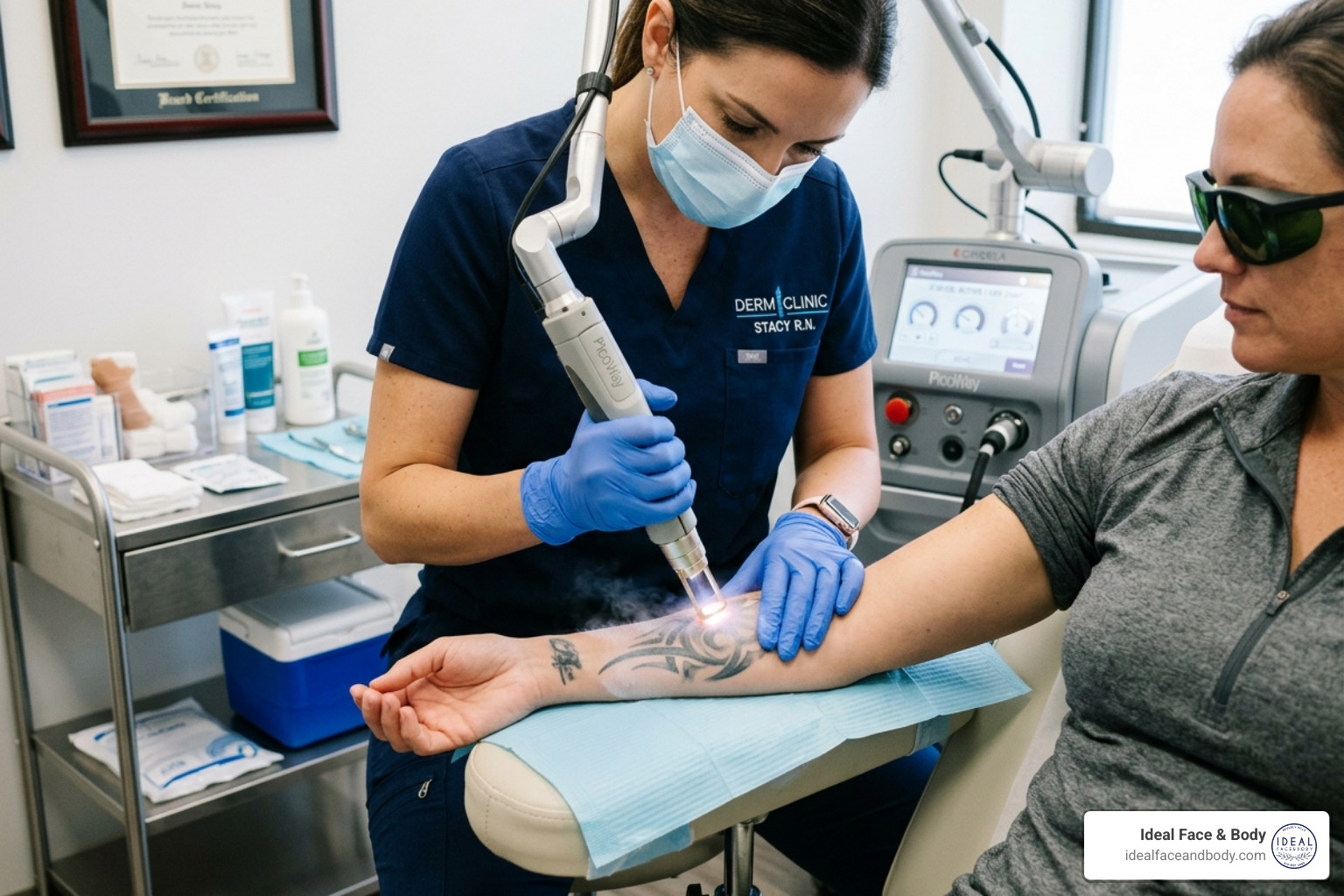
Modern technology has introduced picosecond lasers, such as the PicoSure system we use. These lasers deliver energy in picoseconds. Instead of just heating the ink, they create a “photoacoustic” effect – essentially a pressure wave that shatters the ink into tiny, dust-like particles that your body can flush away more efficiently.
Because this technology is more advanced and often results in fewer required sessions, the overall investment can vary depending on the device used and the complexity of the tattoo. You can read more about why we prefer this tech in our guide to picosure-price-per-session.

Why the Number of Sessions Varies for Every Patient
One of the most frequent questions we hear is, “How many times do I have to come back?” The average range is anywhere from 4 to 12 sessions, but some complex cases can take more. This variability is why “unlimited” packages are so popular in the industry—they take the guesswork out of the total investment.
Several biological factors influence this timeline:
- Ink Color: Black ink is the easiest to remove because it absorbs all laser wavelengths. Bright colors like green, light blue, and yellow are notoriously stubborn and require specific laser wavelengths to target.
- Tattoo Age: Older tattoos have often already begun to fade naturally as your immune system slowly carries away small amounts of pigment over the years. These usually clear faster than a “fresh” tattoo.
- The Lymphatic System: The laser doesn’t actually “remove” the ink; it just breaks it up. Your body’s white blood cells and lymphatic system do the heavy lifting of carrying that ink away. This is why we space sessions 6 to 8 weeks apart—to give your body time to do its job.
We often see that professional ink is much more resilient than amateur ink. A professional artist knows exactly how deep to place the pigment for it to stay forever, which ironically makes our job a bit harder! To see what the progression looks like over several months, check out our tattoo-removal-before-and-after-pictures and learn more about the session count at how-many-laser-sessions.
Comparing Laser Removal to Alternative Methods
While laser treatment is the most common and generally the safest method, it isn’t the only way to say goodbye to a tattoo. However, these alternatives come with their own sets of “prices”—both financial and physical.
- Surgical Excision: This involves a surgeon literally cutting the tattooed skin away and stitching the remaining skin back together. This is usually only an option for very small tattoos. While it is a “one-and-done” procedure, it always leaves a scar. For those interested in this route, we discuss surgical-tattoo-removal options for specific cases.
- Dermabrasion: This is an older method where the skin is “sanded” down to reach the ink layers. It is highly invasive, carries a high risk of scarring and infection, and is generally less effective than modern lasers.
- Chemical Peels: Some people attempt to use high-strength acid peels to “eat away” the ink. We strongly advise against this, as it often leads to chemical burns and permanent skin texture changes without actually removing the deep-seated ink.
When you look at the “fairness” of laser tattoo removal prices, you have to factor in the value of your skin’s integrity. Laser technology allows us to target the ink without destroying the surrounding tissue, which is something these other methods simply cannot guarantee.
Frequently Asked Questions about Tattoo Removal Costs
Is tattoo removal covered by health insurance?
The short answer is: almost never. Because tattoo removal is considered a cosmetic, elective procedure, health insurance providers do not view it as a medical necessity. You should expect this to be an out-of-pocket expense.
However, there are rare exceptions. If a tattoo was the result of a traumatic accident (like “road rash” where debris is embedded in the skin) or if it is part of a medical procedure (like radiation markers), some insurance plans might offer coverage. For the vast majority of our patients in Beverly Hills, we recommend looking into financing plans like CareCredit, which allow you to break the investment into manageable monthly payments. You can read more about evaluating these quotes at is-that-tattoo-removal-quote-fair-what-reviews-say-about-pricing-and-what-to-expect.
Are there additional costs for numbing or aftercare?
At some clinics, the price you see on the flyer isn’t the price you pay at the front desk. You should always ask if things like topical numbing cream or local anesthesia are included.
At Ideal Face & Body, we prioritize patient comfort. We often use local-anesthetic-tattoo-removal techniques to make the process as “painless” as possible. We also provide guidance on aftercare, which may include antibacterial ointments and specialized skin restoration creams to ensure your skin heals perfectly. While these might add a small amount to your initial budget, they are essential for preventing complications like scarring or infection.
What is the typical cost for cosmetic tattoo removal?
Cosmetic tattoos—like microbladed eyebrows or lip liner—are a different beast entirely. These inks are often iron-oxide based, which can actually turn black or grey when hit with a standard laser.
Removing these requires a very specialized touch and specific laser settings. Because the area is so small and delicate (near the eyes or mouth), the per-session price reflects the high level of precision required. If you’re looking to fix a “permanent makeup” mistake, our guide on from-bold-to-bare-navigating-laser-lip-tattoo-removal is a great place to start.
Conclusion
Deciding to remove a tattoo is a big step toward reclaiming your skin and your confidence. While laser tattoo removal prices can seem complex at first glance, they are ultimately a reflection of the technology, expertise, and time required to safely erase the past.
In Beverly Hills, we pride ourselves on offering a premium experience that prioritizes your results and your safety above all else. Whether you are looking for a complete removal or just want to fade a piece for a better cover-up, we are here to help.
Under the leadership of Dr. Justin Yovino and Dr. Sarah Yovino, our team at Ideal Face & Body provides personalized consultations to give you a clear, honest estimate of your removal journey. We don’t believe in “hidden fees”—just clear results.
Ready to see what’s possible? Schedule your consultation at Ideal Face & Body today and let’s start your journey to clear skin.