What You Need to Know About Tummy Tuck Muscle Repair
Tummy tuck muscle repair is a surgical technique performed during abdominoplasty to stitch separated abdominal muscles back together, restoring core strength, improving posture, and creating a flatter, firmer midsection.
Quick answers:
- What is it? Suturing the rectus abdominis muscles back to the midline after they have separated — a condition called diastasis recti
- Who needs it? Most tummy tuck patients, especially those post-pregnancy or after significant weight changes
- What does it fix? A protruding belly, weak core, back pain, and poor posture that diet and exercise alone cannot correct
- Is it just cosmetic? No — it also delivers functional benefits like better core stability, reduced back pain, and improved pelvic floor health
- How long do results last? Results can be long-lasting with a stable weight and healthy lifestyle
Many people assume a tummy tuck is only about removing loose skin. But for a large number of patients, the deeper issue is inside — separated abdominal muscles that no amount of crunches or physical therapy can fully fix.
About 60% of people develop diastasis recti, and nearly 40% still experience it six months after giving birth. That lingering belly bulge, the nagging lower back pain, the feeling that your core just isn’t holding together — these are signs that something structural needs to be addressed.
Is muscle repair always necessary? And what should you realistically expect? This guide walks you through everything.
I’m Dr. Sarah Yovino, MD, a double board-certified specialist at Ideal Face & Body in Beverly Hills, CA, where I work closely alongside Dr. Justin Yovino to provide patients with comprehensive, personalized body restoration care — including guidance on tummy tuck muscle repair and its role in whole-body rejuvenation. My training in pain management and advanced aesthetics gives me a unique perspective on both the functional and cosmetic dimensions of abdominal restoration.
Tummy tuck muscle repair terminology:
Understanding Diastasis Recti and the Need for Tummy Tuck Muscle Repair
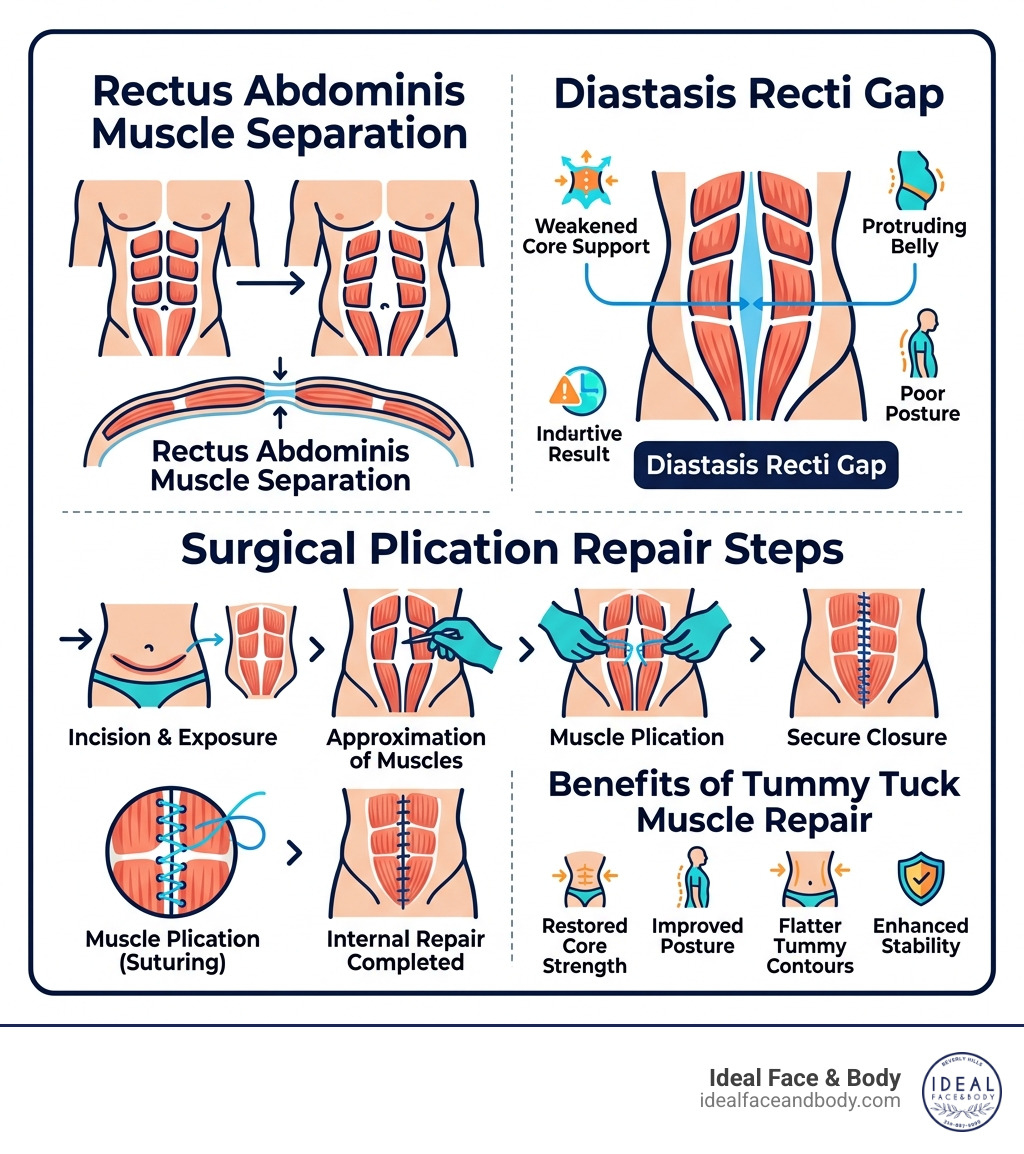
To understand why tummy tuck muscle repair is so transformative, we have to look at the anatomy of the abdominal wall. Your “six-pack” muscles, known as the rectus abdominis, are two parallel bands of muscle connected by a thin layer of connective tissue called the linea alba.
Think of this tissue like a piece of spandex. It is designed to stretch and snap back. However, during pregnancy or significant weight fluctuations, that spandex can be stretched beyond its elastic limit. When this happens, the fascia thins and the two muscle bands drift apart. This is diastasis recti.
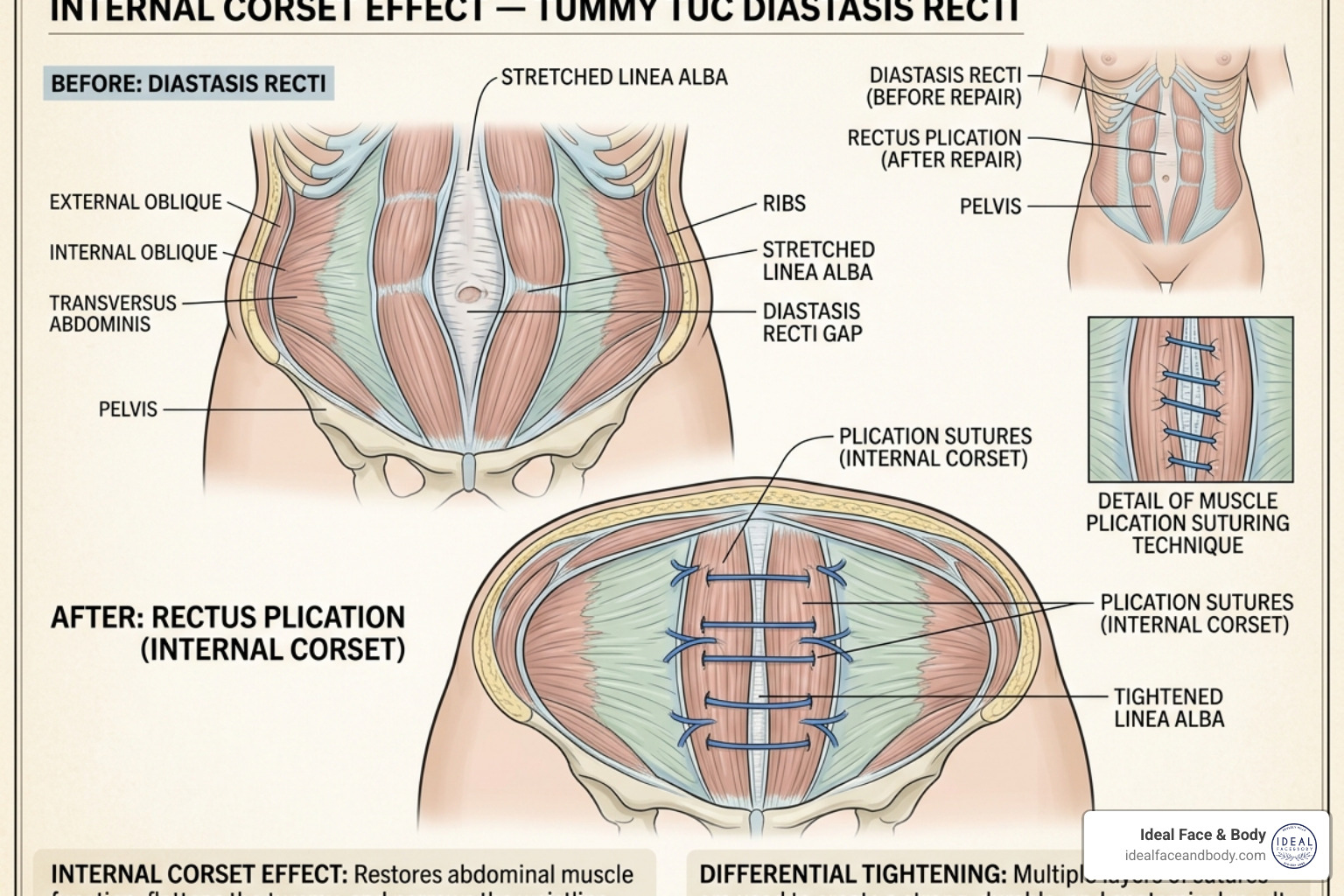
Once this tissue has overstretched, it cannot “shrink” back through exercise alone. This is where we step in. During a tummy tuck procedure, we lift the skin and fat to reveal the underlying muscle. We then perform muscle plication—essentially using the muscles to create an “internal corset.” By pulling the muscles back to the midline and securing them, we restore the structural integrity of your core.
Who is a Candidate for Tummy Tuck Muscle Repair?
While many patients come to us at Ideal Face & Body in Beverly Hills seeking a flatter stomach, we perform a thorough evaluation to see if muscle repair is the missing piece of their puzzle. You might be an ideal candidate if you experience:
- A “Pooch” That Won’t Go Away: If you are at a stable weight but still have a protruding abdomen that looks “pregnant” even though you aren’t, you likely have muscle separation.
- Post-Pregnancy Changes: Carrying a baby (especially multiples) is the leading cause of diastasis recti.
- Significant Weight Loss: Large fluctuations in weight can stretch the abdominal fascia just as much as pregnancy does.
- Core Weakness: If you feel like your “middle” is weak or you struggle with balance and stability, your muscles may be separated.
In many cases, we combine this repair with Tummy Tuck Lipoabdominoplasty to remove stubborn fat while simultaneously reinforcing the abdominal wall.
The Role of Permanent Sutures in Abdominal Restoration
A common question we hear is: “How do the muscles stay together?” The answer lies in the technique of muscle plication. We use permanent, non-absorbable sutures to bridge the gap between the separated muscles.
These sutures act as a permanent reinforcement for the fascia. We often use a “double reinforcement” or “corset” suturing technique, which involves multiple layers of stitches. This ensures that the repair is durable enough to withstand the daily pressures of breathing, lifting, and moving. By tightening this fascia, we don’t just flatten the stomach; we narrow the waistline and create a much more contoured, athletic profile.
The Functional Benefits of Surgical Muscle Restoration
While the aesthetic change is usually what brings patients through our doors in Beverly Hills, the functional benefits are often what they rave about most during follow-up appointments.
When your core is separated, your back has to do double the work to keep you upright. This often leads to chronic lower back pain. By restoring the abdominal wall, tummy tuck muscle repair rebalances the load on your spine. Research shows that muscle repair can improve back pain in approximately 80% of patients dealing with diastasis recti-related discomfort.
Other functional benefits include:
- Pelvic Floor Health: A strong abdominal wall supports the pelvic organs. Many of our patients report a significant reduction in stress urinary incontinence after their repair.
- Improved Digestion: Some patients find that “holding things in” more effectively helps with issues like bloating and certain IBS symptoms.
- Core Stability: Restoring the “internal corset” provides a stable base for all physical movement.
For more information on the clinical aspects of these benefits, you can refer to the American Society of Plastic Surgeons.
Beyond Aesthetics: How Tummy Tuck Muscle Repair Enhances Daily Life
The impact of a stronger core ripples through every aspect of your day. We’ve seen patients who previously struggled with heavy lifting or high-impact workouts suddenly hit new personal bests in the gym because their core can finally engage properly.
For mothers, this procedure is often a key component of a Mommy Makeover Tummy Tuck Breast Lift. Beyond the muscle repair, we can often perform a C-section scar revision. We typically remove the old, sometimes indented or thick C-section scar and replace it with a single, thinner, and much lower incision that is easily hidden by swimwear.
Some patients even report improved voice projection! Because the abdominal muscles help control intra-abdominal pressure used for breathing and speaking, a tighter core can actually help you “find your voice.”
Can Exercise Replace Surgical Muscle Repair?
We are big fans of fitness at Ideal Face & Body, but we have to be honest: exercise cannot fix a structural gap in the fascia. Think of the fascia like a rubber band that has been stretched out so many times it has lost its “snap.” You can build the muscles underneath that rubber band (the rectus abdominis), but you cannot make the rubber band itself shorter or tighter through crunches.
In fact, performing heavy abdominal exercises with severe diastasis recti can sometimes make the bulge worse by pushing the internal organs against the weakened fascia. While physical therapy is excellent for strengthening the existing muscle fibers, Tummy Tuck Abdominoplasty is the only way to physically close the gap and remove the loose skin that exercise simply cannot touch.
Comparing Full vs. Mini Tummy Tuck Muscle Repair
Not every “tummy” requires the same level of intervention. Depending on where your muscle laxity and excess skin are located, we may recommend a full or a mini version of the procedure.
| Feature | Full Abdominoplasty | Mini Tummy Tuck |
|---|---|---|
| Incision Length | Hip to hip (usually) | Similar to a long C-section scar |
| Navel Position | Navel is repositioned | Navel remains in place |
| Muscle Repair | Full (from ribcage to pubic bone) | Limited (below the navel only) |
| Skin Removal | Above and below the navel | Below the navel only |
| Best For | Significant laxity and separation | Mild “pooch” below the belly button |
A Mini Tummy Tuck Procedure is a fantastic option for those who have “great abs” but a little bit of stubborn skin or a small muscle gap at the very bottom of the abdomen. However, most patients presenting for a tummy tuck require the full version to address separation that typically extends the entire length of the abdominal wall.
The Step-by-Step Process and Recovery Journey
At Ideal Face & Body, we prioritize your comfort and safety. The process begins with general anesthesia to ensure you are completely asleep and pain-free. We then carefully mark the incision lines—usually low enough to be hidden by a bikini—and the center of the torso.
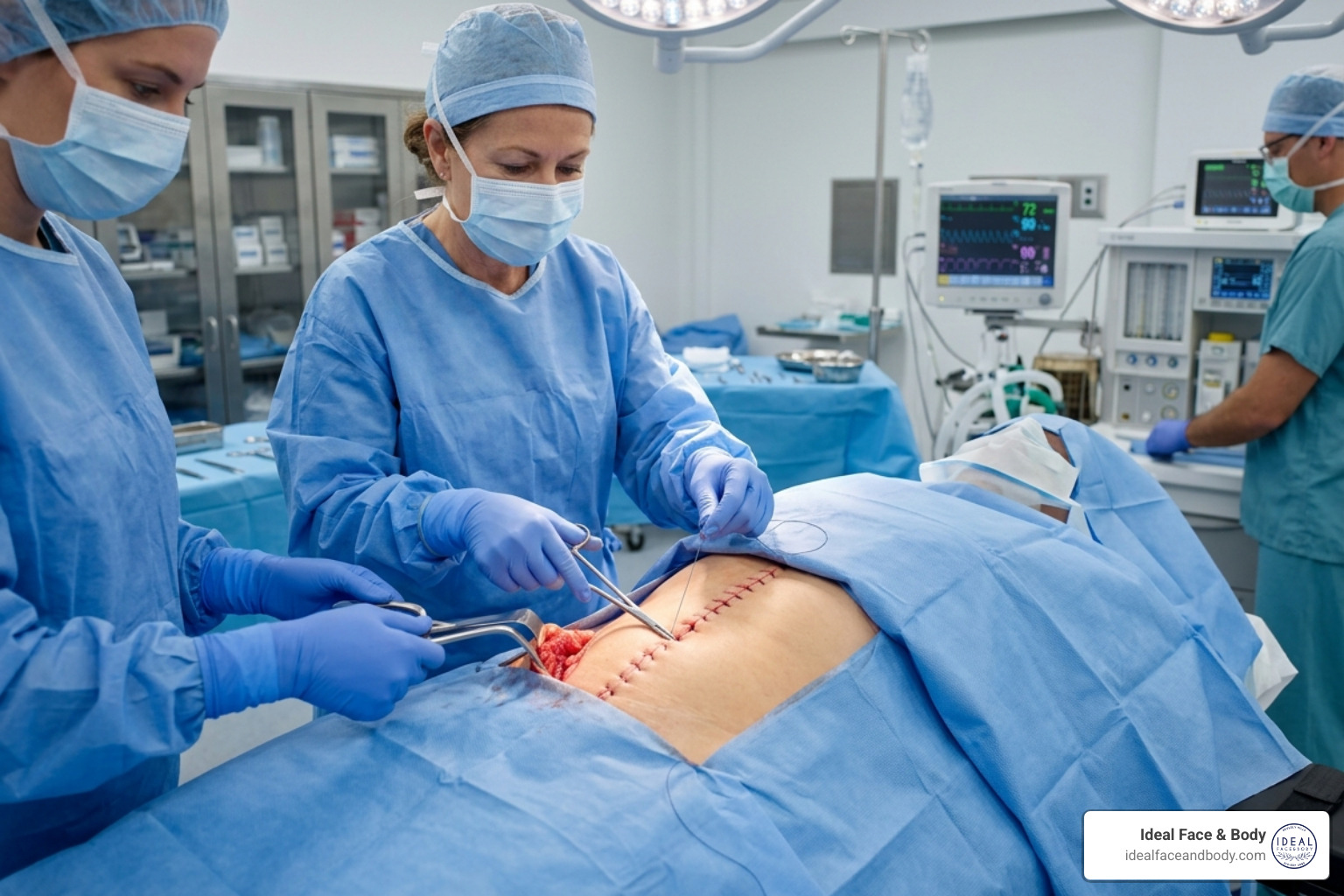
Once the incision is made, we lift the skin and fat to access the muscle. We often integrate liposuction at this stage (a technique sometimes called lipoabdominoplasty) to contour the flanks and waist. After the tummy tuck muscle repair is completed with permanent sutures, the skin is pulled down, the excess is trimmed, and the navel is artistically repositioned.
To ensure a smooth recovery, we often use surgical drains to prevent seroma (fluid accumulation), which can occur in up to 15.4% of cases. We also take steps to minimize the risk of hematomas, which occur in about 2% of surgeries. You can see examples of these results in our Tummy Tuck Liposuction Lipoabdominoplasty gallery.
Recovery Timeline for Tummy Tuck Muscle Repair
Recovery from a tummy tuck with muscle repair is a marathon, not a sprint. Because we have tightened the “internal corset,” you will feel a significant amount of tightness in the first few weeks.
- Days 1–7: You will need to walk with a slight “hunched” posture to avoid tension on the repair. Light walking is encouraged to prevent blood clots.
- Weeks 2–4: Most patients can return to desk jobs. You will wear a compression garment 23–24 hours a day.
- Weeks 4–6: You can begin to stand up straighter. Lifting is usually restricted to less than 10 lbs.
- Weeks 6–8: You can gradually return to low-impact exercise.
- 3 Months+: Full activity is usually cleared, and you can begin to see your final “toned” results.
We also highly recommend lymphatic drainage massage during recovery. This helps prevent “fibrosis”—firm, uneven lumps that can form as the body heals. Early intervention with professional massage helps ensure the skin heals smoothly over the newly repaired muscle. You can learn more about the Mini Tummy Tuck recovery which is often slightly faster.
Frequently Asked Questions about Abdominal Muscle Repair
Is muscle repair covered by insurance?
In the vast majority of cases, a tummy tuck is considered a cosmetic procedure. While the muscle repair provides functional benefits, insurance companies typically classify it as an elective aesthetic surgery. However, if the repair is performed in conjunction with a medically necessary hernia repair, some portions of the surgical facility or anesthesia fees might be affected, but this is rare. Costs vary significantly based on the complexity of the repair and whether additional liposuction is needed. A personalized consultation is the only way to get an accurate estimate.
How long do the results of muscle repair last?
The permanent sutures we use are designed to last a lifetime. However, the “longevity” of your results depends largely on you. Significant weight gain or a future pregnancy can re-stretch the fascia and pull the muscles apart again. We generally advise patients to wait until they are finished having children and have maintained a stable weight for at least 6 to 12 months before undergoing the procedure.
What are the risks of muscle repair during a tummy tuck?
Like any major surgery, there are risks. These include:
- Seroma: Fluid buildup under the skin (minimized by drains and compression).
- Hematoma: Localized blood collection.
- Infection: Managed with sterile techniques and post-op antibiotics.
- Sensation Changes: Numbness around the incision or lower abdomen is common and usually resolves over several months to a year.
- Wound Healing Issues: Especially in smokers (which is why we require you to stop smoking well before surgery!).
Conclusion
Restoring your core is about more than just looking good in a swimsuit—it’s about reclaiming your strength, your posture, and your comfort. At Ideal Face & Body in Beverly Hills, Dr. Sarah Yovino and Dr. Justin Yovino specialize in these complex abdominal restorations.
Whether you are interested in our “Precision Sculpt” techniques or our specialized approach to tummy tuck muscle repair, we are here to guide you through every step of the journey. We believe in a “painless” approach to aesthetics—from our lip augmentations to our meticulous surgical recovery protocols.
Ready to see what’s possible for your core? Schedule a personalized consultation for Tummy Tuck services in Beverly Hills today and let us help you build a stronger, firmer foundation.