If lumps after liposuction are always described as normal healing, how do you know when one needs treatment? The missing distinction is that lumpy skin after liposuction is a symptom, not a diagnosis. Swelling, scar tissue, fluid pockets, uneven fat removal and loose skin can look similar while needing different care.
The safest approach starts with the lump's feel, when it appeared and whether it's improving. Those observations help a clinician decide whether to monitor healing, investigate a fluid collection or assess a lasting contour problem. They aren't a substitute for an examination, especially when pain, redness or swelling is increasing.
Table of Contents
- What Different Lumps After Liposuction Usually Mean
- Healing Timeline for Firmness After Liposuction
- Why Lumps Form from Fibrosis, Fluid and Uneven Fat Removal
- Conservative Care with Massage, Compression and Lymphatic Drainage
- When Revision Makes Sense and Which Option Fits
- Preventing Lumps Before and During Recovery
- Red Flags and the Right Next Step
What Different Lumps After Liposuction Usually Mean
A broad firm patch isn't the same problem as a soft swelling or a visible groove. Even within one treated area, you might have swelling beneath the skin and a separate surface depression. Calling everything fibrosis can lead to the wrong treatment.
Reported complication rates also need context. A 2024 systematic review reported contour deformity in approximately 3% to 9% of patients across published studies, with a pooled absolute risk of 2.35% and statistical heterogeneity of 97.4%; the BAPRAS and BAAPS liposuction guidelines recognize uneven fat extraction and contour irregularity as aesthetic complications. The variation between studies means a percentage can't identify what an individual lump represents.
In a separate fibrosis-management study involving 75 women with post-liposuction fibrosis, depressions were documented in 99%, soft nodules in 95%, hard nodules in 81% and adhesions in 47%. This was a group already affected by fibrosis, not a measure of risk for everyone having liposuction.
Lump patterns, likely causes and next steps
The patterns below help organize a conversation with your clinician. Feel alone can't confirm the diagnosis, and a warning sign overrides an otherwise reassuring pattern.
| Feel or appearance | Likely cause | Next step |
|---|---|---|
| Diffuse firmness that softens over time | Postoperative edema or early induration | Observe and reassess as swelling subsides |
| Soft, mobile, fluctuant swelling | Seroma or hematoma | Clinical examination; ultrasound can confirm fluid |
| Firm, discrete nodule that is tender or fixed | Fibrosis or adhesion | Examination and staged management plan |
| Persistent visible dip, groove or ridge | Uneven fat removal or superficial fat layer injury | Assess after tissues mature before any correction |
| Skin folds that do not retract | Loose skin after volume reduction | Assess skin laxity separately from fat irregularity |
| Red, warm, painful or enlarging area | Possible infection, hematoma or other complication | Urgent medical assessment |
“Fluctuant” means the area feels as though fluid moves beneath the skin. “Tethered” describes skin that seems attached to deeper tissue rather than sliding freely over it.
Before your appointment, record texture, mobility, symmetry, pain trend and improvement. Describe what you notice without repeatedly squeezing or pressing the area. “The left side is firmer and more painful than it was” gives your clinician more useful information than saying the result looks lumpy.
Healing Timeline for Firmness After Liposuction
Typical healing timeline for firmness and lumps
The American Society of Plastic Surgeons recovery guidance describes bruising, swelling and firmness during weeks 1–3, swelling generally beginning to subside around weeks 4–5, and continued improvement from week 6 onward. For laser-assisted procedures, its laser-assisted liposuction recovery guidance notes that skin can continue firming for up to six months as new skin layers form.
| Stage | What is typical | When to review |
|---|---|---|
| Weeks 1–3 | Bruising, swelling and firmness are common | Pain or redness that is worsening |
| Weeks 4–5 | Swelling generally begins to subside | Firmness that is not softening |
| Week 6 onward | Improvement can continue | Persistent dip, nodule or asymmetry |
| Up to six months, laser-assisted procedures | Skin continues firming as new layers form | Contour unchanged; discuss correction options |
These are review checkpoints, not deadlines for a finished result. A firm area that hasn't softened deserves discussion, but it doesn't automatically mean healing has failed or surgery is necessary.
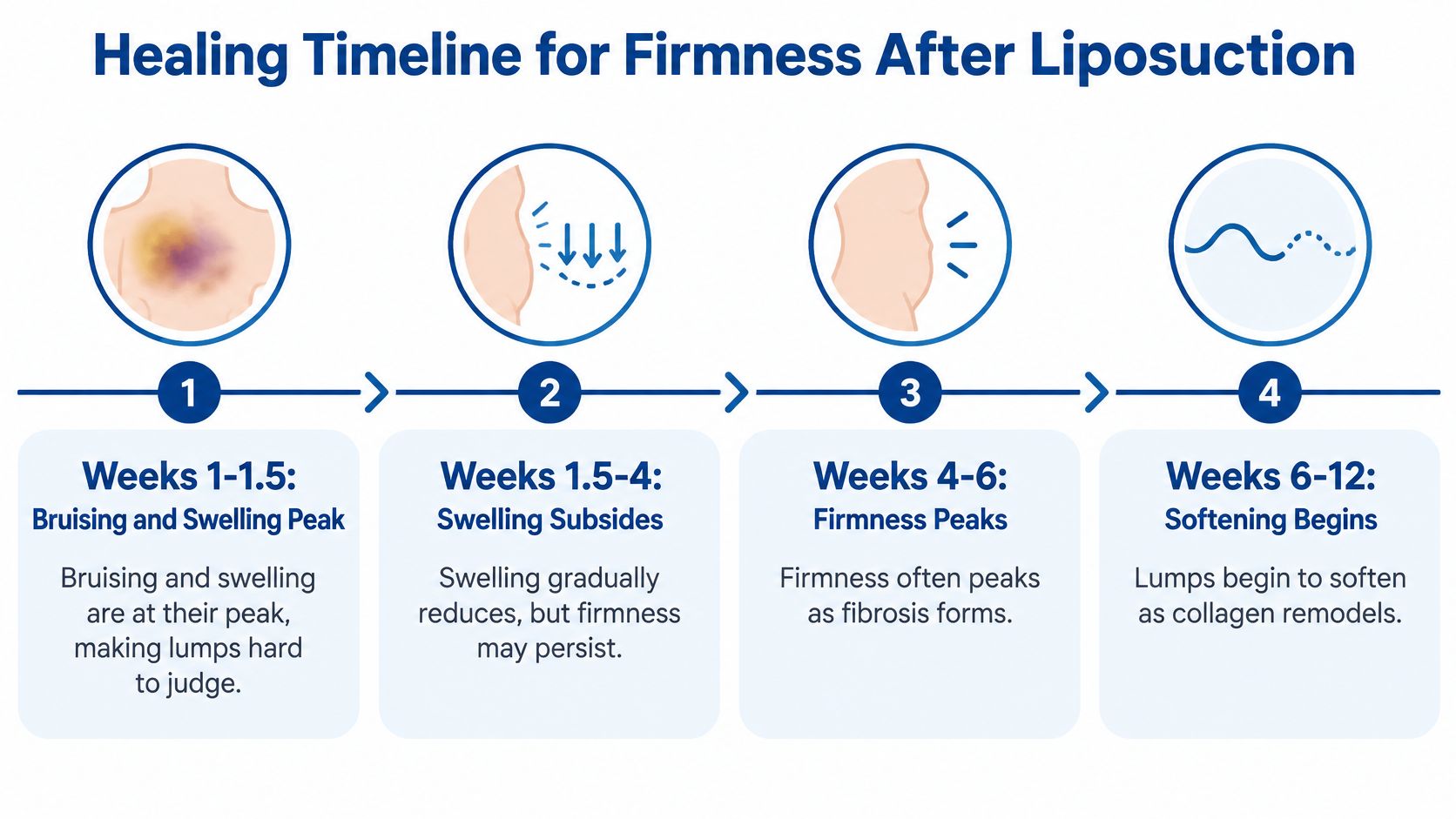
Recovery illustrations simplify a process that differs by treatment area, procedure, skin quality and individual healing. Exact peaks of swelling or firmness aren't universal, so your surgeon's examination matters more than matching an illustration.
Look for a trend rather than a single appearance
An early photograph captures swelling as well as contour. A later photograph may reveal a groove that was previously hidden, even while the overall recovery is progressing. That's why an immediate judgment about the final result can be misleading.
Gradual softening is more reassuring than unchanged hardness, but any progressive symptoms need review regardless of the recovery stage. Stable asymmetry and a persistent nodule also deserve examination rather than indefinite waiting.
For broader recovery planning, our guide to recovery time from liposuction provides additional context. Take photographs in consistent lighting at planned intervals, note firmness and pain regularly, and bring that record to follow-up appointments.
Why Lumps Form from Fibrosis, Fluid and Uneven Fat Removal
Liposuction removes fat through a cannula, leaving small tunnels within the treated tissue. The body responds to that tissue injury with swelling and repair. Fibrin forms an early repair framework, fibroblasts produce collagen, and that collagen later reorganizes during remodeling.
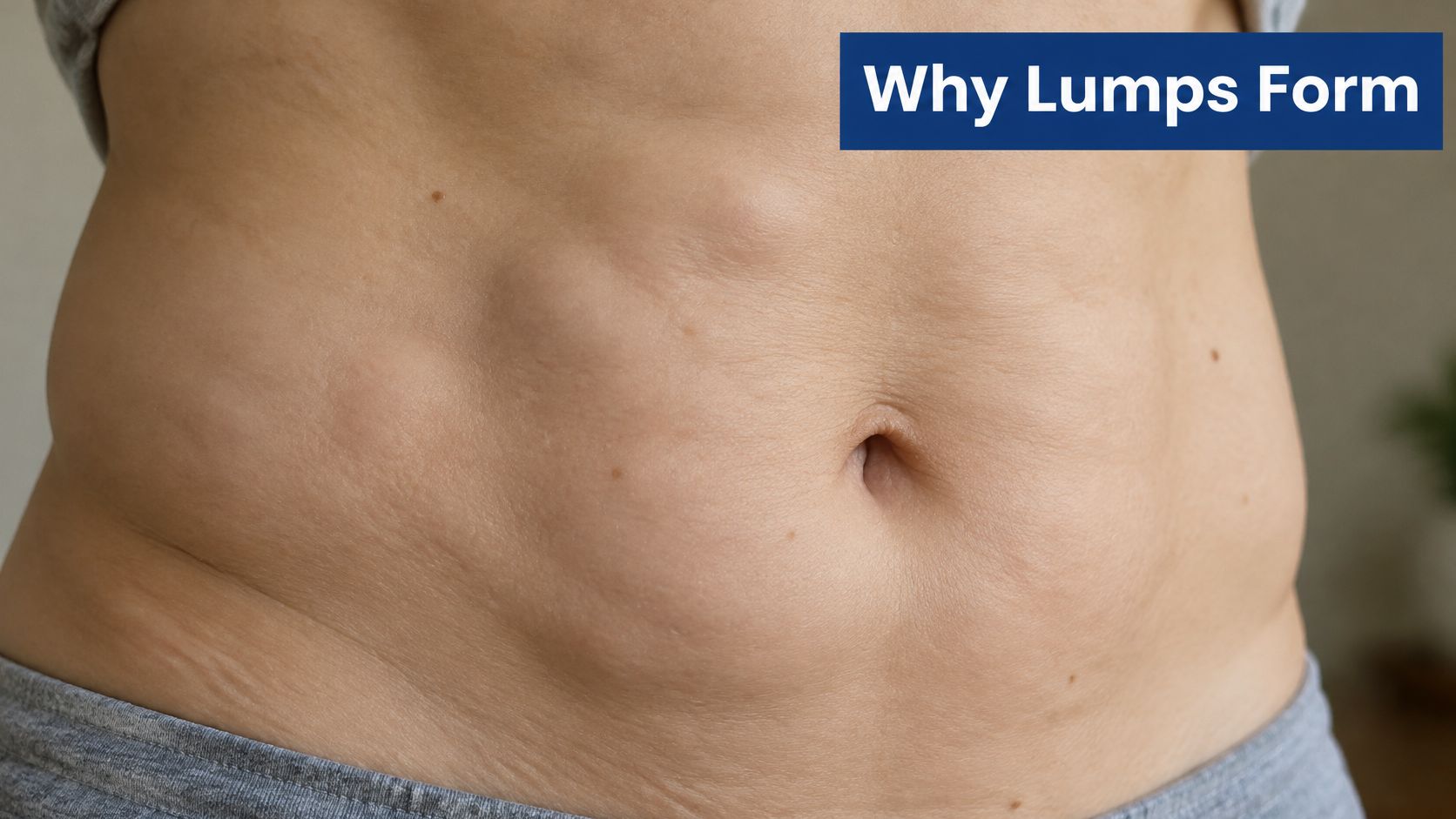
When repair tissue forms thick bands or attaches the skin to deeper fascia, the area can feel firm or look pulled inward. Think of repairing a tear in a sheet: a thick, tight repair can create a ridge and pull on the surrounding material. Beneath the skin, a similar tethering effect can produce a visible indentation.
Different causes can overlap
Edema is swelling distributed through tissue, while a seroma is a localized fluid collection. A hematoma is a collection of blood. Early firmness can also be temporary induration, meaning tissue has become denser during healing without necessarily forming a permanent scar band.
Later nodules or skin tethering may represent fibrosis. A persistent dip or ridge can instead reflect uneven fat removal or injury to the superficial fat layer. These distinctions matter because a depression caused by missing volume won't respond like a swollen patch.
A 2024 systematic review and meta-analysis of isolated aesthetic liposuction found pooled rates of approximately 2% for contour irregularity, 2% for seroma and 1% for fibrosis or induration. A large database study described in that evidence reported palpable irregularities in 7.36% and visible irregularities in 3.25%, illustrating how examination-based findings can exceed visible findings.
A lump you can feel and an irregularity you can see aren't necessarily the same problem.
Why ultrasound may change the plan
Consider a swelling that feels soft and seems to move under gentle contact. Treating it as solid scar tissue without checking for fluid could delay appropriate care. An enlarging collection particularly needs assessment rather than harder massage.
Diagnostic ultrasound can help distinguish fluid from solid fibrosis and guide aspiration when appropriate. It doesn't replace examination, but it can answer a specific question when touch and appearance leave uncertainty.
The useful question isn't whether the area contains scar tissue. It's whether fluid, fibrosis, a contour defect or a combination best explains the symptoms.
Conservative Care with Massage, Compression and Lymphatic Drainage
Conservative care should follow a diagnosis, not an online routine. Your operating surgeon's protocol overrides general advice, including the timing, pressure and frequency of hands-on treatment. More treatment isn't automatically better.
A sequence that protects healing tissue
Get the lump examined first. Your clinician should establish whether the concern is diffuse swelling, a solid nodule, a fluid pocket or a surface defect. Don't begin targeted massage over an undiagnosed collection or suspected infection.
Check compression instructions and fit. Follow the prescribed garment schedule rather than choosing tighter compression yourself. Fabric that rolls, bunches or creates concentrated pressure needs attention; our explanation of how compression garments help after liposuction discusses their role in recovery.
Begin lymphatic drainage only as directed. An American Society of Plastic Surgeons recovery article describes some surgeons starting appointments the day after surgery and continuing several times per week for two months. That's an example of a supervised protocol, not a universal prescription.
Add gentle scar massage after clearance. Ask your clinician to demonstrate the intended pressure and identify areas to avoid. For additional education after clearance, Lake City Physical Therapy's safe post-surgical scar massage steps provide a resource to discuss with your care team.
Treat confirmed fluid appropriately. If ultrasound identifies a collection, your clinician may recommend aspiration rather than massage. Never attempt to puncture or drain it yourself.
Continue observation with reassessment. Track whether the treated area is becoming softer, less tender and more even. Bring an unchanged or worsening area back for review instead of automatically increasing treatment intensity.
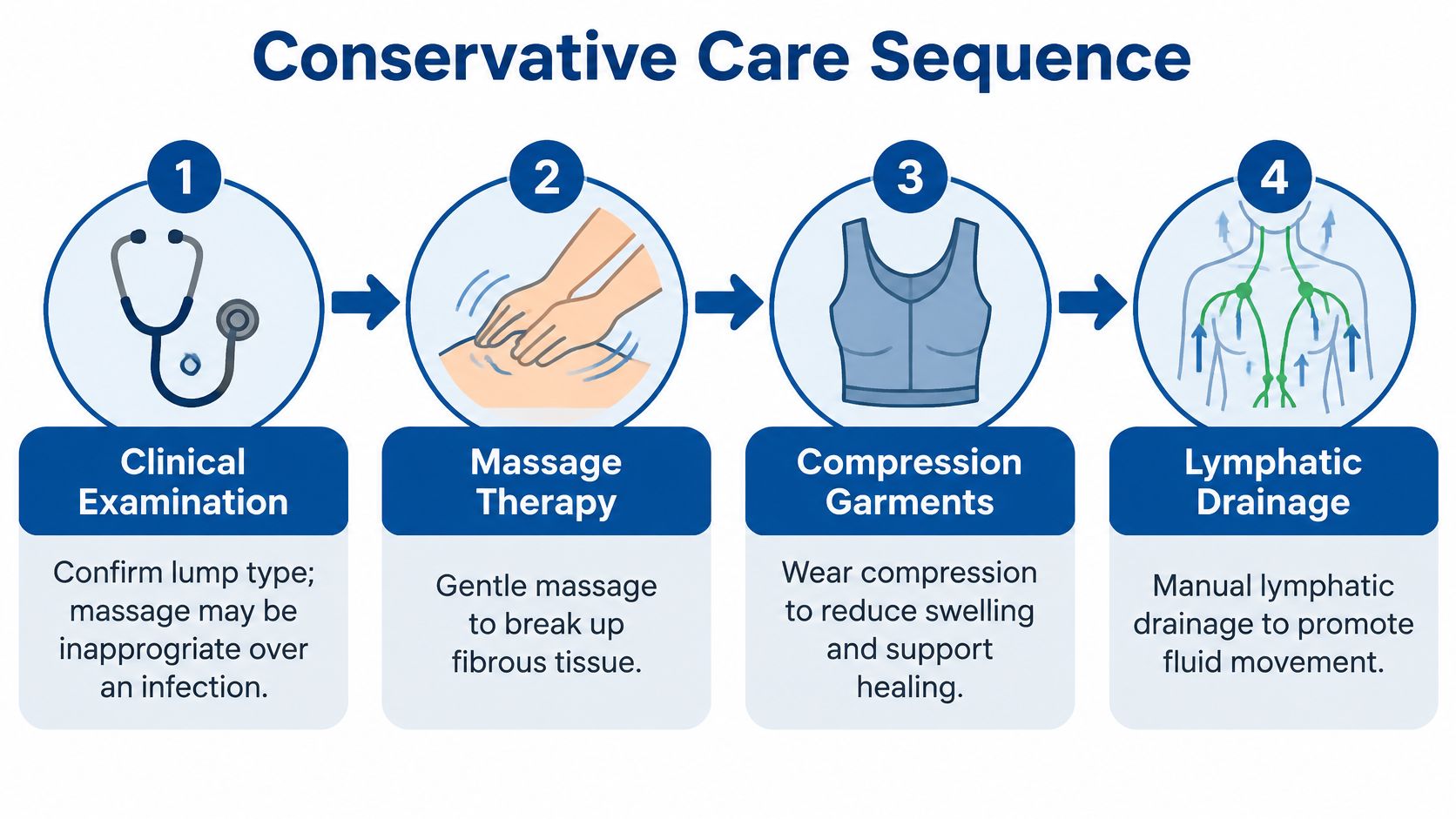
The illustration groups common recovery measures, but it doesn't establish a required order after examination. Massage, compression and drainage should be selected and timed for the actual finding.
Know when to stop
Practical rule: New tenderness is a reason to reassess pressure, not a reason to press harder.
Stop massage and seek medical advice for spreading redness, unusual warmth, drainage, fever or increasing pain. One-sided calf swelling requires urgent assessment rather than local treatment.
Published secondary-liposculpture protocols have described favorable results with staged care, but observational outcomes don't guarantee an individual result. The number of sessions should follow recovery and examination findings, not a preset promise that every lump will disappear.
When Revision Makes Sense and Which Option Fits
Correction options by problem and timing
| Option | Best suited for | Timing considered |
|---|---|---|
| Observation only | Early or improving irregularity | During the healing period |
| Targeted revision liposuction | Residual unevenness from earlier fat removal | After tissues have stabilized |
| Laser-assisted revision liposuction | Irregular contour in selected areas | After tissues have stabilized |
| Fat grafting | Depressions where volume is lacking | Once tissue is stable and fibrosis has been assessed |
| Scar-release or targeted energy release | Firm bands or tethering from fibrosis | Selected cases after examination and imaging |
Correction usually makes more sense after tissue has stabilized. Operating while inflammation and remodeling are still active can make the problem harder to judge and may remove additional viable fat.
A 2024 secondary-liposculpture algorithm classified nodules by physical consistency and used targeted energy-assisted release in selected cases; its authors reported more than 90% resolution of irregularities in their clinical experience. That was an observational treatment report, not a randomized benchmark or a guaranteed outcome.
Match the procedure to what is missing or restricted
Revision liposuction may be considered when residual fat creates a raised area or an uneven transition. It isn't a universal solution for every depression. Removing more fat around a low spot can sometimes create a different contour problem rather than restore the missing volume.
Fat grafting addresses a volume deficit, while scar release addresses restricted movement from tethering. Some patients have both problems, so a surgeon may need to assess the tissue in layers instead of selecting a procedure from a photograph.
Laser-assisted revision is also a selection decision, not an automatic upgrade. The surgeon should explain why energy assistance fits the particular area and how existing scar tissue affects the plan.
Loose skin needs its own assessment
Skin folds can remain even when the underlying fat layer is reasonably even. If the main problem is laxity, removing additional fat may increase looseness rather than smooth the surface. The clinical review of unfavorable liposuction outcomes discusses the distinction between contour irregularity, fibrosis and skin-related concerns.
Useful consultation questions include:
- What is the primary defect? Ask whether the concern is excess fat, missing volume, tethering or loose skin.
- What still needs to settle? Find out which examination findings would support continued observation.
- Why this option? Ask what the proposed treatment can change and what it won't address.
- What should be reassessed first? A suspected collection or active inflammation should be resolved before elective contour planning.
Our guide to revision liposuction offers additional preparation for that conversation. The decision should be based on a stable, identifiable problem and realistic expectations, not frustration with an unfinished recovery.
Preventing Lumps Before and During Recovery
Prevention means reducing avoidable problems, not guaranteeing perfectly smooth skin. Technique, treatment area, skin quality and individual healing all influence the result. Following instructions carefully still doesn't eliminate every contour change.
The most useful preparation is a clear discussion about skin behavior, fluid management and follow-up. A patient with loose skin needs different expectations from someone whose skin retracts readily after volume reduction.
Questions to settle before surgery
- Skin quality and laxity. How much retraction is realistic, and could existing folds remain after fat removal?
- Fluid management. What symptoms should trigger assessment for a collection rather than routine observation?
- Compression planning. Which garment is appropriate, how should it fit, and whom should you contact if it digs in?
- Follow-up arrangements. When will healing be examined, and how can you report a new concern between visits?
- Revision assessment. How will the surgeon distinguish an unfinished recovery from a lasting contour defect?
Disclose nicotine use early because it can interfere with healing. Include vaping and other nicotine-containing products rather than assuming only cigarettes matter. Ask for individualized cessation instructions before the procedure.
Recovery habits that support an assessable result
- Wear compression as prescribed. Don't add tighter garments, padding or extra pressure without approval.
- Follow the assigned drainage or massage plan. Avoid borrowing another patient's schedule.
- Leave unexplained firm spots alone. Don't knead them aggressively or use a device to force them flat.
- Keep follow-up appointments. An examination can identify a pressure issue or collection that photographs miss.
- Report changes promptly. Increasing pain or skin changes shouldn't wait until a routine review.
Choose consistent photo checkpoints with your care team, including early recovery, later follow-ups and the tissue-maturation stage. Use the same lighting, camera distance, posture and viewing angles so differences are easier to interpret.
Better recovery records help your clinician make decisions. They aren't a scorecard for how well you've healed.
Try not to inspect or press the area repeatedly throughout the day. A planned record is more useful than comparing changing shadows, garment marks or soreness after repeated handling. Your role is to follow the care plan and communicate changes, not to diagnose or physically reshape healing tissue.
Red Flags and the Right Next Step
Progressive redness, unusual warmth, drainage, fever and escalating pain need same-day contact with the treating clinician. Infection and other complications must be excluded. Don't wait for a scheduled appointment or try to massage the symptoms away.
Sudden shortness of breath requires emergency care. One-sided calf swelling also needs urgent assessment because a blood clot must be considered; don't massage the calf. A recovery timeline should never be used to dismiss these symptoms.
Concerns that need a prompt appointment
Arrange review within days for an enlarging or fluctuant lump, a painful firm nodule that isn't softening, severe asymmetry or a persistent visible dip. Damaged-looking or unusually discolored skin deserves prompt contact, with faster assessment if the change is progressing.
Seroma, hematoma, infection and fat necrosis require different management. The patient-facing guide to post-liposuction fibrosis highlights why texture, mobility and symptom progression matter when deciding what needs examination. Ultrasound may help clarify whether a suspected lump contains fluid or solid tissue.
A practical decision path
Place the change in its recovery context. Compare its progression with your expected healing stage. Lack of improvement is a reason to arrange review, not proof of a particular diagnosis.
Check for urgent symptoms. Contact your clinician today for concerning local changes, and seek emergency care for breathing symptoms rather than waiting for a reply.
Prepare for an examination. Bring dated photographs, pain notes and a description of changes. Ask whether ultrasound would answer an unresolved question.
Discuss correction only after the problem is defined. Once the area is stable, observation, targeted revision or fat grafting may fit different findings.
At Ideal Face & Body in Beverly Hills, CA, we offer Precision Sculpt® liposuction for the arms, bra roll and armpits, and list Revision Liposuction among our Precision Sculpt® services. PRECISION SCULPT lipo was developed and pioneered by Dr. Justin Yovino.
An in-person examination can review your photographs and healing timeline together. The next step should follow the diagnosis, not a single photo or a guess.
Ideal Face & Body offers Precision Sculpt® liposuction and revision liposuction for patients considering body-contour treatment or correction. If you're concerned about persistent lumpy skin after liposuction, visit Ideal Face & Body to arrange a consultation and bring your dated photographs, procedure details and recovery notes for review.