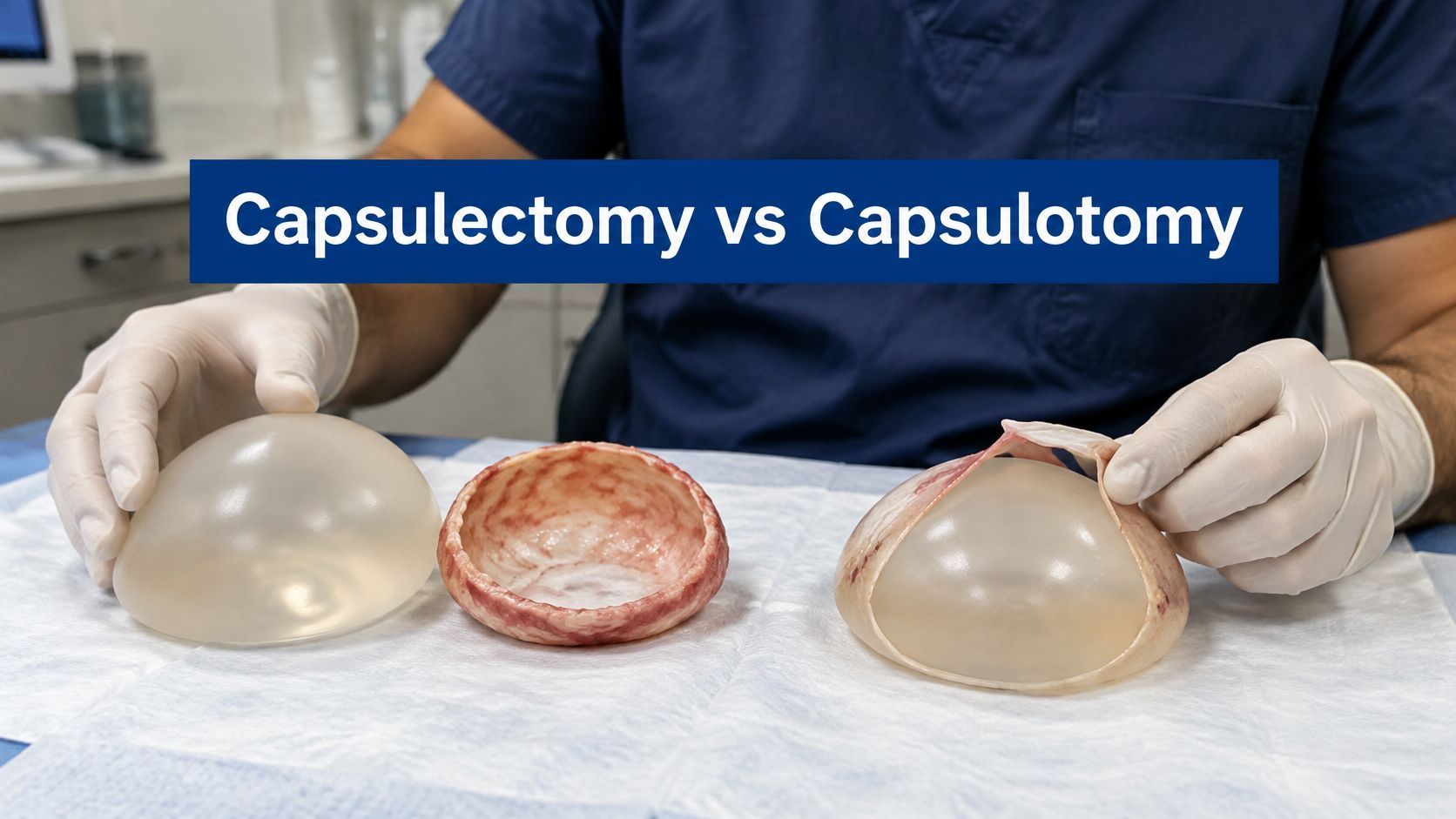
The most repeated advice about capsule surgery is also the least supported: if you're having breast implants removed, insist on total capsulectomy, because anything left behind is a failure. It sounds like the cautious position. It's quoted in forums, in videos, and across consultation rooms, and it turns a surgical judgment into a test of thoroughness.
The evidence doesn't carry that certainty. Comparisons between capsulectomy and capsulotomy have never been run as a randomized trial, and the pooled data from the studies that exist fail to show that removing the whole capsule prevents recurrent contracture better than releasing it. That's not an argument for leaving diseased tissue in place. It's an argument that the decision carries a genuine trade-off, and the trade-off has to be settled by the condition of your capsule rather than by a slogan.
The reframe matters. Capsulectomy and capsulotomy aren't rival versions of the same operation. One removes tissue; the other releases it. The key question isn't which procedure wins. It's how much of your own scar tissue needs to be removed for the problem you have, and what that extra tissue costs you in dissection, bleeding risk, and recovery time.
Table of Contents
- Capsulectomy and Capsulotomy Defined Side by Side
- Matching the Operation to Capsule Findings and Recurrence Evidence
- Complication Trade-offs to Plan Around
- Breast Implant Illness and Explant Decisions
- Recovery Differences Patients Should Expect
- Confirm the Capsule Findings Before You Choose
Capsulectomy and Capsulotomy Defined Side by Side
Every breast implant sits inside a capsule, the layer of scar tissue the body builds around anything it cannot absorb. When that layer tightens, the breast firms up, sits higher, and sometimes hurts. Two operations treat the problem, and they handle the capsule in opposite directions.
A capsulectomy removes the scar-tissue capsule, either completely or in large part. Removal is frequently partial rather than total, with the portion of capsule fused to the chest wall left in place. An open capsulotomy releases the capsule instead, making surgical incisions that divide the constricting scar without taking the tissue out. A third technique, closed capsulotomy, tries to break the capsule by pressing on the outside of the breast, and the U.S. Food and Drug Administration warns against it because forceful compression can rupture or damage the implant, as the FDA's guide to making an informed implant decision sets out.
The difference shows up in the dissection. Removing a capsule means peeling scar tissue off the surrounding breast and, when the implant sits deep, off the muscle or chest wall behind it. Releasing a capsule means cutting through it and stopping there.
Capsulectomy vs open capsulotomy at a glance
| Criterion | Capsulectomy | Open capsulotomy |
|---|---|---|
| Capsule treatment | Removes the scar capsule fully or in large part | Incises and releases the capsule, not necessarily removing it |
| Dissection required | Extensive pericapsular dissection | Less dissection |
| Operating time | Generally longer | Generally shorter |
| Bleeding and pneumothorax | Associated with higher risk | Associated with lower risk |
| Typical use | Severely thickened, calcified, infected or ruptured capsule | Constricting scar where full removal is not needed |
| Closed capsulotomy | Not applicable | Not recommended by the FDA because compression can rupture the implant |
One question applies this table in a consultation: ask the surgeon to name the capsule finding behind the recommendation. Release needs only a constricting scar. Removal needs a finding release cannot address, such as thickened, calcified, infected, or ruptured tissue. When no such finding exists, the added dissection buys nothing the incision would not.
Matching the Operation to Capsule Findings and Recurrence Evidence
Capsule findings, not philosophy, decide the operation. What a surgeon sees on imaging and then directly at operation maps to a procedure, and the mapping is fairly consistent from one practice to the next.
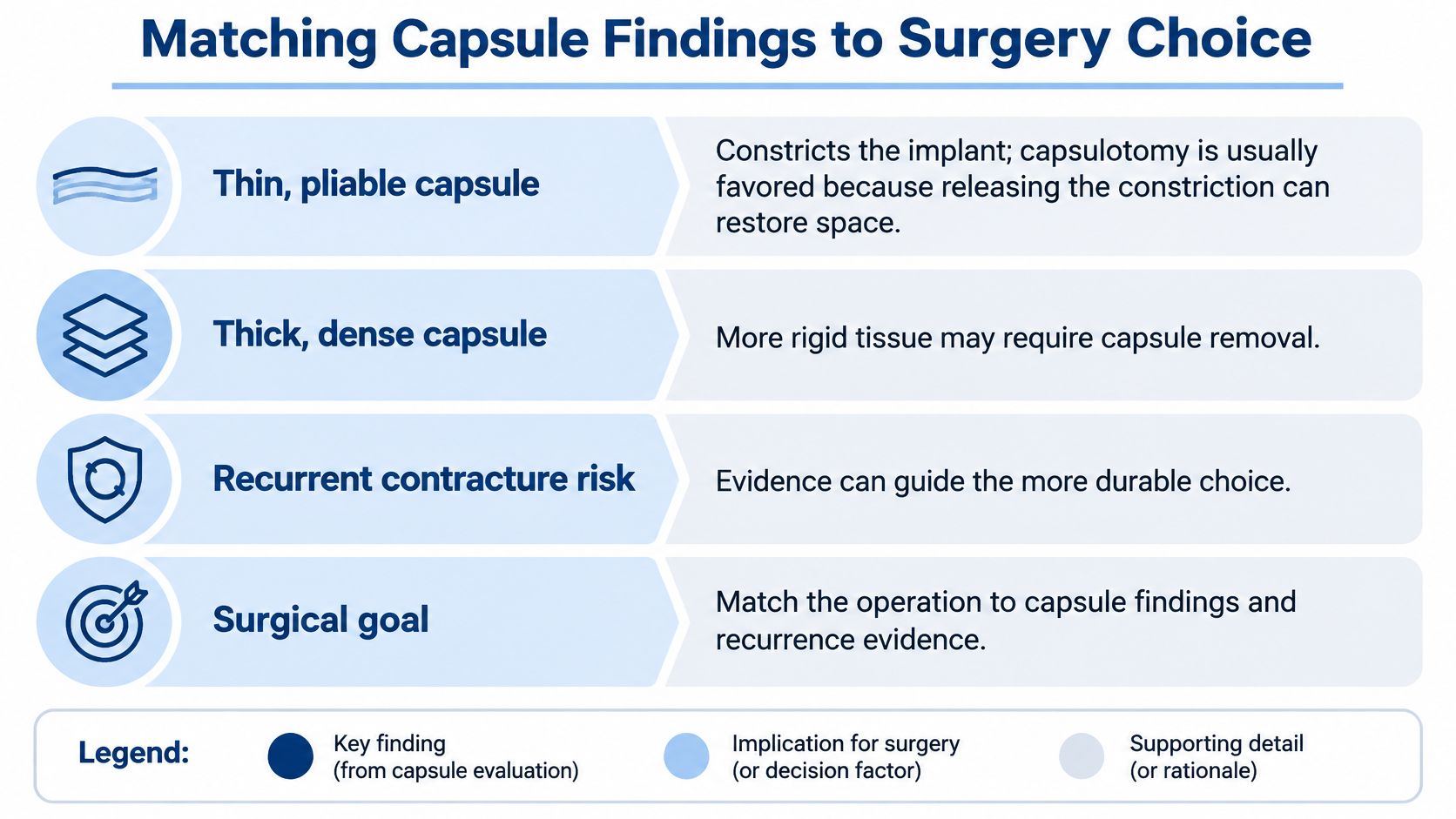
Capsule findings and the operation they usually favor
| Clinical situation | Usually favors | Reasoning |
|---|---|---|
| Contracture with a thin, pliable capsule | Open capsulotomy | Releasing the constriction needs less dissection |
| Severely thickened or calcified capsule | Capsulectomy | Release cannot address abnormal tissue that must be removed |
| Infection | Capsule removal often considered | Infected tissue is taken out with the implant |
| Implant rupture or silicone leakage | Capsulectomy, often with explant | Rupture pathology may warrant complete removal |
| Confirmed BIA-ALCL | Implant and surrounding capsule removal | FDA generally recommends removing the capsule |
| Recurrent contracture after an earlier operation | Individualized choice | Capsule thickness and recurrence history guide the decision |
What the pooled evidence does and does not show
Here is where marketing and literature part company. A 2023 systematic review and meta-analysis examined 21 eligible studies comparing capsulectomy with capsulotomy for breast-implant capsular contracture, and found no randomized controlled trial among them. Most of the included authors described capsulectomy as the preferred or gold-standard approach.
The pooled numbers didn't agree with that framing. The analysis did not demonstrate a statistically significant recurrence advantage for either technique, and the pooled recurrence estimate numerically favored capsulotomy. The contributing studies were heterogeneous enough that nobody can claim superiority from them in either direction.
Recurrence ranges explain why the debate stays noisy. A separate review of capsule management in revision surgery reports recurrence rates running from 0% to 53% after capsulectomy and 0% to 54% after open capsulotomy, and finds inadequate evidence that capsulectomy is superior to open capsulotomy, or that total capsulectomy beats partial removal. Those ranges are wide because the underlying cases differ in implant type and position, follow-up length, contracture severity, surgical technique, and whether the implant was replaced at all.
What surgeons actually do in practice
Real-world practice looks nothing like a single hierarchy. In the same review, among reconstruction patients treated for contracture, capsulotomy was used far more often than either form of capsulectomy, with 31 breasts receiving capsulotomy versus 5 partial and 1 total capsulectomy. Surgeons facing the same diagnosis are choosing differently depending on the capsule in front of them.
The question that actually decides it
The useful question is narrower than "which operation is best." It's for which patient does the added tissue removal of capsulectomy provide enough incremental benefit to justify its extra risk? A thickened, calcified, or contaminated capsule answers that clearly. A thin, pliable one that merely constricts usually doesn't.
Complication Trade-offs to Plan Around
The clearest short-term numbers come from an analysis of 9,734 patients undergoing implant exchange or revision, which found a statistically significant gap in overall adverse events between the two operations.
Short-term complication rates in implant exchange and revision
| Outcome | After capsulectomy | After capsulotomy | Notes |
|---|---|---|---|
| Overall adverse events | 5.79% | 4.50% | Statistically significant difference |
| Hematoma | About 1.00% | 0.56% | About 1.8-fold higher with capsulectomy |
| Seroma | 0.83% | Not reported separately | 0.23% in the implant exchange comparison group |
All figures above come from a large review of revision outcomes.
Each row maps to a concrete planning decision. Hematoma running roughly 1.8-fold higher with capsulectomy means bleeding control and a clear post-operative contact plan carry more weight when the capsule comes out, because more raw surface is left behind. The seroma gap points to fluid collecting in dead space after tissue is removed. The review also found hematoma rates significantly higher with capsulectomy than with capsulotomy, while capsulotomy was not significantly different from implant exchange alone on that measure. The bleeding signal tracks the dissection, not the decision to operate.
Practical rule: the extra dissection in capsulectomy is what buys the more complete tissue removal. Counseling should name both sides of that sentence in the same breath, not one without the other.
One caveat belongs next to every number above. This is an observational study, so patient selection and operative indications may confound direct comparisons between the groups. Patients referred for capsulectomy may have had thicker, more symptomatic capsules to begin with, which raises risk independent of the technique itself. Treat the rates as planning benchmarks rather than a personal risk estimate, and read about complications of breast implant removal before you consent to anything.
Breast Implant Illness and Explant Decisions
The assumption worth testing directly is that the capsule stores something harmful, so it has to come out along with the implant. That story is tidy. The evidence behind it is thinner than the story suggests.
In a review of the evidence connecting capsule removal to symptom outcomes, a 2024 cohort review found that symptom improvement after explantation was not significantly different between patients who had implant removal alone and those who had partial or total capsulectomy. The same review's 2025 case-control study found no meaningful histological differences between capsules from patients with breast implant illness and capsules from asymptomatic patients. If the capsule shows no distinguishing pathology, the histological case for taking it out by default does not exist.
That finding does not settle what causes the symptoms. It addresses a narrower question: whether removing the capsule changes the outcome in a way anyone has measured. So far it has not, which makes the added dissection a cost paid against a benefit nobody has demonstrated. The key decision is how much tissue to remove, and this evidence does not make the answer automatically "all of it."
Separate the reasons, because each changes the operation
Counseling goes wrong when every explant gets one label. Breast implant illness, suspected silicone leakage, capsular contracture, an abnormal fluid collection or mass, and confirmed BIA-ALCL are five different problems with five different operative answers. In confirmed BIA-ALCL the FDA generally recommends implant removal together with removal of the surrounding capsule, and that recommendation is specific to the diagnosis.
For patients whose reason is systemic symptoms, the practical question is what the capsule itself shows. Capsule pathology, imaging, or fluid testing can change the operation, and any of those findings should be able to justify the extra dissection on its own. A thin, non-problematic capsule can reasonably stay. Framing illness related to breast augmentation as a symptom picture rather than a surgical target keeps the two conversations separate.
Removing an implant treats the device. Removing a capsule treats the tissue around it. Those are separate decisions, and the evidence supports the second one only when the capsule itself is abnormal.
Recovery Differences Patients Should Expect
The two operations heal on different clocks, and the gap shows up most clearly in the first week. After a capsulotomy, soreness and swelling typically settle in the range of ordinary post-operative healing, and most patients move through days 1 to 3 with standard pain control and a gradual return to desk work. A capsulectomy usually stretches that arc: expect a longer stretch of visible swelling, more days where reaching and lifting feel limited, and a higher chance you leave surgery with a drain that someone has to empty and measure until the surgeon removes it.
By weeks 2 to 6 the curves start to converge, but restrictions differ in duration. Chest exercises and heavy lifting come back later after capsule removal, and the breast can sit firm and slightly distorted longer before it softens into its final shape.
Plan around specifics rather than a generic calendar. Ask whether a drain is expected and who manages it, when lifting restrictions lift, and when the swelling should be visibly settling. The answers depend on whether the implant was replaced, whether it sat under the muscle, and how much capsule came away, so a timeline borrowed from someone else's surgery tells you very little.
Warning signs that need a same-day call
- Swelling that grows instead of settling: a breast that becomes rapidly larger, tighter, and more painful than the other, particularly in the first days, can indicate a hematoma that may need draining.
- A new firmness or a new lump: a breast that hardens, changes shape, or develops a lump in the breast or armpit needs an examination rather than a wait-and-see.
- Fever, spreading redness, or wound changes: these point to infection, and drainage that turns cloudy, bloody, or foul-smelling belongs in the same call.
- Breathing changes or chest pain: sudden shortness of breath or pain on deep breathing needs urgent assessment rather than a message left at the front desk.
A breast that stays soft but changes contour, pulls higher, or aches weeks later may be early recurrence of contracture, and it deserves imaging rather than resignation. A retained capsule and a replaced implant both shape how stable the result looks months out, so any recovery estimate should be tied to what was done in your case.
Confirm the Capsule Findings Before You Choose
A consultation is more useful when it ends with a written capsule plan than when it ends with a preference for one operation name over another. Bring implant records, operative notes, prior pathology if any exists, and imaging. The goal is to leave with enough detail to compare surgeons on the same facts.
- The current capsule picture, in words. Thickness, calcification, constriction, fluid, infection concern, rupture concern, and any mass or lymph-node finding should be described plainly in the plan.
- The tissue amount being proposed. Ask whether the recommendation is an incision that releases the capsule, removal of part of it, or removal as completely as anatomy allows, and what changes if the implant is exchanged or removed.
- The evidence boundary. Published recurrence and complication ranges work as benchmarks, not a personal risk score, so ask how your contracture grade, rupture status, implant plane, and prior surgery move you within or outside those ranges.
- The stopping rule for testing. State which result would change the operation and which result would only postpone it.
That last item keeps the workup honest. why more tests isn't better applies once another scan cannot alter incision, tissue removal, implant handling, or reconstruction. If rupture is part of your picture, review signs of breast implant rupture so the history is specific: onset, shape change, pain, swelling, hardness, and any prior trauma.
For readers in Los Angeles, Ideal Face & Body lists Breast Implant Removal (Awake), explant/breast implant removal, breast implant revision, Awake Breast Lift, Awake Breast Reduction, and Raise Your Cup fat transfer among its breast procedures. Ask Justin Yovino, MD, FACS which of those settings your capsule decision belongs to, and request the capsule findings, planned tissue removal, drain plan, and recurrence rationale in writing before a date is booked.