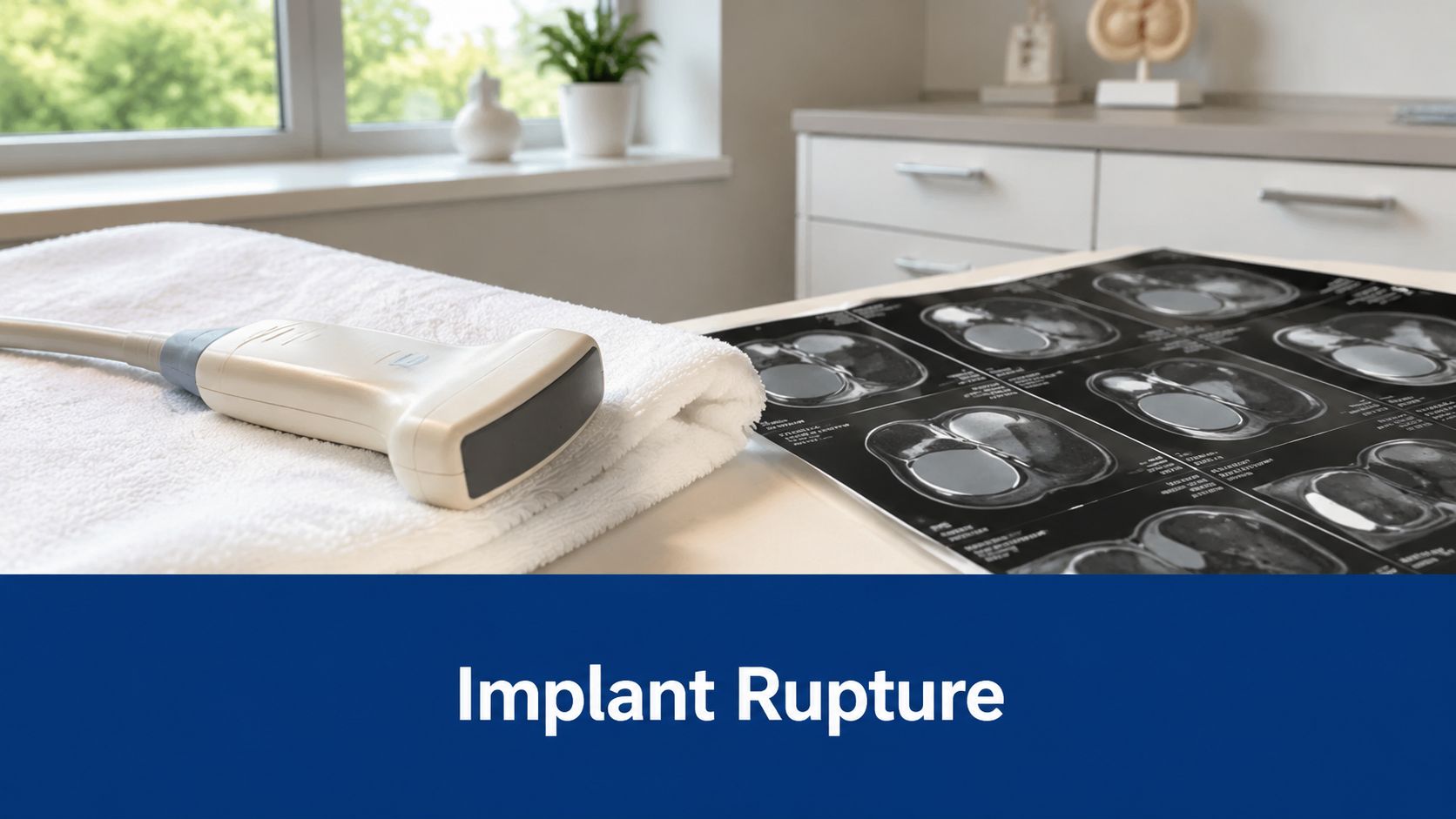
Most silicone breast implant ruptures cause no visible or physical symptoms, and historical reviews report rupture prevalence of about 30% at 5 years, 50% at 10 years, and 70% at 17 years. That means the absence of pain, swelling, or shape change doesn't reliably prove that an implant is intact.
That challenges the most popular advice about breast implant rupture signs: waiting until something feels obviously wrong. Saline rupture often causes visible deflation, but silicone rupture can remain contained inside the surrounding scar-tissue capsule. The implant may have failed while your breast looks and feels much the same.
This distinction matters because symptoms can guide an evaluation, but they can't replace surveillance. If you have silicone implants, the safest approach combines awareness of changes with imaging and follow-up from a qualified plastic surgeon.
Table of Contents
- Understanding Breast Implant Rupture and the Silent Reality
- Silicone Implant Rupture Symptoms to Monitor
- Saline Versus Silicone Rupture and How They Differ
- Diagnostic Imaging for Breast Implant Rupture
- When to Seek Immediate Medical Evaluation
- Treatment Options After Rupture Diagnosis
- Building a Proactive Implant Surveillance Plan
Understanding Breast Implant Rupture and the Silent Reality
Why silicone rupture can go unnoticed
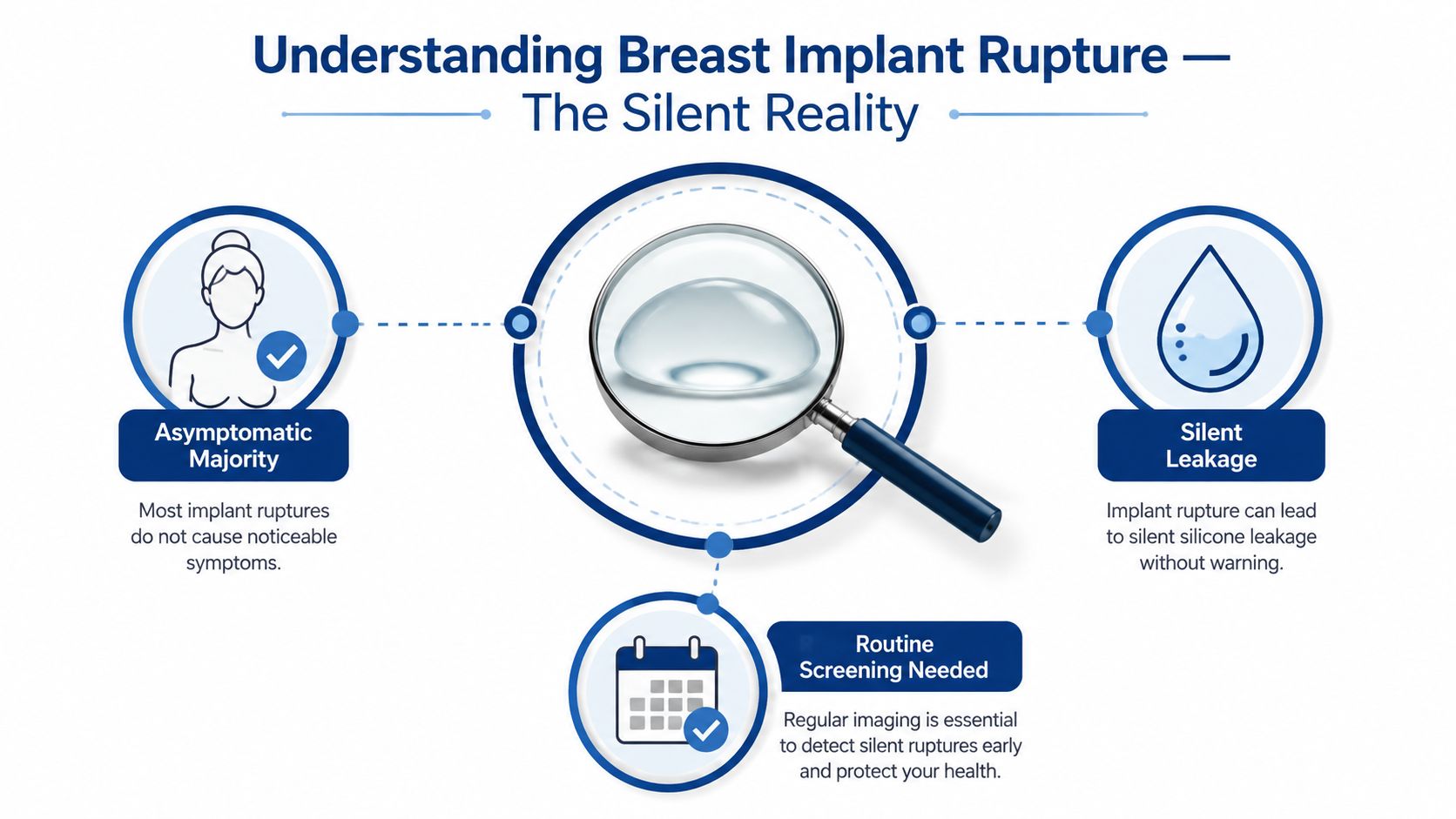
A silicone implant has an outer shell filled with cohesive silicone gel. If the shell breaks, the gel may remain within the capsule of scar tissue that naturally forms around the implant. This is called an intracapsular rupture. The capsule acts like a sealed envelope, so the breast may not suddenly shrink or look dramatically different.
The FDA states that most silicone implant ruptures cause no immediate visible or physical change, and that MRI is the most effective method for detecting asymptomatic rupture. A medical review explains why examination alone isn't enough, noting that clinical examination can miss up to half of ruptures and that imaging has therefore become central to surveillance. The review of silicone breast implant rupture also describes how rupture risk increases as implants age, with a median implant age at rupture estimated at 10.8 years.
That doesn't mean every implant will rupture at those points, and it doesn't mean a symptom-free implant is necessarily damaged. It means symptoms are an unreliable screening tool.
Intracapsular and extracapsular failure
An extracapsular rupture occurs when silicone moves beyond the scar-tissue capsule into nearby breast tissue or lymph nodes. This may produce more noticeable firmness, lumps, inflammation, or shape changes, and it has greater clinical significance because the gel has extended outside the implant's immediate enclosure.
By contrast, a saline implant usually deflates when its shell breaks. The body absorbs the sterile saline, so the breast typically becomes smaller and softer. A silicone leak is more like a slow internal leak, while saline rupture is closer to a punctured water balloon.
For broader, plain-language information about women's health and medical follow-up, the Vitamin Planet women's health guide can provide useful general context. It shouldn't replace an implant evaluation.
Practical rule: Feeling normal is reassuring, but it isn't a reliable test of silicone implant integrity.
Silicone Implant Rupture Symptoms to Monitor
Silicone rupture signs can range from a mild sensation to a clear change in breast shape. The FDA lists decreased breast size, altered shape, hard lumps, uneven appearance, pain or tenderness, tingling, swelling, numbness, burning, and altered sensation among possible warning signs. A major review also describes breast pain, firmness, capsular contracture, palpable lumps, asymmetry, and a palpable implant shell in symptomatic patients. The clinical review of silicone implant rupture provides further detail on this broad symptom pattern.
None of these findings proves rupture by itself. Firmness may reflect capsular contracture. A change in position may reflect implant malposition. Rippling can result from implant characteristics, thin tissue coverage, or ordinary changes in the breast. A lump may have another benign explanation, while altered sensation can arise from nerve changes unrelated to implant failure.
The clues patients notice most
In an FDA interview study of 303 women who went to surgery because they suspected rupture, 70% said breast, chest, or upper-body pain led them to suspect a problem, while 58% cited a breast shape change. Seventy-three of those women reported surgery for suspected rupture. These figures describe reasons for suspicion, not proof that every symptom represented confirmed rupture. The FDA's breast implant safety information makes that distinction important.
A separate clinical-imaging correlation study reported rupture signs in 17 of 50 patients, or 34%, and in 22 of 85 implants, or 26%. The practical lesson is straightforward: symptoms can justify assessment, but symptoms alone can't confirm the diagnosis.
Contact your surgeon if you notice:
- A new size difference: One breast appears smaller or loses fullness.
- A developing shape change: The contour looks different or the implant seems to sit differently.
- New firmness or hard areas: The breast feels unusually hard or you can feel a lump or shell edge.
- Pain or tenderness: Persistent discomfort deserves assessment, particularly when it's new or one-sided.
- Sensory changes: Burning, tingling, numbness, swelling, or altered sensation should be reported.
For additional context on medical conditions associated with augmentation, you can review this guide to illness related to breast augmentation. It's still essential to discuss personal symptoms directly with a clinician.
Saline Versus Silicone Rupture and How They Differ
The implant filling changes what rupture looks like. With saline, the most noticeable event is usually deflation. The breast can become smaller, softer, or visibly uneven as the body absorbs the saline. This change may be apparent without advanced imaging.
Silicone behaves differently. The gel can remain inside the surrounding capsule, so the implant may rupture without obvious deflation. The breast may retain its size and general appearance, which is why silicone rupture is often called silent rupture.
| Implant type | Typical pattern after shell failure | Main monitoring concern |
|---|---|---|
| Saline | Deflation and visible size or shape change are usually apparent | Physical changes often prompt evaluation |
| Silicone | Leakage may remain contained and produce no immediate visible change | Imaging is important even without symptoms |
| Silicone with extracapsular spread | Silicone extends beyond the capsule into tissue or lymph nodes | Prompt surgical assessment is appropriate |
The safest way to understand the difference is to use two simple images. Saline rupture resembles a punctured water balloon. Silicone rupture resembles a slow leak inside a sealed envelope. The first tends to announce itself from the outside. The second may remain hidden until imaging identifies the damaged shell.
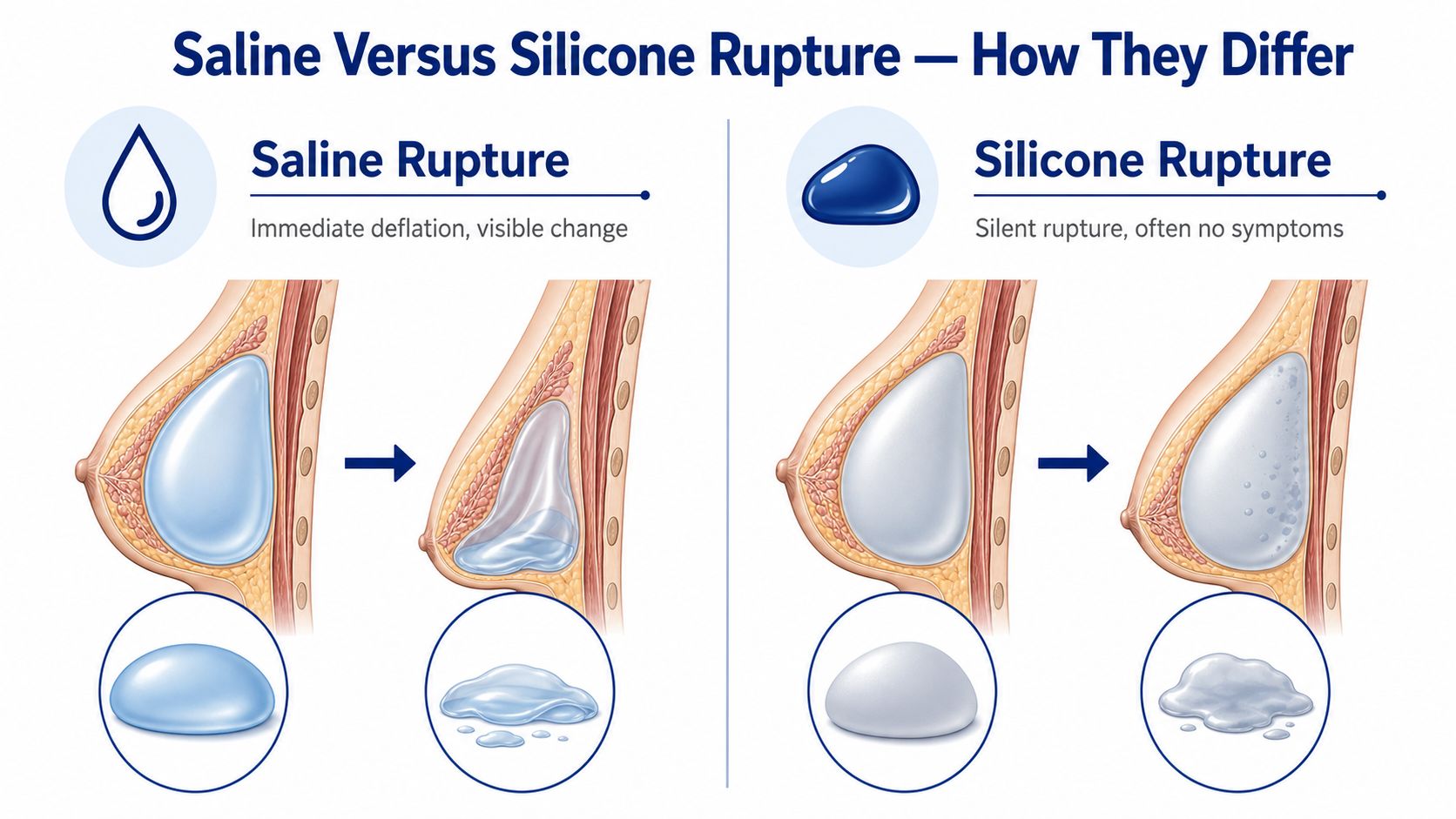
Extracapsular silicone is more concerning because the gel has moved beyond the capsule and may involve breast tissue or nearby lymph nodes. That finding doesn't tell you what treatment you personally need, but it does make a timely evaluation more important.
If you know your implant type, keep that information with your medical records. If you don't know it, your operative report or implant documentation can usually clarify whether the device contains saline or silicone.
Diagnostic Imaging for Breast Implant Rupture
A physical examination is a sensible starting point, especially when you have pain, firmness, a lump, or a new contour change. It can identify asymmetry, palpable shell edges, or tightening around the implant. It can't reliably exclude a silent silicone rupture, however, because examination alone can miss a substantial proportion of failures.
MRI and the linguine sign
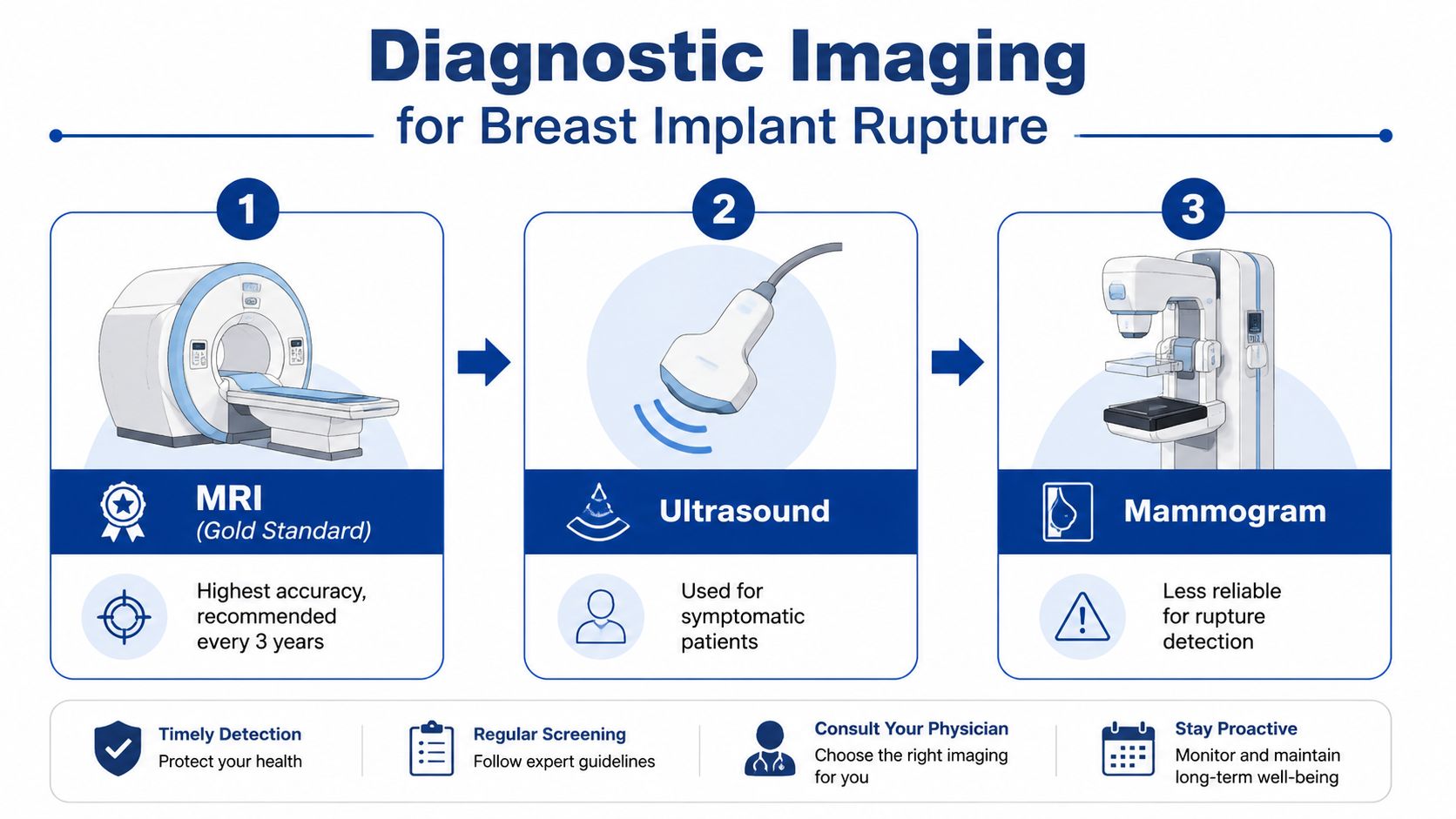
MRI is the most effective method for finding asymptomatic silicone rupture. The classic intracapsular MRI pattern is the linguine sign, where the collapsed implant shell appears as wavy lines floating within the silicone gel. In one surgical-correlated series, this sign had reported sensitivity of 87% and specificity of 100% for intracapsular rupture. The MRI study of implant rupture signs also describes other patterns, including the teardrop or keyhole sign and rat-tail sign, but those are less reliable.
A useful way to interpret this is that not all imaging signs carry equal weight. A named sign can sound definitive, yet its value depends on the pattern, the imaging quality, and the rest of the examination.
Ultrasound and extracapsular spread
Ultrasound can complement MRI and may show the stepladder sign associated with intracapsular rupture. When silicone has escaped beyond the capsule, ultrasound may show a snowstorm appearance. That appearance can indicate silicone in breast tissue or lymph nodes.
Mammography may still be part of age-appropriate breast screening, but it isn't the primary test for confirming a silicone implant rupture. Your imaging plan should account for the implant type, symptoms, previous findings, and the need to screen breast tissue separately from the implant.
Surveillance timing
The FDA's older recommendation was MRI at 3 years after implantation and every 2 years afterward. Later reviews describe a shift toward imaging at 5 years after placement and every 2 to 3 years after that. Because recommendations can evolve, ask your surgeon which schedule applies to your implants and health history.
A normal breast examination doesn't cancel the need for appropriate silicone implant imaging.
When to Seek Immediate Medical Evaluation
Most suspected implant ruptures aren't a reason to panic, but a new or rapidly changing breast still deserves medical attention. Contact your plastic surgeon promptly when a change develops over days rather than gradually over a long period.
Arrange prompt evaluation for:
- Sudden one-sided deflation: This pattern is particularly suggestive of saline implant failure.
- Rapidly increasing pain: Significant new pain without an obvious explanation should be assessed.
- Fast-developing asymmetry: A breast that changes shape or size over a short period needs examination.
- A palpable shell edge or hard lump: New hardware-like edges, nodules, or focal firmness shouldn't be self-diagnosed.
- Fever or spreading redness: These may signal infection or another inflammatory problem requiring urgent care.
Persistent swelling, pain, or a fluid collection around an implant also needs proper evaluation. These findings can have several causes, including rupture, infection, contracture, or other implant-related conditions. Breast implant-associated anaplastic large cell lymphoma, or BIA-ALCL, is a separate and serious concern that can present with persistent swelling, pain, or fluid around the implant, often many years after placement. Your clinician may recommend examination, imaging, and fluid testing when appropriate.
Even if none of these warning signs is present, symptom-free silicone implants still require surveillance. Waiting for an emergency symptom defeats the purpose of screening, particularly because many silicone ruptures are clinically silent.
If you have sudden severe symptoms, spreading redness, fever, or rapidly worsening swelling, contact your surgeon or seek urgent medical care rather than waiting for a routine appointment.
Treatment Options After Rupture Diagnosis
A confirmed rupture doesn't force every patient into the same operation. The appropriate plan depends on whether the implant is saline or silicone, whether the rupture is intracapsular or extracapsular, what symptoms are present, and whether you want to keep an implant.
Removal without replacement
Explantation removes the implant. The surgeon may also address the surrounding capsule when its condition, location, or the presence of leaked silicone makes that appropriate. This option may suit someone who no longer wants implants or who prefers to avoid future implant-related monitoring.
Breast appearance after removal varies with the original implant volume, skin elasticity, tissue thickness, and changes that occurred over time. Some patients choose a breast lift to reshape the remaining tissue, while others prefer removal alone.
Revision with a new implant
Implant revision removes the damaged device and places a replacement when the patient still wants implant-based volume. The procedure may also address capsule problems, implant position, or breast asymmetry. Replacement isn't an automatic requirement, and the decision should follow an honest discussion about goals and future surveillance.
Ideal Face & Body no longer offers breast implant placement, implant-based breast augmentation, or breast implant revision procedures. For general educational information about removal and reconstruction pathways, see breast implant removal and reconstruction.
Removal with fat transfer
Some patients consider explantation with autologous fat transfer, which uses fat taken from another area of the patient's body to restore selected volume and contour. Fat transfer doesn't recreate an implant's exact shape or volume, and candidacy depends on available donor tissue, breast anatomy, skin quality, and the desired result.
The emotional decision matters as much as the technical one. A patient may feel relieved to remove an implant, while another may prefer replacement because maintaining breast volume is central to her goals. Neither choice is universally correct.
When silicone has moved outside the capsule, timely surgical planning becomes more important because the surgeon must evaluate where the material has traveled and how much tissue is involved.

Building a Proactive Implant Surveillance Plan
The most useful plan doesn't ask you to examine your breasts obsessively. It gives you a repeatable way to notice meaningful changes while relying on appropriate clinical imaging for what you can't see or feel.
Start with these actions:
- Confirm the implant type. Find out whether you have saline or silicone implants and keep the device information with your medical records.
- Record your baseline. Notice your usual size, shape, firmness, and sensation so a genuine change is easier to identify.
- Report changes without self-diagnosing. Pain, swelling, a lump, altered sensation, or a new contour change warrants professional assessment, but none proves rupture.
- Follow an imaging schedule. MRI is especially important for silent silicone rupture. Discuss the timing that fits current guidance and your individual history.
- Maintain specialist follow-up. A board-certified plastic surgeon can interpret symptoms alongside examination and imaging rather than treating one clue as conclusive.
Surveillance recommendations have changed over time. Earlier FDA guidance used a 3-year starting point followed by imaging every 2 years, while later reviews describe imaging at 5 years and every 2 to 3 years afterward. Ask your surgeon which current approach applies to you instead of relying on an old discharge sheet or an internet symptom checklist.
A breast implant revision consultation can help clarify whether a suspected problem calls for observation, further imaging, removal, or another treatment pathway.
Your main takeaway is simple: breast implant rupture signs are clues, not a diagnosis. Proactive imaging matters because silicone rupture can remain silent, while prompt evaluation gives you more control over the next decision.
Ideal Face & Body provides consultations for implant-related concerns, including discussions about removal and reconstruction options, while its current services no longer include breast implant placement, implant-based breast augmentation, or breast implant revision. Visit Ideal Face & Body to request a consultation and discuss your symptoms, implant history, and appropriate surveillance plan.