As many as 1 in 2 primary breast reconstruction patients required implant removal within 10 years in silicone-gel implant studies summarized by the U.S. Food and Drug Administration. That figure describes the long-term implant story, not the risk of the removal operation. Understanding breast implant removal complications starts with separating what the implant has done from what surgery to remove it might do.
Removal can address a damaged device, an uncomfortable scar capsule, or a wish to live without implants. It also creates a surgical wound and changes the support beneath the breast, so relief, healing, and appearance need separate expectations.
Table of Contents
- Why Implant Problems Differ From Removal Risks
- Surgical and Healing Complications After Explant
- Ptosis Volume Loss and Rippling After Removal
- Leaving the Capsule Versus Taking It Out
- Systemic Symptoms After Implant Removal
- Steps That Lower Explant Complication Risk
- Plan an Awake Removal With Clear Expectations
Why Implant Problems Differ From Removal Risks
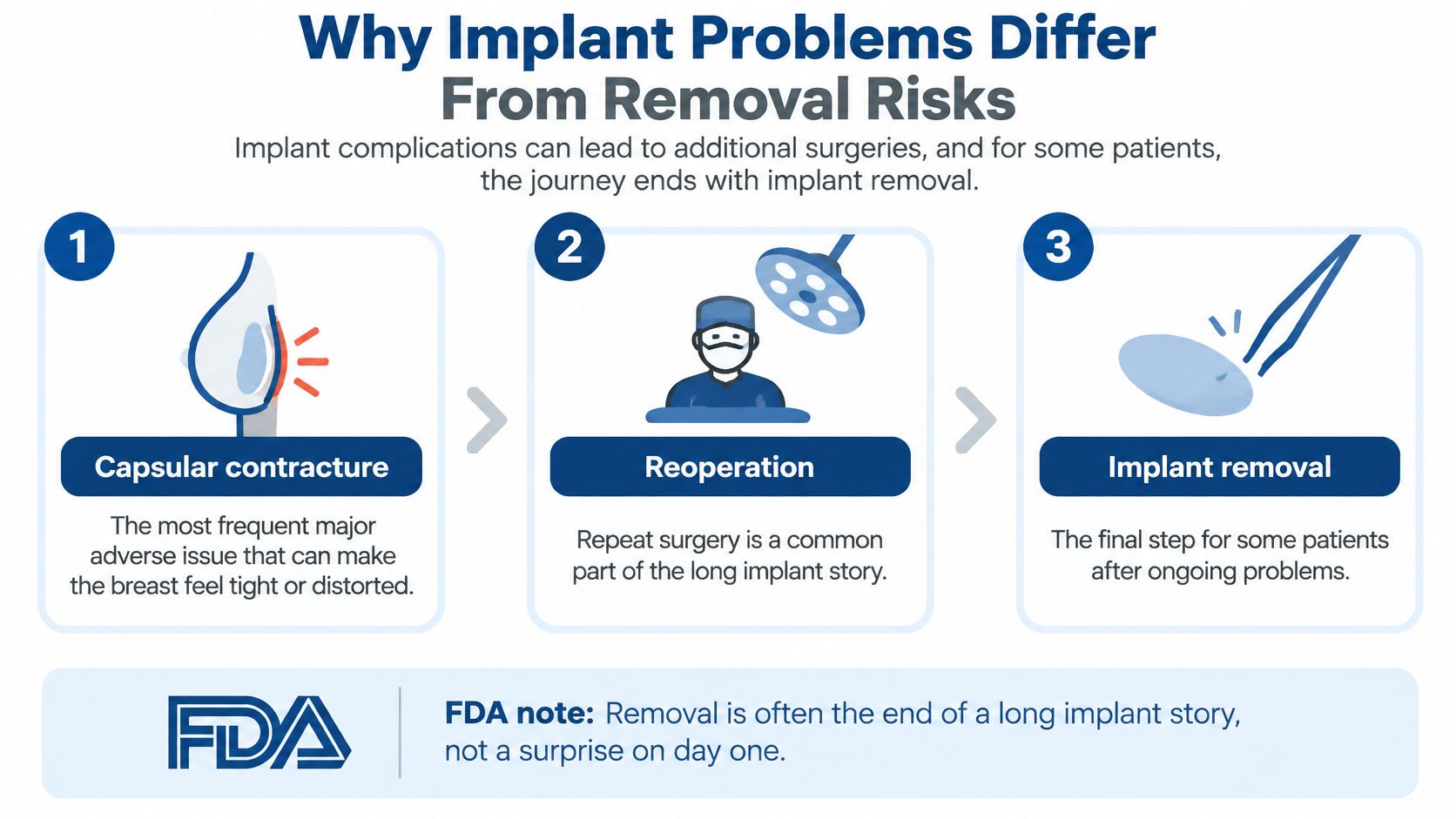
At a routine follow-up visit, a patient mentions that one breast has gradually become firmer, sits higher than the other side, and aches by the end of the day. The surgeon examines her and finds capsular contracture: the scar tissue that naturally forms around the implant has tightened and squeezed it. Before anyone schedules removal, she already has an implant-related problem, and that distinction shapes everything that comes next.
The FDA identifies capsular contracture, reoperation, and implant removal among the most frequent major adverse outcomes associated with breast implants. Rupture or deflation, wrinkling, asymmetry, scarring, pain, and incision-site infection also belong to the implant safety picture. These problems tend to develop over time rather than appearing immediately after placement.
Two separate questions now sit on the table. The first is what the device has done: a tightened capsule, possibly a worn shell, years of pressure on the surrounding tissue. The second is what the operation to remove it might do: a fresh incision, a pocket that has to heal, and support that changes the moment the implant comes out. Removing the implant treats the device; the scar and the wear it caused remain until the surgeon addresses them directly.
Sort the concern before choosing the operation
A useful consultation separates concerns into two groups:
- Problems with the retained implant: Contracture, rupture, pain, and malposition, meaning the implant has shifted into an unwanted position.
- Problems that can follow removal: Bleeding, infection, delayed healing, scarring, contour irregularity, and an appearance the patient finds disappointing.
Pain can belong to either group, and the source changes the plan. Pressure from a tight capsule calls for different decisions than incision soreness during recovery. A breast that looks uneven because an implant has shifted presents a different problem from unevenness that only becomes visible once volume is gone.
Your implant history matters. The length of time the device has been in place, its type, whether it was used for augmentation or reconstruction, and previous operations all influence the assessment. Longer implant duration raises the likelihood that removal or replacement will eventually become necessary.
Practical rule: Ask which existing problem removal is intended to solve, then ask which new risks that specific operation introduces.
Bring implant records and describe changes in firmness, position, size, and discomfort. Reviewing the signs of breast implant rupture can help you organize those observations before the visit, although symptoms alone cannot confirm whether a device is intact. A focused diagnosis gives the surgeon something more useful than a general request to take everything out.
Surgical and Healing Complications After Explant
Removal is its own operation. It creates a fresh wound, leaves an empty pocket where the device sat, and starts a new healing curve, so complications can appear even when the implant itself was the entire problem. The table below groups the ones worth knowing by when they tend to show up and what typically helps.
Complications that can follow implant removal
| Complication | Usual timing | What raises risk | What usually helps |
|---|---|---|---|
| Bleeding or hematoma | Hours to a few days | Wider dissection, capsule removal, blood thinners | Clinician-directed pressure and monitoring; return to the operating room if expanding |
| Seroma | Days to weeks | Large empty pocket after a big implant | Prescribed compression, observation, drainage if it persists |
| Infection | Days to weeks | Combined procedures, poor wound care | Antibiotics, wound care, reoperation if severe |
| Delayed healing or skin necrosis | First weeks | Thin skin, nicotine, tight closure | Wound care, avoiding tension, stopping nicotine |
| Scarring | Months | Incision choice, tension, personal healing | Time, scar care, sun protection |
| Pain or discomfort | Days to months | Swelling, nerve stretch, prior tight capsule | Pain control, activity limits, follow-up if worsening |
| Anesthesia-related problems | During surgery and right after | General anesthesia, medical conditions | Medical assessment, technique matched to health |
| Loss of breast tissue | Immediate and lasting | Long-standing implants, capsule removal | Honest volume planning, possible fat transfer later |
Treat these as practical timing windows. An individual patient can fall earlier or later than any cell. The FDA's patient guidance lists hematoma or seroma, delayed wound healing, necrosis, pain, anesthesia-related complications, infection, scarring, loss of breast tissue, and undesirable cosmetic results among potential adverse outcomes.
Early changes need attention to direction
A hematoma is a collection of blood. A breast that becomes increasingly swollen, firm, and painful needs urgent surgical review, particularly when one side changes much faster than the other. Don't try to manage an expanding collection with tighter compression at home.
A seroma is a fluid collection rather than a collection of blood. Fluid can accumulate in the space left behind, and persistent fullness may require examination or drainage. The right compression level comes from the surgical team, since guessing at pressure on your own can work against healing.
Infection can involve the incision or deeper tissues. Increasing redness, warmth, fever, worsening pain, or concerning drainage warrants prompt contact with the surgical team. Antibiotics alone aren't always enough when an infected collection or damaged tissue needs treatment.
Wound quality matters beyond the first days
Delayed healing means the incision isn't closing as expected. Necrosis means tissue has died, which is more serious than a slow-closing surface wound. Thin skin, nicotine exposure, and excessive closure tension can make tissue survival more difficult.
Scars change as they mature, while discomfort should be assessed by its pattern. Improving soreness is different from escalating pain or pain accompanied by new swelling. Anesthesia planning belongs before surgery, with disclosure of medical conditions, medications, and previous reactions. Techniques that keep the patient awake under local anesthesia take general anesthesia out of the risk column, though candidacy still depends on the scope of the operation planned.
Combining removal with a lift or another corrective procedure adds incisions and contour work. Each added element means another wound to heal, more dissection, and more time under anesthesia, so a combined plan should earn its place by fixing something removal alone cannot, such as skin that is unlikely to retract.
For people whose implant history includes breast cancer reconstruction, Sunridge Medical's breast cancer guide offers broader context for discussing cancer-related care. It doesn't replace individualized guidance from the treating oncology and surgical teams.
Get urgent help: An expanding bruise or breast, fever, or wound separation needs prompt assessment. Chest pain, breathing difficulty, or fainting requires emergency care, not a routine follow-up message.
Ptosis Volume Loss and Rippling After Removal
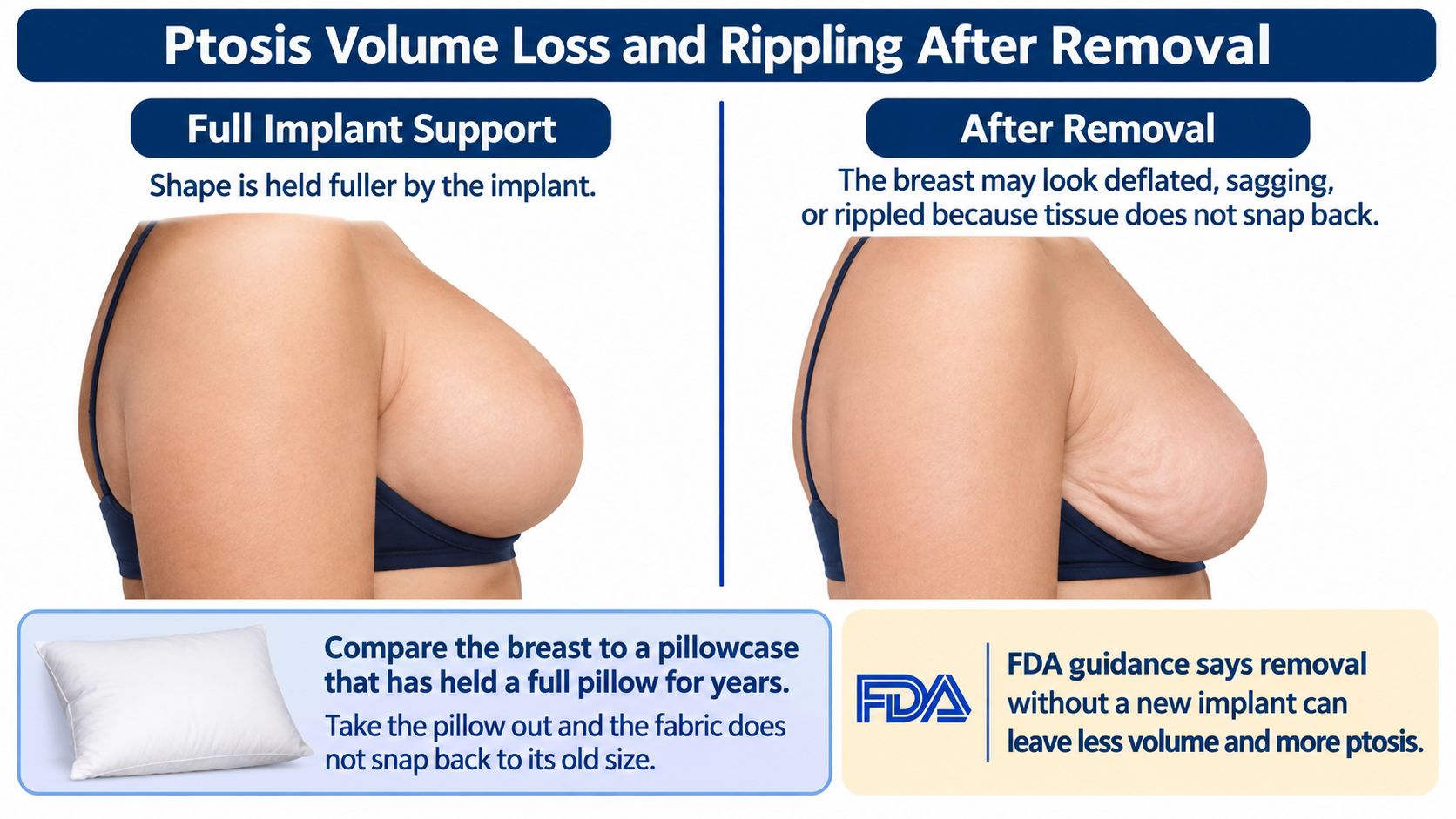
A breast can behave like a pillowcase that has held a full pillow for years. Remove the pillow and the fabric doesn't necessarily return to its original size. After explantation, the remaining skin and breast tissue must settle without the device that previously filled the space.
Possible appearance changes include dimpling, chest-wall concavity, puckering, wrinkling, and reduced fullness. These aren't interchangeable problems, and they don't automatically mean the operation healed incorrectly. The distinction matters because lifting skin and adding volume accomplish different things.
Droop is a position problem
Ptosis means drooping of the breast, often with a lower nipple position. Implant weight, pregnancy, weight changes, and aging can stretch the tissue envelope before removal. Taking the device out can reveal that stretch rather than create it from nothing.
A lift addresses excess skin and tissue position. It doesn't replace the volume of the removed implant. Understanding breast ptosis helps distinguish a wish for a higher nipple from a wish for a fuller upper breast.
Lost fullness and surface folds need different plans
Volume loss is the reduction in breast size after the implant leaves. The change begins immediately, although swelling can temporarily obscure how much natural tissue remains. Someone who liked the implanted size may feel unexpectedly flat even when the incision and underlying tissues heal well.
Rippling or wrinkling describes folds or surface irregularity. Thin tissue over the former pocket, inward folding of skin, and residual capsule shape can contribute. A fold that remains visible during healing isn't the same finding as a newly red, hot, draining wound.
The starting anatomy makes a substantial difference:
- More tissue over a smaller implant: The remaining breast may show a relatively modest change.
- Thin skin over a large, long-standing implant: Hollows, loose folds, and concavity may be more noticeable.
- Different tissue on each side: Preexisting asymmetry may become clearer when the devices no longer provide similar fullness.
Bring current front and side photographs, early post-implant photographs, and pre-implant photographs if available. They help distinguish longstanding differences from implant-related stretching and make goals more concrete than a desired cup size.
Fat transfer can soften selected hollows and add fullness using your own tissue. A lift can reposition the breast envelope. Neither should be presented as a promise to recreate the size, firmness, or upper-breast shape of a large implant.
Leaving the Capsule Versus Taking It Out
Implant-only removal versus capsulectomy
| Approach | What is removed | Dissection and bleeding | Often considered when |
|---|---|---|---|
| Implant-only removal | Implant, capsule left behind | Less dissection; lower local bleeding exposure than capsule removal | Capsule is soft, no rupture concern, smaller operation preferred |
| Partial capsulectomy | Implant plus selected capsule | More dissection than implant-only removal, generally less than full capsule removal | Selected areas are thick or symptomatic, with thin tissue elsewhere |
| More complete capsulectomy | Implant and most of the scar capsule | Wider exposure and more bleeding risk | Contracture, calcified or painful capsule, ruptured silicone |
| Removal when gel has escaped | Implant, capsule, and affected nearby tissue as needed | Potentially complex dissection; nodules and lymph nodes may need assessment | Imaging or surgery shows silicone beyond the capsule |
The capsule is the scar shell the body forms around an implant. Capsulectomy means removing some or all of that shell. Removing more capsule isn't automatically better, just as leaving it isn't automatically appropriate.
A soft, uncomplicated capsule presents a different problem from a thick, contracted, painful one. The surgeon must balance the reason for removing scar tissue against the tissue injury required to reach and separate it. The back of a capsule can be closely attached to the chest wall, while the front may lie beneath very thin breast tissue.
Silent rupture can change the tissue assessment
The FDA's implant labeling document explains that silicone rupture can be silent, without symptoms or visible breast changes, and may not be detectable through physical examination alone. Appropriate imaging, particularly MRI, may be needed. A normal-feeling breast therefore isn't proof that a silicone implant is intact.
If silicone has escaped beyond the capsule, the surgeon may need to assess more than the implant pocket. Associated findings can include inflammation, additional scar formation, enlarged lymph nodes, nodules, and granulomas, which are localized foreign-body reactions. Silicone can also migrate into nearby tissue.
Saline deflation is usually more apparent because the breast loses fullness. Silicone assessment can require a different level of investigation, so the capsule plan shouldn't be finalized on appearance alone when rupture is suspected.
Completeness must be weighed against tissue safety
Removing every fragment of capsule isn't always anatomically safe or feasible. Forcing separation from the chest wall or thin skin can increase bleeding or injure tissue. The operative plan should allow the surgeon to respond to what is found rather than pursue an absolute removal goal regardless of anatomy.
Use these questions to clarify the trade-off:
- Symptoms: Is there contracture or pain that points to a capsule problem?
- Device integrity: Is rupture proven, suspected, or unsupported by the current assessment?
- Priorities: Is the goal the smallest suitable operation or more complete capsule removal for a specific clinical reason?
If rupture is found, ask afterward whether residual silicone is possible and whether follow-up imaging, including MRI, is appropriate. Imaging can help assess remaining concerns, but it shouldn't be framed as a guarantee that every microscopic trace has been removed.
Systemic Symptoms After Implant Removal
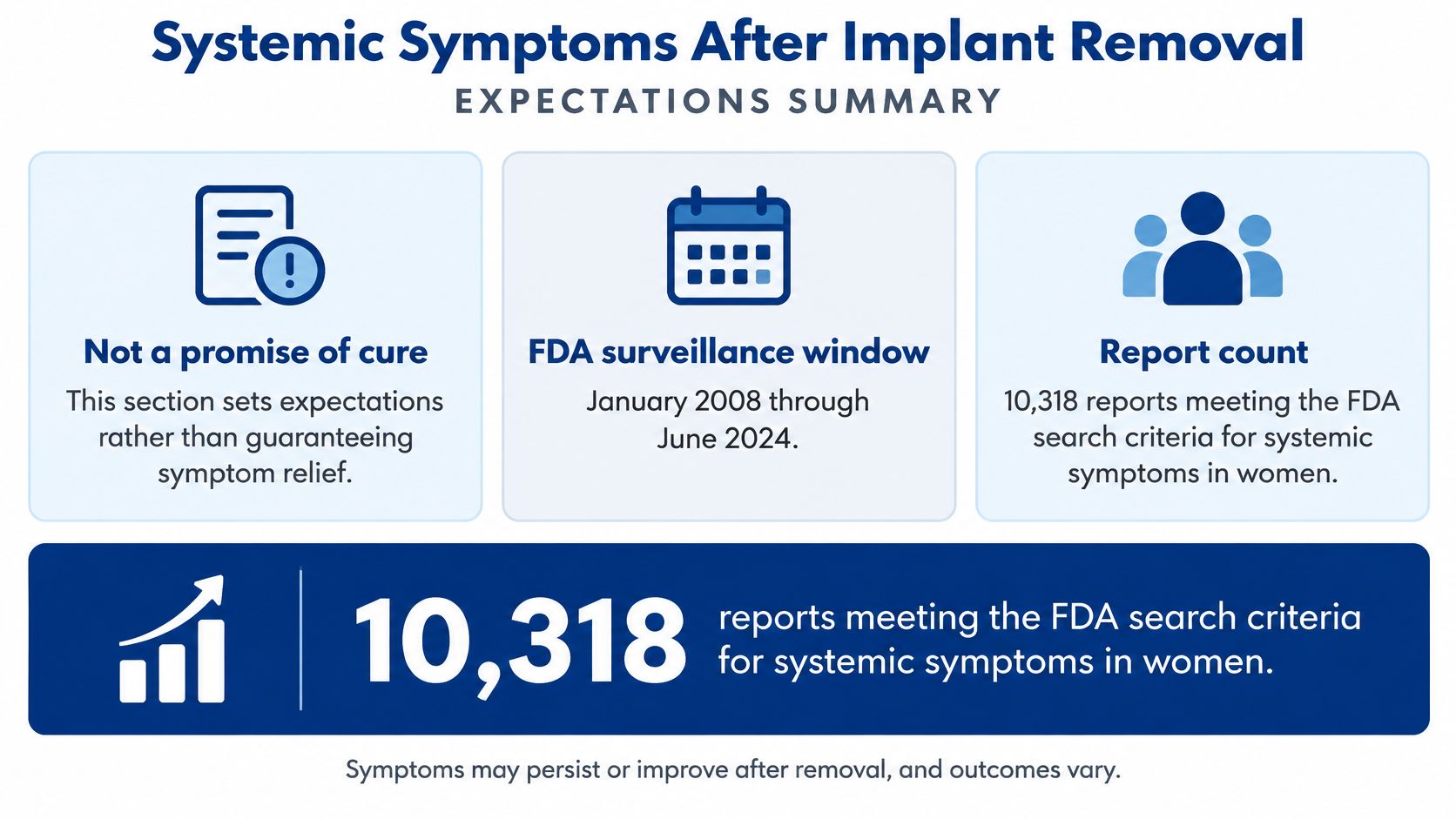
The FDA's systemic-symptom surveillance summary identified 10,318 reports meeting its search criteria from January 2008 through June 2024, including 4,210 reports, or 40.8%, that mentioned implant removal after symptoms began. These are reports about people with implants, not a group composed entirely of people who developed symptoms after removal. That distinction matters when interpreting any summary graphic.
The FDA also received descriptions of improvement alongside descriptions of no improvement or worsening. These reports aren't a controlled clinical trial, and the agency states that the cause of symptoms and degree of benefit from removal remain unclear. They can't establish an individual patient's likelihood of recovery.
A symptom can have more than one contributor
People use breast implant illness to describe systemic concerns such as fatigue, joint pain, brain fog, and rashes. Those symptoms deserve a careful medical evaluation, even when an implant-related explanation seems plausible. Symptoms can have several contributors, so removal addresses only the part linked to the device.
A concrete example makes this clearer. A patient reports months of fatigue and attributes it to her implants. Testing also reveals an untreated thyroid condition. Surgery may relieve whatever the device or capsule was contributing, but the thyroid problem needs its own treatment, and her fatigue won't fully resolve until it gets one. Autoimmune illness, medication effects, disrupted sleep, and mood symptoms can operate the same way, and more than one can be present at the same time.
A preoperative review should include:
- Symptom history: What began when, what fluctuates, and what limits daily life.
- Medical assessment: Whether another condition needs testing or treatment.
- Medication and sleep review: Whether either could contribute to fatigue, concentration changes, or pain.
- Mental health support: Help with anxiety, low mood, or body-image concerns without dismissing physical symptoms.
Track improvement without promising a deadline
Some people describe feeling better over weeks to months. Others don't experience the relief they hoped for.
Early surgical fatigue and soreness can also muddy the picture, making it difficult to interpret systemic symptoms in the first weeks after removal. A simple record of sleep, energy, pain, and daily functioning reveals trends that a single good or bad day cannot.
Removal can be a reasonable choice without being a guaranteed cure for systemic symptoms.
Reviewing illness related to breast augmentation can help you prepare questions, but keep ongoing medical care in place. Rupture, contracture, or a personal wish to be implant-free can justify removal even when broader symptoms persist.
Steps That Lower Explant Complication Risk
Start with a specific plan for each complication you can reduce. Removal is its own operation with its own healing demands, so the goal is to match the extent of surgery to the actual problem and protect the tissue that has to recover.
Before surgery
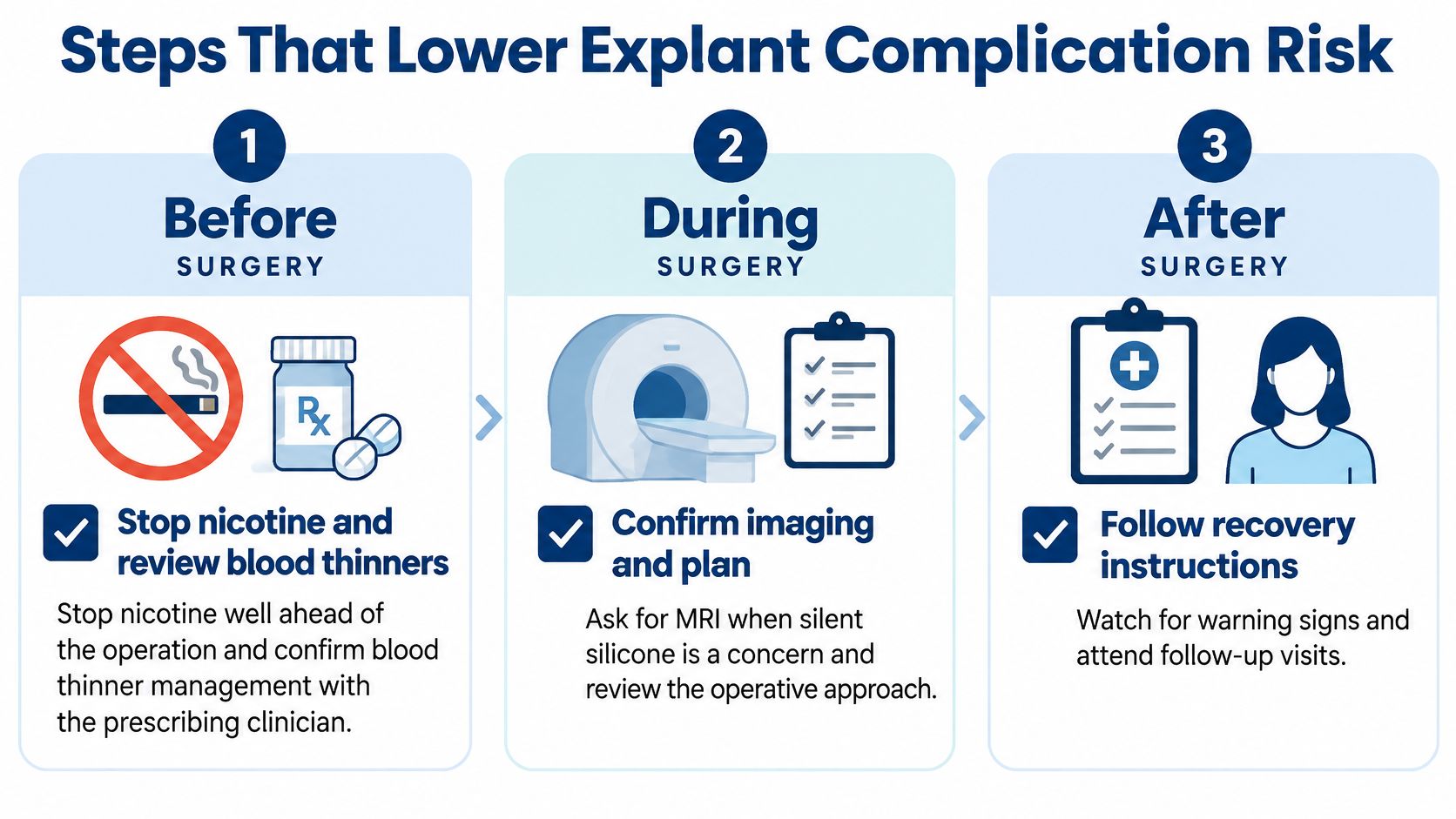
Stop nicotine and coordinate medications. Discuss nicotine cessation well ahead of surgery and disclose every nicotine product you use, including replacements. Review blood thinners and supplements with the surgeon and the prescribing clinician, and never stop a prescribed medication on your own.
Complete the appropriate imaging assessment. When silent silicone rupture is possible, ask whether an MRI should come before the operation is finalized. Bring previous imaging reports and implant information so decisions rest on records rather than memory.
Describe the outcome you want. Say whether you prefer a smaller natural breast or want to keep as much fullness as an implant-free approach allows. That preference determines whether removal alone is enough or whether a lift or fat transfer belongs in the discussion.
Share the medical history that affects healing. Include autoimmune conditions, previous infections, prior breast operations, medication reactions, and earlier wound problems. Arrange practical help at home for tasks that would otherwise require lifting or straining.
During surgical planning
Choose the extent of surgery for a reason. A capsule may be left in place, partly removed, or more extensively removed depending on symptoms, imaging, and anatomy. More dissection means more tissue that must heal, so the most extensive option should never be the automatic default.
A lift can be combined with removal or staged for later. Thin skin or limited tissue circulation can make a single combined procedure the poorer choice, since blood supply is what keeps reshaped skin viable. Fat transfer adds a second healing site at the donor area and requires enough suitable fat to harvest. Because some transferred fat will not survive, additional treatment may be discussed later rather than a fixed final volume promised up front.
The smallest operation that adequately solves your actual problem generally exposes less tissue to local surgical risk than combining every contour step at once.
After surgery
Use support and activity limits as prescribed. Wear the recommended garment without improvising tighter compression. Follow lifting restrictions even if discomfort fades early; feeling better and being healed are different things.
Attend wound checks. Keep appointments even when the incisions look satisfactory to you. Report new swelling, drainage, increasing redness, or worsening pain as it appears rather than waiting for the next scheduled visit.
Allow shape to settle. Swelling changes appearance during early healing, so a breast that looks boxy or uneven in the first weeks may soften considerably later. Wait until the surgeon confirms recovery before judging the lasting contour or planning another procedure.
Plan an Awake Removal With Clear Expectations
A sound decision begins with three checks: what you are trying to solve, how much surgery you are willing to undergo, and what information is still missing. A device problem, an appearance concern, and systemic symptoms often coexist. Each carries a different likelihood of improvement, and removal is its own operation with its own healing demands rather than an automatic fix for everything the implant caused.
Match the choice to a realistic endpoint
- Define success: Is your priority relief from a local implant problem, becoming implant-free, a different shape, or improvement in broader symptoms? The first three can be planned concretely. Systemic symptom relief is possible after explant, yet it can never be promised in advance, because symptoms like fatigue or joint pain can have other causes.
- Accept the healing work: Removal alone, capsule surgery, a lift, and fat transfer each place different demands on tissue and recovery time.
- Resolve unanswered questions: Clarify imaging findings, medical concerns, and the decisions your surgeon may need to make during the operation.
At Ideal Face & Body, we offer awake breast implant removal, the Awake Breast Lift, Awake Breast Reduction, and Raise Your Cup breast fat transfer. The Awake Breast Lift repositions your own tissue under local anesthesia, without general anesthesia or an IV. Raise Your Cup uses fat taken from areas such as the abdomen to reshape the breast without an implant. Breast augmentation and implant revision are also part of the practice, so a patient weighing removal against a revised implant plan can compare both paths in one consultation.
Before-and-after photographs help you describe a preferred contour. They are not predictions of your result.
A consultation with Dr. Justin Yovino and our team, in person in Beverly Hills, CA, or virtually, can match your imaging, capsule findings, and shape goals to an appropriate awake plan. Suitability is set by the operation your anatomy and health require.
Ideal Face & Body offers awake breast implant removal and implant-free options for reshaping the breast after explantation. Visit Ideal Face & Body to review before-and-after context and book a consultation with Dr. Justin Yovino and the team about your removal plan, capsule questions, and recovery expectations.