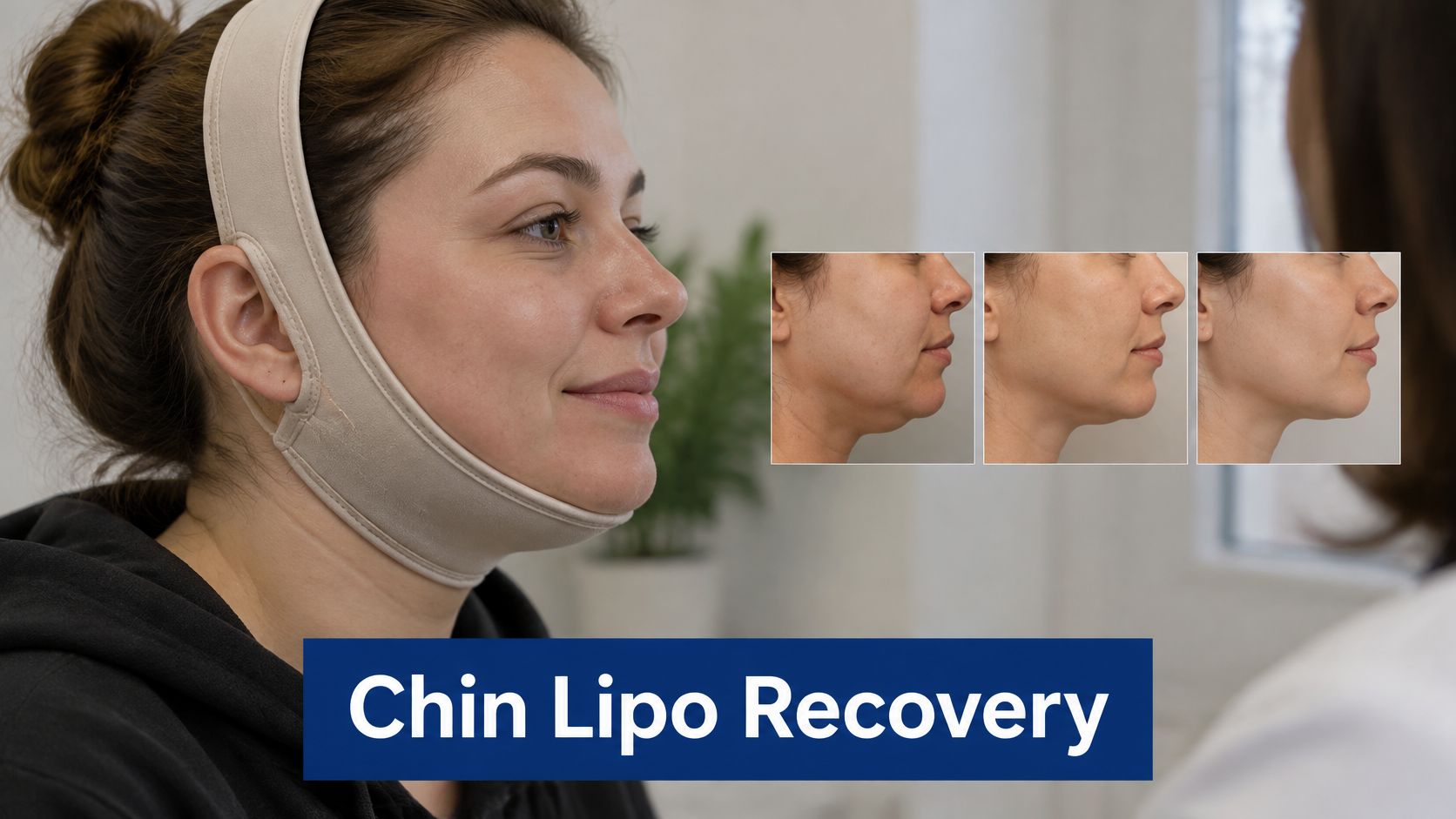
Many people resume desk work in a few days to about two weeks after chin liposuction, strenuous activity often waits two to six weeks, and the settled chin contour is commonly judged around three to six months. The popular advice that you'll be recovered in a week confuses being ready to face your calendar with being finished healing.
That distinction matters when your chin looks fuller than you expected, your skin feels firm, or your reflection changes from morning to evening. A useful recovery plan separates what you can do, what you can see, and which symptoms need medical attention.
Table of Contents
- Two Clocks for Chin Liposuction Healing Time
- Healing Phases From the First Night to Six Months
- Compression and the Return to Work and Exercise
- What the Chin Looks Like as Weeks Pass
- When Swelling Stops Being Routine
- Numbness Versus Lower Lip Weakness
- Plan Recovery Before the Procedure Day
Two Clocks for Chin Liposuction Healing Time
A fuller chin in the first days doesn't automatically mean fat was left behind. Fluid and inflammation can temporarily hide the shape underneath, so an early mirror check isn't a reliable assessment of the procedure.
Social recovery means you're comfortable enough for desk work, ordinary errands, and conversation without needing frequent rest. Biological healing means the deeper tissues have settled, residual swelling has cleared, and the skin has adapted to the new contour. These milestones don't arrive together.
The Ohio State University Wexner Medical Center's liposuction guidance describes return to work or routine activities within a few days for many patients, while strenuous activity commonly requires several weeks. Those are broad liposuction benchmarks, not a promise for every isolated chin procedure.
Why looking better doesn't mean healing is finished
A bruise is like the weather. Tissue remodeling is more like the season. The visible color can clear while deeper firmness, skin contraction, and altered sensation continue changing.
You might feel ready for a remote meeting while still preferring to keep your camera off. Alternatively, your profile might look noticeably slimmer while the area under your chin feels tight or unusually firm. Neither situation establishes the final result.
Practical rule: Judge readiness for work by comfort and job demands. Judge the contour with your surgeon after the tissues have had time to settle.
Several factors change both clocks:
- Treatment extent: A small isolated area isn't the same recovery commitment as combined chin and neck surgery.
- Skin response: Elasticity and the way your body clears fluid affect how quickly definition becomes visible.
- Healing conditions: Smoking, bleeding risk, compression use, and your individual lymphatic response can alter recovery.
- Additional procedures: Neck tightening can introduce restrictions beyond those needed for fat removal alone.
Treat chin liposuction healing time as a planning range, not a personal prediction. Your operating surgeon's instructions take priority over a generic schedule.
Healing Phases From the First Night to Six Months
Healing under the chin runs in overlapping phases. Swelling, bruising, and tissue remodeling each move at their own pace, so no single recovery date tells the whole story.
The windows below combine two sources: a 50-patient ultrasound-assisted chin and jawline liposuction series performed under local anesthesia, which supplies the chin-specific compression schedule, and American Society of Plastic Surgeons recovery guidance, which supplies the broader activity and bruising milestones.
Chin liposuction healing phases
| Phase | Window | What is common | Still unfinished |
|---|---|---|---|
| Peak swelling | 48-72 hours | Chin looks fuller, tight, and sometimes uneven from fluid | Fluid can obscure the underlying contour |
| Continuous early support | Days 1-5 | In the chin series, the strap was worn 24 hours a day and stitches were checked on day 5 | Bruising is still changing |
| First-week limits | Days 1-7 | Pain, swelling, and bruising need close watch; activity stays limited | Final jawline |
| Feeling better | Weeks 2-3 | Many return to desk work; the chin series used nighttime strap wear until about day 19 | Strenuous exercise |
| Bruise fade | Weeks 2-4 | Bruising fades over roughly 2-4 weeks; swelling starts to subside by weeks 4-5 | Firmness and residual puffiness |
| Gentle rebuild | Week 6 onward | Gentle exercise may start if the surgeon clears it | Tissue remodeling |
| Settled contour | About 3-6 months | Residual edema and skin adaptation keep refining the line | Some results are still incomplete at 6 months |
Read each row as a typical range, not a deadline. The chin-series rows describe one specific protocol, while the activity rows reflect general guidance. Ultrasound-assisted, radiofrequency-assisted, and other approaches should not be assumed to share identical garment or exercise instructions.
One row deserves a closer look. During peak swelling the chin can look fuller or more uneven than it did before surgery, and that early shape is largely trapped fluid rather than fat the procedure missed. Judging the contour at that stage is like weighing yourself while still holding your luggage.
The early phase is about protection
During the first night and the days that follow, concentrate on your written medication, incision-care, positioning, and garment instructions. Resist removing the wrap to inspect the result or tightening it because swelling seems disappointing.
At the initial review, the team checks more than appearance. Wounds, discomfort, bruising, fluid accumulation, and garment fit all help determine whether recovery is progressing appropriately.
Later visits answer different questions
As daily comfort improves, follow-up shifts toward the developing contour, skin adaptation, and any persistent firmness or asymmetry. A concrete example: three weeks in, the bruise color may be gone while the tissue under the chin still feels firm or slightly uneven to the touch. That firmness is remodeling still in progress, rather than a sign that fat was left behind.
Sensation changes and any changes in lower-lip movement follow their own schedule, separate from how the swelling looks, so they deserve their own expectations.
How to use this table: Find your row in the window column, then read the last column before drawing conclusions. The "still unfinished" items are exactly what later appointments are for.
Compression and the Return to Work and Exercise
Day five at your desk can feel like full recovery until a video call shows a chin that looks rounder than it did the morning after surgery. That gap is the whole point of this section: comfort for daily tasks runs on a faster clock than the tissue settling underneath, and compression is what the garment contributes to the slower clock. It supports the treated skin and the layer beneath it while fluid shifts. Tightening the strap harder does not speed that process, because pressure only helps while it stays tolerable.
The studied patterns illustrate why instructions differ: some protocols use a shorter continuous-wear period, while others transition from continuous support to nighttime wear. After chin and neck sculpting at Ideal Face & Body, for example, patients go home in a custom head and neck wrap for support. Whatever your version looks like, your exact garment, fit, cleaning method, and removal schedule should come from the operating team.
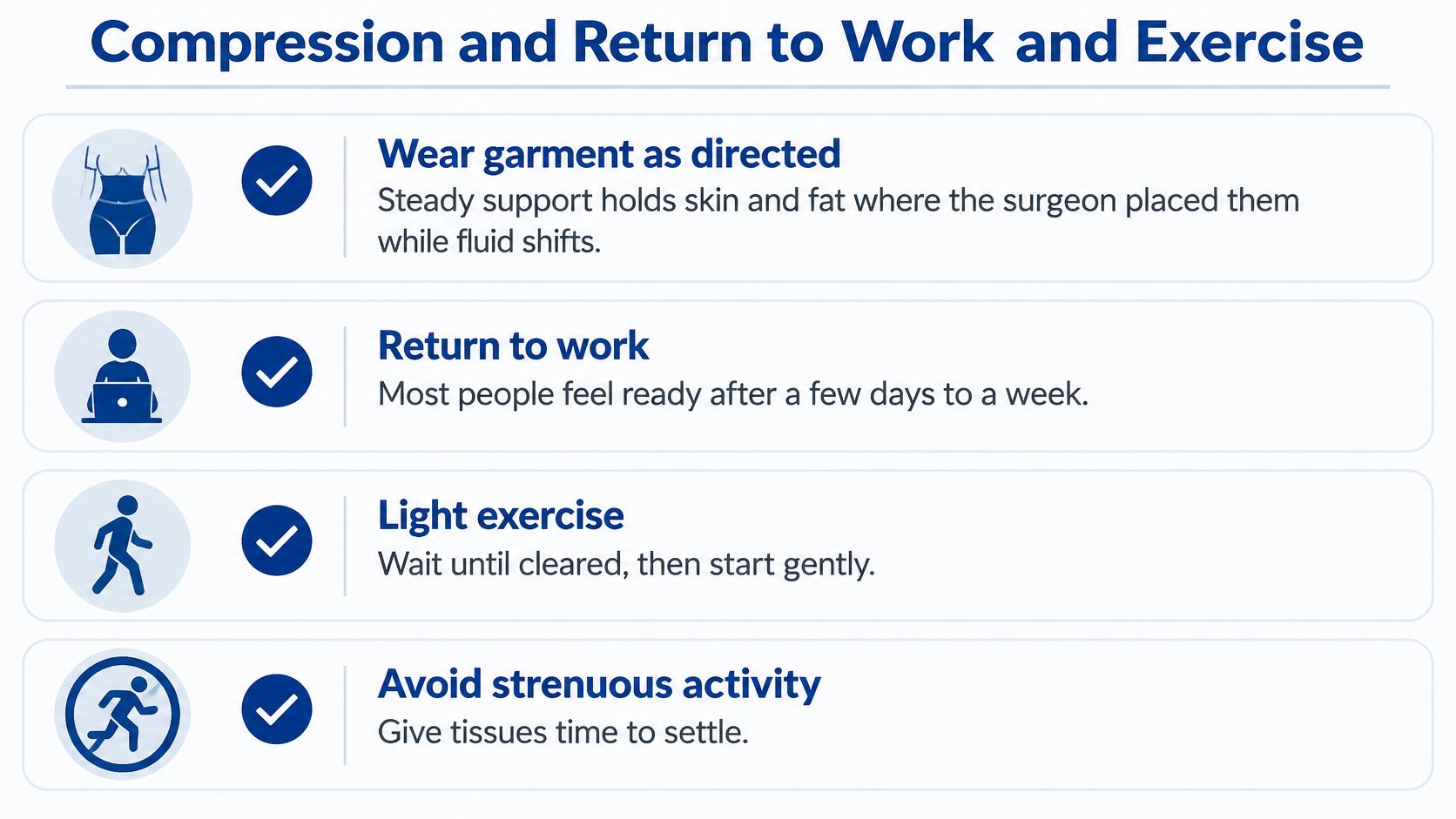
A wrap should feel supportive. Skin pain, or any interference with breathing or swallowing, means it is too tight. Loosen the constriction and seek medical advice promptly, and treat breathing difficulty as an emergency rather than a garment-fitting question.
Our guide to compression garment wear after chin liposuction can help you prepare questions about fit and wear instructions without substituting for your personal protocol.
Match the activity to the demand
The American Society of Plastic Surgeons' patient guidance describes work resumption within a few days and exercise within 2-4 weeks or less for many liposuction patients, while another ASPS recovery overview advises planning at least a week away from work and allowing 4-6 weeks before strenuous activity. Procedure extent, job demands, and healing explain the difference.
When activities usually return after chin liposuction
| Activity | Typical return | Clearance rule |
|---|---|---|
| Short walks | First few days if comfortable | Stop if pain, dizziness, or bleeding increases |
| Desk or remote work | A few days to 1-2 weeks | Plan at least a week if the role is public-facing |
| Driving | When alert and able to check blind spots | Not while using strong pain medicine |
| Exercise such as gym or running | Often 2-4 weeks, sometimes 4-6 weeks | Resume only after the surgeon clears it |
| Heavy lifting or contact sport | Often after week 6 at the earliest | Obtain explicit clearance and increase only if swelling doesn't flare |
These are planning windows, not automatic permissions. Contact sport also introduces direct injury risk to a still-settling area, so an exercise clearance does not necessarily include it.
Short, comfortable walks are usually a better starting point than testing your usual workout. Driving deserves its own check: it requires clear thinking and enough neck rotation to scan traffic safely, which is a different ability than feeling okay.
Don't use appearance as an exercise test
A flattering photo only tells you how the surface looks on a good day. It says nothing about whether the deeper layer can tolerate running, heavy lifting, or repeated neck movement. Resume gradually after clearance, and report a significant swelling flare instead of pushing through it. The same logic applies to sensation: feeling normal at your desk does not mean the nerves under the chin have finished recovering.
During roughly the first two weeks, watch the triggers that show up specifically under the jawline. A very salty meal, a hot shower or sauna session, or a long stretch out of the garment can each leave the chin visibly puffier the next morning. Learning which one moves your swelling is more useful than avoiding everything.
Don't trade a good early photo for an early workout.
What the Chin Looks Like as Weeks Pass
The early mirror check
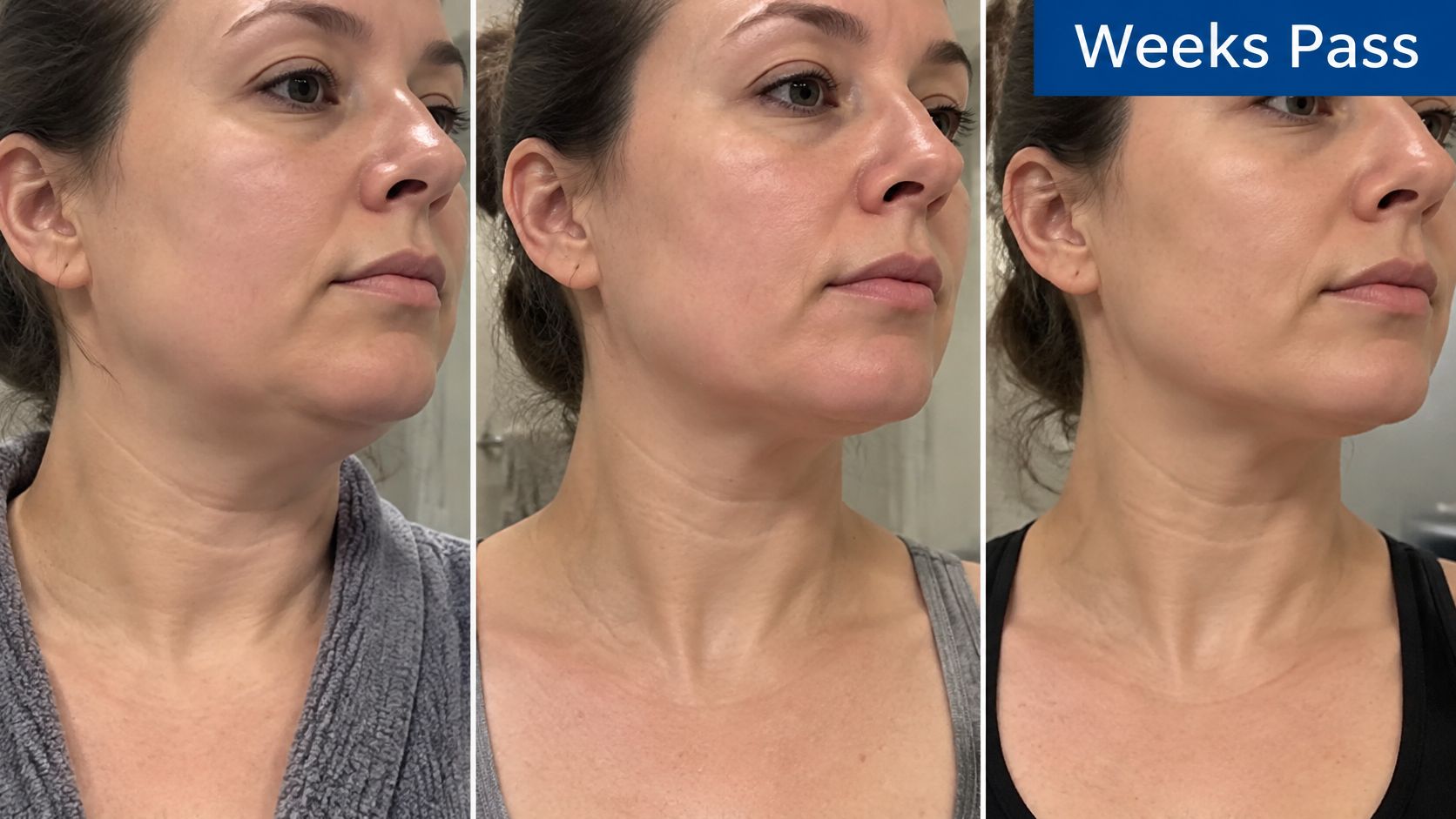
Two weeks after a chin procedure, a reader might compare the mirror with a photo taken the day before surgery and see a rounder under-chin area, one side slightly fuller than the other. That gap between expectation and reflection is usually fluid still settling, and it is exactly why early photos need a consistent method before they mean anything.
A snug compression wrap can also leave temporary creases across the skin that show up in pictures. Leave them alone. Pressing, rolling, or massaging the area should wait for explicit approval from your surgeon.
The American Society of Plastic Surgeons' liposuction guidance notes that swelling begins immediately after surgery and can take several months to fully dissipate, with the full result becoming apparent over weeks to months. Any visible outline has to be read against that timeline.
When color improves before texture
Bruises tend to resolve on a faster schedule than firmness. Yellow-green marks can fade while the skin underneath still feels woody, tight, or slightly lumpy, and small incision marks can stay pink even after the profile already reads slimmer. A photo taken at this stage can look fully healed while the tissue under the skin is still remodeling.
The practice's page on chin liposuction after one week shows how much swelling can still sit on top of the eventual contour at that stage. Treat it as a visual reference point, then measure your own progress against your own earlier photos.
Follow the developing shape, not every fluctuation
Reliable comparison needs a controlled setup: the same lighting, the same camera height, the same head position, and a relaxed posture in every shot. Looking upward in one picture and tucking the chin in another can manufacture an apparent change that positioning explains better than healing does.
A practical test works like this. At week 2, stand in the same spot each time, hold the camera at eye level, and keep your chin parallel to the floor. At week 6, recreate that exact shot. If the week-6 photo was taken from a higher angle or with the chin lifted, the "improvement" may be camera work, so matching the setup matters more than the dates on the files.
Spaced photos, weekly or every other week, tell you more than daily mirror checks. Record symptoms separately so a good-looking picture does not distract from worsening discomfort.
A few details also change how any two photos read:
- Treatment extent: A chin-only procedure tends to photograph as socially recovered sooner than combined neck surgery.
- Skin behavior: Elastic skin reveals new definition sooner than skin that cannot fully contract.
- Recovery habits: Smoking and inconsistent compression wear can keep puffiness visible longer.
Fix the setup first, and the weeks in between will tell you more than the mirror ever will.
When Swelling Stops Being Routine
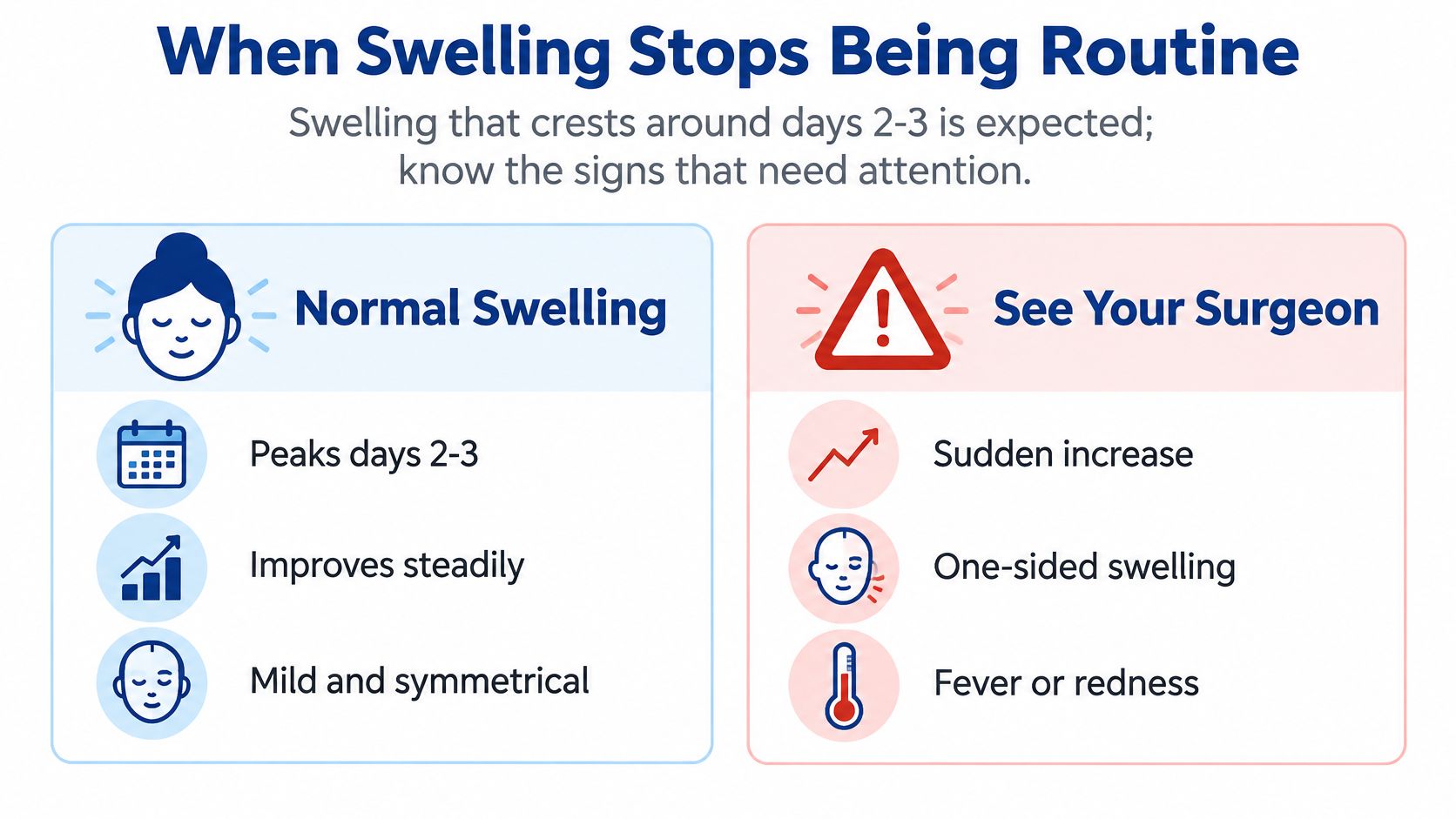
A puffy chin stops being routine based on its direction. Swelling that is shrinking, softening, or at least holding steady fits normal healing. Swelling that keeps expanding, turns rapidly tense, or arrives with fever, spreading redness, or new weakness belongs in a different category.
The trap is that fluid mimics fat. A chin that looks fuller or uneven early in recovery is often holding peak fluid, and that fullness can hide the contour the procedure created. Judging the result from that puffy window works like weighing yourself while carrying a bucket of water: the number is real, yet it answers the wrong question. Let the fluid clear before drawing conclusions.
Expected chin healing versus signs to report
| Sign | Often part of healing | Get assessed |
|---|---|---|
| Fuller chin early on | Swelling commonly peaks in the first days | Swelling that keeps expanding after that peak |
| Bruising | A common early change that fades gradually | Bruising with fever, spreading redness, or drainage |
| Firm or tight skin | Remodeling can feel woody for weeks | Rapidly tense swelling or severe new pain |
| Early unevenness | Fluid can hide the contour | Asymmetry that persists or worsens |
| Trouble breathing, fever, or new facial weakness | Not routine recovery | Breathing trouble needs emergency care immediately; fever or new weakness needs prompt same-day assessment |
Separate a bruise from a complication
A 2024 systematic review pooling 60 studies and 21,776 aesthetic liposuction patients reported an overall complication rate of 12%, which fell to 6% once expected bruising and edema were excluded; major complications occurred in approximately 1% and minor complications in approximately 5%. Those figures describe liposuction broadly rather than predicting your outcome from an isolated chin procedure.
Bruising by itself usually fades on schedule. The findings that move a symptom out of routine territory are the ones around it: fever, spreading redness, drainage, bleeding that soaks dressings, or swelling that becomes rapidly tense.
Know which call to make
Contact the surgical team promptly for spreading redness, fever, drainage, bleeding that soaks dressings, worsening asymmetry, or new facial weakness. If the office is unreachable, seek urgent assessment rather than waiting for your scheduled visit.
Difficulty breathing or swallowing, especially with rapidly expanding neck swelling, requires emergency care immediately. A fast-growing collection under the chin can press on the airway, and no photograph or callback should delay that evaluation.
Before discharge, save the after-hours number and ask which photographs the team wants when you report a concern. A scheduled wound check is no reason to sit on a new symptom.
For nonurgent texture questions, our guide to lumpy, uneven skin after liposuction can help you describe what you feel. Firmness that gradually softens usually belongs to remodeling; firmness that worsens alongside pain or heat belongs in a call.
Numbness Versus Lower Lip Weakness
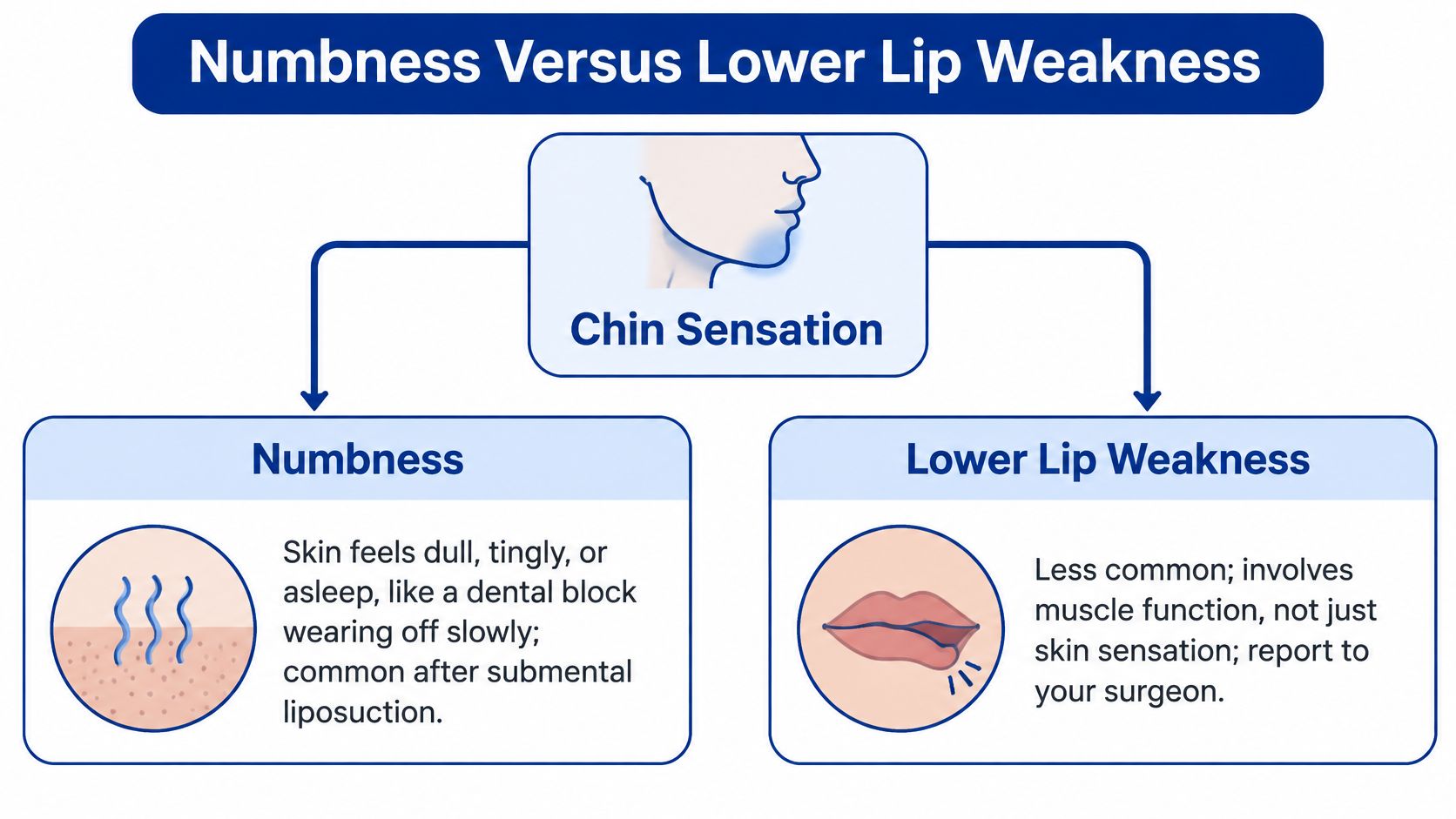
A numb patch that shrinks each week follows one timeline; a lower lip that will not pull down evenly follows another. Skin can feel dull, tingly, or asleep while a smile still looks symmetrical, so describe feeling and movement as separate findings when you call.
Feeling belongs to small sensory nerves in the skin. Movement depends on muscle control, including branches near the jawline that help the lower lip depress. Published clinical series describe marginal mandibular nerve problems after neck liposuction as uncommon and often temporary, with sensory change usually improving over weeks to months. That is reassurance about the category and still leaves new motor change worth a prompt call.
What the lower lip tells you
The marginal mandibular nerve helps control muscles that pull the lower lip downward. Irritation near it can make the lip look uneven when you smile, show your teeth, or try to lower the lip.
Track the border of numb skin and whether it is shrinking. For movement, note whether the lip has started looking uneven, whether the change is new, and whether it is worsening.
- Sensory change: Describe where the dull or tingly skin is and whether the affected area is shrinking.
- Motor change: Report new lower-lip asymmetry, trouble pulling the lip downward evenly, or worsening weakness promptly.
- Combined warning signs: Weakness with expanding swelling needs urgent assessment.
Why technique and anatomy matter
Cannula depth, individual nerve anatomy, combined neck procedures, and surgeon experience can influence risk. A social-media recovery chart cannot set the deadline for your symptoms.
Do not repeatedly stretch or exercise an uneven lip to test it. Send a clear description and, if requested, a short video showing the movement.
A chin can look slimmer before sensation feels normal. New loss of movement follows a different rule and deserves a prompt call.
Before the procedure, ask who answers nerve-related questions after hours and exactly which changes in lip movement mean you should call immediately.
Plan Recovery Before the Procedure Day
Recovery planning works backward from two different dates: the day you look presentable enough for work and the day the tissue has settled. Build the plan around the slower clock, then enjoy it if the faster one surprises you.
Put practical arrangements in writing
Protect your work calendar. Reserve a full week away from public-facing duties as a practical buffer, even if quiet desk work becomes manageable sooner. Use the activity table to discuss provisional return dates, then confirm them with your operating surgeon.
Prepare the prescribed support. Have the correct wrap or strap and approved cleaning supplies ready before the procedure, and set up a recovery spot where medications and printed instructions sit within reach. Arrange a driver for the trip home when your team requires one.
Save your escalation plan. Record the office contact numbers, the warning symptoms, and where to seek emergency care in a single note you can find quickly, rather than leaving them buried in a message thread.
Make comparisons consistent. Choose photo checkpoints spanning early recovery and later contour review. Keep lighting, angle, and posture identical each time so the photos measure real change instead of camera differences, and bring symptom questions to each follow-up.
Clarify what your procedure includes. Ask whether treatment involves fat removal alone, additional neck tightening, or suture support. Leave with written garment instructions, required visits, and individualized activity restrictions.
If you need help organizing transportation, supplies, or appointment logistics, Approved Lux care coordination support from Approved Lux Personal Assistant is a resource to explore. Coordination support doesn't replace clinical advice or postoperative monitoring.
Personalize the plan to the actual procedure
At Ideal Face & Body in Beverly Hills, chin and neck sculpting uses permanent sutures followed by a custom head and neck wrap for support, and a chin and neck lift, also called platysmaplasty, is performed in the office with the patient awake and relaxed. PRECISION SCULPT lipo, developed and pioneered by Justin Yovino, MD, is performed using numbing rather than general anesthesia.
Those details change the recovery math. Fat removal alone carries one garment schedule, while adding suture-supported neck tightening can change how long the wrap stays on and which movements are restricted. A borrowed recovery chart fails for exactly this reason: the timeline belongs to the procedure you had, not the one a stranger posted about.
A consultation with Dr. Justin Yovino or Dr. Sarah Yovino can clarify candidacy and the recovery discussion for your anatomy. If you live out of town, ask whether a virtual consultation is available, and confirm technique details directly with the team.
Leave with a recovery plan written for your procedure, not a copied day count.
Ideal Face & Body offers awake chin, neck, and jawline sculpting with recovery planning suited to the procedure and your anatomy. Visit Ideal Face & Body to arrange a consultation and discuss your compression plan, follow-up visits, and realistic return-to-work and exercise milestones.