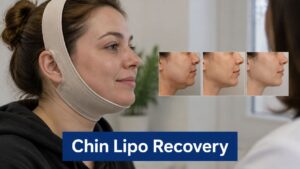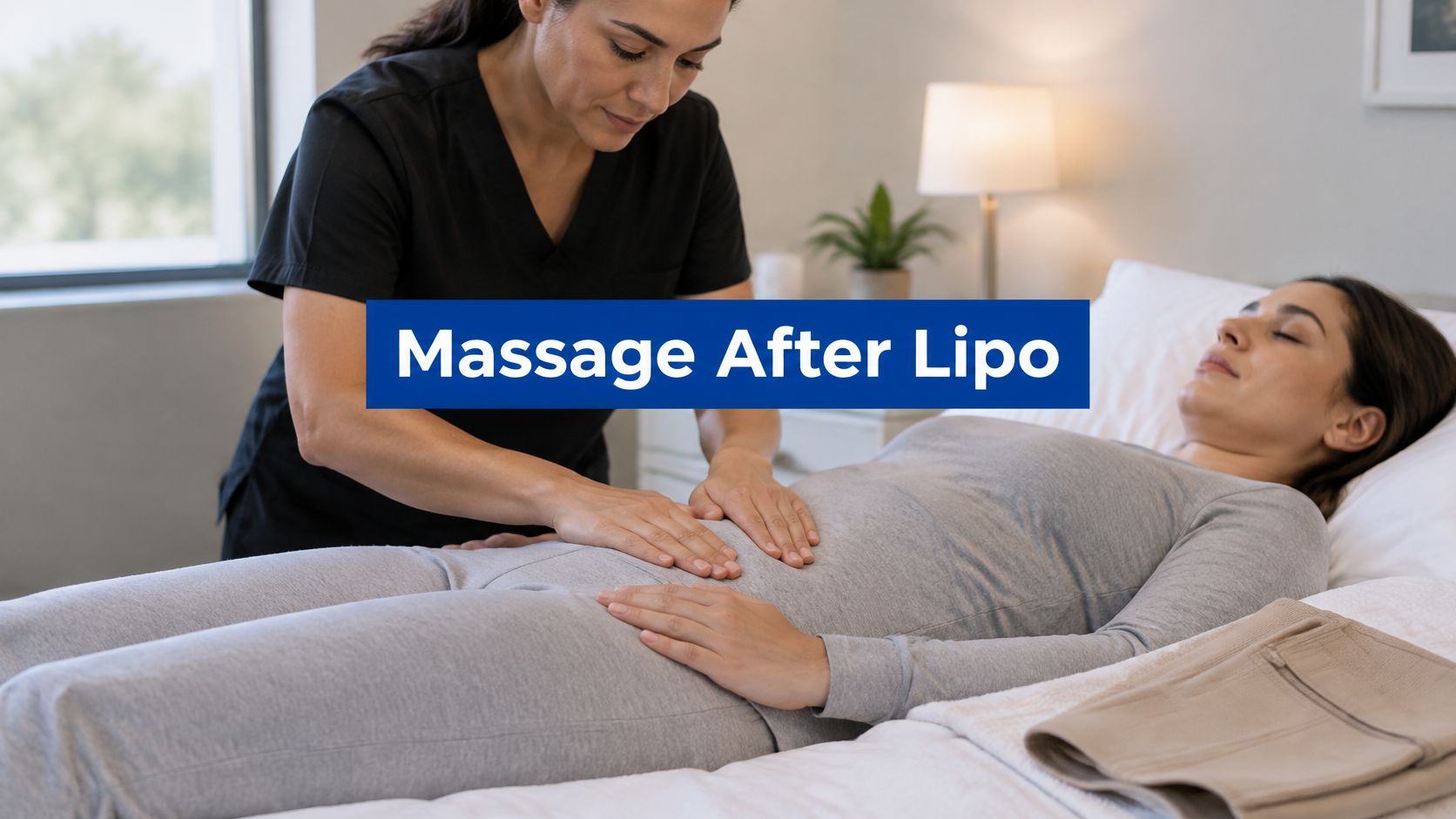
Lymphatic massage after liposuction usually starts only after your surgeon approves it, often around day 2 to 3 after surgery, and typically runs two to three times a week for the first three to four weeks. That's the window most recovery plans settle into before the schedule tapers.
So why does nearly every recovery guide present massage as a mandatory step with a set number of sessions, when the evidence behind it is smaller than the confidence around it?
Two very different claims get bundled together. One is that gentle drainage helps move fluid out of a swollen, freshly treated area during the first weeks, which small studies partly support. The other is that massage shapes your final contour, prevents every lump, and must run on a fixed calendar, which no study has shown. Keeping those apart changes how you plan, and it puts one person at the center of every decision: the surgeon who performed your procedure.
Table of Contents
- When Lymphatic Massage Typically Starts and How Often
- What Lymphatic Massage Does and How a Session Works
- What Studies Show About Benefits and Limits
- Who Needs Lymphatic Massage and Who Can Skip It
- Warning Signs That Need a Surgeon, Not a Massage
- Plan Massage With Your Surgeon
When Lymphatic Massage Typically Starts and How Often
The most useful timing picture comes from protocols written for liposuction recovery. A national technology assessment describes manual lymphatic drainage starting 2 to 3 days after liposuction and continuing for at least 6 to 8 weeks, while noting that clinics vary (NICE technology assessment). A 2023 review in the Aesthetic Surgery Journal Open Forum recommends manual lymphatic massage 2 to 3 times per week during the first 3 to 4 weeks after cosmetic procedures, including liposuction (Aesthetic Surgery Journal Open Forum review).
| Phase | Typical timing | Typical frequency | Reference point |
|---|---|---|---|
| Early window | From about day 2 to 3 after surgery | Only when the surgeon approves | Lipedema-protocol timing described in a national technology assessment |
| First weeks | Weeks 1 to 4 | 2 to 3 times per week | 2023 review in the Aesthetic Surgery Journal Open Forum |
| Extended course | About 6 to 8 weeks, sometimes about two months | Several times per week | National technology assessment; the American Society of Plastic Surgeons describes a roughly two-month course as common practice |
| Structured study protocol | 12 sessions over about 4 weeks | Three times weekly, about 40 minutes each | Prospective study of 18 women, with ultrasound before massage |
Why the start date is a window rather than a date
Day 2 to 3 is a ceiling on how early a session might be allowed, never a floor you're obligated to hit. Your drainage status, incision healing, whether you still have drains in place, and any fluid collection your surgeon found at examination all move the start date. So does the size of the area treated: a small flank contour and a multi-area procedure don't heal at the same pace.
The rule that overrides every schedule: the day your surgeon names is the day you start. Not the day a prepaid package expires, and not day 3 because a forum post said so.
How to read the table for your own recovery
Find the phase you're in, then confirm the start date and frequency at your next visit instead of guessing from the row above. If you're still working out how long the whole recovery runs, our guide to recovery time from liposuction walks through what each week tends to look like.
Massage is also one item on a longer list. Sleep, hydration, protein intake and early walking all influence how quickly swelling settles, and a wider set of post surgery recovery tips helps you build the rest of the week around your sessions rather than around the appointments alone.
What Lymphatic Massage Does and How a Session Works
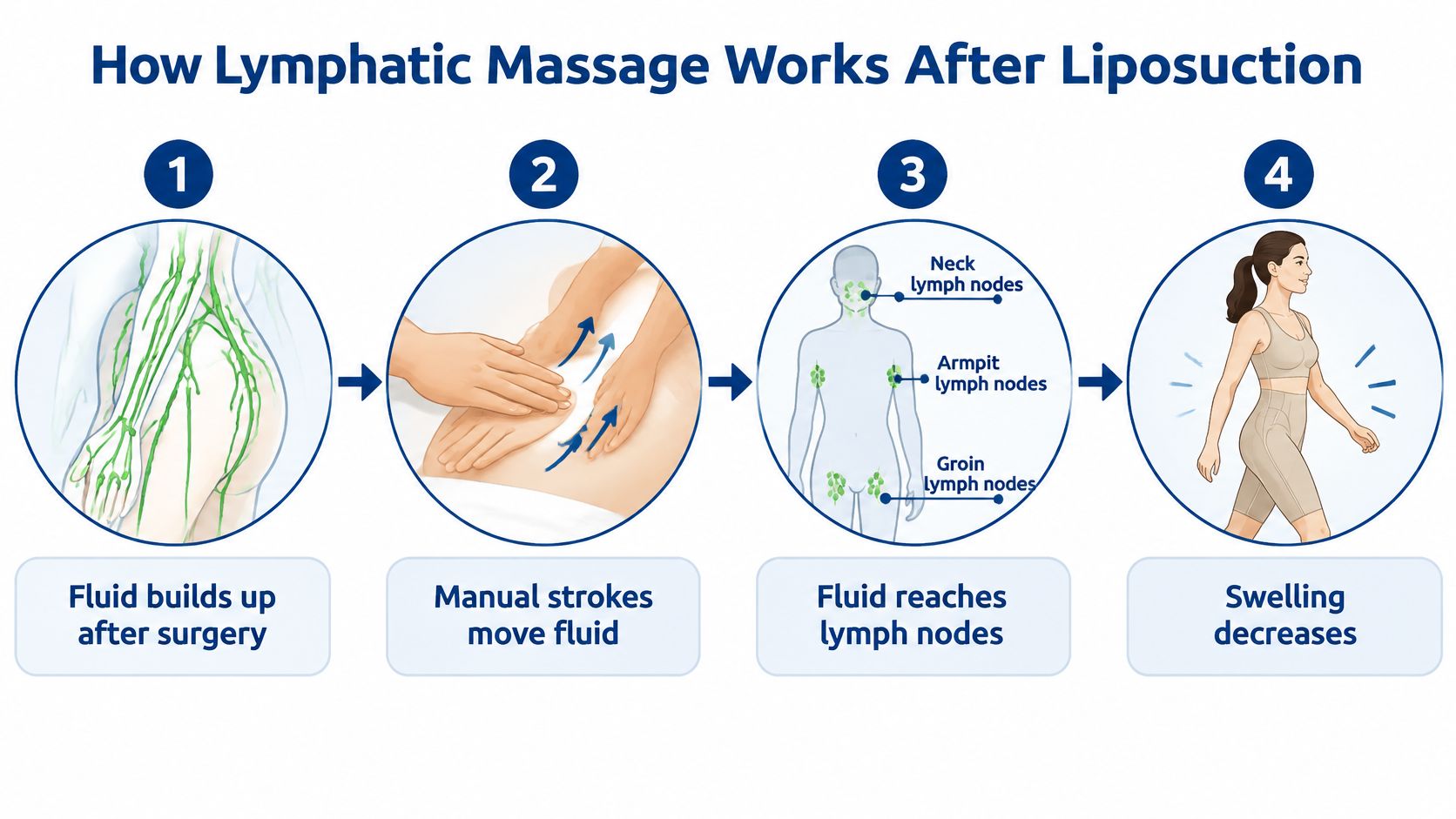
Your lymphatic system is the body's slow-return network. It gathers excess fluid from tissue and carries it back toward lymph nodes at the neck, armpits and groin, where it's filtered and returned to circulation. Liposuction disturbs that drainage in the treated area, so fluid pools in the space where fat was removed and the tissue feels tight, heavy and full. Massage doesn't remove fat or reshape anything. It gives pooled fluid a lower-resistance path toward nodes that can clear it.
Think about a flooded basement. You don't start by pushing water out of the far corners. You clear the main drain first so the water has somewhere to go, then work the side channels. Manual lymphatic drainage follows that same order, which is why a good session begins at the nodes and not at the sorest spot.
The sequence, step by step
A published Leduc-based protocol shows the order clearly, and it's worth knowing so you can tell whether a therapist is following a real drainage sequence or just rubbing the area (systematic review of manual lymphatic drainage protocols).
- Clear the top of the chain. Roughly 15 gentle maneuvers over the supraclavicular lymph nodes just above the collarbone, using light skin-level pressure rather than kneading.
- Add breathing. Three repetitions of diaphragmatic breathing follow, because slow deep breathing changes pressure inside the abdomen and draws fluid toward the central channels.
- Open the armpit and groin nodes. About 15 maneuvers across the axillary and inguinal node groups, again before any work on the treated area itself.
- Treat the body last. The therapist then works across the abdomen, lower trunk and flanks, moving from proximal to distal and returning toward the pathways already cleared.
What light pressure means in practice
Manual lymphatic drainage uses stretching pressure at the level of the skin, enough to move fluid in the superficial vessels without compressing the tissue underneath. Deep-tissue massage is a different technique with a different purpose, and pressing hard on healing liposuction sites can irritate tissue that is still closing.
A session should feel rhythmic and gentle. If you're bracing against the pressure, or you're bruised the next day, the technique is wrong for this stage of healing.
Sessions in the published protocol ran about 40 minutes each. Yours may be shorter or longer depending on the number of areas treated and how much fluid your surgeon wants moved.
What Studies Show About Benefits and Limits
Here's the honest summary. The evidence for lymphatic massage after liposuction is real but small, built on modest studies with designs that can't isolate massage from everything else happening in recovery. That doesn't make it useless. It tells you exactly how much weight to put on it.
What the stronger studies actually measured
A prospective study of 18 women recovering from abdominal or flank liposuction, or lipoabdominoplasty, delivered 12 sessions three times weekly at about 40 minutes each, with therapeutic ultrasound before the massage. Both surgical groups showed statistically significant reductions in pain, swelling and tissue fibrosis (prospective study of postoperative lymphatic drainage). The catch is in the design: with ultrasound, compression and ordinary healing all in play, the study can't tell you how much of that improvement the massage produced on its own.
A 2022 randomized controlled trial of 60 patients found statistically significant swelling reductions at 4 and 6 weeks among patients receiving lymphatic drainage massage, but no significant difference at 3 months (2025 evidence summary of lymphatic massage research). That pattern, a real short-term effect that fades by three months, is the most defensible claim in this whole field.
| Study or review | Population | Main finding | Main limit |
|---|---|---|---|
| Prospective study | 18 women after abdominal or flank liposuction, or lipoabdominoplasty | Significant reductions in pain, edema and fibrosis in both groups | Small sample; design can't separate massage from ultrasound, compression or natural healing |
| Prospective comparative study | 20 women after abdominoplasty with core liposuction | Greater average edema reduction with massage than compression alone between weeks 6 and 8 | Difference not statistically significant (P = .11) |
| Review of 17 studies | 869 participants | Some studies report better volume and quality of life; others find no added benefit over compression | Mixed results across study designs |
| Cochrane review | Participants in manual lymphatic drainage trials | Limited high-quality evidence | Evidence too weak for firm conclusions |
Where the marketing outruns the evidence
The most misused number in this field comes from a study of 30 women with an average age of 36, where manual lymphatic drainage twice weekly for four weeks was linked to a 15.4% reduction in subcutaneous fat thickness, while shock-wave therapy produced a larger 24.4% reduction (American Society of Plastic Surgeons recovery guidance). That study looked at cellulite-related tissue change, not liposuction healing, and it doesn't make massage a fat-removal method.
The comparison study of 20 women is equally instructive. Average edema reduction was greater with massage than with compression garments alone between weeks 6 and 8, but the difference didn't reach statistical significance (P = .11) (comparative study of drainage and compression after abdominoplasty). Meanwhile the review of 17 studies covering 869 participants found mixed results, with the American Venous Forum describing the evidence for drainage alone as poor.
What the evidence supports: less short-term swelling, and often more comfort in the first weeks. What it doesn't support: a guaranteed smoother final contour, or a fixed session count that decides your result.
If you want to understand the light-stroke technique in a general context before your first appointment, this explanation of lymphatic drainage massage in Kuta Lombok covers the underlying principles.
Who Needs Lymphatic Massage and Who Can Skip It
There's no correct number of sessions, and anyone who quotes one without examining you is guessing. Some patients need hands-on drainage for weeks. Others heal smoothly with a compression garment and a walking routine. The difference isn't discipline or budget. It's what's happening in the tissue.
Six things that actually decide it
Work through these with your surgeon rather than deciding alone. Each one changes the answer.
- The size and location of the treated area. Large abdominal or flank liposuction, or lipoabdominoplasty, disturbs more tissue and moves more fluid than a small contour of the arms or chin.
- How much swelling there is, and whether it's one-sided. Symmetrical swelling is expected. Swelling that's clearly worse on one side needs a conversation before any appointment is booked.
- Your pain level, and whether it's limiting movement. Pain that stops you walking or doing breathing exercises slows the very things that clear fluid naturally.
- Whether your surgeon found a fluid collection. Seroma risk changes what can be safely treated and where a therapist should keep hands off.
- Skin and incision healing. Intact, closed incisions tolerate gentle work. Broken skin, irritation or a healing wound changes the plan entirely.
- Whether compression and walking are already controlling the swelling. If they are, massage is optional comfort rather than a missing piece.
When compression and walking are enough
If your swelling is settling, your garment fits without digging in, and you're walking comfortably, you may not need drainage at all. That's not a failure of effort. Compression and movement work continuously, while massage works for the length of the session. A therapist's hands can't replicate hours of steady garment pressure, which is why massage never replaces it.
The reverse is also true. If swelling plateaus, the tissue feels dense, or pain is limiting your walks, your surgeon may add massage to the plan. Suitability is a clinical judgment made after examination. It isn't decided by a calendar, and it isn't decided by a therapist's default routine.
Warning Signs That Need a Surgeon, Not a Massage
Massage is never the response to a complication. Some findings need same-day contact with your surgical team, and a few need emergency care. Knowing which is which matters more than any technique in this article.
| Sign | Why it matters | What to do |
|---|---|---|
| Sudden shortness of breath or chest pain | Possible blood clot in the lung | Call emergency services immediately |
| Fever | Possible infection | Contact the surgeon promptly |
| Increasing redness, warmth or tenderness | Possible infection | Contact the surgeon the same day; do not massage the area |
| Swelling that worsens on one side | Can signal fluid collection or a circulation concern | Contact the surgeon promptly |
| Severe or worsening pain | Pain out of proportion to expected healing | Seek urgent medical review |
| Calf pain, swelling or warmth | Possible deep vein thrombosis | Seek urgent medical assessment |
| Firm, fluid-filled lump | Possible seroma | Report to the surgeon for evaluation before any massage |
Stopping a session mid-way
A session should be stopped if pain rises during or after the work, or if the skin looks broken, red or irritated. That's not a sign to push through. It's a sign to call the surgical team and describe what happened, including how long the discomfort lasted and which area it covered.
Never massage over tissue that's warm, red or firm. Those features don't fit the normal healing pattern, and pressing on them can make an infection or fluid collection harder to assess. If you're noticing new hardness or lumps weeks after surgery, our guide to lumpy skin after liposuction explains the usual fibrosis timeline and when a lump deserves an appointment.
This table is general guidance. Your surgeon's instructions and local emergency services take priority over anything written here.
Plan Massage With Your Surgeon
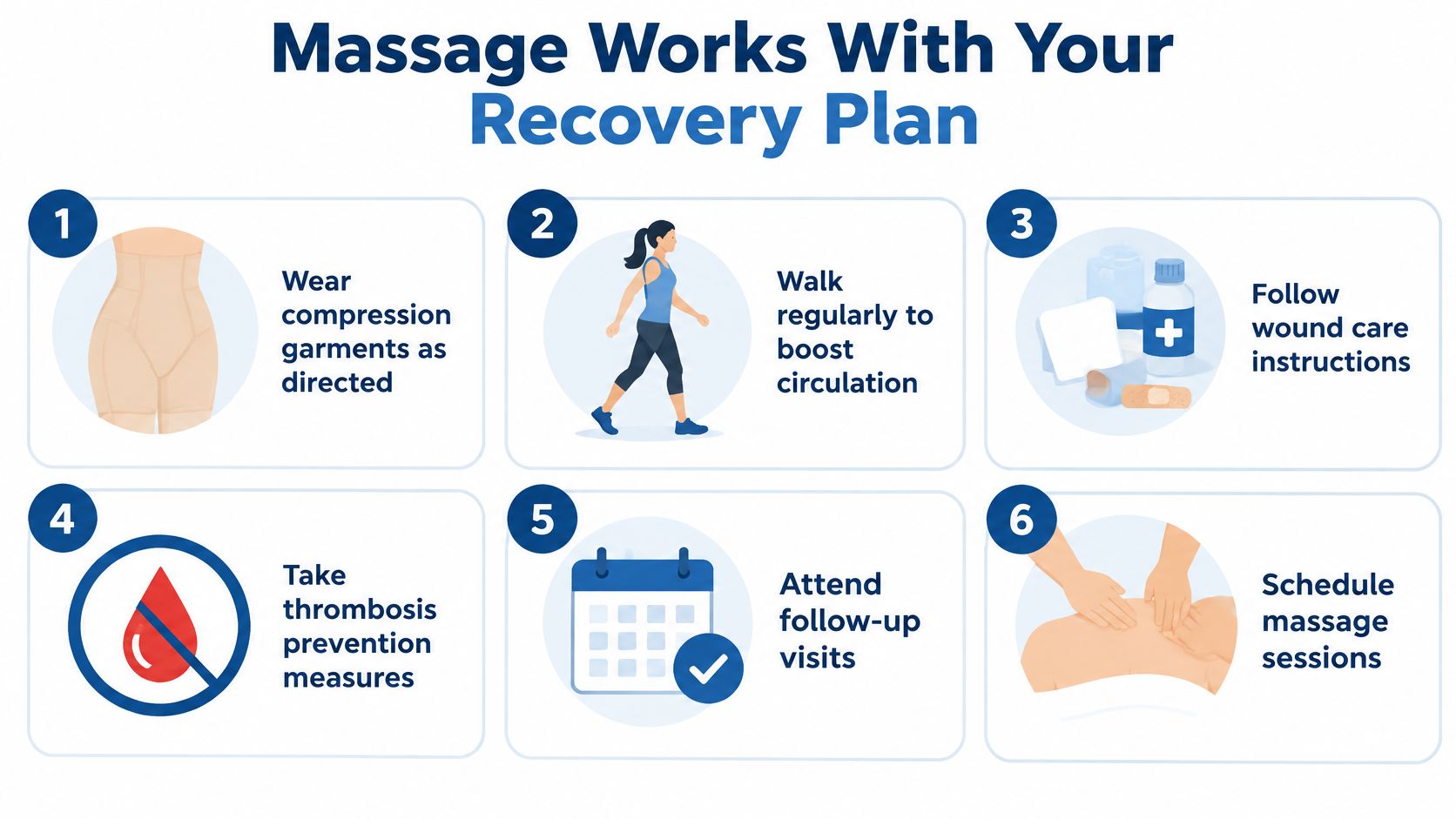
Massage sits alongside compression garments, walking, wound care, thrombosis prevention and follow-up visits. It doesn't stand in for any of them. Bring a short list to your next appointment and leave with a plan you can follow.
A checklist for the conversation
- Ask whether massage is approved, and which day to start. The surgeon sets the date, because drainage status and incision healing decide it.
- Confirm frequency and session length. Published protocols range from two to three sessions weekly to sessions of about 40 minutes each.
- Ask how drains and garment wear should be timed around sessions. A garment goes back on after treatment, and drains need handling instructions.
- Ask whether your therapist is trained in manual lymphatic drainage, and whether ultrasound comes first. The protocol with the strongest published detail used ultrasound before massage.
- Keep walking and keep wearing the garment as instructed. These carry the work between appointments.
- Record changes in swelling, pain or skin colour. Patterns across days tell your surgeon more than a single observation in the office.
- Stop any session that causes sharp pain, bruising or skin irritation. Then tell your surgeon what happened.
Before the conversation, gather your surgery date, treated areas, current garments or drains, the pattern of your swelling and any symptoms from the warning list.
Why one plan doesn't fit two people
The same schedule can suit one patient and work against another. A patient with a closed incision, even swelling and good garment fit may be cleared on day 3. A patient with a seroma under review may be told to wait. That's not inconsistency, it's examination. Our own guidance on how compression garments help after liposuction explains why the garment remains the backbone of early aftercare around any hands-on therapy.
At Ideal Face & Body, PRECISION SCULPT lipo, the procedure developed and pioneered by Justin Yovino, MD, is built around awake, office-based treatment, which means the recovery conversation starts before you ever leave the room.
The surgeon's plan overrides any generic schedule you find online. If you had your surgery elsewhere, ask your own surgeon, not a therapist's booking page.
Write down your questions this week and book the conversation before your first session. One appointment with the person who performed your procedure will answer more than a dozen search results.
Ideal Face & Body in Beverly Hills performs awake, office-based body contouring under local anesthesia, which puts recovery planning in the same room as the procedure itself. If you're considering liposuction or you're already healing and want your aftercare mapped to your specific areas, visit Ideal Face & Body to talk through the plan with the surgical team.