
You notice it in the bathroom mirror first. The face may still look rested, but the neck tells a different story. A few horizontal lines. Maybe some crepey texture. Maybe a heavier angle under the jaw that makes the whole lower face look older than it feels.
That's usually the moment people start searching for how to reduce neck wrinkles, and most advice they find is too simple to be useful. Neck rejuvenation isn't one treatment. It's a decision tree. Fine lines from sun exposure and dryness need a different approach than platysmal bands, deep etched creases, loose skin, or fullness under the chin.
The right plan starts with identifying what you have. Then you match the treatment to the problem, rather than chasing every cream, device, or procedure at once. In practice, the best outcomes come from moving in levels. Prevention first. Then targeted skincare. Then injectables or collagen-stimulating procedures when skin quality declines. Surgery comes in when the issue is structural, not superficial.
Table of Contents
- Why Neck Wrinkles Form and How to Prevent Them
- Your First Line of Defense At-Home Skincare for the Neck
- Smoothing Lines and Bands with Injectable Treatments
- Advanced Resurfacing and Skin Tightening Procedures
- Definitive Solutions Minimally Invasive and Surgical Options
- Your Path to a Rejuvenated Neck
Why Neck Wrinkles Form and How to Prevent Them
You notice neck lines in the mirror after a long week of staring down at a laptop, but the treatment decision depends on what shows up when your neck is at rest. Fine creases that appear mainly with movement call for prevention and skin care. Lines that remain visible without bending usually mean collagen loss, sun damage, or early laxity is already established.
The neck ages in more than one way
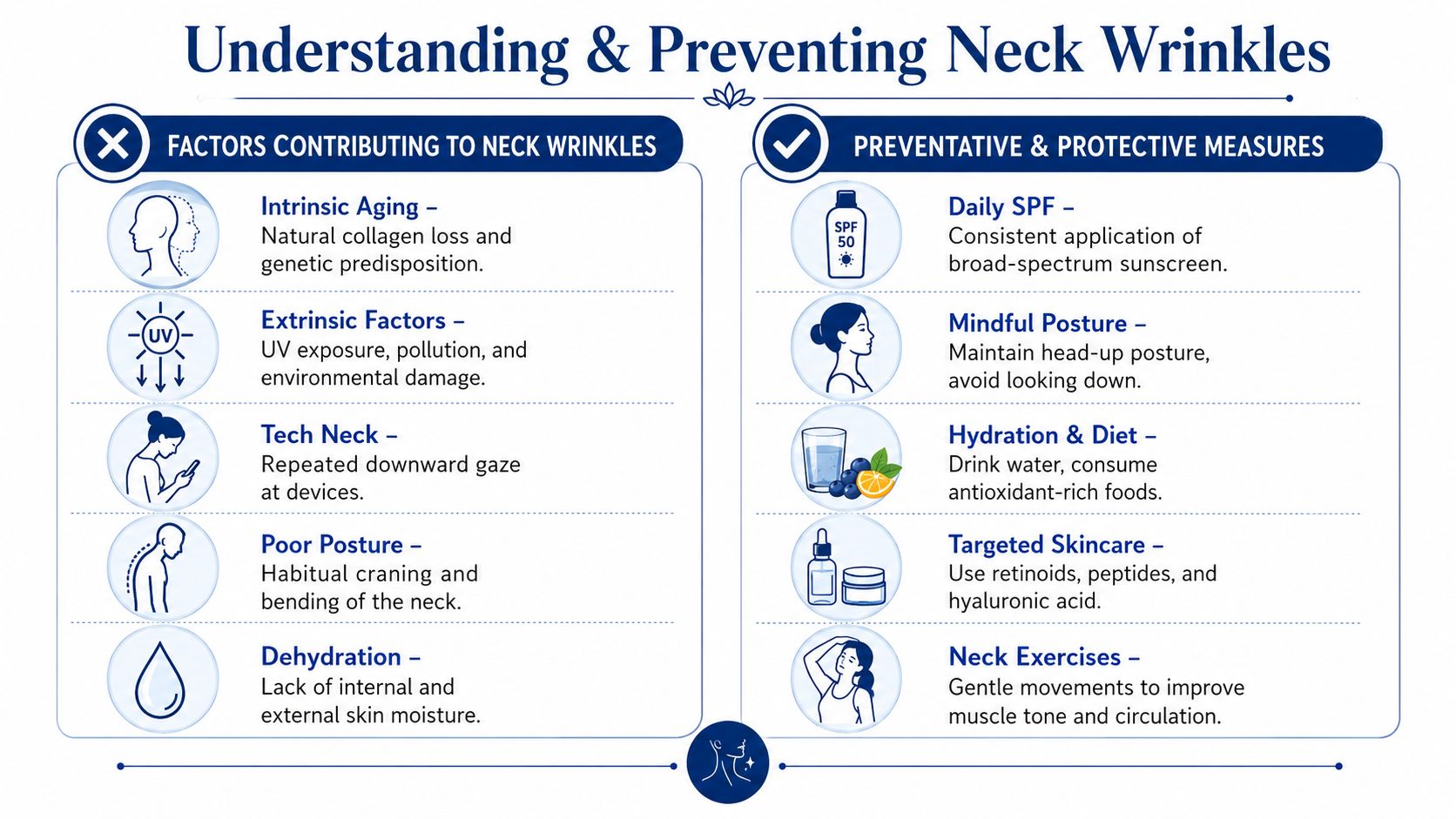
Neck wrinkles do not come from one cause. In practice, I see four patterns repeatedly: early horizontal lines from repeated folding, crepey texture from sun exposure and collagen loss, vertical platysmal banding from muscle activity, and loose skin or fullness that changes the jawline. Each pattern points to a different level of treatment, which is why a simple list of remedies often misses the mark.
The neck is also less forgiving than the face. It has thin skin, fewer oil glands, constant motion, and years of incidental ultraviolet exposure from driving, walking, and exercise. Published dermatology research on neck aging describes progressive loss of collagen, elastic fibers, and skin quality in this area, which helps explain why wrinkles and laxity become more noticeable over time (review of age-related changes in neck skin).
Posture matters, but it is only part of the story. Looking down at a phone or tablet increases repeated skin folding, so horizontal lines tend to set in earlier in people who spend hours in neck flexion. I would treat posture as a modifier, not the sole cause. If a line disappears when you lengthen the neck, prevention still has value. If it stays etched in at rest, prevention helps slow progression but will not reverse it on its own.
Practical rule: Faint lines that appear mostly with motion are the stage for prevention. Lines, bands, or loose skin visible at rest usually signal it is time to consider treatment beyond prevention alone.
What prevention looks like
Good prevention lowers the rate of change. It does not freeze the neck in place.
Start with the basics that affect skin quality every day:
- Use broad-spectrum sunscreen on the neck and chest: Chronic ultraviolet exposure accelerates collagen breakdown and uneven pigmentation.
- Reduce repeated neck flexion: Raise screens to eye level, especially for work sessions that last hours rather than minutes.
- Use neck-friendly active skin care: The neck irritates more easily than the face, so a gradual approach to retinol use for delicate skin areas makes more sense than copying a strong facial routine.
- Protect the barrier: Over-cleansing, aggressive exfoliation, heat, and friction can keep the neck mildly inflamed and dry, which makes fine lines look worse.
I tell patients to judge prevention by the right standard. It can soften early creasing, improve texture, and delay the point when injectables or tightening procedures become reasonable. It will not lift hanging skin, erase prominent platysmal bands, or sharpen a neck contour that has already lost structural support.
That distinction matters. Prevention is the right first step for early lines and mild crepiness. It is the wrong endpoint for deeper wrinkles, visible bands, or skin laxity.
Your First Line of Defense At-Home Skincare for the Neck
A patient in her 30s or 40s often notices the same pattern first. The face still looks well cared for, but the neck starts to show faint horizontal lines, a dry crepey texture, or patchy sun damage. That is the point where home care still has real value, provided the problem is skin quality and not structural laxity.

Why the neck needs its own routine
Neck skin is thinner, has fewer oil glands than the face, and gets irritated more easily. Patients get into trouble when they copy an aggressive facial routine and run it straight down to the collarbone. Redness, scaling, and persistent dryness make neck lines look worse, not better.
Topicals are a reasonable first treatment when the findings are mild. A prospective double-blind, placebo-controlled neck skincare trial found visible improvement in wrinkling and biopsy evidence of new collagen and elastic fiber formation with an active serum and cream (prospective neck skincare trial).
That is the right level of expectation. Skincare can improve texture, hydration, and early creasing. It does not relax platysmal bands, restore a sharper jawline, or remove extra skin.
How to decide whether home care is still the right level
Stay with skincare as the main treatment if the lines are fine, shallow, and more visible when the skin is dry or sun-exposed. It also fits patients whose concern is rough texture or early crepiness without hanging skin.
Move beyond skincare when wrinkles stay etched in at rest, vertical bands show with speaking or clenching, or looseness collects under the chin and jaw. Those findings usually mean the problem is no longer just surface quality.
This decision point matters.
Patients who are also weighing early injectable options sometimes review neurotoxin treatment options for dynamic neck bands and lines to understand where skin care stops helping and muscle-targeted treatment starts. The same stepwise logic applies in other areas of facial aging, including subtle facial line reduction, where treatment choice depends on whether the issue is surface texture, muscle activity, or tissue descent.
A practical neck routine that makes sense
Morning should protect the skin. Night should focus on repair, with enough restraint to keep the barrier intact.
Cleanse gently
Use a mild cleanser that removes sunscreen, sweat, and residue without leaving the skin tight or stinging.Apply a supportive treatment layer
An antioxidant or peptide product can be useful if tolerated. Sensitive patients often do better with these than with stronger active products at the start.Use a moisturizer that reduces irritation
The best neck moisturizer is the one you can use consistently without burning or flaking. Barrier support matters more than complicated layering.Apply sunscreen down to the collarbone
Daily ultraviolet exposure is one of the fastest ways to worsen neck texture, pigment irregularity, and collagen loss.
At night, retinoids remain the topical category I reach for most often in patients with early neck lines. The catch is dosing and frequency. Start with a lower-strength product, use it only a few nights a week, and increase slowly if the skin stays calm. Applying moisturizer before or after the retinoid often improves tolerance. The sides of the neck usually react before the center, so that area needs extra caution.
If the neck stays red, flaky, itchy, or burning for more than brief adjustment periods, the routine is too strong. In practice, a calmer routine used consistently beats an aggressive one that has to be stopped.
Home care earns its place early. It can delay the need for procedures and improve the result of later treatments by keeping the skin healthier. Once the concern shifts from fine lines to bands, laxity, or heavier tissue under the jaw, skincare becomes supportive care rather than the primary solution.
Smoothing Lines and Bands with Injectable Treatments
Injectables are where treatment becomes more precise. Instead of treating “the neck” as one issue, you target the structure creating the problem. That distinction is what produces natural results and avoids overtreated ones.
When neuromodulators make sense
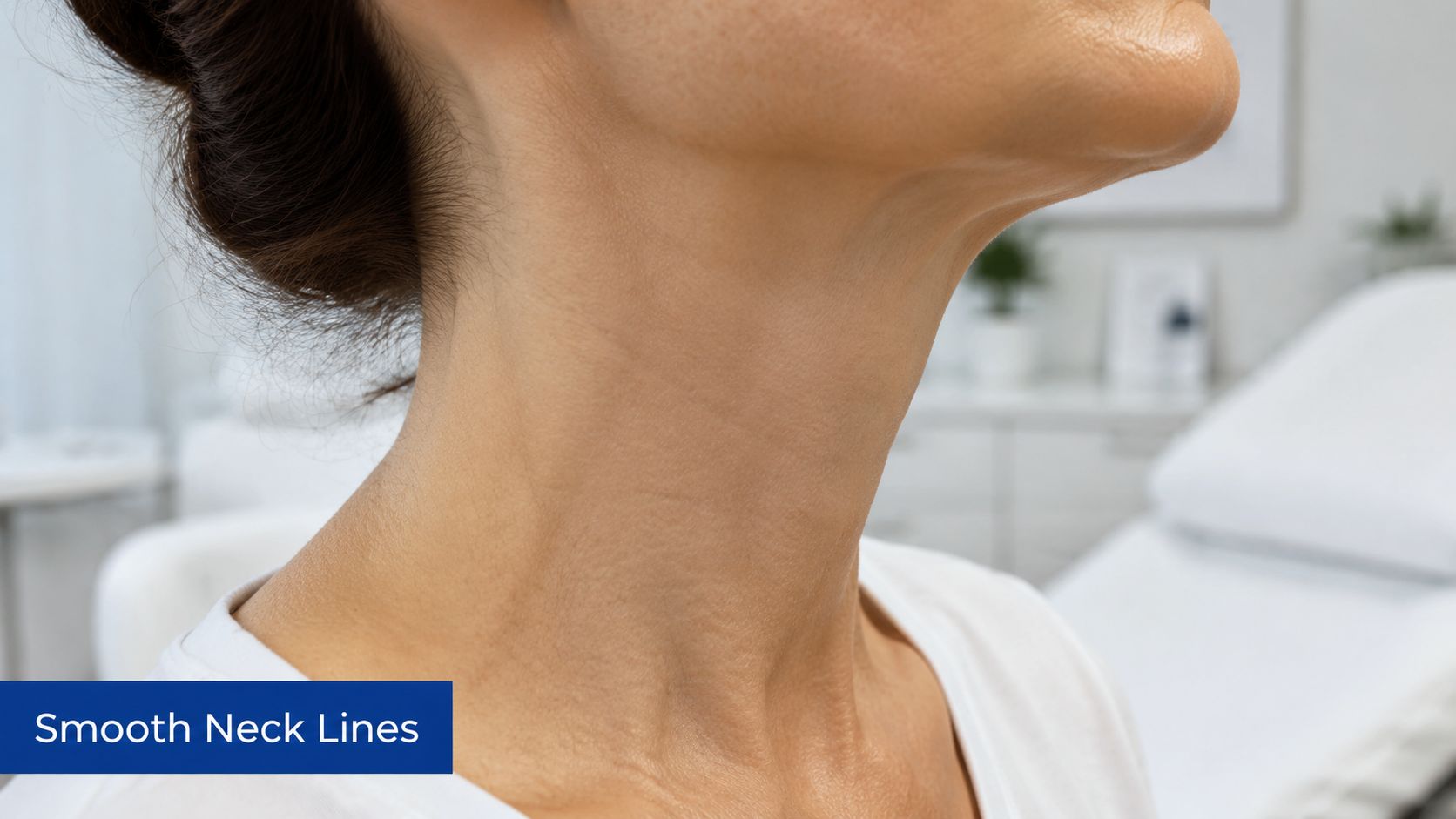
If you see vertical platysmal bands when speaking, clenching, or making strong expressions, neuromodulators are often the first treatment to consider. They work by relaxing the underlying platysma muscle rather than filling the skin.
Clinical discussion of non-surgical neck treatment notes that Botox can reduce horizontal lines and muscle bands, with visible smoothing in 3 to 7 days after treatment (clinical discussion of Botox for neck lines and bands).
This category works best when the problem is motion-driven. It's less effective when the line is prominently etched at rest or when the underlying issue is loose skin. That's where patient selection matters. Dr. Sarah Yovino's injectable approach is most relevant in exactly this zone, where anatomy, dosage, and placement have to be balanced carefully in a thin and highly visible area.
For readers also comparing how injectables are used more broadly for subtle facial line reduction, the same principle applies in the neck. You want softening, not stiffness.
You can also learn more about neurotoxin treatment options when bands or dynamic lines are the main concern.
When filler is the better tool
Horizontal “necklace lines” are different. If the crease is present even when the neck is relaxed, filler may be more useful than muscle relaxation. Hyaluronic acid can be placed directly into selected creases to soften indentation.
A strong data point in this category comes from clinical trials for a specific hyaluronic acid filler, where 80% of patients achieved at least a 1-grade improvement in neck line appearance after one month.
What filler does well:
- Softens etched horizontal lines
- Improves hydration in select formulations
- Produces visible change without surgery
What filler does not do well:
- Lift heavy tissue
- Correct major skin laxity
- Replace a neck lift when the jawline has blurred
The neck punishes overfilling quickly. Small-volume, carefully placed treatment usually looks better than trying to erase every line.
The decision point is practical. Choose neuromodulators for active bands. Choose filler for fixed creases. Choose neither as a standalone answer if the neck has become loose, heavy, or structurally descended.
Advanced Resurfacing and Skin Tightening Procedures
When the issue is no longer just a line, but skin quality, texture, crepiness, or early laxity, resurfacing and tightening procedures start to make more sense than injectables alone. These treatments don't just fill or relax. They ask the skin to remodel.
How these treatments differ
RF microneedling is useful when you want collagen stimulation with controlled heat delivery. It can help with crepey texture, mild laxity, and shallow lines. The trade-off is that results build gradually and usually require patience.
Microneedling with PRP is often chosen by patients who want a regenerative option with a lighter-touch profile. It can improve texture and surface quality, but it usually won't do as much lifting as energy-based tightening.
Laser resurfacing is stronger when texture damage is more pronounced. In the right patient, it can improve the appearance of sun damage and fine wrinkling effectively. The downside is a more noticeable recovery period and a narrower tolerance window for irritated or sensitive skin.
A broader regenerative conversation is also happening around treatments aimed at cellular regeneration for younger skin. For neck skin specifically, the key is to match the regenerative tool to the actual problem, rather than assuming every biologic treatment tightens tissue in the same way.
Who should move up to this level
These procedures make sense when:
- Skincare helped somewhat, but not enough: The skin feels thin, dull, or crepey despite consistent home care.
- The neck has early looseness: Not enough for surgery, but too much for creams to matter.
- You want collagen remodeling rather than camouflage: Especially if you prefer to improve the skin itself.
Microneedling is recognized as a legitimate intervention for collagen remodeling in the neck, and RF-assisted approaches build on that concept by adding thermal stimulation to the injury pattern. For some patients, that's the right middle tier before surgery.
A treatment such as Morpheus8 for skin remodeling fits in this category. It's not a substitute for a neck lift, but it can be reasonable when the skin has started to loosen and the underlying framework is still fairly good.
Here's the trade-off:
| Treatment Type | Best For | Main Strength | Main Limitation |
|---|---|---|---|
| RF microneedling | Mild laxity and crepiness | Collagen stimulation with tightening effect | Won't remove excess skin |
| Microneedling with PRP | Texture and recovery-focused patients | Skin quality improvement | More modest structural change |
| Laser resurfacing | Sun damage and fine wrinkling | Surface refinement | More downtime |
The wrong reason to choose advanced resurfacing is hoping it will replace surgery when the neck already has visible hanging skin or significant banding. It won't.
Definitive Solutions Minimally Invasive and Surgical Options
Once the neck has crossed from a skin-quality problem into a structural problem, non-surgical care becomes supportive rather than corrective. This is the point where many patients waste time bouncing between creams, energy devices, and repeated injections while the underlying issue remains unaddressed.
When non-surgical treatment stops being enough
There are a few signs that usually mean you should at least discuss a surgical option.
- The jawline has lost definition: If the neck and jaw are blending together, skin tightening alone won't reliably recreate contour.
- There's fullness under the chin: Extra submental fat creates shadowing, heaviness, and folding.
- Bands are severe or persistent: Some platysmal changes are too strong or too structural for injectables alone.
- Skin hangs or bunches: Once there is true excess skin, surgery becomes the most direct answer.
This isn't about making surgery sound inevitable. It's about honesty. If the problem is tissue descent, a treatment that only improves skin texture can leave patients frustrated because the mirror still shows the same silhouette.
A useful test is to look at your profile, not just the front view. Many neck problems are contour problems first and wrinkle problems second.
Minimally invasive contouring and support
Between injectables and formal surgery, there is a middle ground for selected patients.
One option is chin and neck contouring with laser liposuction, especially when the neck looks older because of excess fullness rather than extreme skin redundancy. Removing fat under the chin can sharpen the cervicomental angle and reduce the folding effect that makes wrinkles look deeper. In an office-based setting under local anesthesia, this can be a practical step for the right candidate.
At Ideal Face & Body, PRECISION SCULPT is one office-based option used for chin, neck, and jawline contouring under local anesthesia. Its role is contour improvement, not skin excision, so it works best when fullness is the dominant issue rather than major hanging skin.
There's also a role for thread-based support in selected patients with mild to moderate laxity. A clinical methodology combining hyaluronic acid filler with thread-lifting for horizontal neck wrinkles demonstrated safe and effective outcomes, with the threads mechanically supporting and elevating tissue to address laxity (clinical report on HA filler and thread-lifting for horizontal neck wrinkles).
That said, threads have limits. They can support. They cannot reproduce what a surgical lift does. They also require restraint in the neck because the skin is thin and irregularities are less forgiving than in fuller facial areas.
When a neck lift is the right answer
If someone has significant skin laxity, separated platysmal bands, or a heavy neck contour, the most definitive treatment is a neck lift, sometimes with platysmaplasty and sometimes combined with contouring work under the chin.
A mini neck lift usually makes sense when the issue is moderate laxity and early contour blurring. It's less about dramatic reconstruction and more about tightening, refining, and restoring a cleaner transition from jawline to neck.
A full neck lift is more appropriate when the anatomy requires deeper correction. That may include platysma tightening, removal of excess skin, treatment of fat beneath the chin, and reshaping of the neck contour in a more thorough way.
For patients in Beverly Hills, CA considering this level of treatment, the most important factor isn't whether surgery sounds “aggressive.” It's whether the treatment matches the anatomy. Dr. Justin Yovino's approach as a double board-certified plastic surgeon is particularly relevant in patients who want natural contour improvement with office-based planning and careful attention to recovery, rather than a one-size-fits-all lift.
Here's the simplest comparison:
Surgical Neck Rejuvenation Options at a Glance
| Procedure | Ideal Candidate | Primary Target | Recovery Profile |
|---|---|---|---|
| Laser liposuction of chin and neck | Fullness under the chin with reasonable skin tone | Excess fat and contour heaviness | Usually lighter than formal lift surgery |
| Thread support with filler | Mild laxity with horizontal creases | Early support and crease softening | Typically shorter recovery, but limited correction |
| Mini neck lift | Moderate laxity and early jowl-neck blending | Skin tightening and contour refinement | More recovery than non-surgical treatment, less than full correction |
| Full neck lift with platysma work | Significant laxity, banding, and contour loss | Structural correction of skin, muscle, and contour | Most involved recovery, most definitive result |
Patients often ask what “long-lasting” really means here. The practical answer is that surgery resets the structure more effectively than anything else, but it doesn't stop aging. You still need good skin habits afterward. The difference is that maintenance now preserves a better foundation.
The biggest mistake is treating a surgical problem like a skincare problem for too long. The second biggest mistake is having surgery too early when the issue could have been managed with lighter treatment. Good decision-making sits between those extremes.
Your Path to a Rejuvenated Neck
The best plan for how to reduce neck wrinkles depends on what's creating them. Fine lines from sun exposure, dryness, and early collagen loss respond to prevention and disciplined skincare. Dynamic bands respond better to neuromodulators. Etched horizontal creases may need filler. Crepey skin and early laxity often improve more with resurfacing and collagen-stimulating procedures. Significant looseness, contour blur, and deeper structural aging usually require a surgical solution.
That's why the neck should be evaluated in layers. Skin. Fat. Muscle. Laxity. Posture. Each one changes the treatment choice.
If you're deciding where you fall on that spectrum, start by asking a simple question: are you trying to improve the skin, or are you trying to restore the shape of the neck? Skin-focused treatments can be very effective when the anatomy is still favorable. Once the anatomy has changed, the most satisfying results usually come from treating the structure directly.
A good consultation should leave you with a staged plan, not a sales pitch. Some people should stay with home care and prevention. Some need a small injectable adjustment. Others are better served by moving directly to a more definitive option instead of spending months on treatments that can't deliver the result they want.
If you're ready for a personalized evaluation, Ideal Face & Body offers consultation-based treatment planning for neck rejuvenation in Beverly Hills, CA, including injectables, skin tightening, contouring, and surgical options matched to the actual cause of neck aging.