A Brazilian Butt Lift is considered semi-permanent and can last for many years, often over a decade, with about 60% to 80% of the transferred fat cells surviving long term. The key nuance is that while those surviving fat cells can remain permanently, the shape you see will still evolve over time with aging, healing, and lifestyle changes.
If you're researching how long do BBL last, you're probably trying to answer a practical question, not a theoretical one. You want to know whether the result is worth the recovery, how long your body will hold the shape, and what can shorten or protect that outcome. Those are the right questions to ask before surgery.
A good BBL is never just about adding volume. It's about creating a contour that looks balanced now and still looks natural years later. That depends on biology, surgical technique, and how well you protect the transferred fat during recovery.
Table of Contents
- Your BBL Investment Understanding Its Lifespan
- The Science of BBL How Fat Transfer Creates Lasting Shape
- Your BBL Results Timeline From Swelling to Stabilization
- Key Factors That Influence BBL Longevity
- How to Maximize and Maintain Your BBL Results for Years
- Comparing BBL Longevity to Other Buttock Augmentation Options
- Frequently Asked Questions About BBL Longevity
Your BBL Investment Understanding Its Lifespan
A BBL is a meaningful investment in your body, your confidence, and your recovery time. So the question isn't just, "Will it last?" The better question is, "What part lasts, and what part changes?"
The short answer is reassuring. A BBL can last for many years, often well beyond a decade, when the transferred fat survives and you maintain your result well. But the final outcome is always a partnership between the surgeon's technique and the patient's follow-through.
For patients who want a foundational overview of the procedure itself, this guide to what a Brazilian Butt Lift is and how it works is a helpful place to start.
What "lasting" really means
When people hear that a BBL is permanent, they often assume the buttocks should look frozen in time. That's not how the body works. Fat can survive long term, but skin, soft tissue support, posture, activity level, and age still affect the overall silhouette.
A long-lasting BBL isn't just about keeping fat. It's about creating a shape that still looks attractive as the body matures.
That distinction matters. It helps you set the right expectations from the beginning and avoid the disappointment that comes from expecting a decade-perfect snapshot.
What determines the lifespan
Several forces shape how long a BBL looks good:
- Fat survival: Some transferred fat will live permanently. Some won't.
- Technique: The way fat is harvested, processed, and placed affects how much survives.
- Recovery discipline: Sitting too soon or putting pressure on the buttocks too early can reduce your retained volume.
- Weight stability: Your grafted fat behaves like the rest of your body fat.
- Aging: Even a beautiful result changes with time.
Patients do best when they understand all five. A BBL isn't maintenance-free, but it can be remarkably durable when it's done well and respected during healing.
The Science of BBL How Fat Transfer Creates Lasting Shape
A BBL works because it uses your own fat as a living filler. That sounds simple, but biologically it's more accurate to think of it as a fat transplant.
Why a BBL is a transplant, not just an injection
The process starts with fat removal from areas such as the abdomen, flanks, thighs, or lower back. In a refined body contouring practice, the goal isn't only to remove fat. It's to remove it gently enough that the fat cells remain viable for transfer. After that, the fat is purified and strategically placed to build shape, projection, and smooth transitions.
A simple analogy helps. Consider it similar to planting a new garden. You can't just throw seeds onto hard ground and expect everything to grow. You need healthy seeds, healthy soil, and careful placement. Transferred fat works the same way.
That is why fat transfer longevity depends on how the graft is handled and how it heals. Placement is not random. It is layered, deliberate, and based on circulation and contour.
What survives becomes living tissue
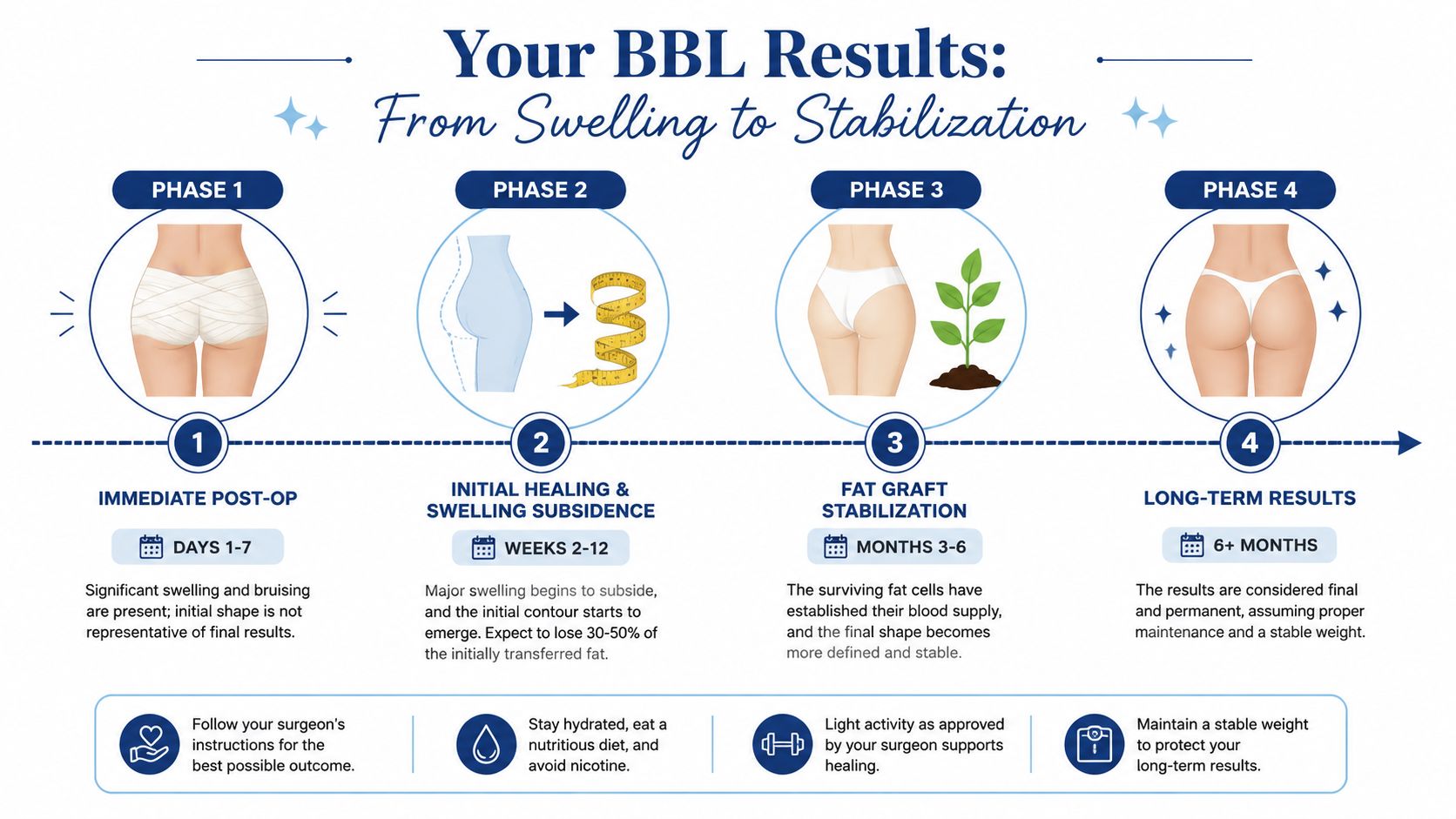
The transferred fat needs to establish a new blood supply. That process is what determines whether the fat cells live or get absorbed. A BBL typically lasts at least five years, with many patients maintaining enhanced contours for over a decade, and approximately 60% to 80% of transferred fat cells successfully establish a blood supply and integrate while the rest are absorbed.
Once that surviving fat stabilizes, usually around the 3 to 6-month mark, it behaves like normal body fat. It doesn't mysteriously disappear. It grows or shrinks with you.
Practical rule: The first few months decide what survives. After that, your long-term habits decide how it looks.
This is also why surgeon judgment matters so much. Overfilling, rough handling, or poor placement can work against survival. The art is not just making the buttocks larger. The art is placing living fat in a way that heals predictably and ages well.
Your BBL Results Timeline From Swelling to Stabilization
Patients often judge their result too early. That's understandable. You notice volume right after surgery, then some of it fades, swelling shifts, and the shape seems to change week by week. None of that means the procedure failed.
The early stage can be misleading
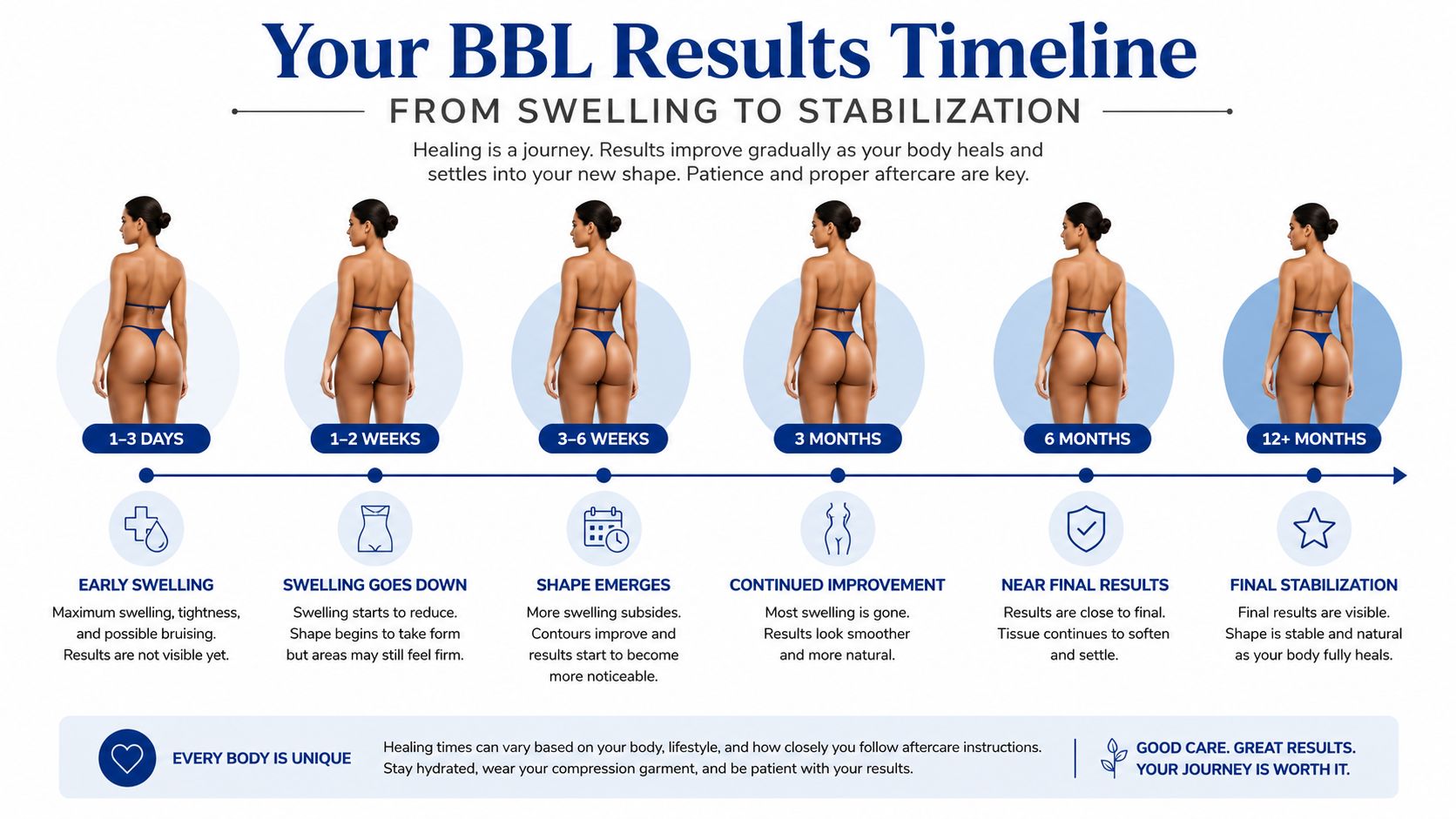
In the beginning, what you see is a mix of transferred fat, swelling, fluid shift, and the fresh effects of liposuction around the donor areas. The shape can look fuller, firmer, and sometimes uneven from one week to the next. That doesn't represent the final result.
This is the phase where patients need patience the most. Recovery has a visual rhythm. Early fullness settles. Bruising fades. Tissues soften. The body keeps only the fat that successfully integrates.
A useful way to think about it is that your body is editing the result. It keeps the cells that establish circulation and lets go of the rest.
When the result starts to look real
The most meaningful checkpoint is the 3 to 6-month window. By three to six months after surgery, approximately 80% of final BBL results are visible because the surviving fat has established its blood supply and transitioned into permanent fat tissue.
At that point, most patients can assess shape more clearly:
- Contour: The outline looks more consistent and less swollen.
- Softness: The buttocks feel more natural and less tense.
- Proportion: The relationship between waist, hips, and projection becomes clearer.
- Stability: Daily fluctuations become less dramatic.
Most concerns I hear early on come from patients looking at a healing body and expecting a finished body.
After that, the result enters a mature phase. It still isn't frozen. It responds to fitness, body composition, and age. But by then, you are looking at your true baseline rather than postoperative distortion.
Key Factors That Influence BBL Longevity
Not all BBL results age the same way. Some stay balanced and attractive for years. Others lose shape earlier than expected. The difference usually comes down to a few variables that are easy to name and harder to master.
Surgical handling matters first
The procedure begins long before the patient goes home. Fat has to be harvested gently, processed carefully, and injected with restraint and precision. If the cells are damaged during collection or placed in a way that compromises circulation, survival drops.
Good technique also means building a shape that will still make sense later. A result can look dramatic early and age poorly if the foundation isn't sound. Consequently, surgical judgment matters as much as technical skill.
In practical terms, durable results tend to come from:
- Controlled harvesting: Healthy fat cells tolerate transfer better than damaged ones.
- Careful purification: Cleaner graft material gives the surviving cells a better environment.
- Layered placement: Small, strategic deposits are more likely to establish blood supply.
- Balanced design: Proportion matters more than chasing extreme volume.
Your metabolism and habits matter next
Once the fat survives, it behaves like your own tissue. That makes weight stability one of the biggest long-term factors. American Board of Cosmetic Surgery data shows that patients with over 5% weight fluctuations lose 30% more BBL graft volume, and rapid weight loss of 10% or more in 3 months can trigger 20% higher fat cell necrosis due to reduced vascular perfusion.
That single point explains a lot of "my BBL didn't last" stories. In many cases, the surgery wasn't the issue. The body composition changed too fast afterward.
If you're someone whose weight tends to swing, it may help to understand the behavior side of metabolic control. Resources on GLP-1s for weight management can be useful for thinking about appetite, set point, and sustainable maintenance habits.
A stable body protects a stable result. A crash diet doesn't just shrink the number on the scale. It can shrink your contour.
Aging changes shape even when fat survives
This is the nuance most articles skip. Surviving fat can remain, but the visual effect still changes with time. Skin quality changes. Tissue support relaxes. The buttocks can lose some upper projection and look less lifted even without major fat loss.
That doesn't mean the BBL stops lasting. It means longevity has two parts: cell survival and shape preservation. A technically strong operation accounts for both by creating contour that can age gracefully rather than only look impressive in early photos.
How to Maximize and Maintain Your BBL Results for Years
Patients have more control over BBL longevity than they think. Once the surgery is done, the priority shifts from creating the result to protecting it.
Protect the fat early
The first rule is simple. Don't crush the graft. Patients must avoid direct pressure on the buttocks for 2 to 4 weeks after surgery, return fully to normal sitting after 6 weeks, and use a BBL pillow to shift pressure onto the thighs because prolonged pressure can kill fat cells and compromise long-term results.
That advice sounds repetitive until you realize why it matters. Newly transferred fat is vulnerable. It is trying to establish blood supply. Pressure works against that process.
Focus on the basics:
- Offload pressure: Use the pillow exactly as instructed during the restricted period.
- Respect sitting limits: Shortcuts here can cost you volume later.
- Sleep correctly: Follow your surgeon's instructions on positioning.
- Wear garments as directed: Compression helps support healing in the treated areas.
Maintain the body that supports the result
The next stage is less about recovery and more about consistency. Your BBL will hold up best when your weight, nutrition, and exercise habits are steady. That doesn't mean living rigidly. It means avoiding big swings.
Nutrition matters because healing tissue needs reliable support. Consequently, healthy nutrition habits after surgery can improve recovery and support your result become part of maintenance, not just postoperative advice.
Exercise matters too, but timing matters just as much. Return gradually and only after clearance. Many patients benefit from glute training later because stronger surrounding musculature can improve the overall look of the area, even though exercise itself doesn't preserve transferred fat.
One mistake I see is patients moving from surgery straight into aggressive dieting cycles. If you're not familiar with how bodybuilders and fitness-focused patients cycle calories, this overview of bulking and cutting explained is helpful because it shows how deliberate weight changes affect body composition. After a BBL, extreme cutting is usually the wrong move.
Your job after surgery is not to get smaller as fast as possible. Your job is to heal, stabilize, and keep your body composition predictable.
For long-term maintenance, keep the strategy simple:
| Habit | Why it helps |
|---|---|
| Stable weight | Preserves the volume and proportion created by surgery |
| Adequate nutrition | Supports healing and tissue quality |
| Gradual return to activity | Lowers the risk of stressing healing tissues too early |
| Follow-up care | Helps catch issues before they affect the final outcome |
This is what works. What doesn't work is impatience, pressure on the graft, nicotine exposure, and dramatic weight changes in the months after surgery.
Comparing BBL Longevity to Other Buttock Augmentation Options
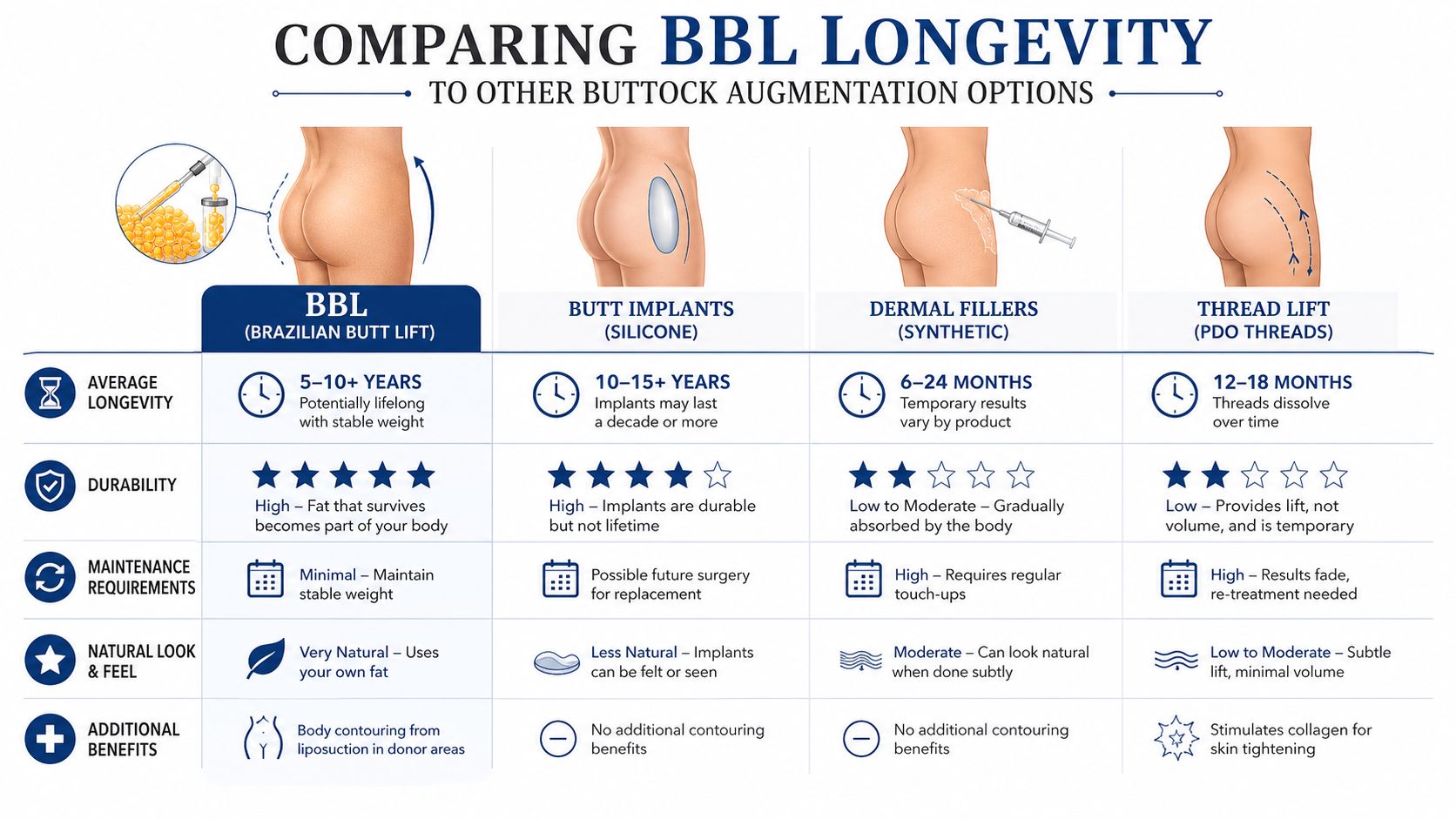
A BBL isn't the only way to change buttock shape, but it offers a different kind of longevity because the result comes from your own tissue rather than a device.
Living tissue versus a device
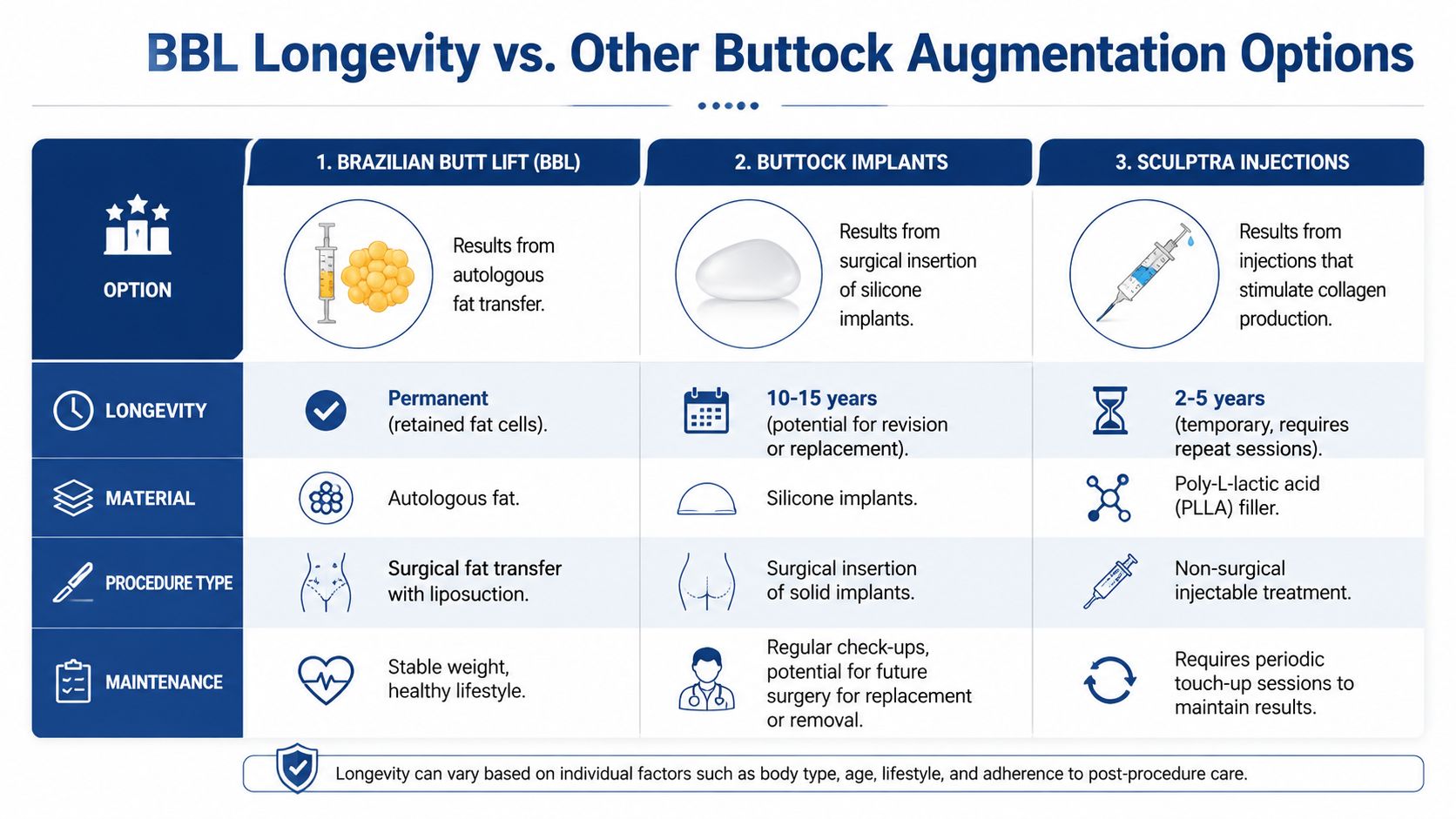
The major advantage of a fat-transfer BBL is biological permanence. When BBL refers to fat transfer, the surviving fat cells are permanent and have no expiration date, unlike butt implants which often require replacement or revision, and patients with stable weight can expect results to persist for many years, often for decades.
That's distinctly different from an implant. An implant is a manufactured object placed in the body. It can look good, but it has a mechanical lifespan and may need future surgery. A BBL uses tissue that becomes part of you.
Here's the practical comparison:
| Option | Longevity profile | Trade-off |
|---|---|---|
| BBL | Long-lasting because retained fat becomes living tissue | Depends on fat survival, healing, and weight stability |
| Buttock implants | Not considered permanent in the same biological sense | May require future revision or removal |
| Injectable collagen stimulators | Temporary by design | Less dramatic volume, ongoing maintenance |
Who each option fits best
A BBL makes the most sense for patients who want a softer, more natural feel and who have enough donor fat to transfer. It also appeals to patients who value waist and torso contouring at the same time, since liposuction is part of the shape change.
Implants can still have a role for very lean patients who lack donor fat, but they come with a different maintenance conversation. Injectable options can help with subtle contour changes, but they don't serve the same purpose as a full surgical fat transfer.
So when people ask how long do BBL last, the better comparison is this: BBL longevity comes from living grafted fat, while other options depend on materials or repeat treatments. Those are not the same category of result.
Frequently Asked Questions About BBL Longevity
Does an Awake BBL last as long as one under general anesthesia
Yes, it can. Longevity comes from fat handling, placement, circulation, and recovery compliance, not from whether the procedure was done under general anesthesia or local anesthesia. What matters is the surgical plan and how carefully the graft is treated.
What happens if my weight changes after a BBL
The surviving fat responds like the rest of your body fat. If you gain weight, the area can become fuller. If you lose weight, you can lose volume there too. The bigger and faster the change, the more visible the effect usually is.
Will I ever need a revision or second BBL
Some patients do, and some don't. It depends on your starting anatomy, your goals, how much fat survives, and how your body ages. Wanting a refinement later doesn't mean the original BBL failed. Sometimes it means your goals changed or your tissues matured.
Is the one-year result the final result
The mature result is usually apparent well before that, but the one-year mark is a very useful point for judging softness, settling, and overall proportion. By then, the body has had time to complete the larger phases of healing.
Why do some older BBLs look different even when the fat is still there
Because shape and support matter along with volume. A person can keep surviving grafted fat and still see changes from skin laxity, tissue descent, and normal aging. That's why the best BBL isn't just fuller. It's well designed.
If you're considering a BBL and want a clear, honest discussion about longevity, recovery, and what kind of result will age well, Ideal Face & Body offers consultations in Beverly Hills, CA with Dr. Justin Yovino and Dr. Sarah Yovino. The right plan starts with realistic expectations, precise technique, and a result built to look good long after recovery ends.