What if your areolas look large because your breasts have dropped, not because the areolas themselves were always wide? That distinction matters more than most pages admit. Shrinking a circle of skin can change diameter, but it can't lift a breast that's sitting low on your chest. If those two problems get blurred, you can end up with a smaller areola, a stretched scar, and the same droop you started with. Female areola reduction works best when you name the problem accurately before you choose the procedure.
Table of Contents
- Who Female Areola Reduction Suits
- Surgical Techniques Compared by Shape and Scar
- Anesthesia Options from Local to General
- Recovery Timeline and When Sensation Returns
- Scars, Shape and Long-Term Results
- Breastfeeding, Pregnancy and Surgical Risks
- Confirm Your Candidacy Before Booking a Consultation
Who Female Areola Reduction Suits
Are your areolas enlarged while your breast shape and nipple position otherwise suit you? Isolated areola reduction may address that specific concern. The surgeon removes a ring of tissue at the outer edge of the areola, brings the remaining skin inward, and closes it around the nipple-areola complex. The resulting circular scar lies at the border between areola and breast skin.
The operation narrows the pigmented circle, while the nipple generally remains central and the breast itself stays largely in its existing position. It does not lift a low breast or move a low nipple. That distinction helps determine whether reducing the areola alone is likely to meet your goal.
Candidacy by Breast Shape
| Breast situation | Areola reduction alone | Usually combined with |
|---|---|---|
| Enlarged areola, firm breast, little droop | Often suitable | None required |
| Enlarged areola, mild to moderate droop | Limited lift; shape may flatten | Mastopexy pattern |
| Large areola, significant droop or poor skin elasticity | Not recommended alone; may produce flat or square contour | Breast lift or mastopexy |
| Areola enlarged after pregnancy or major weight change | Wait until weight and shape are stable | Lift if droop remains once stable |
| Nipple sits low or off-centre | Does not correct nipple position | Nipple repositioning |
Start with the row that best matches your breast shape. Firm breasts, skin that recoils well, and a nipple that sits comfortably above the fold make isolated reduction a reasonable option to discuss. In that setting, the procedure focuses on the areola rather than trying to change the breast's overall position.
Mild or moderate droop changes the plan. A closure around the areola can create a limited lift by tightening the surrounding skin, but that tension has trade-offs: the scar may widen, the breast cone may flatten, or the areola may stretch again. A mastopexy pattern often enters the plan as structural support for the breast.
A reduction can change the size of the circle. It cannot change where the breast sits on your chest.
With significant droop or poor skin elasticity, areola reduction alone may leave a flat or square contour and place ongoing tension on the closure. A breast lift may better address the overall shape. If breast volume and heaviness are also part of the concern, breast reduction may be considered alongside the lift. A low or off-centre nipple requires a separate plan for repositioning, because reducing the surrounding ring does not move it.
What Pairings Add and What We Measure
Adding a lift or reduction involves more tissue handling and a longer healing period than operating around the areola alone, and it increases exposure to surgical complications. A combined procedure may also involve general anesthesia, though awake options exist for selected breast procedures. The plan depends on the operation and your individual anatomy. The guide to checking whether you are a breast lift candidate can help you distinguish excess skin from a nipple-position concern before a consultation.
Assessment goes beyond areola diameter. Surgeons consider breast volume, nipple-to-inframammary-fold distance, skin elasticity, and asymmetry when judging how well the result may hold. Swelling and scar maturation can affect the final appearance, and the two sides may heal differently, leaving differences in size, shape, or position.
Before a consultation, use a mirror and soft tape to consider three questions:
- Width versus goal: How wide is my areola compared with the size I want?
- Nipple position: Does my nipple sit well above the fold, or at or below it?
- Stability: Has my shape changed after pregnancy or weight change, and has it settled?
Clarify which procedure addresses each concern. Ideal Face & Body lists breast augmentation and breast implant revision among its breast procedures, as well as awake breast lift and reduction. Its published notice about breast implant removal and scars discusses implant procedures; it does not define candidacy for areola reduction.
Surgical Techniques Compared by Shape and Scar
| Technique | Incision pattern | Best suited for | Main trade-off |
|---|---|---|---|
| Crescent areolar lift (Höllander) | Skin removed above the areola only | Limited enlargement at the upper border | Less control over the full circle |
| Periareolar (doughnut) mastopexy (Hinderer) | Ring of skin removed and closed in a circle | Enlarged areola with mild droop | Circular scar that can widen |
| Periareolar reduction with inferior dermal pedicle | Ring excision with pedicle preserving blood supply | Moderate reduction with preserved vascularity | Flattening if too much tissue is removed when elasticity is poor |
| Single-stage crown-shape debulking | Reshapes areola and nipple without visible frontal scar | Selected cases under evaluation | Long-term outcome data is limited |
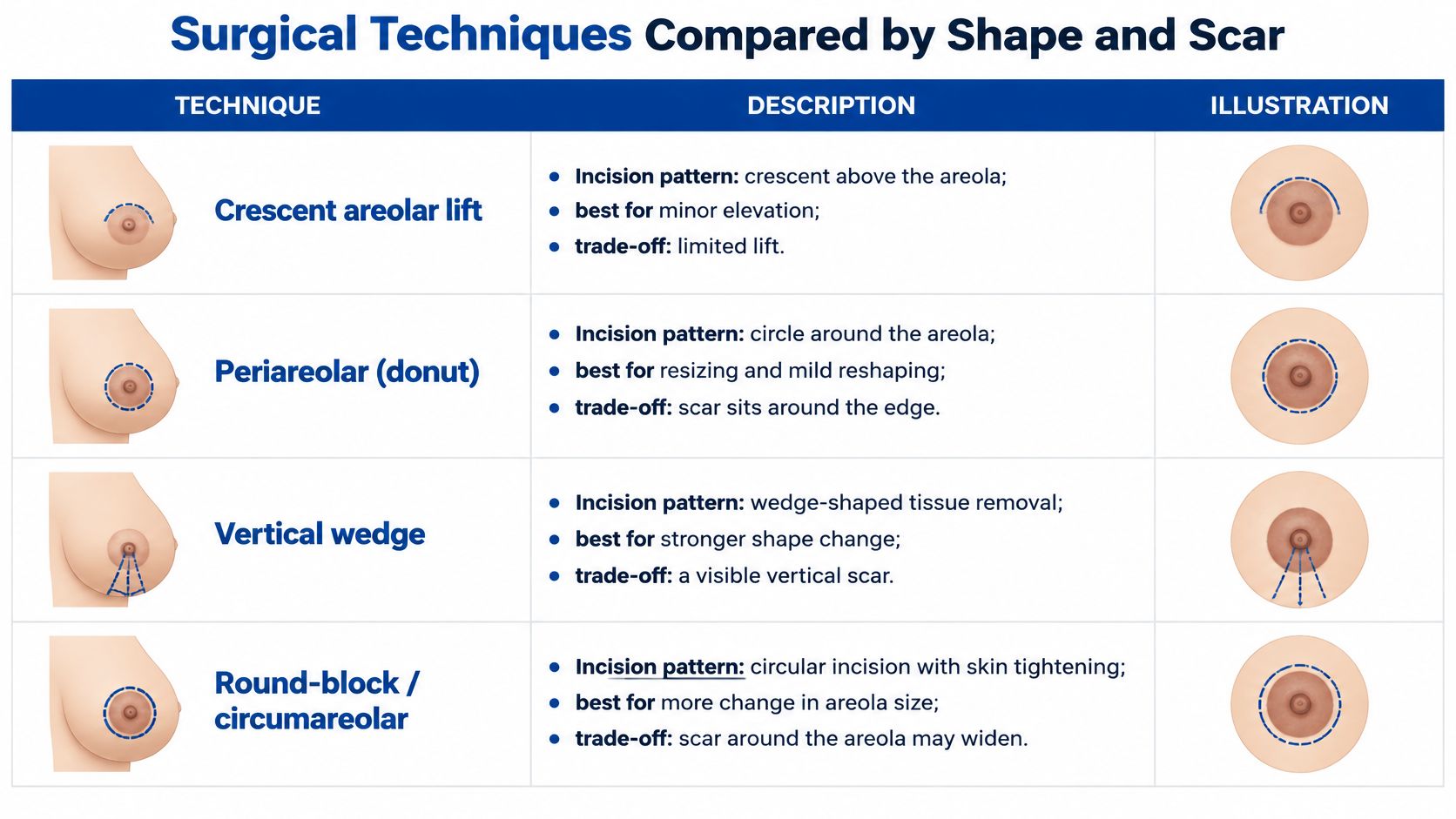
Reading the Four Options
Areola reduction changes the areola, not the position of a drooping breast. If the nipple sits low or there is substantial breast sagging, reducing the circle alone will not lift the breast. A combined lift addresses that separate problem, with additional incisions and trade-offs.
The crescent areolar lift removes skin only above the areola. It is suited to enlargement or pull concentrated at the upper border, but gives less control over the full circle. When the entire areola is wide, this approach may not reduce it evenly.
The periareolar doughnut approach removes or de-epithelializes a ring of skin around the areola and closes the incision in a circle. A periareolar surgery review describes a target areola often approximately 38 to 50 mm in diameter, with closure using a purse-string suture. This method suits an enlarged areola with mild droop. The full-circle closure must hold tension, so the scar can widen.
The inferior dermal pedicle method preserves a tissue bridge that maintains blood supply while skin is removed in a ring. It can suit moderate reduction when maintaining vascularity matters. If too much tissue is removed, especially with poor skin elasticity, the breast may look flat or square rather than rounded.
Crown-shape debulking is an early technique report intended to reshape the areola and nipple without a visible frontal scar. Long-term outcome data is still limited. Ask how many cases have been followed and for how long before considering a newer approach.
When Tension Wins
Excessive circumferential tension can cause widening, irregular edges, hypertrophic scarring, flattening of the breast cone, or a “starburst” appearance. These changes reflect how the closure and skin tolerate tension, and may become clearer as healing progresses.
Working rule: The more skin that must be removed, the more likely the plan will need a lift or other structural support.
Plan for the possibility of revision as well. Recurrent enlargement, scar irregularity, or persistent asymmetry may require another procedure, particularly after removal of a large amount of periareolar skin.
Anesthesia Options from Local to General
Anesthesia is a separate decision from technique. It follows how much surgery you're having, not just the size of the areola.
| Option | What the patient experiences | IV and monitoring | Typical trade-off |
|---|---|---|---|
| Local anesthesia alone | Awake, numbed area, feels pressure | No IV in the simplest cases | Less medication and quicker discharge; patient must tolerate pressure and communicate |
| Local with oral or IV sedation | Relaxed and drowsy, area numbed | IV line placed and monitored | Calmer experience; a driver is usually needed |
| General anesthesia with breathing tube | Asleep through the procedure | IV line and full monitoring | Usually needed when combined with a lift, reduction or other surgery; longer recovery |

With local anesthesia alone, you're awake, the area is numbed, and you'll feel pressure and movement without sharp pain. Discharge is usually quicker, but you need to lie still and speak up if you feel discomfort.
Sedation makes that easier for anxious patients. You're drowsy rather than fully asleep, an IV line is placed, and you'll need a driver. General anesthesia means you're asleep with a breathing tube and full monitoring, with a longer recovery in the room afterward.
Surface numbing has its own place in minor skin work, and patients who want background on how topical products fit other settings can read about topical numbing for microneedling procedures. For areola surgery, injected local anesthesia does the heavy lifting, and breast lift under local anesthesia is worth reviewing if you want to understand awake breast surgery.
Ask four questions before you agree to a plan:
- Planned method: Which anesthesia is planned for me, and why?
- Backup plan: What happens if the plan changes mid procedure?
- Monitoring: Who monitors me throughout?
- Stay time: How long do I stay before discharge?
Recovery Timeline and When Sensation Returns
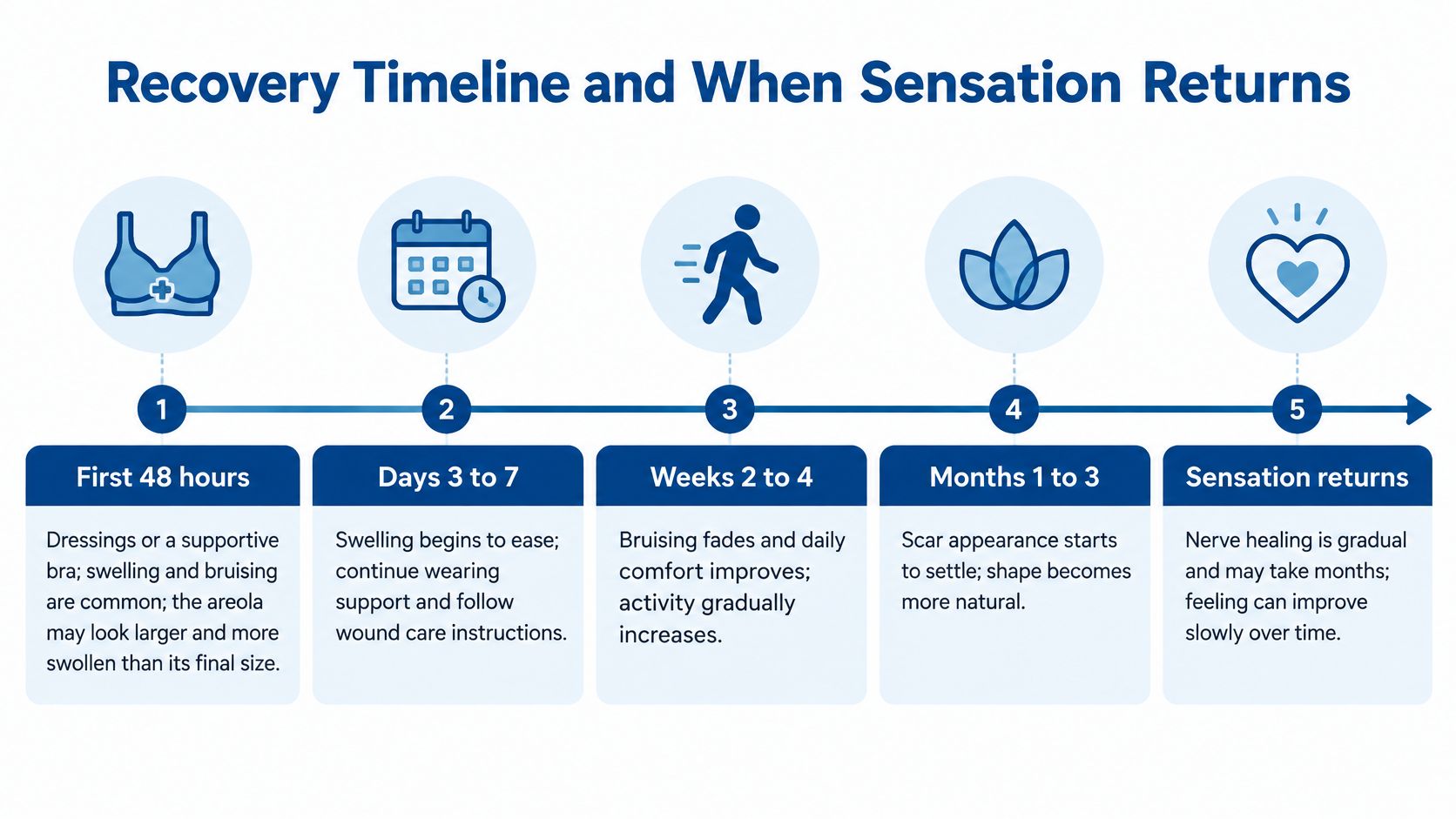
Recovery tends to follow a clear sequence, though the pace varies. Swelling, tenderness, and temporary changes in sensation are common early on.
- First 48 hours: Keep dressings or a supportive bra in place as instructed. Swelling and bruising may make the areola look larger than its intended size. Wait for these to settle before judging the result.
- Days 3 to 14: Numbness, tingling, or increased sensitivity may become noticeable. Follow your surgeon's directions for wound care, including how to manage dressings and keep the area clean and dry.
- Weeks 2 to 6: Light activity can gradually resume, according to your surgeon's advice. Wait for clearance before heavy lifting or strenuous exercise, since chest movement can strain the healing area.
- Months 3 to 6: Swelling continues to settle, and the scar softens. The areola's appearance becomes easier to assess as healing progresses.
- Around 12 months: Sensation and healing can still be changing. Persistent numbness, heightened sensitivity, or discomfort should be discussed at follow-up.
What Sensation Usually Does
Temporary numbness or reduced sensation can occur after areola reduction. Feeling often returns gradually, though the timing varies. Some patients notice tingling, discomfort, or heightened sensitivity instead, and sensation may not fully return.
Track changes rather than relying on memory. Take weekly photos in consistent lighting and from the same position, and note where sensation feels reduced or unusually strong, along with when you noticed it. Contact your surgeon promptly about redness, discharge, or a wound opening instead of waiting for a scheduled visit. These notes can help make follow-up discussions more specific.
Scars, Shape and Long-Term Results
The incision follows the areola's edge, but its position does not guarantee an inconspicuous scar. The closure is under outward tension, so the scar can widen, pucker, or become raised. Some people develop hypertrophic or keloid scars, and the areola may gradually enlarge again as the closure relaxes.
Why Timing Changes the Result
Timing also affects the result, because it shapes how the skin behaves over time. Skin that is stretched after surgery can alter the areola's size and the breast's contour. If pregnancy plans are settled and weight is stable, the result is easier to assess over the long term.
A conservative excision helps limit tension, but it also limits how much the areola can be reduced. Removing too much skin can flatten the breast's natural projection, creating a flat or square contour. When breast droop also needs correction, isolated areola reduction cannot lift the breast. A combined lift may be considered, with additional incisions and scars as a trade-off.
| Problem | Typical trigger | Response |
|---|---|---|
| Areola widens again | Tension on the circular closure or changes in skin stretch | Conservative excision; consider revision if the enlargement persists |
| Flat or square breast contour | Excessive skin removal or poor skin elasticity | Limit the excision; consider combining reduction with a lift |
| Puckered or stretched scar | Tension on the closure or raised scar healing | Follow scar-care instructions; assess revision after the scar matures |
| Altered sensation | Tissue removal or sutures around the nipple-areola complex | Discuss persistent changes with the surgeon |
Scar quality depends on both technique and healing. The circular border may look uneven while it settles, and a mature scar may remain visible or raised. Revision is a separate procedure, not a guarantee of a finer scar, so allow the incision to mature before deciding whether further treatment is appropriate.
Ask to see before-and-after photos of the same technique at a comparable healing stage. Look closely at the scar's width and the breast's contour, not just the areola's diameter. Be cautious of promises of scar-free or permanently stable results. A natural result means a balanced shape and an acceptable scar, not perfect symmetry or an unchanged appearance over time.
Breastfeeding, Pregnancy and Surgical Risks
Could an areola reduction affect breastfeeding? The answer depends on what the operation removes. A standalone reduction limited to the skin around the areola is different from surgery that cuts through underlying tissue or changes the nipple's position. The deeper the dissection, the greater the potential to disturb ducts or other structures involved in milk production. Preserving breastfeeding may be possible, but it cannot be guaranteed.
If the operation is combined with a breast lift, the technique and extent of tissue movement also matter. Read about whether you can breastfeed after a breast lift when weighing that combined procedure against an isolated areola reduction. Shrinking the areola alone does not correct breast droop. A lift addresses breast shape and nipple position, but adds a different surgical scope and its own trade-offs.
Before planning surgery, discuss your individual priorities and history:
- Prior surgery: Tell your surgeon about breast operations or biopsies, particularly near the ducts.
- Pregnancy plans: Consider whether you may become pregnant and how important breastfeeding is to you. Pregnancy can also change breast shape and areola size after surgery.
- Existing changes: Report any current loss or increase in nipple sensation.
Milk production can naturally differ between breasts, so an uneven supply after surgery does not by itself establish that the procedure caused it. Reviewing possible causes of unequal breast milk production can help put that concern in context.
Numbers, With Their Limits
The figures below concern breast reduction, not isolated areola reduction, so they provide context rather than a precise estimate of risk for this procedure. A systematic review summary covering 912 breast reduction patients and 244 repeat reductions reported minor wound separation in 4.05%, hematoma in 1.2%, and no nipple-areola complex necrosis in the reviewed primary reductions. Repeat reductions had 2.5% major and 9.4% minor complication rates.
A 2024 study in Plastic and Reconstructive Surgery Global Open of 1,200 patients treated between 2010 and 2023 reported 2.7% partial areola-nipple complex necrosis, 8% altered sensation, and 99% patient satisfaction after reduction mammoplasty. These results should not be treated as predictions for isolated areola surgery. Likewise, the 14.3% complete-loss figure in a 2025 report concerned a highly selected group already experiencing perfusion problems, not a routine areola reduction population. The linked systematic review summary addresses breast reduction outcomes, not that separate report, so the 14.3% figure is omitted here.
Sensation is a functional outcome, not just a cosmetic one. Numbness, tingling, or heightened sensitivity can occur during healing, and some changes may be permanent. Smoking, obesity, prior surgery, tissue tension, and the amount of correction required can affect risk. Disclose smoking, including vaping, and ask your surgeon for complication information specific to isolated areola reduction.
Confirm Your Candidacy Before Booking a Consultation
Does the change you want involve areola size alone, or does the breast itself need lifting? Reducing the areola cannot correct breast droop. If the breast sits low, resizing alone may leave the main concern unchanged. Use this checklist to clarify your goals before booking.
- Measure and compare: Record each areola's diameter and compare the sides in a straight-on photo. Treat your target size as a discussion point, not a guaranteed outcome.
- Check breast position: Note the nipple-to-fold measurement and whether the breast looks flat or square when gently lifted by hand. These observations can help distinguish isolated areola reduction from a possible combined lift.
- Consider stability: Write down whether your weight is stable and whether you plan to become pregnant. Either may affect how the breast and areola look over time.
- Record smoking status: Tell the surgeon whether you smoke or vape, and discuss when to stop before surgery.
- List functional priorities: Note breastfeeding plans and any existing changes in sensation.
- Discuss anesthesia: Decide how much awareness you are comfortable with and ask which anesthesia approach fits the proposed procedure. Awake breast lift and reduction are offered without general anesthesia or intubation. Awake options also include Awake Breast Lift®, Awake Breast Reduction, and Awake Butt Lift® (Awake BBL).
- Ask about revision and risk: Request the surgeon's revision policy and complication information for isolated areola reduction, rather than relying on figures for broader breast procedures.
- Prepare your health history: Bring your age, medical conditions, medications, and supplements that could affect bleeding.
Bring your measurements, photos, and notes to a consultation with a qualified surgeon. Ask whether your goal is suited to areola reduction alone or whether breast position calls for a combined procedure. The distinction matters: a lift changes breast position, while areola reduction changes the size of the pigmented area.
Cost varies with the treatment plan. Before choosing a date, request a written plan that lists each procedure, the anesthesia approach, and expected recovery.
If your measurements and goals do not yet support a clear decision, wait. A stable shape gives you a better basis for planning.
If your checklist points to an enlarged areola with a breast that sits well, or to droop that needs a lift alongside resizing, Ideal Face & Body offers awake breast procedures performed under local anesthesia in Beverly Hills, CA, so you can plan the areola and the breast shape in one honest conversation. Bring your measurements, photos, and breastfeeding priorities, and visit Ideal Face & Body to start that assessment with Dr. Justin Yovino or Dr. Sarah Yovino.