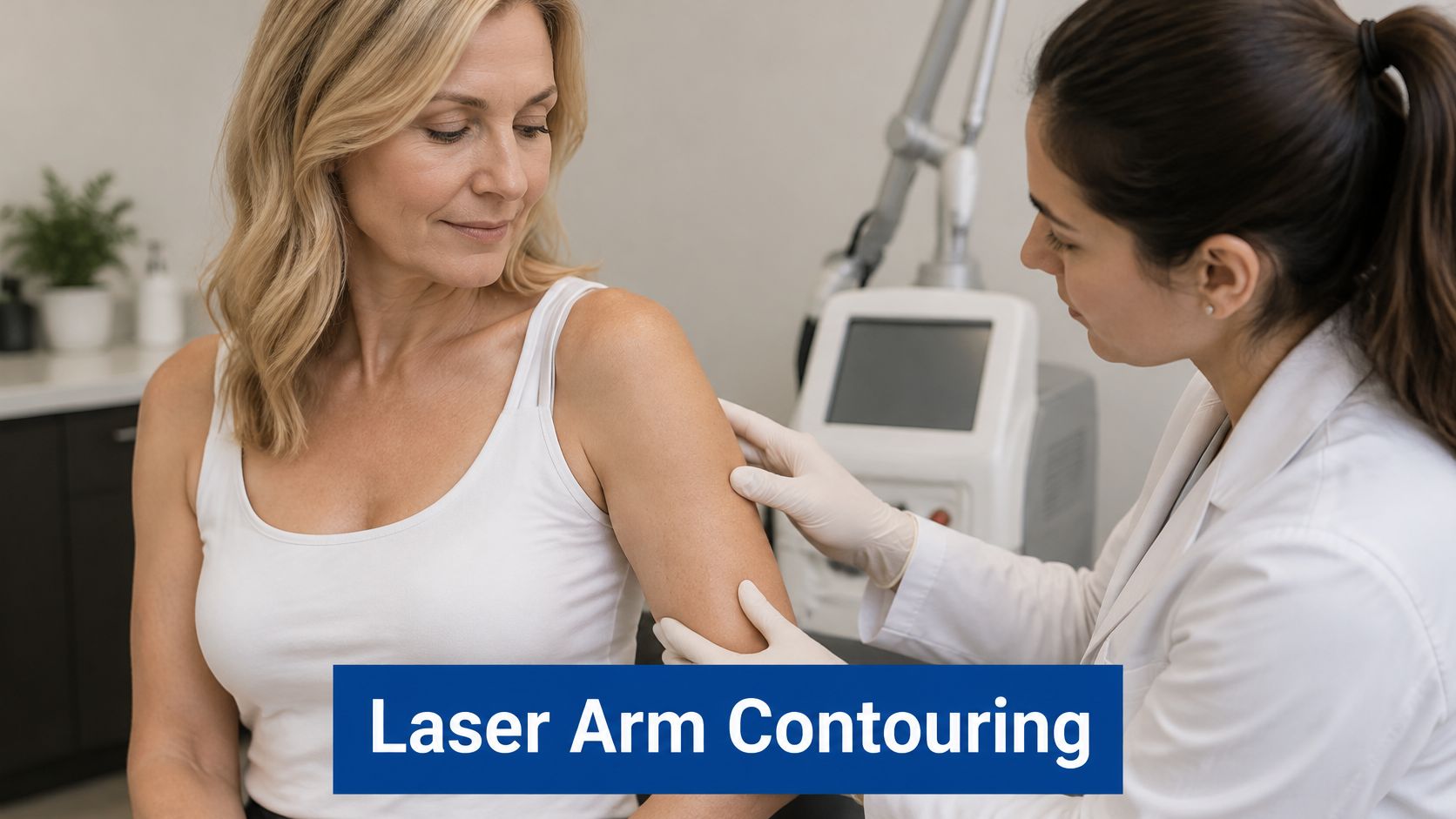
Most patient guides treat laser energy as an automatic upgrade that melts away extra arm fat and snaps loose upper-arm skin right back into place. That popular advice conflates two separate biological jobs: removing subcutaneous fat volume and shrinking stretched dermal tissue. When you look closely at peer-reviewed plastic surgery trials, laser energy doesn't guarantee greater slimming than standard suction alone.
The clinical history makes this distinction clear. Laser-assisted lipolysis entered mainstream US practice after an October 2006 FDA clearance for surgical incision, vaporization, ablation, and coagulation, as documented in a clinical review of current laser lipolysis practices. In an early upper-arm series cited in that same review, 20 patients reported high satisfaction after laser lipolysis, yet their measured drop in arm circumference was modest and didn't differ from traditional liposculpture.
That pattern still holds today for anyone evaluating laser liposuction arms options. Suction removes the fat, while controlled thermal energy targets tissue contraction in the skin envelope. Because the measured advantage of adding a laser is skin retraction rather than extra fat debulking, your underlying arm skin quality decides whether laser-assisted liposuction fits your anatomy or whether an entirely different surgical plan makes more sense.
Table of Contents
- What Results to Expect From Arm Laser Liposuction
- How Laser Energy Changes the Arm Procedure
- Who Qualifies Based on Arm Skin Quality
- Laser Versus Conventional Liposuction for Arms
- Local Anesthesia and What You Feel on Procedure Day
- Recovery Timeline and Warning Signs to Watch
- Confirm Candidacy and Book a Consultation
What Results to Expect From Arm Laser Liposuction
Chasing the largest centimeter drop is the wrong way to read arm liposuction evidence. The consistent signal across upper-arm studies is a modest change in circumference paired with a separate skin-tightening effect, and the second variable often decides whether the result looks refined.
| Study or review | Patients or arms | Reported outcome | What it means |
|---|---|---|---|
| Pooled systematic review and meta-analysis | Several small clinical studies | Group-level circumference reduction | Establishes an average direction and spread, never an individual promise |
| Same review, skin-retraction reporting | Same pooled evidence base | Pooled skin-retraction estimate | Useful signal, limited by protocol differences and bias risk |
| Same review, downtime reporting | Same pooled evidence base | Short mean social downtime | Bruising and swelling can outlast time away from work |
| Argon plasma-assisted arm study | Selected mild-to-moderate laxity cohort | Ptosis, diameter, and thickness changes | Adjacent thermal technology that bounds expectations for energy-assisted contraction |
| Pulsed Nd:YAG pilot | Very small pilot cohort | Inconsistent mid-arm circumference change | Device settings alone did not guarantee visible slimming |
Reading the Meta-Analysis Benchmarks Carefully
The clearest pooled benchmark is a 2025 systematic review and meta-analysis on laser-assisted arm contouring that screened 135 studies, pooled 7 clinical studies covering 199 treated arms, and reported an average circumference reduction of 2.95 cm with a 95% confidence interval of 1.50 to 4.41 cm (P < .001), average skin retraction of about 29.87%, and mean downtime from 0.08 to 0.73 days. A confidence interval that wide shows a real group-level effect and meaningful patient-to-patient spread. One arm can sit near the high end because baseline fat thickness, body-mass index, skin recoil, and technique line up favorably, while another arm changes far less under the same label.
Reported adverse events were mostly mild and temporary, including bruising, swelling, discomfort, and occasional prolonged edema, with no serious long-term complications recorded in the pooled material. The skin-retraction estimate carried a high risk of bias, so treat tightening as a plausible advantage with measurement limits. That distinction matters because contraction quality, especially in thinner or looser upper-arm skin, shapes the visible result more than the suction volume alone.
Research reality check: A pooled average describes a group of small studies with different devices and surgeon protocols. It never acts as a promise for what your own upper arms will measure at three or six months.
Comparing Related Energy Devices and Small Pilot Trials
A different thermal adjunct shows why context matters: a 2025 argon plasma-assisted arm contouring study documented mean reductions of 29% in arm ptosis, 15% in arm diameter, and 42.7% in arm thickness in patients with mild-to-moderate laxity. Those outcomes describe plasma-assisted contraction in a selected cohort, so they frame what energy-assisted tightening can do without setting a laser-specific forecast.
The pilot literature is even more cautionary. A clinical evaluation of Nd:YAG arm lipolysis described a five-patient pilot using a 1,320-nm pulsed Nd:YAG laser at 15 W, 30 Hz, and a 100-µs pulse width, with a mean three-month mid-arm circumference change of 0 cm and a range from -1.5 to +2 cm. Safety and technical delivery did not convert into dependable slimming. For patients comparing device names, wavelength and pulse format are weaker predictors than skin quality, fat distribution, and whether laxity is mild enough to retract cleanly.
Setting a Realistic Outcome Target
For a well-selected candidate, a laser liposuction arms procedure typically delivers visible but modest slimming of the upper arm with smoother skin draping. Skin contraction is the main measurable benefit over suction alone. The practical target is a firmer arm whose outline matches the fat removed; loose, crepey skin can blunt that contour even when suction succeeds.
During consultation, ask to review standardized outcome photos and measurements from patients whose starting arm thickness, skin tone, and laxity resemble yours.
How Laser Energy Changes the Arm Procedure
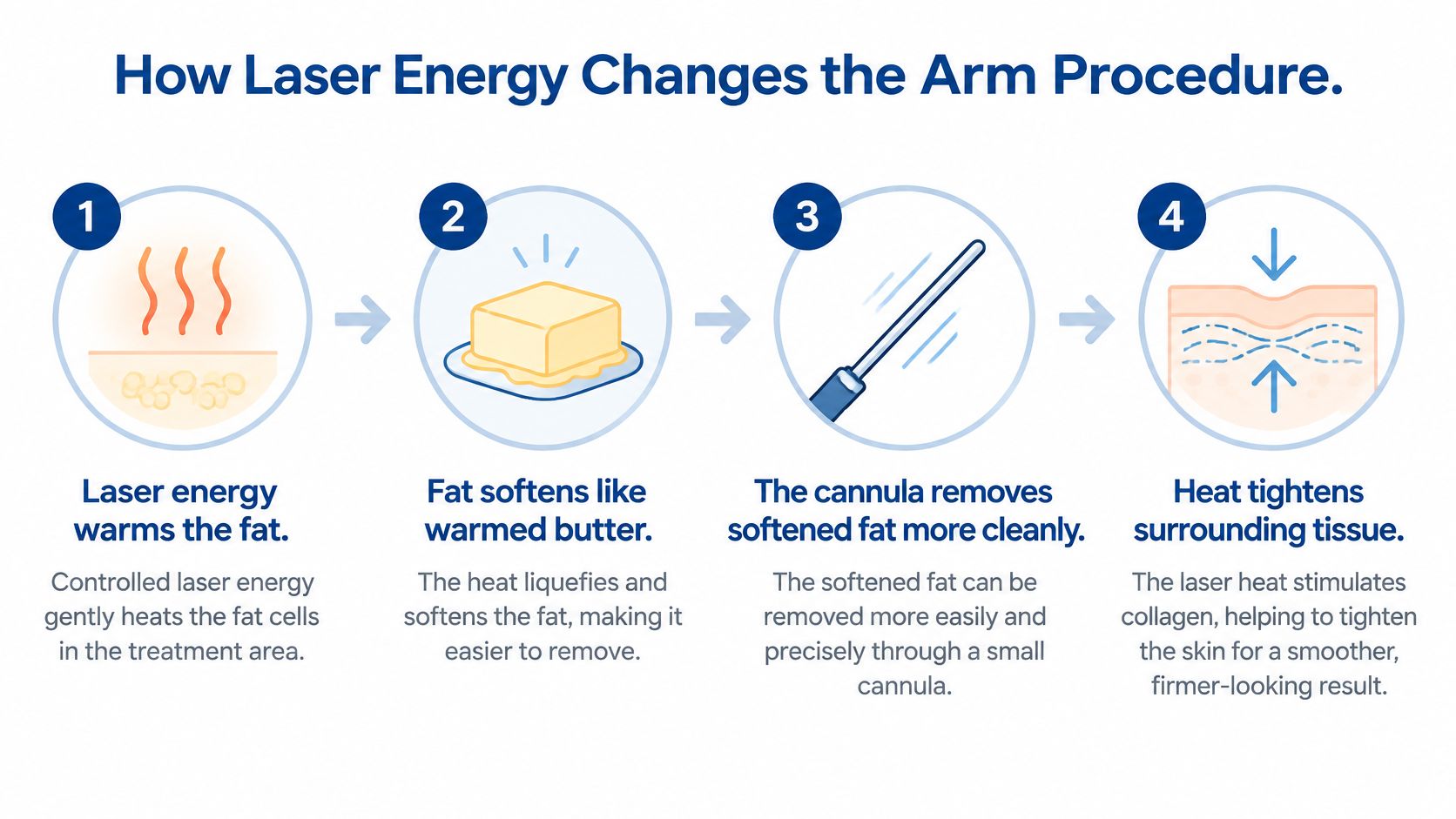
Think of adding laser energy to upper-arm liposuction like warming cold butter before scooping it out of a dish. Softening the fat makes it easier for a thin suction cannula to glide through fibrous upper-arm tissue, while controlled heat simultaneously contracts the surrounding collagen framework. The sequence is straightforward, and each step has a distinct mechanical or thermal purpose.
Four Steps Inside the Fat Layer
- Place the subdermal laser fiber. The surgeon threads a narrow bare optical fiber through a tiny entry point directly into the subcutaneous fat layer beneath the skin. Placing the tip at the right depth protects the overlying dermis while reaching the targeted fat pad.
- Deliver conservative thermal energy. According to a comparative upper-arm study using a 1,064-nm Nd:YAG protocol, safe technique relies on low power, continuous-wave operation, a bare fiber, and relatively long irradiation times exceeding two minutes. Aggressive focal heating spikes the risk of dermal burns and uneven, lumpy contraction, so slow, even passes keep tissue temperatures controlled.
- Disrupt fat cells and contract collagen. Steady thermal energy ruptures adipocyte membranes, seals tiny local blood vessels to limit oozing, and denatures dermal collagen fibers so they shorten as they heal. This thermal step is what separates energy-assisted contouring from mechanical suction alone.
- Aspirate the liquefied fat. A fine cannula suctions out the softened fat and emulsified oil. Removing that debulked volume reduces bulk immediately and prevents leftover oily fluid from prolonging inflammation.
Debulking With Aspiration Versus Non-Aspirational Tightening
Not every laser arm protocol removes fat with suction, and that distinction drives your visual result. Laser-assisted debulking pairs subdermal heating with cannula aspiration, physically extracting fat cells from the upper arm. Non-aspirational laser tightening applies thermal energy without suction, relying on the body to clear disrupted fat cells while aiming mainly for mild dermal contraction.
Pairing laser heat with mechanical removal matters when fat thickness is your primary complaint. In a clinical study of 20 women aged 44 to 66 treated on the extensor arm fat pads with a single 1,064-nm Nd:YAG laser-lipolysis protocol, most participants showed visible reduction in unwanted fat alongside skin tightening and decreased circumference, with no significant complications reported. Even so, when true volume reduction is the goal, aspiration does the heavy lifting while laser heat refines the skin envelope.
Before booking a procedure, ask two technical questions. First, confirm whether suction aspiration is part of your surgical plan or whether the laser will be used alone. Second, ask how the surgeon controls energy settings and monitors skin temperature during superficial passes.
Who Qualifies Based on Arm Skin Quality
Laser energy can trigger measurable collagen contraction, yet it can't replace surgical removal of excess hanging skin. That single anatomical rule settles more candidacy questions than any device brochure ever will. When a surgeon examines your upper arms, four physical factors determine whether laser-assisted liposuction can meet your goals.
- Pinch-test thickness and snap-back: Pinching the back of the upper arm separates subcutaneous fat from thin, stretched dermis and shows how quickly the tissue recoils once released.
- Age-related elasticity: Collagen density and elastin quality decline over time, meaning two arms of identical circumference can respond very differently after fat removal.
- Weight stability: Active weight loss or gain shifts subcutaneous volume and skin drape, making surgical contouring unpredictable until your weight settles.
- Expected residual laxity: Every fat-removal plan leaves an empty envelope behind, so the surgeon estimates how much looseness will remain even after maximum thermal contraction.
| Skin quality | Laser-assisted fit | Excision discussed when | Key caveat |
|---|---|---|---|
| Good elasticity, localized fat only | Good fit for fat removal and mild contraction | Usually not needed | Pinch test shows thick fat over firm skin |
| Mild laxity | Reasonable fit; studied in the newer contouring study | Residual laxity remains after treatment | Mild-to-moderate laxity was the study group |
| Moderate laxity | Partial tightening likely | Case by case, with photos and pinch test | Expect incomplete skin tightening |
| Substantial hanging skin | Often not enough alone | Excisional brachioplasty commonly discussed | Scar trade-off must be weighed |
| Advanced Teimourian grade III to IV deformity | Circumference reduction but incomplete tightening | Excisional surgery usually needed | Staged or combined plans may be more realistic |
| Post-weight-loss tissue | Limited fit while weight is still changing | Excision generally discussed once weight is stable | Weight stability comes first |
Where Laser Tightening Stops Working
Clinical trial data draws a clear ceiling for severe laxity. In a prospective analysis of upper-arm deformities, patients with advanced Teimourian grade III to IV arm deformities achieved arm circumference reduction after laser-assisted lipolysis, yet skin tightening stayed incomplete and couldn't deliver full contour correction. Trying to force dramatic shrinkage in severely stretched skin by cranking up thermal energy only raises burn risk without eliminating hanging folds.
Major weight reduction creates a similar structural limit. Understanding why skin sags after weight loss helps explain why prolonged dermal stretching weakens elastin fibers far beyond what heat alone can reverse. Once your weight has remained steady, a surgeon will typically evaluate whether removing excess tissue through excisional arm lift surgery gives a cleaner silhouette than liposuction alone.
Two Patients With Identical Arm Fat
Consider two patients who both carry the same volume of localized fat along the back of the upper arm. Patient A pinches a thick, firm fat pad under resilient skin that snaps right back into place; she qualifies well for laser-assisted liposuction alone because removing the fat and mildly contracting the dermis matches her tissue quality. Patient B pinches the same fat thickness, yet her skin feels thin, hangs below the tricep border, and settles back slowly after a pinch.
For Patient B, removing fat without trimming skin would deflate the arm further and accentuate the drape. Weighing a visible inner-arm incision line against leftover loose skin becomes the decision.
When fat bulk and substantial skin excess show up together, a staged or combined plan pairing liposuction with surgical excision often produces a cleaner, safer result than pushing a laser past its anatomical limit.
Laser Versus Conventional Liposuction for Arms
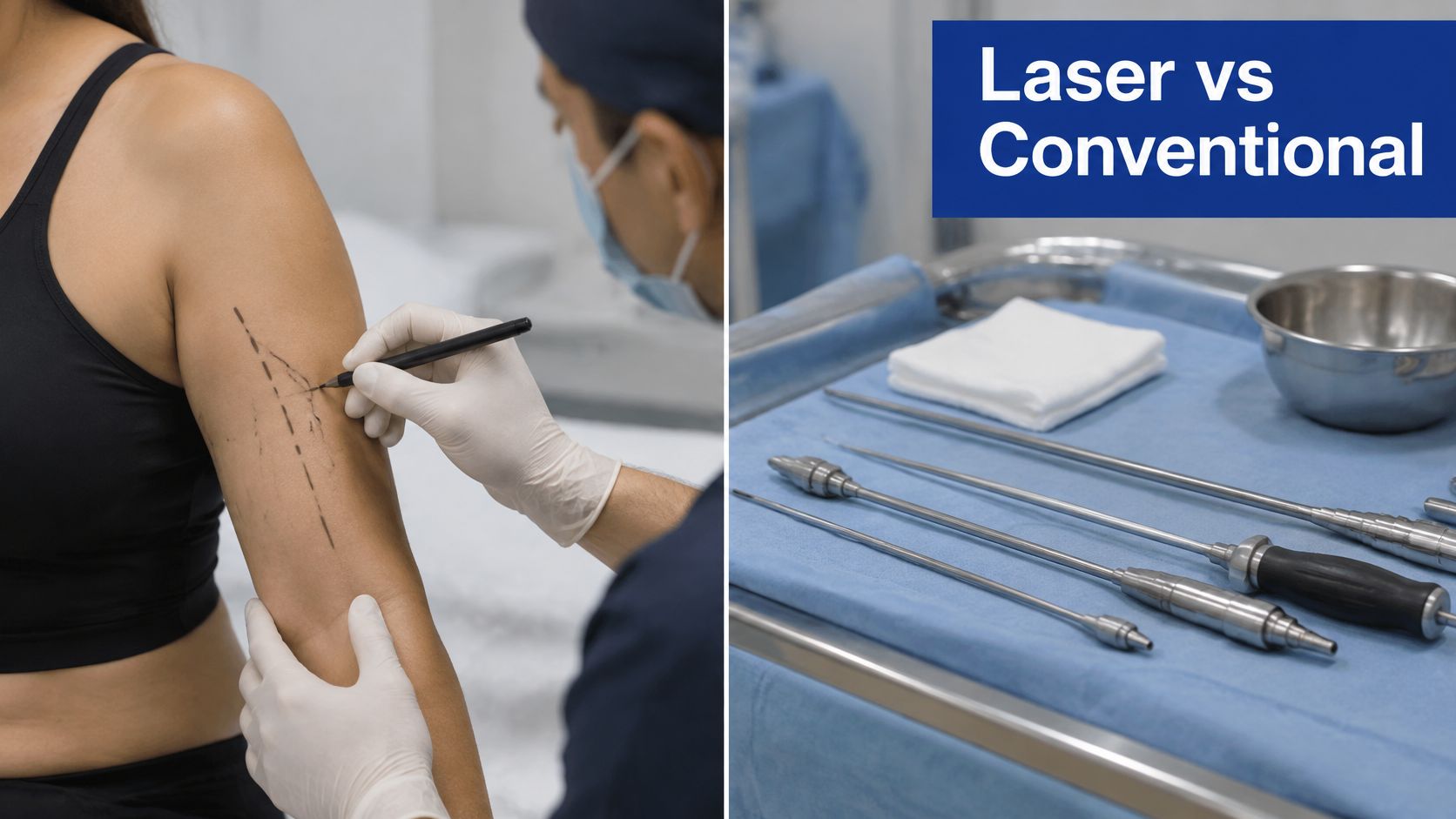
Controlled side-by-side trials offer the clearest look at what adding a laser provides. In a clinical comparison of 28 upper-arm patients with arm lipodystrophy and mild-to-severe skin laxity, 14 patients received subdermal 1,064-nm Nd:YAG laser treatment combined with liposuction while 14 patients received conventional liposuction alone. Mean measured skin retraction reached 11.4% ± 3.17% in the laser group compared with 8.70% ± 2.40% in the conventional group, with no burns, contour irregularities, or unaesthetic scars observed in the cohort.
What That Difference Does and Does Not Prove
A 2.7-percentage-point edge in mean skin contraction is real, yet it doesn't prove across-the-board superiority. Systematic reviews evaluating technology-assisted liposuction still find no substantial proof that energy devices outperform well-executed conventional liposuction overall, and they document clear risks including burns, seromas, hematomas, infection, and scarring. Meanwhile, mechanical arm liposuction has deep clinical validation on its own: a 2024 study of 496 patients undergoing circumferential upper-arm liposuction in Aesthetic Plastic Surgery reported a 99.0% overall satisfaction rate with no serious complications.
Five Criteria That Separate the Two Methods
- Skin contraction: Laser passes hold a modest measured edge in mild-to-moderate laxity, whereas conventional suction relies entirely on your skin's natural elastic recoil after debulking.
- Fat removal volume: Suction cannulas determine how much fat leaves the arm in both techniques; laser energy softens tissue beforehand but doesn't independently remove larger fat volumes.
- Recovery and downtime: Early return to desk work looks similar across both methods, though thermal passes can leave temporary firmness or woody areas under the skin that take longer to soften.
- Complication profile: Both share surgical risks such as swelling, contour irregularity, numbness, fluid pockets, and infection. Laser adds one risk conventional suction largely avoids: thermal burn injury to the thin dermis of the upper arm.
- Evidence depth: Conventional circumferential arm liposuction is backed by multi-hundred-patient cohorts, whereas laser-assisted arm trials remain smaller and use varied wavelengths and power settings.
Take a patient with localized tricep fullness and borderline mild laxity who wants every realistic edge in tissue shrinkage without an arm-lift scar. Weighing the laser's added contraction makes logical sense there. By contrast, a patient with firm, youthful elasticity doesn't necessarily gain much from thermal heat, and a patient with heavy hanging skin will likely need surgical excision regardless of which cannula enters the fat layer. Choose the technique based on skin quality and surgical goals, not on the word "laser."
Local Anesthesia and What You Feel on Procedure Day
Walking into an office-based laser liposuction arms appointment under local anesthesia feels very different from preparing for hospital general anesthesia. You arrive awake, review your standing arm markings with the surgeon, and settle onto the treatment table without a breathing tube or deep anesthetic fog.
From Numbing Infusion to Heading Home
First, the surgeon infuses tumescent local anesthesia through tiny skin entry points. This sterile saline mixture contains numbing medication to block pain signals and a vessel-constricting agent to minimize bleeding. You'll feel brief stinging at the initial entry sites, followed by a cool, tight fullness as the solution firms the upper-arm fat layer.
Once the numbing fluid takes full effect, sharp pain disappears. During the laser passes and suctioning, most awake patients describe dull pressure, rhythmic tugging, mild vibration, and occasional gentle warmth as the fiber and cannula move beneath the skin. If you feel a sudden sharp pinch or localized hot spot, you can speak up immediately so the surgeon can add numbing fluid or adjust technique.
After the surgeon checks symmetry between both arms, the tiny openings are dressed and a snug compression sleeve goes on. Because you haven't been placed under general anesthesia, you skip prolonged grogginess and head home the same day with a pre-arranged driver. If you're weighing whether pure numbing or light relaxation suits your comfort level, comparing local anesthesia and IV sedation clarifies how each option changes awareness and recovery on procedure day.
Sensation Changes and Five Questions to Ask Beforehand
Temporary numbness or altered touch along the upper arms is an expected part of healing because fine sensory nerves travel through the fat layer. While sensation gradually returns over the following weeks, numb skin can't warn you accurately about heat, so keep heating pads and scalding water away from healing arms.
Before procedure day, ask your care team five direct questions:
- Anesthetic and fluid volume: Which local anesthetic solution is used, and how are total fluid volumes kept within safe margins?
- Sedation choices: Is light oral or IV relaxation offered if you feel anxious while awake?
- Numbness timeline: How long does reduced skin sensation typically last for your planned treatment zones?
- Transportation and discharge: Who needs to drive you home, and when can they pick you up?
- In-procedure signals: Which exact sensations, such as sharp stinging or burning heat, should you report right away during laser passes?
Comfort on the procedure table is only half the equation. An easy awake afternoon doesn't bypass the weeks of tissue remodeling that follow.
Recovery Timeline and Warning Signs to Watch
An arm that moves freely the morning after liposuction sends a misleading signal. Feeling normal within a day says nothing about how the deeper tissue is healing: subcutaneous swelling, bruising, and nerve recovery unfold over weeks and months, and the collagen contraction that gives laser energy its firming benefit follows the slowest clock of all. Knowing which symptoms belong in a routine recovery and which require urgent evaluation protects both your safety and your final contour.
| Symptom | Typical course | Contact surgeon or seek care when |
|---|---|---|
| Bruising | Fades gradually over the first several weeks | Dark discoloration spreads or pain grows |
| Swelling (edema) | Common; persisted in about 8.5% of patients in a 683-patient arm-liposculpture cohort | Sudden swelling in one arm only |
| Reduced sensation | Often continues for weeks while sensory nerves recover | Numbness that spreads or does not improve |
| Cording (firm band under the skin) | Reported in about 4.4% of patients in that same cohort | Tightness or pain that worsens |
| Seroma or hematoma | Possible, usually minor and early | Growing firm lump or ongoing drainage |
| Burns or skin changes | Not reported in the reviewed comparative study | Blistering or deepening redness |
| Fever or spreading redness | Not expected | Contact surgeon the same day |
| Breathing symptoms or chest pain | Not expected | Seek emergency care immediately |
What Cohort Data Shows About Minor Complications
Independent surgical tracking confirms that mild postoperative hiccups happen more often than glossy clinic pages imply. In a cohort study of 683 arm-liposculpture patients treated with energy- or ultrasound-based adjuncts, overall complications occurred in 14.6% of cases. Persistent edema accounted for 8.5% and subcutaneous cording accounted for 4.4%, with the majority classified as minor and early.
Averages like these describe groups, not your arm. Individual healing still moves through predictable phases across the laser liposuction recovery timeline. Pink-tinged fluid may seep from tiny incisions for the first couple of days while swelling builds. Bruising and temporary numbness commonly linger for weeks, and mild lumpiness or firmness where laser heat remodeled collagen gradually softens as the months pass. That last phase is the point patients most often misjudge: the skin's contraction keeps progressing long after you feel recovered.
Practical Care Rules During the First Six Weeks
Your surgeon sets the exact calendar for garments and workouts, yet four daily habits drive smoother healing:
- Compression garment wear: Consistent compression presses the skin against underlying muscle, limiting fluid pockets (seromas) and guiding smoother skin draping.
- Arm elevation: Propping your forearms slightly above heart level on pillows while resting helps lymphatic channels clear early swelling faster.
- Gradual return to work and lifting: Desk work typically resumes much sooner than heavy upper-body resistance training, which strains healing vessels and increases swelling.
- Patience with temporary asymmetry: One arm almost always swells or bruises slightly more than the other, so judging contour symmetry during the first month leads to unnecessary worry.
Why Escalation Rules Separate Same-Day Calls From Emergencies
Some warning signs point to localized problems your surgical team can treat promptly if caught early. Increasing pain after day three, spreading warmth or redness, fever, cloudy drainage, blistering skin, or sudden swelling limited to one arm warrants a same-day call to your surgeon to rule out infection, thermal injury, fluid collection, or a localized blood clot.
Systemic symptoms sit in a separate category altogether. Sudden shortness of breath, chest pain, dizziness, or confusion can indicate an urgent cardiopulmonary event such as a pulmonary or fat embolism and requires immediate emergency medical care, not a clinic voicemail.
Keep a two-minute daily log on your phone with consistent lighting photos, a one-to-ten swelling score, and notes on skin sensation. Objective daily records help your surgeon spot real trend changes immediately, and you should never try to wait out a red-flag symptom.
Confirm Candidacy and Book a Consultation

Averages from systematic reviews describe how laser energy behaves across hundreds of arms, yet only a hands-on exam predicts how your own skin will rebound. Because the measured advantage of laser energy is subdermal contraction rather than greater fat removal, the exam's real job is to judge whether your skin can tighten enough to justify it. This five-step checklist prepares you for an honest surgical evaluation.
- Document your skin baseline. Try a gentle pinch test on the back of your upper arm, note how quickly the skin recoils, and record how long your body weight has stayed steady.
- Capture consistent reference photos. Take clear front and side photos of both arms in good light, once relaxed at your sides and once raised horizontally.
- Verify the exact surgical technique. Ask whether subdermal laser passes will be paired with suction aspiration, and which local anesthetic or sedation protocols fit your health history.
- Request skin-matched outcome data. Ask to see before-and-after results and a written recovery schedule for patients who share your skin-laxity category.
- Match the procedure to your anatomy. Choose between laser-assisted liposuction, conventional liposuction, or excisional arm surgery based on what the physical exam shows, rather than on marketing labels.
What to Expect at an In-Person Assessment in Beverly Hills
Ideal Face & Body in Beverly Hills, CA offers Precision Sculpt® liposuction, a technique developed and pioneered by Dr. Justin Yovino, for contouring the arms, bra roll, and armpits, along with awake liposculpting performed using only numbing. An in-person visit with Dr. Justin Yovino or Dr. Sarah Yovino confirms whether your skin elasticity suits laser-assisted contouring alone or whether your anatomy points toward a different plan. If you are weighing combined procedures during the same visit, the practice also provides breast surgery, including breast augmentation with implants, implant revision, and implant removal.
Total cost varies based on your anatomy, the number of treatment zones, and the surgical plan confirmed during your exam. Ask for a line-item written quote that lists each zone and fee separately. Professional services bill consultations differently across fields, and the same logic behind law firm intake pricing on Heyline applies here: know before you arrive whether the consult itself carries a fee and what the quoted plan covers. A written quote also lets you compare laser-assisted, conventional, and excisional options on equal terms, which online averages and filtered galleries cannot do.
Ready to find out whether your upper-arm skin quality fits awake Precision Sculpt® arm contouring or calls for a different surgical plan? Schedule an in-person evaluation in Beverly Hills, CA with Dr. Justin Yovino or Dr. Sarah Yovino to review your pinch-test findings, anesthesia options, and personalized recovery plan. Visit Ideal Face & Body to book your consultation and get evidence-based guidance specific to your arms.