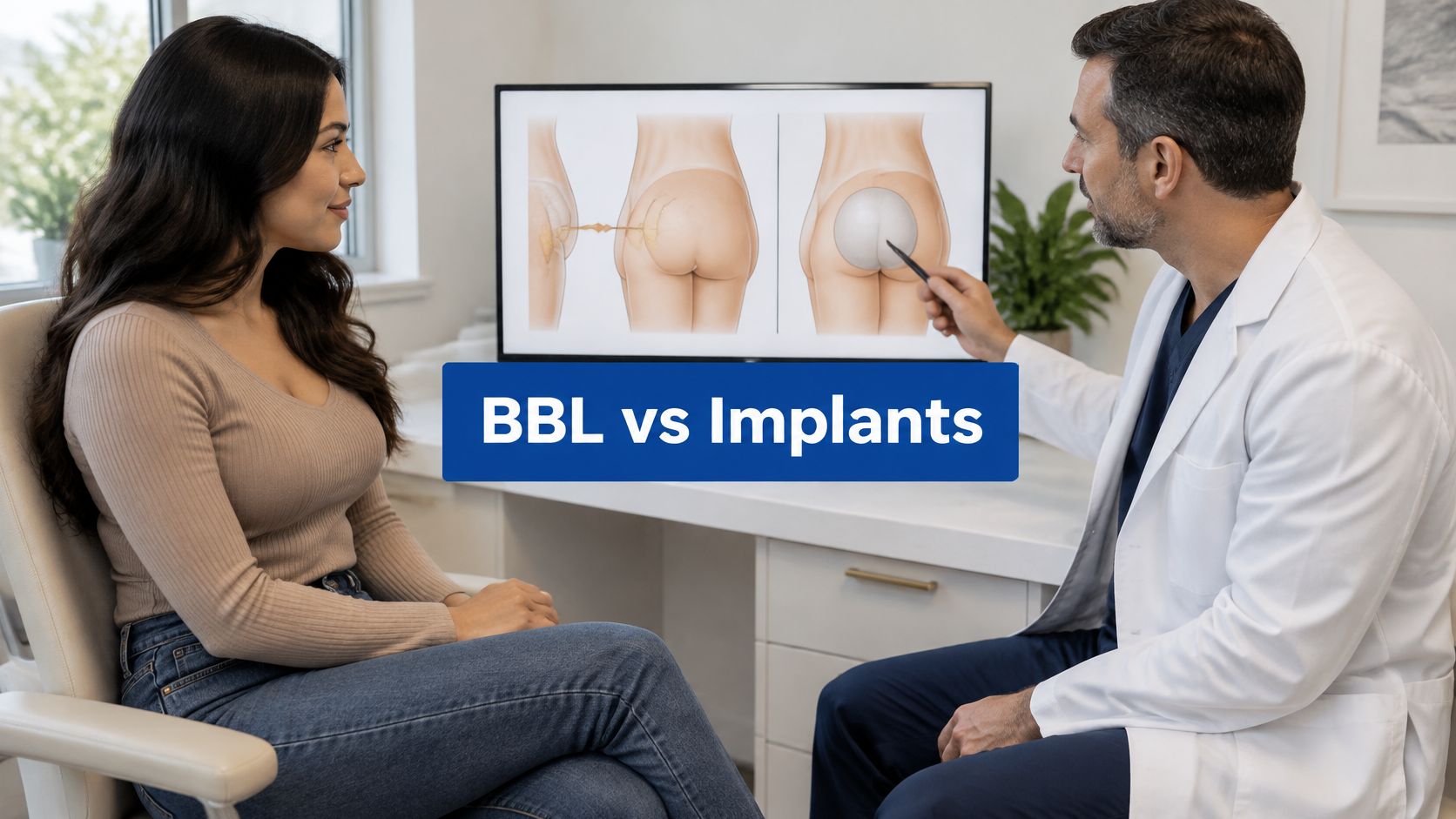
A 2018 survey of Brazilian plastic surgeons estimated the death rate from gluteal fat grafting at 1 in 20,117 cases, and found the risk of death was 16 times higher when fat was injected into the gluteal muscle rather than kept in the subcutaneous layer (National Center for Biotechnology Information). That one comparison explains the bbl vs butt implants question better than any before-and-after gallery. The variable that decides whether a patient is safe isn't fat versus silicone. It's depth, plane, and who is holding the cannula.
Most comparisons end at the first result, the shape you see once swelling settles. This one follows the result forward: how much of the transferred fat survives, what happens to each option when body weight moves, and what a revision costs you in time and recovery.
Table of Contents
- BBL and Butt Implants Compared at a Glance
- How Each Procedure Works and Which Fits Your Body
- Complication Rates Behind the Numbers
- Safety Protocol Questions to Ask Before Surgery
- Results, Recovery and Revision Over Time
- Book a Consultation for Your Specific Case
BBL and Butt Implants Compared at a Glance
A BBL uses a patient's own fat; butt implants use manufactured silicone devices. That difference shapes the donor-site requirements, the degree of volume predictability, whether other areas can be contoured, and the options available if revision is needed.
| Criterion | BBL (fat transfer) | Butt implants |
|---|---|---|
| Material | Patient's own fat | Manufactured silicone device |
| Donor site needed | Yes, liposuction from abdomen, flanks or thighs | No |
| Volume | Variable, depends on fat survival | Fixed, set by device size |
| Contouring of other areas | Yes, donor areas are reshaped | No |
| Main safety concern | Fat embolism if fat is injected too deep | Pocket-related problems and device issues |
| Revision path | Additional fat grafting | Implant revision or removal |
Procedure counts show that fat transfer was more common than implants in the cited data. The American Society of Plastic Surgeons recorded 28,076 gluteal augmentations with fat grafting and 970 gluteal implant procedures in 2019, a ratio of about 29 to 1. Separate 2021 Aesthetic Society data counted 61,387 buttock augmentations using either fat grafting or implants, placing the procedures among established options for gluteal enhancement by the early 2020s (Aesthetic Surgery Journal).
These figures describe procedure volume, not how long results last or how often patients need revision. Those outcomes depend on the procedure and the patient. For a BBL, the amount of fat retained and later weight changes affect the result; implants provide device-defined volume, with a different revision path.
How to use the table: Consider whether you have harvestable fat in the abdomen, flanks or thighs, then decide whether you prefer volume based on transferred fat or a device-defined size.
If donor fat is limited, a BBL may offer less scope for augmentation. If donor areas also need contouring, fat transfer can address both goals in one operation. Neither factor alone determines which procedure is appropriate.
How Each Procedure Works and Which Fits Your Body
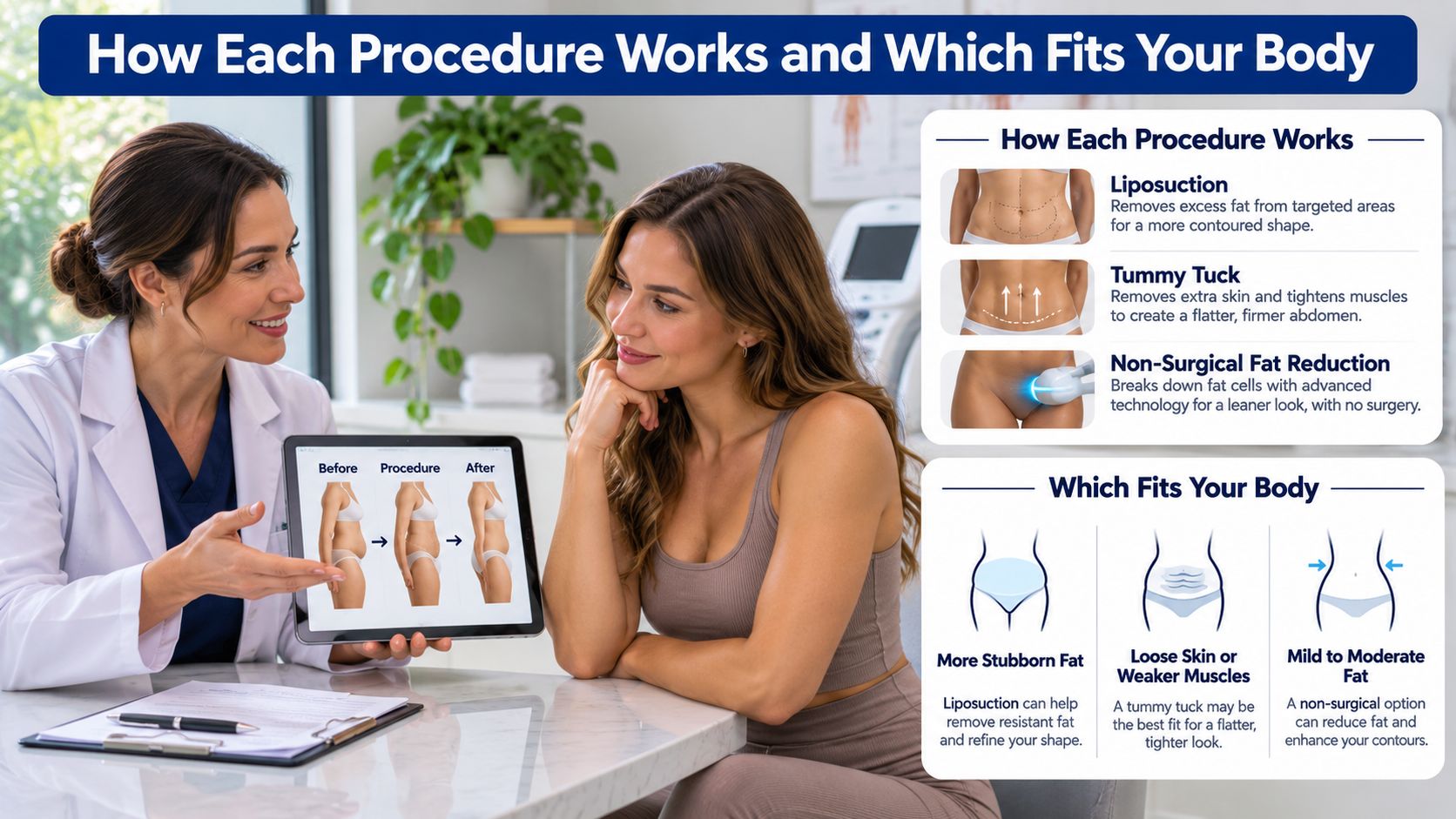
The first result is only part of the comparison. With fat transfer, the eventual shape depends partly on how much transferred fat survives and how body weight changes. Implants provide fixed volume, but later changes in surrounding tissue can alter how they look.
How a BBL works
Liposuction removes fat from donor areas, often the abdomen, flanks or thighs. The fat is processed and transferred in thin passes into the tissue beneath the skin over the buttocks and hip dips. This can add volume while reshaping the areas from which fat was taken.
Transferred fat must establish its own blood supply, so the amount that remains varies between patients. That variability affects the shape after healing and can influence whether further treatment is considered (research on fat survival after gluteal fat grafting).
Injection depth is a key safety consideration. A 2026 systematic review of 22,151 patients reported a pooled pulmonary-embolism incidence of 0.04% and found lower complication rates with ultrasound-guided, subcutaneous-only injection than with deeper or combined approaches.
How butt implants work
An implant provides volume without relying on harvestable fat. It sits within a surgically created pocket, and its projection does not change directly with weight fluctuations. A systematic review of implant and lipoplasty procedures reported potential issues including palpability, contour irregularity, malposition and removal. Its pooled implant-removal rate was 1.70%. Reported risks also varied by placement plane: intramuscular placement had wound dehiscence of 14.56% and hematoma of 1.10%, while submuscular placement had a reported sciatic-neuropathy rate of 3.91% (systematic review of gluteal implants and lipoplasty).
| Placement plane | Reported risk |
|---|---|
| Pooled implant removal, all planes | 1.70% |
| Intramuscular placement | Wound dehiscence 14.56%, hematoma 1.10% |
| Submuscular placement | Sciatic neuropathy 3.91% |
Matching the procedure to your body
A patient with little harvestable fat may consider implants or staged fat transfer if enough donor volume becomes available. Someone seeking reshaping of the waist and hips along with buttock volume may find fat transfer a better match, since liposuction addresses the donor areas as part of the procedure. These are starting points for discussion, not fixed rules. The BBL procedure, from fat harvest through transfer, helps clarify what the operation entails.
Consider how your priorities may hold up over time:
- You want pronounced, fixed projection. Implants provide volume that does not depend on fat survival. Discuss the placement plane, incision and tissue coverage alongside the size.
- Your weight may change substantially. Transferred fat can shrink or grow as body weight changes; an implant's volume remains fixed, while the surrounding body may change. A stable weight can make the intended shape easier to assess.
- You already have an implant you want changed. Discuss revision or removal options before considering another augmentation.
- You prefer not to have an implant. Fat transfer avoids an implant device, but the final volume depends partly on fat retention.
Ideal Face & Body offers the Awake Butt Lift® (Awake BBL), which transfers a patient's own fat to the buttocks and hip dips.
The best fit depends on the tissue available, the desired shape and how the result may change with weight and healing. A plan should account for the possibility that the first result may not be the final one.
Complication Rates Behind the Numbers
A comparative review of 2,312 gluteal augmentation procedures reported different overall complication rates for implants and fat grafting. The figures below describe those studies, not a controlled head-to-head comparison.
| Complication | Implants | Fat grafting |
|---|---|---|
| Overall complication rate | 25% | 13% |
| Wound dehiscence | 9.16% | Not reported among leading complications |
| Excessive implant palpability | 5.92% | Not applicable |
| Seroma | 3.82% | 6.9% |
| Infection | Not reported among leading complications | 3.0% |
| Transient sciatic paresthesia | Not reported among leading complications | 1.0% |
Source: American Society of Plastic Surgeons gluteal fat grafting safety advisory. The review covered 524 implant cases and 1,788 fat-grafting cases.
The studies combined different patient populations, implant planes, graft volumes and follow-up periods. The percentages therefore do not establish that one procedure is safer for a particular patient. They show different reported complication patterns: implant cases included wound and device-related problems, while fat-grafting cases included fluid collections and other complications.
A separate 2024 analysis of documented gluteal fat-grafting and augmentation complications found that wound infection accounted for 22.3% of reported complications, 12.6% of affected patients underwent reoperation, and four deaths were described (analysis of documented gluteal augmentation complications). These figures describe a collection of reported complications, not the rate among all patients who undergo surgery.
A small 2024 retrospective study of 50 implant-based buttock augmentations reported a 6.0% complication rate (retrospective study of implant-based buttock augmentation). A single-team case series cannot set a general risk estimate. Differences in patient selection, surgical technique and follow-up help explain why published rates vary.
The practical question is how a complication could affect the result over time. A wound problem or fluid collection may require treatment; some complications lead to reoperation. For fat grafting, the final result also depends on how much transferred fat survives and how the patient's weight changes. Rates from historical studies cannot predict an individual outcome, so discuss the study population and follow-up alongside any percentage.
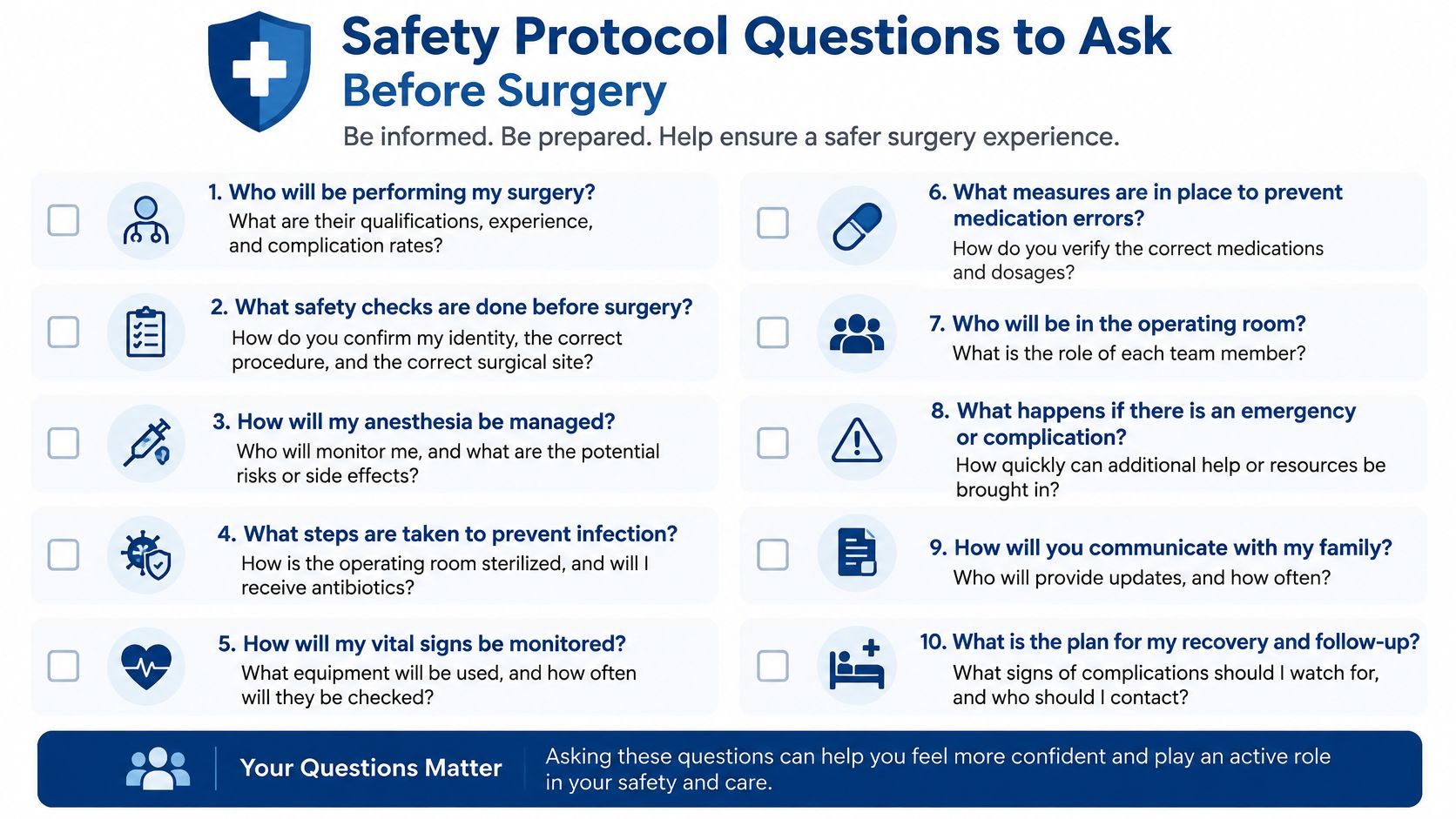
Safety Protocol Questions to Ask Before Surgery
Safety isn't a property of a procedure name. It's a property of technique and setting, and each option fails in a different way. For fat grafting, major professional-society guidance recommends injecting only into the subcutaneous space above the gluteal fascia and avoiding intramuscular or submuscular placement, because a deep cannula can cause fatal pulmonary fat embolism. Intraoperative ultrasound is recommended by several regulatory and professional bodies to verify cannula position in real time, with the explicit caveat that ultrasound reduces risk rather than eliminating it (Modern Aesthetics).
Implants fail differently. They carry no injected-fat embolism risk, but they need a pocket created and maintained, and the reported problems are device and pocket problems: wound dehiscence, palpability, seroma, malrotation, infection, extrusion, and eventual revision or explantation.
That's why the useful question isn't which procedure is safer. It's what protocol the surgeon follows, and whether you can verify it.
The questions that actually change your risk
Ask them in this order, and write down the answers:
- Cannula depth and plane. For fat transfer, will the fat go into the subcutaneous layer only, and how is that confirmed during surgery? A vague answer about "experience" isn't an answer.
- Ultrasound. Is real-time imaging used to track cannula position, and who operates it?
- Facility accreditation and emergency readiness. If something goes wrong, what's in the room, who responds, and how fast can a patient be transferred?
- Surgeon credentials. Board certification, volume of this specific procedure, and whether the surgeon or a delegate performs the injection.
- Thromboembolism prevention. What's the plan for clot risk: positioning, compression, mobilization, medication?
- Anesthesia and monitoring. Which sedation plan, who is monitoring, and what's the rescue pathway?
- Setting. Office-based or hospital-based, and what that choice changes about your anesthesia options.
Questions 6 and 7 apply directly to awake surgery. An office-based, local-anesthesia case has a different monitoring and rescue profile than a hospital general-anesthetic case. That's not a downside, but it's a conversation you should have explicitly rather than infer from a brochure.
A newer favorable series from an experienced team doesn't automatically transfer to your case, because most such reports are non-comparative case series rather than controlled studies. Our safe fat transfer to the buttocks approach is built around awake, office-based surgery under local anesthesia, which makes the anesthesia plan, monitoring and patient selection part of the first conversation instead of an afterthought.
Results, Recovery and Revision Over Time
Fat transfer and implants involve different recovery demands. With fat transfer, the donor areas recover from liposuction while the buttocks need time for the grafted fat to establish a blood supply. With implants, healing centers on the incision and the tissue around the implant pocket. Swelling takes weeks to settle, so the early shape is not the final result.
What survives, and for how long
Fat retention varies, and no surgeon can guarantee how much transferred volume will remain. A published series of 7,000 patients estimated approximately 70% graft survival and reported revision surgery in 0.21% of cases (the published BBL patient series). Those results describe that study population; they should not be treated as a prediction for an individual patient.
Transferred fat can add volume while contouring the waist, hips, and nearby areas. An implant adds volume within a single pocket, so it does not reshape surrounding areas in the same way.
Implants have a different set of possible long-term problems, including visibility or palpability, wound issues, fluid collection, migration, infection, and eventual removal or replacement. The implant complication figure discussed in the previous section reflects a particular study population, not a universal rate.
By year three, the practical question is whether the result remains acceptable after changes in weight, shape, or personal preference. Significant weight changes can affect the appearance of transferred fat, while an implant may require attention if its position or surrounding tissue changes.
The correction menu, separate from the first decision
- Top-up fat grafting. Additional fat can address lost volume or asymmetry, with a separate recovery period.
- Implant revision or removal. A surgeon may reposition an implant, exchange it, or remove it, with the pocket managed as needed.
- Scar management. Liposuction entry points and implant incisions heal differently, and either may need attention.
- Staged contouring. A second, smaller procedure may be considered after the tissues have settled.
- Reduction. Some patients seek less volume after an initial enhancement. Ideal Face & Body offers BBL reduction and revision to reshape and reduce enhanced buttocks for a more proportionate appearance.
Weight stability affects how long BBL results last, so understanding the longevity of BBL results can help set expectations before surgery.
Book a Consultation for Your Specific Case
A useful consultation turns your goals into a plan tied to your anatomy and priorities. Bring recent photographs from several angles, and point out the areas you want to change. “More volume” can mean fullness in the upper buttock or added contour at the hip dips.
Ask how the surgeon would assess your available donor fat and what follow-up might be needed. For fat transfer, discuss the expected result in your case and what another procedure could involve. For implants, ask about placement, the implant pocket, and options if you later want revision or removal.
Request a clear explanation of the safety protocol, including the anesthesia plan, how the procedure is performed, and who monitors you. Also ask to see before-and-after photos of patients with similar goals, then record the recommendation and the reasons behind it.
Ideal Face & Body offers Brazilian Butt Lift fat transfer, BBL reduction and revision, breast augmentation with implants, implant revision and removal, and awake procedures including the Awake Butt Lift®. A complimentary virtual surgical pre-screening with a surgical consultant is available to discuss goals and options. Fees vary by practice, location, and treatment plan, so request a written quote.
A good recommendation should connect your anatomy and goals to the expected outcome, follow-up, and possible revision needs. Visit Ideal Face & Body to begin the conversation with your questions and photos.