The advice you hear most often sounds sensible. If you're anxious, ask to be put under. If you can handle it, local numbing is enough. That advice misleads in two directions at once. It turns two levels of support into rival camps, and it assumes that awake means you'll feel everything while sedated means you'll be unconscious.
Neither is reliably true. Local anesthesia and IV sedation sit on the same ladder of anesthetic support, and plenty of office procedures use both at the same time: a numbing agent controls pain at the treatment site while a sedative calms the mind. What moves you up or down that ladder is procedure length, how much stimulation the surgery involves, your medical history and how much you want to remember afterward.
That makes the honest version of the local anesthesia vs IV sedation question narrower than the internet suggests. Not which is better in general, but which level fits your procedure, in your body, on your schedule.
Table of Contents
- Local Anesthesia and IV Sedation Side by Side
- How Each Approach Works in the Body
- Comfort, Awareness and Memory During the Procedure
- Safety, Monitoring and Complication Rates
- Recovery, Discharge and What Happens at Home
- Matching the Method to Your Procedure and Health
- Confirm the Right Approach With Your Clinician
Local Anesthesia and IV Sedation Side by Side
The short answer is that these aren't competing techniques. They're different levels of anesthetic support, and many procedures use both together. The table below sets them side by side on the criteria that change how your day feels.
| Criterion | Local anesthesia | IV sedation |
|---|---|---|
| What it targets | Pain signals at the treatment site | Anxiety, awareness and memory through centrally acting medication |
| Consciousness | Patient stays awake and can respond | Ranges from light relaxation to deep sedation |
| Breathing | Usually spontaneous and largely unaffected | Can be reduced in a dose-dependent way; oxygen may be needed |
| Monitoring | Vital signs at regular intervals plus patient feedback | Continuous assessment of ventilation, oxygenation and hemodynamics, with capnography for moderate and deep sedation |
| Recovery | Fewer sedative-related recovery requirements | Recovery observation and discharge criteria required; prolonged recovery reported in a small share of cases |
| Typical use | Focused procedures where infiltration controls discomfort | Longer, more stimulating procedures or high anxiety |
| Main trade-off | Injection discomfort and full awareness | Added monitoring, medication variability and possible delayed discharge |
Each row is a separate decision, and each one carries different weight depending on the procedure. Consciousness decides whether you can answer a question halfway through or move a limb when asked. Breathing decides how much monitoring equipment and standby rescue capacity the room needs. Recovery decides whether you drive yourself home or arrange an escort and clear your afternoon.
Start with the row that worries you most, then read the section that explains why the difference exists. If it's breathing, go to safety and monitoring. If it's memory, the comfort and awareness section covers it. If it's how soon you can return to work, jump to recovery and discharge.
Sedation depth is often described in tiers, and if you want a plain-language walkthrough of those tiers written for a different clinical setting, sedation levels for anxious implant patients from Winn Smiles lays them out clearly. The vocabulary transfers even when the procedure doesn't.
How Each Approach Works in the Body
Local anesthesia works at the site. A clinician injects an agent into the tissue being operated on, and that agent blocks pain signals from travelling along the nerves serving that area. You stay conscious. You can speak, swallow, answer questions and move a hand or leg on request, and the numbness stays confined to the region that was infiltrated rather than spreading through your body.
The two options differ in where they act, not in whether they work.

IV sedation works on the brain. Medication goes into a vein and reduces anxiety, awareness and sometimes memory, with depth running from minimal sedation, where you're relaxed but fully conversational, through moderate sedation, to deep sedation, where you're barely responsive to repeated stimulation. Oxford Academic's review of anesthesia in office-based settings describes the two as different levels of anesthetic support rather than mutually exclusive techniques, and that's the frame worth carrying into your consultation.
Three plans cover most patients
- Local infiltration alone for a short, focused procedure where numbing the treatment area controls the discomfort completely and your cooperation is useful.
- Local anesthesia plus light IV sedation for a longer or more stimulating operation, where the site still gets numbed but the anxiety and the awareness of the room are turned down.
- A deeper anesthetic plan when medical risk, procedure length or surgical complexity calls for it, delivered in a setting with the staffing and rescue equipment that depth requires.
Four factors set which plan you land in: procedure length, surgical stimulation, medical risk and patient preference. None of them is a verdict on your pain tolerance.
The practical consequence is breathing. Local anesthesia generally preserves spontaneous breathing and protective airway reflexes, while IV sedation can produce dose-dependent respiratory depression, which is why it demands continuous monitoring, trained personnel, rescue equipment and a period of recovery observation. That's the reason sedation adds time and staffing to a schedule.
The distinction that matters: awake describes your level of consciousness, not your level of comfort.
So check two assumptions at the door. Awake does not mean pain-free, because the area is numbed even though you're conscious. Sedated does not automatically mean general anesthesia, where you're unconscious and your airway is managed for you. Most sedation sits well short of that.
Comfort, Awareness and Memory During the Procedure
Ask a patient who had surgery under local anesthesia alone and the description usually comes in three beats. There is a brief sting or burn as the injection goes in, often the sharpest moment of the whole experience. Then the area goes quiet and heavy. Then you spend the procedure awake, hearing the room, answering questions and moving when asked, feeling pressure and movement rather than sharp pain.
IV sedation changes the middle of that sequence. Anxiety drops, awareness narrows, and memory may not record the procedure at all. Accounts of how that altered awareness feels, including Grand Parkway Smiles on IV sedation, describe a drowsy, time-compressed experience where the appointment seems to end shortly after it begins. Some patients find that gap a relief, especially if they have had a difficult medical experience before. Others find it unnerving to lose a stretch of time they cannot account for. Both reactions are normal, and both are worth saying out loud before the plan is set.
One detail matters here. Sedation usually does not replace the numbing at the site. The local anesthetic still does the pain control while the IV medication quiets the mind, so a sedated patient still gets infiltrated tissue. The two layers do different jobs, which is why clinicians combine them so often instead of choosing between them.
Lips are a good illustration of how sensation behaves after local-only work. Numbness outlasts the procedure itself, and it fades on its own schedule. If you have ever wondered when lip numbness wears off after a dental visit, the physiology carries over to cosmetic work: the agent has to diffuse away from the tissue before full sensation returns, and you feel it come back in stages rather than all at once.
A three-question self-check
Answer these before you book, because each answer points somewhere different.
- How do you feel about needles? A strong aversion points toward discussing light sedation, since the injection is the part you would dread rather than the surgery.
- Can you lie still for the full procedure? If stillness is hard, either from back pain or restlessness, a sedated plan may serve you better than a local-only one.
- Do you want to remember it? A wish to forget points toward sedation. A wish to stay alert and in control points toward local anesthesia alone, confirmed by your clinician.
At Ideal Face & Body, awake plastic surgery uses only local anesthesia, so patients stay conscious and numb throughout. The Awake Breast Lift is performed in the office with the patient relaxed on oral medications and fully numbed with freshly mixed local anesthesia. For a longer walkthrough of what staying awake during an operation feels like, this guide to being awake during surgery covers it step by step.
Numbness is a sensory state. Sedation is a state of mind. You can have either one, both, or neither.
Safety, Monitoring and Complication Rates
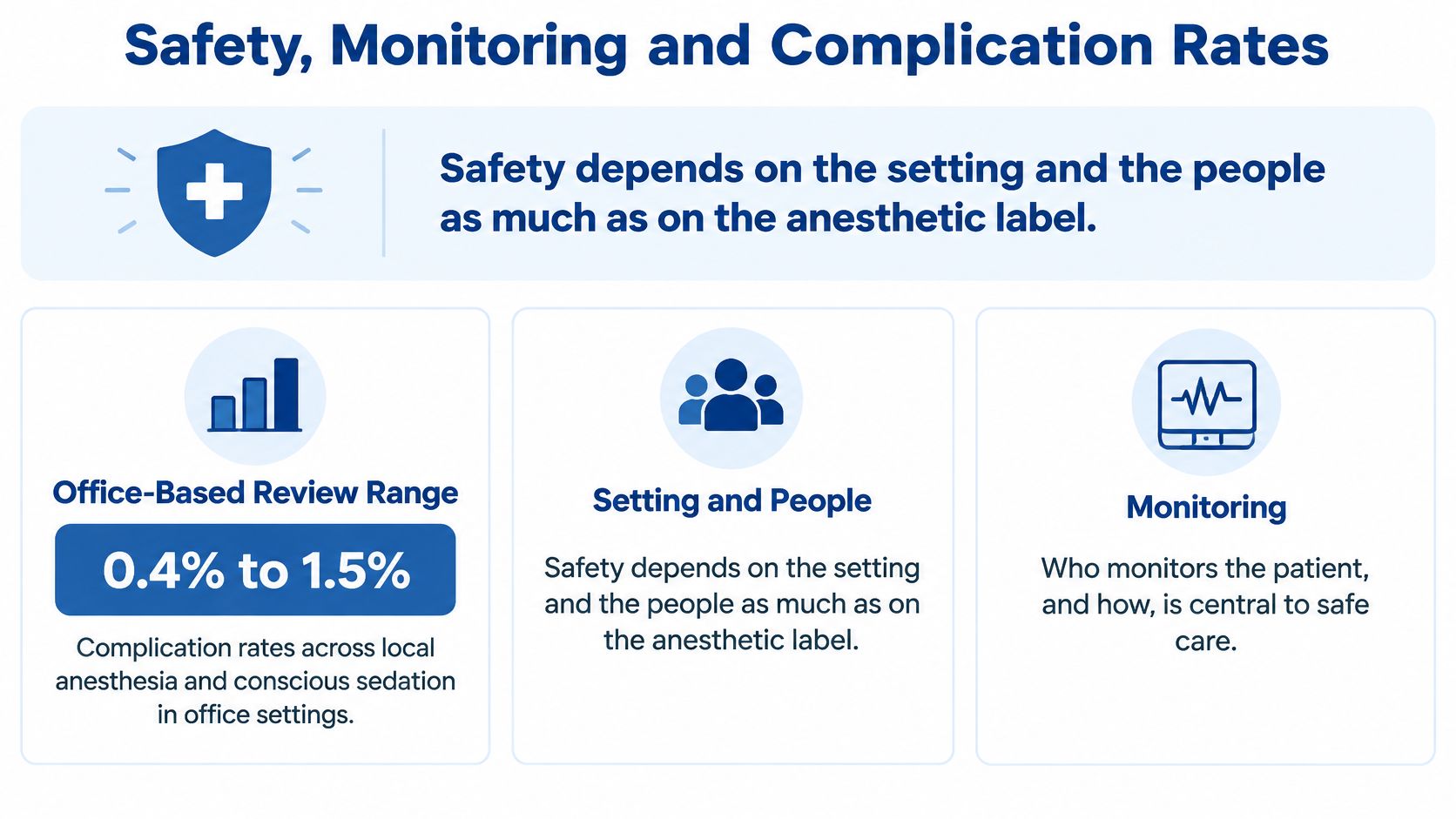
Fewer drugs does not automatically mean safer. That instinct pushes patients toward local anesthesia, and the same instinct in reverse pushes others toward sedation for comfort. Safety tracks the setting and the people in it as closely as it tracks the anesthetic label, because sedation is a layer of support added on top of numbing, not a separate risk category.
A review of office-based anesthesia published in Anesthesia & Analgesia's analysis of office-based anesthesia safety and outcomes cited complication rates of 0.4% to 1.5% across local anesthesia, conscious sedation and general anesthesia. Within that range, reported events included respiratory complications at 0.3%, cardiac arrhythmia at 0.1%, syncope at 0.1%, prolonged recovery at 0.2%, and seizure or neurologic impairment below 0.1%. Those figures describe office-based anesthesia as a category, not one method inside it, so they cannot tell you which single approach is safest for you.
A large office-based plastic-surgery series using monitored anesthesia care or IV sedation found no deaths, no ventilator requirements and no deep-vein thromboses, though nausea, vomiting, airway events and occasional hospital admission still appeared. Local-only care carries its own list: local anesthetic toxicity, vasovagal events, bleeding and airway problems remain possible, so each path requires structured emergency preparedness. Credentials matter here more than labels. Sarah Yovino, MD, a double board-certified anesthesiologist specializing in medical aesthetics and whole body rejuvenation, works in exactly this territory, matching the depth of support to the procedure rather than defaulting to a label.
What each approach has to watch for
The American Society of Anesthesiologists' moderate-sedation guidance calls for continual assessment of consciousness, ventilation, oxygenation and hemodynamics, with capnography supplementing observation and pulse oximetry and vital signs commonly recorded every 5 minutes once sedation is stable, as set out in the ASA practice guidelines for moderate sedation.
| Approach | Monitoring in place | Preparedness required |
|---|---|---|
| Local anesthesia only | Vital signs at regular intervals; patient communication as feedback | Local anesthetic toxicity, vasovagal and bleeding response plans |
| Moderate IV sedation | Continuous assessment of consciousness, ventilation, oxygenation and hemodynamics; pulse oximetry and capnography; vital signs commonly every 5 minutes once stable | Dedicated sedation monitor, airway rescue equipment, trained staff |
| IV sedation with recovery | Ongoing monitoring until recovery criteria are met | Recovery assessment, escort rules and discharge criteria |
Read that table as a staffing plan rather than a risk ranking. Each added level of sedation brings more comfort and more monitoring duty at the same time, which is why a sedated patient is never "put under" the way general anesthesia implies. In either model, safety rests on screening, airway preparedness, physiologic monitoring, qualified supervision and a defined recovery process. Before any procedure, ask a direct question: who will be watching me for the entire operation, and what are they watching for? For a closer look at how complications get caught early in facial procedures, this overview of eyelid surgery risks shows what vigilant monitoring looks like in practice.
Recovery, Discharge and What Happens at Home
Recovery runs on two clocks at once, and confusing them is where patients get tripped up. The first clock is the numbing medicine wearing off. The second is the sedative leaving your system. Local anesthesia alone starts only the first clock. Adding IV sedation starts both, and the second one runs longer than many patients expect.
The newest same-day data on the sedation side are reassuring. A 2025 retrospective audit of 4,397 consecutive office-based aesthetic procedures using IV sedation, reported in this audit of IV sedation outcomes in office-based aesthetic procedures, found no major cardiopulmonary events, with a 95% confidence interval of 0.00 to 0.08%, prolonged recovery in 75 cases, or 1.7%, and every patient discharged the same day.
Those numbers carry a built-in limit. The audit was not randomized and had no local-only control group, so it shows that IV sedation can run with a low major-event rate when trained clinicians, monitoring, screening and rescue systems are in place. It cannot rank one approach above the other.
The first clock moves on its own schedule. Patients who had local anesthesia alone often ask about the lingering numbness, the same question behind when lip numbness wears off after dental work, because feeling returns gradually rather than all at once. Awake and numb during surgery does not mean instantly back to normal afterward.
The second clock sets the discharge timeline. Local-only pathways generally sidestep sedation-related recovery delay and oxygenation checks. IV sedation adds observation time before anyone hands you discharge papers, plus an escort, since grogginess, nausea and slowed judgment can outlast the point where you feel fine.
Before you book: ask who stays with you, for how long, and what the clinic does if you feel sick on the way home.
What to ask before you're discharged
- When exactly will I be cleared to leave? Ask for the criteria, not just an estimate, so you know what has to happen first.
- Who must stay with me, and for how long? Escort rules vary and are generally required after sedation.
- What do I do if nausea or breathing trouble starts at home? Get a phone number and a clear threshold for calling versus returning.
- Can I drive, work or sign documents? Sedation affects judgment and reaction time well past the point where you feel normal.
- What should the person with me watch for? Give your escort specific signs rather than a vague instruction to keep an eye out.
Matching the Method to Your Procedure and Health
Four factors decide this, and they pull in different directions. Procedure length and invasiveness set the floor of what's needed. Your medical risk sets the ceiling. Your tolerance for awareness shapes the middle. And your priority between comfort and a fast return to normal decides which side of the trade-off you'd rather live with for a day.
Short, focused procedure where infiltration controls discomfort. Local anesthesia alone usually fits, keeping breathing, cooperation and feedback intact.
Longer or more stimulating procedure. Local anesthesia with IV sedation is the usual pairing, reducing anxiety and awareness at the cost of added monitoring.
High anxiety or fear of awareness. Light IV sedation on top of local anesthesia improves tolerance, reviewed by the clinician first, with memory effects discussed before the plan is set.
Sleep apnea, respiratory disease or obesity. Individual clinician review comes before any sedation, because airway management becomes the deciding concern.
Regular medications or prior sedation problems. A medication and history review shapes the plan, since interactions and recovery effects vary by patient.
A comparative study summarized in sedation and recovery outcomes compared with spinal anesthesia found that IV sedation combined with local anesthesia produced lower 24-hour pain scores and earlier discharge readiness than spinal anesthesia, while hypoxemia and oxygen supplementation were more frequent with IV sedation. That wasn't a cosmetic-surgery comparison, yet the shape of the finding holds: sedation can improve the experience and speed some milestones while adding respiratory demands.
When the trade-off shifts
The conditions above are starting points, not verdicts. A prior bad reaction to sedation is one of the most useful things you can tell a clinician, because it changes which agents, doses and monitoring the team chooses.
Two clarifications prevent most regret. Local anesthesia can involve real injection discomfort and full awareness of the room, so it isn't the effortless option. And IV sedation sits on a spectrum: light sedation is a long way from general anesthesia, and the planned depth, rather than the delivery route, is what determines how aware you are. Sedation medications also keep being refined, which tells you the field is still working on recovery quality, not only on depth.
Awake liposculpting shows this matching at work: numbing alone does the job for a procedure that would otherwise call for sedation. The walkthrough of liposuction performed under local anesthesia shows what that plan looks like in practice.
The question to end on: which combination gives you enough pain and anxiety control with the least disruption to your breathing, thinking, mobility and recovery?
Confirm the Right Approach With Your Clinician
Bring questions in writing. Conversations in a consultation room move quickly, and the details that matter are the ones you'd otherwise reconstruct from memory on the drive home. These six cover the ground:
- What exactly will I feel, remember and be able to communicate? Ask for specifics on sensation, memory and whether you can speak during the procedure.
- Who will monitor me, and how? You want a name and a role, not a general assurance that someone is nearby.
- What depth is planned, and what would change it mid-procedure? Ask what triggers an adjustment and who makes that call.
- What rescue equipment and trained staff are on site? Airway equipment and a person trained to use it should be answerable in one sentence.
- What fasting, escort and discharge rules apply? Get these before you schedule, since they affect your ride and your day.
- How do my breathing, sleep, medications and past sedation experiences change the plan? The plan should be personalized rather than generic.
One more distinction worth confirming, because the words sound alike. IV infusion therapy, the kind offered for hydration and wellness, is a separate service from IV sedation for surgery. If you hear "IV" in a cosmetic practice, ask which one is meant. Ideal Face & Body, a Beverly Hills practice focused on awake, office-based procedures, is led by Justin Yovino, MD, FACS, with Sarah Yovino, MD, an anesthesiologist, and offers both in-person and virtual consultations to discuss IV therapy options, so the two conversations don't get blurred.
The sedation guidance used by state nursing boards makes this concrete. As described in the Oregon State Board of Nursing sedation guidelines, moderate and deep sedation differ substantially in responsiveness, airway risk, monitoring, recovery and memory, and continuous assessment covers airway patency, ventilation, oxygen saturation, blood pressure, heart rate and consciousness. That's why "what will I feel" and "who is dedicated to monitoring me" belong in the same conversation.
Write down three things before you call: the procedure you're considering, your health history including sleep and medications, and your personal priority between comfort and a quick return to normal. Then book the consultation early enough that the plan is settled well before the day of surgery, not on it.
At Ideal Face & Body in Beverly Hills, awake surgery under local anesthesia is the default rather than the exception, and procedures like PRECISION SCULPT laser liposculpting and the Awake Breast Lift are performed in the office with patients numb and conscious throughout. If you're weighing local anesthesia vs IV sedation for a body, breast or facial procedure, we'll walk through your health history, your procedure length and what you want the day to feel like, then confirm the level of support that fits. Visit Ideal Face & Body to book a consultation, in person or virtually, and settle the plan before surgery day arrives.