Most patients return to desk work within 2 to 5 days after laser liposuction, with lighter activity resuming quickly. Full swelling resolution and the final contour can take several weeks to months to fully settle.
You may be trying to schedule treatment between work deadlines, family commitments, travel, or an important social event. The practical question usually isn't whether you can walk after the procedure. It's whether you'll be comfortable sitting at a desk, driving, changing clothes, exercising, and being seen in public while your body is still swollen.
The useful way to understand laser liposuction recovery time is to separate three milestones: returning to work, returning to exercise, and reaching your final contour. Laser assistance may make the early experience easier than traditional suction techniques, but it doesn't make swelling disappear immediately or eliminate the need for careful aftercare.
Table of Contents
- Understanding Your Laser Liposuction Recovery Timeline
- The Recovery Phases After Laser Liposuction
- Factors That Influence Your Individual Recovery Speed
- Managing Pain and Swelling During Recovery
- Activity Restrictions and Exercise Guidelines
- Tips to Optimize Your Healing Process
- When to Expect Final Results
Understanding Your Laser Liposuction Recovery Timeline
A patient planning treatment around a busy calendar often imagines recovery as a single date. In reality, recovery is a sequence. You may be mobile soon after treatment, capable of desk work a few days later, and still notice firmness, uneven swelling, or numbness long after you feel functional.
That distinction matters. A person with a computer-based job may manage a return sooner than someone who stands, lifts, drives for long periods, or works in a physically demanding setting. The treatment area matters too. A small contouring procedure can feel very different from treatment across several larger areas.
Recovery is a series of milestones
The first milestone is functional recovery, meaning you can walk, use the bathroom, prepare simple food, and manage basic daily tasks. The next is work recovery, which depends on your job and how much swelling or soreness you can tolerate. Exercise recovery comes later because strenuous movement places different demands on healing tissue.
The final milestone is visual recovery. Bruising may fade while swelling remains. One side may look more defined than the other during healing. Temporary firmness or numbness can make the result feel unfinished even when the procedure has gone as planned.
Before booking, learn exactly how laser liposuction is performed and ask which recovery milestone your clinician is describing. “Back to normal” should mean something specific, such as walking comfortably, returning to desk work, resuming workouts, or seeing the final contour.
Practical rule: Plan time away from work based on your job demands, not only on the earliest possible return reported by another patient.
Contemporary evidence supports a pattern of faster early recovery with energy-assisted techniques, including laser-assisted lipolysis, compared with conventional suction methods. However, the quality of evidence for recovery outcomes remains low to very low because studies use different techniques, patient groups, and definitions of recovery, so no single timeline applies to everyone (systematic review of contemporary energy-assisted liposuction).
The Recovery Phases After Laser Liposuction
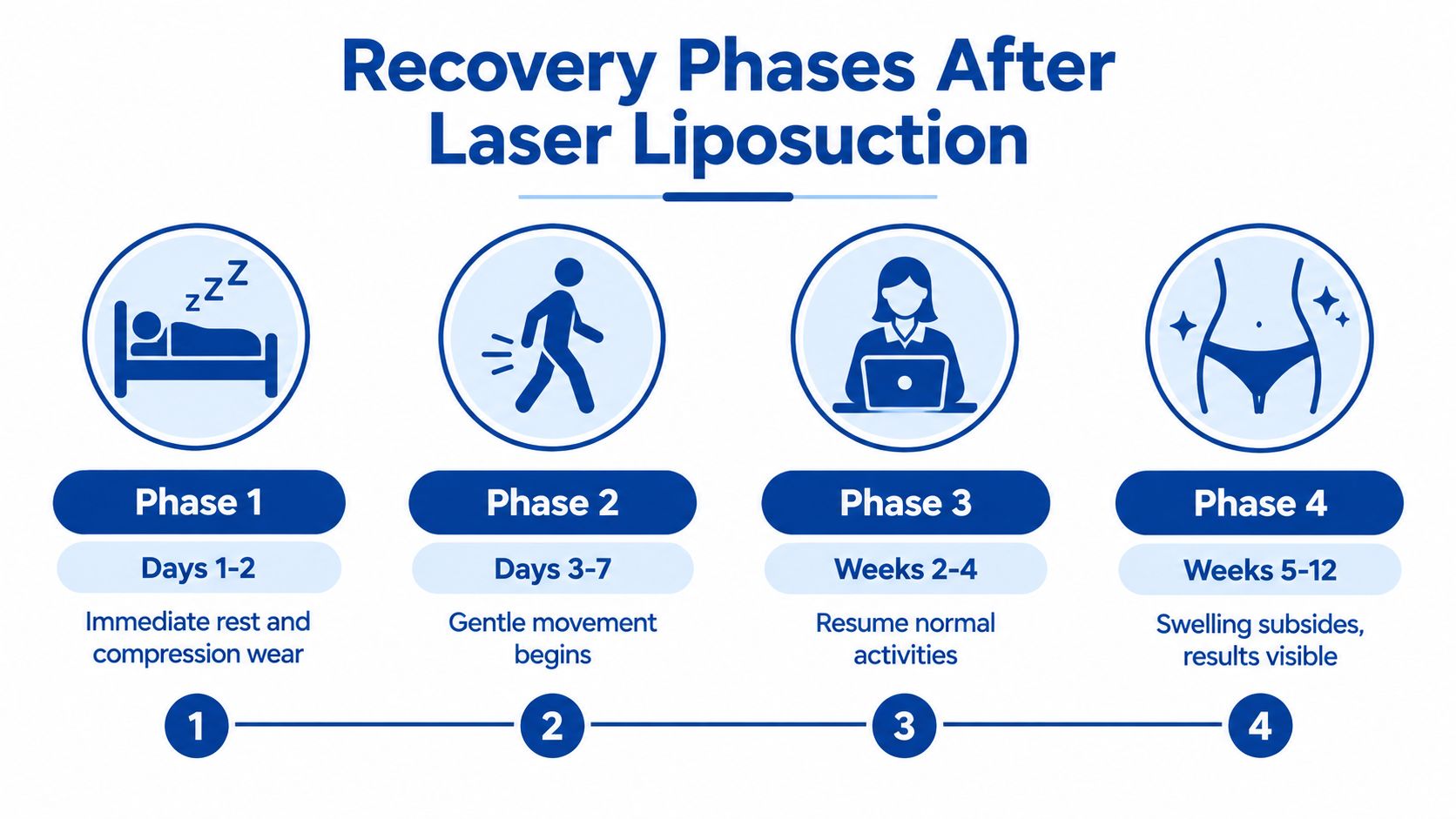
Laser liposuction recovery is easier to manage when each milestone has a clear purpose. The first days protect treated tissue, the next weeks restore comfortable movement, and the following months allow swelling, skin, and deeper tissues to settle. The laser component may reduce early tissue disruption compared with more extensive conventional suction, but it does not eliminate inflammation or shorten every phase equally.
The first days
During the first 24 to 48 hours, rest, compression, and brief, gentle walks usually take priority. Soreness, swelling, bruising, tightness, and mild drainage from the access points can occur. The treated area will not look smooth immediately, and early asymmetry does not by itself indicate a problem.
Walk for circulation, not to test endurance. Arrange help with transportation and heavier household tasks, follow the prescribed medication plan, and keep your follow-up instructions available. Contact your clinician if symptoms differ from the instructions you received.
Days two through seven
Patients often become more independent during this phase, although swelling may make clothing tight and movement awkward. Desk work may be reasonable once you can sit comfortably and manage pain without repeatedly changing position. The second and third days are often the least comfortable because swelling can be more noticeable, so an early return does not always feel like a practical one.
Work involving prolonged standing, lifting, or repeated bending usually requires more recovery time. The American Society of Plastic Surgeons describes return to work within a few days after assisted liposuction, with soreness and swelling continuing for several days (assisted liposuction recovery guidance). Your clinician's instructions take priority because the treated area and treatment extent determine how much activity the tissues can tolerate.
Weeks two through four
Everyday movement often feels easier, but that change does not mean the tissue is ready for intense workouts. Increase light activity only while swelling and discomfort continue to improve. Compression may remain part of your care plan when treated areas are tender or puffy. Return to exercise should follow your clinician's clearance rather than a calendar alone.
The following months
Feeling well does not mean the contour is finished. Swelling may fluctuate with activity, heat, and time of day, while firmness and numbness can persist as tissues remodel. Judge progress through consistent follow-up rather than a single early photograph. A clinical review of laser lipolysis distinguishes an early return to daily activities from the longer process of contour refinement.
Factors That Influence Your Individual Recovery Speed
Two patients can undergo similar laser liposuction and have noticeably different recoveries. The difference isn't necessarily a sign that one result is better. It often reflects the area treated, the amount of tissue affected, work demands, baseline health, and each person's inflammatory response.
Treatment area is one of the clearest variables. A small area such as the chin, arms, or ankles may interfere less with movement than a broader treatment involving the abdomen, flanks, or multiple zones. More treated tissue generally means more swelling to manage, even when the technique is designed to limit trauma.
Technique and tissue handling
Laser-assisted liposuction uses heat energy to help disrupt fat before removal and may support skin contraction. The advantage is not that the procedure produces no inflammation. The practical advantage is that precise energy delivery and smaller access points may reduce early tissue disruption compared with more extensive conventional suction.
The surgeon's technique still matters. Controlled passes, appropriate energy settings, careful treatment of tissue planes, and avoiding excessive trauma all influence how the area behaves afterward. A proprietary approach such as PRECISION SCULPT should be discussed in terms of what it involves, which areas it treats, and how the planned technique changes your individual aftercare.
Personal factors
Your health, skin quality, healing response, and adherence to instructions all affect the pace of recovery. Smoking can impair healing, and uncontrolled medical conditions may require additional planning. Medication and supplement use should be reviewed before treatment rather than changed independently.
Job demands matter just as much as biology. Someone who works at a computer may return while still mildly swollen. Someone who lifts, bends, exercises, or remains on their feet may need a more conservative plan.
Recovery speed is partly biological, but the quality of the plan determines whether you protect that recovery or repeatedly aggravate the treated area.
A consultation should produce a personalized range, not a promise. Ask what is realistic for your specific body area, whether your work counts as sedentary or physical, and which symptoms would change the plan.
Managing Pain and Swelling During Recovery
Pain after laser liposuction is usually described as soreness, tenderness, tightness, or a bruised feeling rather than severe constant pain. The laser component may reduce early tissue trauma for some patients, but swelling remains a normal part of healing.
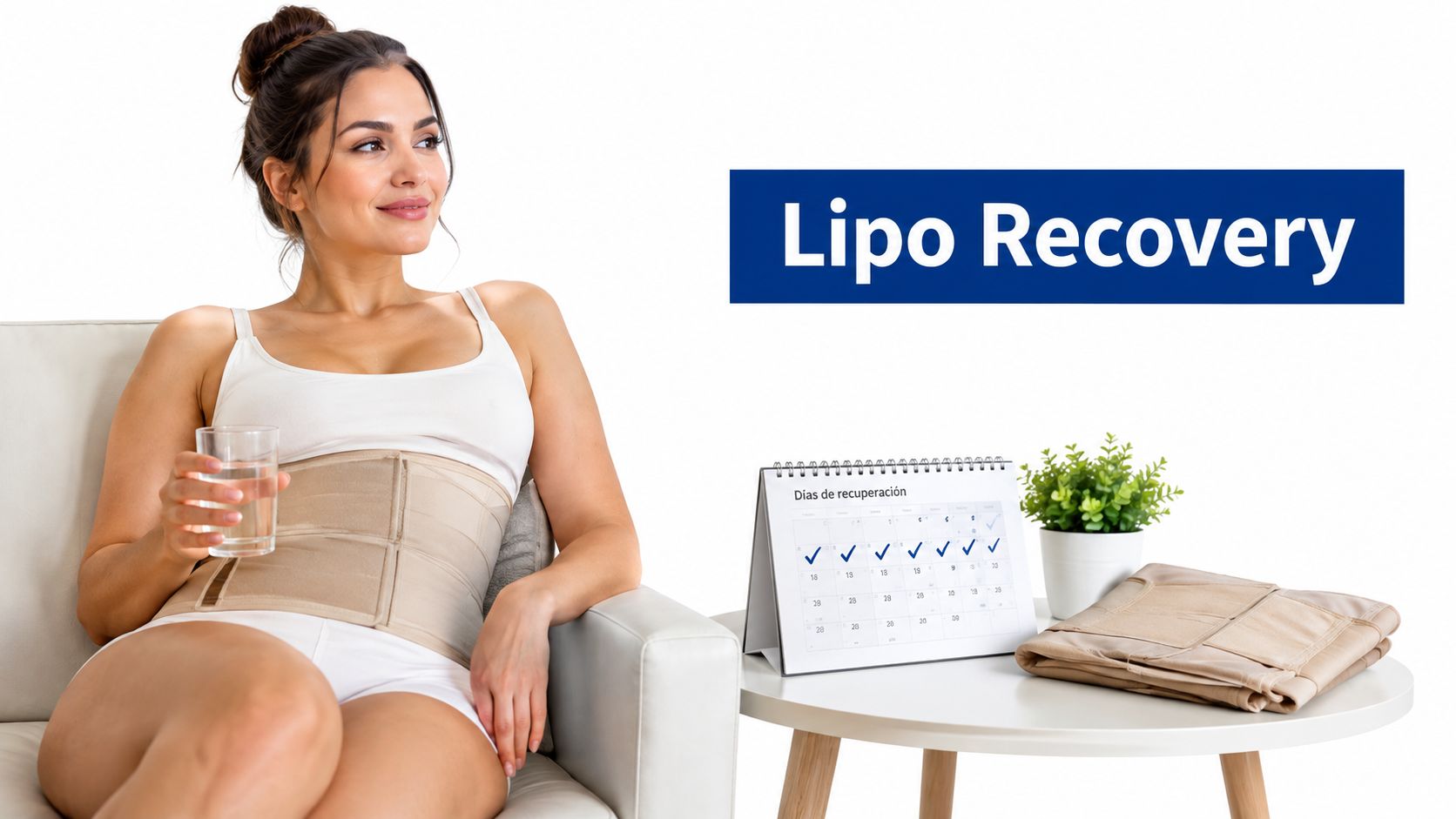
Compression garments can support the treated area and may be recommended to help control swelling. Wear them exactly as directed, because excessive tightness, rolling, skin irritation, or numbness should be reported rather than ignored. You can learn more about how compression garments help after liposuction before treatment so you know what proper fit should feel like.
What usually helps
- Short walks: Gentle movement supports circulation without turning recovery into a workout.
- Elevation when appropriate: Positioning the treated area comfortably while resting may reduce dependent swelling.
- Prescribed medication: Take medication only as directed by your surgical team.
- Consistent compression: Follow the schedule your clinician gives you, including instructions for bathing and sleeping.
- Simple routines: Keep frequently used items nearby so you aren't repeatedly bending, reaching, or carrying.
For broader guidance on how to manage pain after surgery effectively, use a resource that explains medication safety and non-drug comfort measures. Don't add supplements, anti-inflammatory medication, or other products without checking with your clinician.
Swelling may look more noticeable after you've resumed normal movement, especially later in the day. Bruising and swelling can last 10 to 14 days at minimum, while residual swelling may persist for months and full settling may take up to 6 months, according to NHS guidance (liposuction recovery and warning signs).
Contact your surgical team if pain is escalating rather than improving, swelling becomes sudden or markedly one-sided, the skin becomes increasingly hot or red, drainage changes, or you develop symptoms that concern you. Don't try to diagnose a complication from photographs or online forums.
Activity Restrictions and Exercise Guidelines
The safest activity plan progresses from movement for circulation to normal daily activity, then to exercise. Early mobility and strenuous activity aren't opposites. Short, gentle walks may be encouraged early, while running, heavy lifting, intense abdominal work, or vigorous upper-body training may need to wait.
Compare the activity milestones
| Activity | Practical recovery principle |
|---|---|
| Walking | Begin with short, easy walks as directed, increasing only when soreness and swelling remain controlled. |
| Desk work | Many patients can return within a few days, but sitting comfortably and managing compression are part of the decision. |
| Driving | Wait until you're no longer impaired by medication, can make necessary movements comfortably, and have clearance from your clinician. |
| Physical work | Lifting, repeated bending, and prolonged standing usually require a more cautious return than computer work. |
| Light exercise | Resume only after your clinician approves it and your symptoms are steadily improving. |
| Strenuous exercise | Treat this as a later milestone, not an extension of early walking. |
For laser-assisted liposuction, the visible limitation is often inflammation rather than immediate mobility. Clinical guidance notes that patients may be sore and swollen for a few days, that minimally invasive laser lipolysis may require a few days of recovery, and that final contour and collagen remodeling can take weeks. Broader liposuction guidance states that full healing can take up to 6 months, with regular exercise often delayed until about 6 weeks (liposuction healing guidance).
A safe progression: If an activity increases pain, pressure, drainage, or swelling that doesn't settle with rest, stop and contact your clinician before trying it again.
Avoid the two common extremes. Staying completely still can make you stiff and may limit circulation, while pushing through pain can aggravate healing tissue and prolong inflammation. Your surgeon should give you area-specific instructions, especially if more than one region was treated.
Tips to Optimize Your Healing Process
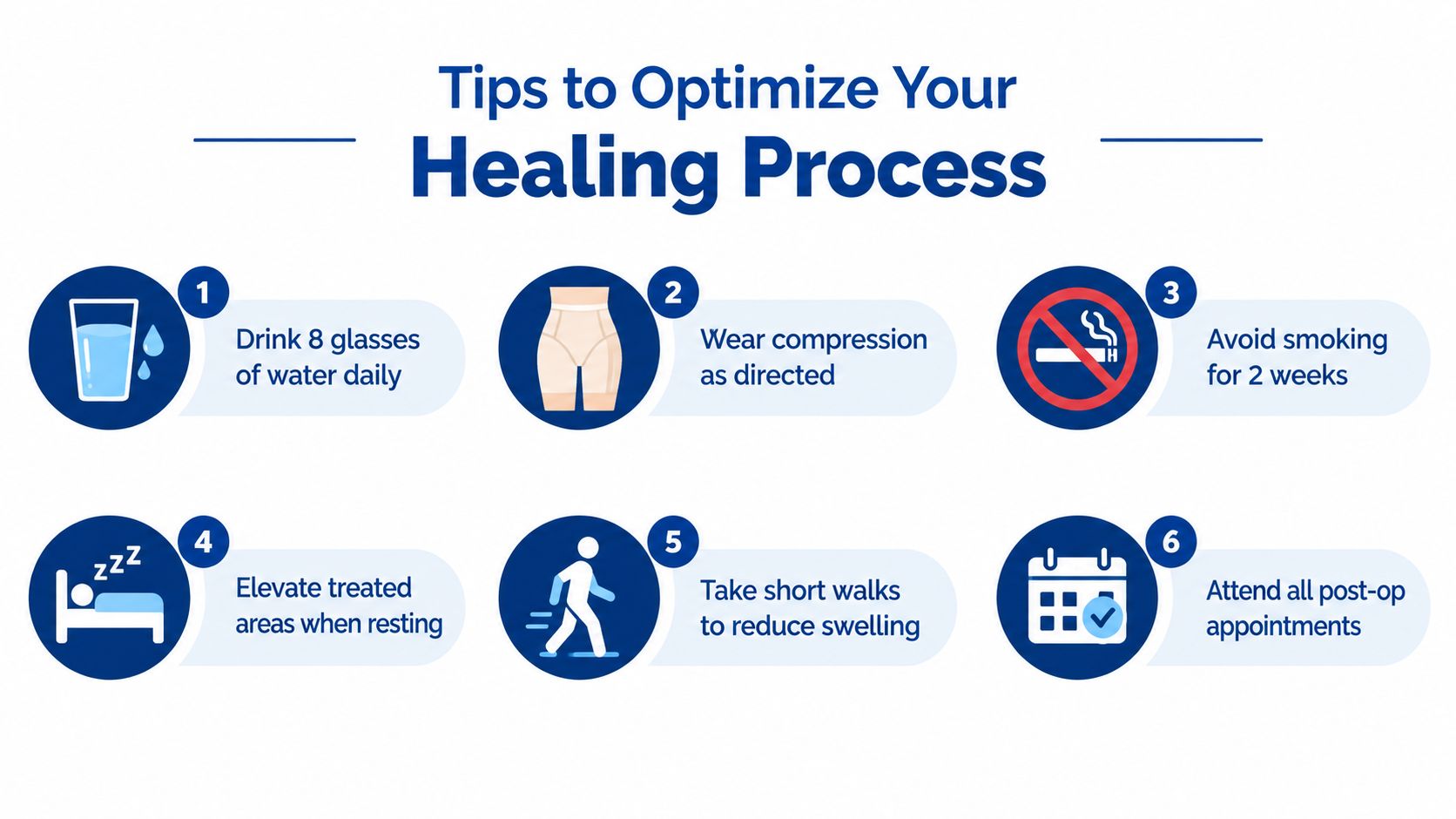
The most effective recovery plan is consistent rather than dramatic. Hydration, adequate food, sleep, compression, gentle movement, and follow-up care work together. No single shortcut replaces that combination.
- Support tissue repair: Eat regular, balanced meals and include adequate protein unless your clinician has given you dietary restrictions. Maintain hydration rather than waiting until you're thirsty.
- Protect your sleep: Rest in the position recommended for your treated area, using pillows to reduce pressure and keep you comfortable.
- Follow compression instructions: Garments should support healing without causing excessive pain, color change, or numbness.
- Avoid smoking: Nicotine can interfere with healing. Follow your clinician's required period of avoidance rather than assuming one universal rule.
- Move gently: Short walks are usually more useful than long periods of complete inactivity during the early phase.
- Keep appointments: Follow-up visits allow your clinician to assess swelling, incisions, firmness, and contour progression.
Medication deserves particular care. Tell your surgical team about prescriptions, over-the-counter products, and supplements before treatment, and don't restart or stop anything without direction. The same applies to massage. Lymphatic techniques may be appropriate in some recovery plans, but they should be recommended and timed by the treating clinician.
You can also review nutrition strategies that may help maximize surgery outcomes as part of your preparation. Good habits won't make recovery instant, but they can reduce avoidable setbacks and help you respond calmly to normal fluctuations.
When to Expect Final Results
A patient may feel comfortable and function normally while the treated area still looks unfinished. Swelling, firmness, numbness, and mild unevenness can persist after the early recovery period. These findings do not automatically mean the result is poor.
Bruising and surface swelling usually settle before deeper inflammation. Each side can drain fluid and soften at a different rate, creating temporary asymmetry. Numbness may last longer than soreness. NHS guidance on liposuction recovery notes that numbness may take 6 to 8 weeks to resolve, while residual swelling can continue for months.
Why the contour keeps changing
Laser-assisted treatment may support skin contraction through collagen remodeling, but collagen changes develop gradually. The American Society of Plastic Surgeons explains that skin firming can continue for up to 6 months (assisted liposuction recovery information). A photograph taken at six weeks may show progress without accurately predicting the final contour.
The skin may also feel firm or irregular as tissues settle. That texture can improve as inflammation decreases and the treated area softens. The contour often improves in stages rather than changing evenly each day.
Use these questions to judge progress:
- Function: Can you complete normal daily tasks without symptoms worsening?
- Appearance: Is swelling gradually decreasing, even if the shape is not final?
- Symptoms: Are pain, redness, drainage, and tenderness moving in the expected direction?
- Follow-up: Has your clinician assessed the area when the result remains difficult to interpret?
Contact your clinician promptly for increasing pain, spreading redness, marked warmth, unusual drainage, sudden swelling, breathing symptoms, or any change outside your instructions. Waiting for the final contour should never mean overlooking warning signs.
The most accurate answer to laser liposuction recovery time has several stages. Early function can return before the tissues look settled. Exercise follows a separate progression, and final swelling reduction and skin refinement may continue for weeks to months. Laser treatment can influence the early skin response, but it does not remove the normal remodeling period.
Ideal Face & Body offers awake, office-based body contouring with local anesthesia, including PRECISION SCULPT laser liposuction for selected treatment areas. Visit Ideal Face & Body to discuss recovery priorities, work demands, treatment goals, and a personalized plan.