Most patients think eyelid surgery risks are mainly about bruising or a scar that heals slowly. The primary safety issue is narrower and more important, because the complications that threaten vision are rare, but when they happen, they can become time-sensitive in the first hours after surgery. In other words, the question isn't just whether blepharoplasty is generally safe, it's whether the practice is built to recognize the worst-case scenario fast enough to protect the eye.
Table of Contents
- Why Eyelid Surgery Risks Deserve a Clearer Conversation
- The Everyday Side Effects Most Patients Actually Experience
- Rare but Serious Complications Worth Understanding
- Your Personal Risk Profile and How Surgeons Screen for It
- Local Versus General Anesthesia Through a Risk Lens
- How Surgeon Technique and Experience Actually Reduce Risk
- Warning Signs by Recovery Phase and When to Call
- Reducing Your Risk and Next Steps for a Consultation
Why Eyelid Surgery Risks Deserve a Clearer Conversation

The most useful way to think about eyelid surgery risks is not safe or unsafe, but how often something happens, how serious it is, and how fast you can intervene. A large U.S. claims-based study reported a national complication rate for blepharoplasty of up to 4%, with hematoma and return to the operating room among the more common adverse events, which is low but not zero in real-world practice (study in Plastic and Reconstructive Surgery Global Open).
That same study found orbital hemorrhage at 0.055%, about 1 in 2,000 cases, and orbital hemorrhage with permanent visual loss at 0.0045%, about 1 in 22,000 cases (study in Plastic and Reconstructive Surgery Global Open). Those numbers are small, but timing matters just as much as frequency, because the highest-risk window is the first 24 hours, especially the first 0 to 3 hours after surgery (study in Plastic and Reconstructive Surgery Global Open).
What that means in a consult
A strong consult does more than name possible complications. It asks what the practice does on the day something goes wrong, who answers the phone, how quickly you would be seen, and whether the surgeon can decompress an orbital bleed without delay.
Practical rule: low frequency does not remove the need for a high-alert plan. For blepharoplasty, the central safety question is whether the surgeon has built for early recognition and immediate action.
A 2025 literature review of lower eyelid blepharoplasty described a low overall complication profile and reported no included-study cases of blindness, diplopia, or inferior oblique muscle injury/paralysis (review). That is reassuring, but it does not make the discussion casual. It means the discussion should be specific, because the small group of serious events still matters clinically even when uncommon.
For patients who want a fuller overview of droopy lid correction, a practical guide to eyelid lift options can help frame the consultation around technique, recovery, and risk, not just the final result.
The Everyday Side Effects Most Patients Actually Experience
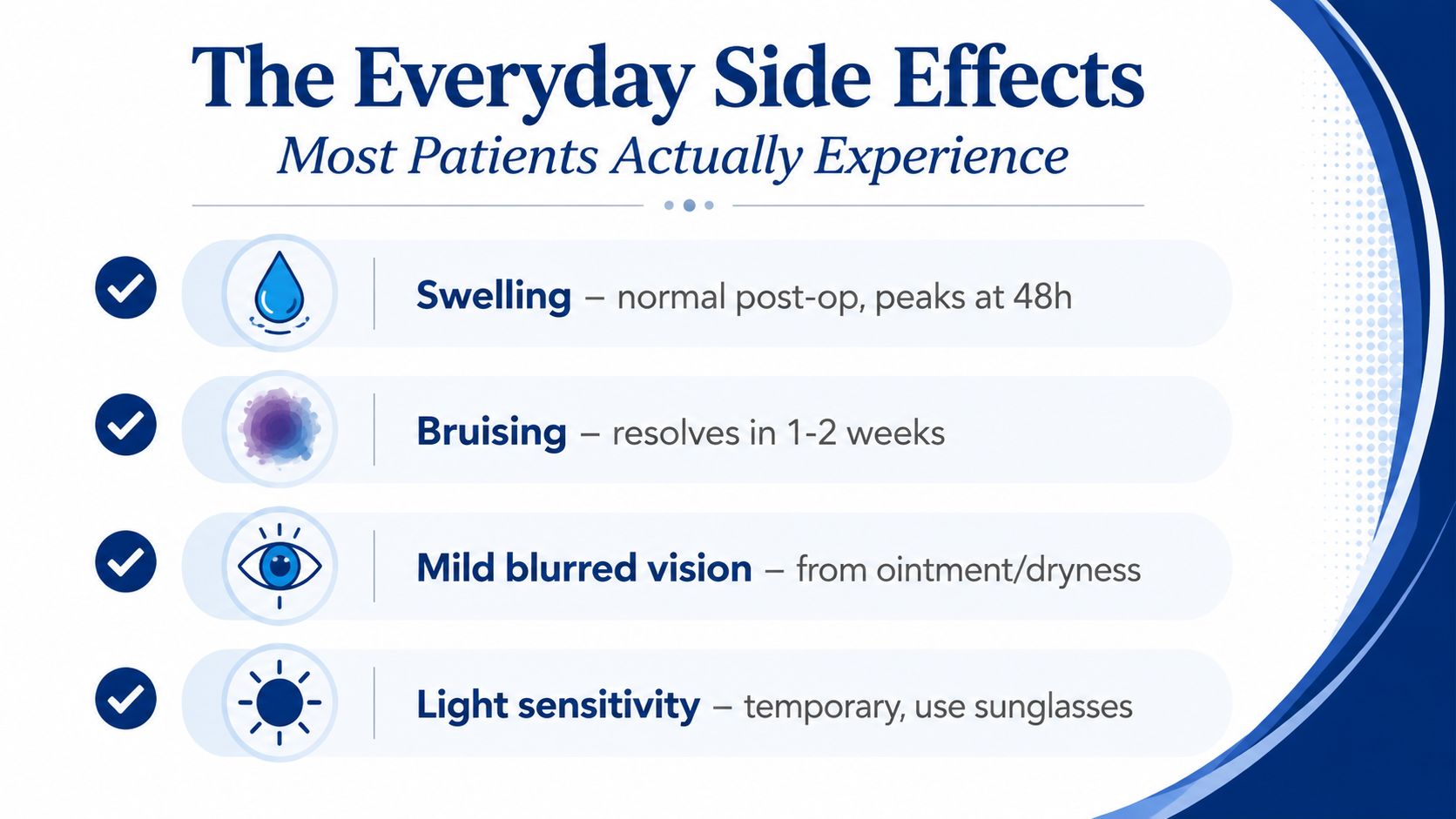
Many individuals recover from eyelid surgery with a cluster of expected side effects that are uncomfortable but not dangerous. The common ones are swelling, bruising, mild blurred vision from ointment or surface dryness, light sensitivity, watery eyes, temporary numbness, and a sense that one eyelid looks a little different from the other while swelling is settling.
What is normal in the first week
Swelling is part of the body's repair response, so it isn't a sign that something has gone wrong. Bruising often looks worse before it looks better, and the eyes can appear asymmetrical because one side sheds swelling faster than the other. That uneven look is one reason patients get anxious too early and start worrying about revision when what they're seeing is still recovery.
Mild blurred vision can come from ointment on the surface of the eye or from dryness, not from true eye damage. Light sensitivity is also common, which is why sunglasses and lower visual stimulation help more than constant mirror-checking.
What usually settles with time
Temporary numbness and a tight, pulled sensation tend to fade as tissues calm down. Small contour differences can also soften as swelling drops and the lids begin to sit naturally.
Mild recovery symptoms should improve, not intensify. If a symptom is easing day by day, that's usually a healing pattern, not a warning pattern.
A patient who understands this difference is less likely to panic over normal bruising or chase a premature revision. That matters, because the first week is not the time to judge final eyelid shape. It's the time to protect the incision, rest the eyes, and watch for the few changes that do need urgent attention.
For patients who want a deeper overview of how eyelid lifting differs from other lid concerns, this guide to fixing droopy eyelids is a useful companion.
Rare but Serious Complications Worth Understanding
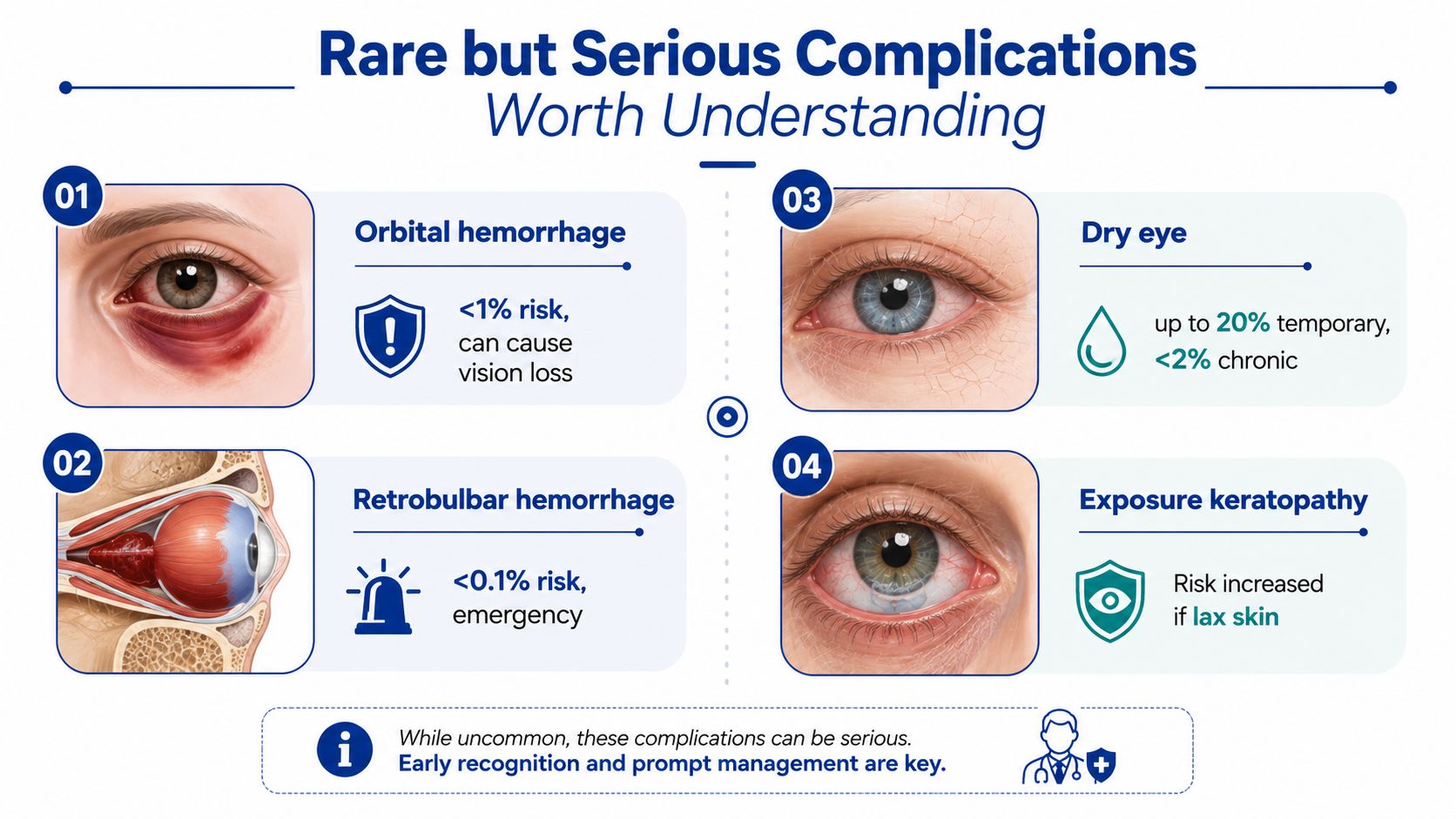
The complication patients worry about most is orbital or retrobulbar hemorrhage. It is rare, but it can matter fast because a rapidly expanding hematoma can raise pressure inside the orbit and threaten the optic nerve and retinal perfusion. Historical literature has estimated retrobulbar hemorrhage at roughly 1 in 2,000 to 1 in 25,000 cases (review), which is why it remains a central part of informed consent even though it is uncommon.
The events that matter most
Orbital hemorrhage is the emergency every eyelid surgeon keeps in mind first. The danger is not the blood itself, it is the speed at which pressure can rise and compromise vision.
Dry eye, lagophthalmos, and ectropion are the next cluster to understand. If the lids do not close completely, or if the lower lid turns outward, the eye surface dries out more easily. That can progress from irritation to keratopathy and, in severe situations, corneal damage. The American Society of Plastic Surgeons lists bleeding, infection, dry eyes, difficulty closing the eyes, ectropion, lid lag, temporary or permanent vision changes, and revision surgery among the major recognized risks (ASPS safety guidance).
Diplopia from extraocular muscle injury is uncommon. A review of lower eyelid blepharoplasty found no reported included-study cases of blindness, diplopia, or inferior oblique injury or paralysis, which is reassuring, but it does not change the fact that careful anatomy matters in every case (review).
A practical way to sort these risks is by what is causing the problem:
- Pressure-related emergencies: orbital hemorrhage, retrobulbar hematoma, acute visual change.
- Surface-exposure problems: dry eye, lagophthalmos, ectropion, exposure keratopathy.
- Technical or inflammatory issues: infection, persistent swelling, scarring, lid position changes.
Any sudden post-surgical change that breaks the expected recovery curve deserves attention. Severe pain, proptosis, or a sudden vision change is an eye emergency, not routine recovery. If symptoms feel out of step with how the lids have been healing, treat them the same way you would seeking medical help for skin burns, early evaluation matters more than waiting to see whether it settles.
Bottom line: serious blepharoplasty complications are rare, but the ones that matter most are the ones you cannot afford to miss.
Your Personal Risk Profile and How Surgeons Screen for It
A careful eyelid consult should start with anatomy, not assumptions. Pre-existing dry eye, lid laxity, negative vector anatomy, prior eyelid or facial surgery, thyroid eye disease, bleeding tendencies, anticoagulant use, smoking, and uncontrolled hypertension or diabetes all change the risk profile in different ways.
What changes the risk
Dry eye and meibomian gland dysfunction make surface irritation more likely after surgery, especially if closure is borderline. Lid laxity and negative vector anatomy increase the chance that lower-lid support problems show up later as ectropion or exposure symptoms. Prior surgery matters because scar tissue changes how the lid moves, which can make symmetry less predictable and revision more complex.
Bleeding tendencies and anticoagulant use naturally raise concern for hematoma and hemorrhagic complications. Smoking and uncontrolled medical disease don't just slow healing, they can also worsen inflammation and make recovery less forgiving.
What a thorough pre-op workup should include
A solid screening exam should include a review of medications and supplements, visual acuity baseline, eyelid position, lower-lid tone, and a direct look at how the eyes close. In practice, that often means looking at Schirmer testing, snap-back test findings, and the presence or absence of ocular surface symptoms.
If the lids already struggle to close fully before surgery, the plan has to account for that before any skin is removed.
The best surgeons don't treat every patient like a standard case. They decide whether the procedure should be adjusted, delayed, or not done at all if the anatomy and medical context don't support it. That judgment is part of risk reduction, even though patients often don't think of it that way.
Local Versus General Anesthesia Through a Risk Lens
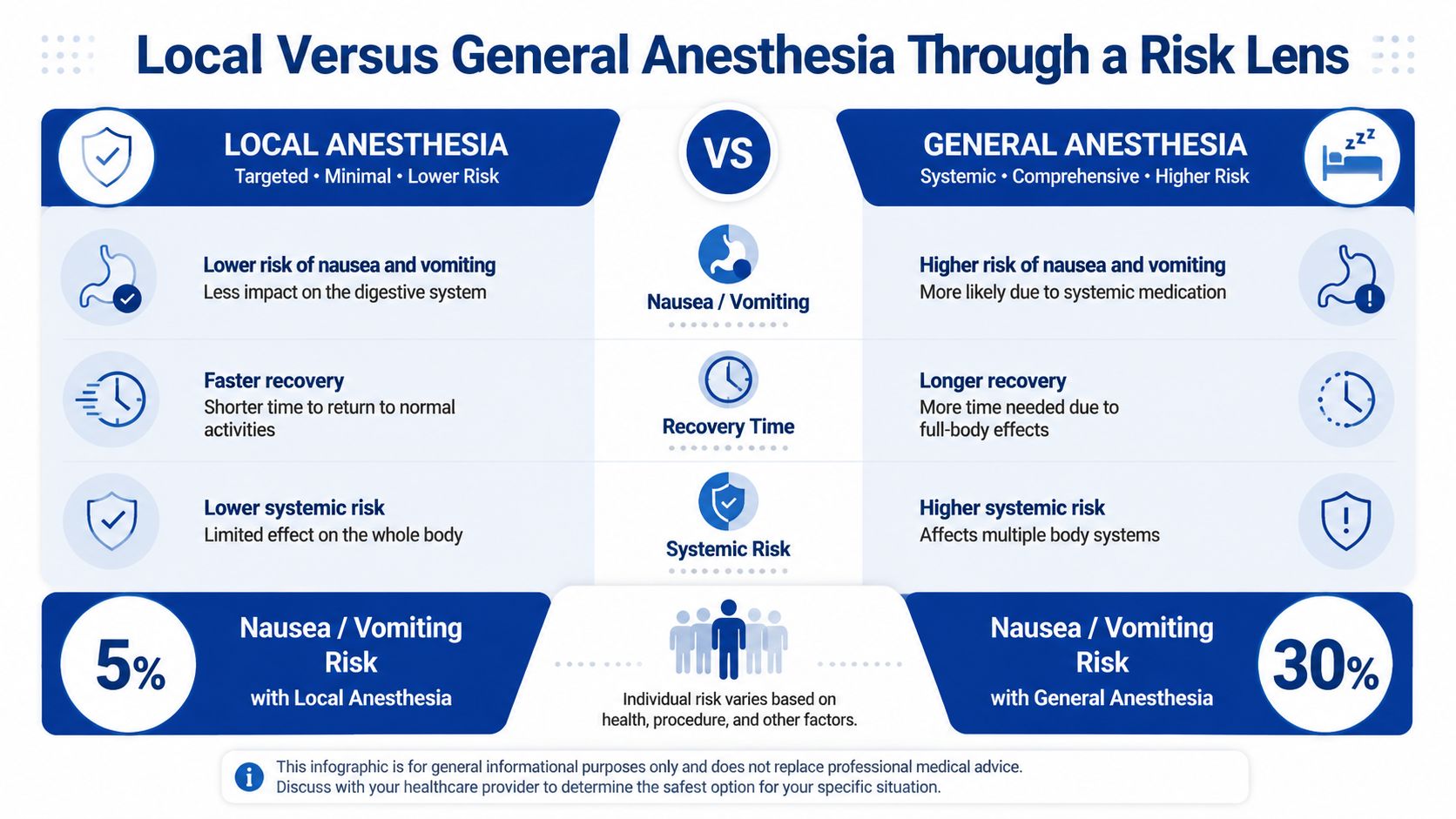
Awake blepharoplasty under local anesthesia changes risk in ways that matter. The patient avoids the systemic burdens of general anesthesia, and the surgeon can often assess lid position and symmetry while the patient is sitting up, which is useful when precision matters more than speed.
What local anesthesia changes
With local anesthesia, there's no airway management in the same way there is with general anesthesia, and many patients prefer that lower systemic load. Awake surgery also lets the surgeon evaluate the eyelid in a more natural posture during the procedure, which can help refine symmetry and avoid overcorrection.
That doesn't mean local anesthesia is automatically better for every person. It means the risk profile is different, and for many eyelid cases the trade-off is attractive because the operation is small, focused, and anatomy-driven. In Beverly Hills, office-based procedures under local anesthesia are often chosen for exactly that reason, the surgery is narrow enough that avoiding general anesthesia can make sense when the patient is a good fit.
What general anesthesia changes
General anesthesia can be appropriate in some situations, but it introduces a different recovery profile and more systemic considerations. Patients who need more extensive work, or who can't comfortably tolerate an awake procedure, may still do better that way.
The practical difference isn't about labels. It's about whether the surgeon can control bleeding, assess symmetry, and keep the procedure customized to the eyelid without adding avoidable systemic stress.
For patients who want to understand the setting better, this overview of plastic surgery under local anesthesia gives useful context for why awake approaches are often considered in facial procedures.
How Surgeon Technique and Experience Actually Reduce Risk
Good technique shows up in the details patients can verify. In blepharoplasty, that includes conservative skin and fat removal, precise incision placement, meticulous hemostasis, and lower-lid support when the anatomy calls for it.
What to ask about in consult
A surgeon should be able to explain why they would or wouldn't use support techniques such as canthopexy or orbicularis suspension. Those choices matter most when lid laxity or lower-lid instability is part of the anatomy, because support can lower the chance of postoperative malposition.
Ask how the surgeon decides when not to remove more skin. That answer tells you a lot. Over-resection is one of the classic pathways to lagophthalmos and exposure problems, so restraint is not hesitation, it's judgment.
Practical rule: the best eyelid result usually comes from removing less than the nervous patient thinks they need, then preserving closure and support.
You should also verify board certification, before-and-after photos, and whether the surgeon talks openly about revision policy and complication management. A surgeon who can explain trade-offs in plain language is usually thinking about safety the right way.
If you're comparing consultation notes, this peak-insights testing resource is useful as a reminder to look for structured evaluation, not just a quick glance and a promise.
Warning Signs by Recovery Phase and When to Call
The timing of complications after blepharoplasty isn't random. The first postoperative week is the window for corneal abrasions and vision-threatening hemorrhage, weeks 1 through 6 are where malpositions and diplopia tend to show up, and problems after 6 weeks are more often contour, scar, or edema issues (timing review).
Blepharoplasty Warning Signs by Recovery Phase
| Time After Surgery | Watch For | Action |
|---|---|---|
| First 0 to 3 hours | Severe pain, sudden proptosis, visual change | Call immediately, urgent evaluation needed |
| First 24 hours | Increasing pressure, expanding swelling, new visual symptoms | Contact the surgeon right away |
| First week | Corneal abrasion symptoms, discharge, fever, worsening redness | Prompt review, don't wait it out |
| Weeks 1 to 6 | Lid malposition, persistent double vision, exposure symptoms, tearing | Call for assessment |
| Beyond 6 weeks | Contour asymmetry, persistent edema, scarring, lid-height changes | Schedule follow-up, discuss revision only after healing |
What is normal, what isn't
Bruising that slowly fades, swelling that improves over time, and mild dryness are expected. Rapid worsening, especially with pain or vision change, is not.
A symptom can be minor and still deserve a call if it's new, strong, or getting worse. That's why patients do better when they know their recovery timeline before they go home, instead of trying to guess later.
If you're balancing post-op concerns after any procedure, the same mindset used to manage post heart surgery issues is useful here too, know the timeline, know the red flags, and escalate early when something changes.
Reducing Your Risk and Next Steps for a Consultation
The safest eyelid surgery plans are simple on paper and disciplined in practice. Pick a surgeon who explains risk clearly, review your own dry eye, lid laxity, medications, and medical history, choose the anesthesia approach that matches your anatomy, and follow the post-op timeline without improvising.
The other half of safety is follow-through. Keep your surgeon's emergency contact information handy, watch the first 24 hours closely, and don't minimize new pain, pressure, or visual change.
If you're considering blepharoplasty, a focused consultation can help clarify whether you're a good candidate, what your personal risk profile looks like, and whether awake local anesthesia makes sense for your situation. You can start that process through this consultation page.
A CTA for Ideal Face & Body.