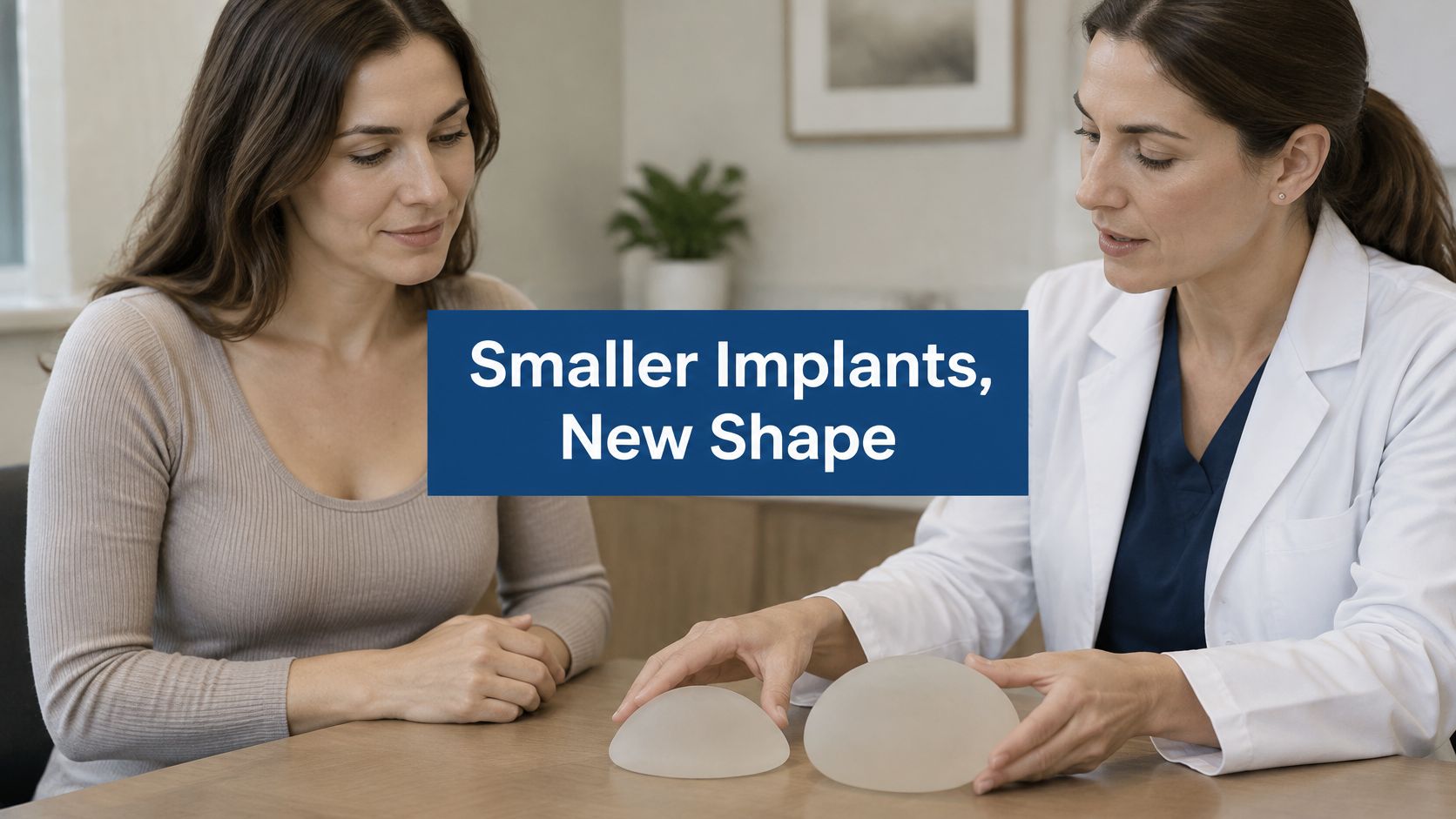
In FDA post-approval reporting, augmentation patients had a 36.1% cumulative rate of any reoperation at 10 years, according to the FDA post-approval study record. That isn't a downsizing rate. It does show why choosing implants should include thinking about what happens when your body, preferences, or surgical needs change.
Downsizing breast implants is a shape decision as much as a size decision. A smaller device may reduce fullness, but it won't necessarily produce the higher, tighter breast you have in mind. The useful starting point is deciding what you want to change, and what you're comfortable keeping.
Table of Contents
- What Downsizing Breast Implants Really Changes
- Pathways From a Smaller Implant to No Implant
- When Smaller Volume Still Needs a Lift
- Imaging, Base Width, and the Capsule
- Three Size Wishes and the Shape That Follows
- Recovery From Surgery to Settled Shape
- Choose the Goal Before You Book Surgery
What Downsizing Breast Implants Really Changes
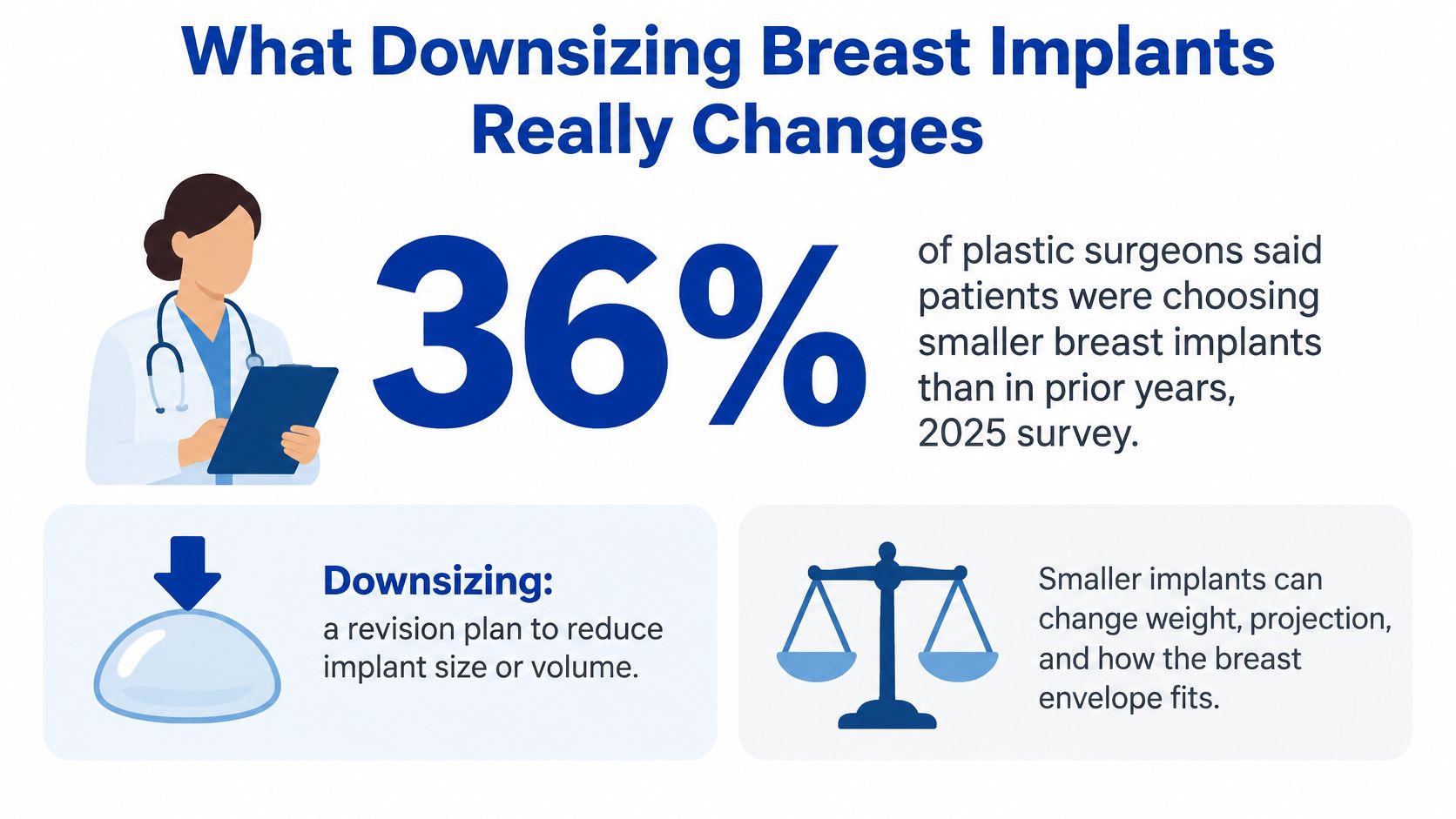
In 2025, 36% of plastic surgeons reported that patients were choosing smaller breast implants than in previous years, according to an American Society of Plastic Surgeons member-surgeon survey. That finding describes surgeons' observations, not the percentage of patients undergoing downsizing.
Consider someone who likes her breasts in a supportive bra but feels they project too far forward in a fitted shirt. She asks for a smaller cup size. During an examination, however, she may discover that she wants less projection rather than substantially less total breast tissue.
Another person makes the same request but wants to stop living with an implanted device. Those requests sound alike, yet they lead toward different operations.
Separate the device from its surroundings
Strictly speaking, implant downsizing means exchanging a larger implant for a smaller one. In a broader conversation about reducing implant-related volume, the alternatives also include removal, sometimes combined with a lift or fat transfer. Removal without replacement is explantation, not a smaller-implant exchange.
Think of a backpack with straps that have stretched. The implant is the weight inside, and the breast's skin envelope is the lengthened strap. Taking weight out doesn't automatically shorten the strap.
That distinction explains why an implant can become smaller while the breast still hangs low or looks loose.
Separate your wishes into less volume, less forward projection, less long-term implant maintenance, and a higher, tighter shape. These aren't interchangeable goals.
Describe the result, not just the cup
A cup-size wish can hide a shape wish. Tell the surgeon whether you're bothered by side fullness, forward prominence, low nipples, heaviness, or the responsibility of keeping implants. Cup labels alone don't communicate those differences reliably.
Published reoperation totals also need careful interpretation. They combine problems such as rupture, capsular contracture, malposition, and asymmetry with patient-requested changes in size or style. They provide context for long-term care, not a personal prediction that you'll need downsizing.
The practical choice is therefore a match between your primary goal, your remaining tissue, and the operation's trade-offs.
Pathways From a Smaller Implant to No Implant
| Pathway | Main goal | Fits best when | Shape trade-off | Implant afterward |
|---|---|---|---|---|
| Smaller implant exchange | Less volume while keeping an implant | Elastic skin, nipple near the fold, modest size drop | Possible lower-pole laxity or a flatter upper pole | Yes, with ongoing device follow-up |
| Exchange plus breast lift | Less volume and a higher, tighter shape | Nipple below the fold or a loose skin envelope | Lift scars, usually around the areola, vertical, or anchor | Yes, with ongoing device follow-up |
| Removal without replacement | No implant and less device maintenance | Enough natural tissue and acceptance of a smaller breast | Flatter contour and possible skin folds | No |
| Removal plus breast lift | No implant plus reshaped, higher skin | Ptosis or excess skin once the implant is gone | Smaller breast and lift scars | No |
| Removal plus fat transfer | Soft fullness without an implant | Donor fat available and a modest size goal | Some transferred fat does not last; size is less predictable | No |
How to read the pathways
Smaller implant exchange preserves device-provided fullness while reducing implant volume. It fits most naturally when the skin can accommodate the change and nipple position is acceptable. The examination still needs to establish whether the existing pocket can hold the new implant securely.
Exchange plus a breast lift addresses a different request: smaller breasts that also sit higher. The lift tailors the surrounding skin and repositions the nipple, rather than asking the replacement implant to perform that job. The trade-off is additional incisions and permanent scars.
Removal without replacement prioritizes being implant-free over retaining the same fullness. It can suit someone who has enough natural tissue and accepts a softer, less projected breast. Removing the device ends implant-specific maintenance, but it doesn't remove the need for ordinary breast health care.
Removal plus a breast lift reshapes the tissue and skin left after explantation. This can improve position and contour, but it doesn't recreate the volume that came from the implant. A well-shaped result may still be considerably smaller than the person initially pictures.
Removal plus fat transfer uses the person's own fat to add modest fullness without another device. Donor fat must be available, and the breast must be suitable for grafting. The considerations surrounding fat transfer after implant removal include donor-site recovery, variable fat retention, and whether skin tailoring is also needed.
Why the original reason for augmentation isn't the whole story
In a 20-year retrospective series of 4,909 cosmetic augmentations, the most common explantation reason was weight gain accompanied by the perception that the breasts had become too large, 35.06%, followed by implant deflation, 31.17%, according to the published explantation cohort. In that single-surgeon cohort, the average time to removal was 12 years, and replacement with smaller implants or later mastopexy occurred only in isolated patients. These aren't universal rates or a recommendation for one pathway.
Before comparing scars or anesthesia, circle your primary goal:
- Volume: You want less breast fullness but still want an implant.
- Position: You want the nipple and breast mound higher.
- Device freedom: You don't want another implant.
- Soft fullness: You want modest volume from your own tissue.
Cosmetic exchange isn't the same operation as breast reconstruction. Even within cosmetic surgery, a requested size change can involve pocket repair, capsule decisions, and a lift rather than an isolated exchange.
When Smaller Volume Still Needs a Lift
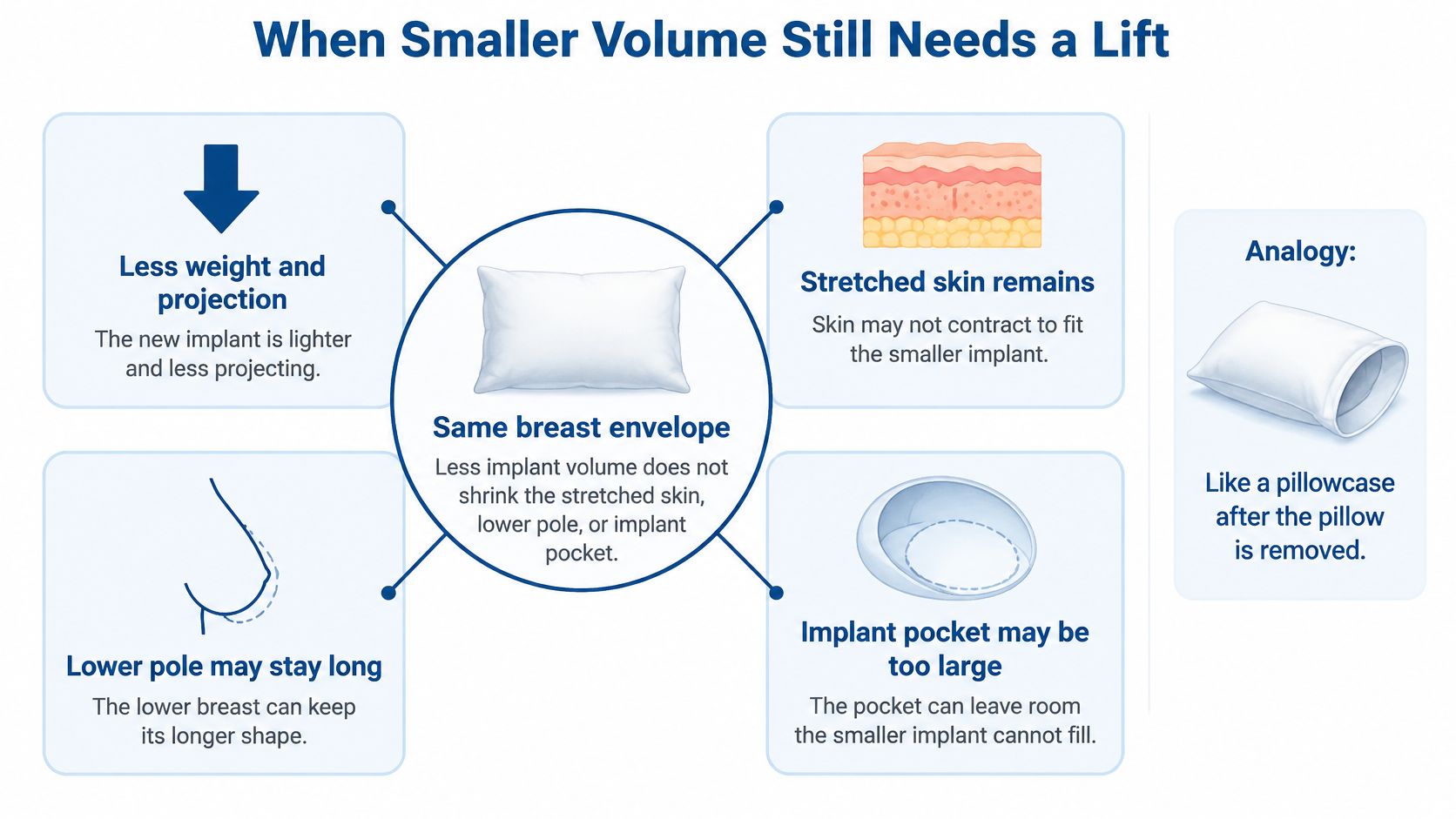
A thinner pillow inside the same pillowcase leaves extra fabric. Unless the case contracts or is resewn, it can wrinkle and fold. Breast skin behaves differently from cloth, but the analogy explains the central problem: reducing the contents doesn't necessarily resize the covering.
After downsizing, breast weight and projection decrease, while stretched skin, the lower breast, and the implant pocket may remain oversized. The upper breast can look less filled even when the replacement implant is technically positioned correctly.
Nipple position helps identify the problem
The inframammary fold is the crease beneath the breast. Surgeons compare nipple position with that fold and the lowest breast contour when assessing ptosis, the medical term for drooping.
Common descriptive grades distinguish a nipple at the fold, a nipple below the fold but above the lowest breast contour, and a nipple at the lowest point. These are examination categories, not a reliable self-diagnosis from a photograph. The amount of tissue hanging below the fold matters too.
A dropped nipple, an elongated lower pole, thin upper-breast coverage, or a substantial reduction in implant width should prompt a discussion about mastopexy. The considerations for a breast lift years after implants include tissue quality and previous surgery, not the desired implant size alone.
Skin tailoring and pocket tailoring do different jobs
Lift scars reflect how much skin needs reshaping. A circle around the areola may address limited excess; a lollipop pattern adds a vertical scar beneath it. An anchor pattern adds a scar along the breast crease for more extensive lower-breast reshaping.
These aren't interchangeable scar options chosen only by preference. The surgeon must select an incision pattern that can manage the actual skin excess without excessive tension or distortion.
Pocket repair happens internally. Capsulorrhaphy uses stitches to narrow or support a pocket that's too wide or too low for the replacement implant. It doesn't substitute for lifting loose external skin, and a skin lift doesn't automatically correct an oversized pocket.
Revision surgery also deserves a separate risk discussion. Severe capsular contracture was reported in 20% of revision-augmentation patients through 7 years in an FDA-cited implant dataset. That finding isn't an individualized forecast, but firmness, pain, or a high-riding implant changes the assessment from an uncomplicated cosmetic size request.
Use this self-check to prepare your questions:
- Nipple position: Is the nipple above, level with, or below the breast crease?
- Skin excess: Where does skin fold or look unsupported in a non-padded bra?
- Desired change: Do you want perkiness, or mainly less weight?
You can't accurately imagine away an implant in the mirror. These observations help describe concerns; the examination determines what remains after removal.
Imaging, Base Width, and the Capsule
Start with the implant card and previous operative note, not a preferred replacement volume. Gather the manufacturer, saline or silicone fill, implant volume, base width, projection, and pocket plane. The operative note can also clarify previous pocket repairs and incision locations.
Base width is the implant's footprint across the chest. Projection is how far it extends forward. A lower-volume implant with a much narrower base may leave inadequate coverage or move within a broad pocket, even if its volume sounds appealing.
The FDA's overview of implant risks and complications identifies rupture, wrinkling, asymmetry, malposition, and other problems that remain relevant when selecting a smaller device. Smaller doesn't mean maintenance-free.
Check integrity before choosing size
Silicone-gel rupture can be silent. A breast may retain its apparent size without an obvious change that alerts you to device failure.
For silicone implants, FDA screening recommendations call for ultrasound or MRI beginning 5 to 6 years after implantation, then every 2 to 3 years. MRI is recommended when symptoms are present or ultrasound findings are uncertain.
Screening for implant integrity doesn't replace routine breast cancer screening. Tell the imaging team that you have implants and provide available device records.
If rupture or silicone outside the capsule is suspected, the surgical discussion changes. Assessing removal and managing affected tissue takes priority over treating the procedure as a routine size swap.
The whole capsule doesn't automatically need removal
The capsule is scar tissue your body forms around an implant. It isn't automatically diseased, and complete removal isn't automatically required during exchange or explantation.
A peer-reviewed review of capsule management found no evidence-based indication for prophylactic capsule removal absent demonstrated pathology such as breast implant-associated anaplastic large cell lymphoma. It also describes the surgical morbidity of capsulectomy, particularly when implants sit beneath the chest muscle.
That doesn't mean abnormal capsules should be ignored. Contracture, suspected disease, rupture, and operative findings can justify a different approach. Partial removal, release or scoring, or preservation of a soft, healthy capsule may be appropriate after examination and imaging.
Prepare for consultation with these practical steps:
- Seek prompt assessment: Rapid swelling, a new hard painful breast, a mass, or a skin change shouldn't wait for a routine cosmetic appointment.
- Bring documentation: Include implant records, operative notes, and imaging reports.
- Show your concern: Bring photographs in a standard, non-padded bra and your written primary goal.
Three Size Wishes and the Shape That Follows
The following are fictional composites, not patient outcomes or promises. They show how similar requests can lead to different plans.
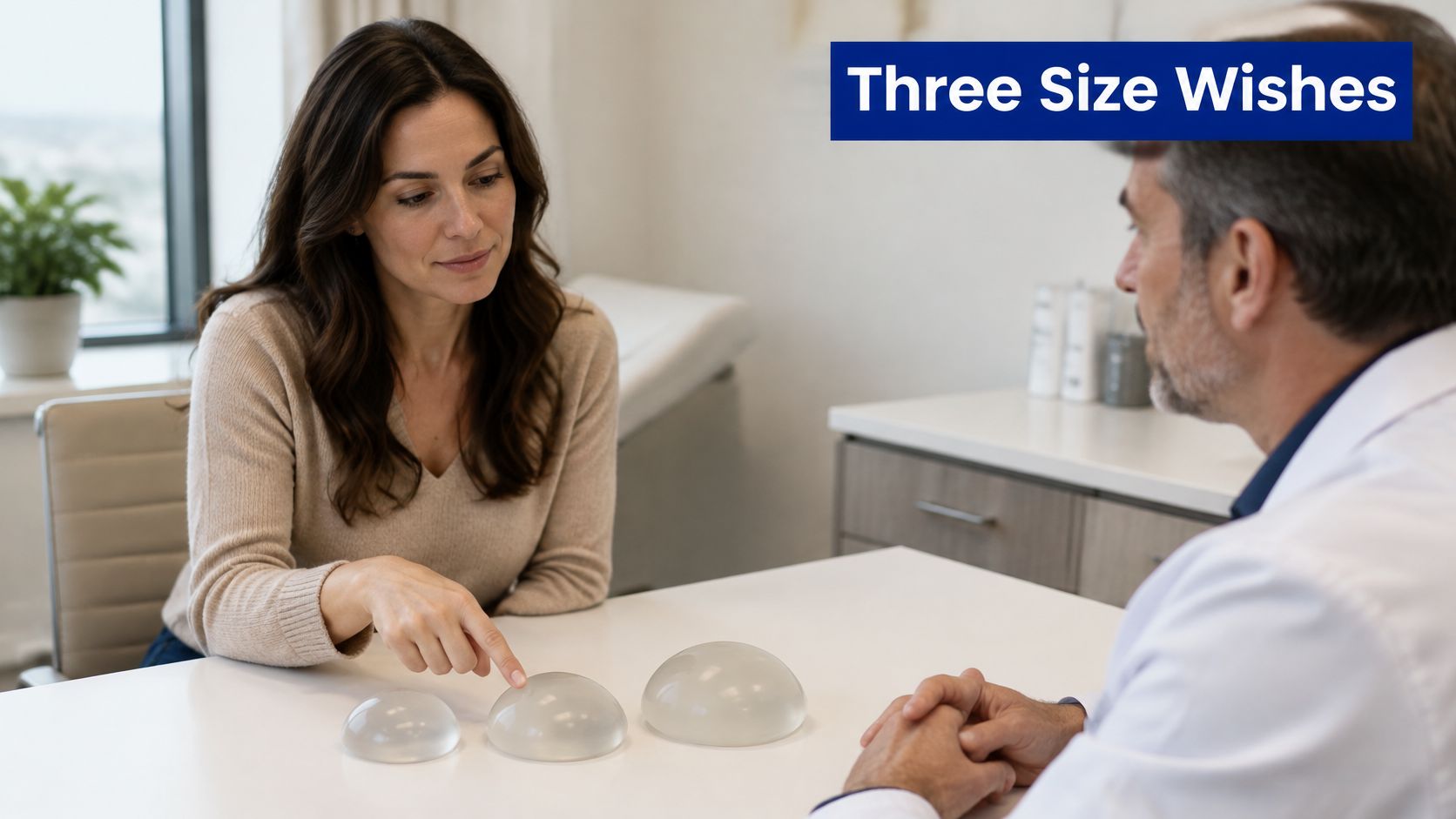
A smaller silhouette with cleavage preserved
Someone who had augmentation years ago wants a modest cup-size reduction but still likes cleavage. Her nipples sit near the breast folds, and she has substantial natural tissue covering the implants. Her main concern is how far her chest projects in clothing.
A smaller implant with an appropriate, similar base width may preserve the breast footprint while softening forward fullness. In a bra, she may see a less prominent silhouette; without one, she should expect a softer upper pole rather than the same rounded contour scaled down perfectly.
If she chooses a much narrower implant solely to reach a volume target, she may dislike the reduced coverage or spacing. Matching pathway: smaller implant exchange, with pocket adjustment if needed.
Less heaviness with a higher shape
Another person feels her breasts became too heavy after weight change. Her nipples sit below the folds, and the lower breasts look elongated, but she still wants implant-supported fullness.
In a bra, her desired result is a compact shape without tissue spilling or folding underneath. Out of a bra, she wants the nipple and breast mound higher, which makes skin reshaping central to the plan.
Exchange alone could disappoint her because the long lower pole would remain. She accepts a vertical or anchor scar to address that concern. Matching pathway: exchange plus breast lift.
No new device
A third person isn't primarily chasing a cup size. She wants to stop replacing and monitoring implants, and she accepts that her natural breasts will be smaller.
In a bra, a supportive cup may provide the outline she likes. Without one, she may accept softness but not a collapsed skin envelope, making a lift worth discussing; fat transfer is optional if modest fullness justifies donor-site treatment and uncertain retention.
Choosing another implant could satisfy her mirror briefly while missing her actual priority. Matching pathway: removal, with a lift or fat transfer only where those additions serve her goals.
Translate the wish into everyday clothing
Use a familiar bra and fitted top to describe the silhouette you want, rather than treating a garment label as a surgical measurement. For clothing context, California Cowboy's sizing help for après-ski shirts can help distinguish garment fit from breast shape, but it can't determine an implant choice.
Pregnancy plans, substantial weight loss, or very thin tissue may favor waiting or staging surgery rather than combining every maneuver. Which composite is closest to your priority matters more than which implant brand is popular.
Recovery From Surgery to Settled Shape
Volume changes during surgery; shape settles during healing. A smaller implant can feel lighter before the skin, breast tissue, and repaired pocket look settled. Recovery instructions must reflect the actual work performed, especially when a lift or fat transfer is added.
Use the following sequence as a discussion guide, not a personal clearance schedule. Your surgeon's written restrictions take priority, and unexpected symptoms can change the plan.
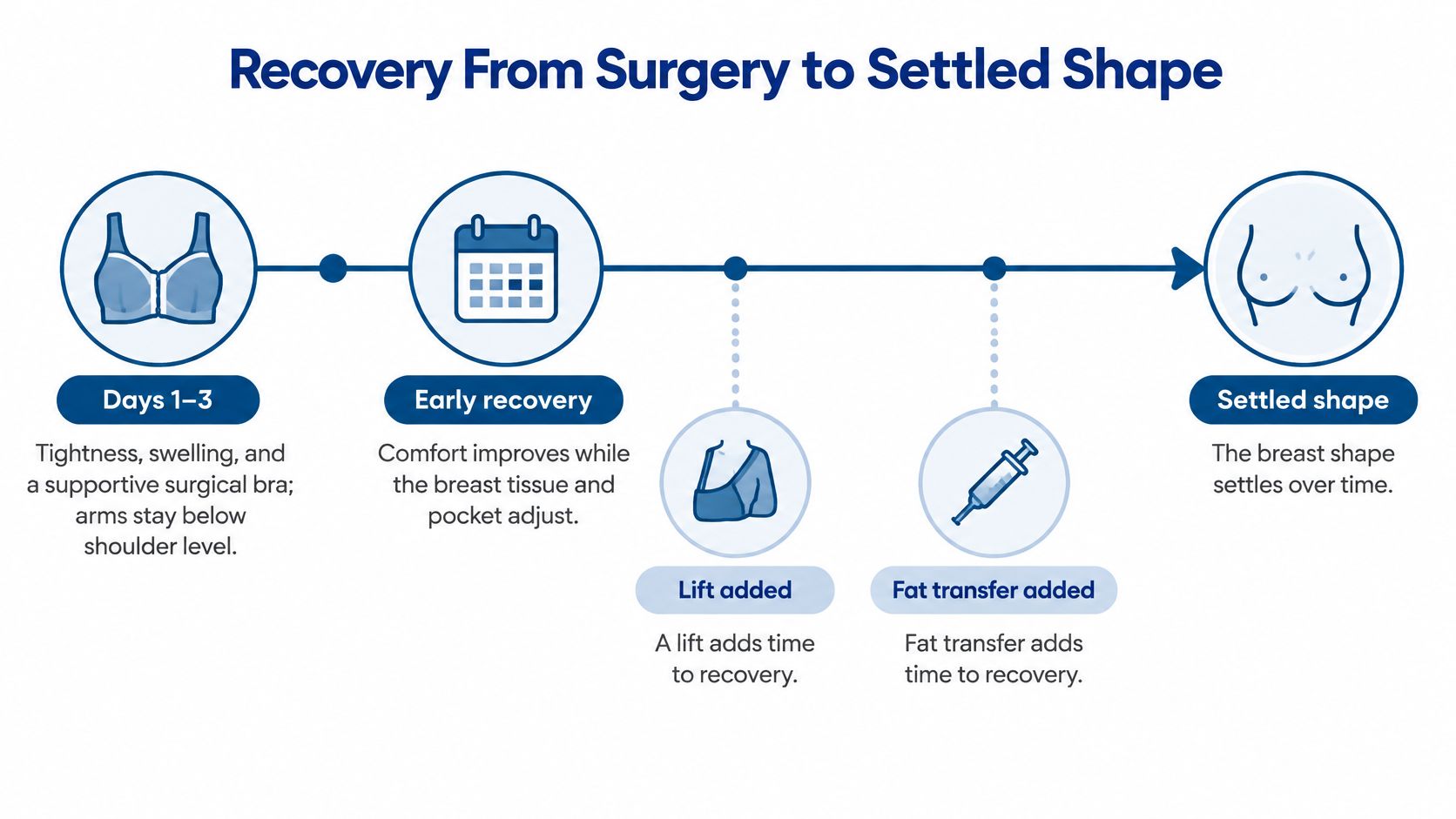
Immediately after surgery
Expect some tightness, swelling, and soreness. Wear the prescribed surgical bra, arrange help with tasks that involve lifting or reaching, and follow the surgeon's arm-movement restrictions. Don't assume that being comfortable means the internal repair is ready for strain.
A lift adds skin incisions that need protection from tension. Fat transfer adds donor areas that can feel bruised or pulled, so breast comfort alone isn't a complete measure of recovery.
Returning to ordinary routines
Desk work may become manageable before carrying groceries, lifting children, or exercising. Plan your return around the physical demands of your day and whether pain medication affects alertness.
As bruising fades, breasts can still appear high, firm, uneven, or somewhat square. Those appearances need assessment at follow-up, but early swelling isn't a reliable guide to the eventual contour.
- Light activity: Follow the walking and daily-movement instructions in your discharge plan.
- Exercise: Resume gradually only after clearance for stress on the incisions and implant pocket.
- Support garments: Use the prescribed bra and donor-site compression as directed, rather than choosing tighter garments yourself.
Judging the later result
Clothing fit becomes easier to assess as swelling resolves. Scars can remain pink or darker before gradually softening and fading, and they won't disappear completely. The lower breast may continue changing as tissues relax.
Fat-transfer results also need time before judging retained fullness. Early volume includes swelling, and some transferred fat won't survive. Avoid buying an entirely new bra wardrobe or deciding on additional surgery from the earliest photographs.
Recognized local breast-surgery concerns include pain, infection, scarring, and asymmetry, as described in the FDA's information on things to consider with breast implants. Report sudden one-sided swelling, fever, wound separation, or a hot painful breast promptly rather than waiting for a scheduled review.
Recovery expectation: Feeling lighter and looking settled happen on different schedules. Early photographs document healing, not the final result.
Choose the Goal Before You Book Surgery
Write a sentence you could hand to a surgeon: I want less volume while keeping an implant, or I want no implant, and this is the shape I can accept. Add whether a higher nipple position, softer fullness, or less forward projection matters most.
A size swap doesn't lift a dropped nipple. Removal doesn't, by itself, fill a loose skin envelope. Choosing the operation by its name rather than its purpose can leave you with the right device decision but the wrong shape expectation.
Send the records before the appointment
Prepare a focused consultation packet:
- Implant card: Include the device information you have, even if incomplete.
- Prior operative note: This helps clarify placement, previous incisions, and pocket work.
- Ultrasound or MRI: Send reports and available images, especially if rupture or another implant problem has been investigated.
- Written goal: State the result you want in clothing and without a bra.
If your goal is a smaller implant exchange or another implant revision, plan that device operation with a surgeon who currently performs implant placement and revision.
Know what our practice offers now
Ideal Face & Body in Beverly Hills, CA, no longer offers breast implant placement, implant-based breast augmentation, or breast implant revision procedures. Our implant-free options with Dr. Justin Yovino include Breast Implant Removal (Awake), the Awake Breast Lift, Awake Breast Reduction, and Raise Your Cup fat transfer.
The Awake Breast Lift is an implant-free mastopexy performed with local anesthesia, without general anesthesia. Raise Your Cup uses your own fat, removed from areas such as the stomach, to enhance and reshape the breasts without a new device. Suitability for an awake procedure still requires surgical assessment; local anesthesia doesn't eliminate surgical risks or the possible need for staged treatment.
Dr. Sarah Yovino is our physician injector, not the surgeon for these operations. Once you've chosen your primary goal, a Beverly Hills or virtual consultation can focus on whether an implant-free approach fits your anatomy and expectations.
For readers considering life without implants, we offer awake implant removal, implant-free breast lifting and reduction, and fat transfer using your own tissue. Visit Ideal Face & Body to arrange a Beverly Hills or virtual consultation, and bring your implant records and a clear description of the shape you want to discuss.