
You may be looking at yourself on video calls, catching your profile in a mirror, or noticing that your jawline doesn't read the way it used to. The issue often isn't your face. It's the neck. A heavier area under the chin, visible vertical bands, or loose skin can blur the transition from jaw to neck and make you look older, more tired, or less defined than you feel.
For many men, that concern has nothing to do with chasing perfection. It's about getting back a cleaner, stronger profile that fits the rest of the face. And for the right patient, surgery is the treatment that corrects the problem instead of managing it around the edges. Modern neck lifts for men can also be done in a more patient-friendly way than many people expect, including awake, office-based approaches that avoid the usual experience associated with general anesthesia.
Table of Contents
- Reclaiming a Strong Defined Jawline
- Why Neck Aging Is Different for Men
- Your Surgical Options for Neck Contouring
- The Awake Neck Lift Advantage
- Exploring Non-Surgical Alternatives
- The Patient Journey What to Expect Step by Step
- Frequently Asked Questions About Male Neck Lifts
Reclaiming a Strong Defined Jawline
Most men don't start by asking for a neck lift. They say their jawline looks softer, there's a double chin that doesn't match their weight, or the neck has started to fold or band in a way that wasn't there before. That's a practical concern, not vanity. The neck frames the lower face, and when it loses definition, the whole profile changes.
A neck lift becomes relevant when the problem is structural. Loose skin, platysmal banding, and deeper fullness don't respond well to surface-level treatments. In those cases, neck lifts for men are often the most direct way to restore a sharper transition from chin to neck and bring back a stronger outline.
That's not a fringe choice. In 2022, neck lifts were the sixth most common facial cosmetic surgical procedure for men in the United States, with 2,845 procedures performed according to American Society of Plastic Surgeons data on male cosmetic procedures. That tells you something important. Men are willing to choose surgery when they want a definitive answer to advanced aging changes that non-surgical options can't correct.
Dr. Justin Yovino's work in male facial aesthetics reflects what experienced surgeons see every day. Men usually want improvement that looks intentional but not obvious. They want a cleaner neckline, a firmer jawline, and a result that still looks masculine.
A well-done male neck lift shouldn't make you look altered. It should make your profile look more disciplined.
If your concern is mainly fullness under the chin without major skin excess, it can also help to understand where contouring starts and where it stops. This overview of double chin removal options is a useful starting point before deciding whether a formal neck lift is the right step.
Why Neck Aging Is Different for Men

A male neck isn't just a female neck with more beard growth. The tissues behave differently, the visual goals are different, and the operation should be planned accordingly. That's why generic advice tends to disappoint men who want a crisp, credible result.
Male anatomy changes the plan
Men often show more obvious platysmal bands, heavier neck fullness, and a blunter angle under the chin as the tissues age. In practical terms, that means the surgeon has to evaluate more than loose skin. The underlying muscle matters. Deep fullness matters. Beard pattern and scar visibility matter too.
One of the clearest differences is incision strategy and surgical intent. As noted in this discussion of plastic surgery for men and neck lift planning, the primary anatomical distinction for male neck lifts involves scar placement and surgical goals. Male incisions are often placed directly on the neck for more powerful correction, unlike female facelift scars that hide around the ear. The goal is to restore a strong cervicomental angle, the critical aesthetic benchmark between the chin and neck.
That matters because men usually tolerate different trade-offs than women do. Many are more willing to accept a more direct scar if it gives a more decisive correction of central laxity and banding. The wrong operation for a man is often the one that prioritizes hidden incisions over actual contour.
The aesthetic target is not a smaller neck
The goal in neck lifts for men isn't softness. It's definition. A good result restores the cervicomental angle so the chin and neck read as separate structures again. It also respects masculine proportions. Over-tightening the skin, over-thinning the neck, or creating an overly sculpted contour can look unnatural very quickly.
Three practical points usually guide the plan:
- Banding needs muscle repair: If the central problem is vertical cords in the neck, fat removal alone won't solve it.
- Skin excess needs skin management: Devices can tighten mildly lax skin, but they won't remove true redundancy.
- Deep fullness needs deeper judgment: A thick neck doesn't always mean removable surface fat.
The best male result is usually the one that looks stronger in profile, not tighter on close inspection.
Your Surgical Options for Neck Contouring
Not every man needs the same operation. The right procedure depends on what is causing the loss of definition. Some men need a full neck lift. Some need a more limited correction. Others mainly need the platysma repaired. The important part is matching the procedure to the anatomy instead of forcing every neck into the same template.
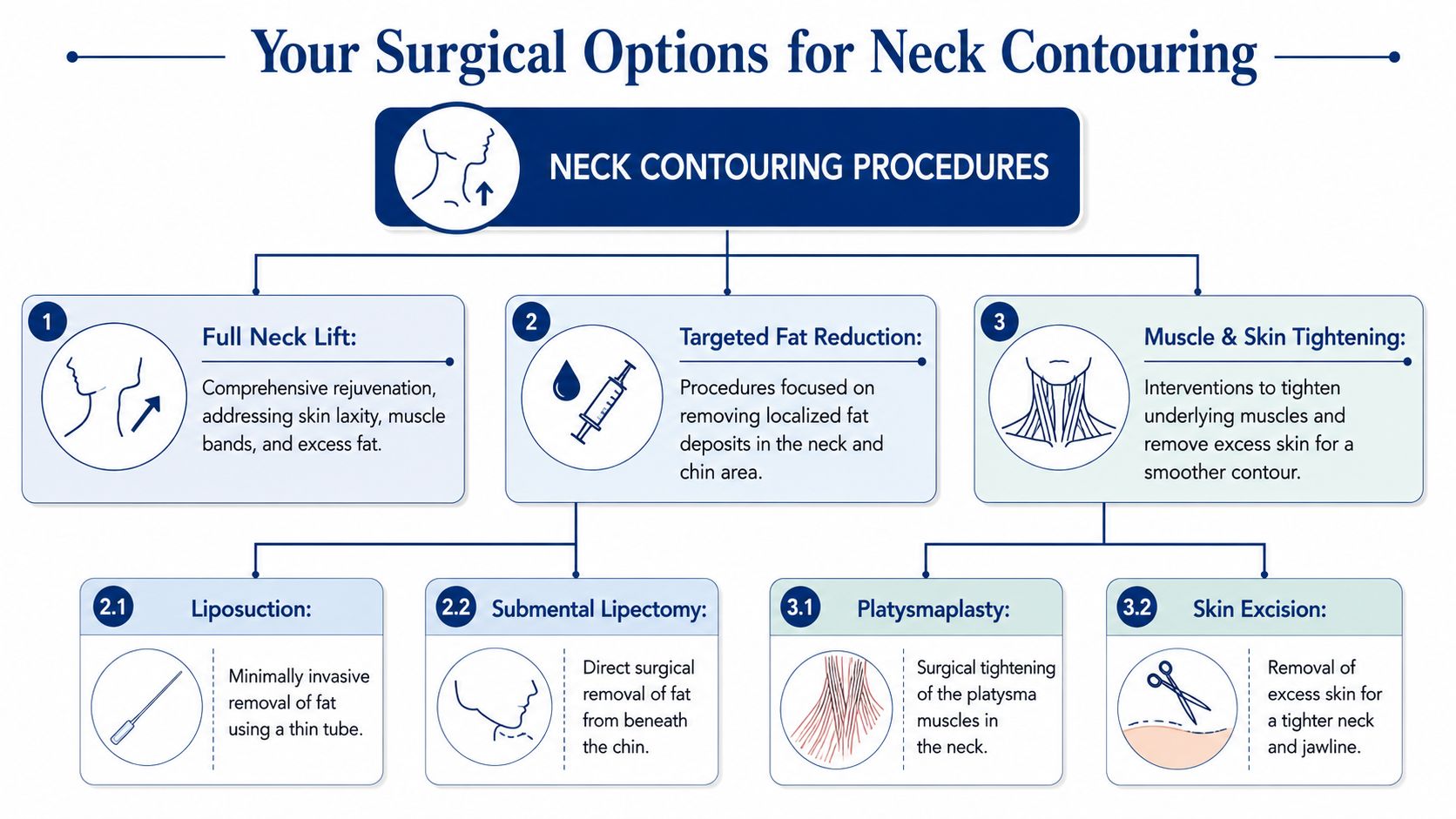
Full neck lift
A full neck lift is the strongest option when you have a combination of loose skin, visible banding, and excess fat under the chin or along the upper neck. This is the operation that resets the lower face and neck most completely.
Its real strength is that it allows the surgeon to work on all three layers that commonly age together in men:
- Skin that has become redundant or crepey
- Fat that thickens the area under the chin
- Muscle that has separated and created vertical bands
For men with a heavy neck or a true “turkey neck” appearance, this is often the most honest solution.
Mini neck lift
A mini neck lift suits the man whose problem is earlier or more limited. There may be some skin looseness and a softening of the jawline, but not the degree of banding or excess tissue that requires a larger correction.
The advantage is restraint. If your anatomy doesn't justify a larger operation, a smaller one can preserve a natural look and shorten the disruption of recovery. The limitation is also clear. A mini lift won't reliably solve severe banding or pronounced central laxity.
Isolated platysmaplasty
Some men don't hate the amount of skin or the amount of fat. They hate the bands. In that patient, the issue is platysma muscle laxity.
As described in this male neck lift surgical overview, male neck lift surgery specifically targets platysma muscle laxity, which causes visible vertical banding. The procedure, lasting 2 to 3 hours, involves suturing the separated platysma edges in the midline to eliminate bands. Surgical drains are often used in male patients to reduce hematoma risk due to the neck's vascularity.
That's why band-dominant necks often disappoint after fat-only treatment. The muscle was always the problem.
Practical rule: If your neck looks worse when you speak, tense, or grimace, the platysma usually deserves close attention.
When fat reduction helps and when it does not
Many consultations go off track because men often assume fullness under the chin equals “fat that can be suctioned out.” Sometimes that's true. Sometimes it isn't.
A targeted fat-reduction procedure can help when the fullness is superficial and the skin still has enough elasticity to contract well. That's where a technique such as chin and neck liposuction can be useful as part of a contouring plan. It can also work as an adjunct to a neck lift, especially when submental fat is part of the problem.
But deeper neck fullness is more complicated. A thick neck can reflect structures beneath the platysma, including subplatysmal fat, digastric prominence, or submandibular gland fullness. In that setting, standard liposuction may do little or even create an unbalanced result. Men who have had liposuction and still feel their neck looks heavy are often dealing with this exact issue.
That's why a careful exam matters more than the menu of procedures. Good surgical planning starts with identifying the primary anatomic driver, then choosing the least aggressive operation that will still produce a convincing result.
The Awake Neck Lift Advantage
For many men, the biggest hesitation isn't the neck lift itself. It's anesthesia. They don't want the full operating room experience, they don't want to feel wiped out afterward, and they don't want a recovery that drags because of the anesthesia as much as the surgery.
That concern is legitimate. It's also one reason awake, office-based neck lifts have become more appealing to informed patients.
Why men ask about avoiding general anesthesia
There's a real information gap here. As noted in this discussion of awake neck lift questions men commonly ask, many men want to know whether a neck lift can be performed under local anesthesia, but much of the available content assumes general anesthesia is standard and doesn't explain the safety protocols or patient selection behind an awake procedure. That leaves men with an all-or-nothing picture that isn't always accurate.
In practice, not every patient is a candidate for an awake approach. The scope of correction, medical history, anxiety level, and anatomy all matter. But for the right patient, local anesthesia with oral sedation can be a very sensible choice.
What the awake experience changes
The first advantage is straightforward. You avoid general anesthesia. For the patient who values discretion and wants to minimize the foggy, nauseated, or out-of-it feeling that can follow a traditional anesthetic, that's meaningful.
The second advantage is precision. In an awake neck lift, the surgeon can assess contour dynamically. Some techniques performed under local anesthesia allow the patient to be positioned in a semi-upright way during contouring so the neck angle can be judged more realistically. That matters because a neck that looks good lying flat can read differently when upright.
A well-run awake approach also tends to fit the priorities many men bring into consultation:
- Privacy: Office-based treatment often feels less dramatic and less public than a hospital-based experience.
- Efficiency: Recovery can feel easier when you're not also recovering from general anesthesia.
- Control: Patients often appreciate knowing what to expect step by step instead of surrendering the entire day to an operating room process.
For men exploring neck lifts for men specifically through an awake model, this awake neck lift guide gives a useful picture of what that pathway can look like.
The modern question isn't just “Can my neck be lifted?” It's “Can it be done in a way that fits my life, risk tolerance, and schedule?”
That said, awake surgery still requires discipline. Careful numbing, patient selection, meticulous hemostasis, and a team that's comfortable performing facial surgery in an office setting all matter. Awake doesn't mean casual. It means deliberate.
Exploring Non-Surgical Alternatives
Non-surgical treatment has a place in male neck rejuvenation. It just has to be matched to the right problem. If the issue is mild submental fullness, early skin laxity, or a patient who isn't ready for surgery, injectables and energy-based devices can help. If the issue is banding, deep fullness, or true excess skin, these options have limits that shouldn't be glossed over.
Where non-surgical treatment fits
Injectable fat-reduction treatments can reduce localized fullness beneath the chin. Energy-based devices can support skin tightening and improve texture. Topical products can help the skin itself look better, and thoughtful skincare does matter. For men trying to improve crepey texture or support skin quality between procedures, these Mesoderm RX neck cream insights offer a grounded look at what topical tightening products can and cannot realistically do.
The problem is that non-surgical options don't reposition muscle and they don't remove extra skin. They also don't reliably fix a neck that looks heavy because of deeper anatomy rather than surface fat.
Here is the cleanest way to think about it.
Surgical Neck Lift vs. Non-Surgical Options for Men
| Feature | Surgical Neck Lift (Platysmaplasty) | Injectables (e.g., Kybella) | Energy-Based Devices (e.g., Morpheus8) |
|---|---|---|---|
| Main target | Platysma laxity, skin excess, structural contour | Localized submental fat | Mild skin laxity and surface tightening |
| Best for | Moderate to advanced aging changes | Small pockets of fat without major laxity | Early changes and maintenance-minded patients |
| Can treat neck bands | Yes | No | No meaningful correction of true bands |
| Can remove excess skin | Yes | No | No |
| Can address deep structural fullness | Sometimes, with proper surgical planning | No | No |
| Recovery style | More involved but definitive | Usually staged, with swelling expected | Usually lighter, often requires repeat treatments |
| Result profile | Structural change with longer durability | Narrower effect | Modest improvement in selected patients |
A non-surgical plan isn't wrong. It's wrong only when it's asked to do a surgical job.
If your neck concern is mostly skin and muscle, trying to inject or heat your way out of it usually leads to delay, not resolution.
The Patient Journey What to Expect Step by Step
A lot of anxiety around neck lifts for men comes from not knowing what the process looks like. Men tend to do better when the sequence is clear. Consultation. Procedure. Recovery. Return to normal life. Each phase has its own purpose.

Consultation and planning
A proper consultation starts with diagnosis, not sales. The surgeon looks at the jawline, chin support, skin quality, platysmal banding, fat distribution, and whether the fullness is superficial or deeper. Beard pattern, scar tolerance, and your usual grooming matter more in men than many expect.
Virtual consultations can also be useful for out-of-town patients, especially for an initial discussion about candidacy and recovery planning. The final surgical plan, though, still depends on an in-person exam.
Useful questions at consultation include:
- What is the main driver of my neck aging: Skin, fat, muscle, or a combination?
- Would I benefit from a direct neck approach or a more limited lift: The scar trade-off should be discussed plainly.
- Am I a candidate for an awake, office-based procedure: Not every neck or every patient is.
Procedure day and early recovery
On procedure day, the office-based awake pathway is usually more controlled and less theatrical than patients expect. Markings are made. Local anesthetic is placed carefully. Oral sedation may be used when appropriate. The operation then proceeds with a focus on contour, symmetry, and hemostasis.
If platysmaplasty is part of the surgery, expect the muscle repair to be central to the outcome. If drains are used, they are there for a reason. Men have a vascular neck, and fluid control matters. Compression and custom head and neck wrapping can also play an important role in the early phase to support contour and limit swelling.
The first several days are usually defined by swelling, tightness, bruising, and a need to take it easy. As noted earlier in the article, recovery for male neck surgery commonly involves soreness, swelling, and bruising that improve over roughly the first several days to about a week and beyond, with many men returning to routine activity within a relatively short window depending on the procedure performed.
Healing, return to routine, and longevity
Most men care about two milestones. When can I look presentable, and how long is this worth doing? The first answer depends on how much correction was done and how visible your work or social schedule is. Remote work is often easier to resume before fully public-facing commitments. Walking usually resumes early. More strenuous activity waits until the tissues are stable.
The second answer is one of surgery's strongest arguments. According to 2024 data on face and neck lift trends and longevity, surgical neck lift results for men typically last 7 to 10 years, with some advanced techniques lasting even longer. That same source notes that this durability outperforms non-surgical options that often require maintenance every 6 to 18 months.
That doesn't mean aging stops. It means the baseline is improved in a lasting way.
A practical recovery mindset looks like this:
- Early phase: Control swelling, protect the repair, keep the head lifted.
- Social phase: Expect steady improvement, not overnight perfection.
- Maturation phase: Final refinement takes time as swelling resolves and tissues settle.
Patience matters. A neck lift often looks better at each stage, but it doesn't reveal its full quality immediately.
Frequently Asked Questions About Male Neck Lifts
How do I choose the right surgeon?
Look for board certification, a strong focus on facial surgery, and specific experience with male neck aesthetics. Men need a different plan than women do. If you're interested in avoiding general anesthesia, ask directly about experience with awake techniques and office-based safety protocols. Dr. Justin Yovino is one of the few surgeons whose practice is built around that model.
Can a neck lift be combined with other procedures?
Yes, in the right patient. Men sometimes combine neck rejuvenation with eyelid surgery or buccal fat removal when the overall facial balance supports it. The key is not stacking procedures just because you can. The combination has to make aesthetic sense.
How much does it cost?
It varies based on the procedure, the setting, and whether other treatments are combined. The only useful number is the one tied to your anatomy and surgical plan.
What are the realistic risks?
The main concerns include bleeding, asymmetry, contour irregularity, scarring, prolonged swelling, and the possibility that a limited procedure won't go far enough. That's why surgical planning matters so much. The safest path is the one that accurately matches the anatomy.
If you're considering neck lifts for men and want a discreet, office-based approach under local anesthesia, Ideal Face & Body offers consultation with Dr. Justin Yovino and Dr. Sarah Yovino in Beverly Hills, CA. It's a practical next step if you want a clearer answer about whether an awake neck lift, mini neck lift, or targeted contouring plan fits your anatomy and goals.