You may be looking in the mirror and thinking a very specific thought: I like my nose overall, but I don't like the tip. Maybe the bridge feels fine. Maybe you don't want a dramatic change. But the tip looks round in photos, droops when you smile, or feels a little too wide from the front.
That's exactly where tip rhinoplasty before and after becomes useful to understand. This isn't about rebuilding the entire nose. It's about refining the part that draws your eye every time you turn sideways, smile, or see yourself on video. For many patients, that small area creates most of their frustration.
As a board-certified plastic surgeon, Dr. Justin Yovino often explains tip rhinoplasty as a focused procedure for patients who want improvement without committing to the scope of a full rhinoplasty. Tip rhinoplasty, also called tip plasty or bulbous tip rhinoplasty, reshapes a bulbous, wide, or droopy nasal tip while avoiding nasal bone removal, which is why recovery is often lighter than full rhinoplasty according to this tip rhinoplasty recovery overview.
The other detail many patients miss is the setting and anesthesia. General guides often assume rhinoplasty happens under general anesthesia in a traditional surgical environment. That's not the only option. A modern, office-based awake approach can make a focused tip procedure feel more manageable, with a recovery experience that better matches the limited scope of the surgery.
Table of Contents
- Introduction Refining Your Profile Without a Full Rhinoplasty
- What Is Tip Rhinoplasty and Who Is It For
- How to Read Tip Rhinoplasty Before and After Photos
- The Realistic Recovery Timeline From Swelling to Final Result
- The Awake Advantage Why Local Anesthesia Is a Game Changer
- Choosing Your Surgeon What to Look For
- Conclusion Your Path to a More Refined Profile
Introduction Refining Your Profile Without a Full Rhinoplasty
A common consultation goes like this. A patient looks in the mirror, points to the lower part of the nose, and says, “I like my nose overall. I just want the tip to look more refined.” That is a very different problem from a nose that needs full structural change, and it calls for a different operation.
Tip rhinoplasty is often the right discussion when the concern is isolated to the lower third of the nose. A round or boxy tip, weak definition, asymmetry, or tip droop can draw attention even when the bridge and nasal bones look appropriate for the face. Small adjustments in this area can improve balance without making the nose look operated on.
A focused procedure with a different recovery experience
In my practice, that distinction matters because a tip-only procedure can often be done awake in the office under local anesthesia. For the right patient, that means avoiding general anesthesia, reducing downtime, and keeping the experience more controlled from start to finish. It also means the plan stays focused on the specific part of the nose that bothers you, rather than expanding into a larger operation that is not necessary.
That approach does not make the procedure casual. It still requires careful analysis of cartilage strength, skin thickness, symmetry, and support. The trade-off is straightforward. A focused operation can produce a meaningful improvement when the problem is at the tip, but it will not correct issues involving the nasal bones, a large hump, or major functional obstruction.
The goal is precision.
What a good result actually looks like
The strongest before and after results usually read as better proportion, not a different identity. The tip looks cleaner. The shape is more defined. The profile appears softer or more balanced. The nose still fits the face.
That is the standard I use when discussing tip rhinoplasty with patients. The operation should be safe, conservative, and suited to the anatomy in front of us. Good planning starts with an honest question. Is the concern really limited to the tip, or does the nose need something more extensive?
What Is Tip Rhinoplasty and Who Is It For
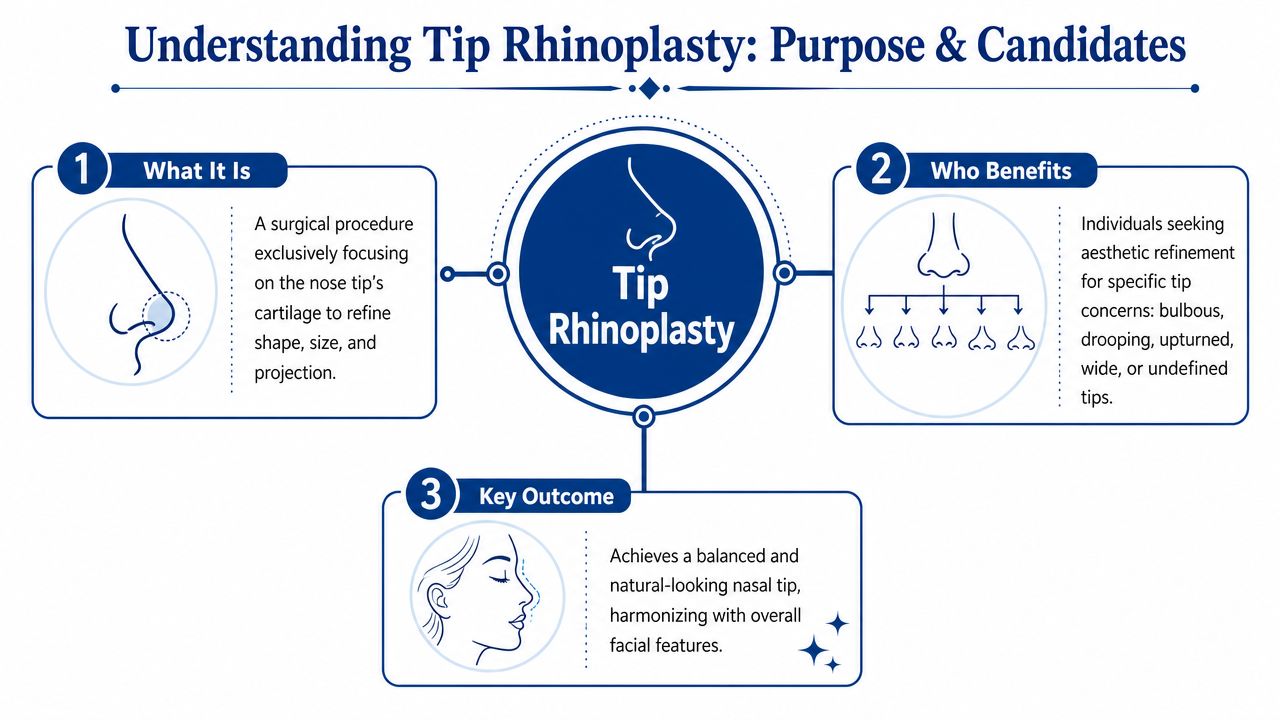
A common consultation goes like this. A patient likes the bridge of the nose, does not want a full rhinoplasty, and keeps coming back to the same concern in photos. The tip looks round, drops when smiling, or draws too much attention from the front. In that situation, tip rhinoplasty may be the right operation because the problem is limited to the lower third of the nose.
Tip rhinoplasty reshapes the nasal tip without changing the nasal bones. The procedure focuses on projection, rotation, definition, and support by working with the lower lateral cartilages and the soft tissue envelope over them.
A targeted procedure for the right problem
Tip surgery is more limited than a full rhinoplasty, but it is still real structural surgery. Small changes in cartilage shape or support can change how refined, lifted, or balanced the tip appears. In my practice, many tip-only cases can be performed awake in the office under local anesthesia with oral sedation, as described in our guide to awake plastic surgery. That office-based approach often means less disruption after surgery and avoids the added recovery and risk profile that comes with general anesthesia.
The trade-off matters. A tip-only procedure can improve a bulbous tip, a drooping tip, poor definition, or mild asymmetry. It will not correct a dorsal hump, wide nasal bones, or a major deviation that involves the rest of the nose. Good planning depends on identifying exactly where the problem starts.
Who tends to be a good candidate
The best candidates usually have a concern that is isolated to the tip. That often includes patients with:
- Bulbous or boxy tip: The tip looks round or broad rather than defined.
- Drooping tip: The tip angles downward at rest or falls further when smiling.
- Underdefined tip: The lower part of the nose lacks contour and structure.
- Mild tip asymmetry: One side of the tip or nostril sits differently from the other.
- Support-related functional issues: Some patients also need better tip support as part of improving airflow.
Skin thickness and cartilage strength have a large effect on what can be achieved. Thick skin can limit how sharp the final definition looks. Weak cartilage may require support grafting or suturing techniques to hold the tip in a stable position. Patients who want refinement usually do well. Patients seeking an extremely small or sharply pinched tip often need a reset in expectations because that result can look unnatural and may not age well.
I tell patients to judge candidacy by anatomy, not by trend photos.
For people researching results, it helps to study cases that resemble their own starting point. Our gallery of real rhinoplasty before and after cases shows how conservative tip changes can improve balance without making the nose look operated on. Consistent photo organization also matters when reviewing results online, and a strong client photo gallery workflow makes comparisons easier across angles and follow-up visits.
A good candidate also understands the limits of this operation. Tip rhinoplasty is a focused procedure for a focused concern. If the bridge, bones, septum, or overall nasal width are part of the complaint, a broader rhinoplasty plan is usually the better recommendation.
How to Read Tip Rhinoplasty Before and After Photos
A patient may walk into my office with one favorite after photo saved on their phone and still have no clear sense of whether the result is good surgery. Tip rhinoplasty photos are useful, but only if you read them with a surgeon's eye. The question is whether the nose fits the face, holds its support, and looks believable from every angle.

Look past the obvious before judging a result
Start with the photo set itself. Reliable galleries show the front, profile, and base views under similar lighting, head position, and camera distance. If the before photo is darker, closer, or angled differently, the comparison loses value.
Then study what changed, and what did not need to change. Tip surgery should refine the lower third of the nose without creating a disconnected look between the tip, bridge, nostrils, and upper lip. In awake, office-based tip rhinoplasty, I am especially focused on controlled, precise adjustments. That usually produces the best photos too, because the goal is refinement, not an exaggerated transformation.
When you review before and after images, look for these points:
- Rotation: The tip should sit at an appropriate angle for the patient's facial structure and sex.
- Projection: The tip should not jut forward or look flattened.
- Definition: The contours should appear cleaner without looking sharp, pinched, or artificial.
- Symmetry: The tip, nostrils, and light reflection should look more even.
- Support: The nose should still look structurally sound, especially on the base view.
- Harmony: Your attention should go to the whole face, not straight to the nose.
A natural result usually feels quiet. If the tip is the first thing you notice in the after photo, the surgery may be overdone.
The details that separate natural from overdone
Good results hold up in more than one view and at more than one time point. An early after photo can look narrow because of swelling patterns, taping, or camera angle. A mature result gives you more useful information because it shows whether the tip settled into a stable shape.
| What to examine | Healthy sign | Warning sign |
|---|---|---|
| Profile view | Smoother tip position with balanced rotation | Tip looks overly turned up or sharply “done” |
| Frontal view | Better definition without collapse | Pinched tip or obvious narrowing |
| Base view | Cleaner triangular shape and symmetry | Distorted nostrils or uneven support |
| Timing of after photo | Mature result with settled tissue | Early photo presented as final result |
I also tell patients to notice restraint. Strong tip rhinoplasty does not chase the smallest possible nose. It improves shape while preserving support, softness, and ethnic or individual character. Those trade-offs matter, especially in thick skin or weaker cartilage, where aggressive narrowing can create long-term problems.
If you are comparing galleries online, consistency matters as much as the result itself. A practice with an organized client photo gallery workflow is more likely to present cases in a way that allows honest comparison over time.
One attractive case is never enough. Look for a pattern across many patients with similar anatomy, similar angles, and follow-up photos that are far enough out to be meaningful. Our real rhinoplasty before and after cases show the kind of conservative, well-documented changes that tend to age well.
Choose the surgeon whose results look consistent, not dramatic.
The Realistic Recovery Timeline From Swelling to Final Result
A common scenario in my office is a patient looking at the mirror one or two weeks after tip rhinoplasty and wondering if the nose is still too round, too stiff, or slightly overprojected. In most cases, that early look is part of normal healing. Tip work settles gradually, and the visible result arrives later than many patients expect.
What healing usually feels like early on
After a focused tip procedure, comfort usually returns before appearance does. Many patients feel well enough to resume light daily activity quickly, especially after awake, office-based surgery under local anesthesia. The tip, however, often stays firm and swollen long after pain has faded.
That difference matters. Feeling better does not mean the final contour is visible yet.
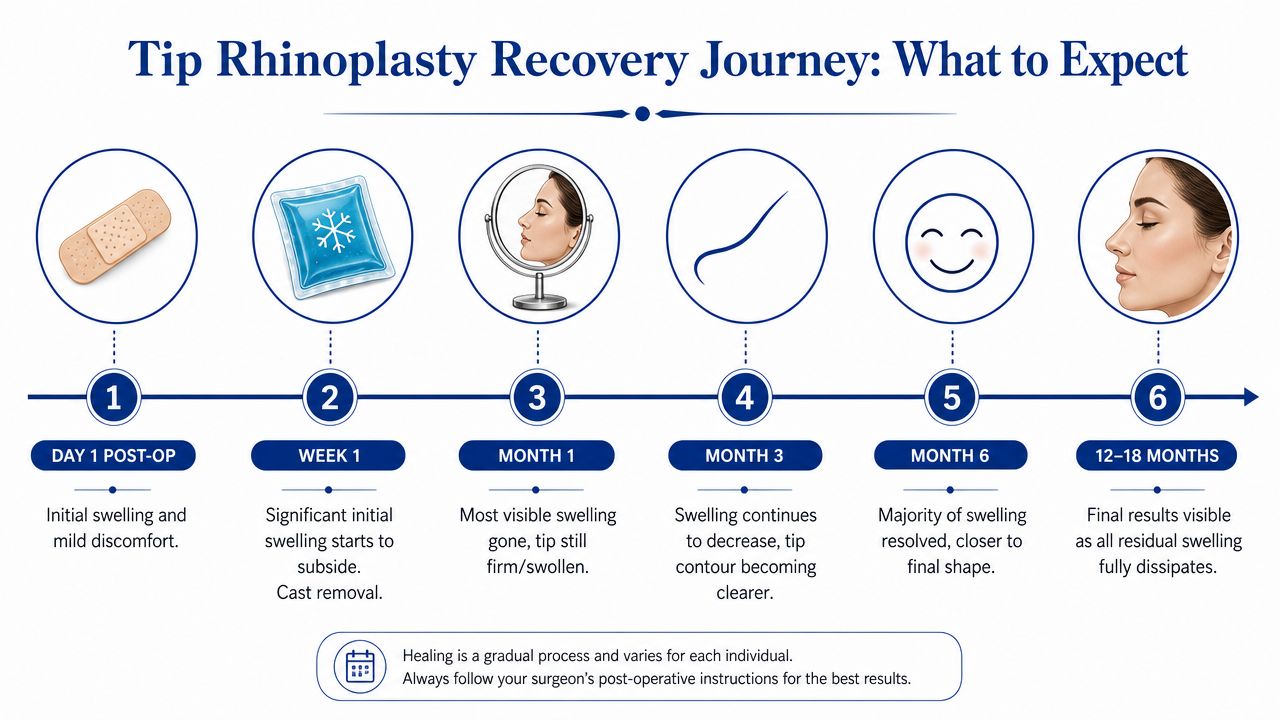
A practical recovery pattern usually looks like this:
- First few days: Mild pressure, congestion, tenderness, and swelling are common. Most patients describe the discomfort as manageable.
- First two to three weeks: Bruising improves and swelling starts to come down, but the tip can still look puffy, stiff, or more lifted than expected.
- First couple of months: The nose begins to look more natural in social settings, although the tip often remains fuller than the final result.
- Longer term: Residual swelling in the tip can persist for many months. Final refinement often takes a year, and sometimes longer in selected patients.
The middle phase is the hardest psychologically. The nose looks improved, but unfinished. Patients often assume something is wrong during that stage when the underlying issue is timing.
Why the tip takes longer to settle
The nasal tip has thicker soft tissue and more delicate support mechanics than the bridge. Small changes in cartilage shape can take time to show through the skin. That is one reason I set expectations carefully before surgery. A tip that looks blunt at three weeks may look defined and balanced months later.
Skin thickness also changes the pace of recovery. Thick skin tends to hold swelling longer and reveal definition more slowly. Thin skin usually shows refinement earlier, but it can also show minor asymmetries or contour irregularities more easily. Neither skin type is better. They heal differently, and the surgical plan has to respect that.
Here is the practical trade-off:
- Thicker skin: Slower definition, longer swelling, and a need for patience.
- Thinner skin: Faster visible change, but less forgiveness if support is not precise.
- Any skin type: Early photos are progress photos, not final-result photos.
This is one reason I prefer a conservative approach to tip work. Over-resection may look sharp early in edited before-and-after photography, but it can create long-term problems with stiffness, pinching, or poor support. A strong result is one that settles well and still looks natural over time.
For patients who want a broader overview of healing milestones after nasal surgery, our nose operation recovery guide explains what typically improves first and what takes longer.
The Awake Advantage Why Local Anesthesia Is a Game Changer
A common consultation starts like this. A patient wants a smaller, cleaner nasal tip but does not want the disruption of a full operating room experience. In many tip-only cases, that concern is reasonable, because the procedure can often be done awake in the office with local anesthesia.
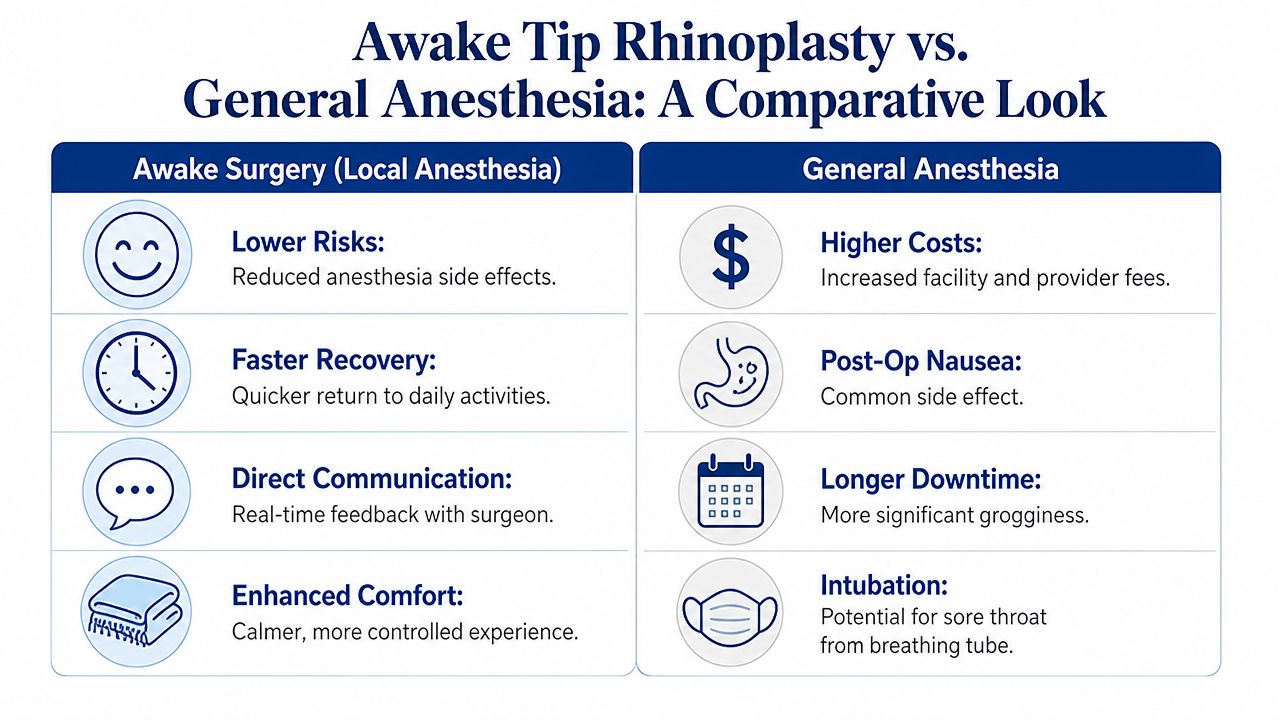
Why anesthesia choice matters in a tip-only procedure
Tip rhinoplasty usually focuses on cartilage shaping, support, and refinement. It does not always require the broader physiologic impact that comes with general anesthesia, especially when there is no nasal bone work and the plan is limited to the tip. Matching the anesthesia to the actual scope of surgery often makes recovery easier.
In my practice, local anesthesia is one of the biggest reasons patients feel that tip rhinoplasty was more manageable than they expected. They avoid the foggy, washed-out feeling that can follow general anesthesia. Nausea is less common. Patients also spend less time recovering from the anesthesia itself, which matters when the surgery is relatively focused.
An awake approach also changes the setting. Office-based surgery is quieter, more efficient, and less intimidating for many patients.
What works well in an office-based setting
The best candidates are patients with isolated tip concerns, realistic expectations, and the ability to stay calm and cooperative during an in-office procedure. This is not the right choice for every nose or every patient. If someone needs major structural work, extensive revision surgery, or feels too anxious to be comfortable awake, general anesthesia may be the better option.
That trade-off matters. Awake surgery can reduce recovery burden, but patient selection has to be disciplined.
Here is how I explain it:
| Consideration | Awake office-based approach | General anesthesia approach |
|---|---|---|
| Recovery feel | Usually lighter, with less grogginess afterward | Often includes more fatigue, nausea, or disorientation |
| Procedure fit | Strong option for isolated tip refinement | Better suited to broader nasal reconstruction or bone work |
| Setting | Office-based and more controlled for focused surgery | Traditional operating room experience |
| Patient role | Requires comfort with being awake and cooperative | Fully asleep during the procedure |
For the right patient, the benefits are practical. Less anesthesia exposure. A faster return to normal routines. A surgical plan that matches the actual problem instead of defaulting to the most intensive setting.
Patients who want a clearer sense of what the process feels like can review this awake surgery guide that explains office-based local anesthesia procedures.
The question I want patients to ask is simple. What approach gives this specific operation the safest, most controlled, and easiest recovery? For many tip rhinoplasty patients, local anesthesia is the better answer.
Choosing Your Surgeon What to Look For
A patient may come in asking for a smaller, cleaner tip, and the exam shows a different issue. Sometimes the tip is only part of the problem. Sometimes the bridge, septum, or overall nasal support also needs attention. Good surgeon selection starts there, with an accurate diagnosis rather than a sales pitch.
Tip rhinoplasty demands restraint. The change is often measured in millimeters, but those millimeters affect definition, symmetry, projection, and airflow. In an awake, office-based setting, judgment matters even more because the plan has to be precise, efficient, and appropriate for local anesthesia. The right surgeon knows which patients are strong candidates for that approach and which patients should be treated in the operating room instead.
Credentials matter, but case selection matters too
Look for a board-certified plastic surgeon who performs nasal surgery regularly and can show consistent before and after results focused on the tip. A common operation can still be technically demanding, and tip work is one of the easiest areas to overdo.
I would pay attention to four things:
- Natural results: The nose looks refined, not pinched, scooped, or surgically obvious.
- Tip-specific experience: The surgeon treats bulbous tips, drooping tips, asymmetry, and weak support patterns routinely.
- Functional judgment: Tip refinement should protect breathing and preserve long-term structure.
- Awake procedure experience: If you want office-based surgery under local anesthesia, the surgeon should already do it regularly, not offer it as an occasional alternative.
Training matters. So does consistency. A surgeon may have strong credentials and still lack a clear aesthetic judgment for subtle nasal work.
Use the consultation to evaluate judgment
The consultation should be detailed. The surgeon should examine skin thickness, cartilage strength, symmetry, tip support, and how the nose fits the rest of the face. If the recommendation is immediate surgery without a careful exam, that is a problem.
Ask direct questions:
- Am I a tip-only candidate?
- What result is realistic for my skin and cartilage?
- Would you recommend awake surgery for me, and why?
- What would make you advise against an office-based approach?
- How do you avoid an over-rotated, pinched, or unnatural tip?
The answers should be specific. “You'll look better” is not enough. A good consultation explains what can improve, what will remain imperfect, and what trade-offs come with each approach.
One more point matters in awake tip rhinoplasty. The surgeon should have a clear office safety protocol, an experienced staff, and a setup designed for patient comfort under local anesthesia. That includes careful numbing, communication during the procedure, and conservative case selection. Those details affect the experience as much as the surgical technique does.
If you leave a consultation feeling rushed, pressured, or promised perfection, keep looking.
Conclusion Your Path to a More Refined Profile
Tip rhinoplasty works best for patients who want precision, not reinvention. If your concern is a bulbous, drooping, asymmetric, or undefined tip, a focused procedure can create a meaningful change without the scope of full rhinoplasty.
The most important part of reading tip rhinoplasty before and after results is understanding what you're seeing. Good results improve rotation, projection, and definition while keeping the nose believable on the face. Recovery also requires patience, especially when swelling lingers at the tip or thicker skin hides refinement for longer than expected.
For many patients, the awake, office-based approach is what makes this feel approachable. Local anesthesia can reduce recovery burden and avoid many of the downsides people associate with surgery under general anesthesia. When that approach is paired with strong surgical judgment, the process becomes more precise and more patient-friendly.
The right next step isn't chasing the most dramatic photo. It's meeting with a qualified surgeon who can assess your anatomy accurately and explain what improvement is realistic.
If you're considering a more refined nasal tip and want a careful, patient-focused evaluation, Ideal Face & Body offers consultations with Dr. Justin Yovino in Beverly Hills, CA, with an emphasis on awake, office-based surgical care and natural-looking results.