
You catch it in photos first. Your face looks softer from the side than it does in your head. Maybe the neck blends into the chin. Maybe the chin sits back more than you realized. Maybe your cheeks are full in a way that hides the angle of the jaw, even when you're at a stable weight.
That frustration is common, and it usually has a specific anatomical cause. A sharper jawline isn't one single procedure. It's the result of correctly identifying whether the issue is fat, skin laxity, muscle, or bone structure. Good jawline definition surgery is both artistic and technical. The art is knowing what will look balanced on your face. The science is choosing the procedure that fixes the problem.
As a double board-certified plastic surgeon, Dr. Justin Yovino approaches lower face contouring with that exact mindset, alongside Dr. Sarah Yovino in Beverly Hills, CA. The most important decision isn't whether someone wants a stronger jawline. It's whether the diagnosis is right before treatment begins.
Table of Contents
- Defining Your Ideal Jawline
- Are You a Candidate for Jawline Contouring
- Surgical vs Non-Surgical Jawline Enhancement
- A Closer Look at Surgical Jawline Procedures
- Your Patient Journey at Ideal Face & Body
- Recovery Results and Long-Term Expectations
- Jawline Surgery FAQs and Your Next Step
Defining Your Ideal Jawline
A well-defined jawline doesn't mean the same thing on every face. For one person, it means cleaning up a double chin. For another, it means bringing a recessed chin into balance. For someone else, it means reducing lower cheek fullness so the mandibular border becomes visible.
That distinction matters because the best result looks natural, not obvious. A strong jawline can read as healthier, more youthful, and more confident in both men and women, but only when it fits the patient's underlying facial proportions. If you've been trying to judge that from selfies alone, tools like this guide to face proportion apps can help you think more objectively about profile balance before you ever step into a consultation.

The patients who are happiest with jawline definition surgery usually aren't chasing a trend. They want one of three things. They want their profile to match how they feel. They want their neck and jaw to look cleaner in photos. Or they want their lower face to look more structured without looking overdone.
A good jawline result doesn't call attention to the procedure. It restores separation between the chin, jaw, and neck.
Experience matters. Some faces need subtraction. Others need support. Some need both. The wrong treatment can leave a patient disappointed even when the procedure was technically done well. The right treatment can make the whole face look more harmonious.
Are You a Candidate for Jawline Contouring
Many individuals considering jawline definition surgery fall into one of a few clear categories. The useful question isn't "Do I dislike my jawline?" It's "What's causing the lack of definition?"
Start with the real source of fullness
If you have excess fat under the chin, contouring can work very well. This group often notices a persistent double chin that doesn't improve much with weight loss. In those cases, removing fat can restore a cleaner angle between the chin and neck. If that's your main concern, this overview of double chin removal options is a helpful starting point.
If the issue is loose skin or jowling, fat removal alone usually won't solve it. Skin that has lost elasticity can drape over the jawline even after volume is reduced. These patients need an approach that addresses tissue position, not just volume.
If you have a weak chin or underdeveloped mandibular angle, the diagnosis changes completely. A key nuance is often missed in online content. An analysis of jawline aesthetics notes that 30 to 40% of patients seeking jawline contouring actually have mandibular hypoplasia, meaning liposuction alone can produce poor or "sagging" results. In plain language, some patients don't need less fat. They need more structural support.
Who tends to do well
Strong candidates usually share a few traits:
- They can identify the concern clearly. "I hate my jawline" is less useful than "my chin is weak" or "my neck looks full."
- They have realistic expectations. Surgery can refine anatomy. It can't turn one face into another.
- They're in stable health. Healing, swelling, and long-term maintenance are easier when overall health is good.
- They're open to the right plan. Some patients come in asking for liposuction and leave understanding they need skeletal augmentation or a lift instead.
Practical rule: The best jawline procedure is the one that matches the anatomy. Not the one that sounds easiest.
A careful consultation should assess the chin projection, mandibular angle, skin quality, fat distribution, and neck anatomy together. That's how you avoid the most common mistake in this area, which is treating the symptom instead of the cause.
Surgical vs Non-Surgical Jawline Enhancement
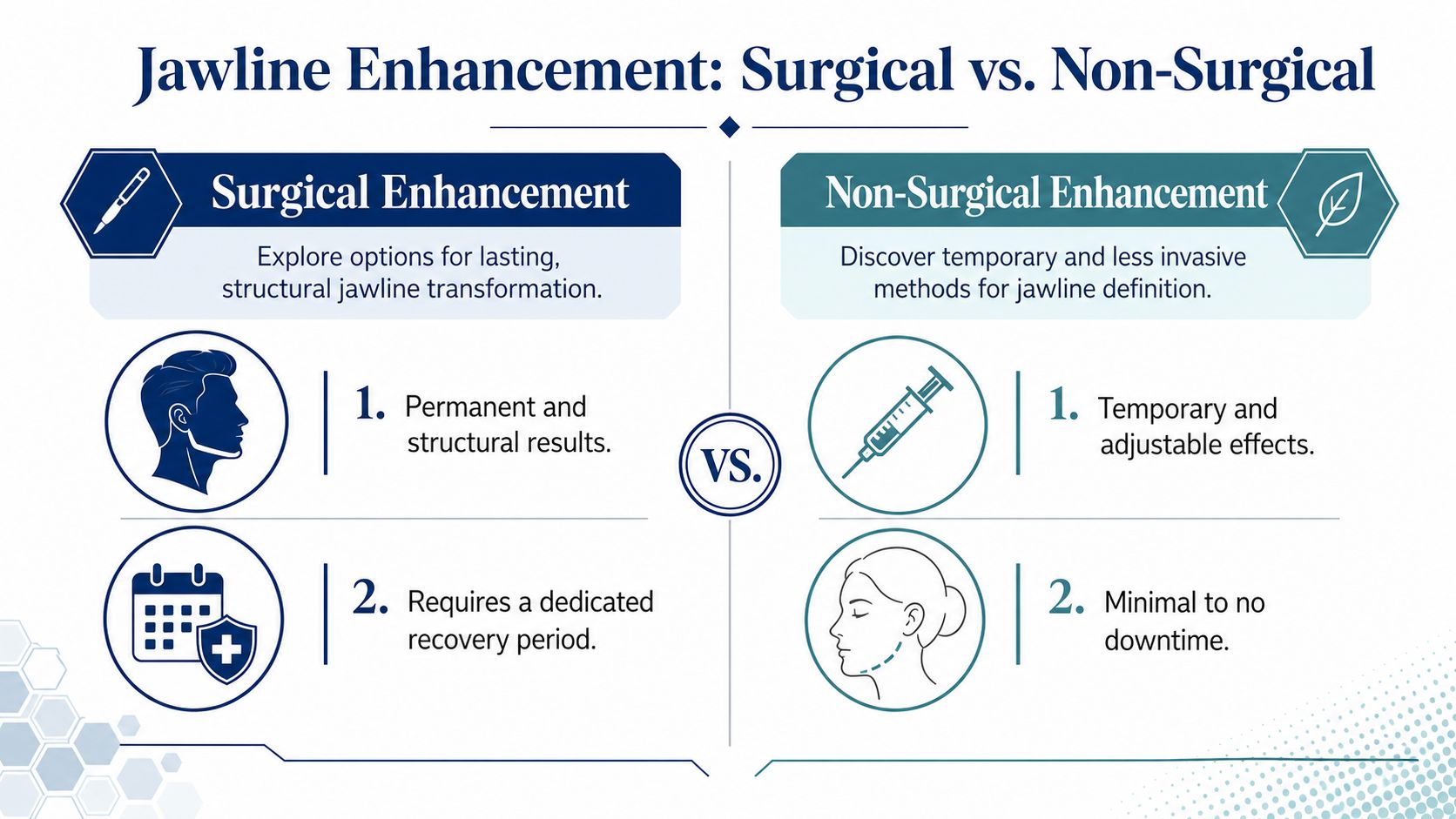
A patient may sit in my office saying, "I want a sharper jawline, but I do not want to look done and I do not want a long recovery." That is usually the moment the true decision starts. The choice is not merely surgery versus filler. The choice is whether the problem is structural, whether it can be camouflaged, and how much precision the patient wants.
Surgical treatment changes anatomy. Non-surgical treatment adjusts appearance within the limits of existing anatomy. Both can work well, but they solve different problems and create different timelines for maintenance.
What surgery changes
Surgical jawline contouring can remove fat, tighten deeper tissues, and improve support in the lower face and neck. That makes it the stronger option when fullness under the chin, loose neck tissue, or weak projection is driving the problem.
National plastic surgery reports continue to show steady interest in both chin augmentation and injectable treatments. I see the same pattern in practice. Some patients want a reversible first step. Others are clear that they want a lasting change and do not want to keep repeating filler appointments.
An awake approach matters here. For focused jawline procedures, local anesthesia allows careful assessment of contour during treatment, avoids the downsides of general anesthesia for many patients, and often makes recovery easier. At Ideal Face & Body, that is one of the reasons procedures such as PRECISION SCULPT appeal to patients who want meaningful definition without the added burden of a hospital-style experience.
What non-surgical treatment can and cannot do
Fillers and neurotoxins can improve contour modestly. They can sharpen a transition, add limited chin projection, and soften early jowling in selected patients. For the right anatomy, Radiesse jawline enhancement can provide subtle definition without surgery.
The limitations are just as important. Injectables do not remove fat. They do not lift descended tissue in a durable way. They do not correct a significant skeletal deficiency. If too much product is placed along a heavy lower face, the jaw can look broader or puffier instead of cleaner.
That trade-off is where good planning matters.
Non-surgical treatment usually fits patients who want:
- A temporary result
- Little to no downtime
- A subtle change
- A conservative first step before committing to surgery
Jawline Contouring at a Glance Surgical vs Non-Surgical
| Attribute | Surgical Options (e.g., Neck Lift, PRECISION SCULPT) | Non-Surgical Options (e.g., Fillers, Neurotoxins) |
|---|---|---|
| Primary goal | Structural contour change | Surface refinement and camouflage |
| Best for | Fat excess, laxity, weak framework | Mild contour issues and subtle enhancement |
| Longevity | Long-lasting to permanent, depending on the procedure | Temporary |
| Downtime | Requires recovery | Minimal to no downtime |
| Precision | Can directly address anatomy, especially with awake contouring under local anesthesia | Can improve appearance without changing anatomy |
| Limitation | Recovery and procedure planning matter | Cannot remove fat or lift loose tissue |
The right option depends on diagnosis, not trend or convenience. If the jawline needs true structural correction, surgery gives a more honest solution. If the issue is mild and the goal is modest refinement, non-surgical treatment can be a very reasonable place to start.
A Closer Look at Surgical Jawline Procedures
A sharper jawline comes from treating the structure that is causing the blur. In practice, that usually means addressing one of three problems: excess fat, tissue laxity, or inadequate support.
When fat is the main problem
If fullness is concentrated under the chin or along the upper neck, targeted liposuction can create a cleaner jaw and a more defined angle between the chin and neck. The best candidates still have enough skin tone for the skin to contract after fat removal.
For patients considering chin and neck liposuction, the appeal is often its precision. In my practice, this is one of the clearest examples of why awake facial contouring matters. Under local anesthesia, I can contour carefully, assess symmetry in real time, and avoid the added recovery and nausea that often come with general anesthesia.
That does not mean liposuction is the answer for every full neck. If the skin is loose or the platysma has separated, removing fat alone may improve volume but still leave a soft outline.
When loose tissue blurs the jaw
Some patients have very little extra fat. Their jawline looks heavier because the deeper support layers have relaxed and descended over time. In that situation, a neck lift often gives the most reliable correction because it treats the actual problem. Skin can be redraped, excess fat can be refined, and the platysma can be tightened to restore a cleaner contour.
This is the difference patients need to understand before choosing a procedure. Liposuction reduces volume. A neck lift repositions tissue and restores support. If laxity is driving the problem, a limited treatment plan usually leads to a limited result.
Average results usually come from using the wrong operation for the anatomy.
When cheek fullness hides the angle
Jawline definition can also be obscured by fullness higher in the lower face. A patient may have a decent neck and reasonable chin projection, but heavy lower cheeks can still make the jaw look less crisp. In carefully selected patients, buccal fat removal can reduce that roundness and reveal more of the natural transition from cheek to jaw.
Selection matters here. Buccal fat removal is not a substitute for a weak chin, a full neck, or loose skin. It works best in patients with persistent lower cheek fullness who want refinement, not a dramatic change.
Some treatment plans combine procedures. A patient with submental fullness and good skin tone may do very well with awake liposuction alone. Another may need a neck lift for lasting definition. Another may benefit from contouring plus structural support. The best surgical plan is individualized, conservative when appropriate, and honest about what each procedure can and cannot accomplish.
Your Patient Journey at Ideal Face & Body
For many patients, the most stressful part of jawline surgery isn't the result. It's the fear of the process. They worry about being put to sleep, losing control, or facing a longer recovery than they can manage.
That concern is exactly why awake facial contouring has become so relevant. Instead of treating local anesthesia as a lesser option, many surgeons now recognize that for the right procedure and the right patient, it can be the smarter one.

The consultation
A strong consultation starts with diagnosis, not a menu of procedures. The jawline is examined in motion and at rest. Chin projection, skin tone, neck fullness, and lower cheek shape all matter. Photos help, but the in-person exam is where definitive planning occurs.
Patients are usually relieved when they hear that not every concern requires a full operating room experience. If a localized contour issue can be treated safely and effectively in an office-based setting, that changes the emotional tone of the decision.
The awake procedure experience
Awake surgery means the patient remains comfortable under local anesthesia while the treatment is performed in a controlled office environment. For jawline contouring, that can be a major advantage. There is no general anesthesia recovery fog. There is often less disruption to the rest of the week. The experience can feel more personal and less intimidating.
The procedure day is typically straightforward. The area is marked carefully. Local anesthesia is placed methodically. The contouring is performed with attention to symmetry and natural transitions. Patients aren't left guessing what's happening.
Why awake surgery matters
Clinical perspective: A well-selected awake procedure can improve safety, recovery, and patient comfort at the same time.
That's the part many general guides miss. Jawline surgery isn't only about what gets removed or tightened. It's also about how the procedure is performed. For the right candidate, the awake approach can make treatment feel more manageable without compromising precision.
Recovery Results and Long-Term Expectations
Healing after jawline definition surgery is a process, not a single moment. Most patients look at themselves too early and worry too soon. Swelling, firmness, and temporary asymmetry are part of normal recovery in the early phase.
The early phase
The first stretch of recovery is about controlling swelling and protecting the new contour. Compression, head elevation, and careful activity restrictions matter. If a surgeon gives you a specific wrapping routine, follow it exactly. That support isn't cosmetic. It helps the tissues settle in the intended position.
Patients usually feel better before they look fully healed. That's normal. The outline often appears sharper, then puffier, then sharper again as swelling resolves unevenly.
The settling phase
Over the following weeks, the contour becomes easier to judge. This is when bruising fades, tenderness improves, and the jawline starts to look more like a result rather than a post-procedure face.
A few practical points help during this stage:
- Be patient with one-sided swelling. Small differences between sides are common early on.
- Protect your result. Avoid the temptation to massage, press, or overexamine the area unless your surgeon tells you to.
- Return to activity gradually. Too much exertion too early can prolong swelling.
Recovery is rarely linear. A day of extra swelling doesn't mean something is wrong.
Long-term expectations
Surgical contouring is long-lasting, but it doesn't stop the aging process. Fat removal remains fat removal. Structural procedures remain structural. But skin continues to age, and body weight changes can still affect the lower face over time.
This is also where expectations need to stay grounded. Surgery can create a cleaner jawline, better profile balance, and stronger separation between face and neck. It can't freeze time, and it can't override future weight fluctuation.
Regarding financial planning, treatment pricing varies based on the anatomy being addressed and whether one procedure or a combination is needed. A precise quote should come after an in-person evaluation, not before.
Jawline Surgery FAQs and Your Next Step
Patients often ask whether there's a "best age" for jawline definition surgery. There isn't. The better question is whether the anatomy supports a clear benefit. A younger patient may need chin support or fat removal. An older patient may benefit more from tissue repositioning.
Scars are another common concern. In well-planned facial surgery, incisions are placed in locations designed to be as discreet as possible. The exact pattern depends on the procedure. What matters most is not just where the incision sits, but whether the procedure chosen fits the problem.
Weight changes can affect results. If someone gains or loses a meaningful amount after surgery, the lower face and neck can change with it. That's why stable habits matter. The best result is easier to maintain when your weight is relatively consistent.
A final concern is whether surgery will look obvious. Done well, it shouldn't. Friends may say you look more rested, more fit, or better in profile. They shouldn't be able to identify a single "worked on" feature unless the change was intentionally dramatic.
If you've been trying to decide between injectables, liposuction, chin support, or a more extensive approach, the next step isn't guessing better. It's getting a precise diagnosis from an experienced surgeon who treats jawline contouring as both structure and aesthetics.
If you're ready to understand what would sharpen your profile, schedule a consultation with Ideal Face & Body. Dr. Justin Yovino and Dr. Sarah Yovino evaluate the cause of jawline blurring and design treatment around the anatomy, with a particular focus on awake, office-based procedures in Beverly Hills, CA.