You're probably here because you've looked in the mirror and noticed something that makeup, moisturizer, or “clean” skincare just doesn't fix. Maybe it's acne scarring that still catches the light. Maybe your skin looks dull, uneven, or tired no matter how careful you are. Or maybe hair thinning has started to show at the temples or along the part, and you want something more biologically active than another over-the-counter bottle.
That's where microneedling with PRP enters the conversation. It's often nicknamed a “vampire facial,” but that label doesn't do the treatment justice. In a medical setting, this is a controlled regenerative procedure that uses two tools together: tiny, precise needle channels and platelet-rich plasma from your own blood. The goal isn't gimmickry. The goal is to trigger repair where your skin or scalp needs it most.
Patients in Beverly Hills, CA often come in wanting a treatment that feels modern, minimally invasive, and grounded in real science. That's the right instinct. The most useful way to think about microneedling with PRP benefits is not as magic, and not as a replacement for every other procedure. It's a treatment with clear strengths, specific limits, and very good evidence in the right situations.
Table of Contents
- The Next Level in Skin Rejuvenation
- The Science of How Microneedling and PRP Work Together
- Evidence-Based Microneedling with PRP Benefits
- Your Treatment Journey from Consultation to Recovery
- Setting Realistic Expectations for Your Results
- Frequently Asked Questions About PRP Microneedling
The Next Level in Skin Rejuvenation
A common patient story goes like this: the skin isn't “bad,” but it no longer looks as fresh, smooth, or even as it used to. Pores look rougher. Old acne marks are more visible in daylight. The overall surface looks less polished. You want improvement, but you don't want a dramatic procedure or a long recovery.
Microneedling with PRP fits that middle ground well. Microneedling creates controlled micro-injuries in the skin, and PRP adds a concentrated portion of your own blood that contains platelets and signaling proteins involved in healing. Together, they aim to stimulate regeneration instead of covering up a problem.
That's why the treatment has stayed relevant long after the “vampire facial” nickname became popular. In experienced hands, it's not a trend piece. It's a regenerative method with practical uses for acne scars, texture changes, certain pigmentation concerns, and even scalp treatments for hair thinning.
Good aesthetic medicine starts with matching the treatment to the biology of the problem. Surface roughness, shallow scarring, and early thinning often respond better to regenerative strategies than people expect.
If you're trying to sort hype from reality before booking anything, one helpful outside read is this overview on how patients achieve a youthful glow. It's useful because many people first need the big-picture idea before they can judge whether the treatment fits their own goals.
For a practice setting, what matters most is evaluation. Dr. Sarah Yovino approaches these decisions the way a thoughtful aesthetic physician should. She looks at whether your concern is a texture issue, a scar issue, a pigment issue, or a laxity issue, because those are not the same problem, and they don't respond the same way.
The Science of How Microneedling and PRP Work Together
A patient will often say, “I understand the needles part. I don't understand what the PRP is adding.” That is the right question, because the value of this treatment is in the interaction between the two steps, not in the buzz around either one.
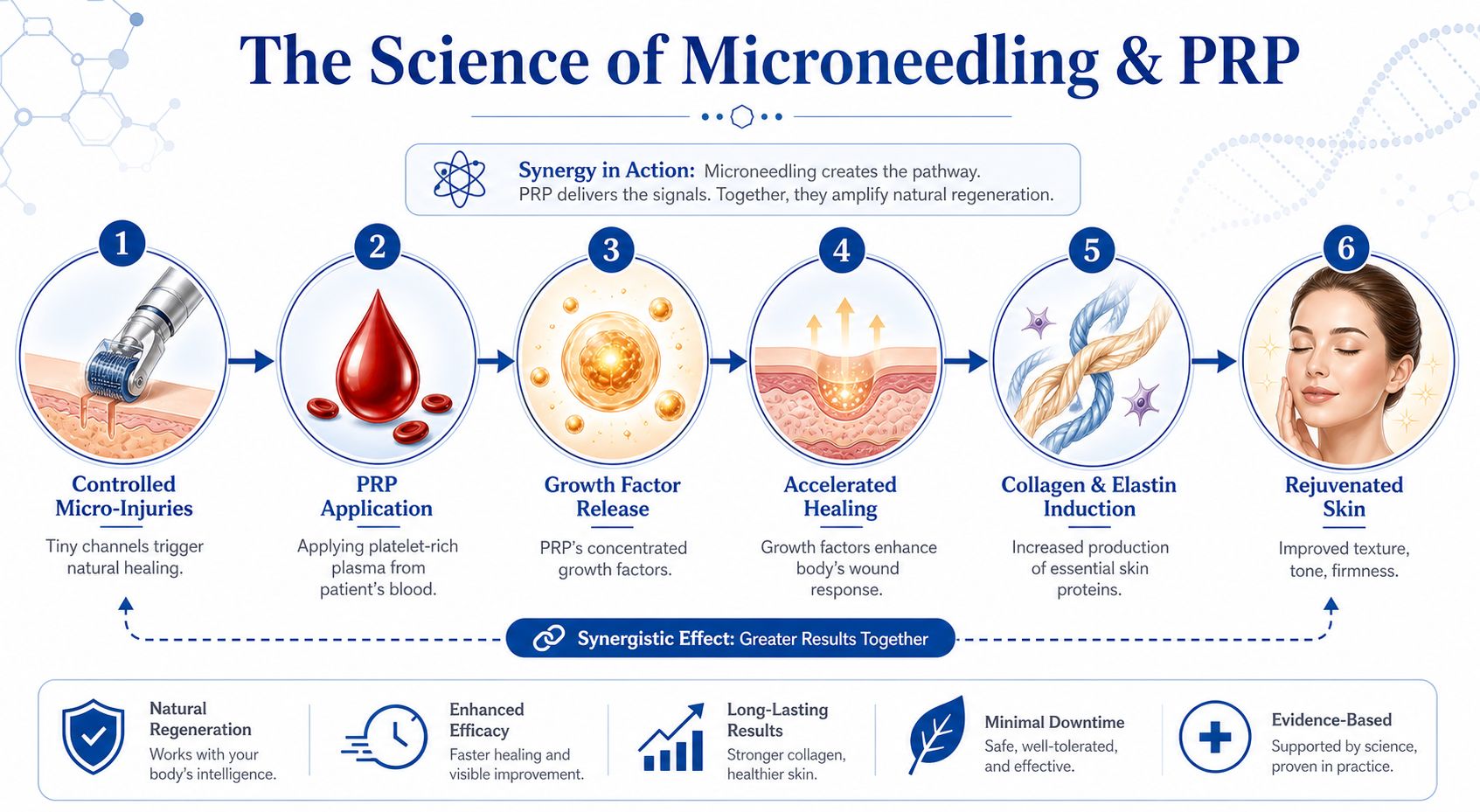
Microneedling starts the process. The device creates thousands of controlled microchannels in the skin. Your body responds the way it always does to a precise, limited injury. It sends inflammatory signals, clears minor damage, and begins rebuilding tissue, including new collagen and other structural proteins over time.
PRP changes the biology inside that healing window. It is made from your own blood after centrifugation separates and concentrates the platelet-rich portion. Platelets are best known for helping blood clot, but in aesthetic medicine we use them for a different reason. They release signaling molecules that drive repair, influence cell behavior, and support new vessel formation.
That is the part patients do not always hear clearly.
PRP is not a filler. It does not “lift” tissue in the way an injectable volumizer can. What it can do is give healing skin a richer concentration of the biologic signals it already uses to repair itself.
Why the pairing matters
Microneedling creates access and starts repair. PRP adds concentrated healing signals at the moment the skin is most receptive. A clinical review describing this combination notes that the microchannels from microneedling can improve transdermal delivery of PRP-derived growth factors such as TGF-β and VEGF, which are linked to dermal remodeling, in this acne scar review.
In practical terms, that helps explain why the combination often performs better than microneedling alone for concerns driven by remodeling, especially acne scars and texture irregularities. It also explains why results are usually gradual. You are watching tissue repair, not an instant mechanical tightening effect.
A helpful comparison is wound care. A clean, controlled wound already heals on its own. If that environment also receives stronger repair signals at the right time, the quality of healing may improve. That is the scientific logic behind combining these treatments.
What patients often misunderstand
“Collagen stimulation” is one of the most overused phrases in aesthetic medicine because it is true but incomplete. Yes, microneedling with PRP can support collagen remodeling. No, that does not mean every aging concern responds equally well.
The best-supported benefits tend to be:
- Texture improvement: skin can feel smoother and look more refined as the surface remodels
- Atrophic scar improvement: depressed acne scars may soften as new collagen forms in the treated area
- Hair restoration support: on the scalp, the same repair signaling may help in carefully selected cases of thinning
The less-supported claim is significant lifting. If a patient's main issue is loose skin, heavy jowling, or substantial facial descent, microneedling with PRP usually will not create the kind of structural repositioning that surgery, energy-based tightening, or other targeted treatments are designed to address.
That distinction builds trust. It also helps patients choose treatment for the biology of the problem instead of the marketing language around it.
Practical rule: Ask what is being treated. Rough texture, shallow scars, and early thinning are different from true laxity.
If you want a broader explanation of collagen biology, VitzAi's guide to enhancing collagen gives useful background. For a treatment-focused overview, this resource on the benefits of microneedling for skin remodeling is also helpful.
Evidence-Based Microneedling with PRP Benefits
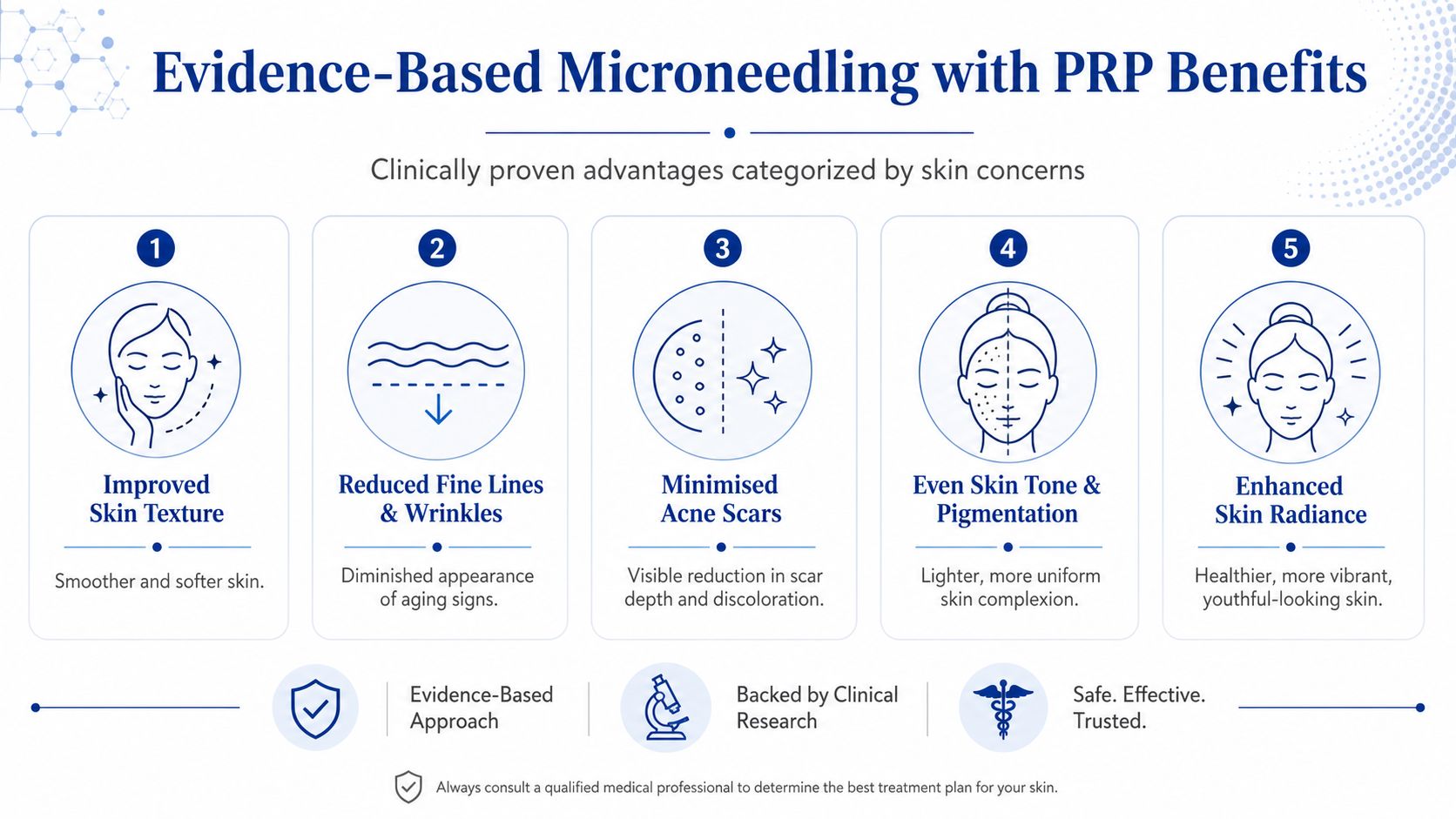
A good treatment plan starts with a simple question: what problem are we trying to solve? If the issue is shallow acne scarring, rough texture, or early patterned thinning, microneedling with PRP has a reasonable scientific basis. If the issue is heavy jowling or significant skin laxity, the expected benefit is much smaller. That distinction matters because it keeps the conversation tied to tissue biology, not marketing promises.
Atrophic acne scars
This is one of the best-supported uses of the combination.
A meta-analysis on acne scar treatment that pooled 10 clinical studies found that microneedling plus PRP significantly improved the odds of substantial clinical improvement compared with microneedling alone, with an odds ratio of 2.97 and 95% CI 1.96 to 4.51, p < 0.001. Put plainly, patients receiving the combined treatment were nearly three times more likely to achieve meaningful visible improvement.
The same analysis found better Global Quality of Scars scores, a mean difference of −0.32 with 95% CI −0.44 to −0.20, p < 0.001, and higher patient satisfaction, with an odds ratio of 4.15 and 95% CI 2.13 to 8.09, p < 0.001. The included studies showed no significant heterogeneity, and adding PRP did not increase adverse event risk.
For patients with depressed acne scars, that matters. Scar improvement depends on remodeling the skin from below, almost like filling small dents in a road rather than polishing the surface. PRP does not replace the need for repeated sessions or good technique, but it may improve the quality of that remodeling.
Skin texture and overall skin quality
Texture is a different goal from scar revision. Here, patients are usually noticing crepiness, dullness, or a surface that no longer reflects light evenly. Microneedling creates controlled micro-injury, and PRP supplies concentrated growth factors to support repair. The practical result can be smoother-feeling skin and a more refined appearance over a series of treatments.
Studies on skin rejuvenation have reported improvements in patient-perceived texture and skin uniformity, as noted earlier. That is encouraging, but it is also where expectations need structure. Texture and mild unevenness often improve more reliably than true lifting.
Pigment is another area that benefits from precision. Some patients see modest improvement in post-inflammatory discoloration or overall tone when texture improves and inflammation is controlled. That is not the same as saying PRP microneedling is a dependable stand-alone treatment for every pigment disorder, especially conditions such as melasma, which can be biologically stubborn and prone to recurrence.
If your goals are surface refinement, glow, or improvement in post-acne textural change, a PRP facial treatment overview can give useful context on how this approach is commonly used in practice.
Androgenetic alopecia and hair restoration
The scalp deserves its own category because the target is different. In facial treatment, we are usually trying to improve texture or scars. In androgenetic alopecia, the goal is to support weakened follicles that are still alive but underperforming.
One comparative study of androgenetic alopecia, reported in this clinical paper on PRP, microneedling, and hair growth, found greater improvement in hair growth in the combination group than in groups treated with PRP alone or minoxidil alone. That does not mean every patient with thinning hair is an ideal candidate. Follicles that have been dormant for a long time are harder to revive, and scarring alopecias require a different level of medical caution.
A useful way to understand the mechanism is to picture the follicle as a mini-organ with a vulnerable support system. Microneedling creates channels and local repair signals. PRP adds a concentrated batch of the body's own signaling proteins. In selected patients, that combination may improve the environment around the follicle enough to support better thickness and density.
What the evidence supports, and what it does not
The strongest benefits are still the most grounded ones: better texture, improvement in atrophic acne scars, and support for hair restoration in selected cases.
The weaker claim is major skin lifting. Microneedling with PRP can improve skin quality. It does not reposition descended tissue in the way surgery or some tightening procedures are designed to do. Patients usually make better decisions when that line is clear from the start.
That realism is not pessimism. It is good medicine.
Your Treatment Journey from Consultation to Recovery
A well-run appointment starts with diagnosis, not sales language. If two patients both say they want “better skin,” one may have acne scars that can respond well to treatment, while the other may have active rosacea or inflamed breakouts that make treatment a poor choice that day. The same device can be helpful or inappropriate depending on what is happening in the skin.

During the consultation, I want to answer three practical questions. What are we treating. Is the condition quiet and stable, or active and irritated. Are your goals matched to what microneedling with PRP can realistically improve. That last point matters because this treatment is much better at improving skin quality than creating major lifting.
Who tends to be a good candidate
Patients who tend to do well usually fit one of a few patterns.
- Scar patients: People with atrophic acne scars who want gradual smoothing and are open to a series of treatments. If scarring is the main concern, it also helps to understand how microneedling for scars is typically planned and layered with other options.
- Texture patients: People with roughness, mild unevenness, or skin that looks tired rather than significantly lax.
- Hair patients: Men and women with pattern hair thinning who want a regenerative treatment as part of a broader hair restoration plan.
Some people need treatment postponed or modified. Active infection, an inflamed rash, certain bleeding issues, or irritation severe enough to disrupt the skin barrier all change the plan. Blood-based treatments also require a careful medical review. A physician-led consultation matters here because the question is not merely “Can we do it?” The better question is “Should we do it now, and if so, how?”
A brief mention of where treatment is offered can be useful. Ideal Face & Body provides microneedling PRP treatment in-office. The more important point is whether the diagnosis and treatment plan make medical sense for your skin or scalp.
What the appointment usually feels like
The visit is usually straightforward. First, the area is cleansed and a topical numbing cream is applied. A small blood sample is then processed so the platelet-rich plasma can be prepared while the skin or scalp is getting numb.
Once treatment begins, the device creates controlled microchannels at a depth chosen for the indication and the body area. For the patient, the sensation is often scratchy, warm, or prickly rather than sharply painful. Bony areas and thinner skin can feel stronger. The scalp can be more tender than the cheeks.
The easiest way to understand the procedure is to picture a carefully timed repair sequence. Microneedling creates the controlled injury signal. PRP is then placed where those fresh channels and local signals may support healing. The goal is not dramatic trauma. The goal is precision.
A typical visit includes:
- Assessment: Confirm the target, depth, and whether the skin barrier looks healthy enough to proceed.
- Preparation: Cleanse, numb, and prepare the PRP.
- Procedure: Microneedle the planned area and apply or deliver PRP based on the treatment approach.
- Immediate aftercare: Review what is normal in the first 24 to 72 hours and what products to avoid.
Recovery and aftercare
Recovery is usually measured in days, not weeks. Right after treatment, the skin often looks pink to red, similar to a moderate sunburn or the flush after a hard workout. It can feel warm, tight, and mildly swollen. Over the next day or two, some patients notice dryness or a fine rough texture as the surface settles.
That reaction is expected.
The early aftercare window is simple for a reason. Freshly treated skin is temporarily more permeable and more reactive, so this is the wrong time for aggressive acids, scrubs, retinoids, or unnecessary experimentation.
A few principles protect the result:
- Keep skincare bland and barrier-focused: Use a gentle cleanser, moisturizer, and whatever post-care products your clinician recommends.
- Avoid heat and friction: Intense exercise, saunas, hot yoga, and rubbing the skin can increase irritation.
- Be disciplined about sun protection: Freshly treated skin is more vulnerable to excess inflammation and post-treatment pigment change.
- Restart active products on schedule: Going back to exfoliants or retinoids too early is a common reason for prolonged irritation.
Scalp recovery follows the same logic. Tenderness, mild redness, and a temporary “worked on” feeling can happen early, but hair treatment is a long-range plan, not a single dramatic event. As noted earlier, combination treatment has shown better hair-growth outcomes than PRP alone in selected patients. In practice, that means consistency matters more than expecting a one-visit transformation.
One of the best aftercare rules is also the least glamorous. Healing skin usually does best with calm, boring skincare.
Setting Realistic Expectations for Your Results
Trust matters more than hype with a treatment like this. Patients often come in having heard that PRP “tightens,” “lifts,” “firms,” and “replaces surgery.” That language overshoots the evidence.

What this treatment does well
Microneedling with PRP is strongest when the target is texture, superficial to moderate atrophic scarring, and selected hair restoration cases. It can also support improvement in some pigment-related concerns when used thoughtfully, especially in broader treatment plans.
Patients usually appreciate it because the changes often look like healthier skin rather than “done” skin. The face still looks like your face. It just tends to look smoother, fresher, and more even when the indication is right.
Where marketing gets ahead of the evidence
A 2024 randomized clinical trial found no evidence that injectable PRP improved skin laxity or deep wrinkles compared with saline controls, according to this randomized trial on PRP and aging skin. That directly challenges the common claim that PRP provides meaningful structural lifting.
So if your main concern is jowling, heavy laxity, or etched deep folds, this treatment may not be the right centerpiece. That doesn't make it ineffective. It means it's being used for the wrong job.
A helpful way to phrase expectations is this:
| Concern | How well microneedling with PRP fits |
|---|---|
| Rough texture | Strong fit |
| Atrophic acne scars | Strong fit |
| Hair thinning from AGA | Strong fit in selected patients |
| Deep wrinkles | Limited support |
| Significant skin laxity | Limited support |
Why technique matters
Another important nuance is how PRP is delivered. A comparative study found that topical PRP had no added advantage over microneedling alone for acne scars, as discussed in this study on PRP application method. Patients are often told that “adding PRP” automatically improves results, but the delivery method can determine whether it adds value.
If scar revision is your focus, the treatment plan should be precise. The same is true if you're evaluating microneedling for scars. Not all scar treatments are interchangeable, and not every PRP add-on is equally useful.
Frequently Asked Questions About PRP Microneedling
Is it painful
A fair question, because the name sounds more intense than the experience usually is.
Most patients do well with PRP microneedling because a topical numbing cream is typically applied before treatment. With numbing on board, the sensation is often described as heat, vibration, pressure, or a scratchy feeling rather than sharp pain. Areas with thinner skin or more nerve endings, such as the forehead, upper lip, and scalp, can feel more sensitive.
The easiest way to understand it is to separate the idea of injury from controlled stimulation. The needles create thousands of very small channels on purpose, at a measured depth, in a sterile setting. That is very different from a random skin injury. Your physician can also adjust needle depth and treatment intensity based on the area being treated and your tolerance.
How is the PRP prepared
PRP begins with a standard blood draw. The sample is then spun in a centrifuge, which separates the blood into layers so the platelet-rich portion can be collected and used during the procedure.
Platelets are best known for helping blood clot, but they also release signaling proteins that participate in repair. In simple terms, they act like a packet of biological instructions. They do not force the skin to become younger, and they do not create dramatic lifting. What they may do is support the healing response that microneedling has already started.
Preparation quality matters. Sterile handling, proper separation, and a treatment plan that matches the diagnosis all affect whether PRP is likely to add value.
Can it be combined with other treatments
Yes, although the timing should be deliberate.
PRP microneedling can be paired with other treatments, but combination plans work best when each treatment has a clear job. Neuromodulators address muscle movement. Fillers replace volume. Energy-based treatments can target laxity or pigment. Microneedling with PRP is usually chosen for surface quality, acne scarring, and selected cases of hair thinning.
That distinction matters because patients are often sold a bundle instead of a plan. If your main issue is melasma, redness, or significant skin laxity, the answer is not automatically to add more procedures in one visit. A careful physician will space treatments appropriately, watch how your skin responds, and avoid creating irritation that makes results harder to judge.
How soon will I see results
There are usually two phases.
The first is the early recovery phase, when mild swelling and increased hydration can make skin look fresher within days. That effect is real, but it is not the final result. The second phase is tissue remodeling, which takes longer as collagen production and scar remodeling gradually change texture.
Hair restoration follows an even slower timeline because hair cycles move slowly by nature. Patients who respond well generally do so over a series of treatments and follow-up visits, not from a single session.
This is where realistic expectations protect you from disappointment. PRP microneedling can improve the look of rough texture, certain acne scars, and some forms of hair thinning. It is less reliable for meaningful lifting or major tightening. That difference is one of the most important parts of an honest consultation.
If you're considering whether this is the right match for your goals, a thoughtful consultation with Dr. Sarah Yovino can help separate a good indication from a disappointing one.
If you'd like a personalized assessment of whether microneedling with PRP fits your skin or hair concerns, schedule a consultation with Ideal Face & Body. A physician-led evaluation can help determine whether your main issue is texture, scarring, pigmentation, or hair thinning, and whether this regenerative treatment makes sense for your specific anatomy and goals.