
You're probably here because you've spent too long adjusting shirts in the mirror, avoiding light-colored tops, skipping the pool, or crossing your arms without realizing it. Most men with gynecomastia don't need a lecture on what it feels like. They already know. The frustrating part is that the internet makes a simple goal, getting a flatter, more masculine chest, feel harder than it should.
The biggest mistake I see is treating this like a generic cosmetic surgery search. It isn't. Choosing the best gynecomastia surgeon has more to do with judgment, surgical planning, and anesthesia approach than flashy marketing. A good result looks natural in a T-shirt, from the side, and with your arms overhead. A bad result can leave behind puffiness, a crater deformity, uneven contour, or a chest that still doesn't feel right.
That's why this decision deserves more care than a quick review search. Gynecomastia is also far more common than most men realize. By age 70, nearly 70% of men will exhibit signs of enlarged male breast tissue, which makes it one of the most prevalent and treatable conditions in male plastic surgery, according to this gynecomastia surgeon selection guide. Common doesn't mean simple, though. It means you should expect a surgeon who treats it with real frequency and takes male chest contour seriously.
Table of Contents
- The First Step Toward a More Confident You
- What Defines the Best Gynecomastia Surgeon
- Comparing Your Gynecomastia Procedure Options
- Spotlight on Beverly Hills Expertise Dr. Justin Yovino
- Your Consultation Checklist Questions to Ask
- Navigating Your Recovery Journey
- Making Your Final Decision with Confidence
The First Step Toward a More Confident You
If you've been dealing with gynecomastia for years, you've probably built small habits around it. Loose shirts. Layering when it's too warm. Dodging situations where your chest might show. Men get very good at hiding this issue, but that doesn't mean it stops affecting them.
I've talked to plenty of patients who say the same thing in different words. They work out consistently, their weight is stable, and their chest still looks soft or puffy. They don't feel comfortable shirtless, and they're tired of being told to “just lose more fat” when that hasn't solved the problem.
That's where the right surgeon changes everything. Not because surgery should be taken lightly, but because this is one of those areas where details matter. The best gynecomastia surgeon isn't just removing tissue. He's reshaping the male chest with restraint, precision, and a clear plan for your anatomy.
Why this decision matters so much
Some men have excess fat in the chest. Others have firm glandular tissue behind the nipple. Many have both. If a surgeon oversimplifies that difference, you should be concerned. A flat, clean result usually comes from proper diagnosis first, then the right combination of techniques.
The consultation should make you feel understood, not rushed. If you leave with more confusion than clarity, keep looking.
Confidence starts with specialization
This is a treatable problem. That matters. You're not stuck with it, and you don't need to settle for a surgeon who only occasionally performs male chest contouring. You want someone who sees the full spectrum of gynecomastia regularly and knows how to avoid the telltale signs of incomplete correction.
Your next step isn't finding the cheapest option or the closest office. It's finding the surgeon whose training, experience, and approach fit the procedure you need.
What Defines the Best Gynecomastia Surgeon
The phrase best gynecomastia surgeon gets thrown around too loosely. A polished website doesn't make someone the right choice. A serious surgeon for this procedure needs proven credentials, real experience with male chest contouring, and the ability to explain exactly what he plans to remove and why.
Before anything else, use this checklist.
Start with credentials you can verify
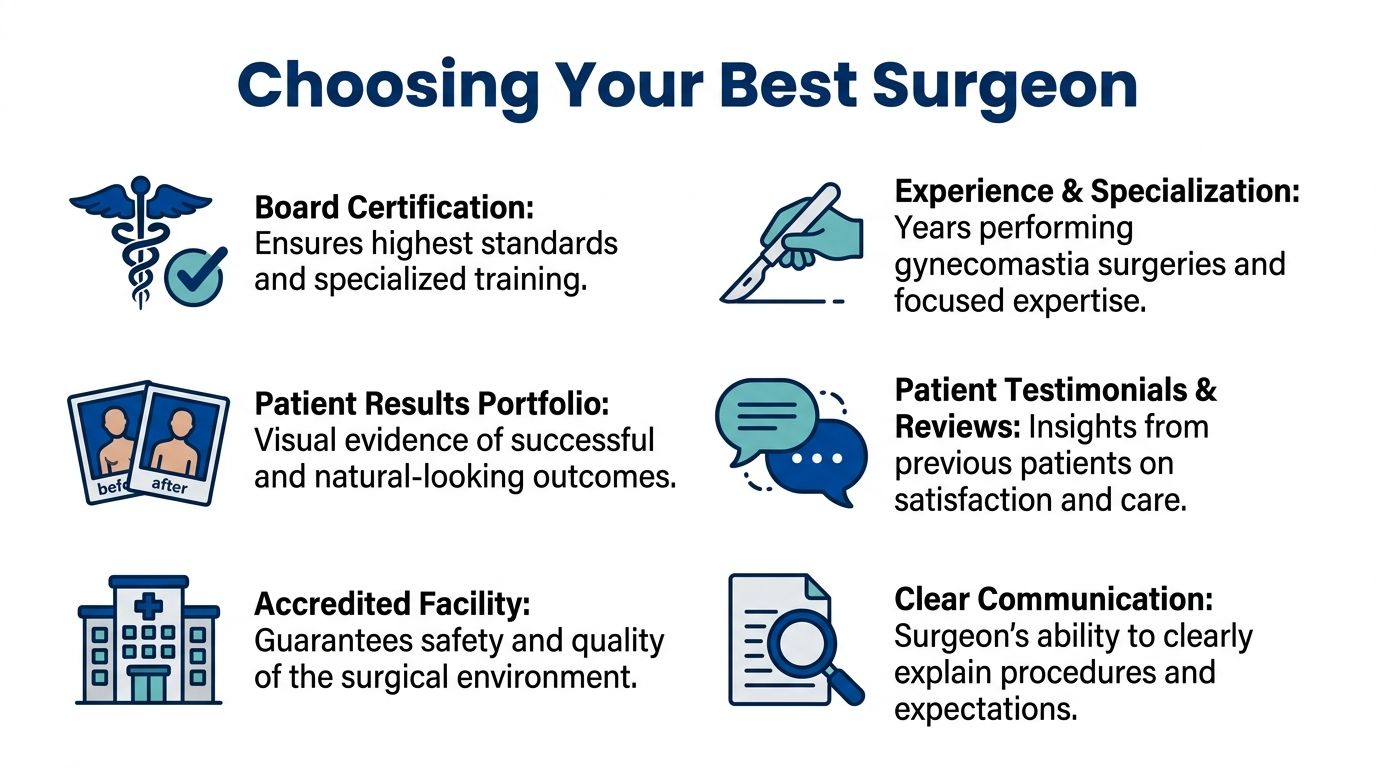
The baseline is board certification. That isn't a bonus. It's the floor. The American Society of Plastic Surgeons emphasizes choosing a surgeon who understands the causes of gynecomastia, has significant procedural volume, and holds proper board certification in plastic surgery, as noted in ASPS guidance on preparing for gynecomastia surgery.
Here's the practical framework I'd use:
- Board certification first: If a surgeon can't clearly present board-certified plastic surgery credentials, move on.
- Gynecomastia-specific experience: Ask how often he performs male chest reduction, not how often he does body contouring in general.
- A real before-and-after portfolio: You want consistent lighting, multiple angles, and patients who started with a chest like yours.
- Clear explanation of technique: The surgeon should explain whether you need liposuction, gland excision, or both.
- Accredited setting: Safety matters just as much as aesthetics.
- Communication that makes sense: If the explanation is vague, the surgical plan may be vague too.
Look for a specialist, not a dabbler
A surgeon can be talented and still not be the right choice for gynecomastia. This procedure requires a feel for the male chest that not every general cosmetic practice has. You want someone who knows how aggressive to be, where to leave support, and how to avoid the chest looking scooped out.
Reviews can help, but read them intelligently. Look for comments about communication, recovery guidance, and whether patients felt their result looked natural rather than just “different.” If you want a model for how detailed patient experiences can help vet a practice, browse customer feedback for Artful Surgeon and notice how much you can learn from specifics instead of star ratings alone.
Practical rule: If a surgeon can't explain his approach to contour, scar placement, and gland removal in plain English, don't trust him with your chest.
The best surgeon won't sell you confidence. He'll earn it by being precise, transparent, and obviously experienced.
Comparing Your Gynecomastia Procedure Options
Many consultations falter precisely when patients hear “lipo,” “excision,” “general anesthesia,” or “local anesthesia,” but nobody slows down enough to explain what those choices mean for the final result and recovery. That's a problem.
Quick comparison of the main decisions
| Decision area | One option | Other option | What matters most |
|---|---|---|---|
| Chest issue | True gynecomastia | Pseudogynecomastia | Whether gland is present or it's fat only |
| Tissue treatment | Liposuction only | Liposuction with excision | Whether fat removal alone can create a flat chest |
| Anesthesia | General anesthesia | Awake procedure under local anesthesia | Safety profile, discharge, and recovery experience |
| Surgical planning | Generic plan | Customized plan | Your skin quality, tissue type, and contour goals |
A proper consultation should sort these choices out clearly. If it doesn't, you're not getting thoughtful care.
True gynecomastia versus pseudogynecomastia
Not every enlarged male chest is the same. Pseudogynecomastia means the fullness is primarily fat. In those cases, liposuction may be enough. True gynecomastia includes glandular tissue, and that tissue usually requires direct excision.
The technical point matters because liposuction doesn't reliably remove dense gland. A published review notes that gynecomastia surgery often requires liposuction for fatty tissue and direct excision of glandular tissue via an infra-areolar incision to create a flat chest and avoid contour problems, as described in this clinical discussion of gynecomastia techniques.
Here's a visual overview.
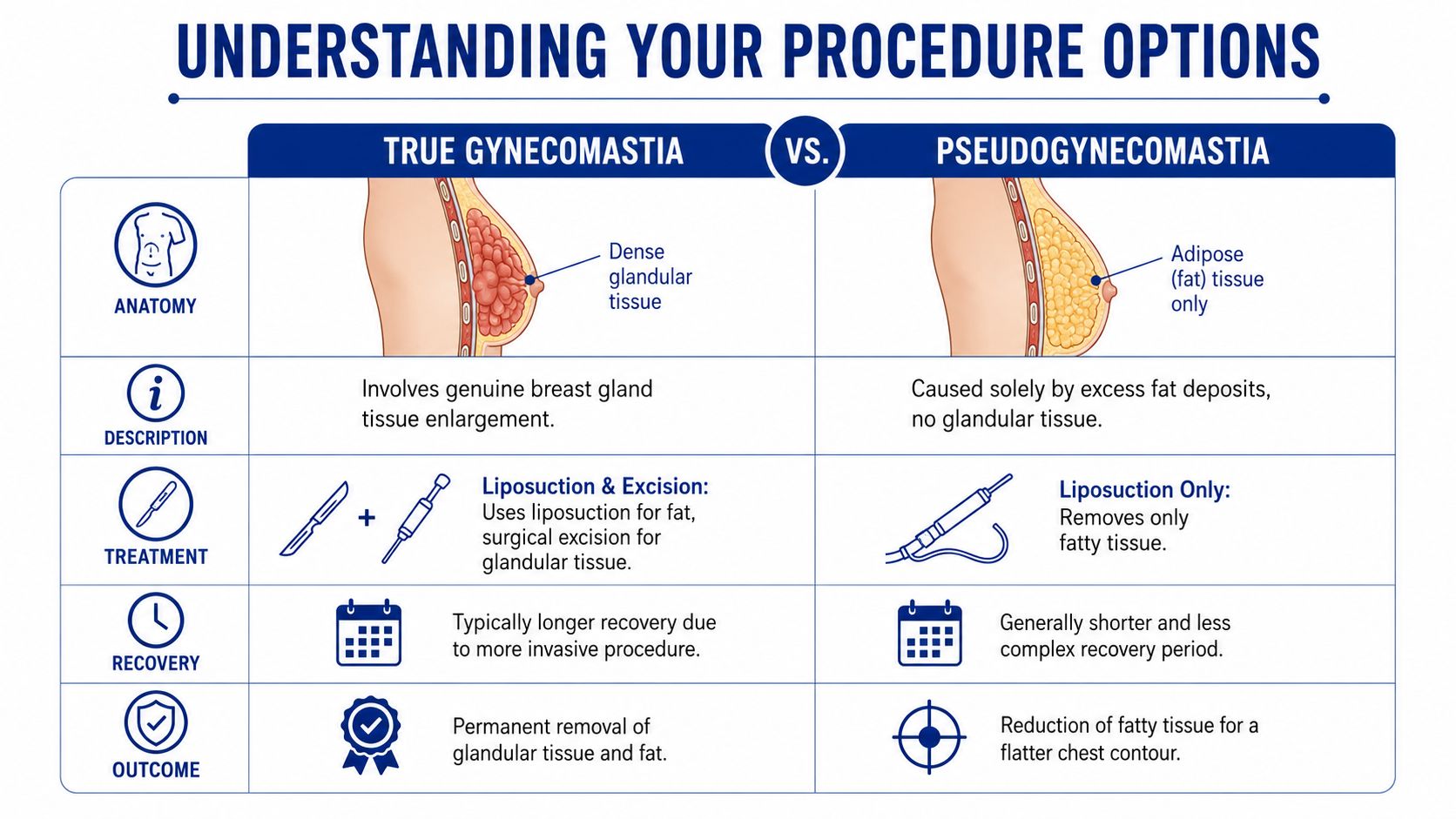
If you want to review how surgeons approach different gynecomastia treatment options, focus on whether the plan distinguishes fat from gland and explains why that distinction changes the operation.
Why the awake approach deserves more attention
Most patients are told about surgeon credentials and facility safety. Fewer are given a thoughtful explanation of anesthesia options. That's unfortunate, because anesthesia changes the experience in a big way.
There's a growing conversation around awake gynecomastia surgery under local anesthesia with sedation, and I think that's a good thing. According to this overview of gynecomastia anesthesia considerations, emerging data suggests local anesthesia with sedation reduces immediate postoperative risks and enables faster discharge, yet patients rarely find useful comparative guidance when searching for the best gynecomastia surgeon.
That gap matters. Patients deserve to know there may be an option that avoids the fog and downsides many associate with general anesthesia.
Awake surgery isn't right for every patient or every case. But if a surgeon never discusses it, you're not hearing the full conversation.
Here's my opinion. For appropriate candidates, an awake approach under local anesthesia is often the more patient-friendly path. You avoid a full general anesthetic experience, the discharge process is typically smoother, and recovery often feels more straightforward in the first phase. That doesn't replace surgical skill. It makes good surgical skill easier to experience well.
Spotlight on Beverly Hills Expertise Dr. Justin Yovino
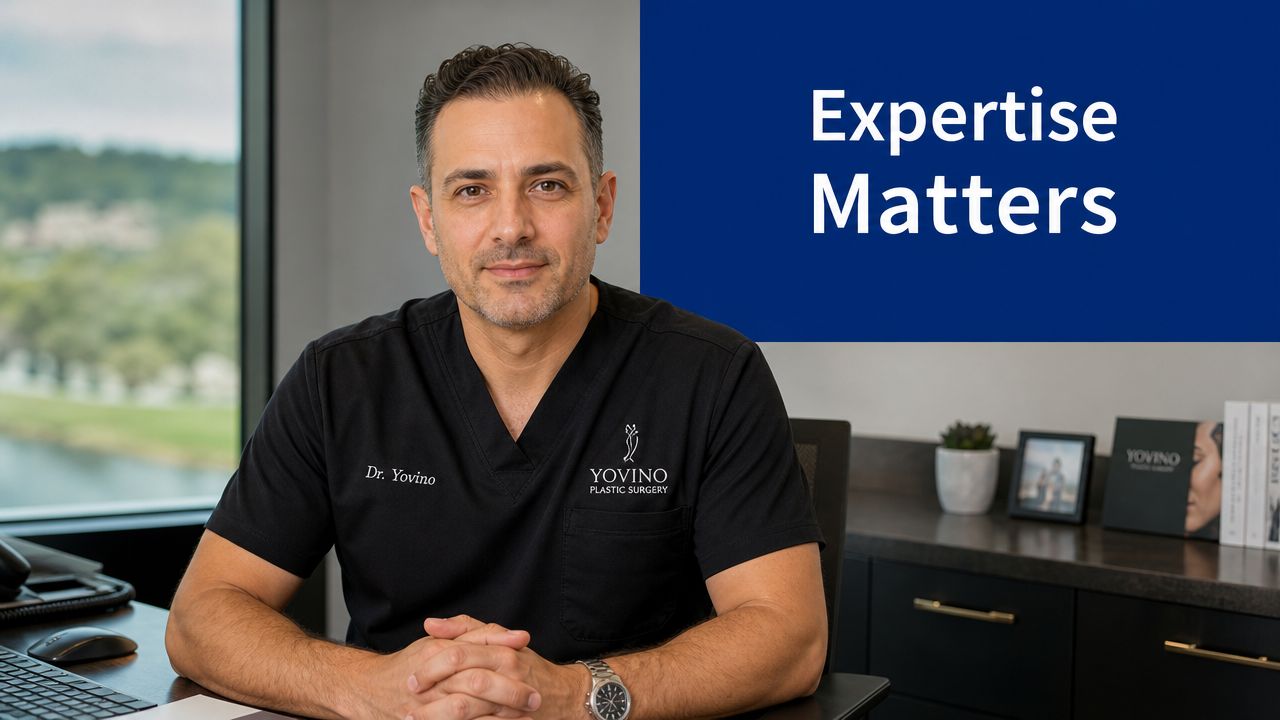
If you're looking in Beverly Hills, CA, Dr. Justin Yovino stands out for one reason that matters more than marketing. His practice aligns with what patients should actually want in gynecomastia care: thoughtful surgical planning, office-based treatment, and a real focus on awake procedures under local anesthesia.
Why his approach fits what patients should want
When men search for the best gynecomastia surgeon, they usually think first about the surgeon's hands. That's reasonable. But the setting and anesthesia approach matter too. A surgeon who routinely performs office-based body contouring under local anesthesia brings a different level of planning to the patient experience.
That's relevant here because Dr. Justin Yovino practices in a model built around awake surgery. This isn't a generic add-on. It's part of how the care is structured.
What to expect from the practice philosophy
According to Ideal Face & Body's practice information, the clinic offers male breast correction as part of its body contouring services using office-based procedures under local anesthesia, and each treatment plan is customized after a personal consultation. That matches what many men are looking for: privacy, a personalized plan, and an approach that doesn't default to general anesthesia just because it's familiar.
Dr. Sarah Yovino is also part of the aesthetic team, which reinforces that the practice isn't built around a one-size-fits-all cosmetic model. It's a focused environment.
One important clarification matters here. Ideal Face & Body no longer offers breast implant placement, implant-based breast augmentation, or breast implant revision procedures. For a male patient researching gynecomastia, that's not a drawback. If anything, it keeps the conversation centered on chest contouring rather than unrelated procedures.
A surgeon earns trust when the practice model supports the procedure, not distracts from it.
If your priority is a customized male chest correction plan with an awake, office-based focus, Dr. Justin Yovino is a serious name to consider in Beverly Hills, CA.
Your Consultation Checklist Questions to Ask
A strong consultation should feel like a working session, not a sales pitch. You're there to find out whether the surgeon understands your anatomy, your goals, and the specific technique required to get you from point A to point B.
Questions that reveal real expertise
Ask these directly, and listen closely to how the answers are delivered:
How do you determine whether I have fat, gland, or both?
A good surgeon should examine you carefully and explain what he feels and sees.Do you think I need liposuction alone, excision alone, or a combination?
The answer should be specific to your chest, not generic.Where would the incision be placed if gland removal is needed?
You want a straightforward explanation of scar placement and why it's chosen.How do you avoid a crater deformity or an over-resected look?
This question tells you whether the surgeon understands contour, not just tissue removal.Can I see before-and-after photos of patients with a starting point similar to mine?
Similar body type matters more than dramatic transformations on unrelated cases.
A clinical review of gynecomastia surgery notes that many patients need a combined approach of liposuction and direct gland excision via an infra-areolar incision to achieve a flat chest and avoid contour deformities. Your consultation should make clear which parts apply to you, based on this published discussion of surgical planning.
Questions that expose weak planning
These questions are just as important because they reveal whether the surgeon has thought through recovery and decision-making.
What type of anesthesia do you recommend for me, and why?
If the answer is “that's just how we do it,” keep your guard up.What will the first few days of recovery realistically feel like?
Honest answers build trust. Vague reassurance doesn't.What happens if there's residual fullness, asymmetry, or a contour issue after healing?
You want clarity on follow-up, not avoidance.What should I stop taking before surgery if supplements or medications may be contributing?
A careful surgeon thinks about causes, not just correction.
Good consultations leave you with a clear surgical plan in your own words. If you still can't explain what's being done after the appointment, the communication wasn't good enough.
Bring notes. Bring photos if you want to describe your goal. Don't worry about sounding picky. The right surgeon won't be annoyed by thoughtful questions. He'll welcome them.
Navigating Your Recovery Journey
Most men can handle recovery well when they know what's coming. The anxiety usually comes from uncertainty, not from the recovery itself. If your surgeon prepares you properly, the process feels manageable and structured.

What recovery usually feels like
Expect swelling, soreness, and tightness early on. Expect to wear compression as directed. Expect the chest to improve in stages rather than all at once. Those are normal parts of the process.
Men also need to understand that the exact recovery path depends on what was done. Liposuction-only cases can feel different from cases that include gland excision. That's one reason general online advice often misses the mark.
If you want a clearer sense of what healing may involve after gynecomastia surgery recovery, focus on timelines for swelling, garment use, exercise restrictions, and follow-up appointments rather than looking for shortcuts.
Red flags during the planning stage
Some surgeons downplay recovery because they don't want to scare patients. I think that's a mistake. Underpromising and overdelivering is better medicine.
Watch for these warning signs:
- Too casual about downtime: If someone makes it sound like nothing happened, that's not realistic.
- No detailed post-op instructions: Recovery should be mapped out clearly before surgery.
- No mention of compression: Chest contouring without compression guidance is sloppy.
- No discussion of activity limits: You need to know when to return to the gym, work, and lifting.
- Overly vague talk about cost: Costs vary with complexity and technique, but the office should still explain what factors change the overall expense.
Recovery goes better when you treat it like part of the procedure, not the part after the procedure.
The men who tend to be happiest after gynecomastia surgery are the ones who planned for recovery with the same seriousness they brought to choosing the surgeon.
Making Your Final Decision with Confidence
The best gynecomastia surgeon is rarely the loudest one online. He's the surgeon with the clearest credentials, the strongest understanding of male chest contour, and a treatment plan that makes sense for your anatomy.
That means you should insist on a few essential criteria. Verified board certification. A consultation that distinguishes fat from gland. A clear explanation of whether you need liposuction, excision, or both. Honest discussion about anesthesia, especially if you're interested in an awake approach under local anesthesia.
Before-and-after photos deserve a closer look than most patients give them. Check for consistency in lighting, angle, posture, and image quality. Don't get distracted by dramatic examples alone. Look for patients who started where you are now. That tells you more about what the surgeon can realistically do for you.
Your goal isn't perfection. It's a chest that looks natural, feels proportionate, and lets you stop thinking about it every day. Choose the surgeon who treats that goal with precision and respect.
If you're ready to talk through your options with a team that focuses on awake, office-based procedures under local anesthesia, Ideal Face & Body is a practical next step for exploring a personalized gynecomastia treatment plan in Beverly Hills, CA.