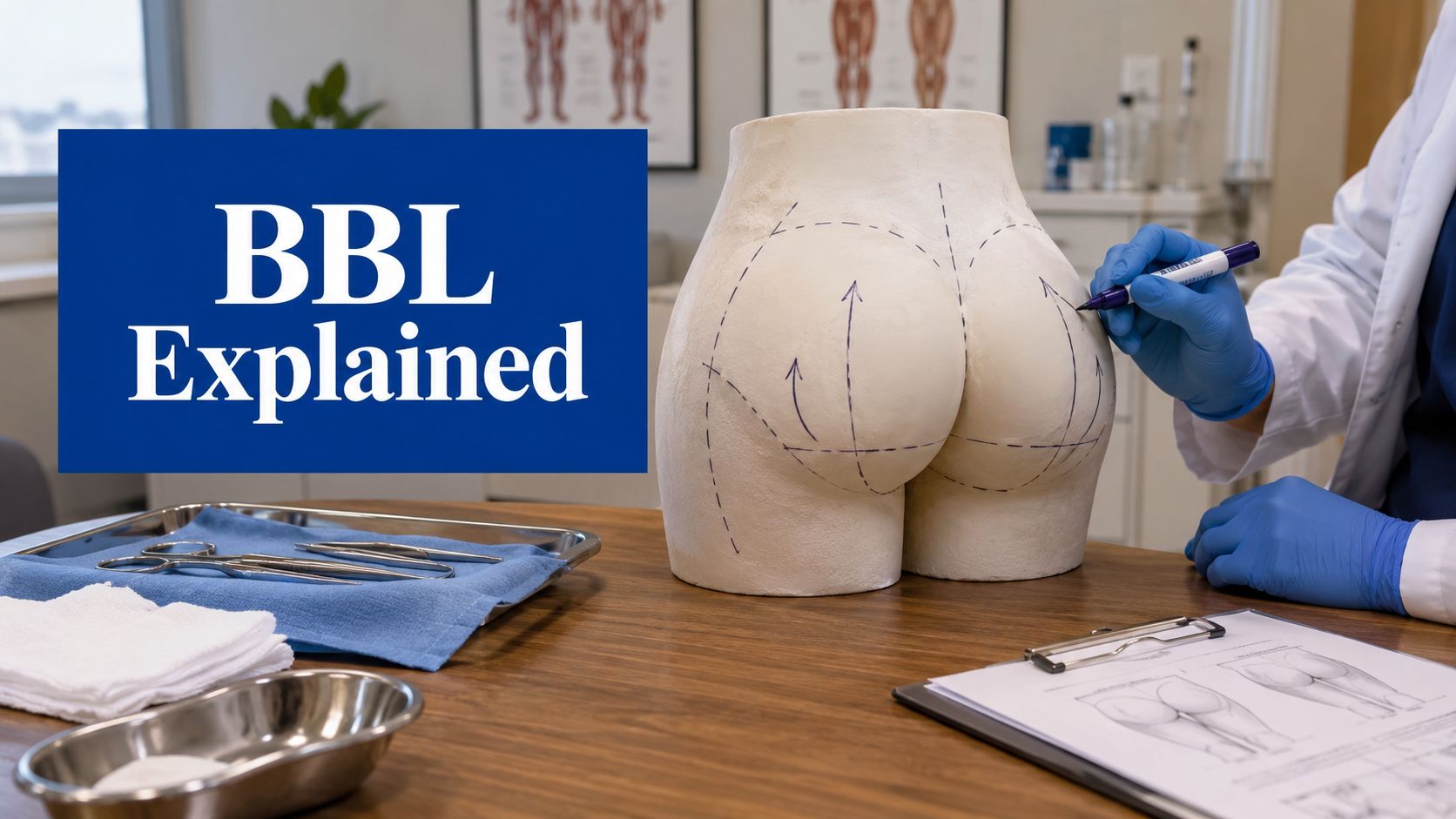
A Brazilian butt lift, or BBL, is a fat-transfer procedure that moves a patient's own purified fat from areas such as the abdomen or flanks into the buttocks and hips to improve contour. Its safety history is unusually serious: annual mortality estimates changed from 1 in 3,448 procedures, about 0.029%, in 2017 to 1 in 14,952, about 0.0067%, in a 2019 survey, as modern guidance reshaped how surgeons perform it. Peer-reviewed safety review
The most popular advice about cosmetic surgery is often “find a good surgeon.” That matters, but with BBL surgery, it's incomplete. You also need to understand where the fat is injected, how the cannula is guided, what type of anesthesia is used, and whether your body has enough donor fat to make the safety-benefit balance reasonable.
An awake, local-anesthesia approach can be appropriate for selected patients, but it isn't automatically safer for everyone, and it doesn't remove the need for disciplined technique. The central question isn't “What is BBL surgery?” It's whether the planned operation matches your anatomy, goals, health, and tolerance for recovery.
Table of Contents
- What BBL Surgery Actually Is
- Why BBL Became the Most Talked-About Cosmetic Procedure
- How the Fat Transfer Procedure Works Step by Step
- Who Makes a Good Candidate for BBL
- Traditional BBL vs Awake Butt Lift Compared
- BBL Recovery Timeline Week by Week
- Real Risks and Complications to Understand
- Common Misconceptions and Questions to Ask a Surgeon
What BBL Surgery Actually Is
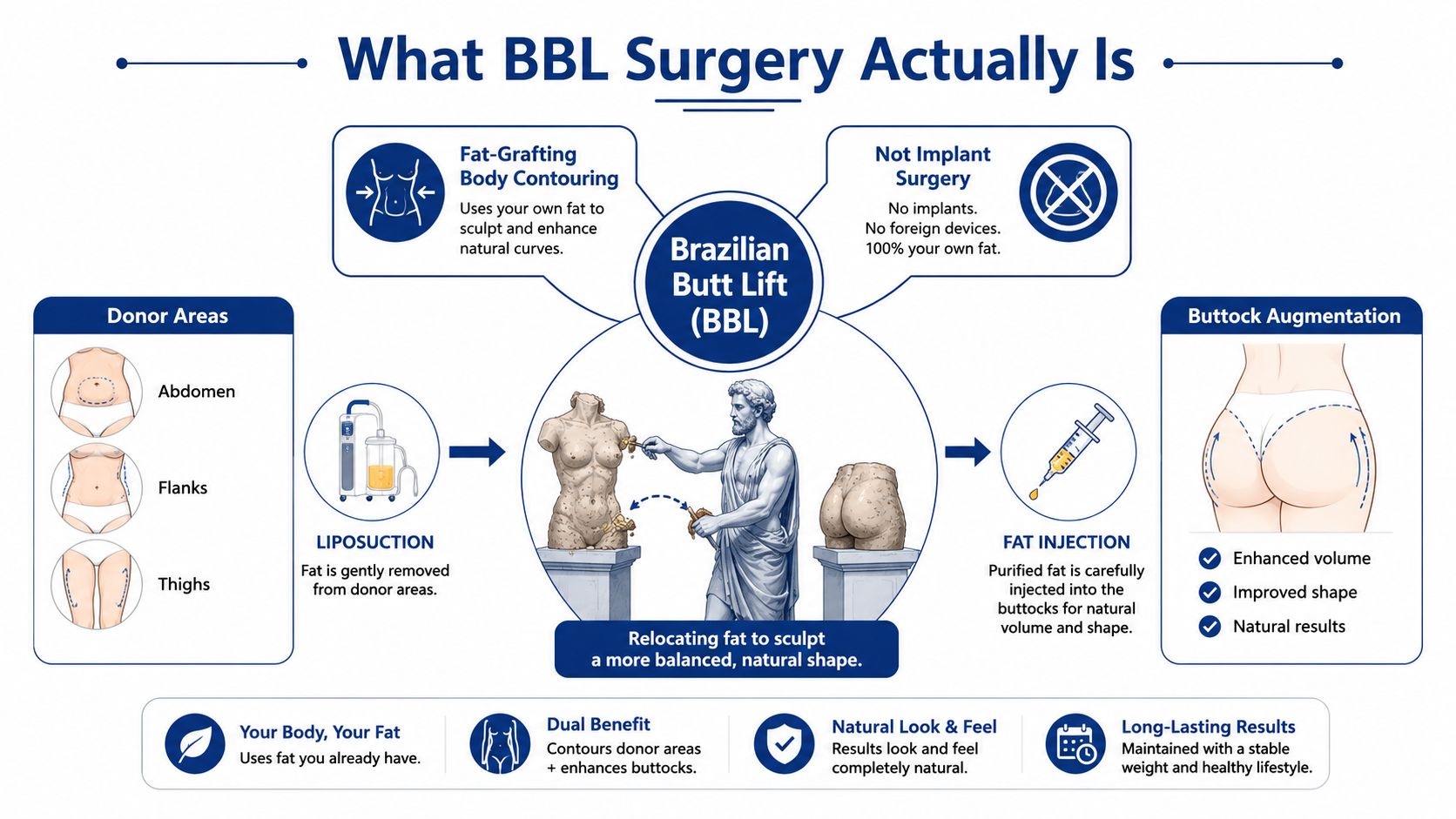
Brazilian Butt Lift surgery is fat-grafting body contouring, not buttock implant surgery. A surgeon removes fat from one or more donor areas, processes it, and places a portion of that fat into the buttocks or hip region to create a different relationship between the waist, hips, and buttocks.
The sculpting analogy is useful. Think of a sculptor relocating clay from a part of the torso where there's excess to a part of the silhouette where volume is missing. In a BBL, the “clay” is your own fat. Common donor areas include the abdomen, flanks, and lower back, although the exact plan depends on your body and how much usable fat is present.
The two parts of the operation
The first stage is liposuction harvesting. The surgeon removes fat through small access points and shapes the donor areas rather than treating the procedure as weight-loss surgery. The second stage is fat reinjection, where prepared fat is placed into the subcutaneous tissue, the layer between the skin and muscle.
That second stage is where the procedure's defining safety issue appears. The American Society of Plastic Surgeons safety advisory states that fat should never be placed in the muscle and should remain in the subcutaneous tissue because fat entering venous circulation can cause a fatal embolism.
A BBL can improve fullness and proportion, but it isn't a weight-loss treatment, it doesn't remove loose skin the way a lift can, and it won't erase cellulite. Liposuction may refine a contour, but it can't substitute for healthy weight management or correct every texture problem.
Practical rule: A successful BBL is not defined by the largest possible buttocks. It's defined by balanced contour, appropriate fat placement, and a plan your body can safely support.
The trade-off is straightforward. You may gain a more pronounced shape and improved donor-area contour, but you're accepting a real complication profile that has forced the specialty to change how the operation is planned and performed.
Why BBL Became the Most Talked-About Cosmetic Procedure
BBL became highly visible because it addressed two aesthetic goals in one operation: reducing fullness in selected areas and adding volume to the buttocks and hips. Fuller lower-body proportions became more desirable, while social media made dramatic body transformations easy to display, compare, and market.
That visibility also compressed a complicated operation into a simple visual promise. A before-and-after image can show shape, but it can't show the injection plane, the surgeon's cannula control, the monitoring process, or how the patient handled recovery. Those invisible details determine much of the safety story.
The safety reckoning
By the late 2010s, reports of fatal pulmonary fat embolism made gluteal fat grafting the focus of urgent safety research. A widely cited task-force estimate placed annual mortality risk at 1 in 3,448 procedures in 2017, and another analysis identified 25 pulmonary fat embolism fatalities in the United States over a five-year, nine-month period from 2011 to 2016, with estimated mortality of 1 in 4,000. These figures are summarized in a peer-reviewed review of BBL safety.
In 2018, major plastic surgery societies warned that estimated mortality could be as high as 1 in 3,000 procedures. By 2019, one peer-reviewed survey estimated mortality at 1 in 20,117 cases and found that death risk was 16 times greater when fat was injected intramuscularly rather than more superficially. A separate analysis reported improvement from 1 in 3,448 in 2017 to 1 in 14,952 in 2019 when current recommendations were followed. Peer-reviewed safety statement and analysis
Those findings changed the definition of a responsible BBL. The procedure is no longer discussed only as a way to create a fuller silhouette. It's discussed as a technically demanding operation in which injection depth, cannula direction, ultrasound use, and patient selection are central clinical decisions.
BBL didn't become irrelevant after the safety scare. It became the procedure where discipline matters most, which is why an informed consultation should focus on technique rather than dramatic promises.
How the Fat Transfer Procedure Works Step by Step
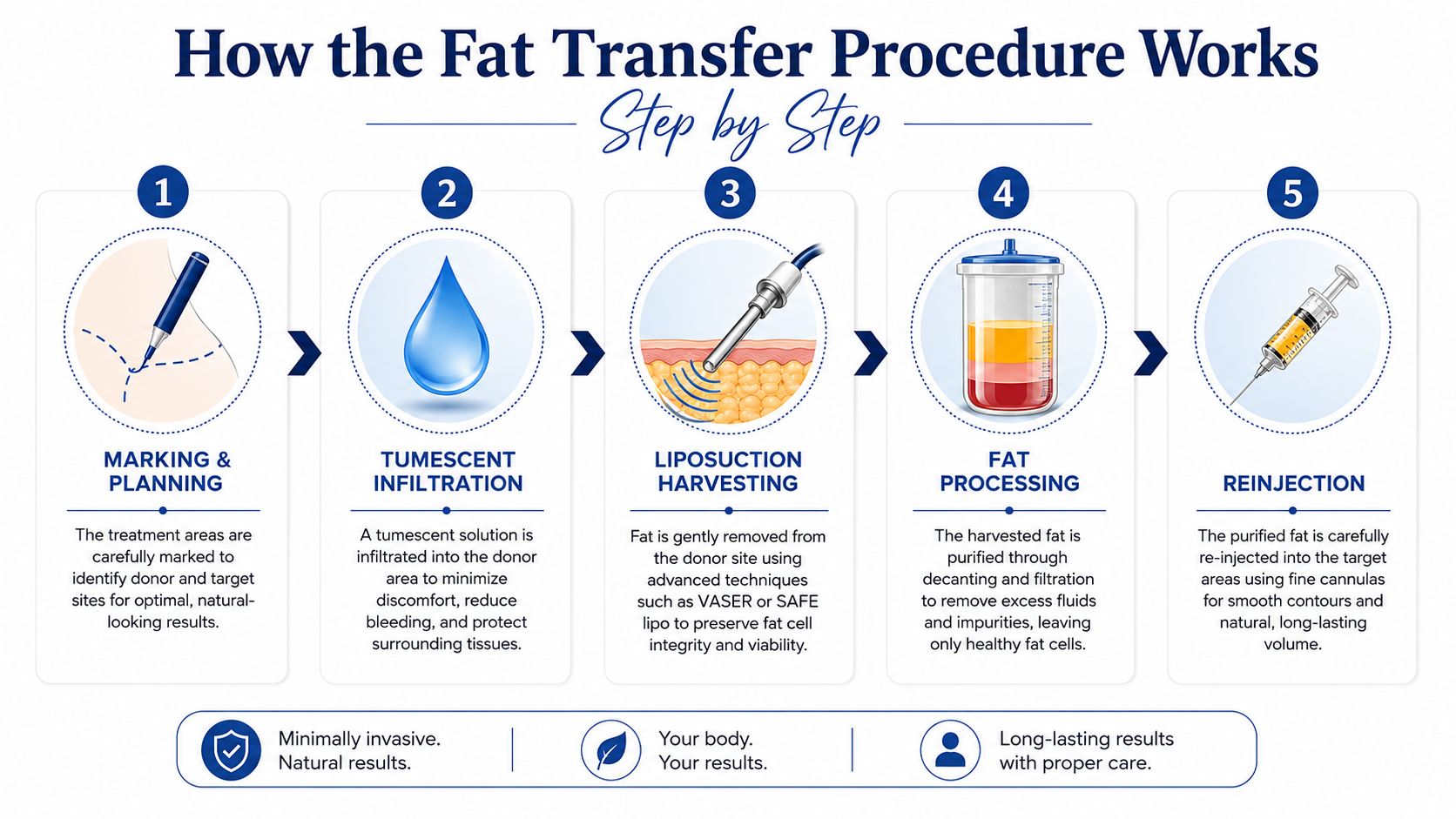
A BBL begins before the operating room. The surgeon marks the abdomen, flanks, lower back, hips, and buttocks while you're standing, because body position changes how proportions appear. The markings identify both donor zones and the areas where added volume may improve balance.
Harvesting and preparing the fat
The surgeon injects tumescent fluid into the donor areas. This fluid helps separate tissue and provides local numbing, and the medication plan should be reviewed carefully if you have a history of sensitivity or allergy. Patients who want broader background on numbing options can review this resource on alternatives to lidocaine for numbing.
Liposuction then removes fat through small incisions. Some surgeons use energy-assisted methods such as VASER or a SAFE-style approach, while others use conventional liposuction. The important question is not the label alone. Ask how the chosen method will protect the donor contour, preserve usable fat, and fit the overall safety plan.
The collected fat is separated from fluid, blood, and unwanted material through methods such as decanting or filtration. The goal is a clean, viable graft that can be placed in controlled passes. Patients considering donor-area contouring can read more about fat transfer from stomach to buttocks.
Reinjection is the safety-critical stage
The surgeon should place fat only in the subcutaneous plane, never in the muscle. Modern safeguards may include a rigid, large-diameter cannula, slow injection, an upward or parallel cannula angle, and real-time ultrasound to monitor the cannula tip. ASPS materials describe recommendations including a stiff cannula of at least 4 millimeters and avoiding a downward angle during injection. ASPS technique guidance
The surgeon typically uses multiple small passes rather than one forceful deposit. Volume is individualized. A large contemporary series involving 7,000 patients reported mean injection volumes of about 1,200 cubic centimeters per buttock, with estimated graft survival around 70%, while also reporting no pulmonary fat embolism, fat embolism syndrome, deep-vein thrombosis, or pulmonary embolism in that series. Peer-reviewed contemporary safety series
Incisions are usually small and placed in discreet areas, but exact locations depend on the treatment plan. Operating time, drains, and compression garments vary with the amount of liposuction and the surgeon's protocol. A well-performed BBL is a layered, contour-led operation, not one dramatic injection.
Who Makes a Good Candidate for BBL
Candidacy starts with the donor areas, not the desired buttock size. You need enough harvestable fat for the planned contour, while still leaving the abdomen, flanks, thighs, or lower back looking natural after liposuction. A patient with very little body fat may have a safer and more predictable result by choosing a smaller enhancement or an alternative procedure.
Many practices describe a commonly suitable body-composition range around a BMI of 22 to 28, but BMI alone doesn't decide candidacy. Skin elasticity, muscle and fat distribution, medical history, weight stability, smoking status, and expectations matter just as much.
Your shape changes the result
A pear-shaped patient already carries more volume through the hips and thighs, so the plan may focus on refinement and proportion. An apple-shaped patient may need more attention to the waist and flanks to create visual balance. Neither body type is “better.” They produce different silhouettes from the same operation.
Stable weight is important because significant weight change after fat transfer can change both the donor areas and the grafted volume. Patients who smoke, have uncontrolled medical conditions, recently lost substantial weight, or expect pregnancy may need to pause and discuss timing with their surgeon.
| Factor | Good Candidate | Caution | Not Ideal |
|---|---|---|---|
| Harvestable fat | Enough donor fat for a proportionate plan | Limited donor volume may restrict enhancement | Too little usable fat for safe contouring |
| Skin quality | Reasonable elasticity over the buttocks and thighs | Mild laxity may limit definition | Significant loose skin requiring a lift |
| Weight pattern | Stable weight and realistic body goals | Ongoing weight changes | Recent major weight loss or planned pregnancy |
| Health habits | Controlled medical conditions and no active smoking | Medical issues requiring optimization | Uncontrolled conditions or continued smoking |
| Expectations | Accepts gradual settling and possible asymmetry | Wants a very specific size | Expects weight loss, cellulite removal, or perfection |
When another option makes more sense
A surgeon may recommend a buttock implant when a patient lacks sufficient donor fat, although implants bring a different set of risks and limitations. BodyTite or another skin-tightening approach may be discussed when laxity is the primary concern rather than missing volume. Skipping surgery is also a valid recommendation when the expected benefit doesn't justify the operative risk.
Psychological readiness matters. You should understand that results depend on technique and healing, that the two sides may not remain perfectly identical, and that revision surgery can sometimes be necessary.
Traditional BBL vs Awake Butt Lift Compared
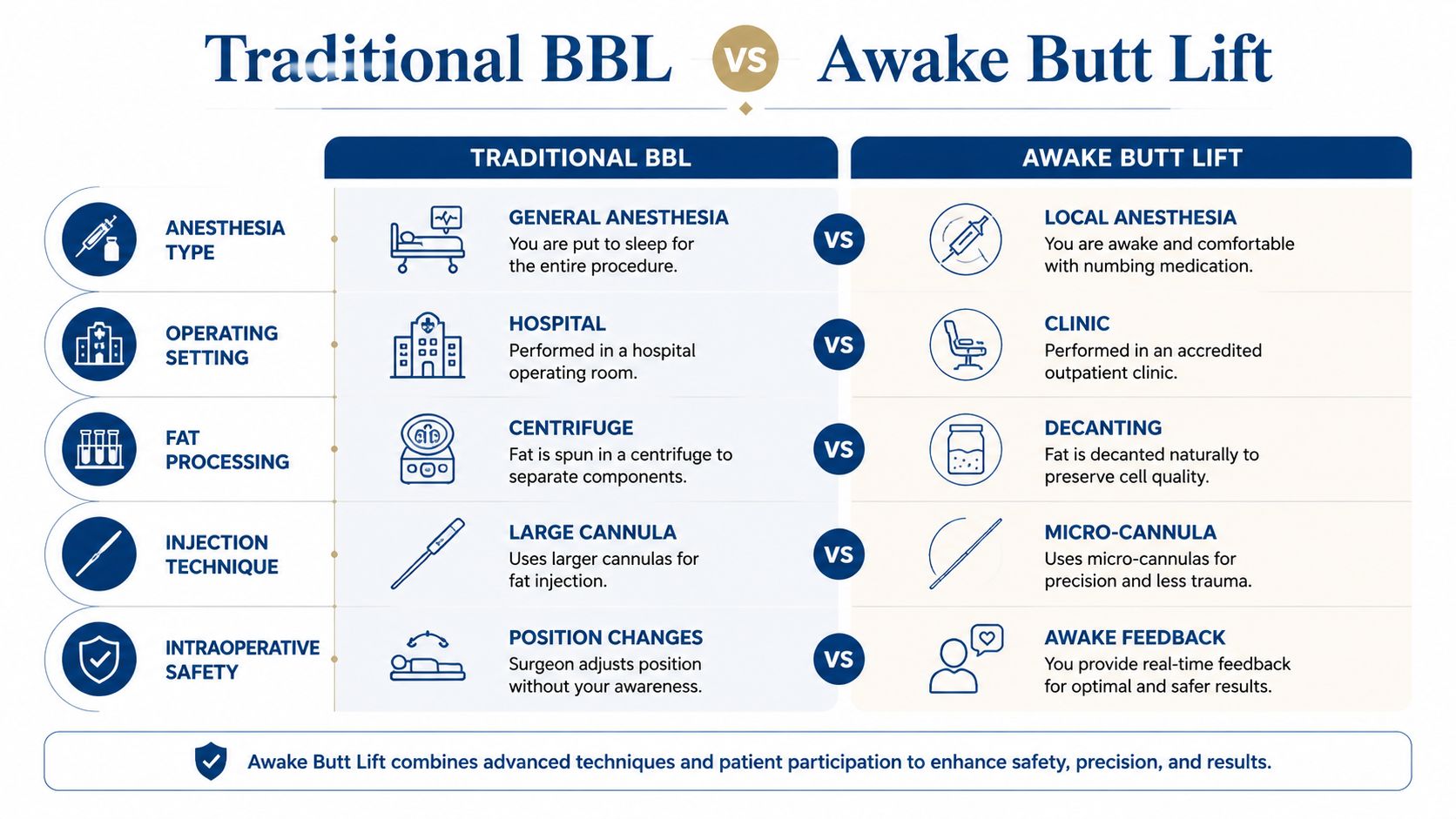
The phrase “awake BBL” describes an approach using tumescent local anesthesia, sometimes with carefully selected sedation, rather than automatically placing the patient under general anesthesia. The patient is relaxed but may remain responsive, which can allow communication about positioning and discomfort during the operation.
A traditional BBL more often uses general anesthesia, broader liposuction, and a larger-volume transfer plan. An awake butt lift generally uses smaller calibrated cannulas, carefully limited treatment areas, and real-time ultrasound guidance. The approach may allow a suitable patient to leave the facility the same day, while a more extensive operation may require a different recovery setting.
The practical trade-offs
| Dimension | Traditional BBL | Awake Butt Lift |
|---|---|---|
| Anesthesia | General anesthesia | Tumescent local anesthesia, with sedation when appropriate |
| Setting | Often a hospital or surgical facility | Often an office-based or ambulatory setting |
| Fat processing | May use a centrifuge or other processing system | May use decanting or filtration |
| Injection tools | Larger cannula selection may be used | Smaller calibrated cannulas may support controlled placement |
| Patient experience | Patient is unconscious | Patient may communicate during the procedure |
An awake approach can limit total liposuction volume and may not suit someone who needs extensive contouring, has extreme anxiety, or cannot comfortably tolerate the positioning. General anesthesia may be more appropriate for a longer or more complex plan. Neither approach should be marketed as universally superior.
The reason to discuss awake surgery is not novelty. Pulmonary fat embolism has been the leading cause of BBL mortality in the historical safety data, and that danger is primarily connected to fat placement and cannula control, not whether the patient is awake or asleep. Joint safety statement from plastic surgery societies
A local-anesthesia model can reduce exposure to general anesthesia and may support direct patient feedback, but it cannot compensate for poor injection technique. Patients interested in the approach can review awake lipo and fat transfer as one example of how an office-based plan may be structured.
BBL Recovery Timeline Week by Week
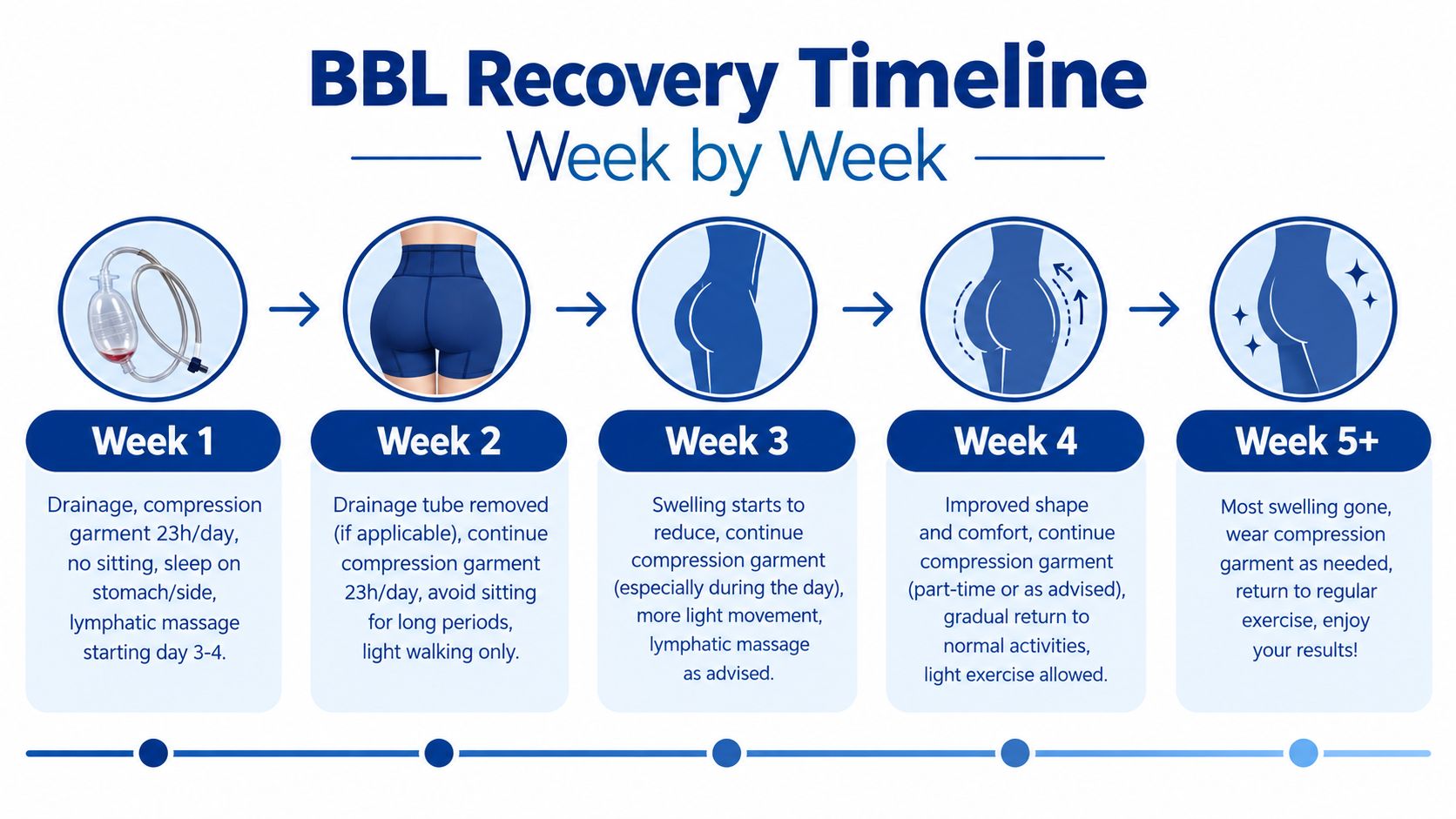
Recovery is not a single event. The donor areas may feel tight and sore, while the grafted buttocks must be protected from direct pressure. Your surgeon's instructions should take priority because restrictions vary with the extent of liposuction, anesthesia, wound care, and your individual healing.
Week one
Expect drainage, swelling, bruising, and limited comfort. Many protocols call for a compression garment for 23 hours per day, no direct sitting on the buttocks, and sleeping on your stomach or side. Lymphatic massage may begin around day three or four when your surgeon approves it.
Walking gently is usually encouraged to support circulation, but strenuous activity isn't appropriate. Contact your surgeon urgently for worsening shortness of breath, chest pain, fainting, one-sided leg swelling, rapidly increasing pain, fever, foul drainage, or skin that becomes unusually dark or pale.
Weeks two through three
Continue the garment according to your protocol. Brief sitting may be allowed with a BBL pillow that shifts pressure toward the thighs, while light walking remains useful. Swelling may peak and then begin to decline. Some transferred fat is naturally resorbed as the graft settles, so early fullness shouldn't be mistaken for the final result.
Weeks four through six
Many patients gradually return to desk work using a pillow and begin light lower-body exercise after clearance. The contour starts to look more recognizable, but residual swelling can still obscure symmetry and definition. Avoid judging the outcome too early.
Weeks six through twelve
Full exercise clearance may arrive during this period, and the garment may become optional. Residual swelling resolves and the retained fat stabilizes. A contemporary safety series estimated graft survival around 70%, but individual retention varies with technique, biology, smoking, pressure, and weight changes. Contemporary BBL series
The first two weeks deserve special attention because newly transferred fat needs a blood supply to survive. Pressure, smoking, dehydration, and premature activity can interfere with healing. For practical recovery ideas, review this guide to best results after BBL surgery, then confirm every recommendation with your surgical team. More details are available in this guide to fat transfer to buttocks recovery.
Real Risks and Complications to Understand
The most feared BBL complication is pulmonary fat embolism. It can occur when fat enters the venous circulation and travels toward the lungs, potentially causing sudden and fatal collapse. Historical mortality estimates made BBL the deadliest aesthetic surgery procedure in multiple reviews, which is why societies emphasized subcutaneous-only placement and changed technical recommendations. Review of BBL mortality and safety evolution
The risk profile has improved in some datasets, but improvement isn't elimination. A surgeon can use local anesthesia and still create danger through poor cannula control, deep injection, or failure to monitor the injection plane.
Catastrophic risks and routine complications
Deep-vein thrombosis and pulmonary embolism are also concerns in longer operations and periods of immobility. Local anesthesia may avoid some general-anesthesia exposure, but it doesn't remove clot risk, infection risk, or the need for careful movement and medical prevention.
More common complications include:
- Seroma: Fluid can collect at a liposuction donor site and may require observation, aspiration, or additional treatment.
- Anemia: Blood loss and fluid shifts can leave patients tired and lightheaded.
- Fat necrosis: Some grafted fat can become firm or lumpy as it breaks down.
- Infection: Infection can involve the incision sites, donor areas, or grafted tissue.
- Asymmetry and contour irregularity: The two sides may heal differently, and donor areas can develop unevenness.
- Revision surgery: A later procedure may be needed to improve shape, volume, or proportion.
A contemporary 7,000-patient series reported seroma in 23%, anemia in 6.6%, fat necrosis in 1.9%, infection in 0.43%, hematoma in 0.14%, asymmetry in 0.29%, and revision surgery in 0.21%. The same series reported no pulmonary fat embolism, fat embolism syndrome, deep-vein thrombosis, or pulmonary embolism, demonstrating that modern technique can shift risk away from catastrophic embolic events while leaving ordinary postoperative morbidity. Peer-reviewed safety series
A rare but serious complication is gluteal skin or tissue necrosis from intra-arterial injection. Ask how your surgeon prevents deep or intravascular placement, how ultrasound is used, and what emergency protocols are available. Complication rates vary with patient factors, surgeon experience, case volume, facility standards, and adherence to current safety guidance.
Common Misconceptions and Questions to Ask a Surgeon
More volume doesn't automatically mean a better result. The surgeon has to balance projection with waist contour, skin capacity, graft survival, symmetry, and the amount of donor fat that can be removed safely.
Transferred fat also doesn't behave like a permanent implant. Roughly 30% to 50% of grafted fat may be naturally reabsorbed, and final shape generally develops over three to six months rather than appearing immediately. Those figures are commonly discussed in patient education, but they aren't included in the verified safety data provided here, so your surgeon should explain the expected retention range for your anatomy and technique.
A BBL is different from a buttock implant because it uses your own fat rather than a foreign device. It's also different from injectable filler, and patients should be cautious about any non-surgical buttock product marketed as a simple substitute. The FDA has issued warnings about off-label use of dermal fillers in the buttocks, so ask exactly what substance would be injected and whether it's approved for that purpose.
Questions worth bringing to your consultation
- Credentials: Is the operating surgeon appropriately board certified and specifically trained in gluteal fat grafting?
- Experience: How frequently does the surgeon perform BBL procedures, and how often are complications or revisions managed?
- Injection plane: Will all fat remain in the subcutaneous tissue, with no intramuscular injection?
- Ultrasound: Will real-time ultrasound guide and confirm the cannula position?
- Cannula design: What type, diameter, and angle will the surgeon use?
- Anesthesia: Why is general or local anesthesia more appropriate for your specific plan?
- Facility: Is the operating setting equipped for monitoring, emergency response, and postoperative care?
- Results: Can you review unretouched images of patients with a similar starting body type?
- Revisions: What happens if you develop asymmetry, contour irregularity, inadequate retention, or another complication?
Ideal Face & Body offers awake body contouring and fat transfer procedures under the direction of Dr. Justin Yovino, with Dr. Sarah Yovino providing physician-led aesthetic care. The practice also offers BBL revision and reduction options, so patients can discuss both initial planning and corrective care during consultation. Visit Ideal Face & Body to learn about the available approach and request a consultation focused on your anatomy, safety questions, and realistic goals.