You may be sitting with several browser tabs open right now, trying to answer what seems like a simple question: what does breast implant removal cost?
Then the confusion starts. One website shows a single number. Another mentions a surgeon's fee. Another talks about implant removal, capsulectomy, or “awake” surgery as if those are all the same thing. They aren't. That's why so many patients feel uncertain before they ever schedule a consultation.
The clearest way to understand breast implant removal cost isn't to chase a single estimate. It's to understand what drives the final quote, what choices change the structure of the procedure, and where hidden expenses tend to appear.
Table of Contents
- Looking Beyond the Price Tag of Explant Surgery
- The Building Blocks of Your Breast Implant Removal Cost
- Key Factors That Influence the Final Surgical Quote
- Navigating Insurance and Financing for Your Procedure
- Understanding Different Explant Surgery Scenarios
- Your Consultation with Dr Yovino in Beverly Hills
Looking Beyond the Price Tag of Explant Surgery
A common patient experience goes like this. She searches for breast implant removal cost, finds a figure that seems manageable, and assumes that number reflects the full procedure. Later, during a real consultation, she learns that the original number only described one piece of the bill.
That disconnect isn't a small detail. It changes how patients budget, compare options, and decide when surgery feels possible.

According to the American Society of Plastic Surgeons page on breast implant removal cost, most online content cites the surgeon's fee of $3,979 as though it were the total cost. That same source notes that anesthesia, facility fees, and capsulectomy can materially change the final amount, with capsulectomy adding up to 40%. It also explains why patients looking into awake, local-anesthesia procedures often get mixed messages. The type of anesthesia and the setting can change the financial picture in ways many quick online summaries don't spell out.
Practical rule: If a quoted number doesn't clearly say whether it includes anesthesia, facility use, and any capsule work, it probably isn't the whole story.
That's why broad estimates often feel misleading. Two patients can both say they want their implants removed, yet one may need straightforward explantation while another needs more involved scar capsule treatment, tissue reshaping, or a different surgical setting. Those aren't interchangeable procedures, even if they sound similar in casual conversation.
Many readers also assume that “hospital surgery” automatically means the same experience and cost structure as an office-based awake approach. It doesn't. When a procedure can be done comfortably under local anesthesia in an appropriate in-office setting, the cost structure changes because some of the biggest drivers of overhead change with it.
For patients in Beverly Hills, that distinction matters. Dr. Justin Yovino's practice is known for discussing procedure planning in a more transparent, patient-centered way, especially for people exploring whether an awake approach may be appropriate for their goals.
The Building Blocks of Your Breast Implant Removal Cost
A final quote works a lot like a detailed invoice at a restaurant. The total matters, but the line items explain why one meal costs more than another. If you only look at the bottom number, you miss what you're paying for.
The same logic applies to breast implant removal cost. Patients usually get the clearest understanding when they stop asking for one number and start asking what's included.
Why one quote can look simple but mean very different things
A “simple removal” and a more involved capsule procedure can sound close enough that patients expect similar fees. In practice, they can be very different operations.
The breast explant surgery pricing breakdown published here describes how the capsulectomy technique changes the scope of surgery. Standalone implant removal typically ranges from $5,500 to $7,800. Total capsulectomy, which removes the full scar capsule, is reported at $7,500 to $10,000. En bloc capsulectomy, where the implant and capsule are removed intact, is listed at $10,000 to $14,000. That source also explains the why. Longer, more technically demanding procedures increase anesthesia time and facility occupancy, which can raise total cost by about 30% to 50% compared with simpler removal.
That relationship matters more than the numbers alone. Time, complexity, and resources move together.
The four parts patients should ask about
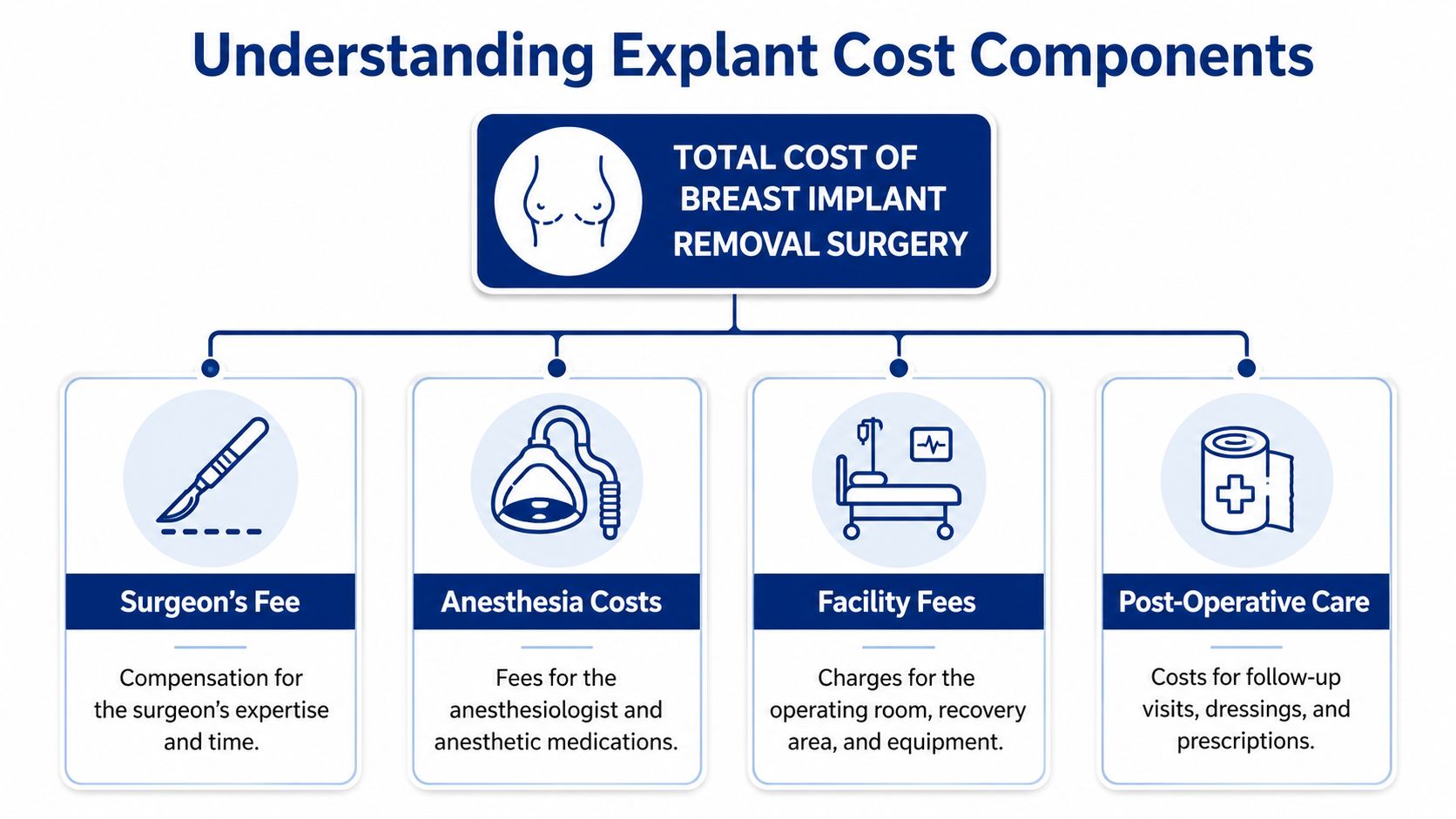
Most explant quotes are shaped by four core components:
Surgeon's fee
This reflects the surgeon's expertise, judgment, planning, and the technical work of the operation itself. It often changes when the case becomes more complex, especially if the surgeon expects difficult capsule dissection or revision work.Anesthesia costs
This category covers how comfort and safety are managed during the procedure. General anesthesia creates a different cost structure than local anesthesia, and many patients don't realize how much that choice can affect the overall quote.Facility fees
These include the operating environment, staff, equipment, and recovery resources. The setting is one of the clearest reasons two apparently similar procedures can be priced differently.Post-operative care
Dressings, follow-up visits, recovery support, and prescribed medications may or may not be folded into a package quote. Patients should ask what care is included after surgery and what would be billed separately.
The most useful quote isn't the shortest one. It's the one that shows you exactly what the plan includes.
Patients also sometimes hear terms like capsulectomy, total capsulectomy, and en bloc and assume one is always better. That's too simplistic. The right choice depends on implant condition, symptoms, surgical goals, anatomy, and the surgeon's assessment. A more extensive technique may be appropriate in some cases, but it also changes operative time and resources.
A good consultation should leave you understanding not just the recommendation, but the reason behind it. If you know which line items are driving your quote, the financial side of the decision becomes much easier to manage.
Key Factors That Influence the Final Surgical Quote
Knowing the building blocks is helpful. Knowing what makes those blocks expand or shrink is what gives patients real clarity.
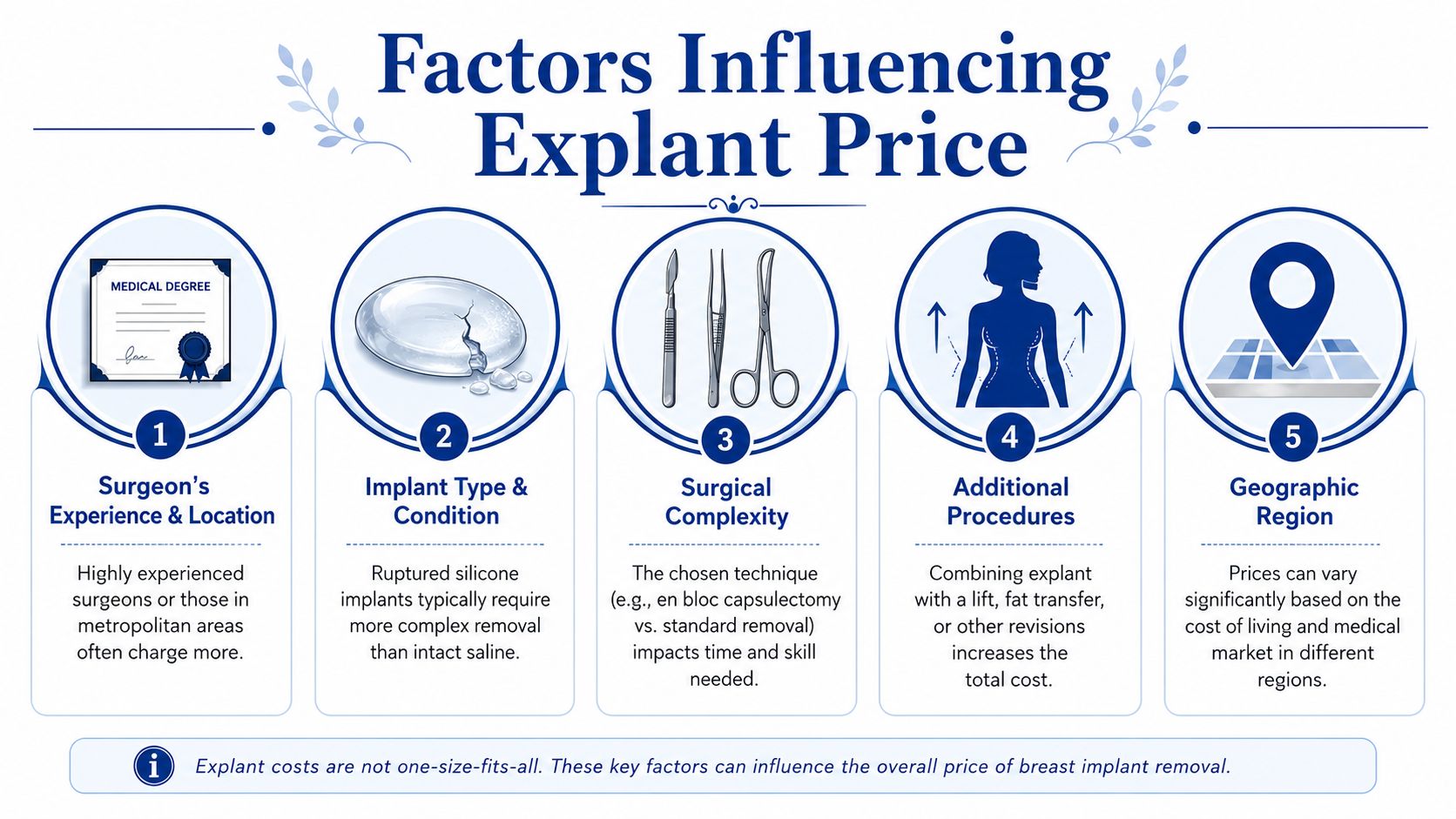
Breast implant removal cost varies because the surgery itself varies. The final quote changes when the procedure becomes more complex, when the setting changes, or when the patient wants reshaping in addition to removal.
Complexity changes the whole equation
The first major variable is surgical complexity. Removing intact implants without extensive capsule work is one kind of procedure. Removing implants plus scar capsule, managing rupture, or combining explant with reshaping is another.
Patients often underestimate how much their personal goal affects the quote. “I just want them out” can still mean different things. One patient may be comfortable with a flatter result. Another may want the breast reshaped after removal. Another may need treatment because the capsule itself is part of the problem.
These choices change more than surgeon time. They can affect the recovery plan, the tools used during surgery, and whether the breast needs additional contouring.
A few examples of variables that commonly shift the quote:
Condition of the implant
A ruptured implant or a heavily scarred capsule can require more careful dissection than an uncomplicated removal.Need for added reshaping
Some patients pair explant surgery with a lift or with fat transfer to improve contour after implant removal.Extent of capsule treatment
The amount of capsule removed and the surgical method chosen can significantly affect operative planning.
Setting and anesthesia matter more than many patients expect
The second major variable is where the surgery takes place and how anesthesia is handled.
The CareCredit explant surgery overview reports that California averages $7,137 for breast explant surgery compared with a national average of $6,837. That same source notes that outpatient surgical centers can offer lower cash prices than outpatient hospitals, listing $3,432 in California for outpatient surgical centers and $6,202 in California for outpatient hospitals. It also cites an average surgeon's fee of $3,979, while making clear that this number excludes anesthesia, operating room facilities, and medical tests.
That's why anesthesia type and facility setting deserve direct questions during consultation. They're not background details. They're major financial drivers.
If you're comparing quotes, compare settings too. A lower surgeon's fee doesn't automatically mean a lower total procedure cost.
An awake, office-based approach becomes particularly relevant. When a patient is an appropriate candidate for removal under local anesthesia in a well-equipped office setting, the cost structure can look very different from a traditional hospital-based plan under general anesthesia. The point isn't that one method fits everyone. It's that the setting and anesthesia strategy can significantly alter the overall expense.
That distinction helps patients ask better questions. Not just “What's the quote?” but “Why is this the quote for my surgery?”
Navigating Insurance and Financing for Your Procedure
For many patients, the financial question isn't only how much the surgery varies. It's whether insurance can help, and if not, how to plan for the procedure without surprises.
This part is where misunderstandings are especially common. Patients often assume that because their implants were cosmetic to begin with, insurance will never apply. That isn't always true.

When insurance may apply
The Medicare explant coverage guide explains that medically necessary removal may be covered in situations such as rupture, infection, or capsular contracture. It also notes that patients who don't understand the Women's Health and Cancer Rights Act, pre-authorization requirements, or the appeal process may miss opportunities for coverage. That source further reports that out-of-pocket costs can drop from $3,000 to $3,440 to near zero in covered cases, and that over 60% of initial insurance denials for explant surgery are reversed after a structured appeal with surgeon documentation.
Those details matter because approval often depends less on what a patient feels and more on what the medical record shows.
A practical checklist helps:
Document symptoms clearly
Keep a concise record of pain, firmness, visible asymmetry, rupture concerns, or signs of infection.Ask about imaging and diagnosis
If rupture or severe capsular contracture is suspected, objective findings can strengthen a claim.Confirm pre-authorization steps
Missing administrative steps can lead to denials even when the medical issue is legitimate.Prepare for appeal if needed
An initial denial isn't always the end of the process.
Many patients give up after a first denial. A structured appeal with strong surgeon documentation can change the outcome.
How to prepare before you commit
Even when insurance doesn't apply, patients still have options to make the process more manageable.
Start by asking for a written breakdown of what is included. You want to know whether the quote covers the procedure itself, anesthesia, facility use, aftercare, and any pathology or follow-up charges that may arise depending on your surgical plan.
Then ask about payment planning. Many practices offer staged payment options or financing arrangements for elective surgery. If you're exploring that route, review the practice's financing options for cosmetic surgery before consultation so you can frame questions around monthly planning, timing, and what counts as part of the full package.
Patients also benefit from one simple habit. Don't compare one office's all-inclusive quote to another office's surgeon-only number. That's how budget surprises happen.
Understanding Different Explant Surgery Scenarios
Abstract explanations help, but individuals understand breast implant removal cost more easily when they can picture actual scenarios.
Not every patient wants the same outcome after explant. Some want removal only. Some want reshaping. Others want natural volume restoration without going back to implants.
Three common paths patients consider
The first scenario is the most straightforward. The patient wants the implants removed and is comfortable with the shape of the breast after removal, or at least wants to keep the procedure focused on explant alone. In this case, the plan may involve implant removal with limited additional revision.
The second scenario is more involved. The patient wants the implants removed but also wants the breast skin and tissue reshaped. This often comes up when implants have been present for years and the breast may look deflated or lower after removal. In those cases, a lift may become part of the conversation.
The third scenario adds another layer. The patient wants implants removed and prefers natural volume restoration using her own tissue. That's where fat transfer may enter the discussion. For patients researching this path, it helps to read about breast fat transfer considerations and tradeoffs before deciding whether that goal aligns with their anatomy and expectations.
Here's a side-by-side view.
| Patient Goal | Typical Surgical Plan | Primary Cost Components Involved |
|---|---|---|
| Remove implants and keep the procedure focused | Explant surgery with limited added revision | Surgeon's fee, anesthesia approach, facility fee, post-operative care |
| Remove implants and improve breast shape | Explant plus capsulectomy as needed, with a breast lift to reshape tissue | Surgeon's fee, longer operative time, anesthesia approach, facility fee, post-operative care |
| Remove implants and restore natural fullness | Explant with contour correction and fat transfer for volume support | Surgeon's fee, added harvesting and transfer steps, anesthesia approach, facility fee, post-operative care |
A patient isn't choosing only a procedure. She's choosing an outcome, and the surgical plan has to match that outcome.
This is why casual online comparisons often fail. Two people may both type “breast implant removal cost” into a search bar while envisioning completely different end results. One wants simple removal. Another wants lifted shape. Another wants volume restored using her own fat.
The quote follows the plan. The plan follows the goal.
Your Consultation with Dr Yovino in Beverly Hills
By the time patients reach a real consultation, the most important shift has usually happened. They stop searching for one magic number and start evaluating the procedure as a set of decisions.
That's the right way to approach breast implant removal cost. The final quote reflects surgical complexity, anesthesia strategy, facility setting, and the result you want after the implants are removed.
The setting matters enough that it deserves careful discussion. The state-by-state explant cost data published here reports that the average outpatient hospital cost in California is $6,202, which is higher than the national range for surgery centers of $2,630 to $6,758 depending on state and facility type. That doesn't tell you what your surgery should cost, but it does reinforce a key point. Facility choice can materially shape the financial side of treatment.
For patients considering an awake, office-based approach, a consultation with Dr. Justin Yovino in Beverly Hills can clarify whether that option fits their anatomy, comfort level, and surgical goals. It also gives patients the chance to understand the role of local anesthesia, the likely scope of capsule treatment, and whether they may want reshaping after explant.
Patients who want to learn more about the team can also review Dr. Sarah Yovino's background and role in the practice. In-person planning is still what turns general information into a personalized surgical roadmap.
If you're considering explant surgery and want a clearer understanding of your options, Ideal Face & Body offers consultations focused on awake, office-based procedures and individualized surgical planning in Beverly Hills.