The biggest myth about an IPL photofacial is that it's a fast cosmetic refresh you do once and forget. That marketing story is convenient, but it's not how the treatment works in real skin, real life, or real maintenance planning. IPL photofacial benefits are best understood as cumulative, not instant, and the patients who do best are the ones who expect gradual clearing of pigment, redness, and uneven tone across a series.
That matters in Beverly Hills, where patients tend to want a polished result without looking overtreated. IPL fits that brief when the goal is to soften sun damage, calm visible redness, and improve overall clarity with limited downtime. It's also a treatment with boundaries, and those boundaries are exactly why it earns a place in a serious skin plan.
Table of Contents
- Why IPL Photofacials Are More Than a Quick Fix
- How IPL Technology Targets Skin Imperfections
- Clinical Benefits of IPL Photofacial Treatment
- Your IPL Treatment Journey and Timeline
- Comparing IPL to Morpheus8 and Laser Resurfacing
- Maintaining Your IPL Results Long Term
- Frequently Asked Questions About IPL Photofacials
Why IPL Photofacials Are More Than a Quick Fix
IPL gets oversold when it's framed as a one-and-done glow treatment. In practice, the best outcomes come from a series-based protocol, because pigment and vascular change don't all clear at the same pace, and the skin responds progressively as each session builds on the last. Clinical references describe IPL as a treatment for photoaging, hyperpigmentation, lentigines, melasma, rosacea, telangiectasias, and acne vulgaris, which already tells you it's meant to do more than chase a single spot NCBI Bookshelf.
A retrospective study indexed in PubMed reviewed 2,534 cases treated over 12 years with at least three IPL sessions and reported an effective rate of 88.24% to 96.45% for photoaging PubMed. That's a strong signal that IPL can be effective, but the design of the study also reinforces the point that meaningful benefit came from repeated treatment, not a solitary flash of light.
Practical rule: if a patient wants a “quick fix,” IPL is usually the wrong mental model. If the goal is cleaner tone with less downtime than resurfacing, the series model makes much more sense.
The most useful way to think about IPL is as a maintenance-oriented correction. It can brighten the skin, reduce visible sun damage, and soften diffuse redness without the recovery burden of more aggressive resurfacing, but it doesn't erase everything and it doesn't stop new damage from forming. That's why experienced patients often treat IPL as a recurring part of skin care rather than a one-time event.
This is also why planning matters. When patients understand that the payoff accumulates across visits, they're less likely to judge the treatment too early and more likely to recognize the clinical value, which is a calmer, more even complexion that still looks like their own skin.
How IPL Technology Targets Skin Imperfections
IPL works by selective photothermolysis, which is a precise way of saying that light is absorbed by the right target, turned into heat, and delivered in a way that spares surrounding tissue when the settings are chosen correctly NCBI Bookshelf. The main targets are melanin and hemoglobin, so IPL is especially useful for brown pigment and redness rather than deep structural laxity. Think of it as aiming at the stain, not the whole fabric.
Why settings matter so much
The device doesn't “know” what you want treated. The clinician chooses filters and parameters to match the lesion type, the patient's skin tone, and the treatment goal. If the settings are too aggressive or the skin has too much competing melanin, the energy can go where you don't want it. If they're too conservative, the result is underwhelming.
That's why IPL is often described as versatile, but not universal. It can address pigmented lesions, telangiectasias, and diffuse redness in one session type, and clinical references note FDA-cleared or approved use for photorejuvenation and several pigment and vascular indications NCBI Bookshelf. Versatility is the advantage. Judgment is the safety measure.
What patients usually notice first
A properly chosen treatment tends to cause pigment to darken before it clears, while redness calms more gradually. That's normal behavior for targeted light therapies. The skin is not being scrubbed or peeled, it's clearing treated chromophores through its own repair processes.
Clinical insight: IPL is most satisfying when the concern is visible color, not when the concern is deep textural change. That distinction saves patients from expecting the wrong thing from the wrong tool.
The treatment is also why one visit can sometimes address multiple concurrent concerns at once. Brown spots, facial flushing, and uneven tone often travel together in photoaged skin, so a broad-spectrum device can make sense when the problem isn't single-lesion-based. If a patient comes in with mixed sun damage and redness, IPL often fits better than a narrower approach.
Clinical Benefits of IPL Photofacial Treatment
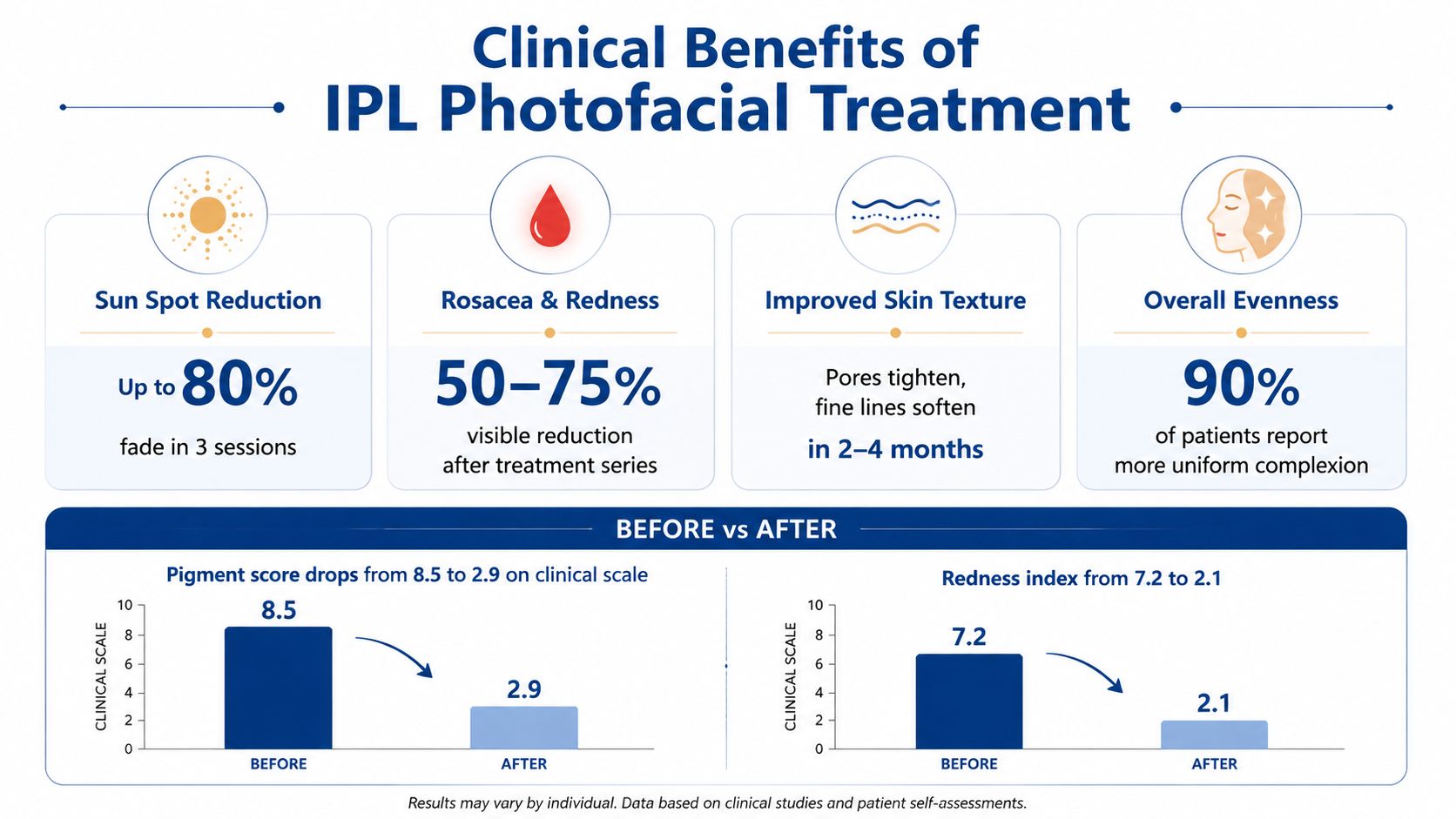
The clearest benefit of IPL is that it treats multiple signs of photoaging at the same time. That includes sun spots, diffuse redness, visible vessels, dull tone, and some of the subtle texture changes that come with long-term sun exposure. A long-term clinical study published in 2004 found statistically significant improvement in wrinkles, facial vascularity, dyschromia, and large pore size from the 6-week follow-up through the 6-month follow-up, with minimal risks and side effects PubMed.
What improves most predictably
Brown pigment and vascular redness are the strongest uses for IPL. The reason is straightforward, melanin and hemoglobin are the main chromophores the light is aiming for, so superficial discoloration tends to respond more cleanly than deeper structural issues NCBI Bookshelf. Patients usually notice that the face looks less mottled and more even before they would ever describe it as “tighter.”
A 2021 systematic review also concluded that IPL is effective for skin rejuvenation across outcomes such as telangiectasia, wrinkles, erythema, texture, lentigines, hyperpigmentation, and photoaging score PubMed. That's important because it supports what clinicians see every day, IPL has real breadth, even if each individual improvement is usually modest rather than dramatic.
Where expectations should stay grounded
IPL is not a deep resurfacing technology. If someone wants major wrinkle reduction or substantial tightening, IPL alone won't get them there. It can improve the overall look of the skin, but the change is usually cleaner tone, softer redness, and better polish, not a rebuilt surface.
The treatment can also extend beyond the face. UTSW notes that IPL photofacial therapy can be used on the face, neck, hands, chest, arms, and other body areas UTSW. That matters because many patients don't have “facial” photoaging only, they have sun damage everywhere they've lived in the sun.
If you want a practical benchmark, think improvement, not perfection. IPL often makes skin look less blotchy, more rested, and easier to maintain. It's a correction tool, not an eraser.
Your IPL Treatment Journey and Timeline
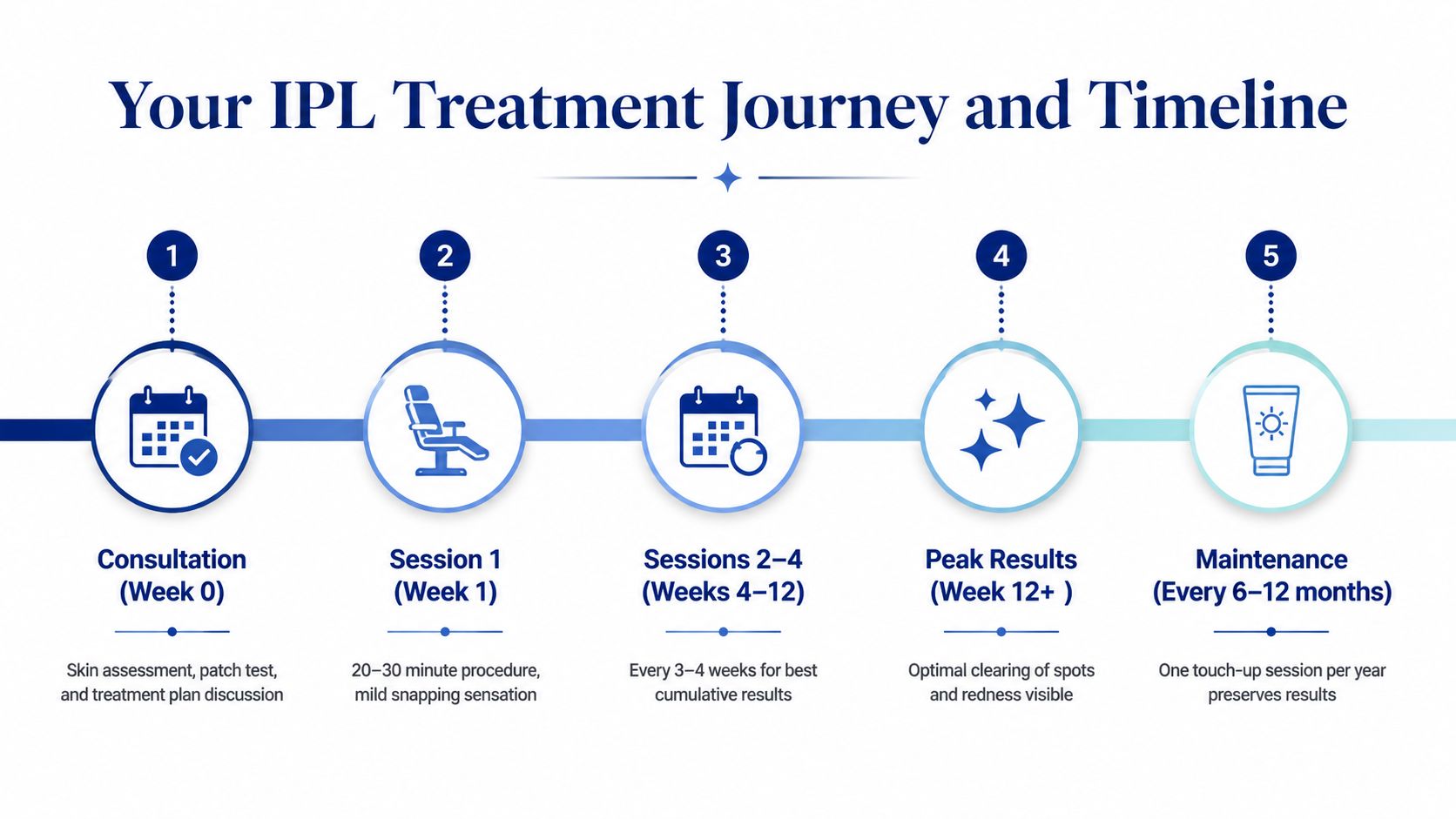
A typical IPL session is brief, usually 30 to 60 minutes depending on the area treated Essential Med Clinic. Most clinical and practitioner guidance converges on a series of 4 to 6 sessions spaced about 4 weeks apart Essential Med Clinic, which matches the rhythm of skin recovery and the way pigment clears after each treatment.
What the visit actually feels like
Most patients describe the sensation as a quick snap or a warm rubber band flick. That's consistent with how pulsed light is delivered, short bursts that target color without cutting the skin. Because IPL is non-ablative, it generally preserves the epidermis and avoids the longer recovery associated with resurfacing procedures YouTube clinical reference.
Immediately after treatment, pigment can look darker. That's expected. Visible change often begins within 7 to 14 days as pigment darkens and clears or redness calms, with fuller results commonly appearing over 3 to 4 weeks after a session and continuing across the series YouTube clinical reference.
Who should be cautious
Skin type matters. Because melanin competes with the target chromophores for energy absorption, darker skin tones carry a higher risk of unwanted heat capture if settings aren't adjusted carefully YouTube clinical reference. Recent sun exposure also matters for the same reason. A good consultation looks at current pigmentation, tanning history, and any tendency toward post-inflammatory pigment change before proceeding.
Darkening after treatment is not a complication by itself. It's often the first sign that the treated pigment is responding.
The patient experience is usually straightforward, but it still needs planning. You don't schedule IPL like an impulse facial. You schedule it like a treatment course with checkpoints, because result shows up after the series has had time to work.
Comparing IPL to Morpheus8 and Laser Resurfacing
The right treatment depends on what you're trying to change. IPL, Morpheus8, and CO2 laser can all improve the skin, but they do different jobs. IPL is strongest for surface color, Morpheus8 leans toward collagen remodeling and texture, and CO2 laser is the more aggressive choice when the priority is dramatic resurfacing.
IPL vs Morpheus8 vs CO2 Laser Comparison
| Criteria | IPL Photofacial | Morpheus8 | CO2 Laser |
|---|---|---|---|
| Primary target | Pigment and redness | Texture and collagen remodeling | Deeper resurfacing and more dramatic wrinkle improvement |
| Best for | Sun spots, diffuse redness, uneven tone | Fine texture, pores, mild laxity | Stronger resurfacing goals and more advanced photoaging |
| Downtime | Minimal compared with resurfacing | Usually more than IPL, less than CO2 | Highest of the three |
| Number of sessions | Usually a series | Often a series | Often fewer sessions, depending on the goal |
| Sensation | Quick snapping pulses | More intense procedure feel | More aggressive treatment experience |
| Fit | Patients wanting tone improvement with limited recovery | Patients prioritizing texture and remodeling | Patients willing to accept more recovery for bigger change |
Ideal Face & Body can be one option for patients who want color correction and photorejuvenation without jumping straight to a more aggressive resurfacing path. It belongs in the same conversation as other energy-based treatments, but it occupies its own lane.
How to choose without overreaching
If the skin concern is mixed sun damage, redness, and general dullness, IPL is usually the cleaner starting point. If the complaint is texture, pore visibility, or early laxity, Morpheus8 may make more sense. If the patient wants a more dramatic resurfacing effect and accepts more recovery, CO2 laser becomes the more logical discussion.
A lot of dissatisfaction comes from choosing a tool based on marketing language rather than the skin problem in front of you. The best consultations separate color issues from structural issues and pick the device accordingly.
Maintaining Your IPL Results Long Term
IPL results aren't permanent because the skin keeps aging and keeps meeting sunlight. That's the honest part most brochures skip. Even after a good series, new pigment and vascular change can develop, so the job shifts from correction to preservation.
What maintenance really looks like
A realistic maintenance plan usually means periodic retreatment rather than a one-time cure. Some patients do well with a touch-up session when new discoloration starts to appear, while others stay on a more regular rhythm if they're prone to redness or spend a lot of time outdoors. WebMD notes that some patients may see about a 70% reduction in brown spots and redness caused by UV rays, which is useful because it frames IPL as major improvement, not complete eradication WebMD via cited summary in brief.
The part that matters most
Daily broad-spectrum sun protection is essential if you want the results to last. Without it, new pigment forms and the value of the series drops quickly. That's why a photofacial plan should always be paired with a skincare plan, not treated like a standalone event.
Practical rule: if the skin is still getting regular UV injury, IPL becomes a revolving door. If sun behavior changes, the benefit holds much better.
Seasonal timing also helps. Many patients prefer to avoid heavy sun periods, which makes sense because a calmer exposure pattern supports more stable results and reduces the chance of re-pigmenting treated areas. A maintenance framework works best when it's paired with medical-grade skincare, and that's where a structured routine matters more than chasing the next procedure Ideal Face & Body skincare guidance.
The most realistic expectation is partial correction that stays attractive with upkeep. That's not a weakness. It's the reason IPL remains useful for patients who want visible change without turning every improvement into downtime.
Frequently Asked Questions About IPL Photofacials
Is IPL safe for all skin tones?
No, not in the same way. IPL can be used selectively and safely in the right hands, but darker skin tones require more caution because melanin absorbs the light too, which raises the risk of overheating or uneven pigment change YouTube clinical reference. A good consultation should be specific about candidacy rather than optimistic for everyone.
Can I keep using retinoids or exfoliants?
Usually yes, but not right around treatment. Irritating actives are commonly paused before and after a session so the skin barrier stays calm while the treated pigment clears. The exact timing should be individualized, especially if you already run a reactive routine.
Is a professional IPL device different from at-home light tools?
Very different. Office-based IPL delivers customizable energy and wavelength selection that at-home devices can't match, which is why clinical treatments can address pigment and redness more meaningfully. At-home tools may offer subtle maintenance, but they're not the same procedure.
Can IPL be combined with injectables or other procedures?
Yes, often it can be part of a broader plan. IPL treats skin color and clarity, while injectables address volume and movement-related wrinkles. The smart approach is sequencing, so each treatment does its job without irritating the skin unnecessarily.
If you're considering IPL photofacial benefits for sun damage, redness, or uneven tone, Ideal Face & Body offers in-office aesthetic evaluation and energy-based skin treatments to support your skin goals. Schedule a consultation through Ideal Face & Body to discuss whether IPL belongs in your treatment plan, or whether a more aggressive resurfacing option would be a better fit.