You're staring at filler photos, reading wildly different quotes, and trying to figure out why one clinic sounds straightforward while another makes the whole thing feel opaque. That confusion is normal. Dermal filler cost is rarely just a product price, and the fundamental question is what you're paying for in expertise, safety, and outcome.
Table of Contents
- Decoding the Price Tag of Dermal Fillers
- What You Are Really Paying For with Fillers
- How Product Area and Volume Shape Your Cost
- The Unseen Value of Injector Expertise and Location
- Planning Your Long-Term Filler Treatment Journey
- Making a Smart and Safe Investment in Your Results
- Your Consultation The Path to a Clear Quote
Decoding the Price Tag of Dermal Fillers
People usually start by asking for a number. That's the wrong first question. The better question is what kind of result you want, what product can safely achieve it, and who should be trusted to place it correctly.
The published benchmarks already show why the answer isn't simple. The American Society of Plastic Surgeons lists an average cost of $715 for hyaluronic acid dermal fillers, $901 for non-hyaluronic acid dermal fillers, and $743 for lip augmentation with dermal fillers in its cost guide, which makes clear that pricing shifts with chemistry and treatment goal, not just with the syringe itself. ASPS cost guide
That's the key mindset shift. You're not buying gel in a vacuum. You're paying for a medical aesthetic treatment that should be matched to your anatomy, your goals, and your tolerance for risk.
Why the quote feels so inconsistent
A simple lip enhancement and a multi-area balancing plan are not the same service. One may need a lighter product and less total volume, while the other requires more product selection, more precision, and more planning. Clinics that quote responsibly tend to reflect that reality instead of pretending every face needs the same solution.
Practical rule: If a quote sounds too easy, it probably left something out.
That's why the language around filler should always be specific. A fair quote is based on the product class, the treatment area, and the amount needed, not on a generic package that hides the work involved. If you want a broader overview of filler categories, this filler type guide is a useful starting point.
What You Are Really Paying For with Fillers
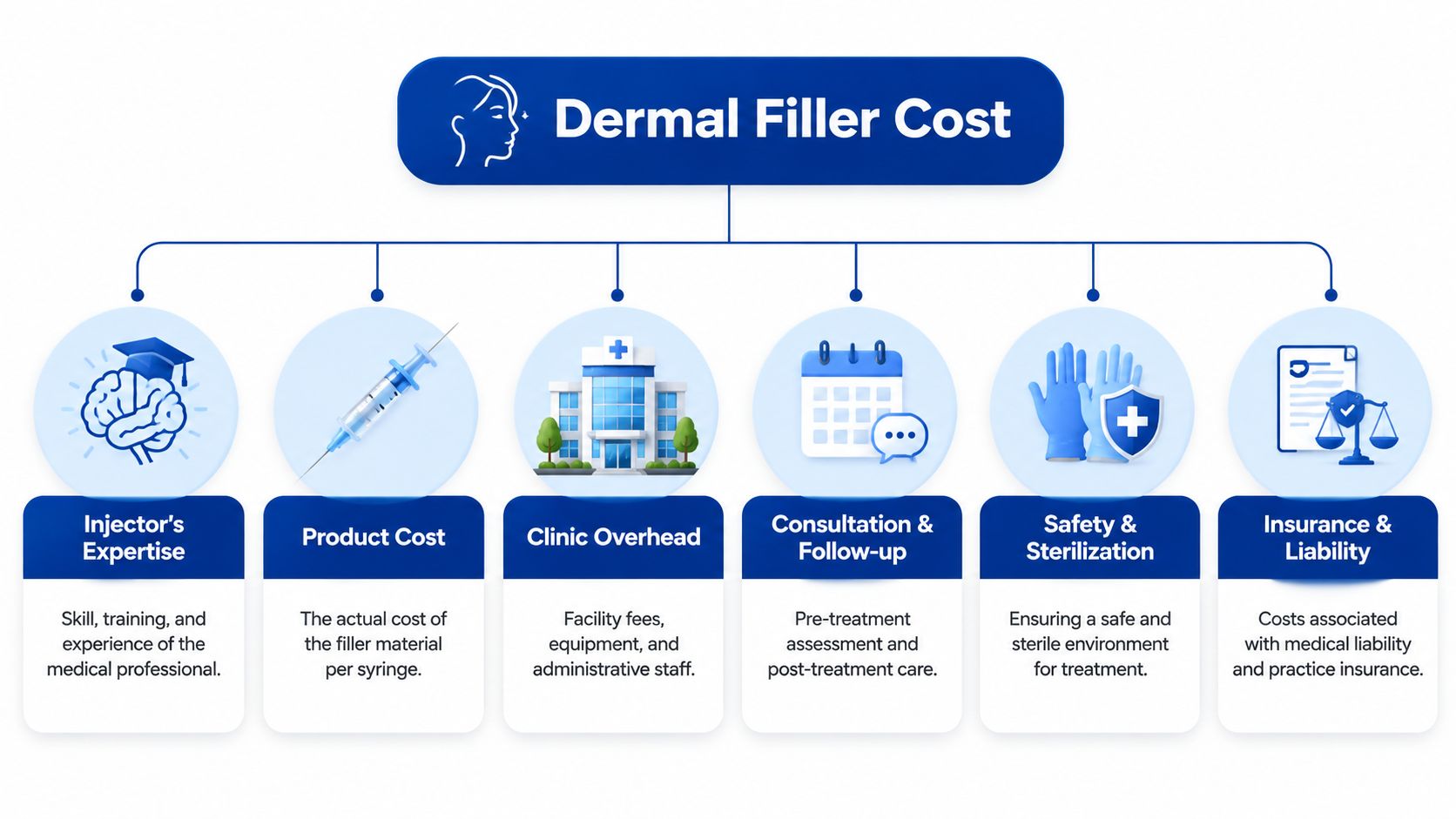
A dermal filler appointment is a medical service, not a retail purchase. The syringe is only one piece of the bill. You're also paying for the injector's training, the clinic's protocols, the supplies used to keep the treatment sterile, and the staff time that supports the visit before and after injections.
Consider commissioning an artist. The canvas matters, but the result comes from judgment, technique, and restraint. Good filler work depends on the same principle. The product matters, but the outcome is driven by where it's placed, how much is used, and whether the injector understands facial balance.
The parts patients don't always see
The quote often reflects more than the injector's chair time. It can also include the consultation, the assessment of facial structure, the selection of an appropriate product, and the follow-up needed if a tweak is required. Those are not extras in a serious practice, they're part of responsible care.
A second point matters here. Filler pricing works differently from neurotoxin pricing because filler is typically priced per syringe, since the treatment is about restoring volume. Neurotoxins are billed differently, which is why it's a mistake to compare injectables as if they follow the same logic. GoodRx on fillers and Botox
Why the service model matters
A lower number can look attractive until you ask what's missing. If the quote leaves out consultation time, sterile supplies, or follow-up planning, the headline figure isn't the complete cost. That's how patients end up comparing incomplete offers instead of comparing true value.
Bottom line: With fillers, value comes from a complete medical process, not a single product line item.
How Product Area and Volume Shape Your Cost
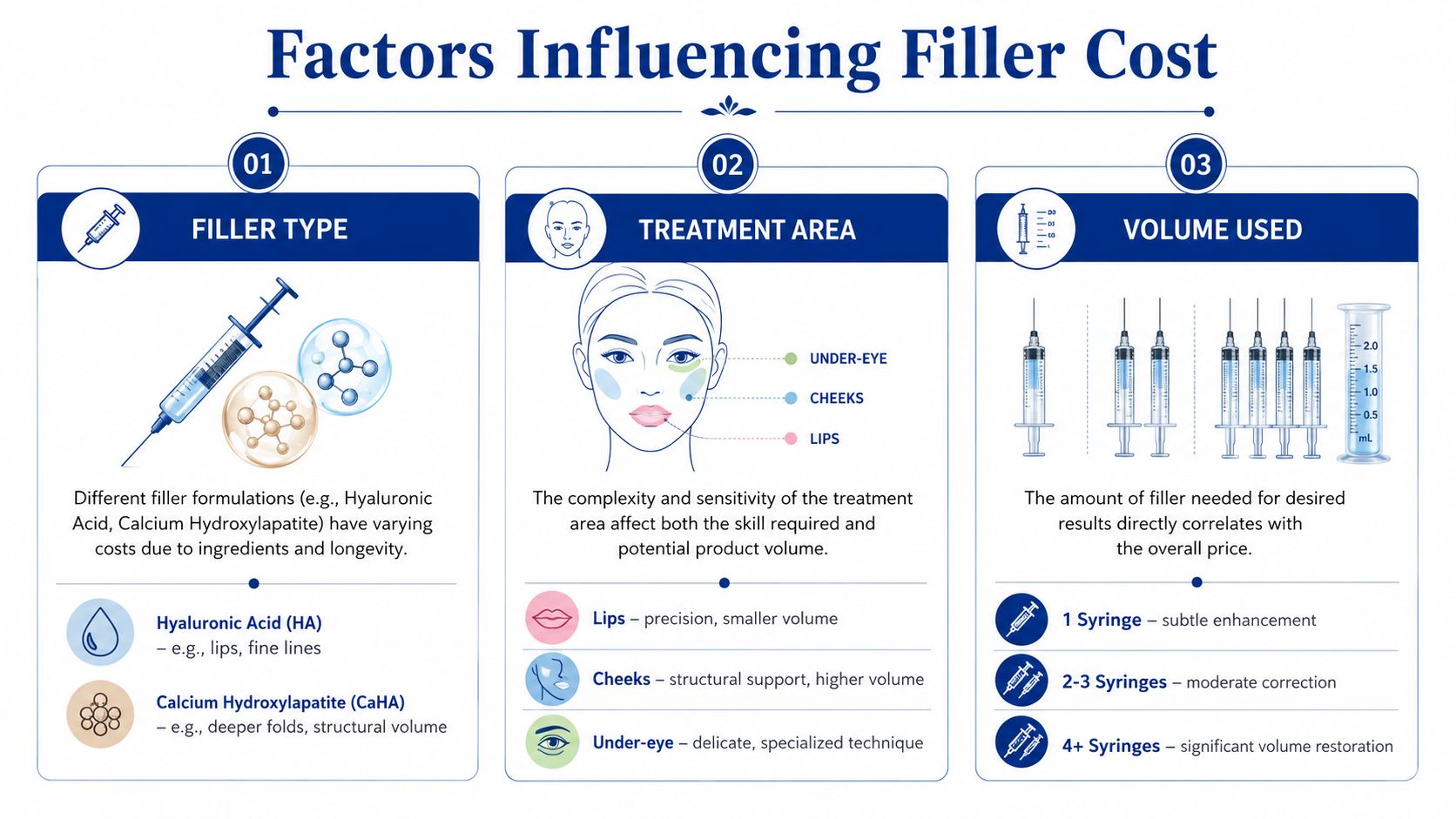
Three variables drive most filler quotes, product class, treatment area, and how much volume the face needs. Once you understand those three pieces, the pricing logic gets much easier to read. The quote stops looking random and starts looking individualized.
Product class changes the price tier
Different fillers are built differently. Hyaluronic acid, calcium hydroxylapatite, and poly-L-lactic acid are not interchangeable materials, and they do not sit at the same market position. CareCredit's guide shows the national average cost per vial ranges from $868 to $1,323, with hyaluronic acid at $868, calcium hydroxylapatite at $1,127, diluted calcium hydroxylapatite at $1,071, hyperdiluted calcium hydroxylapatite at $1,007, PMMA at $1,263, and poly-L-lactic acid at $1,323. CareCredit dermal filler guide
That tiering makes sense. More specialized formulas are designed for different depths, different structural jobs, and different longevity goals. In a real consultation, that means the product is chosen for the face, not the other way around.
Area matters because anatomy matters
Delicate areas need more precision. Broader structural zones often need more product. The lips, under-eyes, cheeks, jawline, and chin each demand a different approach because the tissue behaves differently and the margin for error changes with each area.
Volume is the biggest surprise for many patients
The initial focus is often on the first syringe. The final bill often depends on how many syringes are needed to finish the plan properly. That's why a clean estimate can't be made without seeing the face, listening to the goal, and deciding whether the plan is subtle enhancement or more complete volume restoration.
If you want a product-specific breakdown, this Restylane cost page is a practical next read.
The Unseen Value of Injector Expertise and Location
The injector is the most important part of the equation. Not the brand, not the marketing, not the waiting room. A skilled medical professional knows facial anatomy, understands balance, and knows when not to chase a result that would look overfilled or uneven.

Skill shows up in the final result
A high-level injector doesn't just place product, they read the face. That means respecting symmetry, supporting natural movement, and choosing the right depth and product for the tissue. In Beverly Hills, CA, that standard is part of the expectation, not a luxury add-on.
Dr. Sarah Yovino and Dr. Justin Yovino represent the kind of provider profile patients should look for, medical training, aesthetic judgment, and a serious understanding of facial structure. That's what protects the result. It also protects the patient from chasing fixes later.
Location affects the cost structure
Geography plays a real role in what a clinic needs to charge. Market guides note that pricing varies by product type and location, and that major metropolitan markets, including Beverly Hills, tend to sit higher in the national spectrum because of demand and overhead. Direct Aesthetics pricing guide
That doesn't automatically mean every higher quote is inflated. It often means the clinic is operating with a higher overhead structure, more specialized staffing, and a stronger emphasis on medical standards. Patients should care about that.
In aesthetics, low overhead isn't the same thing as good value.
A safer, more refined treatment environment usually costs more to run. For patients who want conservative placement, better aesthetic judgment, and a controlled medical setting, that difference is usually worth it.
Planning Your Long-Term Filler Treatment Journey
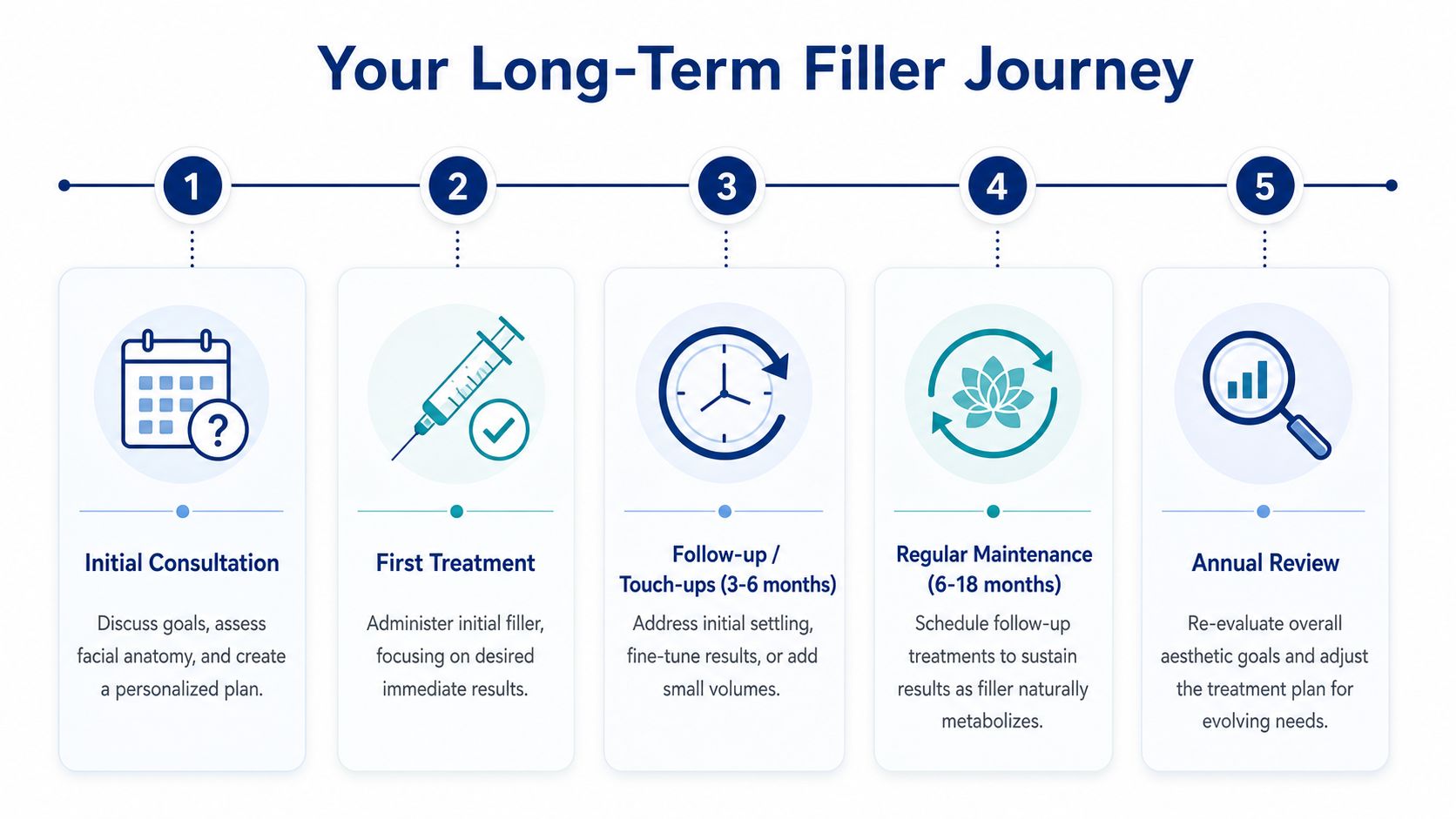
Filler shouldn't be treated like a one-and-done splurge. It's better to think in terms of a treatment lifecycle. The first appointment starts the process, but maintaining a polished result usually requires planned follow-up and periodic reassessment.
Build the plan around maintenance, not surprise
Patients are often more comfortable when they know the treatment is designed to evolve. RealSelf reports an average cost of $1,621 based on recent patient reviews, and says treatment can reach $5,299 when multiple areas or combinations with other injectables are involved, which is exactly why the total investment can be more than the first syringe or even the first visit. RealSelf dermal filler cost
That's the part many quotes leave out. If the face needs more than one area treated, or if a product is selected for a structural role that requires follow-up, the complete plan includes future touch-ups and review visits. That doesn't make the treatment expensive in a vague sense. It makes the budgeting honest.
A good plan keeps the result stable
Long-term filler care works best when the provider builds a schedule around the face's actual response. Some patients need small refinements after the initial treatment. Others need maintenance to keep the result from fading too far before the next appointment.
Practical rule: Don't wait until everything is gone before you revisit your plan.
If you prefer to manage treatment in a structured way, patient payment planning can help spread the investment over time. Clarity's payment plan solutions are one resource patients sometimes review when they want a cleaner way to budget for aesthetic care.
Making a Smart and Safe Investment in Your Results
Choosing a filler treatment based on the lowest price can lead to costly corrections later. In a city like Beverly Hills, the better question is not what looks cheapest on paper, but what gives you the safest plan, the strongest result, and the least chance of needing repair work.
Comparing Your Options Wisely
A qualified injector with strong anatomical knowledge is where your money is best spent. A provider who cuts corners on product sourcing, assessment, or clinical standards creates avoidable risk, and those mistakes are expensive to fix. Cosmetic fillers are generally not covered by insurance, so the decision is usually self-pay, which makes disciplined spending even more important.
There is a clear difference between responsible financing and a risky shortcut. Financing helps you manage payment without changing the treatment itself. Discounting that looks attractive upfront can mean rushed evaluations, weaker standards, or filler choices that do not suit the face.
Choose value over false savings
Some patients chase the lowest advertised deal and ignore the larger cost of a poor outcome. That approach often backfires. If correction is needed later, the financial burden rises, and the stress usually rises with it.
My advice: Pay for precision once, not for repairs twice.
If you are evaluating how aesthetic practices present their services online, it also helps to understand how treatment pages are built around intent. For that broader marketing context, this guide on how to dominate med spa transactional searches is useful reading, but the clinical decision should still come first.
Your Consultation The Path to a Clear Quote
A real consultation is the only honest way to get a useful dermal filler quote. Pricing changes based on the filler type, the treatment goal, and how much product is needed, so any one-line estimate is only a rough starting point. The ASPS cost guide supports that reality.
At a reputable clinic, the visit should include a facial assessment, a direct conversation about your goals, product selection, and a quote that explains what is being recommended and why. That is the standard patients should expect from a careful practice. It is also the only way to avoid paying for the wrong plan.
What a good consultation should include
You should leave with clarity on the product class being considered, the likely volume needed, and the reason that approach fits your anatomy. You should also know whether the goal is subtle refinement, structure, or fuller correction. A transparent estimate should make the treatment feel straightforward, not mysterious.
A strong consultation also shows you how the provider thinks. You want a clinician who explains tradeoffs clearly, uses product recommendations that match the face, and ties the quote to a specific plan instead of a vague promise. If you want a sense of how a serious aesthetic practice frames that process, Ideal Face & Body's consultation page is a practical place to start. That kind of planning is what patients should expect before they commit to filler.
The right question is not, “How cheap can I make this?” It is, “What plan gives me a safe, natural result with no surprises?” That mindset protects both your outcome and your budget.