You know the look. You catch your reflection in bright office lighting or a bathroom mirror, and the problem isn't just a wrinkle. The outer brows feel heavy, the upper lids look hooded, and the space between the brows makes you seem more tired or tense than you feel. A forehead lift for men is usually about solving that exact mismatch, not chasing a smoother forehead for its own sake.
The hard part is that the right solution for men is rarely the same as the one sold in generic brow-lift advice. In male faces, the decision usually comes down to scar placement, hairline preservation, and keeping a masculine brow position at rest. That's where the technique matters, because the wrong lift can leave the upper face looking too high, too arched, or too obviously operated on.
Table of Contents
- What a Forehead Lift Actually Changes on a Man's Face
- Incision Patterns and How They Interact With a Male Hairline
- Why a Male Brow Is Not a Smaller Female Brow
- Anesthesia Choices Including Awake Office-Based Forehead Lift
- Who Is a Good Candidate for a Male Forehead Lift
- Recovery Timeline and What Actually Happens Week by Week
- Non-Surgical Alternatives and Where They Fit
- Costs, Risks, and Choosing the Right Surgeon
What a Forehead Lift Actually Changes on a Man's Face
A man usually starts noticing it the same way every morning. He looks in the mirror and sees a brow that sits low, an upper lid that feels crowded, and a crease pattern that makes him seem irritated or exhausted before the day even starts. That's the lived problem a forehead lift is trying to solve, and it's more structural than many might assume.
A forehead lift, also called a brow lift, changes the resting position of the brow by working on the soft tissues of the upper face. It doesn't just remove skin, and it doesn't erase wrinkles. The operation releases and repositions forehead tissues, softens overactive frontalis compensation, and helps the eyebrows sit where they belong at rest.
Why that's different from Botox or eyelid surgery
Botox can relax the muscles that pull the brow down, but it can't physically reposition tissue that has descended. Upper eyelid surgery can remove redundant skin from the lid, but it doesn't fix a low or heavy brow driving that hooding in the first place. A well-planned forehead lift is about choosing the right structural problem to correct, then matching the correction to the male face.
That distinction matters because men often blame the lids when the brow is the underlying issue. If the brow is low, the upper lid gets crowded and the eye reads as tired even when the skin itself is healthy. In that setting, lifting the brow can improve the whole upper third of the face more naturally than chasing the eyelid alone.
Practical rule: If the brow is sitting on the lid, treat the brow. If the lid is the issue, treat the lid. If both are contributing, the plan usually needs to address both.
The upper face only looks refreshed when the correction respects the underlying structure. That's why a male forehead lift is never just a wrinkle procedure.
Incision Patterns and How They Interact With a Male Hairline
Men ask a different question than women in brow surgery. They don't usually ask, “How do I get the highest lift?” They ask, “Where does the scar go, and will it make my hairline look worse?” That's the right question, because scar placement and hairline preservation often determine whether the result looks clean or obvious.
The main incision patterns and what they trade off
The endoscopic forehead/brow lift is often favored in men because it uses a few small scalp incisions, with published male-specific guidance describing paramedian ports about 4 cm off midline and just behind the anterior hairline to reduce visible scarring while preserving a natural brow position (male-specific endoscopic technique guidance). A coronal lift places the incision farther back, which hides the scar better in hair, but it can also lengthen the forehead. An anterior hairline incision does the opposite, it can shorten the forehead when that's the goal, but it has to be placed and beveled carefully so hair follicles survive and the scar doesn't widen.
A mid-forehead lift is a real option for men with a receding hairline or little scalp coverage, because trying to hide every scar in hair can backfire. A direct brow lift places the incision at or near the brow itself, which can be useful when the concern is very specific brow ptosis, but the trade-off is obvious scar visibility. A transpalpebral approach uses an upper eyelid incision, which can be helpful when brow work is combined with lid surgery.
Men with short hair, a shaved head, or a retruded hairline should think in terms of “what scar can I live with?” rather than “which lift is the fanciest?”
The right pattern depends on whether the surgery is meant to preserve the hairline, shorten a long forehead, or avoid a conspicuous scar in someone with sparse frontal hair. Those are design choices, not marketing labels.
Hairline preservation is the real male issue
For men with a high forehead or receding hairline, incision placement becomes even more strategic. A transcoronal incision is often placed 6 to 8 cm posterior to the frontal hairline, while an anterior hairline incision may be used when forehead shortening is desired, sometimes with placement about 1 to 2 mm behind the hairline to protect follicles and reduce scar visibility (forehead incision planning reference). Moving the incision back helps conceal it, but it can also make the forehead look longer. Moving it to the hairline can shorten the forehead, but only if the closure is meticulous.
The men who struggle most with one-size-fits-all advice are the ones with limited hair coverage. In that setting, a technique that hides beautifully in dense hair may look worse than a more visible incision that's placed well and closed carefully. That's why scar strategy is central to male brow surgery, not secondary.
Why a Male Brow Is Not a Smaller Female Brow
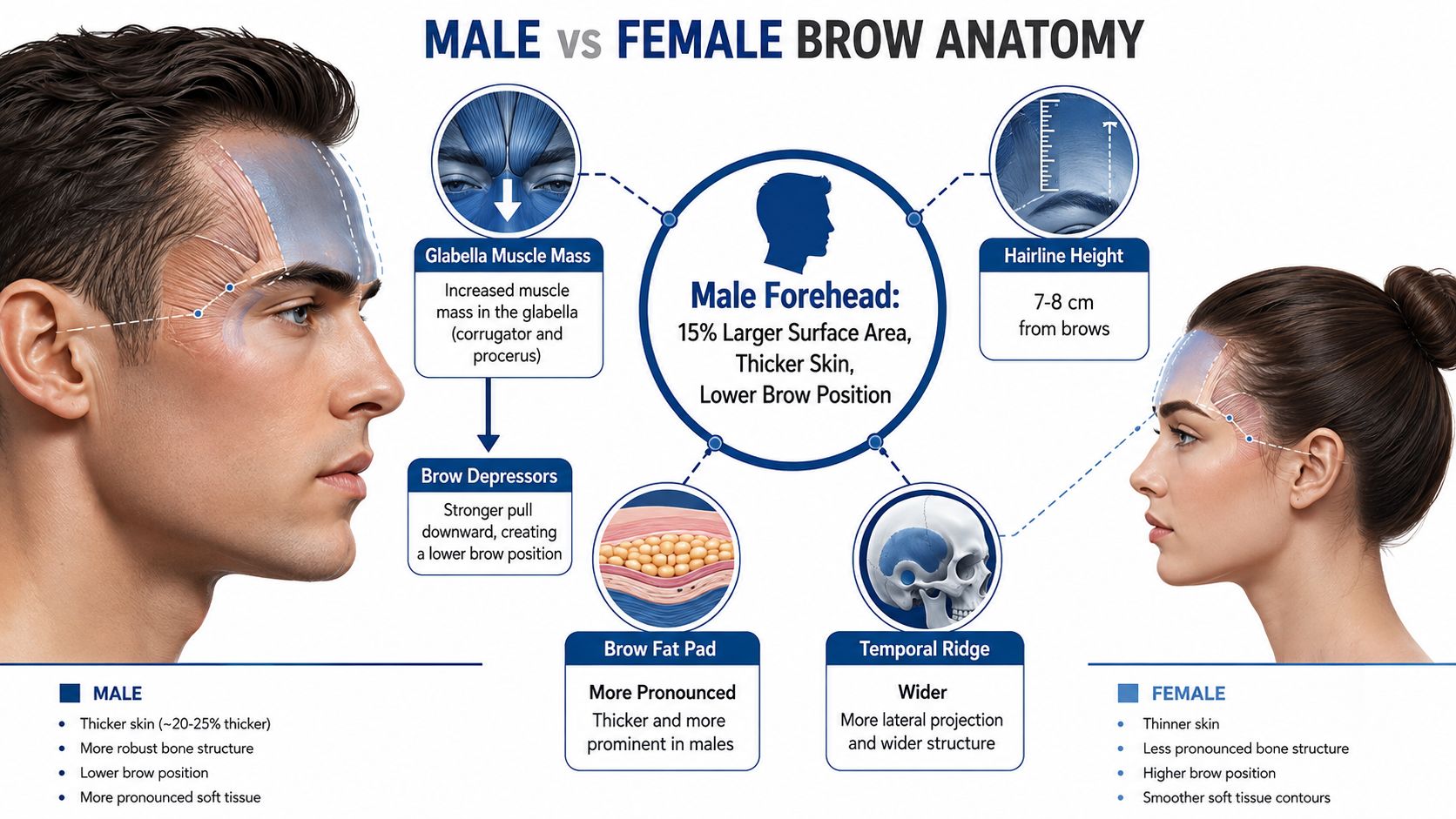
A man's forehead brings its own proportions into the room, and those proportions explain why an aggressive lift looks off so quickly. A 2023 analysis found mean forehead height above the lateral eyebrow of 4.16 cm in men versus 3.51 cm in women, and forehead height from trichion to glabella has been reported at roughly 7 to 8 cm in average men compared with 6 to 7 cm in average women (forehead sexual dimorphism analysis). Those measurements explain why a masculine brow lift must aim for restraint.
The goal is reduction of heaviness, not an arched brow
Men usually want a flatter, lower, and less heavy brow, not a high, curved one. The resting brow should still read as male, so conservative lift and careful vector control matter more than dramatic repositioning. If the brow is lifted too far, the upper face can start to look surprised, artificial, or feminized.
I approach male brow surgery as a balance problem. The job is to reduce hooding, soften an angry or tired look, and leave enough descent to keep the face natural. In practice, a smaller correction in the right direction usually beats a bigger correction in the wrong one.
A recent clinical series reinforces how individualized this needs to be. In 895 forehead-eyebrow lift procedures, 107 patients, 13.2%, were male, the mean male age was 47.9 years, and nearly 20% of male cases required a customized endoscopic technique. The same series reported a mean satisfaction score of 97.5/100 at a mean follow-up of 25.2 months, which supports the idea that men do well when the technique matches the anatomy rather than forcing a generic lift (2025 forehead-eyebrow lift series).
What the male face usually needs around the eyes
The upper lid and brow often travel together in male rejuvenation planning, and the clinical series above noted that all but one male patient had simultaneous upper blepharoplasty. That fits what shows up in consultation. A man may think he needs a forehead lift, but part of the problem is redundant lid skin. In some cases, the answer is a combined plan rather than a bigger lift.
A useful visual resource for how upper-face framing affects overall appearance is a professional headshot gallery, because small changes in brow position can change how severe, approachable, or rested a face looks on camera.
Anesthesia Choices Including Awake Office-Based Forehead Lift
Anesthesia changes the whole day in male brow surgery. It affects how relaxed the patient feels, how much memory he has of the operation, and how quickly he gets back to routine. The practical options are general anesthesia, IV sedation with local anesthesia, and awake surgery under local anesthesia.
Hairline preservation is the central male concern
A man's choice of anesthesia is tied to the operation plan. If the surgeon expects a longer dissection, deeper tissue release, or a more extensive correction, general anesthesia can make sense because it gives a completely controlled operating room setting. IV sedation with local anesthesia sits between the two. The patient is relaxed and drowsy, while the forehead and brow are numbed.
Awake surgery under local anesthesia is different. Most men feel pressure, movement, and some tugging, but not sharp pain when the numbing is working properly. That experience fits many endoscopic and hairline-based lifts, while longer coronal dissections more often call for deeper sedation.
If a man wants to avoid general anesthesia, he should ask whether the planned technique fits local anesthesia cleanly, not assume every brow lift feels the same.
Awake office-based surgery appeals to men who want to avoid the fog that can follow general anesthesia or who prefer a private surgical suite setting in Beverly Hills, CA. It also keeps the discussion focused on a practical trade-off, scar placement versus hairline preservation versus brow position. That does not make it the best choice for everyone, but for the right candidate it can be more controlled and less disruptive than a deeper anesthetic plan.
For readers who want a closer look at how local anesthesia changes the planning conversation, this complete guide to awake surgery explains the awake model in more detail.
Who Is a Good Candidate for a Male Forehead Lift
A man doesn't need to be “old enough” in some abstract sense to be a candidate. He needs the right anatomy, the right hairline, and a realistic goal. The decision starts with the brow itself, then moves to scalp coverage, skin quality, and scar tolerance.
A practical self-check
The published anatomic thresholds surgeons measure against can help a man orient himself. One forehead-lift criteria paper reports an average midpupil-to-upper-eyebrow distance of 2.5 cm and an average upper-eyebrow-to-hairline distance of about 5 cm (forehead-lift criteria paper). If your brows sit lower than you expect, or the distance between brow and hairline feels very short or very long compared with your own facial proportions, that's worth discussing in person.
The more important questions are practical:
- Brow position: Is the heaviness mostly lateral, central, or both?
- Hairline stability: Is the hairline holding steady, or is it receding?
- Skin quality: Is the skin thin and mobile, or thick and sebaceous?
- Scar tolerance: Can you live with a visible scar if it gives the right result?
- Goal: Do you want less heaviness, less hooding, or a more alert look without changing your masculine shape?
Men with a very high forehead or a receding hairline may be better served by an endoscopic, direct, or hairline-based strategy than by a coronal approach. That's because the wrong incision can make the forehead look longer or place a scar where it can't be hidden.
Who usually isn't a fit
A man who wants a fully wrinkle-free forehead is usually chasing a result that doesn't age well. The same is true for a patient asking for a high arched, feminized brow. If the goal conflicts with masculine anatomy, the surgery will fight the face instead of working with it.
Good candidacy is less about age and more about whether the brow, hairline, and scar plan can all work together.
| Factor | Typical Male Range or Rule | What It Means for Candidacy |
|---|---|---|
| Midpupil to brow | Around 2.5 cm on average in published criteria | A low brow can support surgery when heaviness is the complaint |
| Brow to hairline | About 5 cm on average in published criteria | Very short or very long upper-face proportions affect incision choice |
| Hairline stability | Stable is better than actively receding | Stable hair makes hidden incisions more feasible |
| Main complaint | Hooding, heaviness, tired look, brow descent | These are better surgical targets than fine lines alone |
| Expected result | Natural, masculine, restrained | Better fit than a lifted or arched look |
Recovery Timeline and What Actually Happens Week by Week
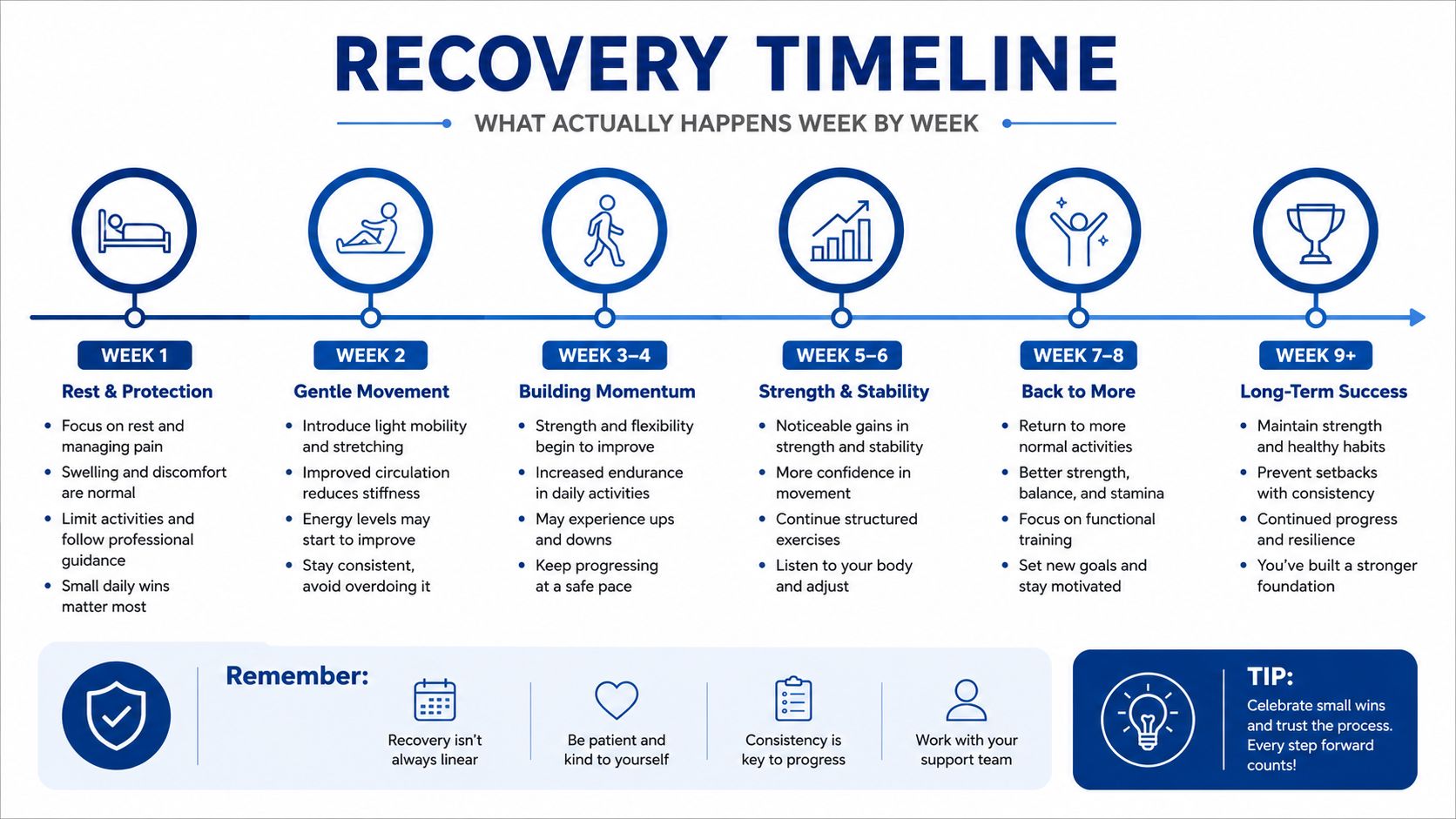
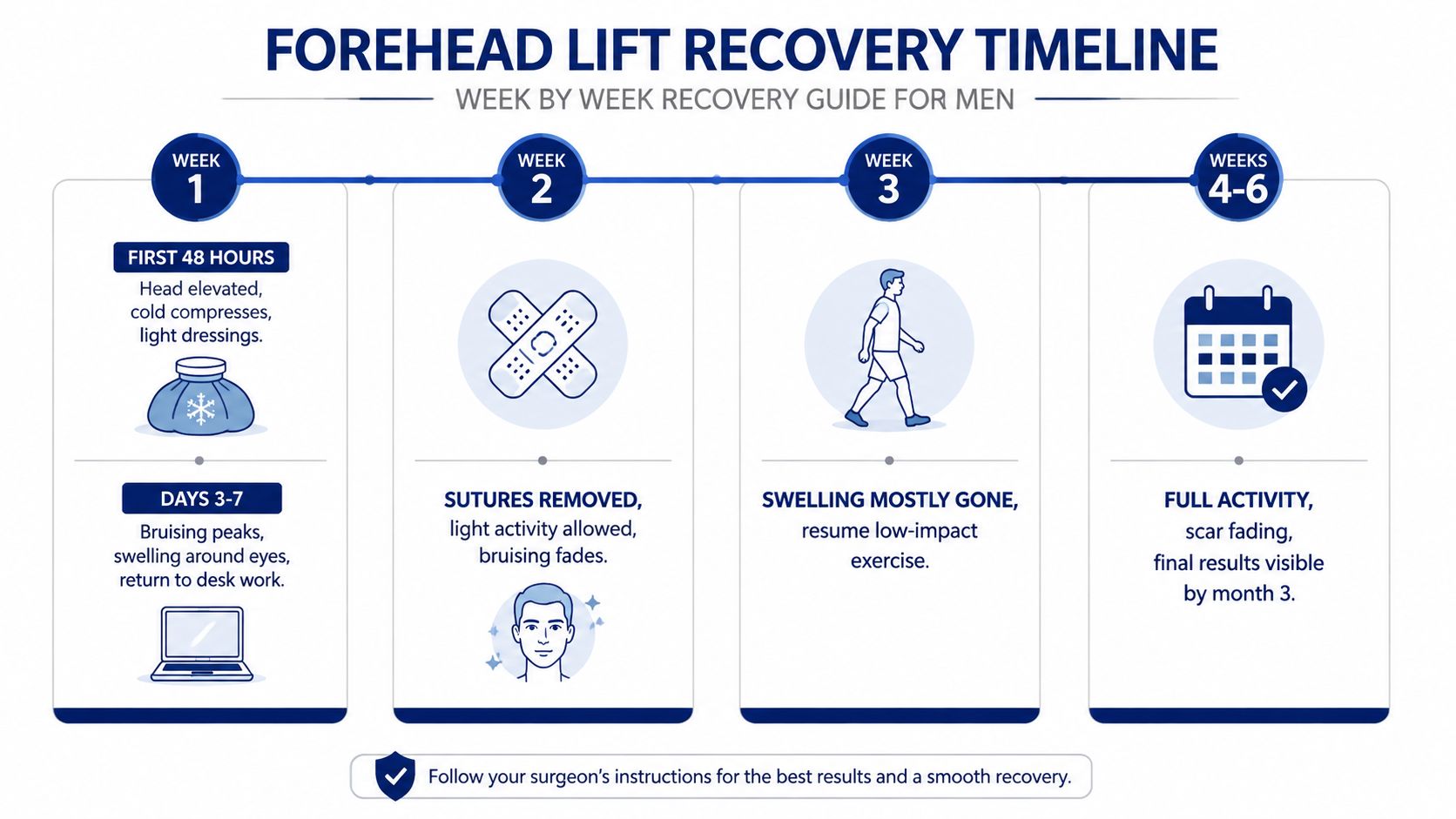
The first two days are usually the most uncomfortable, not because the surgery is dangerous, but because the body is reacting normally. Head elevation helps. Cold compresses help. Dressings and swelling are part of the deal. Most men are less worried about pain than they are about looking obviously swollen around the eyes.
What changes by the end of the first week
Bruising often peaks between days 3 and 7, and that's also the window when many men feel okay for video calls but not for being seen in person by everyone. Sutures or staples are commonly removed in week 2, and that's usually when desk work feels more realistic. Mild numbness, itching, and altered scalp sensation are common and tend to improve gradually rather than all at once.
By weeks 3 to 4, the swelling is mostly settling, the forehead starts to feel more like your own again, and the result becomes easier to read in the mirror. Light exercise usually returns before heavier training, and patients should get specific clearance before lifting hard or resuming intense routines. Sunglasses and hats are typically introduced once the incisions can tolerate them without pressure, which depends on the exact closure and healing pattern.
The final look still evolves after the early swelling disappears. A forehead lift doesn't settle overnight, and the scar keeps maturing long after the first visible improvement. That slower refinement is normal.
Symptoms that should not wait
A patient should call the surgeon promptly for increasing redness, concerning drainage, severe asymmetry that worsens, uncontrolled bleeding, or a sudden change in vision. Those are not “wait and see” symptoms. They're the sort of problems that deserve a direct check.
Non-Surgical Alternatives and Where They Fit
Not every tired or heavy brow needs surgery on day one. Some men do well with staged treatment, especially if the issue is mild or if they're trying to postpone a lift. The key is knowing what each non-surgical tool can do.
What each option solves
Botox can relax the muscles that pull the brow down and create a subtle lift, especially at the tail of the brow, but it can't reposition descended tissue. Fillers can camouflage temple hollowing and soften nearby transitions, but they can't lift a heavy lateral brow. Energy-based tightening, CO2 resurfacing, Morpheus8, and microneedling with PRP can improve texture and fine lines, but they don't move the brow itself.
That's why non-surgical care works best for line softening, early hooding, mild brow descent, and skin quality. Once the brow has descended, the visible problem is structural. A non-surgical treatment may make the skin look better, but it won't restore the original brow position.
Men sometimes use injectables as a stop-gap or as maintenance after surgery. That's a sensible use of them. It's not sensible to expect a neurotoxin or resurfacing device to do the job of a lift when the brow is already sitting low.
The broader decision tree for these treatments is covered in this brow lift non-surgical guide for readers comparing conservative options against surgery.
Costs, Risks, and Choosing the Right Surgeon
A man asking about a brow lift usually wants a straight answer on cost, but the honest answer starts with the plan. Pricing changes based on the incision pattern, anesthesia choice, and whether the procedure is combined with upper eyelid surgery or other facial rejuvenation. The label matters less than the anatomy being corrected and the amount of work required to keep the brow masculine.
The risks that matter in male brow surgery
The usual risks include bleeding, infection, scarring, hair loss along the incision line, asymmetry, nerve injury, and altered sensation. A surgeon who does this well plans for those issues before the first incision is made. That means careful bleeding control, closure that protects hair follicles, and an incision placed to match the hairline instead of forcing the hairline to suit the incision.
Men with thicker skin or denser soft tissue often need a more individualized plan. That is not a problem by itself, but it does change how the lift is designed and how much contour refinement is realistic. The goal is a result that looks clean on the male face, not a brow that reads overtreated.
What to look for in a surgeon
Choose a surgeon who is double board certified in plastic surgery, shows male-specific before-and-after photos with scars at different hairline stages, and can discuss awake and traditional anesthesia options without hedging. A good consultation for a forehead lift for men should also include a direct conversation about hairline preservation and scar placement. If you want to review a focused surgical approach first, you can start with this male brow lift overview.
You also want a surgeon who will say no when surgery is the wrong answer. If the brow position is only mildly low, or if injectables and skin treatments are still doing the job, that should be stated clearly rather than brushed aside. The consultation should measure the brow and the hairline, then connect those measurements to a plan that fits your face.
A virtual or out-of-town consultation can still be a smart first step if you want to compare approaches before traveling. It should feel anatomical and practical, with clear discussion of scars, preservation of the hairline, and the result you want to see in the mirror.
If you're considering male brow surgery and want a candid assessment of scar placement, hairline strategy, and whether surgery or a non-surgical plan makes more sense, visit Ideal Face & Body to explore a consultation. The practice offers awake, office-based facial surgery in Beverly Hills, CA, and the right next step is a face-to-face conversation about your brow, your hairline, and the result you want.