The old assumption that breast implants are a permanent decision is giving way to a more flexible view: implants can be temporary, and removing them doesn't always mean accepting a flat or deflated appearance. For selected patients, breast implant removal with fat transfer combines explantation with the use of the patient's own tissue to restore some volume and soften contour changes.
That doesn't make the procedure a replacement for every implant size or shape. Fat behaves differently from an implant, and some of the transferred tissue will be naturally reabsorbed. The most useful decision begins with understanding why patients are choosing removal, how the procedure works, what the evidence shows, and where awake surgery may fit.
Table of Contents
- Why Breast Implant Removal with Fat Transfer Is Rising
- Understanding the Procedural Steps
- Evaluating Clinical Outcomes and Fat Retention
- Benefits of Awake Surgery for Implant Removal
- Recovery Expectations and Aftercare
- Choosing the Right Surgeon and Clinic
- Final Considerations for Your Decision
Why Breast Implant Removal with Fat Transfer Is Rising
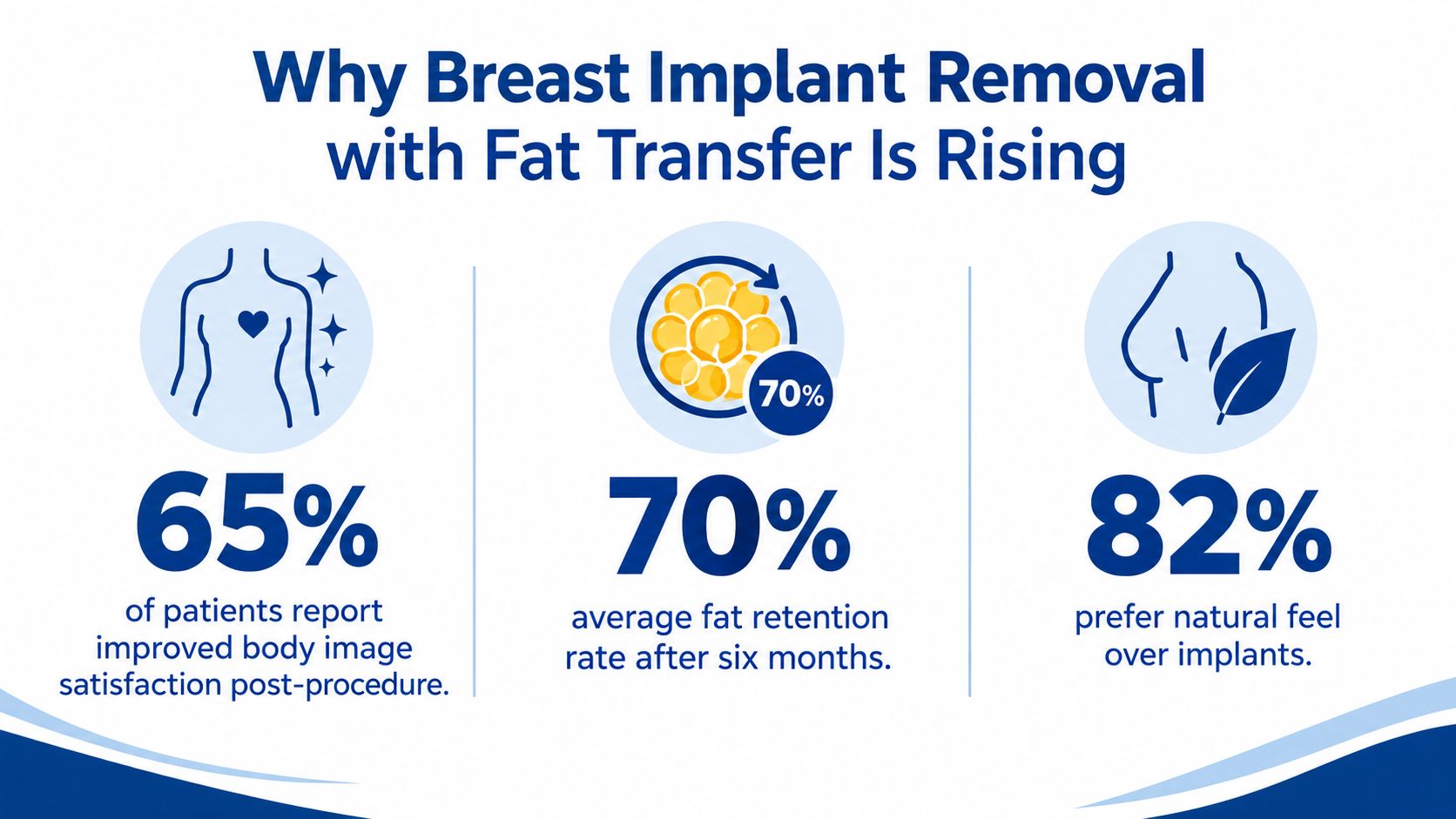
Breast implants are temporary devices, not lifetime commitments. That shift is changing the conversation around breast surgery. A patient can decide that an implant no longer suits her body, health concerns, or daily life without assuming that removal must mean accepting a flat or hollow result. For selected patients, fat transfer offers a way to restore some volume with the patient's own tissue rather than replacing one device with another.
The change reflects more than appearance. Some patients reconsider implants because of discomfort, lifestyle changes, evolving body-image goals, concern about future implant management, or a preference for tissue that feels more like their own body. Others want a smaller, softer breast profile. The suitable plan still depends on skin quality, existing breast tissue, implant size, capsule condition, and available donor fat.
Awake, office-based explantation has also made the idea feel more practical for carefully selected patients. Under local anesthesia, the implant can sometimes be removed without general anesthesia, while fat transfer provides a natural-volume option instead of automatic replacement. This approach is not appropriate for every patient or every procedure, but it reflects a broader choice: remove the device, then restore contour thoughtfully when the anatomy allows.
Explantation is no longer a niche conversation
Implant removal now represents a substantial part of cosmetic breast care. Published figures recorded 49,834 breast implant removals in 2018, 66,982 in 2019, and 65,076 in 2023. They also showed that 2.3% of explant cases in 2017 included fat grafting after removal without new implants or a lift. International figures recorded 1,008 breast implant removals in 2023, an increase of 79% from the prior year. Together, these figures show sustained interest in implant removal and explain why implant-free reconstruction deserves a careful discussion (The Aesthetic Society's 2023 statistics).
The relatively limited use of fat grafting in the earlier figure is also informative. Fat transfer was available, but it was not yet the usual route after explantation. Surgeons and patients have since gained more experience using it to soften hollows, improve contour irregularities, and address selected volume loss. The method works less like inserting a fixed object and more like adding small layers of living tissue where the breast needs support.
What patients should expect from the concept
An implant provides defined volume and projection. Fat creates softer volume that can be shaped around the breast, but the final result depends on donor supply and how much transferred fat remains healthy. It cannot reproduce every implant feature or guarantee the same breast dimensions.
A realistic goal is better contour, improved softness, and a balanced implant-free appearance, rather than an exact return to the shape created by an implant. Understanding that difference helps patients choose removal with a clear view of what fat transfer can, and cannot, accomplish.
Understanding the Procedural Steps
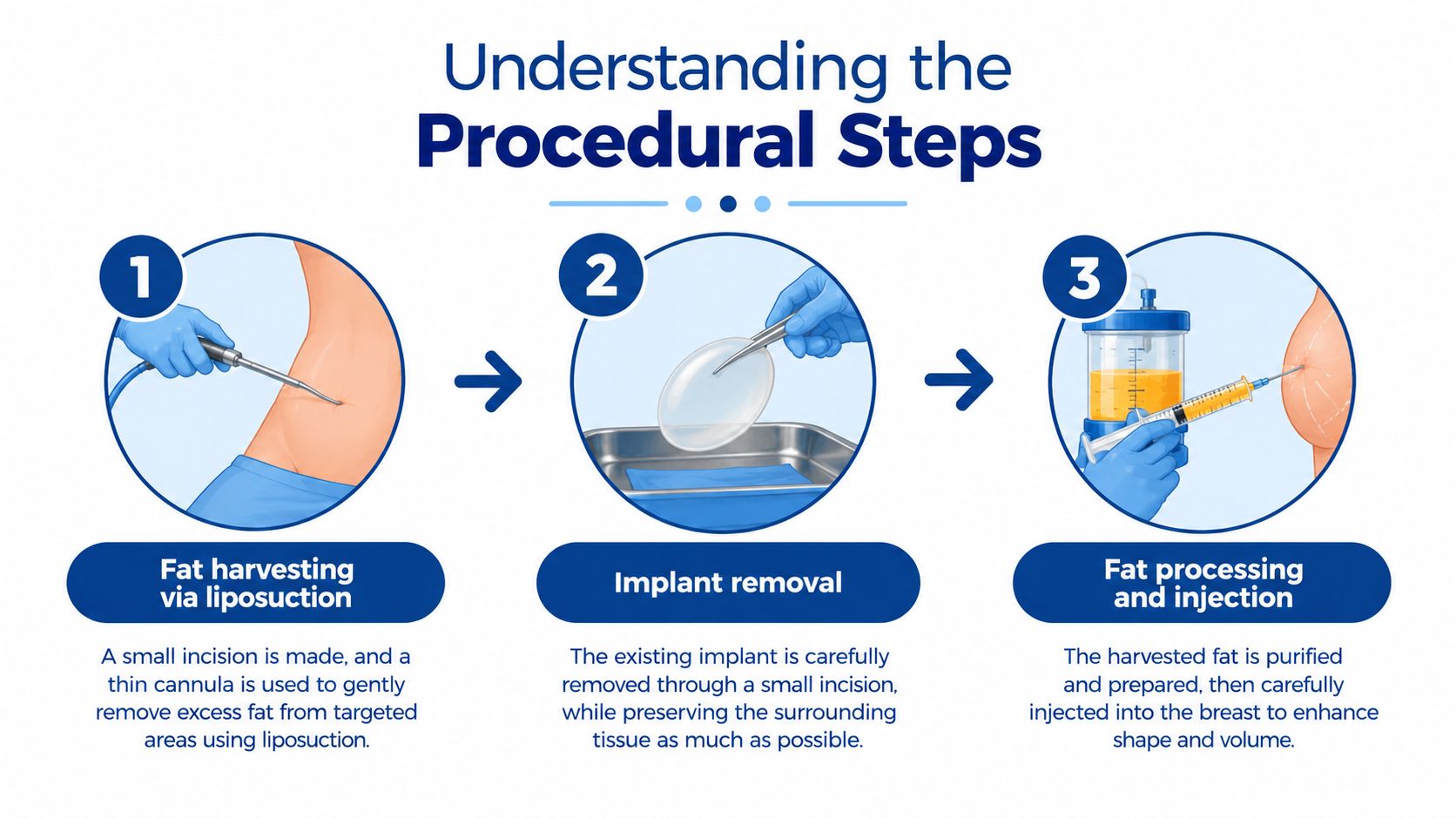
Breast implant removal with fat transfer is a coordinated process rather than a single maneuver. The surgeon evaluates the breast pocket, removes the implant, harvests fat from an appropriate donor area, prepares that fat, and places it where additional volume or contour support is needed.
The sequence can vary. In many cases, the surgeon uses an existing breast incision for removal, then performs liposuction on areas such as the abdomen, flanks, or thighs. The harvested tissue is processed before injection, because fluid, blood, and damaged cells can interfere with graft survival.
Consultation and surgical planning
The planning visit should answer several practical questions:
- Breast tissue: How much natural tissue remains, and how much skin laxity is present?
- Implant history: Is there evidence of rupture, contracture, significant scar tissue, or other pocket concerns?
- Donor areas: Is there enough suitable fat to create the intended contour change?
- Shape goals: Is the priority upper-pole fullness, cleavage, symmetry, softening of an indentation, or overall volume?
- Anesthesia plan: Is an awake, local-anesthesia approach appropriate for the extent of the procedure?
A surgeon may also discuss whether removal alone, removal with fat transfer, or a separate lifting procedure better matches the anatomy. Fat can improve contour, but it can't tighten every stretched skin envelope.
The three coordinated stages
The technical pathway usually has three linked parts.
Fat harvesting: Liposuction removes fat from selected donor areas while the surgeon aims to preserve viable cells and maintain a smooth donor contour.
Implant removal: The surgeon opens the breast through an appropriate incision and removes the implant. The capsule and surrounding tissues require individualized assessment rather than an automatic, identical treatment for every patient.
Fat processing and injection: The harvested fat is purified and placed through small injection points in multiple tissue planes. Layered placement helps the surgeon shape the breast and gives the grafted cells access to a suitable blood supply.
The recipient bed matters because transplanted fat needs contact with surrounding tissue to establish a blood supply. A large amount placed into a poorly prepared space may not survive as reliably as carefully distributed grafts. Patients who want a clearer explanation of the harvesting and grafting principles can review this guide to fat transfer in Beverly Hills.
A prospective study of 80 patients reported injected volumes of 300 to 600 mL per breast, operating times of 45 to 90 minutes, and a single-session replacement strategy for all patients in that cohort. The same findings are summarized in the available clinical policy literature (the study summary on immediate explantation and fat transfer). Those results show what may be technically possible in a selected group, not what every patient should expect.
Evaluating Clinical Outcomes and Fat Retention
The most important distinction in fat transfer is the difference between fat injected and fat retained. The surgeon may place a specific volume during the operation, but the body decides how much of that tissue remains. Some cells establish a blood supply and become part of the breast contour. Others are reabsorbed.
That biological process is why the early postoperative appearance isn't the final result. Swelling can temporarily make the breasts look fuller, while later resorption can reduce some of that volume. A thoughtful plan accounts for this from the beginning instead of presenting the first postoperative shape as permanent.
What the clinical evidence shows
A 2025 clinical series followed 38 patients, with 76 breasts grafted bilaterally after implant removal. The mean transferred volume was 222.8 cc per breast, with a range of 80 to 350 cc and a median of 200 cc. Patients were followed for a mean of 24.60 months. The series reported no complications in 14 patients, and satisfaction was higher in the mastopexy-incision group than in the inframammary-fold group, with p = 0.037 (the PubMed clinical series).
Those findings support immediate fat transfer as a feasible single-stage option for selected patients. They don't guarantee a particular cup size, projection, or retention pattern. Anatomy, surgical technique, tissue quality, smoking status, weight changes, and available donor fat can all influence the outcome.
A separate review found pooled volume retention of 63.7% at 12 months and 56.2% at 24 months after autologous fat grafting in breast procedures (the systematic review of retention and complications). Another review reported 61.3% retention at 12 months for breast augmentation with fat grafting, with higher retention in stromal vascular fraction or PRP-enriched grafts than in standard grafts, 68.9% versus 56.1%, while also describing the evidence as heterogeneous. These findings are useful for expectation-setting, but they don't establish that an enrichment method is necessary or worthwhile for every patient.
How surgeons protect the result
The technical objective isn't just to inject more fat. It is to place viable tissue in a way that supports survival and produces a controlled contour.
- Harvest gently: Excessive trauma during liposuction can reduce the quality of the graft.
- Process carefully: Removing unwanted fluid and damaged material helps create a more consistent injectable graft.
- Distribute in layers: Small deposits across multiple planes are generally more biologically sensible than placing one dense bolus.
- Respect tissue limits: The surgeon must balance the patient's desired fullness against the recipient bed's ability to accept the graft.
- Plan for evolution: The final shape should be assessed after swelling settles and the retained fat stabilizes.
Long-term results can be durable, but “natural” doesn't mean that every transferred cell remains forever. The same review reported fat necrosis in 13%, cysts in 27%, infection in 11%, calcification in 6%, and reoperation in 11%. These figures come from a broader review of breast fat grafting rather than a promise about an individual patient, and they reinforce why follow-up and appropriate imaging matter.
Patients who want a practical discussion of how results change over time can also review how long fat transfer results last. A touch-up may be considered if later volume loss creates an imbalance, but it should be based on the healed result rather than early swelling.
Benefits of Awake Surgery for Implant Removal
Awake, office-based explantation uses local anesthesia to numb the treatment area while the patient remains responsive. For an appropriate candidate, this can avoid exposure to general anesthesia and may reduce the recovery burden associated with being fully anesthetized. It doesn't mean the procedure is casual or that every patient qualifies.
The setting must match the operation. A surgeon needs to evaluate the implant, capsule, incision, anticipated liposuction, fat transfer volume, medical history, and comfort level before recommending an awake approach. More extensive surgery may require a different anesthesia plan.
Why the awake model appeals to patients
Patients often value the ability to remain awake because they can avoid the grogginess, nausea, airway management, and broader physiologic effects associated with general anesthesia. They may also appreciate returning home from an office setting after observation rather than arranging care around a hospital-based anesthetic.
There is a psychological benefit for some people, too. The patient can communicate during the procedure, report discomfort, and remain involved in the experience. Local anesthesia doesn't remove the need for careful monitoring, sterile technique, emergency preparedness, or a surgeon trained to recognize when the plan needs to change.
A practical rule: “Awake” should describe the anesthesia plan, not a lower standard of surgical care.
Recovery and evidence need to be considered together
The retention evidence discussed above still applies whether fat transfer occurs under local or general anesthesia. Awake surgery may change the anesthesia experience and immediate recovery, but it doesn't stop fat biology. Transferred tissue can still be reabsorbed, and complications such as infection, cyst formation, fat necrosis, asymmetry, or contour irregularity remain relevant.
That is why patients should evaluate an awake clinic by asking specific questions:
- How does the team manage pain during implant removal and liposuction?
- What happens if the procedure becomes more extensive than expected?
- Who monitors the patient throughout the operation?
- What follow-up is provided if swelling, fluid, or asymmetry develops?
- Is the surgeon experienced in both explantation and breast fat grafting?
A detailed explanation of this model is available in the awake breast implant removal overview. The right choice is the one that matches the procedure's complexity, the patient's health, and the clinic's safety protocols.
Recovery Expectations and Aftercare
Recovery has two sources of healing: the breasts have undergone implant removal and grafting, while the donor areas have undergone liposuction. Bruising, swelling, tightness, tenderness, and temporary asymmetry can occur in both regions. The early appearance is also affected by fluid shifts and inflammation, so it shouldn't be treated as the finished result.
The surgeon's instructions take priority because aftercare depends on the incision, the amount of liposuction, the extent of breast work, and the individual response. Patients should keep dressings and incisions managed as directed, take prescribed medication responsibly, and attend follow-up visits even when they feel well.
Comparing awake recovery with general anesthesia
| Awake, office-based approach | General-anesthesia approach |
|---|---|
| Uses local anesthesia for the treated areas | Uses medication that produces full unconsciousness |
| May avoid airway management and general-anesthesia after-effects | Includes recovery from the anesthetic as well as the surgery |
| Often allows discharge after office observation | May involve a more structured facility recovery process |
| Still requires surgical monitoring and emergency planning | May be selected when procedure extent or patient factors require it |
This comparison isn't a promise that awake surgery always feels easy or that general anesthesia is inappropriate. The operation itself remains the major driver of breast and donor-site healing. Local anesthesia can reduce one part of the recovery experience, but it can't eliminate soreness, swelling, activity limits, or the need to protect the grafted tissue.
Protecting the early result
Avoid pressure, impact, heavy exertion, and premature exercise until the surgeon clears them. The breasts need time for the injected fat to settle, while the donor areas need time for their small incisions and deeper tissues to heal.
Call the surgical team promptly if pain suddenly worsens, one breast changes rapidly, drainage becomes concerning, fever develops, or the incision separates. Later, weight stability helps preserve contour. If a touch-up is discussed, the decision should wait until the tissues have matured enough for the surgeon to judge retained volume and symmetry.
Choosing the Right Surgeon and Clinic
The quality of the result depends on more than removing an implant and adding fat. The surgeon must assess the breast pocket, skin envelope, scar tissue, donor areas, anesthesia needs, and the patient's preferred level of fullness. A specialist who performs awake procedures should also be prepared to explain when awake surgery isn't appropriate.
Questions that reveal the planning process
Ask to see examples involving anatomy similar to yours, not only idealized results. Then ask how the surgeon handles the issues that photographs can't show:
- Volume planning: How will the surgeon decide how much fat to harvest and inject?
- Skin laxity: Would fat transfer alone address the shape, or is lifting also part of the discussion?
- Implant and capsule: What findings could change the surgical plan?
- Retention: How will the team evaluate the healed result if some volume is resorbed?
- Safety: What monitoring, emergency equipment, and follow-up are available in the office?
- Continuity: Who will answer questions after surgery, and how are concerns assessed?
A consultation should feel specific. General assurances about “natural results” aren't enough. You should understand what fat transfer can improve, what it can't reproduce, and how the surgeon will respond if your anatomy limits the achievable volume.

Why a focused Beverly Hills consultation helps
Patients considering an awake procedure in Beverly Hills, CA should look for a clinic whose protocols match that model, rather than choosing a provider based only on location or marketing language. A focused consultation can clarify whether local anesthesia, immediate fat transfer, a lift, or a different surgical pathway best fits the patient's goals.
Ideal Face & Body offers awake, office-based procedures under local anesthesia and provides planning for breast implant removal with optional fat transfer. The practice also describes its Raise Your Cup approach for breast fat transfer, so patients can ask how that technique relates to their own anatomy and expectations. The important point is not a branded name. It's whether the surgeon can explain the method, limitations, alternatives, and follow-up in concrete terms.
Credentials matter, but so does judgment. A qualified surgeon should be willing to recommend less surgery when that is safer or more appropriate, explain uncertainty instead of promising a fixed result, and provide a clear plan for managing complications or a later contour adjustment.
Final Considerations for Your Decision
Breast implant removal with fat transfer can offer a practical middle path between keeping implants and accepting the full visual change of removal alone. It uses the patient's own tissue, can restore selected volume in the same operative stage, and may support an implant-free shape for carefully chosen candidates.
The tradeoff is biological uncertainty. Fat retention varies, some volume is commonly reabsorbed, and complications such as fat necrosis, cysts, infection, calcification, or reoperation are possible. An awake approach may avoid general anesthesia for suitable patients, but it doesn't remove the need for careful surgical planning or realistic expectations.
If breast tenderness concerns you during recovery or at other points in your cycle, a resource on tracking breast tenderness with Venus Health Co. can help you record patterns to discuss with a clinician. Keep that information separate from assumptions about the surgical result, and report new or persistent symptoms to your medical team.
Ideal Face & Body offers awake breast implant removal with individualized planning for fat transfer, helping patients in Beverly Hills consider an implant-free contour with realistic expectations. Visit Ideal Face & Body to request a consultation and discuss whether this approach fits your anatomy, goals, and anesthesia preferences.