You look in the mirror after your Brazilian Butt Lift and notice what photos didn't show clearly: one side sits higher, a small dip catches the light, or an area looks fuller than you wanted. You may not need a major return to the operating room. For selected patients, awake BBL revision can refine limited contour concerns while you remain comfortable, responsive, and able to help the surgical team evaluate your shape as it changes.
Revision isn't about chasing perfection. It's about identifying whether the problem comes from excess fat, uneven transfer, scar tethering, skin laxity, or a result that no longer fits your proportions. The right plan may involve focused liposuction, fat redistribution, subcutaneous fat grafting, or waiting until the tissues stabilize. You can review the fundamentals of the original procedure in this guide to what BBL surgery involves.
Table of Contents
- Introduction to Awake BBL Revision
- Understanding Awake BBL Revision
- Candidate Profiles and Revision Reasons
- Real World Examples of Awake Revision
- Surgical Techniques and Anesthesia Practices
- Risks and Known Complications
- Planning Consultation and Recovery Timeline
- Conclusion and Next Steps
Introduction to Awake BBL Revision
Consider a patient who feels comfortable with the overall size of her buttocks but sees a shallow hollow on one side and a firm bump on the other. In clothing, the difference may be subtle. Without clothing, especially while standing or tightening the gluteal muscles, the imbalance becomes obvious. Her concern isn't necessarily that the original surgery failed. She wants a measured correction rather than a completely new operation.
That distinction matters. Awake BBL revision is generally considered for focused changes that can be performed under local anesthesia with carefully selected oral sedation. Instead of relying only on a fixed operating position, the surgeon can assess the contour while the patient stands, sits, and contracts the muscles. This dynamic information can reveal whether a correction looks smooth only while lying down or remains balanced during ordinary movement.
A historical foundation for awake body contouring was the development of tumescent local anesthesia, introduced by Jeffrey Klein in 1985. It helped make awake liposuction-based contouring possible for selected patients. In a modern clinical summary, 77 of 123 BBL revision or buttock reduction procedures, or 63%, were performed under local anesthesia with oral sedation from 2018 through 2023 (clinical summary of awake BBL reduction procedures).
Practical rule: A smaller procedure isn't automatically a simpler procedure. Previous surgery can leave scar tissue and altered tissue planes, so candidacy depends on anatomy, goals, and the surgeon's ability to maintain a safe, controlled technique.
The pages that follow focus on how awake revision works, who may benefit, what happens during the procedure, how safety is evaluated, and what questions deserve clear answers before you schedule a consultation.
Understanding Awake BBL Revision
Think of the surgeon as a sculptor refining a finished piece rather than carving a new block of stone. The original BBL created the broad form. Revision removes a prominence, softens a transition, or adds a small amount of tissue where the contour needs balance. Because the patient can participate in position changes and provide feedback, the surgeon can evaluate the result from more than one viewpoint.
Awake revision commonly combines local anesthesia, mild oral sedation, and contouring techniques such as PRECISION SCULPT laser-assisted liposuction. If added volume is appropriate, harvested fat may be processed and placed in the subcutaneous layer, above the muscle. The procedure is planned around the actual defect, not around a preset volume or a promise of dramatic enlargement.
The dynamic assessment
A typical evaluation begins with the patient standing. The surgeon marks uneven fullness, hollows, scar bands, and the areas that create an abrupt transition. The patient may then sit or contract the gluteal muscles. Those changes matter because a contour that appears smooth at rest can look tethered or asymmetric during movement.
The awake setting supports communication throughout the sculpting process. You can describe pressure, discomfort, or the way a position feels, while the surgeon checks the body's shape in real time. That feedback doesn't replace anatomical knowledge or imaging, but it adds information that a motionless, fully anesthetized patient can't provide.
A 2026 systematic review of 22,151 gluteal fat grafting cases reported fewer complications with ultrasound-guided awake procedures than with non-guided techniques. Major complications were 0.02% versus 0.08%, and minor complications were 2.82% versus 3.70% (review of BBL revision safety and ultrasound guidance). These figures describe pooled evidence, not a guarantee for an individual patient, and they don't mean that every awake procedure carries the same risk profile.
What the approach can and can't do
Awake revision is best understood as a precision option. It may be suitable for localized contour refinement, but extensive scar release, major skin removal, or complex reconstruction may require a different setting and anesthesia plan. Your surgeon should explain why the proposed scope fits an office-based procedure and when another pathway would be safer.
Candidate Profiles and Revision Reasons
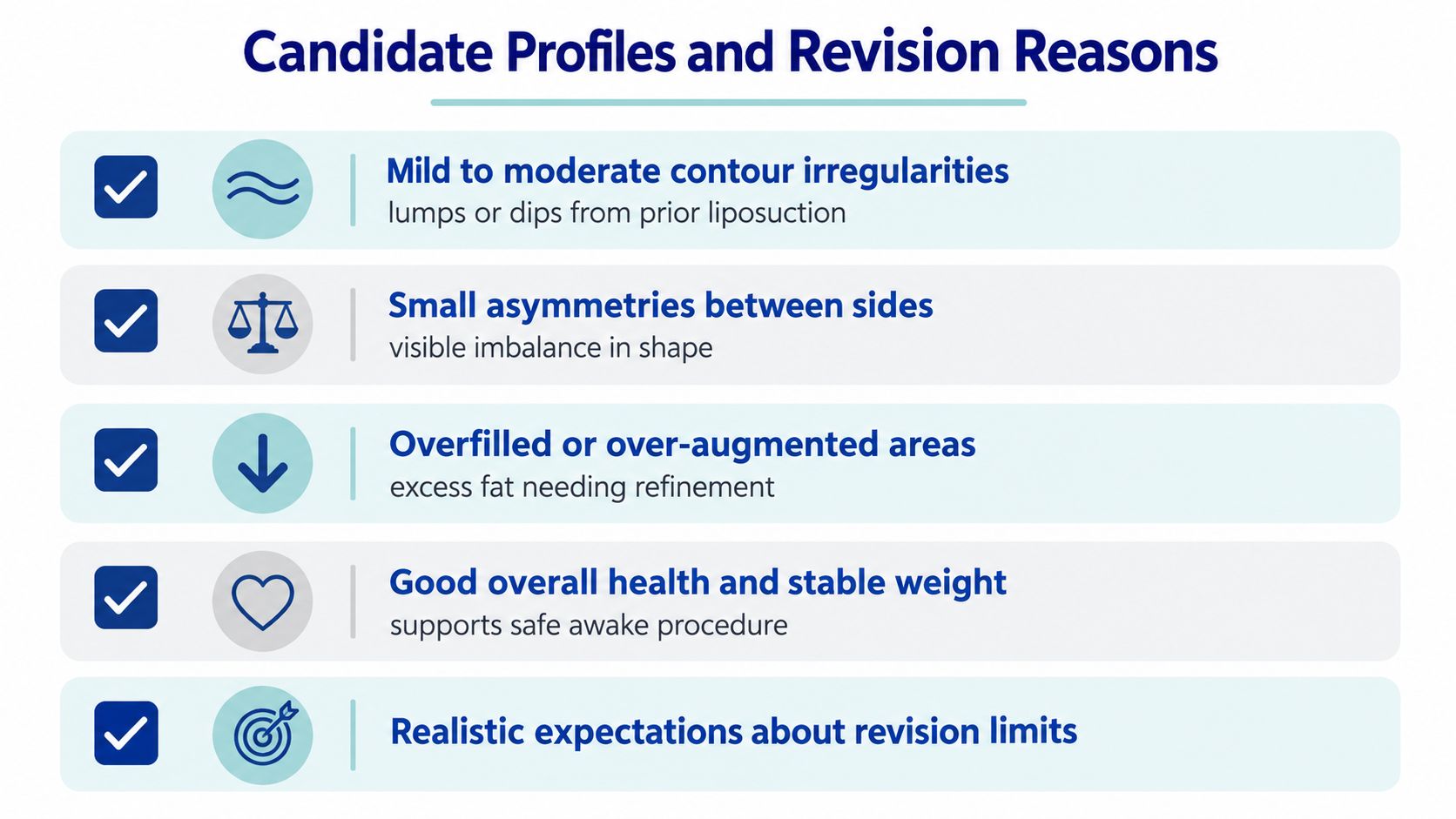
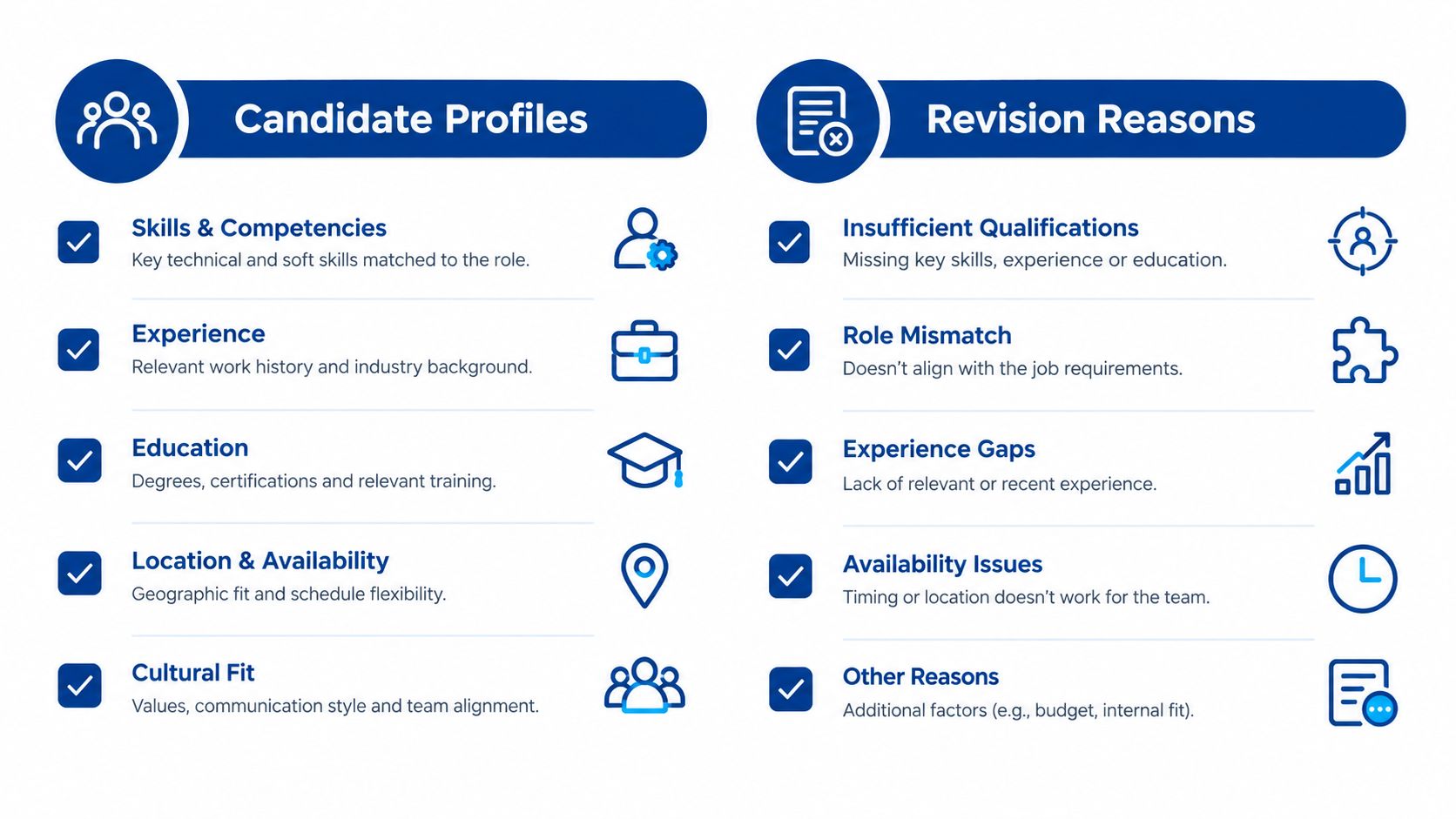
The most suitable candidate often has a specific, limited concern rather than a need to rebuild the entire buttock. Examples include a residual fat pocket near the lower back, a visible difference between the two sides, or a small overfilled area that disrupts clothing fit. Stable health, stable weight, and realistic expectations are just as important as the contour itself.
Common reasons patients seek correction
A patient may feel a firm, palpable area where transferred fat didn't settle evenly. Another may notice a shallow indentation caused by uneven harvesting or by a scar tethering the skin. Someone else may like the overall projection but dislike excess fullness at the outer buttock or the transition between the waist and hip.
A 2022 registry study recorded measurable buttock fat-grafting complications that can become revision triggers: palpable mass in 1.33% of cases, fat necrosis in 1.02%, infection in 1.12%, wound-healing issues in 0.92%, and seroma in 1.84% (registry data on buttock fat-grafting complications). Those figures don't describe every reason for revision, and dissatisfaction can occur without a medical complication.
Why prior surgery changes the decision
Scar tissue behaves differently from untreated fat. It can make dissection less predictable, tether the skin, and blur the boundary between tissue planes. Altered vascularity can also affect how safely the surgeon identifies and treats a problem area.
For that reason, the consultation should examine more than photographs. The surgeon may assess the skin while you stand and move, feel for firm areas, review operative records, and determine whether the concern is caused by residual adiposity, transferred fat, scar tissue, or lax skin.
A useful candidate profile
An appropriate candidate may have:
- A defined contour problem: The concern can be located and described, such as a small asymmetry or isolated fullness.
- Adequate health for local anesthesia: Medical conditions, medications, prior anesthesia experiences, and healing risks need review.
- Reasonable expectations: Revision can improve proportion and smooth transitions, but it can't always erase every irregularity.
- An appropriate tissue plane: The surgeon must be able to perform the correction without creating an unsafe deep injection or overly aggressive dissection.
Patient comfort preferences can influence the discussion, but comfort alone doesn't determine candidacy. A surgeon should recommend awake revision only when the anatomy and scope support it.
Real World Examples of Awake Revision
A patient with subtle asymmetry may notice that the right buttock looks rounder from the side while the left appears flatter from behind. During evaluation, the surgeon identifies a small excess area on one side and a shallow deficiency on the other. With the patient standing and then contracting the muscles, the team can compare the two sides as the contour changes.
The revision plan may involve focused liposuction from the fuller area, processing a limited amount of usable fat, and placing it subcutaneously where the depression remains. The patient's feedback helps the surgeon judge whether the correction feels balanced in different positions. The postoperative goal isn't a new silhouette. It's a smoother relationship between the existing curves.
A successful revision often looks less like adding volume and more like correcting a distracting transition.
A second patient has several small bumps after a traditional BBL. Some are soft residual fat pockets, while others feel firm because of scar tissue or fat necrosis. The surgeon first distinguishes what can be safely reduced from what should be observed or medically evaluated.
During awake contouring, the patient can communicate pressure and reposition as requested. The surgeon checks the surface while the patient stands and sits, refining the areas that remain visibly uneven. Recovery then focuses on protecting the treated tissues, monitoring swelling, and allowing the final contour to settle before judging the result.
These examples illustrate why no single revision plan fits everyone. A correction that works for a small asymmetry may be inappropriate for severe skin laxity, a large volume reduction, infection, or a deep structural problem. The patient's priorities and the tissue findings must guide the choice.
Surgical Techniques and Anesthesia Practices
Awake BBL revision follows a controlled sequence. The team maps the contour, numbs the treatment area, reshapes selected tissue, and checks the result while the patient can respond. Office-based protocols often make that feedback part of the safety process, rather than treating the body as a fixed image on a table.
Step one, map the contour
The surgeon begins with the patient standing and marks excess fullness, depressions, scar bands, and asymmetry. These marks should reflect the patient's actual concern, not a standard body-contouring template. Photographs, posture changes, and muscle contraction help document how the shape behaves in daily positions.
A dip that appears while standing may soften when the patient sits. A fullness that seems minor at rest may become more visible when the muscles contract. Mapping captures those changes before treatment begins.
Step two, create local anesthesia
Tumescent local anesthesia places diluted anesthetic solution into the treatment area. The fluid expands the subcutaneous space, reduces discomfort, and helps separate fat from nearby structures during aspiration. Oral sedation may ease anxiety while preserving the patient's ability to communicate.
The feasibility of awake techniques for selected revision cases has already been documented in the earlier discussion. The practical focus here is control. The surgeon adjusts the anesthetic plan to the treatment area, the expected amount of correction, and the patient's response. A backup plan remains necessary if comfort becomes inadequate or the procedure proves more extensive than expected.
Patients can review the general principles of plastic surgery under local anesthesia before the consultation.
Step three, release and sculpt carefully
PRECISION SCULPT laser-assisted liposuction may loosen and remove targeted fat. Revision tissue requires restraint because firmness does not always mean removable fat. A lump may be scar tissue or fat necrosis, and removing it aggressively can create a hollow or worsen tethering.
The surgeon may use larger blunt cannulas and a controlled path through the subcutaneous layer. The aim is a gradual transition, similar to sanding the edge of a repair so it blends with the surrounding surface instead of creating another groove.
Step four, process and place fat safely
If a depression needs volume, harvested fat can be prepared for grafting. Current safety guidance emphasizes subcutaneous-only placement, larger blunt cannulas, and retrograde deposition while the cannula moves. These measures keep the graft in the intended layer and reduce the chance of entering muscle or nearby vascular structures.
Ultrasound may help the surgeon see the cannula and confirm its tissue plane. That visual check matters in revision surgery, where scar tissue and altered fat planes can make the anatomy less predictable.
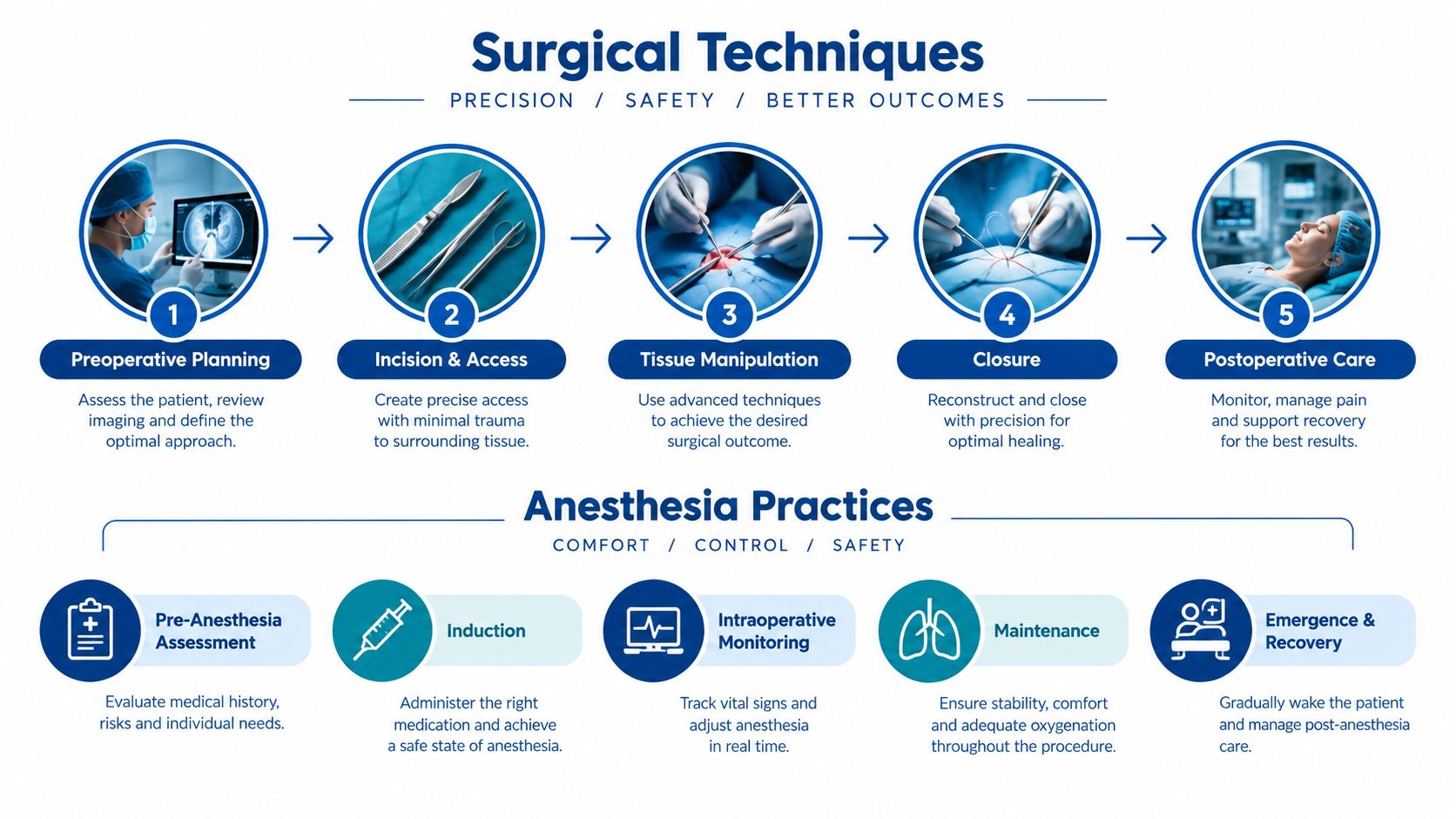
Step five, check the result dynamically
The patient may stand, sit, or contract the muscles while the surgeon evaluates symmetry. This creates a live comparison between the planned correction and the way the contour behaves under movement. A small amount of additional sculpting may improve the transition, while another area may already look balanced once posture and swelling are considered.
The patient also reports comfort and pressure during the procedure. That feedback does not determine where fat is placed, but it helps the team adjust positioning, assess sensations, and identify how the treated area functions in normal positions. A static photograph shows one frame. Awake revision can provide several views while the correction is being made.
Risks and Known Complications
A patient may feel comfortable, stand, and see the contour during awake BBL revision, yet the procedure still carries medical risks. Local anesthesia avoids some general-anesthesia concerns, but medication reactions, incomplete comfort, excessive dosing, and monitoring requirements remain. Previous surgery can make the anatomy less predictable because scars and altered blood vessels change how tissue responds.
The most serious BBL-specific concern is pulmonary fat embolism. Safety therefore depends heavily on where grafted fat is placed. Because intramuscular placement carries a substantially higher complication risk, the injection plane is the single most important safety decision in revision grafting. Conservative correction is safer than pursuing depth or volume that the tissue cannot accommodate. The earlier review of injection-plane safety supports this practical principle.
What large series can tell us
A large 7,000-patient Brazilian butt lift series found that secondary procedures represented 3% of cases, while revision surgery specifically was required in 0.21%. It also reported seroma in 23%, anemia in 6.6%, fat necrosis in 1.9%, infection in 0.43%, hematoma in 0.14%, and asymmetry in 0.29% (large BBL series and revision data). These figures show that revision may address a residual contour concern rather than a major complication. They describe a group, not an individual patient's forecast.
| Outcome | Rate |
|---|---|
| Secondary procedures | 3% |
| Seroma | 23% |
| Fat necrosis | 1.9% |
| Infection | 0.43% |
| Hematoma | 0.14% |
| Asymmetry | 0.29% |
How safety is managed
The surgeon should set a conservative plan, keep any grafting in the subcutaneous plane, and consider ultrasound guidance. Larger blunt cannulas and retrograde deposition help control delivery as the cannula moves. In an office-based protocol, awake feedback adds another safety check: pressure, discomfort, posture, and muscle movement can reveal how the treated area behaves while correction is underway. That information supports measured adjustments, while monitoring and dosing remain the team's responsibility.
After surgery, the team should explain warning signs such as worsening pain, drainage, fever, shortness of breath, or sudden changes that need prompt attention. Ask Dr. Justin Yovino's team how it assesses scar tissue, which corrections are appropriate while awake, when a traditional operating-room setting would be safer, and how postoperative concerns are handled.
Planning Consultation and Recovery Timeline
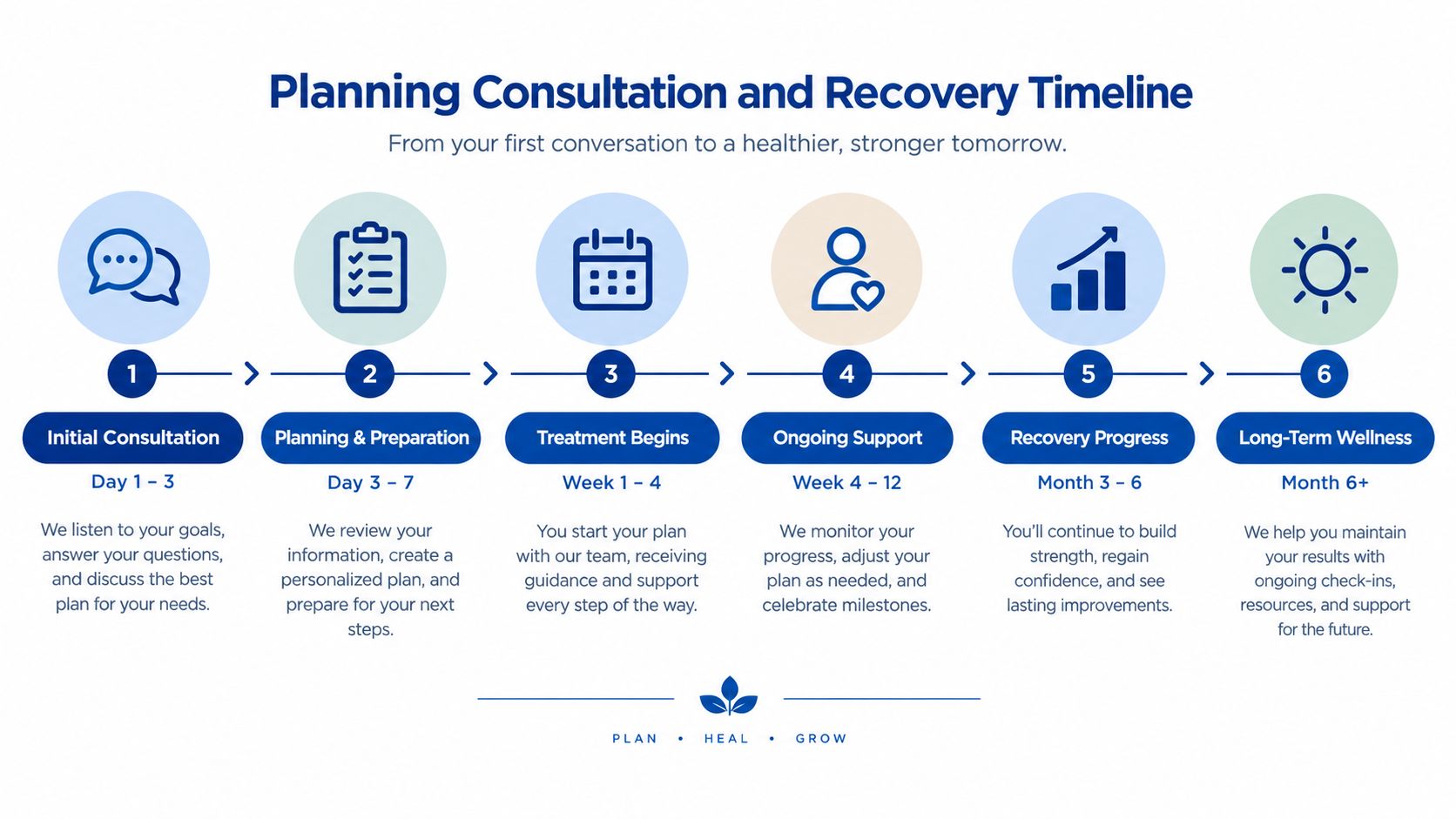
A productive consultation turns a vague complaint into a defined problem. Bring photographs from before and after the original BBL if you have them, along with the operative report, a list of medications, allergies, medical conditions, and any history of anesthesia difficulty. Describe what bothers you in practical terms, such as “the left side looks flatter when I sit” or “this area feels firm and catches on clothing.”
Questions to bring
Use the appointment to clarify:
- The diagnosis: Is the issue excess fat, fat necrosis, scar tethering, skin laxity, asymmetry, or a combination?
- The proposed scope: Which areas will be treated, and which concerns won't be changed?
- The anesthesia plan: What local anesthetic and oral sedation approach will be used, and how will comfort be monitored?
- The safety plan: Will ultrasound guidance be used if fat is grafted, and will placement remain subcutaneous?
- The recovery plan: How will sitting, sleeping, compression, bathing, exercise, and follow-up be managed?
- The alternatives: Would observation, non-surgical contouring, delayed revision, or a traditional surgical setting better match the problem?
A patient intake coordinator can help organize medical records, photographs, forms, and consultation questions before the appointment. That type of administrative support may be useful if you want to arrive with a clear history and a complete list of concerns, and you can learn what a patient intake coordinator typically handles.
What recovery may involve
Recovery varies with the amount of liposuction, whether fat is grafted, the number of treated areas, and your healing response. Early swelling can make the contour look uneven before the tissues settle, so the first impression isn't the final result.
Your surgeon may provide compression instructions for the liposuction areas while avoiding pressure on newly grafted buttock tissue. Sitting and sleeping positions may be limited for a period, and strenuous exercise should wait until the treating team confirms that the tissues are ready. Follow-up visits let the surgeon distinguish ordinary swelling from a seroma, infection, wound concern, or contour issue.
For broader guidance on the healing process, review fat transfer to buttocks recovery.
Why plane selection affects healing
The injection plane affects both safety and recovery. The available review data report a 4% complication rate for subcutaneous-only grafting versus 28.7% when any intramuscular injection was used (evidence on subcutaneous-only grafting). That doesn't mean every subcutaneous procedure heals quickly or without problems, but it explains why a conservative plane is central to planning.
Costs vary by the extent of correction, the number of areas treated, and whether additional procedures are needed. A consultation should provide the specific financial information after the surgeon has determined what treatment is medically and technically appropriate.
One final planning point matters: Ideal Face & Body no longer offers breast implant placement, implant-based breast augmentation, or breast implant revision procedures. Its awake BBL revision discussion is focused on selected buttock contour concerns and does not extend to implant-based breast procedures.
Conclusion and Next Steps
Awake BBL revision can be a thoughtful option when the concern is localized and the patient is a good candidate for local anesthesia. Its distinctive benefit is dynamic evaluation. Standing, sitting, and contracting the muscles can show the surgeon how a contour behaves in real life, not only while the patient lies still.
The safety discussion is equally important. Evidence supports subcutaneous-only fat placement, conservative correction, blunt cannulas, retrograde deposition, and ultrasound guidance when grafting is performed. Prior scar tissue and altered planes still matter, so an awake approach should be recommended after an individual examination rather than selected only for convenience.
Dr. Sarah Yovino or Dr. Justin Yovino can discuss whether your concern is better addressed with focused liposuction, limited fat grafting, observation, or another revision pathway at the Beverly Hills, CA practice. Bring your records, describe the positions in which you notice the problem, and ask for a clear explanation of what awake revision can and cannot change.
Ideal Face & Body offers selected office-based body-contouring and awake BBL revision procedures under local anesthesia, with planning centered on contour goals, dynamic assessment, and patient safety. Visit Ideal Face & Body to review the practice's services and request a consultation with Dr. Sarah Yovino or Dr. Justin Yovino.