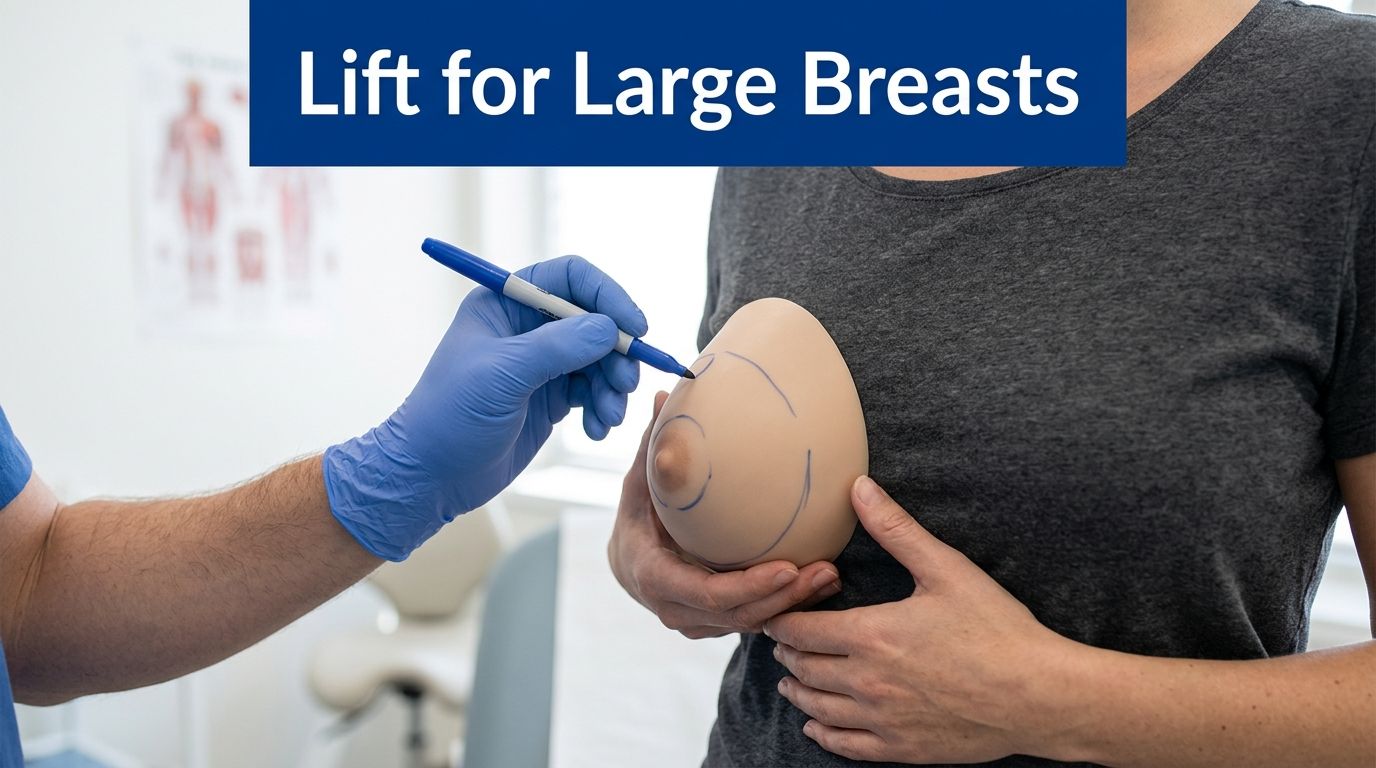
For very large breasts, a standard skin-tightening lift often isn't enough. The decision usually turns on either reducing the breast's weight or adding stronger internal structural support, and an Awake Breast Lift may offer an office-based alternative for appropriate patients.
You may be searching for breast lift for large breasts after months or years of neck strain, shoulder grooves, back discomfort, or difficulty finding supportive clothing. Perhaps you like your overall breast volume but dislike how low the breasts sit. Or perhaps you want relief from the weight as much as you want a higher nipple position.
Those are different problems, and they don't always have the same surgical answer. A mastopexy can raise and reshape the breast, but a breast reduction removes tissue that continues to pull downward. The right plan depends on whether your main concern is position, weight, or both.
Table of Contents
- Understanding the Challenge of Large Breasts
- Lift vs Reduction Deciding the Right Procedure
- Surgical Techniques and Incision Patterns
- The Awake Breast Lift and Office-Based Surgery
- Risks, Complications, and Patient Factors
- Long-Term Outcomes and Scarring Realities
- Consultation Checklist and Questions to Ask
- Conclusion and Next Steps
Understanding the Challenge of Large Breasts
By the end of a long day, a heavy breast can feel less like a cosmetic feature and more like a load attached to the front of the body. Bra straps may press into the shoulders, the skin beneath the breasts may become irritated, and you may unconsciously round your shoulders to compensate. A practical bra fit checklist for large breasts can help identify whether your current support is contributing to discomfort, but better bra fit won't remove the underlying tissue weight.
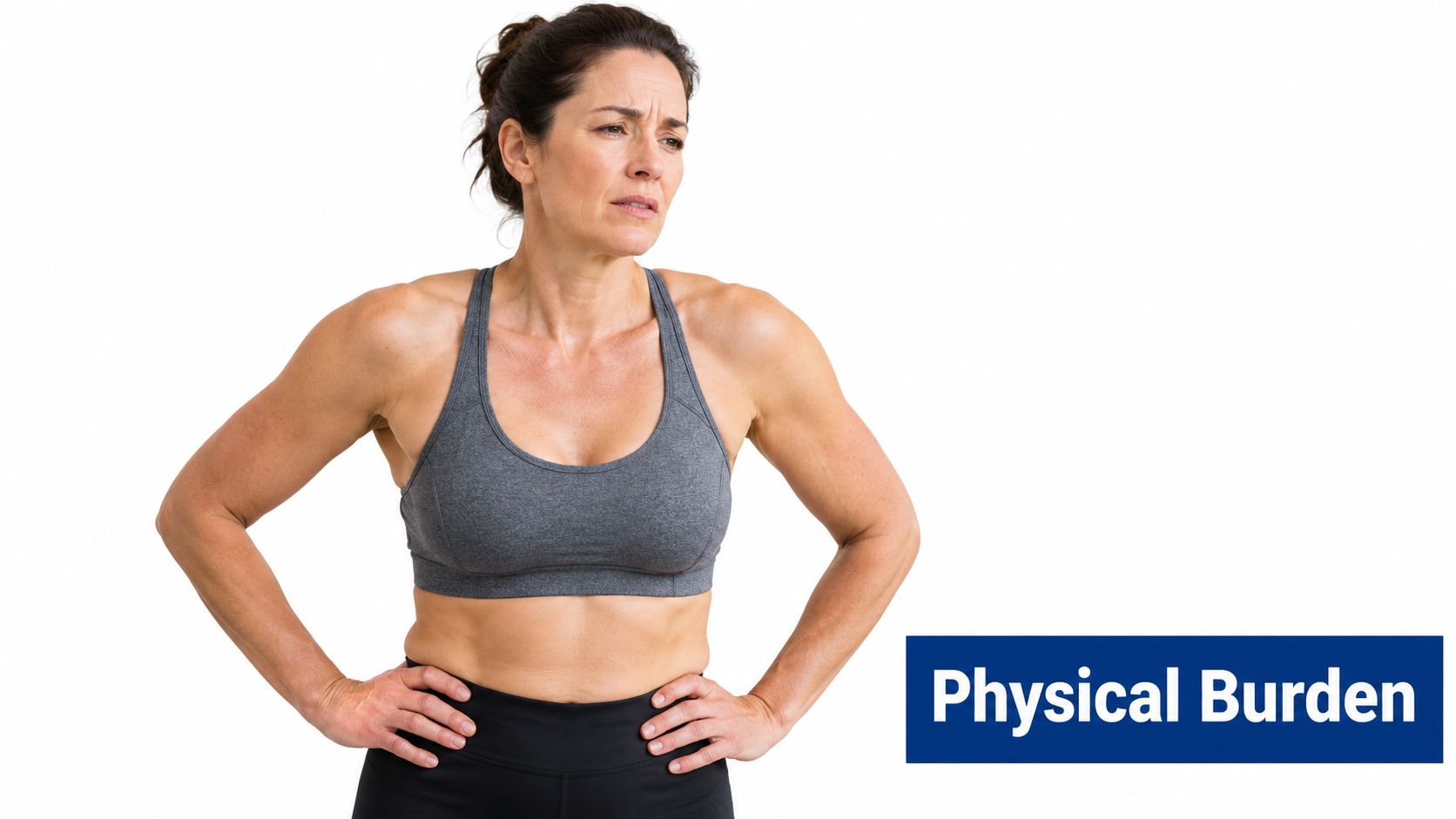
Macromastia, or excessive breast volume that creates physical or emotional burden, isn't defined by a single breast size alone. A PubMed-indexed study found significant improvement in every analyzed macromastia-related symptom and quality-of-life factor after reduction mammoplasty, with improvement that didn't differ significantly among four breast-size groups (study findings). That supports a symptom-based conversation rather than a rigid size threshold.
Gravity changes the surgical problem
With smaller or moderately sized breasts, a lift may focus mainly on removing loose skin and repositioning the breast mound. With very large breasts, the glandular and fatty tissue itself becomes an active downward force. Tightening the outer envelope without addressing that force can leave the internal load largely unchanged.
That distinction separates aesthetic ptosis, meaning drooping or low breast position, from functional hypertrophy, meaning breast volume that contributes to discomfort and physical limitation. You may have one, the other, or both.
Practical rule: A higher nipple position isn't the same as a lighter breast. Your consultation should address both goals separately.
The meaningful endpoint isn't just a breast that looks higher immediately after surgery. It's a result that balances comfort, shape, nipple safety, sensation, scar length, and the likelihood of recurrent descent. That requires examining the breast's weight, skin quality, nipple position, lower-pole length, and the amount of tissue that would need to be repositioned or removed.
Lift vs Reduction Deciding the Right Procedure
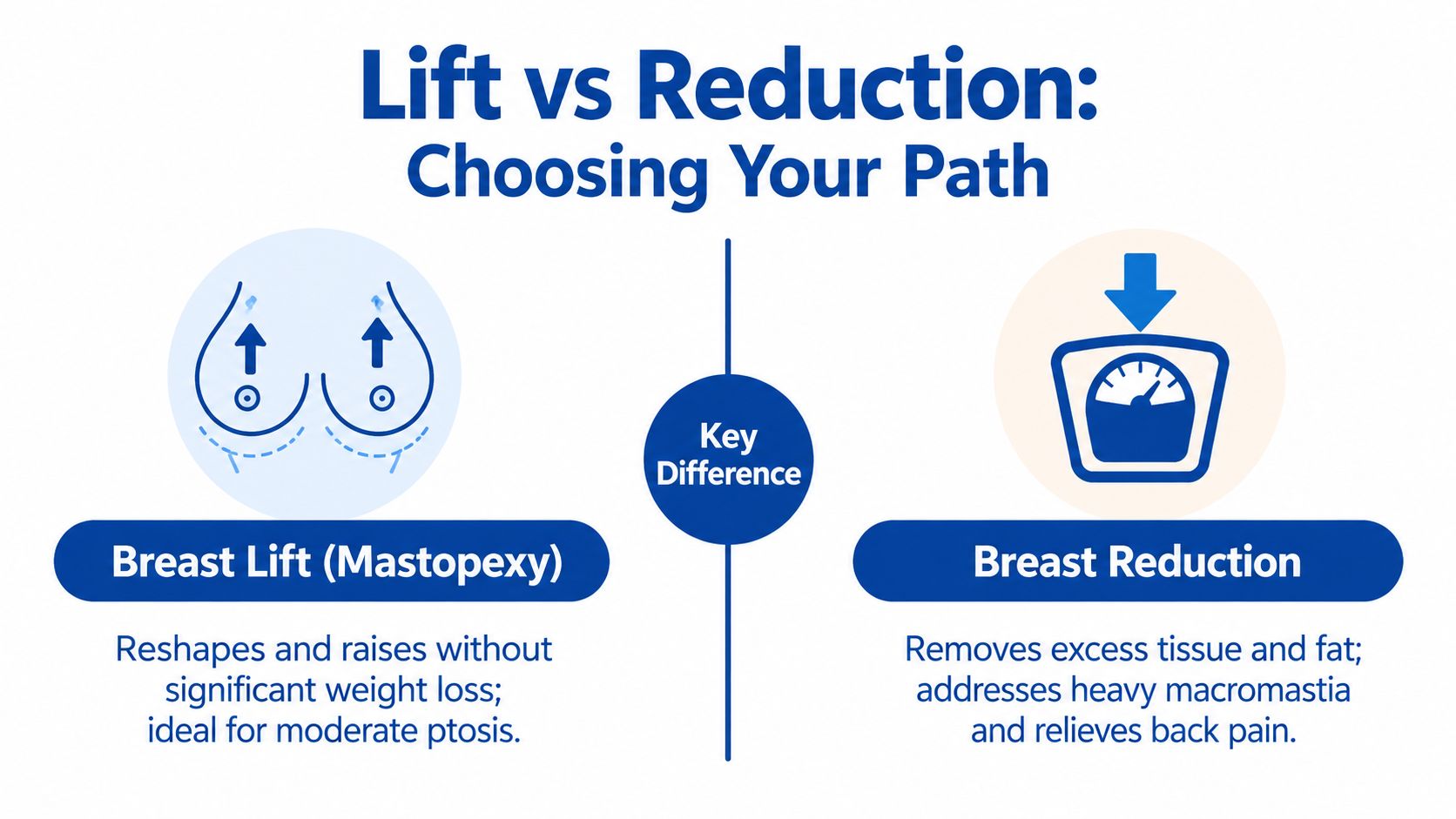
A breast lift, or mastopexy, primarily changes position and shape. It removes excess skin, reshapes the breast mound, and raises the nipple–areola complex, but it doesn't significantly reduce breast volume. The American Society of Plastic Surgeons describes combining mastopexy with reduction when a patient wants both elevation and a smaller, lighter breast.
A breast reduction adds a different objective. The surgeon removes selected glandular and fatty tissue, reduces the downward load, and then lifts and reshapes the remaining breast. In that sense, reduction and lifting often work together rather than compete.
What each operation is designed to do
| Procedure | Primary change | Often fits a patient who |
|---|---|---|
| Mastopexy | Raises and reshapes existing tissue while removing excess skin | Likes the current volume but wants improved position |
| Reduction mammoplasty | Removes tissue and fat, then lifts and reshapes the breast | Wants relief from weight, symptoms, or excessive lower-pole volume |
| Lift with reduction | Combines elevation, reshaping, and volume reduction | Has substantial drooping and wants a smaller, more supported breast |
A lift alone may be mechanically insufficient when stretched skin and heavy tissue continue pulling on the lower pole. In a seven-year retrospective study of gigantomastia-level cases, each procedure removed more than 1,000 grams per breast. Mean resections were approximately 1,311 grams on the right and 1,289 grams on the left, with an overall complication rate of 14.5% and a secondary revision rate of 12.7% (retrospective study).
Those figures don't predict your personal result, and they come from a particularly demanding group. They do show why a skin-only operation may not match the anatomy of very large breasts.
A symptom-focused decision
If your priority is preserving most of your volume, a lift with structural reshaping may be worth discussing. If your main complaint is shoulder, neck, or back burden, reduction deserves serious consideration. In a 12-year review, back pain affected 80% of participants before reduction, shoulder grooving affected 49%, and 78.6% reported that preoperative symptoms were completely or mostly resolved afterward (long-term reduction review).
The choice isn't just “lift or reduction.” It's a conversation about how much weight should remain, how high the nipple can safely move, and which trade-offs matter most to you.
Surgical Techniques and Incision Patterns
A large breast can look lifted after the skin is tightened, yet still feel heavy if the deeper tissue remains unsupported. The operation therefore involves more than choosing a scar. The surgeon must reshape the breast mound, protect blood flow to the nipple, and give the lower pole a structure that can carry its remaining weight.
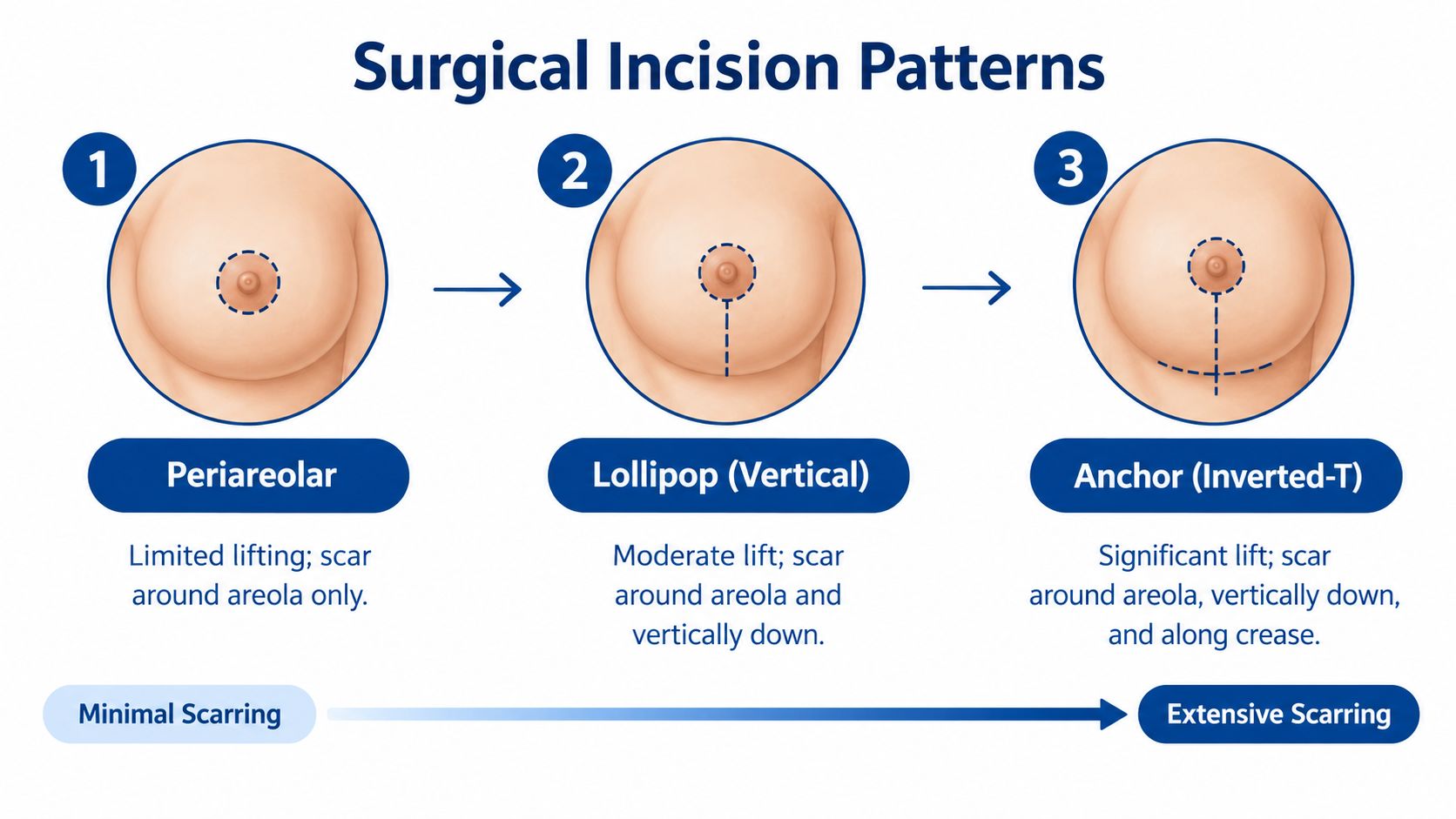
Choosing the incision pattern
The incision reflects how much skin must be removed and how much internal reshaping is needed.
- Periareolar pattern: The incision circles the areola. It may suit a limited lift, but gives less control when the lower breast carries substantial excess skin or weight.
- Vertical, or lollipop, pattern: The incision circles the areola and continues downward. It permits more reshaping than a periareolar approach while avoiding an incision along the breast crease in selected patients.
- Inverted-T, or anchor, pattern: The incision circles the areola, extends vertically downward, and follows the breast crease. This provides broad access for removing skin, reducing tissue, and reshaping a long or heavy lower pole.
Very large breasts with severe ptosis often require an inverted-T design because the surgeon needs room to manage the lower pole. The pedicle, a tissue bridge carrying blood supply and nerves to the nipple–areola complex, must be chosen and shaped with care.
The internal scaffolding matters
Skin is the outer envelope. Breast tissue is the load inside it. Tightening only the envelope can leave the remaining weight pulling downward, much like placing a heavy object in a newly tightened bag. Parenchymal reshaping, pillar sutures, and fixation techniques can create a more stable internal mound.
A systematic review found that superior and superomedial pedicles generally provided better long-term stability against recurrent drooping than inferior pedicles. In studies using supportive pillar sutures, nipple-to-inframammary-fold elongation during follow-up ranged from a decrease of 0.4 centimeters to an increase of 1.4 centimeters, equivalent to approximately 3.9% to 20% change.
The review also summarized a retrospective analysis of 760 reduction or mastopexy patients. Complications occurred more often with inferior pedicles, at 50%, compared with 36% for superomedial pedicles and 26% for superior pedicles. Removing more than 650 grams per breast was an independent risk factor for complications.
Ask how the planned operation will support the breast internally after excess skin and weight are addressed. A standard lift may reposition the skin, while a carefully selected technique also addresses the tissue creating the downward force.
The Awake Breast Lift and Office-Based Surgery
An Awake Breast Lift uses local anesthesia, often with carefully controlled sedation, so the patient remains comfortable while the surgeon performs the procedure. “Awake” doesn't mean you should feel cutting or uncontrolled pain. It describes the anesthesia setting, not a requirement to endure discomfort.
For an appropriate candidate, an office-based approach may avoid general anesthesia and IV lines. That can appeal to patients who want a more direct recovery experience, but it doesn't make the operation biologically simple. A lift still involves incisions, tissue movement, blood-supply decisions, wound healing, and a period of swelling and activity restrictions.

Who may be a candidate
An office-based procedure may be considered when the planned operation, medical history, tissue characteristics, and expected duration fit the setting. The surgeon still needs to evaluate the breast volume, degree of drooping, nipple position, skin quality, anticipated tissue removal, and your ability to remain comfortable during the procedure.
The approach can include an implant-free mastopexy or a reduction plan when removing weight is necessary. For some patients with large, drooping breasts, the relevant option is an Awake Breast Lift with reduction, not a skin-only lift.
You can review how the office-based approach is described in this Awake Breast Lift guide, then use your consultation to ask whether your anatomy is suitable. The answer should be individualized rather than based on the label “awake” alone.
Convenience doesn't replace candid counseling
Avoiding general anesthesia may be one advantage for a suitable patient, but it doesn't eliminate wound separation, scar widening, asymmetry, delayed settling, nipple complications, or the possibility of revision. The setting also doesn't determine whether the internal support plan is strong enough for large breasts.
A careful surgeon should explain what can be done comfortably in the office, what cannot, and when a different surgical environment would be safer. Your priorities matter, but so do the limits imposed by breast weight, skin quality, and nipple blood supply.
Risks, Complications, and Patient Factors
A large breast can look lifted while still feeling heavy. A skin lift changes the outer envelope, but it may not sufficiently address the weight underneath. That distinction shapes both the procedure choice and the risk discussion. Breast size, tissue removal, skin tension, medical conditions, smoking, age, and the selected pedicle all influence healing and nipple blood supply.
A claims-data analysis compared 2,403 obese and 5,597 non-obese patients undergoing breast surgery. Among patients having breast reduction, 30-day complication claims occurred in 14.6% of obese patients compared with 1.7% of non-obese patients. Recorded problems included inflammation, infection, pain, and seroma or hematoma. The analysis also associated age above 50 with increased risk, with an odds ratio of 2.7 (a BCBS claims-data analysis of complications after breast surgery).
These figures do not predict an individual outcome. They show why a consultation must examine more than breast appearance. The surgeon should consider whether the plan lifts skin alone or also reduces and supports the tissue creating the downward pull. For suitable patients, an Awake Breast Lift may offer an office-based approach, but the setting does not remove the biological risks of surgery.
Factors worth reviewing before surgery
- Nicotine exposure: Smoking and nicotine can reduce blood flow and slow wound healing, especially when the nipple and skin flaps depend on carefully preserved circulation.
- Diabetes and medical conditions: Blood-sugar control and general health can affect recovery and infection risk.
- Weight stability: Major future weight changes can reshape the breast and place new stress on the skin envelope.
- Tissue removal: Larger resections create longer incisions and greater tension, particularly where the vertical and horizontal limbs meet.
- Nipple priorities: The plan should address nipple viability, sensation, position, and possible effects on breastfeeding.
A 2025 systematic review of staged breast reduction or mastopexy before nipple-sparing mastectomy included 11 studies, 288 patients, and 542 breasts. Nipple–areola complex necrosis occurred in 3.1% of breasts, while mastectomy skin-flap necrosis occurred in 2.4% (systematic review). These studies involve staged cancer-reconstruction pathways, not every standalone lift. They still show why blood supply deserves careful attention when breast size and drooping are substantial.
Long-Term Outcomes and Scarring Realities
A breast lift is a suspension, not a permanent escape from gravity. Even after excellent reshaping, the skin and supporting tissues continue to age, and pregnancy or substantial weight change can alter the result.
Scars also require realistic expectations. An anchor pattern creates more visible incision lines than a limited periareolar approach, but it may provide the control needed for a large, heavy breast. Scars usually mature and soften over time, yet they remain part of the operation. Larger breasts can place more tension on the incisions, especially at the lower-pole junction.
Durability is more than an early photograph
A fresh postoperative result can look high and firm before swelling resolves and the tissues settle. Long-term assessment asks different questions: Has the nipple remained appropriately positioned? Has the lower pole stretched? Has asymmetry become more apparent? Did the patient experience wound problems or need a minor revision?
Recurrent ptosis is recognized as a leading complication in mastopexy literature. One cited review reported a 13.12% cumulative complication rate and recurrent ptosis in 5.2% of cases (clinical reference). Those figures don't guarantee recurrence in an individual patient, but they reinforce why internal support and weight management deserve attention.
The recovery plan should include scar care, follow-up, support garments when recommended, and gradual return to activity. A detailed guide to recovery from breast lift and augmentation can help you prepare questions, even if your plan doesn't involve implants.
The most durable outcome may not be the highest possible breast. It may be a breast that sits better, feels lighter, maintains useful shape, and accepts a reasonable scar in exchange for improved comfort.
Consultation Checklist and Questions to Ask
Arrive with more than a preferred cup size or reference photograph. Describe what you want the operation to change: preserving most of your volume, reducing physical burden, improving nipple position, protecting sensation, maintaining breastfeeding potential, or limiting scar length. These priorities help distinguish a skin-lifting procedure from one that must also address the weight of the breast tissue.
Use the following questions to make the consultation concrete:
- Do I need a lift, a reduction, or both? Ask which concerns come from loose skin and which come from breast weight.
- How much tissue would you recommend removing? The answer should relate to your symptoms, proportions, nipple position, and the plan for maintaining blood supply.
- Which pedicle would you use, and why? Ask how the technique protects the nipple–areola complex while allowing the breast to be reshaped.
- How will you support the breast internally? The breast needs more than a tighter outer envelope when its tissue remains heavy. Ask about parenchymal reshaping, fixation, pillar sutures, or another structural method.
- Which incision pattern fits my anatomy? Discuss why a periareolar, vertical, or inverted-T design is recommended and where each scar will sit.
- Could an Awake Breast Lift or Awake reduction be appropriate for me? Ask about local anesthesia, sedation, comfort, monitoring, and the situations in which another surgical setting would be safer.
- What are my personal risks? Review nicotine use, body weight, age, diabetes, medications, previous surgery, skin quality, and any history of delayed healing.
- What happens if the breasts settle or become asymmetric? Ask how recurrence is assessed, when revision may be considered, and what follow-up is included.
Ask specifically how the operation could affect breastfeeding potential and nipple sensation. Breastfeeding after reduction may remain possible, but the outcome depends on the amount and location of tissue removed, the surgical technique, and your anatomy. Discuss your future pregnancy plans and whether preserving milk production is a priority.
Bring a written list, and ask the surgeon to explain the trade-offs in plain language. A useful consultation should leave you understanding not only the planned lift, but also how much weight will remain and what will support it over time.
Conclusion and Next Steps
Choosing a breast lift for large breasts starts with identifying the actual burden. If the issue is mainly drooping with acceptable volume, a lift with internal reshaping may fit. If weight drives your neck, shoulder, or back symptoms, reduction may be the more logical foundation. Many patients need both elevation and removal of excess tissue.
The Awake Breast Lift offers a modern office-based pathway for appropriate candidates, using local anesthesia and individualized tissue reshaping. It isn't automatically suitable for every large breast, and being awake doesn't remove the need for careful planning, realistic scar expectations, or honest risk counseling.
The decisive step is an examination with Dr. Justin Yovino or Dr. Sarah Yovino, where your breast weight, skin envelope, nipple position, symptoms, and priorities can be evaluated together. The right plan should leave you understanding not only how the breasts may look, but also how they'll be supported and how the result may behave over time.
Ideal Face & Body offers Awake Breast Lift and Awake Breast Reduction consultations for patients considering an office-based approach to large, drooping breasts. Visit Ideal Face & Body to learn about the available options and request a consultation customized to your anatomy and goals.