Visible microneedling improvement commonly lasts several months, roughly 3 to 6 months for texture and fine lines, with acne-scar remodeling detectable for 6 months or longer. Maintenance treatments every 6 to 12 months are a common approach to preserve results.
That answer is more useful than the popular advice that microneedling results last for one fixed period. If you've just booked a session, or you've noticed your initial glow beginning to fade, you probably want a simple number. The honest answer depends on what you're treating, how the skin was treated, how your skin responds, and whether you're discussing standard microneedling or radiofrequency microneedling.
The confusion usually comes from treating initial improvement, peak collagen remodeling, and long-term maintenance as if they were the same phase. Once you separate those stages, the timeline becomes much easier to understand.
Table of Contents
- How Long Do Microneedling Results Last
- Why Microneedling Results Build Over Time
- What to Expect From First Session to Peak Results
- Factors That Influence How Long Your Results Last
- How Technique and Adjuncts Change Longevity
- Your Maintenance Schedule and Touch-Up Timing
- Making Your Results Last Longer With Smart Habits
How Long Do Microneedling Results Last
The most useful answer is not a single number. Microneedling results pass through three different phases: initial improvement, peak collagen remodeling, and long-term maintenance. Treating them as one timeline makes early glow, later structural change, and eventual fading seem contradictory.
Standard microneedling may leave the skin looking fresher or smoother before deeper remodeling is complete. That first improvement is like seeing a room look better after cleaning, while the renovation underneath still needs time. Radiofrequency microneedling follows the same broad principle, but it also delivers heat beneath the surface. Its timeline and durability should therefore be discussed separately from standard microneedling, rather than compared as though both treatments were identical.
The practical answer
For texture and fine lines, noticeable improvement may remain evident for roughly 3 to 6 months. The change usually softens gradually as normal aging, sun exposure, and other influences affect the skin again, rather than disappearing on one exact day.
For atrophic acne scars, measurable improvement may remain present at 6 months or longer, and some remodeling can continue after the final session. That does not establish a permanent endpoint for every patient, treatment depth, or treatment plan. The review of microneedling for acne scars describes why results should be discussed as a range, not a guarantee.
Your first visible change is also not necessarily your final outcome. Brightness and surface smoothness can appear while collagen is still reorganizing in the dermis. Conversely, a result that seems to fade may reflect unfinished remodeling rather than treatment failure.
A review around 3 to 6 months after a treatment series often gives a more meaningful picture than an assessment made as soon as redness settles. Your practitioner can then separate the early response from the peak result and discuss whether maintenance is appropriate.
The result you see today is a snapshot. The collagen your skin builds over the following months is part of the treatment outcome.
Why Microneedling Results Build Over Time
Microneedling works by creating controlled micro-injuries rather than placing a temporary coating over the skin. Those tiny channels activate a wound-healing response, and the response continues after the surface looks calm.
Think of the skin as a renovation project. The initial disruption is relatively quick, but the rebuilding crew needs much longer to reinforce the underlying structure. Redness may settle while the deeper work is only getting started.
The rebuilding process
A fibronectin matrix forms approximately 5 days after controlled injury and helps organize later collagen deposition. Early in the process, the skin produces more collagen type III. Over approximately a year or longer, that early collagen is gradually replaced by stronger, more organized collagen type I. The clinical reference on microneedling wound healing describes this progressive remodeling process and explains why structural changes can remain visible long after surface healing.
That sequence matters because patients often use the end of redness as the end of treatment. It isn't. Surface healing and collagen remodeling are separate events. The first tells you the skin is recovering from the controlled injury. The second determines how texture, fine lines, and scar depressions continue to change.
A histologic acne-scar study found that collagen type I increased from 67.1% before treatment to 70.4% one month afterward, then to 78.2% three months afterward. The delayed rise helps explain why a patient may see continued improvement after the last appointment. The histologic study of collagen remodeling supports evaluating the durable result after the skin has had time to reorganize its collagen.
Why the early glow can mislead you
Some changes appear before the deeper remodeling is complete. The skin may look fresher, feel smoother, or appear more even, but those early signs don't tell you exactly how much collagen-based improvement will develop later.
After four microneedling sessions spaced one month apart, collagen and elastin deposition increased by 400% at the six-month assessment, with structural changes still observed at one year. That finding comes from a specific treatment protocol, so it shouldn't be treated as a promise for every patient. It does show why “the treatment is over” and “the result is finished” are not interchangeable statements.
You can learn more about the treatment principles in this guide to the benefits of microneedling. The central idea is simple: the surface recovers first, while the skin's internal support network keeps developing.
What to Expect From First Session to Peak Results
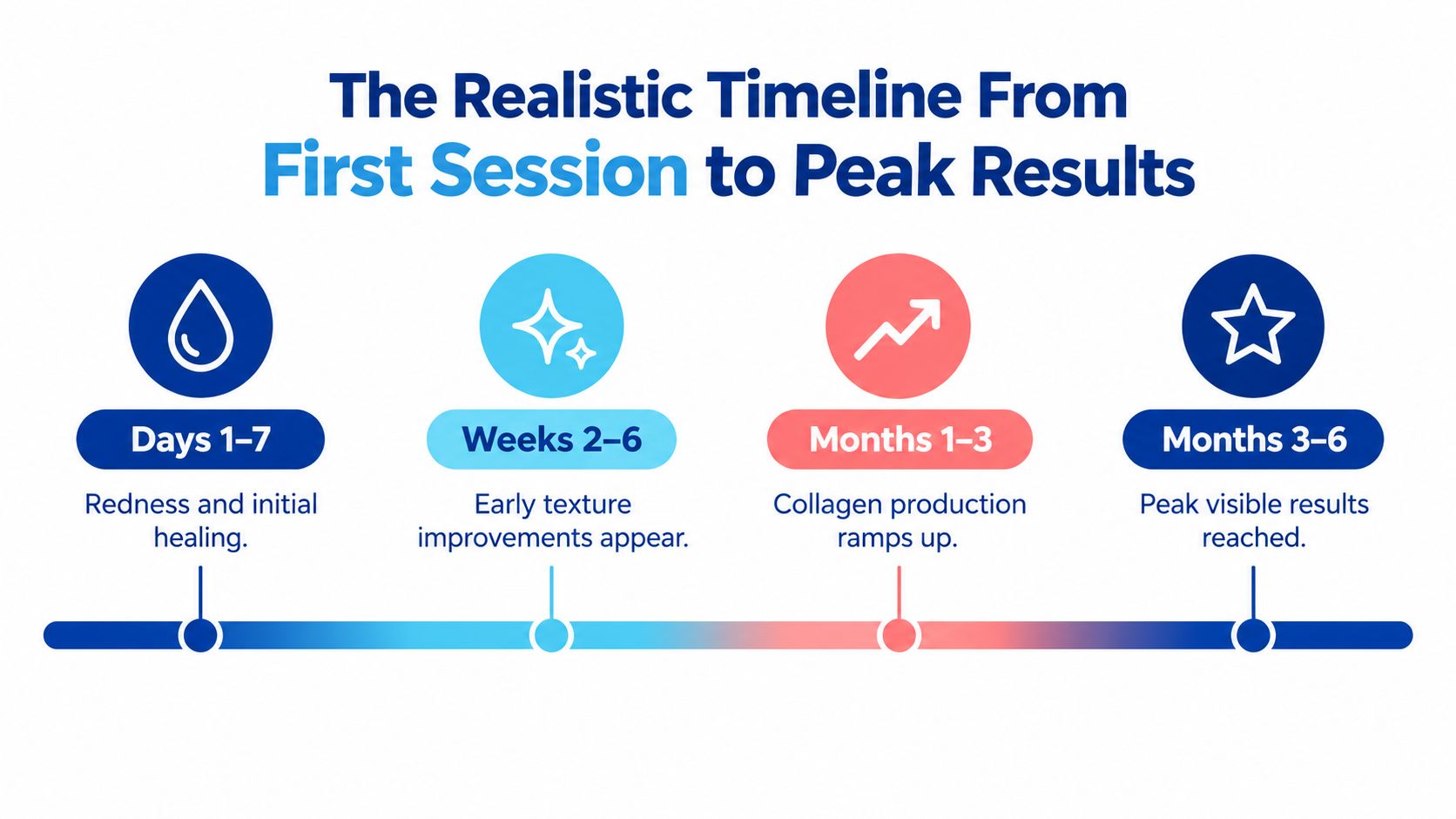
A microneedling result does not arrive as one finished event. It develops in four practical phases. The boundaries overlap, but the sequence helps explain why an early change, a peak result, and a maintenance result should not be treated as the same thing.
Days 1 to 7
The first phase centres on initial healing. Redness, warmth, tightness, and temporary sensitivity may appear while the skin settles after the controlled injury. By the end of this period, you can judge how the surface is recovering, not how long the eventual improvement will last.
Do not use the first week to score the treatment. A calmer surface means healing is progressing. It does not show that deeper structural changes have finished.
Weeks 2 to 6
Early texture changes may become easier to notice during these weeks. Skin can feel smoother or more refined, while the collagen response continues beneath the surface. Modest improvement at this point does not mean the result has reached a plateau.
The gap before another appointment also matters. Skin needs time to recover and respond before another treatment adds a new stimulus. Your practitioner should weigh the treatment goal, needle depth, visible response, and any ongoing inflammation before setting the next appointment.
Months 1 to 3
This phase is often more informative because structural improvement has had longer to develop. In a prospective facial rejuvenation study using four microneedling treatments, dermal density increased 101.86% from baseline at three months, epidermal density increased 19.28%, and collagen type III and elastin gene expression were significantly higher at that assessment. The prospective facial rejuvenation study reported improved skin density and elasticity through the three-month post-treatment assessment.
Those findings describe one study protocol, not a guaranteed schedule for every face. They show why the first visible change should be viewed as an early checkpoint rather than the finished outcome.
Months 3 to 6
For many patients, this is the most useful window for evaluating visible results. Texture and fine-line changes may be clearer, while atrophic acne scars can continue to change after the final appointment.
In one randomized, split-face, placebo-controlled trial, 20 patients received three sessions over 5 weeks for atrophic acne scars. Assessments at 3 and 6 months found continued improvement in scar appearance compared with the control side. The systematic review discussing this trial, The systematic review discussing this trial, provides the relevant follow-up context.
| Treatment Focus | Typical Series | Documented Follow-Up | What Was Measured |
|---|---|---|---|
| Facial rejuvenation | Four microneedling treatments | Three months after treatment | Dermal density, epidermal density, collagen type III, and elastin expression |
| Atrophic acne scars | Three sessions over 5 weeks | Three and six months | Scar appearance compared with the control side |
| General microneedling remodeling | Protocols varied across studies | Approximately 18 weeks to 8 months | Texture, scars, collagen remodeling, and other outcome measures |
The evidence supports a 3-to-6-month assessment window more strongly than any promise of permanence. These checkpoints describe standard microneedling. Radiofrequency microneedling uses a different treatment approach, so its recovery and result timelines should not be compared as though they were interchangeable.
Factors That Influence How Long Your Results Last
A single duration estimate cannot describe every microneedling result. The starting concern, your skin's biology, the treatment plan, and what happens afterward all influence how long improvement remains visible. Collagen remodeling works more like repairing a structure over time than applying a temporary surface coating.
The condition being treated
A fresh glow and an atrophic scar involve different kinds of change. Glow and mild texture improvement may soften gradually as skin continues to age. Scar treatment addresses a deeper structural depression, so improvement may keep developing for longer, although aging, inflammation, and environmental stress can still affect the appearance.
A treated scar can improve without becoming permanently protected from new acne or future skin changes. Learn more about whether microneedling results are permanent for acne scars and how recurrence affects longevity.
Skin biology and age
Your ability to repair tissue and maintain collagen affects both the pace and persistence of remodeling. Age, baseline skin quality, skin type, inflammation, and the severity of the concern all shape the response. These factors cannot be controlled completely, so a treatment schedule should be personalized rather than copied from another patient.
Treatment depth and number of sessions
A shallow protocol and a deeper, scar-focused protocol create different levels of controlled injury. Published studies have used needle depths from 0.25 to 3.5 mm, two to twelve sessions, and intervals ranging from two weeks to one month. The systematic review of microneedling protocols shows why no single duration figure applies reliably to every protocol.
More treatment does not automatically produce a longer-lasting result. The appropriate depth and number of sessions depend on the goal, treatment area, skin sensitivity, and how well your skin recovers between appointments.
Sun exposure
Ultraviolet exposure can speed collagen breakdown and contribute to new texture changes or pigmentation. Continued unprotected exposure works against the remodeling you are trying to preserve. Daily photoprotection gives the skin a better chance of maintaining its improvement.
Smoking and inflammation
Smoking can interfere with tissue repair, while ongoing inflammation can make healing less predictable. Active acne, irritation, or another inflammatory condition may need attention before a practitioner chooses more aggressive remodeling. Treating the trigger supports a more dependable outcome.
Acne recurrence and weight change
Recurrent acne can create new inflammation and new scars, even where an earlier scar improved. Weight change may also alter the appearance of laxity or texture in stretched skin. The visible result can therefore change even when some remodeled collagen remains.
Your personal self-check
Separate factors you can influence from those you cannot:
- You can control: sun protection, smoking, skincare consistency, acne management, and aftercare.
- You can't fully control: age, skin biology, skin type, starting scar severity, and the natural pace of collagen turnover.
- You can discuss: treatment depth, session number, spacing, and whether standard or radiofrequency microneedling suits your goal.
This distinction keeps maintenance from feeling like failure. Skin continues to change, so preserving improvement requires a plan that can change with it.
How Technique and Adjuncts Change Longevity
The word microneedling describes more than one approach. Standard mechanical microneedling uses needle penetration to trigger remodeling. Radiofrequency microneedling adds delivered heat energy, which changes the treatment mechanism and means its durability data shouldn't automatically be applied to conventional microneedling.
PRP may also be used as an adjunct in some treatment plans. Its role should be discussed in relation to your skin concern, medical history, and practitioner's protocol rather than treated as proof that every result will last longer.
Comparing the approaches
| Approach | Main action | How to interpret durability evidence |
|---|---|---|
| Standard mechanical microneedling | Controlled needle injury stimulates wound healing and collagen remodeling | Expect gradual improvement over weeks to months, with longevity influenced by the concern and protocol |
| Microneedling with PRP | Mechanical microneedling combined with an adjunctive biologic preparation | Results depend on the complete treatment plan and shouldn't be assigned a universal duration |
| Radiofrequency microneedling | Needle penetration combined with radiofrequency energy | Published studies support improvement through roughly six months, with some follow-up extending to twelve months, but this isn't the same as standard microneedling |
The strongest durability evidence for radiofrequency microneedling supports effects lasting approximately 6 to 12 months, while also emphasizing uncertainty beyond that period. The review of radiofrequency microneedling for facial rejuvenation notes that most studies evaluated patients at three to six months and that longer-term evidence remains limited.
A prospective facial radiofrequency study used 1 to 3 sessions spaced 6 to 8 weeks apart. At six months after the final session, imaging showed mean wrinkle reductions of 25.3% in the infraorbital area and 37.3% around the crow's-feet region. The facial radiofrequency microneedling study shows both measurable persistence and variation by facial area.
Supporting the remodeling process
Medical-grade skincare can help protect the skin while it remodels, especially when products are chosen around sensitivity and recovery. Hydration, barrier support, and disciplined photoprotection are more useful than adding aggressive ingredients without guidance.
If you're exploring topical support, this educational resource on stem cell serums for microneedling from Skin Perfection offers background for discussing adjunctive skincare with a qualified practitioner. The product choice should remain secondary to safe technique, correct treatment selection, and appropriate aftercare.
For patients considering an approach that combines microneedling and PRP, microneedling PRP treatment is one treatment category to discuss during consultation. The key is to compare like with like. Don't use radiofrequency results to promise the same duration from a standard mechanical treatment.
Your Maintenance Schedule and Touch-Up Timing
Maintenance isn't a sign that microneedling failed. It reflects the fact that skin continues to age after it has remodeled. A dermatology review describes maintenance treatments approximately every 6 to 12 months as a common approach for preserving results, while emphasizing that the interval should be adjusted to the patient's condition and goals. The dermatology review on microneedling durability supports using that range as a planning framework, not an automatic prescription.
Start with reassessment
An assessment around 8 to 12 weeks after the final session can help separate incomplete remodeling from early fading. If the skin is still improving, another treatment may be unnecessary. If the result has stabilized and a specific concern is returning, your practitioner can discuss whether a touch-up makes sense.
Look for a pattern rather than a single disappointing day. Temporary dryness, irritation, or changing light can alter how texture appears.
Signs to request a consultation
- Texture returning: Previously smoother areas begin to feel uneven again.
- Fine-line improvement fading: Lines that had softened become more noticeable under the same lighting.
- New sun damage: Pigment or roughness develops after repeated ultraviolet exposure.
- Recurrent acne scarring: New breakouts create inflammation or additional scar changes.
- Different priorities: Your original concern has improved, but laxity, tone, or another issue now matters more.
| Treatment Goal | First Reassessment | Typical Maintenance Window |
|---|---|---|
| Surface texture | Around 8 to 12 weeks after the final session | Individualized, often considered within 6 to 12 months |
| Fine lines and facial rejuvenation | Around 8 to 12 weeks after the final session | Individualized according to visible change and ongoing aging |
| Atrophic acne scars | Around 3 to 6 months after the treatment series | Considered when scar improvement stabilizes or the concern remains clinically relevant |
| Ongoing skin quality support | After the initial course has matured | Approximately every 6 to 12 months may be considered |
The right schedule depends on your response, not a calendar reminder alone. A patient with stable improvement may wait longer, while someone with continuing acne activity or a persistent structural concern may need a different strategy.
Making Your Results Last Longer With Smart Habits
Longevity is a partnership between the treatment room and your daily routine. Microneedling can initiate remodeling, but your habits influence how well the skin protects and maintains that new structure.
The most important controllable habit is consistent photoprotection. This matters for everyone, and it deserves special attention in darker skin types. Temporary post-inflammatory hyperpigmentation can obscure the cosmetic improvement for weeks or months, particularly when sun protection is inadequate or treatment settings aren't conservative. A review of radiofrequency microneedling in Fitzpatrick skin types III to VI reported temporary hyperpigmentation in 7 of 35 studies, while a separate 126-patient study recorded one case that resolved within 1 to 3 months with treatment. The review of pigmentation outcomes in darker skin types reinforces the need to discuss pigment recovery separately from collagen durability.
A gentle, consistent skincare routine can support the barrier while remodeling continues. Avoid turning a healing period into an experiment with multiple irritating products, and follow the aftercare plan given for your treatment depth and skin type.
Remember the three phases: the surface settles first, collagen continues developing for months, and maintenance is individualized afterward. For readers in the Beverly Hills area, Dr. Justin Yovino and Dr. Sarah Yovino offer microneedling with and without PRP as part of a broader aesthetic treatment plan.
Schedule a personalized consultation with Ideal Face & Body to discuss your skin concern, treatment approach, and realistic remodeling timeline. The practice can help you decide whether standard microneedling or microneedling with PRP fits your goals, then build a maintenance plan around how your skin responds.