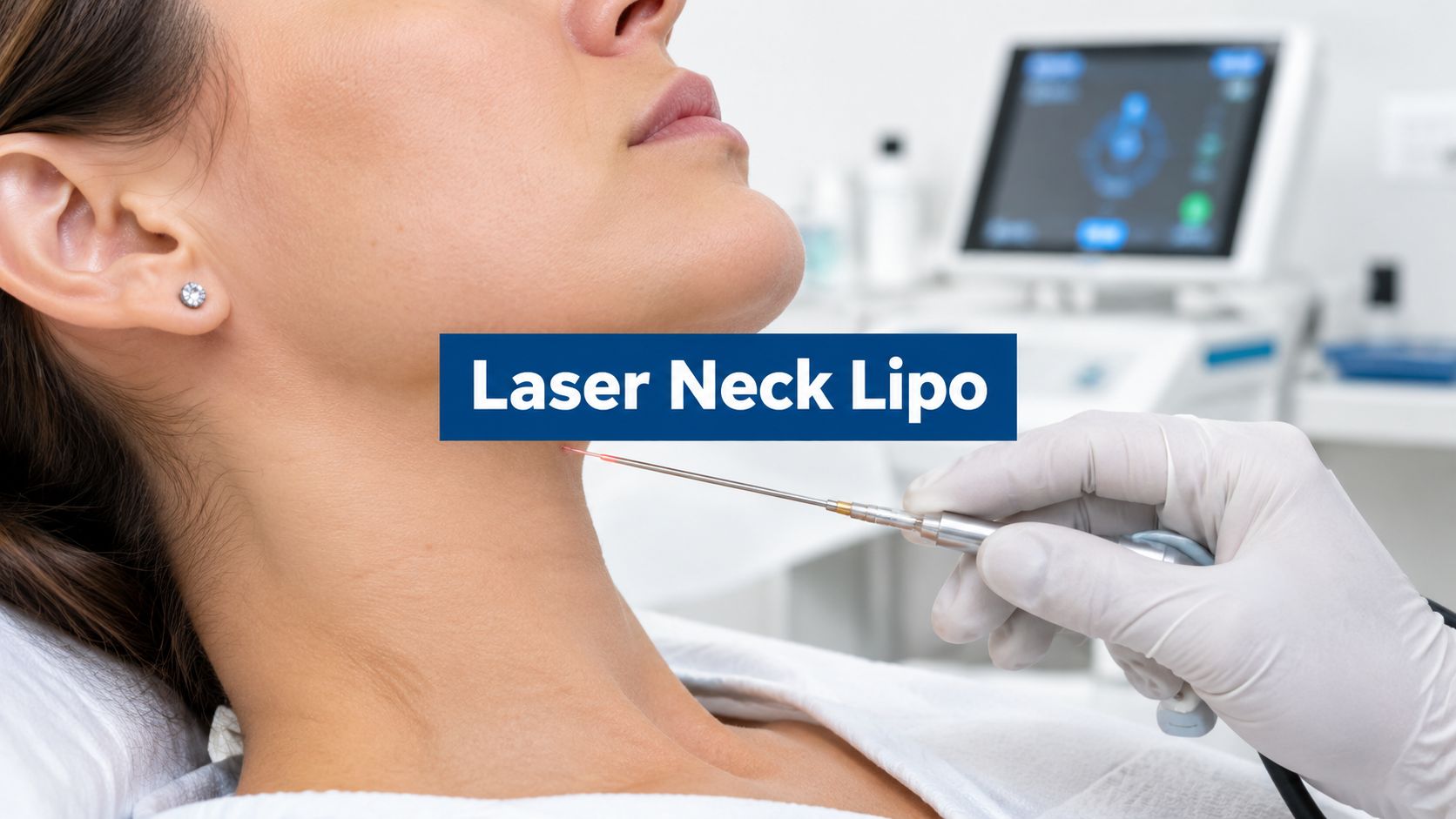
Laser liposuction for the neck is an awake, office-based procedure under local anesthesia that removes localized submental fat and may provide mild skin tightening, best suited to patients with good elasticity and a thin skin envelope. It isn't the right solution for every double chin, especially when loose skin, platysmal bands, deep fat, or jaw anatomy drive the problem.
You may be noticing fullness beneath your chin in photographs, a softer jawline in profile, or skin that seems less firm after weight change or aging. The natural question is whether removing the fat will restore definition. The honest answer depends less on the device name than on what creates the fullness in the first place.
A small, localized fat pocket under otherwise resilient skin can respond well to focused contouring. Loose skin or separated neck muscle may require a different plan. The distinction is important because removing volume from beneath lax skin can sometimes make that laxity easier to see.
Table of Contents
- What Is Laser Liposuction for Neck Contouring
- Who Is a Good Candidate for Neck Laser Liposuction
- How the Procedure Works Step by Step
- Laser Liposuction vs Traditional Liposuction
- Safety, Risks, and What Recovery Looks Like
- Realistic Results and Before and After Expectations
- Taking the Next Step with Dr. Yovino
What Is Laser Liposuction for Neck Contouring
Consider two people with a similar-looking double chin. One has a compact pocket of fat and skin that snaps back when gently pinched. The other has a smaller fat deposit, but also loose skin and visible platysmal bands. The same laser liposuction neck procedure may be appropriate for the first person and incomplete for the second.
Laser-assisted liposuction uses a thin cannula to treat localized fat beneath the chin and along the neck. Laser energy thermally affects tissue before the treated fat is removed, while the heat can support hemostasis and collagen remodeling. The goal is refined contour, not broad weight reduction.

A technology with a long history
This technique isn't a recent invention. Laser use in liposuction was reported by Dressel in 1990, followed by a 1994 U.S. Food and Drug Administration-approved study led by Apfelberg that examined whether laser energy could reduce bleeding, discomfort, and swelling during conventional liposuction. The first laser system reported as receiving FDA clearance for liposuction was a 1,064-nanometer Nd:YAG system on October 31, 2006. The history therefore spans more than three decades, although device clearance doesn't guarantee superior cosmetic results for every patient or anatomical area. The clinical history of laser-assisted liposuction provides that important context.
Later adoption expanded into localized areas such as the submental region. A 2011 series involving 478 patients reported generally favorable final results, but a favorable series still doesn't mean every neck contour will respond identically. Skin thickness, recoil, fat depth, platysma anatomy, and the position of the jaw all affect the visible result.
Practical rule: The device can assist the contouring process, but it can't replace an anatomical diagnosis.
Laser liposuction isn't a neck lift, and it can't reliably remove excess skin or tighten a significantly separated platysma muscle. It's best understood as a targeted method for reducing localized fat, with possible tissue-tightening effects that tend to be most useful when laxity is mild.
Who Is a Good Candidate for Neck Laser Liposuction
Good candidacy starts with identifying the source of fullness. Submental fat is soft tissue that can be selectively reduced. Loose skin is a coverage problem, while platysmal banding involves the thin muscle layer that helps shape the neck. Deep fat, a low hyoid, and a naturally less-projecting jaw can also affect the cervicomental angle, the transition between the chin and neck.
These conditions can overlap, which is why a mirror test isn't enough. A clinician typically examines how the skin recoils after gentle pinching, whether the platysma is relaxed or banded, where the fat sits, and how the jaw and chin project in profile.
The anatomy behind the decision
A patient with a thin, localized fat pocket and good skin recoil may need only focused fat reduction. Someone with modest fat but visible hanging skin may need a tightening approach or a neck lift to address the excess tissue. A patient with prominent bands may need treatment directed at the platysma rather than more fat removal.
Removing fat from lax or deflated skin can make the surface look less supported. Similarly, liposuction can't change the underlying position of the hyoid or create projection that the jaw doesn't naturally have. It may improve the shadow beneath the chin, but the final profile still reflects the patient's skeletal structure.
The decision can be organized around three questions:
- Is the fat localized? A focused pocket is more suitable than diffuse fullness caused by several tissue layers.
- Does the skin recoil? Good elasticity gives the outer envelope a better chance of settling smoothly.
- What else shapes the neck? Platysmal bands, deep fat, jaw projection, and the hyoid position may require additional planning.
A 2026 systematic review found similar 12-month neck-satisfaction scores between approaches, while satisfaction with the submental area was higher when liposuction was added in selected patients. The authors also emphasized that nonrandomized designs and small cohorts limit definitive conclusions. The comparative review of neck contouring approaches supports a measured conclusion: selection matters more than a promise attached to a device.
Laser-assisted fat reduction alone may be reasonable for a patient with isolated fat and mild laxity. With moderate or substantial laxity, combining contouring with tightening or choosing a surgical neck lift may produce a more complete result.
How the Procedure Works Step by Step
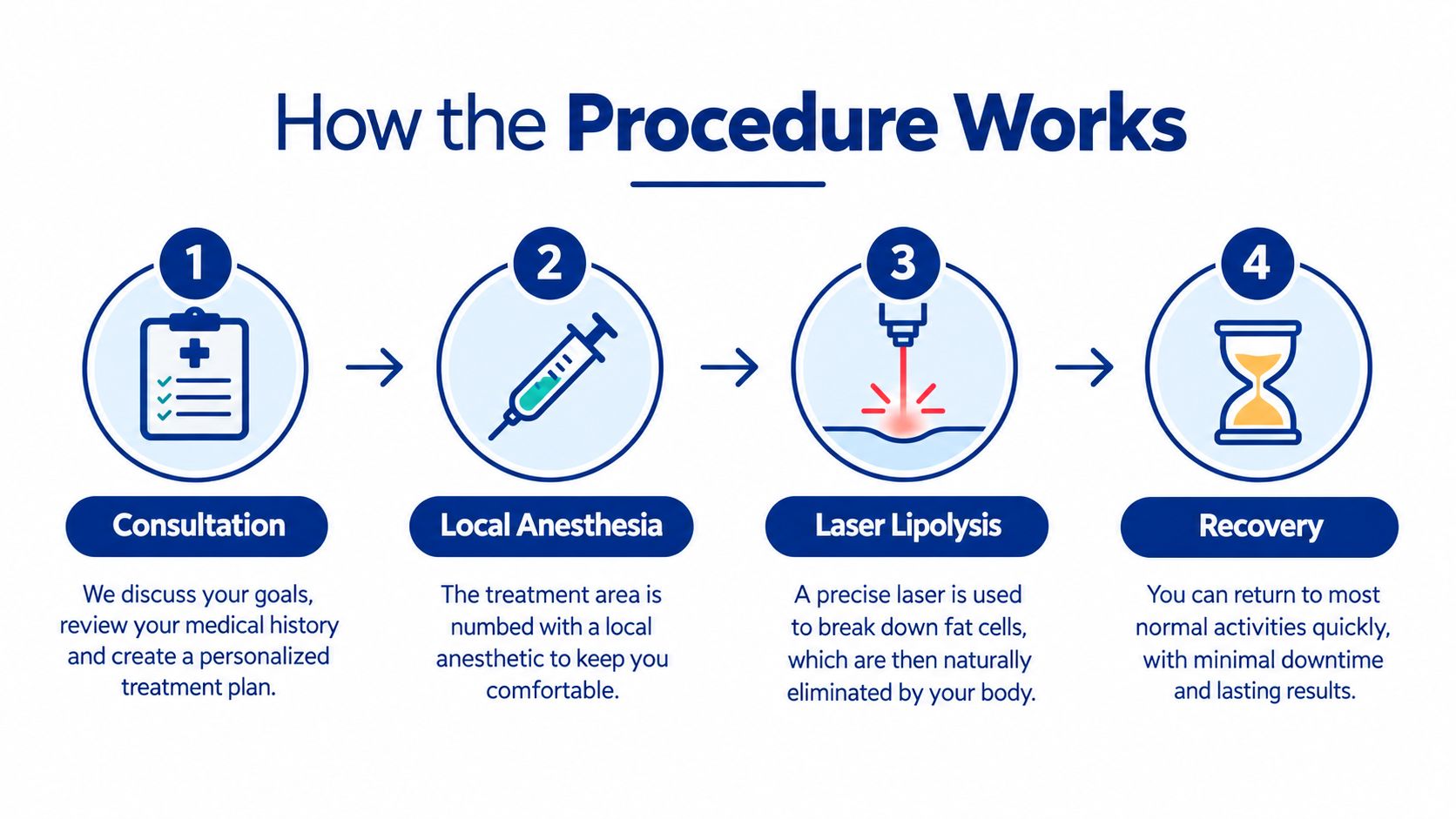
At Ideal Face & Body, the planned approach is awake and office-based, using local anesthesia rather than general anesthesia. That means you remain responsive during treatment, and many patients who prefer to avoid an IV line or general anesthesia can discuss whether this setting is appropriate for them.
Consultation and preparation
The process begins with an assessment of the chin, neck, skin envelope, platysma, fat depth, and profile. Goals matter as well. Someone seeking a sharper profile may need a different treatment map from someone focused on fullness visible from the front.
The treatment area is marked while you're upright. Local anesthetic is then placed to numb the skin and deeper tissues. The anesthetic also helps create a controlled working field for the cannula.
Laser treatment and fat removal
A small entry point allows a thin cannula and laser fiber to reach the targeted tissue. The laser energy thermally affects fat-associated tissue and the dermis. In the submental series using a 1,064 nm Nd:YAG laser, histology showed adipocyte-membrane disruption, collagen coagulation, tissue channels, and coagulation of small vessels. These mechanisms may support fat reduction, hemostasis, and collagen remodeling, but they also explain why controlled energy delivery is essential near the marginal mandibular and cervical nerves. The five-year submental Nd:YAG series describes these findings.
After laser treatment, the affected fat is removed with suction through microcannulas. The surgeon works conservatively because the neck has a thin soft-tissue envelope, and even a small contour irregularity can be noticeable.
Finishing and wrapping
Ideal Face & Body describes its proprietary PRECISION SCULPT approach as laser liposculpting for the chin and neck, performed while awake under local anesthesia. A custom head and neck wrap is used afterward to support the treated area during early healing. You can review the clinic's explanation of how laser liposuction is performed before your consultation.
Laser Liposuction vs Traditional Liposuction
A patient with a small pocket of under-chin fat and mildly loose skin may benefit from laser-assisted liposuction alone. A patient with heavier laxity, loose bands, or excess skin may need a lifting or separate skin-tightening approach. The key decision is candidacy, not choosing the newer-sounding device.
Laser-assisted and traditional tumescent liposuction share the same goal, targeted fat removal. Traditional treatment removes prepared fat mechanically. Laser-assisted treatment adds thermal energy before suction, which may encourage some tissue contraction in selected patients. That heat also requires careful control near nerves and thin skin.
| Consideration | Laser-assisted approach | Traditional approach |
|---|---|---|
| Fat removal | Uses thermal treatment before suction | Removes fat mechanically after preparation |
| Skin response | May provide mild contraction in selected tissue | Doesn't use internal laser heat |
| Pain and swelling | Some evidence suggests less pain, but results vary | Effects depend on technique and individual healing |
| Bruising and edema | Blinded evaluations found no significant advantage | Comparable clinical findings in that review |
| Main planning issue | Energy must be controlled near nerves and thin skin | Sculpting remains dependent on careful cannula technique |
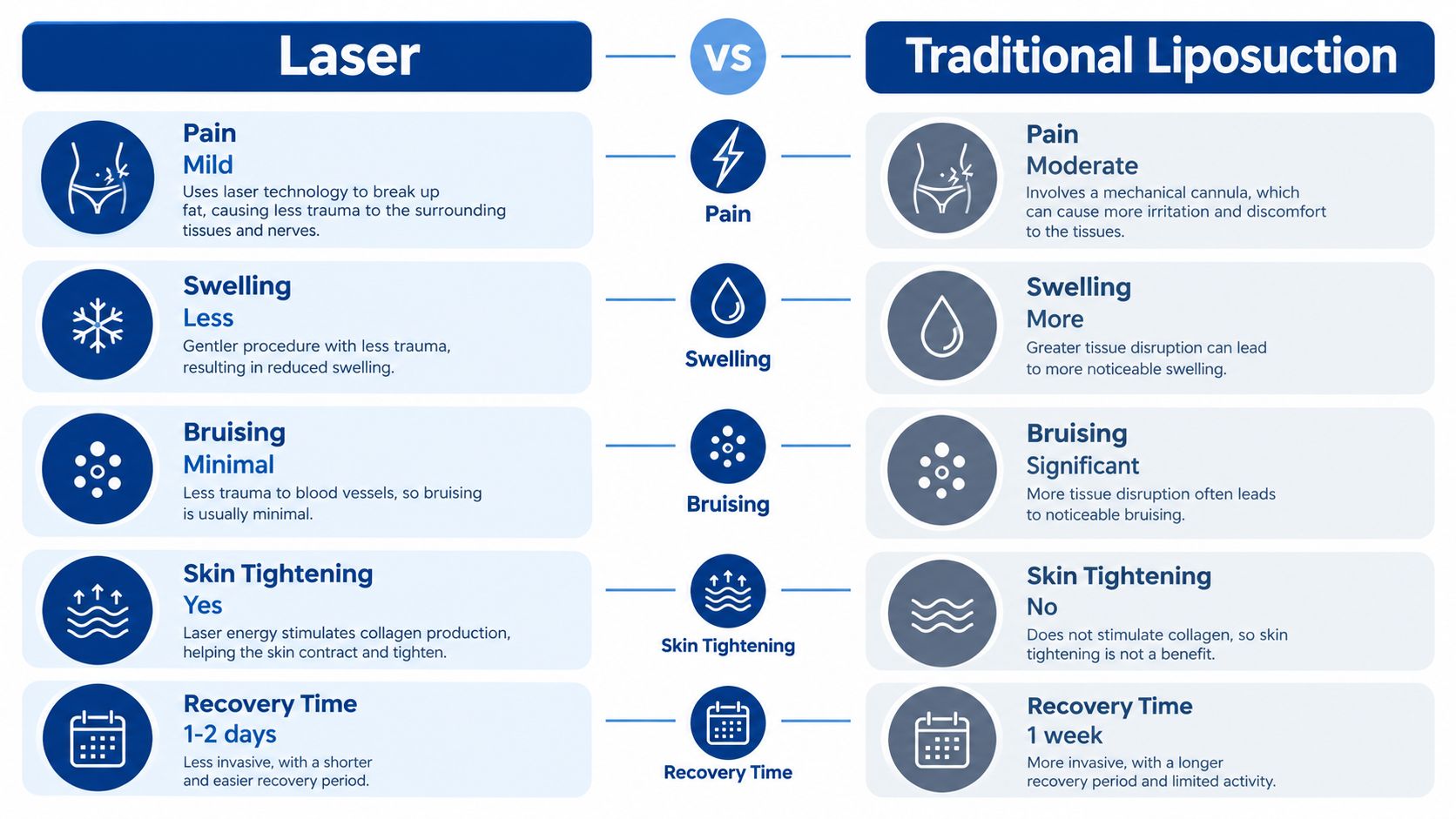
The evidence does not support treating laser energy as an automatic upgrade. A review found no statistically significant differences in bruising, edema, or clinical outcome in blinded evaluations, so expectations should remain moderate. The review of traditional lipo and laser lipo offers a practical overview of the two methods.
Laser treatment may suit localized fat with mild laxity. Traditional liposuction may suit a patient whose main need is precise fat removal without added thermal treatment. Neither method can replace a lift when loose skin or neck structure is the dominant concern. A consultation should assess skin recoil, fat distribution, neck anatomy, and the amount of correction required before selecting an approach.
Safety, Risks, and What Recovery Looks Like
A small access point does not make neck contouring risk-free. The neck contains superficial sensory nerves, the marginal mandibular facial-nerve area, thin skin, and tightly spaced structures. Heat or uneven suction in this region can affect sensation, movement, healing, or the final contour.
A retrospective investigation involving 537 laser-lipolysis patients reported rates below 1% for nodularity, skin infection, burns, and nerve damage. The group was not limited exclusively to neck procedures, so the findings provide context rather than a guarantee. Swelling, bruising, and pain were common inflammatory effects during healing. The clinical safety investigation supports describing laser lipolysis as generally well tolerated in selected series, while still requiring careful patient selection and technique.
Risks specific to contouring
A meta-analysis of isolated aesthetic liposuction reported an overall complication rate of 12%, with a 95% confidence interval of 8% to 16%. After temporary bruising and swelling were excluded, the rate was 6%, with a 95% confidence interval of 4% to 8%. The pooled figures included 2% for contour irregularities, 2% for seroma, 1% for hematoma, 1% for surgical-site infection, 1% for fibrosis or induration, and 1% for pigmentary changes. The liposuction meta-analysis shows why complication rates must be read alongside the definitions used.
Energy-assisted treatment carries its own thermal considerations. In a neck and lower-face study of radiofrequency-assisted liposuction involving 55 patients, two developed small full-thickness thermal burns. The reported thermal-injury rate was 3.6%. Each burn measured 5 mm by 5 mm, received local wound care, and left an inconspicuous scar. The technology differed from laser, but the safety lesson applies to both: temperature, depth, and tissue contact require disciplined control. The neck and lower-face contouring study provides that context.
Early healing
Expect swelling, bruising, tenderness, and temporary tightness. A supportive wrap can protect the treated area while the tissues settle, much like a gentle splint supports a healing joint. Your surgeon's instructions should determine when to resume exercise, how to clean the access points, and when follow-up is needed. Recovery depends on the treatment area, the amount removed, skin response, and whether another procedure was performed.
Transient lower-lip weakness has been reported after submental treatment, along with soreness, edema, and bruising. A seroma may rarely require aspiration. Conservative energy delivery and postoperative monitoring help protect nearby nerves and identify complications early. Guidance on recovery after neck liposuction outlines practical recovery considerations.

Realistic Results and Before and After Expectations
The strongest results usually come from a modest, well-defined goal. A patient with localized submental fat and mild laxity may see a cleaner transition from chin to neck, especially in profile. The change may be subtler from the front if the jaw, chin, or deeper tissues continue to shape the silhouette.
A prospective study of 57 patients with submental fat and mild-to-moderate laxity treated with a 1,440 nm Nd:YAG laser reported 97% overall satisfaction and significant improvement in skin laxity at six months, measured at 34.6%. The same study reported edema, soreness, lower-lip weakness, and bruising as expected short-term effects, with resolution through conservative care except for one seroma requiring aspiration. The prospective 1,440 nm study offers encouraging evidence for appropriately selected patients, but it shouldn't be used to promise the same outcome to everyone.
How to judge a result
When reviewing before-and-after photographs, look for consistent lighting, head position, facial expression, and camera distance. Study the profile first, because the cervicomental angle and the shadow beneath the chin often show the contour change most clearly. Then look at frontal views for residual fullness, skin texture, symmetry, and whether the jawline appears natural rather than sharply hollowed.
Ask what the photographs don't show:
- Skin quality: Was the patient's starting elasticity similar to yours?
- Anatomy: Did the patient have comparable jaw projection and platysma behavior?
- Treatment scope: Was liposuction used alone or combined with tightening?
- Healing stage: Were the images taken after swelling had settled?
Laser energy may help mild laxity, but it shouldn't be presented as a substitute for a surgical neck lift when skin excess or muscle separation is substantial. The most useful consultation doesn't ask only, “Can this device remove my fat?” It asks whether removing that fat alone will create the contour you want.
Taking the Next Step with Dr. Yovino
A consultation with Dr. Justin Yovino and Dr. Sarah Yovino at Ideal Face & Body in Beverly Hills begins with the anatomy, not the device label. The assessment should consider the amount and depth of submental fat, skin recoil, platysma bands, nerve function, jaw structure, and the difference between your profile goal and your frontal-view goal.
You can ask direct questions:
- Is my fullness mainly localized fat, loose skin, muscle, or deeper anatomy?
- Would laser liposuction alone be enough?
- What degree of tightening is realistic for my skin?
- What would make a neck lift or another approach more appropriate?
- How will energy delivery protect the nerves and thin skin in this area?
The practice's model centers on awake, office-based care under local anesthesia. Virtual and out-of-town consultations are available for patients who need to begin the evaluation remotely, although an in-person examination may still be necessary before treatment.
If you're considering laser liposuction neck contouring, bring photographs, your medical history, and a clear description of what bothers you in profile and from the front. A careful candidacy assessment can prevent an incomplete procedure and help you choose a plan that matches your anatomy.
Ideal Face & Body offers awake, office-based PRECISION SCULPT laser liposuction for localized chin and neck contouring under local anesthesia. Visit Ideal Face & Body to request a consultation with Dr. Justin Yovino or Dr. Sarah Yovino and discuss whether laser liposuction alone, tightening, or a neck lift best fits your goals.