You've tried the supportive bras, adjusted how you sleep, taken pain medication, and perhaps even completed physical therapy. Yet your neck and upper back still ache, bra straps leave deep grooves, and skin beneath your breasts may become irritated after an ordinary day. If you're searching for how to qualify for breast reduction surgery, the most important answer is that qualification usually depends on documented symptoms and functional impairment, not cup size alone.
The part many patients discover too late is the requirement to show that conservative treatment didn't provide enough relief. Your records should tell a clear story: what symptoms you have, how long they've lasted, what you tried, and how those problems limit work, exercise, sleep, or daily activities. Insurance approval and medical candidacy are related, but they aren't the same decision.
Table of Contents
- Understanding What Breast Reduction Qualification Really Means
- Recognizing the Symptoms That Establish Medical Need
- Navigating Insurance Requirements and Tissue Criteria
- Comparing Insurance Coverage Versus Cosmetic Pathways
- Preparing for Your Consultation With Dr. Yovino
- Essential Questions to Ask Before Surgery
Understanding What Breast Reduction Qualification Really Means
A common consultation scenario goes like this: someone has lived with heavy, painful breasts for years, has already bought supportive bras, tried medication, maybe even completed physical therapy, and still wonders whether she “qualifies.” The answer usually depends on whether your records show a persistent medical problem that has not improved enough with reasonable non-surgical care.
That hidden requirement matters because qualification works a lot like building a case file. Symptoms matter, but insurers and surgeons also look for a clear trail showing what you tried, how long you tried it, and what happened afterward. A strong note is specific: “Physical therapy twice a week, fitted bra trial, daily anti-inflammatory use, still unable to sit through a full workday without upper-back pain.” That kind of documentation carries more weight than a general statement that your breasts feel uncomfortable.

The medical question is function
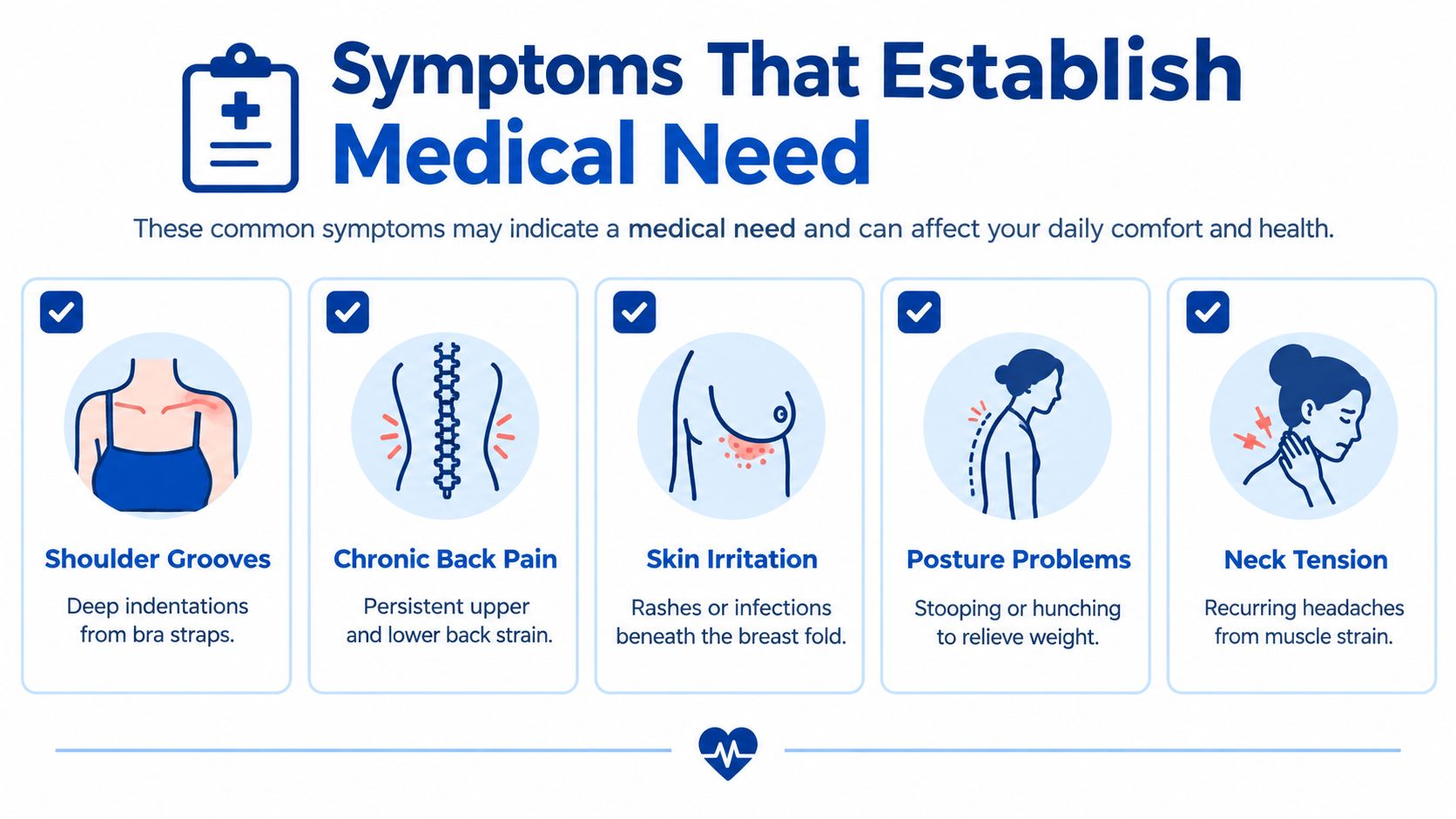
Clinical and insurance review usually centers on functional impairment caused by breast weight. That can include chronic breast, neck, shoulder, or upper-back pain, skin irritation beneath the breasts, shoulder grooves, numbness, headaches, and trouble with exercise, sleep, work, or daily tasks. The NHS guidance on female breast reduction notes that treatment may be considered when persistent symptoms continue after alternatives such as professionally fitted bras have not helped enough.
This is why cup size alone does not decide much. Two patients can look very different on paper and still have the same level of limitation in real life.
Professional societies have encouraged clinicians to document at least two symptoms and explain how those symptoms affect quality of life, instead of relying only on body weight or tissue estimates. In practice, that means your chart should connect the symptom to a real limitation. “Shoulder pain after twenty minutes at a computer” is useful. “Back hurts sometimes” is weak.
Include dates, treatment trials, exam findings, photos of rashes or strap grooves when present, and notes about activities you have reduced or stopped. If conservative care failed, say so clearly. Reviewers often want evidence that the problem remained despite appropriate efforts, not just proof that the problem exists.
Emotional strain deserves attention too. Shame, anxiety, and body discomfort can intensify physical suffering, even when they are not the main reason coverage is approved. If that part of the experience feels heavy, reVIBE Mental Health therapy options may offer support alongside surgical evaluation.
You can also review the procedure pathway, including the practice's awake breast reduction approach, through Ideal Face & Body's breast reduction information. A consultation then focuses on medical symptoms, failed conservative treatment, health history, and whether surgery is an appropriate next step.
Recognizing the Symptoms That Establish Medical Need
A strong breast reduction case reads less like a complaint and more like a clear medical timeline. The hidden requirement that trips up many patients is not having symptoms alone. It is showing that the symptoms kept interfering with daily life even after reasonable non-surgical care was tried.
Start with a simple chart you can update in real time: Date, symptom, trigger, duration, treatment tried, result, functional limit, clinician. That format helps reviewers see the pattern quickly. It also helps you remember details that are easy to forget during a consultation, especially if you have been living with discomfort for years.
Build a record that shows daily impact
Instead of making a long symptom list, describe what the symptom stopped you from doing. “Upper-back pain after folding laundry.” “Shoulder grooves by the end of a workday.” “Rash under the breast fold that returns in warm weather.” “Numb hands while sleeping on my side.” Short, concrete entries are stronger than broad statements.
Photos matter too. If you get strap grooves, skin irritation, or visible redness, take dated photos when the problem is active. Keep receipts or visit summaries for bras, creams, physical therapy, or other care. If a clinician examined the area, ask for that note to be included in your record. Public health guidance in the UK recognizes persistent pain, skin irritation, shoulder grooving, reduced ability to exercise, and similar burdens when other measures have not helped. The key point is the same across many policies: symptoms should be specific, repeated, and tied to function.
Why failed conservative care matters
This is the part many articles miss. Insurers often want proof that conservative treatment was attempted and did not solve the problem. Your chart should show what you used, how long you used it, and what happened next. Supportive bras, medication, physical therapy, skin treatment, activity modification, or posture changes may all belong in that record if they were actually tried.
A useful entry might say: physical therapy recommended by clinician, attended as advised, temporary relief, pain returned with work and exercise. Another might note a properly fitted support garment that reduced bounce but did not prevent shoulder pain or grooves. That kind of detail shows persistence, not just diagnosis.
Pain medicine by itself may not meet a policy that expects broader conservative care, and a verbal summary rarely carries the same weight as visit notes. The Beverly Hills breast reduction guidance for back pain offers a practical example of how breast weight can connect to back symptoms and activity limits.
Do not downplay what you have adapted around. If you stopped running, buy two bras to get through the day, avoid lifting, change clothes because of recurrent irritation, or lose sleep from pressure and pulling, write that down. During consultation, that record also helps clarify whether a standard operation or an awake breast reduction approach at Ideal Face & Body fits your symptoms, history, and goals.
Navigating Insurance Requirements and Tissue Criteria
Insurance review often combines two separate questions. First, does the patient have documented medical need? Second, does the planned operation meet the policy's objective requirements for tissue removal and safety?
Some policies use the Schnur Sliding Scale, which compares estimated tissue removal with body-surface area. One published framework describes thresholds ranging from at least 300 grams per breast for patients under 5 feet 2 inches or under 120 pounds to 600 grams per breast for taller or heavier patients, as described in the medical policy from Blue Cross Blue Shield of Michigan. These figures illustrate why there isn't one worldwide gram requirement.
Why cup size isn't enough
A bra cup designation doesn't consistently measure tissue volume across manufacturers, body shapes, or breast composition. Cigna's policy uses the 22nd percentile on the Schnur Sliding Scale and also recognizes removal of more than 1 kilogram of breast tissue per breast regardless of body-surface area, according to its reduction mammaplasty coverage criteria.
The surgeon estimates the planned amount during evaluation. That estimate supports the review, but it shouldn't force a surgeon to remove more tissue than is appropriate for your anatomy or goals. The American Society of Plastic Surgeons has argued that tissue weight shouldn't be the decisive test because symptomatic patients may improve even when the amount removed differs.
Other policy checkpoints
Insurers may also review whether breast development is complete or stable, whether weight has been stable, whether the patient meets an age requirement, and whether cancer screening is current. One policy uses age 18 as a standard threshold while allowing younger patients when documentation indicates completed growth. The same policy requires a negative mammogram or other appropriate imaging within the preceding year for women aged 40 or older.
Keep your insurer's policy, medical records, treatment notes, photographs, and surgeon's examination together. The prior authorization approval guide from Weight Method offers general context about organizing approval materials, but it can't replace your plan's current checklist.
Ask the insurer and surgical office to confirm whether weight stability, nicotine use, BMI, imaging, estimated tissue removal, and conservative treatment duration apply to your case. A preauthorization checklist obtained before scheduling can prevent a missing record from delaying review.
Comparing Insurance Coverage Versus Cosmetic Pathways
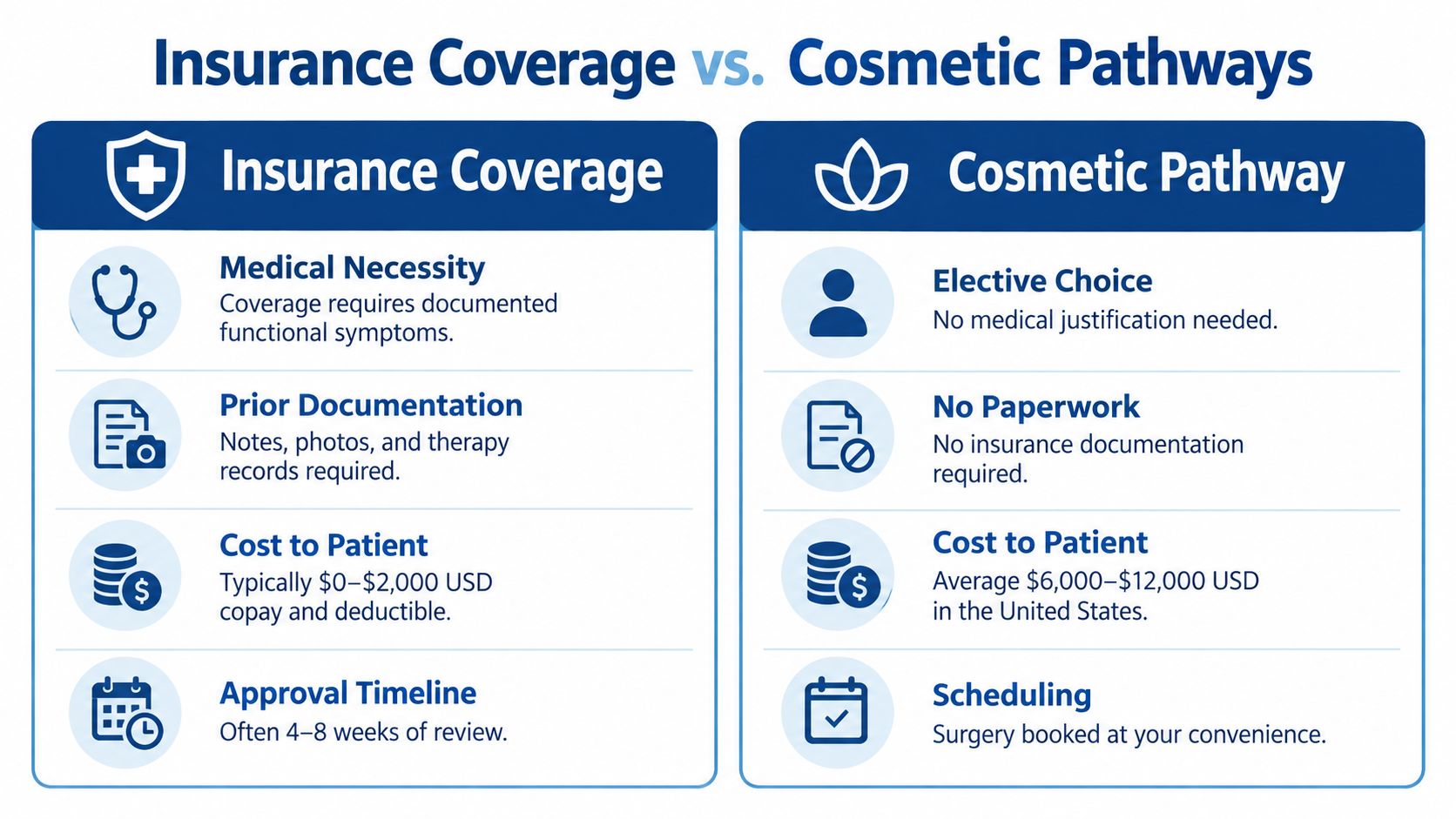
The same operation may follow different administrative paths depending on whether the primary goal is relief from documented symptoms or an elective change in breast size and shape.
For insurance, the record usually needs to establish medical necessity, symptom duration, failed conservative treatment, examination findings, and the anticipated tissue removal. A cosmetic pathway generally doesn't require an insurer to approve those criteria, so the patient and surgeon can focus on anatomy, goals, safety, and informed consent instead.
| Consideration | Insurance pathway | Cosmetic pathway |
|---|---|---|
| Primary question | Are symptoms medically significant and documented? | Does the patient want an elective change in size or shape? |
| Treatment history | The insurer may require records of failed conservative care. | Prior treatment history may not be required for the procedure decision. |
| Tissue criteria | The plan may apply body-surface-area or tissue-removal rules. | The surgeon plans removal around anatomy, safety, and goals. |
| Approval | The insurer reviews submitted clinical documentation. | No insurance authorization is needed for an elective pathway. |
| Patient responsibility | Coverage and patient obligations vary by plan. | Financial arrangements vary by practice and procedure. |
Intertrigo can be an important pathway
Some policies recognize recurrent or chronic intertrigo beneath the breast as a qualifying condition, even when pain isn't the main complaint. That doesn't mean every rash automatically establishes coverage. The record should show recurrence, examination findings, treatment, and whether the problem continued despite appropriate skin care or medical therapy.
A person whose main limitation is skin infection may therefore need a different documentation strategy from someone whose primary concern is neck pain. The symptoms still must be connected to breast anatomy and evaluated under the specific plan.
Make the decision with exact information
Insurance rules vary by payer and country, and a policy that approves one patient may not apply to another plan. Ask both the insurer and surgeon:
- Which symptoms qualify?
- What duration is required?
- Which conservative treatments count?
- Is a tissue-removal estimate required?
- Are age, growth, weight, imaging, or nicotine rules included?
- What happens if authorization is denied?
Weight-related medical care can also involve separate authorization questions, so patients exploring treatment for body-weight concerns should seek evidence-based Wegovy UK information from an appropriate medical source. It shouldn't be treated as a substitute for a breast reduction evaluation.
Preparing for Your Consultation With Dr. Yovino
The consultation often feels like the first real checkpoint. For many patients, it is also the moment they learn that symptoms alone may not be enough. The missing piece is often proof that you tried reasonable nonsurgical measures and still kept hurting, rashing, or struggling with daily activity.
Bring more than a general description of discomfort. A short, one-page summary helps. Include when your neck, back, shoulder, or skin symptoms started, which treatments you tried, how long you used them, and what happened. Add your medication list, relevant medical conditions, nicotine status, current weight pattern, prior breast imaging if applicable, and photos of shoulder grooves or rashes if those problems come and go. This record can work like a receipt trail. It shows not only that the symptoms exist, but that they persisted despite conservative care.
Dr. Sarah Yovino and Dr. Justin Yovino can then examine your breast anatomy, symptom pattern, health history, medications, weight stability, and goals with more precision. That makes it easier to sort out symptoms likely related to breast weight from symptoms that may have another explanation. It also helps identify healing issues before surgery instead of after it.
Discuss the awake approach clearly
Ideal Face & Body offers an awake breast reduction option for eligible patients, performed in an office setting with local anesthesia. For the right patient, this changes the anesthesia setting, not the seriousness of the operation. You still need a thoughtful exam, a safety review, and a clear discussion of tradeoffs.
Ask how the team decides whether awake surgery fits your anatomy, medical history, and comfort level. Ask what you are likely to feel during the procedure, how comfort is managed, what monitoring is used, and when a different setting would make more sense. You should also get direct answers about scars, breast shape, nipple sensation, symmetry, breastfeeding considerations, recovery, and follow-up.
If you want to review your options in detail, you can request a plastic surgery consultation with Ideal Face & Body.
Address modifiable risks without shame
Risk review should feel practical, not judgmental. A surgeon is looking for factors that can affect wound healing, infection risk, and recovery so the plan can be made safer.
In its published analysis, a systematic review and meta-analysis found that obesity, defined there as BMI at least 30 kg/m², was associated with higher odds of fat necrosis, with OR 3.00 and 95% CI 1.37–6.57, and infection, with OR 1.66 and 95% CI 1.15–2.40. The same analysis identified smoking, diabetes, unilateral resection of at least 1,000 grams, and prior radiation as complication risks.
Those findings do not create one universal cutoff for surgery. They support honest discussion about nicotine exposure, blood-thinning medicines, supplements, diabetes control, previous operations, and whether weight stabilization would improve safety in your case.
Questions patients often ask
Will I be fully awake? If you are a candidate for the awake technique, your surgeon should explain the expected experience under local anesthesia in plain language.
Will recovery be easier? Recovery still depends on the amount of surgery, your health, and how your body heals.
Can I qualify if I'm younger than 18? Age by itself does not answer that question. Adolescents need individualized evaluation of growth stability, symptom burden, goals, and recurrence risk. A recent published evidence review found consistent symptom relief and high patient satisfaction after adolescent reduction surgery.
Essential Questions to Ask Before Surgery
You can learn a lot from the questions you ask before surgery. A strong consultation should leave you with a clear picture of whether you qualify, what still needs to be documented, and which surgical approach fits your body and goals. Bring a written list. Take notes. If the office allows it, bring a support person or ask whether you may record the conversation so you can review the details later.
Start with candidacy, because confusion often begins here. Ask, What in my history supports medical necessity? A good answer should connect your symptoms to breast weight and explain how those symptoms affect daily life. Then ask, What proof of failed conservative treatment is still missing? This point gets overlooked often. Many patients assume pain alone is enough, but insurers commonly want records showing what you already tried, for how long, and why those steps did not solve the problem. That documentation may matter as much as breast size.
Next, ask, How much tissue do you expect to remove from each breast, and how does that compare with my insurer's requirements? This helps you understand whether your estimated resection clearly meets the policy or whether your surgeon may need to make a stronger case based on functional impairment. If your estimate is close to a threshold, ask directly, What will you include in my chart to support medical necessity if the tissue estimate is lower than expected? That question often reveals how carefully the office handles preauthorization.
Technique matters too. Ask, Would awake breast reduction be appropriate for me? For the right patient, local anesthesia can be a reasonable office-based option. You should hear a plain explanation of comfort, monitoring, who qualifies, and when another setting would make more sense. At Ideal Face & Body, Dr. Sarah Yovino and Dr. Justin Yovino discuss symptoms, documentation, surgical goals, and anesthesia options during awake breast reduction evaluations. Visit Ideal Face & Body to begin the consultation process and learn whether an office-based approach may fit your needs.
Then move to results and tradeoffs. Ask where scars are likely to sit, how incision choice affects shape, what changes may occur in nipple sensation, and how surgery could affect breastfeeding. These are not small details. They shape satisfaction after recovery.
Recovery questions should be practical. Ask what you can do in the first days and weeks, how wound care works, when follow-up happens, and which symptoms require an urgent call. Also ask how the practice handles asymmetry, delayed healing, infection, fluid collection, or a result that does not match expectations.
A take-home checklist helps. Bring medical records, a symptom diary, a list of medications and supplements, your coverage questions, your personal priorities, and a realistic aftercare plan.
The right surgeon welcomes careful questions and answers them without rushing. Qualification depends on symptoms, documented treatment history when required, anatomy, health, expectations, and the rules of the path you choose.