You left the office with smooth, freshly treated skin and a head full of questions. By the time you get home, the mirror can look a little less reassuring, redness shows up, tightness kicks in, and the concern becomes simple, when does this stop looking like a treatment and start looking like healed skin again? Chemical peel recovery is mostly about knowing what your peel depth means, then matching your routine to the stage your skin is in.
Table of Contents
- Why Chemical Peel Recovery Looks So Different
- Light Peel Recovery Day by Day
- Medium-Depth Peel Recovery Week by Week
- Deep Peel Recovery and the Long Remodeling Phase
- Skincare, Sun Protection, and Active Ingredients
- Recovery by Skin Tone and Pigmentation Risk
- Pain Control, Activity, and Warning Signs
Why Chemical Peel Recovery Looks So Different
Two people can compare notes after a peel and sound like they had completely different treatments. One is back at work in a few days, lightly flaky and mostly comfortable. Another is still pink a month later, careful with sunlight, makeup, and every product that touches the face. The biggest reason is peel depth, because depth controls how much of the skin barrier is disrupted, how much inflammation follows, and how long remodeling takes.
The American Academy of Dermatology says light peels typically heal in 1 to 7 days, medium peels in 7 to 14 days, and deep peels in 14 to 21 days. Cleveland Clinic gives a similar range and notes that deep peels may require 3 to 6 months of sun avoidance while the skin fully recovers, which is why recovery counseling matters so much before treatment. A light peel often looks like a sunburn with redness and scaling, while a deep peel can involve bandaging, ointment-based wound care, and delayed makeup use for at least 14 days. Those milestones shape scheduling, work plans, and what you can safely put on your skin.
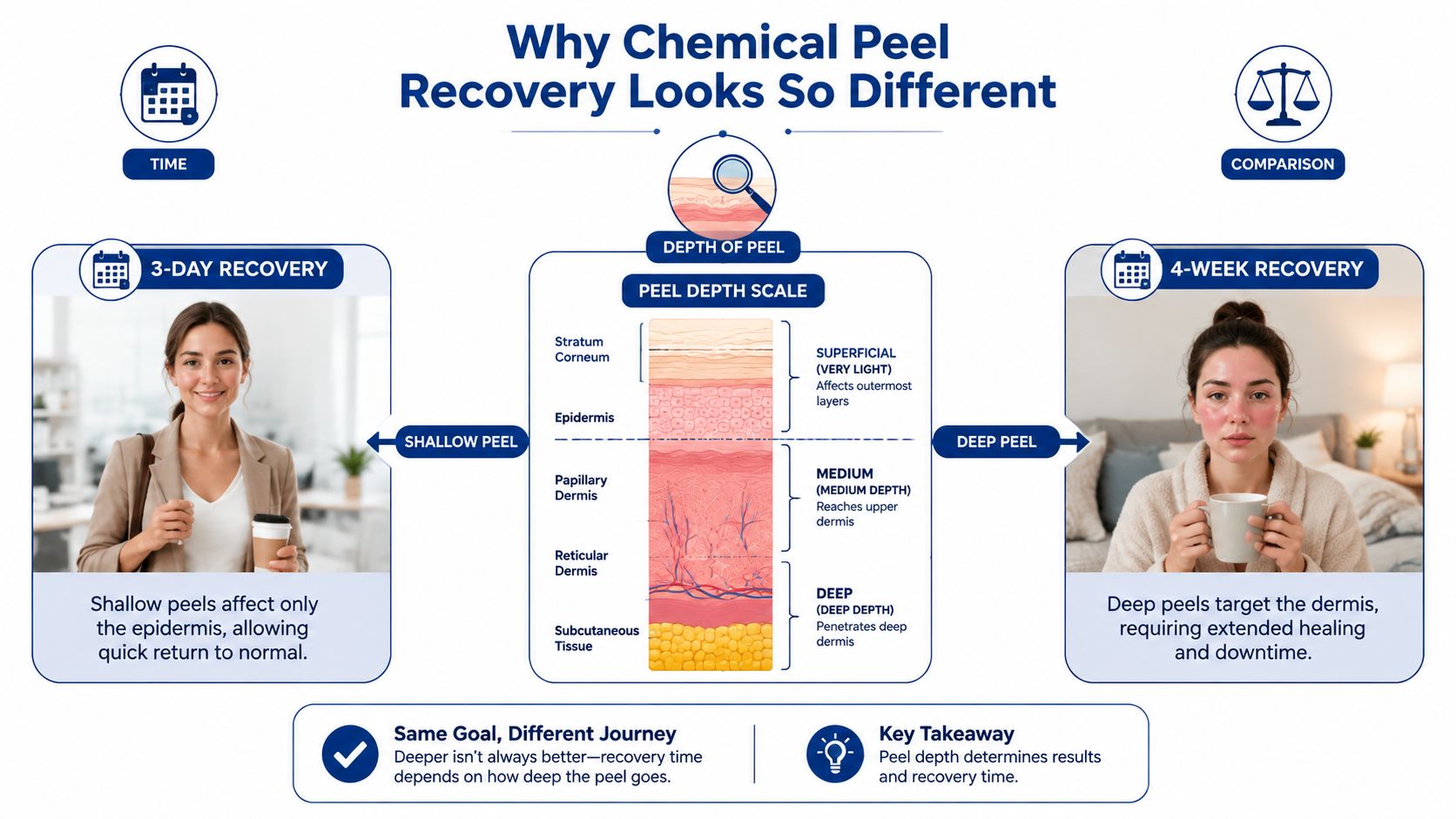
A practical way to think about peel categories is simple, shallow peels are usually maintenance, medium-depth peels are a bigger reset, and deep peels are a major resurfacing event. A review in PMC reported that chemical peels were the third most commonly performed noninvasive cosmetic procedure in the United States, with more than 1.3 million procedures performed in 2016 PMC review of procedure volume. That volume matters because it means recovery expectations are not guesswork, they're shaped by broad clinical experience.
Practical rule: match your expectations to the depth, not the product name. Two peels can both sound “light” in conversation and still heal differently if one reaches deeper than the other.
Quick reference by peel depth
| Peel depth | Typical feel | Healing window | Common use pattern |
|---|---|---|---|
| Light | Sunburn-like redness, scaling | 1 to 7 days | Repeated every 2 to 5 weeks |
| Medium | More swelling, more visible shedding | 7 to 14 days | Repeated every 6 to 12 months |
| Deep | Bandaging, ointment care, longer redness | 14 to 21 days with longer remodeling | Usually done once on the face |
If you're still deciding which category fits your skin and goals, it helps to browse chemical peel options and then compare those choices against your tolerance for downtime, not just the promise of smoother skin. For patients who are also weighing resurfacing alternatives, laser resurfacing may be part of the broader conversation, but peel depth still determines the basics of healing.
Light Peel Recovery Day by Day
A light peel usually feels manageable in the moment, then more noticeable once the first day has passed. The first 24 to 72 hours are the inflammatory phase, so redness, tightness, and mild swelling are normal. After that, the skin usually shifts into visible shedding, and that's when people start thinking the peel is “too much,” even though this is exactly what a superficial peel is supposed to do.
What the first week usually feels like
Days 3 to 5 are often the most obvious part of the process. The skin can look dry, rough, and sunburned, and the flaking is usually most visible in this window. Recovery guides commonly describe visible recovery as 5 to 7 days for a light peel, with active peeling often showing up on days 3 to 5 AAD chemical peel FAQ, Tactus Health recovery overview.
Don't try to speed up the flaking. Scrubs, picking, and rubbing create more inflammation than healing, and that's how a routine peel can turn into a pigment problem.
By days 6 to 10, the renewal phase is usually underway. The barrier starts to normalize, makeup tends to sit better again, and patients can move back toward routine life as long as the skin has stopped actively peeling. Cleveland Clinic notes that light peels can be repeated every 2 to 5 weeks, and that 3 to 5 peels are often needed to reach the desired result Cleveland Clinic chemical peels. That rhythm makes light peels feel less like a single dramatic event and more like maintenance.
The habits that protect the result
Use only cool or lukewarm water, a bland moisturizer, and clean hands. If a flake is hanging on, leave it alone. If the skin stings when you touch it, that's your signal to simplify, not to exfoliate harder.
Best clue you're on track: peeling slows on its own, the skin stops feeling raw, and makeup no longer catches on dry patches.
Socially, many can plan for a week of being a little shiny, red, or flaky, then expect a more normal appearance after that. A light peel doesn't usually demand the kind of prolonged isolation or bandaging that deeper peels do, but it still rewards patience. The cleanest recoveries come from people who do less, not more.
Medium-Depth Peel Recovery Week by Week
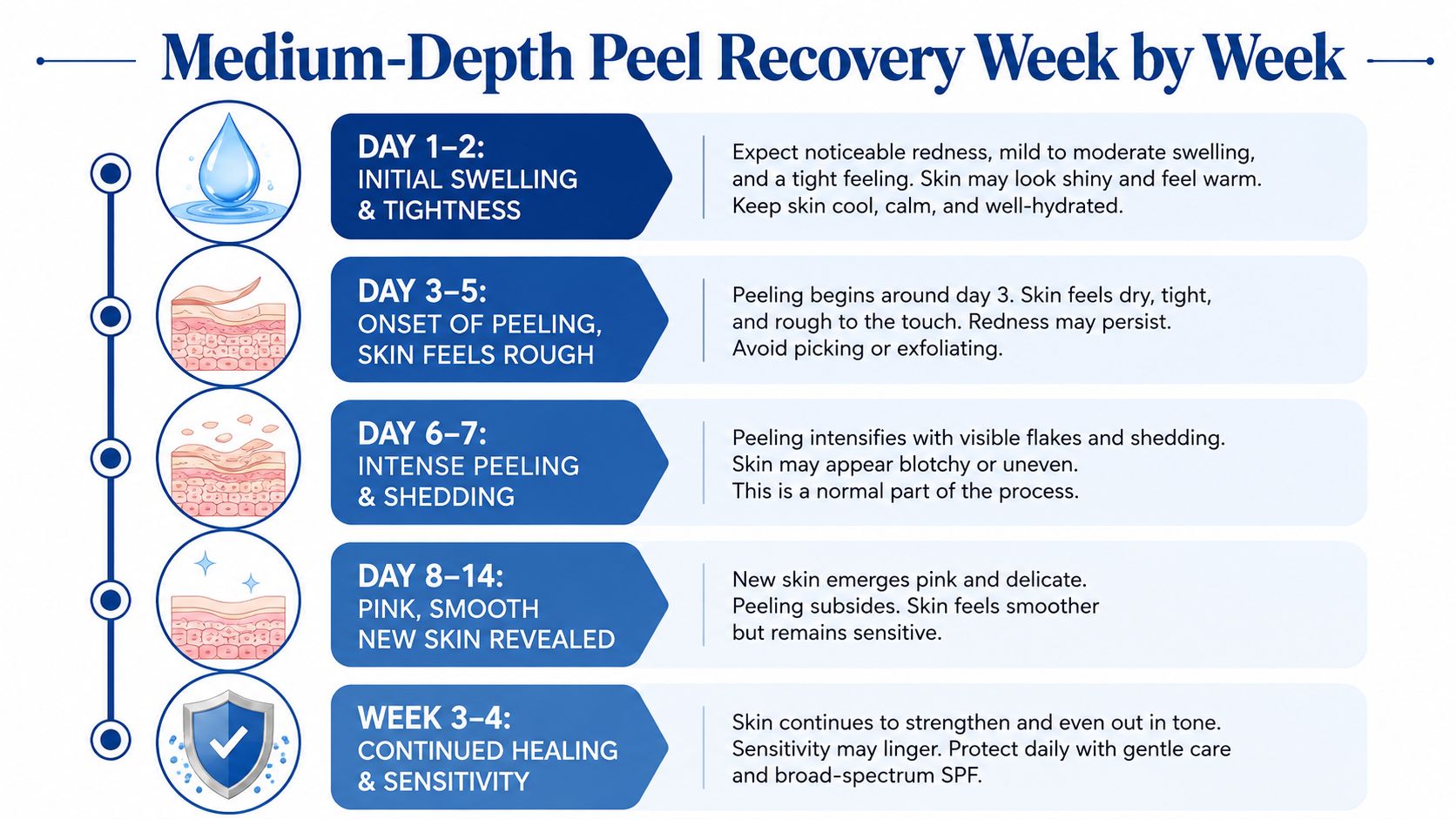
Medium-depth peels, including TCA or Jessner-style combinations, ask for more respect than light peels do. The skin doesn't just shed, it swells first, then peels more decisively, then settles into a pink, sensitive phase that can last longer than the visible flaking. A practical recovery timeline is often 7 to 10 days, with the broader healing window commonly landing at 7 to 14 days AAD chemical peel FAQ, Tactus Health recovery overview.
What the middle of recovery feels like
The first 24 to 72 hours are usually about tightness, swelling, and a warm, inflamed feeling. By days 3 to 5, the skin starts to roughen and lift, and by days 6 to 7, the shedding can become more dramatic. That's when ointment-based care matters most, because the new epidermis underneath needs protection while the old surface separates.
Use the simplest routine possible, cleanse gently, reapply a bland occlusive or moisturizer after washing, and stop treating the face like an exfoliation project. If there's mild crusting or light oozing early on, that can be part of the process, but worsening pain, thick drainage, or spreading redness should not be brushed off.
When you can start looking more normal again
By days 8 to 14, the new skin is usually revealed, but it often looks pink and feels reactive. This is the stage where mineral makeup may become reasonable again if the surface is intact and your clinician has cleared it. Sun protection stays essential because the barrier is still new and vulnerable.
A practical milestone list helps keep expectations realistic:
- Swelling easing: the face should look less puffy as the week goes on.
- Flakes slowing: the most active shedding should taper rather than spread.
- Barrier rebuilding: burning with basic products should lessen, not worsen.
- Makeup tolerance: mineral makeup can often return once the skin is closed and calm.
Do not restart retinoids early, and do not scrub off loose skin. Both are common mistakes that can extend redness and increase the odds of post-inflammatory hyperpigmentation. If you're unsure whether the surface is ready, let the skin win the race on its own timeline.
Deep Peel Recovery and the Long Remodeling Phase
Deep peels are where expectations need to be the most honest. They don't just create a few days of shedding, they create a wound-healing process that usually includes bandaging, ointment care, and a much longer remodeling phase. The AAD places deep-peel healing in the 14 to 21 day range, and Cleveland Clinic notes that full recovery can include 3 to 6 months of sun avoidance while the skin finishes healing AAD chemical peel FAQ.
The first two weeks are about protection, not cosmetics. Deep peels may need no makeup for at least 14 days, and the skin is usually managed with occlusive ointments and careful wound care until the surface closes. That level of aftercare is why deep peels are generally reserved for patients who can really commit to the downtime and the sun restrictions.
What the long phase really means
After the visible peeling ends, the skin is still remodeling underneath. Collagen is rebuilding, redness can linger, and the tissue keeps maturing long after the mirror stops showing obvious peeling. That's why a deep peel can look “done” to a friend while still being medically sensitive to sun and irritation.
The practical trade-off is clear. Deeper treatment can mean a larger change in skin quality, but it also means a more serious recovery rhythm, more caution with products, and more restraint with outdoor exposure. Patients who handle this best are the ones who plan their life around the treatment instead of trying to fit the treatment into a busy week.
Useful rule: if a treatment requires bandaging and ointment care, treat every shortcut as a healing risk, not a convenience.
Deep peels are not the time to experiment with new serums, aggressive cleansing, or “just a little” exfoliation. They reward consistency, photoprotection, and patience. If your schedule can't tolerate that, a less aggressive peel is usually the smarter choice.
Skincare, Sun Protection, and Active Ingredients
The first signs of recovery should look calm, not polished. Cleanse with lukewarm water and a mild, fragrance-free cleanser, then apply a thick bland moisturizer or ointment right after washing so the skin stays protected instead of drying between steps. That barrier-first approach matters because freshly peeled skin loses moisture quickly and can sting if you ask too much of it.
Sun protection has to be daily, broad-spectrum, and consistent. Freshly peeled skin is highly photosensitive, so shade, hats, and sunscreen all matter. Many post-peel plans keep active ingredients off the skin for at least 7 to 14 days after a peel, then bring them back slowly only once peeling has ended and the barrier looks intact. For a useful practical framework, see this internal skin-repair resource and the repair routine for sensitive skin, because the same logic applies here, calm the barrier first, then rebuild the routine.
What to avoid early on
For the first 48 to 72 hours, keep away from heat, sweat, hot water, steam, and hard exercise. Those triggers do more than feel uncomfortable. They can deepen redness and stretch out irritation, especially when the skin is already raw and reactive. The same caution applies to washcloth rubbing, hot showers, and anything that makes the face flush strongly.
A simple sequence works better than a crowded routine.
- Cleanse gently: use fingertips only, no scrubbing tools.
- Seal moisture in: apply ointment or bland cream to damp skin.
- Block the sun: use daily broad-spectrum protection.
- Delay actives: retinoids, acids, and exfoliants wait until the barrier is steady.
When actives can come back
Retinoids, AHAs, BHAs, vitamin C, and scrubs should stay out until the skin has stopped peeling and no longer stings when you apply a bland moisturizer. Patients often want to restart early because the surface looks smoother before it is stable. That is the step that turns a clean peel into a longer irritation cycle.
If basic moisturizer still burns, the skin is not ready for actives. If a workout or warm shower brings on tightness and flushing, the barrier is still too reactive. Wait for calm skin, not just skin that looks better in the mirror.
Recovery by Skin Tone and Pigmentation Risk
Skin tone changes the recovery conversation more than most consumer guides admit. Patients with darker phototypes often need a more cautious plan because inflammation can more easily leave behind post-inflammatory hyperpigmentation, and deeper injury raises the risk of prolonged redness and scarring Mayo Clinic chemical peel overview. That doesn't mean peels are off the table, it means the aftercare has to be tighter and the decision about peel depth has to be more deliberate.
What is expected and what is not
Redness is expected after a peel. Darkening can happen transiently as part of the healing process, but persistent dark patches, spreading discoloration, or a mark that keeps getting more obvious deserve a call back to the treating clinician. The same goes for redness that doesn't steadily soften, because prolonged erythema is not something to wait out forever.
Patients with higher pigmentation risk often do better with gentler peels, longer pauses before restarting actives, and earlier sun protection discipline. In practice, that means fewer experiments, less friction, and more consistency with moisturizer and photoprotection. The skin needs fewer variables, not more.
If color change looks worse instead of calmer after the first few days, don't treat it yourself. Call the clinic before adding acids, bleaching products, or extra exfoliation.
A good post-peel plan also accounts for how the skin behaves in real life, not just in the treatment room. Heat, friction, and sun all matter more when pigment risk is higher, so the safest course is usually a conservative one. That's especially true if you already know your skin marks easily after acne, irritation, or procedures.
Why the consultation matters
At a well-run consultation, the clinician should choose peel depth based on skin type, goals, and lifestyle, not just on the skin concern itself. The day of treatment should come with clear post-peel skincare instructions, follow-up guidance, and a direct line for questions if the skin reacts unexpectedly. In a Beverly Hills office setting, that conversation can also include whether a peel should be paired with other resurfacing options such as microneedling, Morpheus8, Venus Viva, or IPL as part of a layered plan.
The practical part matters too. Virtual and out-of-town consultations can make planning easier if you're traveling, and an office-based setting in the Golden Triangle keeps the process straightforward for patients who want careful, supervised care. For a closer look at the peel itself, Perfect Derma Peel information can help frame the kind of treatment decision that leads to smoother recovery.
Pain Control, Activity, and Warning Signs
Most chemical peel recoveries are uncomfortable, not miserable. A light to medium peel can create stinging, burning, tightness, and a sunburn-like feel, especially in the first part of the day. For short-term discomfort, over-the-counter acetaminophen or ibuprofen is commonly used, and aspirin is usually avoided at first because of bleeding risk in more aggressive treatments.
How to move without irritating the skin
Light walking is usually fine and can help you feel normal again without overheating the face. Strenuous exercise, sauna time, hot yoga, swimming, and long hot showers are the things most likely to prolong redness or trigger extra swelling, so they belong in the “wait” column. Sleeping with the head raised can also help reduce puffiness.
Reasonable standard: if the activity makes you flush, sweat heavily, or feel pulsing in the face, it's probably too much for the current stage of healing.
The timing is different for everyone, but a conservative approach usually means keeping intense sweat off the face for about a week, especially after a medium or deeper peel. Alcohol can also make flushing worse in some people, so it's smarter to be careful with it until the skin is calm again. The goal is simple, avoid anything that makes the newly treated skin work harder than it should.
Red flags that deserve a call
Contact the clinic if you notice any of the following:
- Severe pain: pain that isn't controlled by normal over-the-counter options.
- Fever or chills: systemic symptoms are not part of routine peeling.
- Pus or foul odor: these suggest infection.
- Widespread redness: especially if it keeps expanding instead of fading.
- Increasing swelling after day three: swelling should not keep ramping up.
- Blistering outside the treated area: that's not typical recovery.
- Pigment change that doesn't fade: persistent darkening or ongoing redness needs review Mayo Clinic chemical peel overview.
For Fitzpatrick IV to VI skin types, the threshold for checking in should be lower, not higher, because the cost of waiting too long can be a lingering mark that's harder to reverse. Most recoveries are uneventful, but knowing the warning signs makes it much easier to stay calm and make smart decisions at home.
If you're considering a peel or trying to make sense of how your skin should look day by day, Ideal Face & Body can help you plan the treatment around your skin tone, downtime, and risk of pigment change. Visit Ideal Face & Body to discuss a peel plan that fits your recovery window and gives you clear aftercare from day one.