Most patients take about 2 to 3 weeks off work, feel socially presentable around one month, and see the final refined result in about 3 to 6 months. That's the timeline that matters when you're trying to plan a wedding, a board meeting, or a camera-facing event without guessing.
Facelift recovery time isn't one number, because healing doesn't happen in one step. A face can be functional long before it feels settled, and it can look good in public before it's fully finished changing underneath the skin. That difference is where a lot of confusion starts, and it's also where the smartest planning happens. In a consultation room, the first question is rarely “When am I healed?” It's usually, “When can I drive, when can I work, and when will I look like myself again?”
At Ideal Face & Body, that conversation is shaped by an awake, office-based approach, which can change the early recovery experience because it avoids the grogginess many people associate with general anesthesia. The practical result is a recovery plan that has to be read in stages, not slogans.
Table of Contents
- What Facelift Recovery Time Really Means
- The First Week After Your Facelift
- Weeks Two Through Six of Healing
- Months Three Through Twelve and Final Results
- Factors That Change Your Recovery Speed
- Practical Aftercare Tips for a Smoother Recovery
- Common Side Effects and Red Flags to Watch For
- Frequently Asked Questions About Facelift Recovery
What Facelift Recovery Time Really Means
A patient comes in with a calendar open on her phone. The surgery date is chosen, but the key question is whether she can attend a family event, show up on camera, or return to client meetings without looking obviously post-op. That's where facelift recovery time gets misunderstood, because people often treat it like a single finish line when it's really three overlapping timelines.
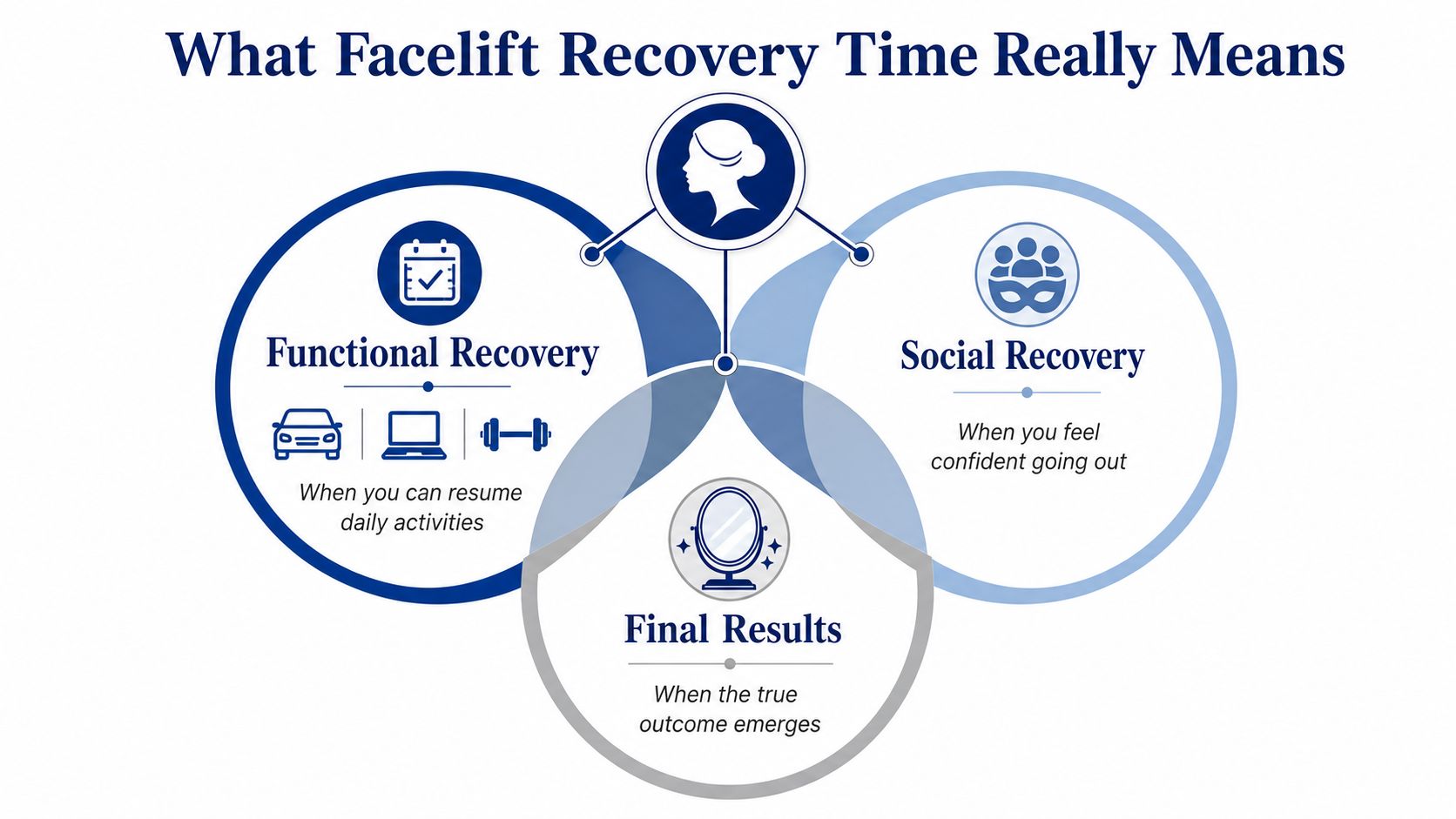
Functional recovery, social recovery, and final settling
Functional recovery is about what you can do. That includes driving, returning to work, and easing back into exercise. The American Society of Plastic Surgeons report found that patients took an average of 24 days off work, typically resumed driving after about two weeks, and felt able to sleep comfortably again after about two-and-a-half weeks. The report also noted that patients often felt “presentable” in public after about one month and “back to normal” after about two-and-a-half months.
Social recovery is different. You may be upright, moving, and back to routine before your face is ready for a dinner, photo shoot, or speaking engagement. That's why a stranger's impression matters more than a patient's temptation to resume everything early.
Final aesthetic settling is the slowest stage. Residual swelling, tightness, and numbness can continue long after the bruising fades, which is why the early mirror check is a poor judge of the final result. If you want a deeper look at why people choose facelift surgery in the first place, this overview of cosmetic benefits of a facelift helps frame the goals behind recovery planning.
Practical rule: plan your life around the timeline you need most. If work matters first, focus on functional recovery. If an event matters first, focus on social recovery. If you're judging the result, wait for contour settling.
Why the technique matters
An awake, office-based facelift changes the early experience because it removes one layer of recovery that can muddy the first days, namely the after-effects people associate with general anesthesia. That doesn't make swelling disappear, and it doesn't shorten tissue healing to nothing, but it can make the beginning feel cleaner and less foggy. In practice, that matters when someone needs to get back to light activity sooner and wants a clearer read on how the face is healing.
The First Week After Your Facelift
The first week is where patients learn whether they're following the plan well enough to protect the result. The face feels tight, the wrap feels unfamiliar, and the mirror is not flattering. None of that is unexpected. The goal during these days is simple, keep swelling controlled, protect the incisions, and avoid anything that spikes pressure or pulls on healing tissue.
What the first 72 hours usually feel like
The first 24 hours are typically about rest, numbness wearing off, and getting comfortable with elevation. Swelling and bruising often look more obvious by 48 to 72 hours than they did right after surgery, which catches people off guard if they expect a dramatic day-by-day improvement. That early intensification is part of normal healing, not a sign that something went wrong.
A custom head and neck wrap usually feels snug rather than painful. It's there to support tissues, limit motion, and keep edema from building unchecked. If drains are used, they're managed according to the surgeon's protocol, and patients should treat them as temporary support devices rather than something to fuss with constantly.
What helps and what doesn't
Cold compresses can help most when bruising and swelling are active, but they need to be used gently and exactly as instructed so the skin isn't overcooled. Head elevation is essential, even during sleep, because lying flat invites fluid to pool where you least want it. Light walking around the home is usually fine, but bending, lifting, and fast exertion are not.
Keep the face quiet. The first week is about reducing movement, not testing limits.
Pain control after an awake, local-anesthesia procedure is often more straightforward than patients expect, because there's no groggy “wake-up” phase from general anesthesia. That doesn't mean there's no discomfort. It means the discomfort is usually managed with a more predictable recovery rhythm, especially when movement stays gentle and the aftercare plan is followed closely.
During the first week, safe activities are the boring ones. Walk a little, rest a lot, keep the head in an upright position, and let the body do the work.
Weeks Two Through Six of Healing
This is the phase commonly meant when they ask how long facelift recovery takes. Bruising starts to fade, swelling drops enough for the face to look less obvious, and the patient finally starts recognizing her own contours again. The change is real, but it's still not the final version.
The middle weeks and what they usually mean
By this point, many people feel comfortable returning to desk work or other light daily responsibilities, especially if the job doesn't involve constant public-facing appearances. Cleveland Clinic notes that bruising and swelling usually last about 2 to 3 weeks, that more invasive facelifts may require up to 3 weeks off work, and that strenuous exercise should be avoided for at least 3 weeks. That guidance lines up with what patients typically experience in the office.
The face may still feel tight or numb. That sensation doesn't mean the lift failed, it means the tissue is still settling and the smaller nerves are recovering. A stranger may think the face looks fine while the patient notices every odd sensation, which is why subjective concern and visible healing don't always match.
A simple planning table
| Timeframe | Functional Milestone | Social Appearance |
|---|---|---|
| Week 2 | Light daily activity often feels realistic | Bruising may still be visible, makeup may help if approved |
| Week 3 | Many patients are back to work with limits | Face often looks much less swollen in public |
| Weeks 4 to 6 | Light exercise may resume gradually, with surgeon clearance | Appearance usually reads as rested rather than post-op |
Makeup usually comes back only after the skin is ready and incisions are protected. Sutures are commonly removed during the early part of this phase if they haven't already been handled sooner. The key is not to rush the visual milestones just because energy is improving.
If you want a good benchmark, judge the face by how it behaves in plain daylight, not by how it looks under soft bathroom lighting. Social confidence lags behind function for a reason, and that gap is normal.
Months Three Through Twelve and Final Results
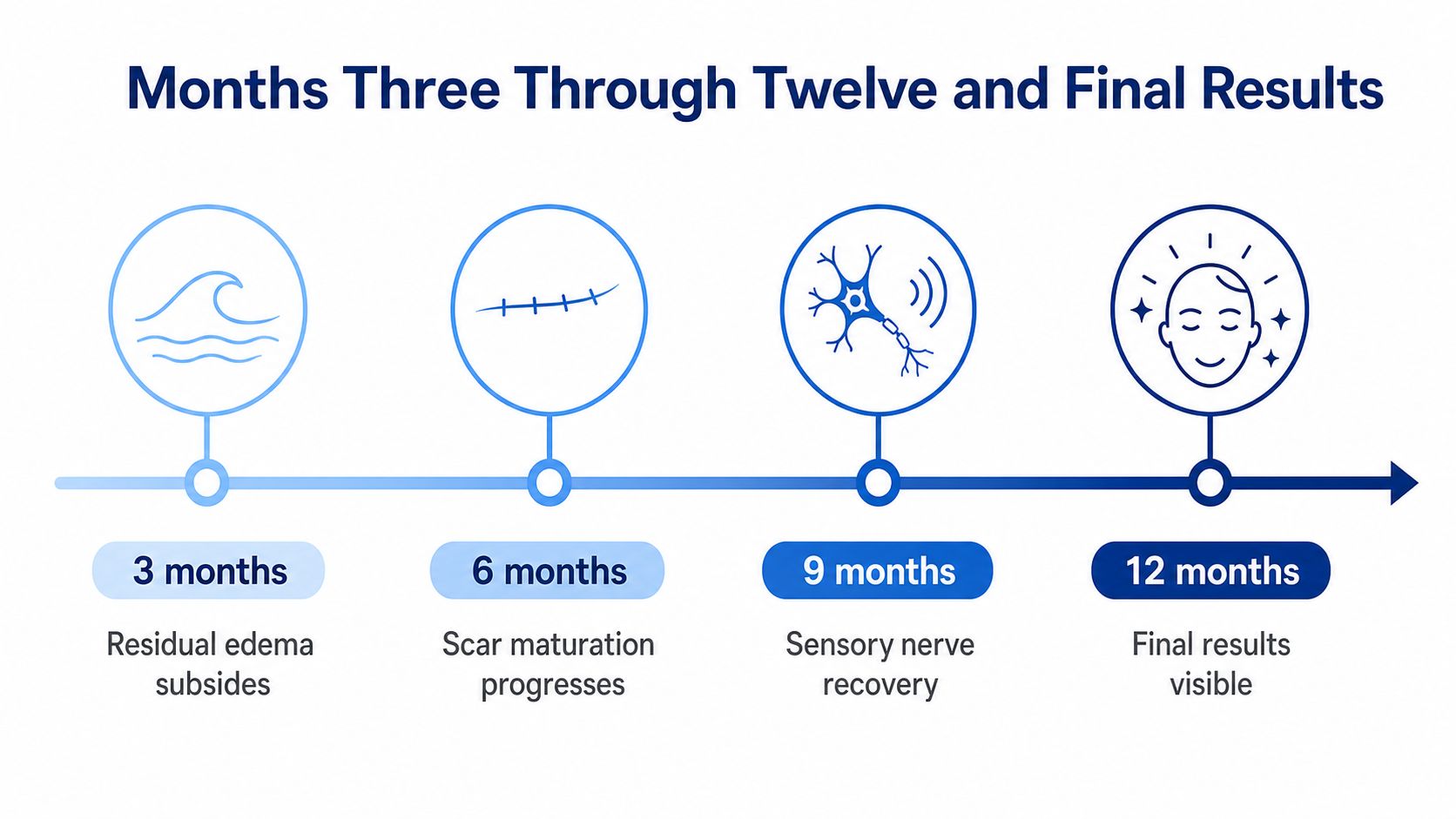
Patients often want to stop the clock once bruising is gone, but the final result isn't measured there. The face keeps changing as residual swelling resolves, scars mature, and small sensory changes improve. This is why the 3 to 6 month contour is the better benchmark for judging the operation than the early post-op mirror.
Why the outcome keeps refining
The American Society of Plastic Surgeons notes that while many patients are back to normal activities by about one month, very minor swelling, bruising, tightness, and numbness can persist for up to a year. Alberta Health also reports that recovery typically occurs in 4 to 6 weeks, but the final result may take 6 months or more to appear. MyHealth Alberta gives the same message in plain language, the surface looks healed long before the contours are fully finished.
That's why a patient can feel eager at three weeks and impatient at three months. Both reactions are normal. The tissue doesn't obey the same calendar as social plans.
The recovery arc from three months onward
At around three months, the result starts to read more cleanly because the face has had time to settle. Around six months, scar maturation is more established, and the shape usually looks more natural in motion. Minor tightness or numbness can still linger, and that doesn't automatically mean a problem.
If a neck lift or skin resurfacing was done at the same time, the settling phase can feel longer because more areas are healing at once. The smartest expectation is patience, not perfectionist checking in the mirror every day. This article on how to prolong facelift results is useful because it reinforces a simple truth, the result you protect after surgery is the result you enjoy for longer.
Best benchmark: judge the facelift by the way it looks and moves at three to six months, not by how it looked when swelling was still obvious.
Factors That Change Your Recovery Speed
A patient can follow the same aftercare instructions and still heal at a different pace. That is normal. Recovery speed depends on how much correction was done, how your tissue responds, and whether the procedure was limited to one area or combined with other work.
What tends to shorten or lengthen the process
A lighter facelift usually brings less early swelling than a more extensive lift because there is less tissue disturbance. Awake, local anesthesia can also make the first day or two feel easier because patients avoid the grogginess that often follows general anesthesia. For many people, that makes the return to normal routines feel more controlled from the start, which is one reason our awake facelift complete guide matters when you are trying to understand the recovery timeline.
Skin quality matters as well. Better elasticity often supports a smoother transition, while thinner or more fragile skin may settle more slowly. Age can influence recovery, but it does not determine it on its own, and overall health often affects the course just as much as the number on a chart.
The trade-off is simple. A more conservative operation may calm down faster early on, while a fuller correction can take longer to settle even if the result is ultimately worth the wait.
What you can control
Certain choices help recovery stay on track.
- Stop smoking well before surgery: nicotine works against circulation and tissue repair.
- Plan real downtime: calendar pressure leads people to do too much too soon.
- Follow elevation and activity rules: swelling is much harder to manage once it ramps up.
- Don't stack unnecessary strain: lifting, workouts, and travel fatigue all add up.
- Use skin-sagging prevention strategies: steady hydration, sensible sun protection, and good skin habits support the result before and after surgery, even though they do not replace surgical technique.
For patients who want a practical reminder that movement after surgery should be deliberate, not rushed, restore mobility after surgery is a useful reference point.
What changes the timeline the most
A mini facelift usually heals on a different schedule than a more extensive lift because the depth and breadth of correction are different. Adding a neck lift, eyelid lift, or resurfacing also changes the schedule because more than one area is recovering at once, and each area can swell or stiffen on its own timetable.
If the face is treated in a more office-based, awake setting, the early phase often feels cleaner because there is less anesthesia recovery layered on top of the surgical recovery. That does not remove the need for careful aftercare. It does make the first stretch easier for some patients, especially when they want to return to light work before they are fully social-ready.
The cleanest way to estimate recovery is to ask two questions. How much visible work was done, and how disciplined will the aftercare be? Those answers tell you more than a generic timeline ever will.
Practical Aftercare Tips for a Smoother Recovery
After a facelift, recovery goes more smoothly when the first few weeks are treated like a protected window, not a time to test limits. Good aftercare does not speed healing in a dramatic way, but it does make the process more predictable. Patients who do best usually follow a simple routine and avoid the urge to keep checking the mirror for instant change.
The daily checklist that helps
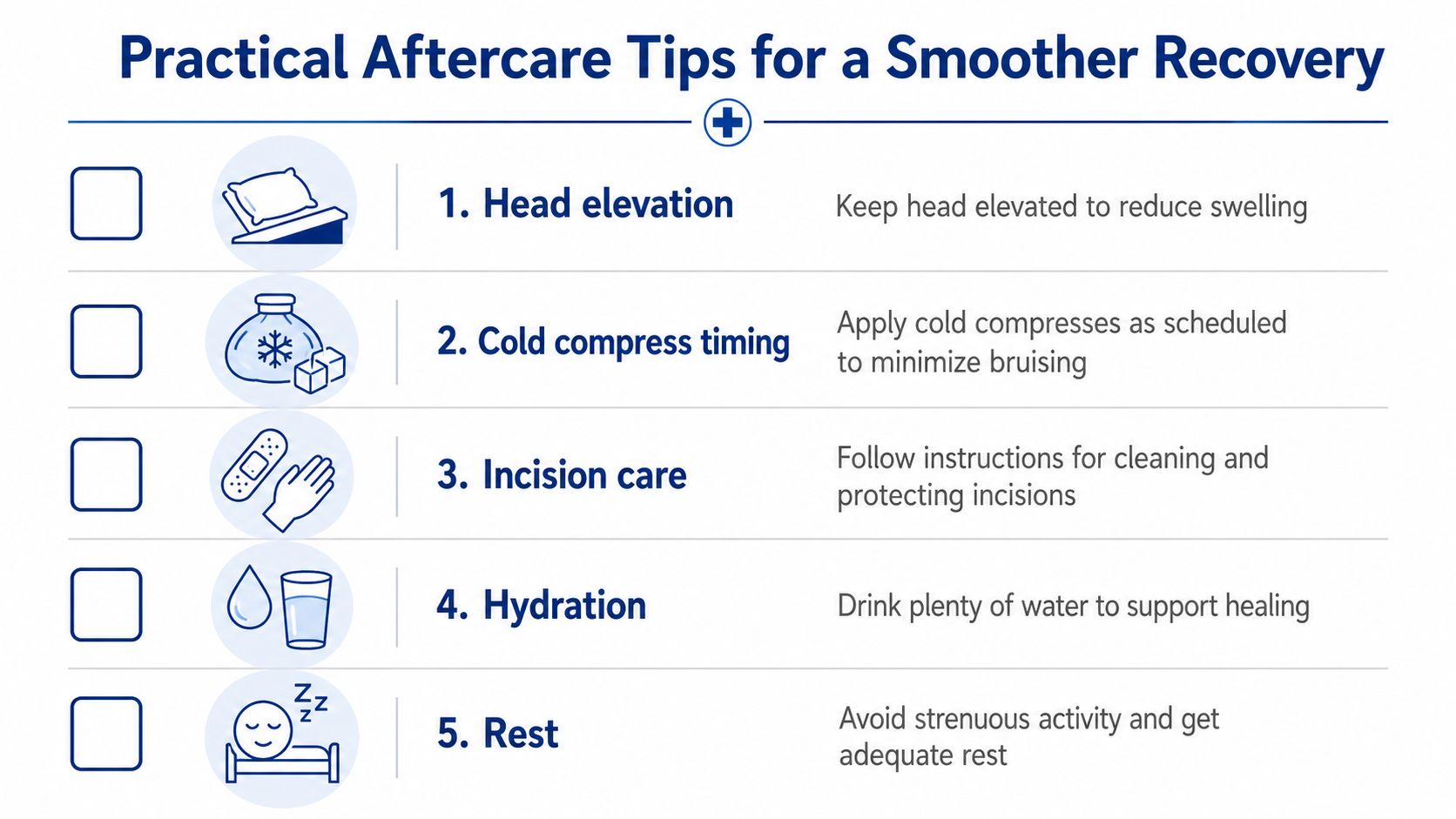
- Keep the head raised: use pillows or a reclined position so fluid does not collect in the face overnight.
- Use cold compresses exactly as directed: they help most while bruising and swelling are active, and they should stay gentle rather than intense.
- Protect the incisions: clean them only as instructed and keep products off the area until you are cleared.
- Hydrate consistently: the body heals better when it is not running dry.
- Walk lightly, rest generously: short walks support circulation, but strenuous activity can disturb the calm you are trying to maintain.
Skin care and comfort
Skincare actives, exfoliants, and stronger products should stay out of the early recovery zone until the incision lines and surrounding skin are ready. Sun exposure deserves real caution, because healing skin does not need extra irritation or pigment changes. If you are eager to restart your routine, that enthusiasm usually outruns the timeline your skin can tolerate.
Pain control is often simpler with an awake, local-anesthesia procedure because the body is not also recovering from deep sedation. That does not mean you should guess at medications or try to push through discomfort on your own. It means the plan should be followed exactly, with only the smallest necessary amount of intervention.
Aftercare also depends on what kind of recovery you are measuring. Functional recovery, like driving, working, or handling routine errands, usually returns before social recovery, the point when the face looks presentable for events and close-up interactions. Final aesthetic settling takes longer still, especially when swelling, tissue stiffness, and subtle asymmetry are still fading. In an awake, office-based setting like Ideal Face & Body, the early phase can feel cleaner because there is less anesthesia recovery layered on top of the surgical recovery, but technique still shapes how quickly each stage arrives. A lighter operation may allow a quicker return to basic function, while a more involved lift or combined procedure usually asks for more patience.
If you want a practical reminder that movement after surgery should be deliberate, not rushed, restore mobility after surgery is a useful reference point.
What works best: quiet early movement, disciplined head support, and patience with your skincare routine.
If you are tempted to judge progress by doing more, hold back. Recovery rewards consistency, not experiments.
Common Side Effects and Red Flags to Watch For
Bruising, tightness, numbness, and some asymmetry are part of the normal picture. They're not proof that something is wrong. They're proof that tissue has been manipulated, blood flow is changing, and the skin is adapting to its new support.
What's expected
Bruising and swelling are usually most obvious early, then taper gradually. Tightness often lasts longer than patients expect, and numbness can be especially unsettling because it makes the face feel unfamiliar. Mild asymmetry is also common during healing, since one side may settle differently than the other while swelling is still uneven.
What needs a prompt call
Sudden changes are the problem, not slow improvement. Rapidly increasing swelling on one side, fever, spreading redness, or sudden severe pain should get immediate attention. Those are not symptoms to watch casually while hoping they fade on their own.
If there's drainage that looks worse instead of better, or if discomfort sharply escalates after it had been improving, the office should hear about it. Patients sometimes read online claims that they'll look fully normal in a few days, but that isn't a realistic standard for facial surgery recovery. A safer expectation is a visible healing phase that stretches across weeks, with refinement continuing afterward.
The right response to a red flag is simple, contact the surgeon's office promptly. Recovery is supposed to evolve, not suddenly reverse.
Frequently Asked Questions About Facelift Recovery
A patient with a late flight asks whether she can travel soon after surgery. Another wants to know when she can color her hair, and someone else asks how long the sun has to be treated like a real concern. Those are the right questions, because recovery has to fit daily life, not a brochure timeline.
Functional recovery, social recovery, and final settling do not happen at the same pace. You may be able to resume light routines before you feel comfortable being out in public, and you may look presentable before the face has fully settled. That difference matters, especially with awake, office-based facelift planning, because the technique and anesthesia approach can change how hard the first stretch of healing feels.
Common questions in consultation
Can I fly soon after a facelift? Usually not right away. Travel adds fatigue, sitting time, and logistical stress that are harder on a healing face than people expect, so the timing should be cleared for each patient.
When can I color my hair? Not until the incisions and the skin around them are ready for it, since chemicals and salon positioning can irritate fresh healing.
How long do I need to avoid the sun? Longer than the bruising stage. Healing skin stays sensitive, and direct exposure can interfere with the final look.
Is recovery easier with local anesthesia? Often, yes. Patients usually avoid the grogginess tied to general anesthesia, which can make the first part of recovery feel less heavy and can help some people get back to basic routines sooner.
A practical recovery plan should match your work, travel, and social calendar, not a generic aftercare sheet. If you want a clear conversation about what you can do first, what still needs to wait, and how awake, office-based surgery may affect the pace of healing, a consultation in Beverly Hills is the right next step.
Ideal Face & Body offers facelift planning built around awake, office-based surgery, which means recovery conversations are practical from the start, not theoretical. If you want a personalized timeline, careful aftercare guidance, and a candid discussion about what healing really looks like, visit Ideal Face & Body and schedule a consultation in Beverly Hills, CA.