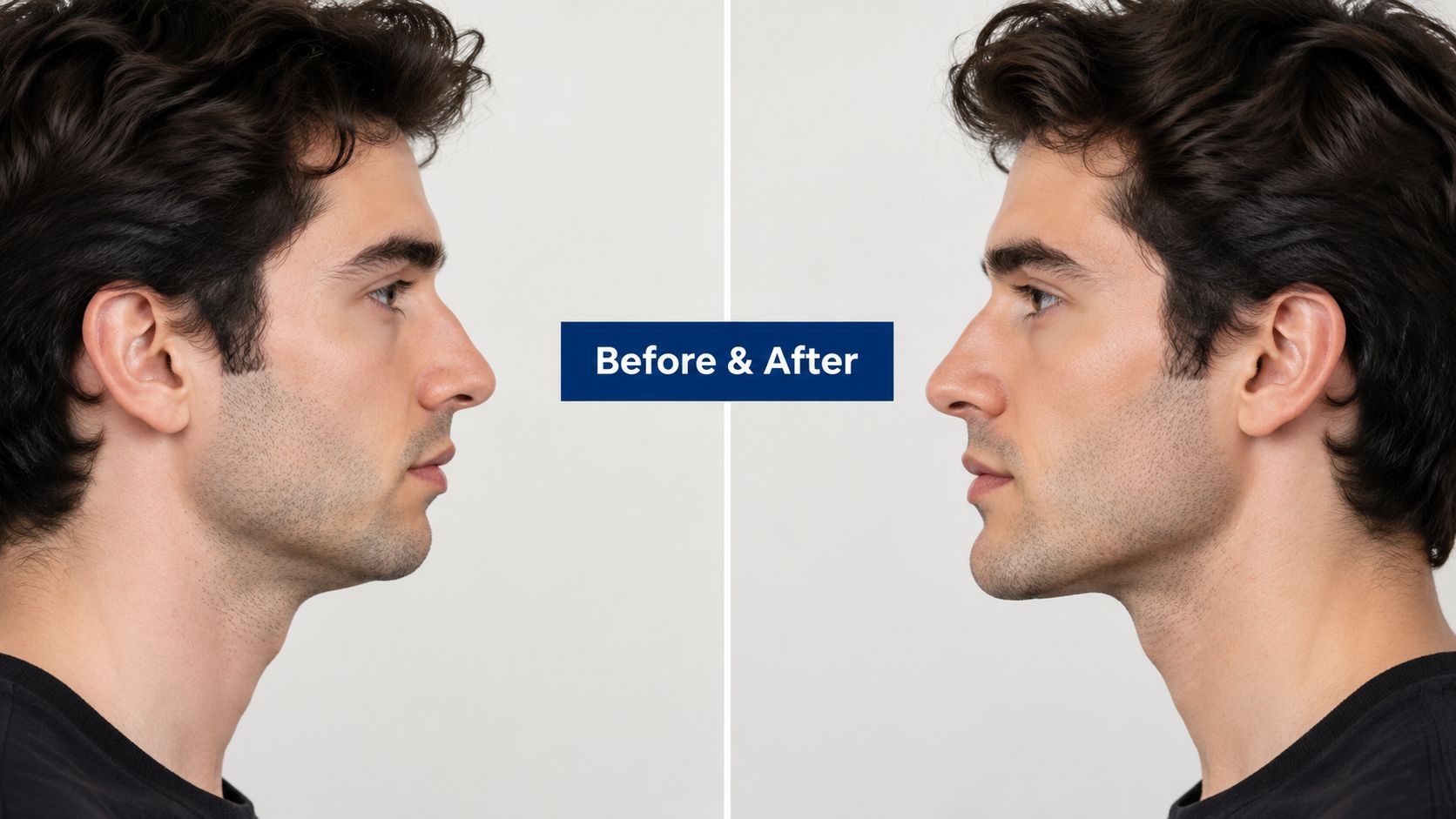
Men accounted for 22% of all chin augmentation procedures reported in the United States in 2024, according to the American Society of Plastic Surgeons' 2024 male procedure statistics. That makes “chin implant men before and after” more than a search for dramatic profile photos. It's a way to judge whether added projection creates durable facial balance, or looks impressive while swelling is still present.
A masculine chin should support the lower face without looking inserted, pointed, or disconnected from the jaw. The right result depends on bone structure, soft-tissue thickness, implant shape, placement, fixation, and the relationship between the chin, lips, nose, neck, and jawline. A gallery can show the visible change, but it rarely tells you how that contour looked after healing or whether the implant remained stable over time.
Table of Contents
- Why Male Chin Augmentation Is Growing in Popularity
- Surgical Techniques and Implant Materials Explained
- Before and After Case Studies in Male Patients
- Chin Implants Versus Genioplasty and Fillers
- Long-Term Risks and What Galleries Do Not Show
- Candidacy and Recovery Expectations for Men
- Making Your Decision with Confidence
Why Male Chin Augmentation Is Growing in Popularity
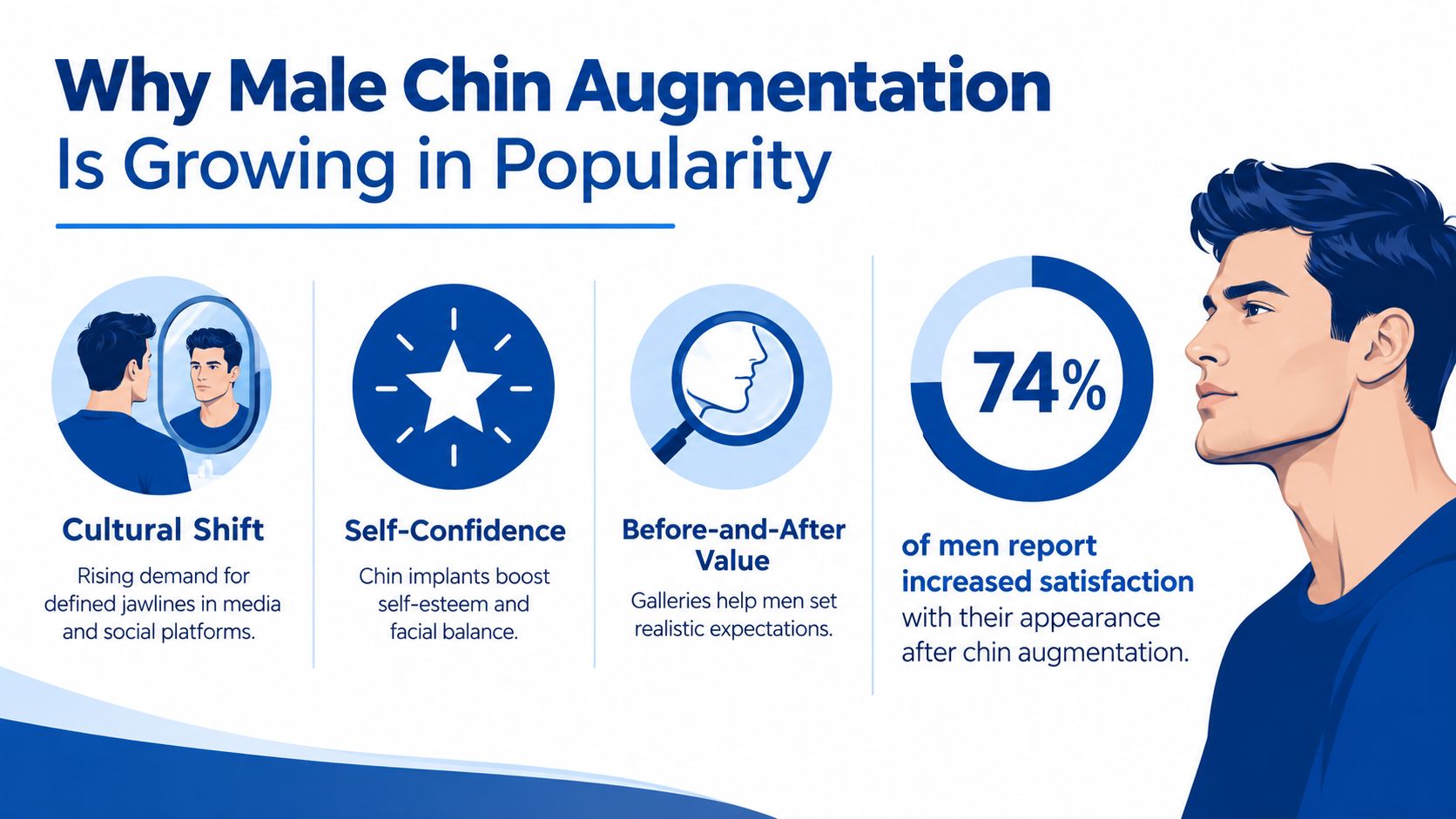
Men increasingly seek chin augmentation because facial balance is more visible in everyday images. Video calls, profile photographs, social platforms, and changing expectations around male grooming can make a recessed chin easier to notice. A weak chin may make the neck appear fuller, shorten the visible jawline, or make the nose look more prominent even though the nose itself has not changed.
The demand is established rather than a short-lived fad. The 2024 ASPS figures cited earlier recorded 1,217 chin augmentations in men, representing 22% of all chin augmentation procedures and a 0.6% year-over-year increase for men. These figures support continued interest in stronger lower-face projection, but they do not show whether a particular implant remains well positioned years later. Durability depends on the patient's anatomy, implant design, pocket preparation, fixation, and how the soft tissues age around the device.
What a useful gallery should reveal
A credible before-and-after gallery should help you judge proportion, not enlargement. Look for consistent lighting, similar head position, a neutral facial expression, and several views. A side profile demonstrates projection. Frontal and three-quarter photographs show width, symmetry, lower-lip support, and whether the contour becomes too narrow or pointed.
Ask when the after photograph was taken. Early images can make the result appear fuller because swelling remains. They may also conceal small contour irregularities that become clearer after the tissues settle. A gallery that includes later follow-up gives a more useful indication of stability, soft-tissue coverage, and whether the chin still fits the patient's face after healing.
Practical rule: Don't ask only, “How much bigger is the chin?” Ask whether the patient's entire lower face looks more proportionate.
Be cautious with photographs showing one flattering angle, forceful facial posing, inconsistent camera distance, or no follow-up information. Men with thin soft tissue may see implant edges or feel the device more readily than men with thicker coverage. A reliable gallery should show those anatomical differences instead of implying that one implant and one fixation approach produce the same face in every patient.
Surgical Techniques and Implant Materials Explained
Implant durability depends on three decisions made in the operating room: the pocket, the material, and fixation. An implant sits in a pocket over the chin bone, but the pocket's depth and boundaries determine how well it remains positioned. Subperiosteal placement places the device close to the bone and beneath the periosteum, the tissue layer covering it. Dual-plane placement uses more than one tissue plane, changing how the implant contacts muscle and overlying soft tissue.
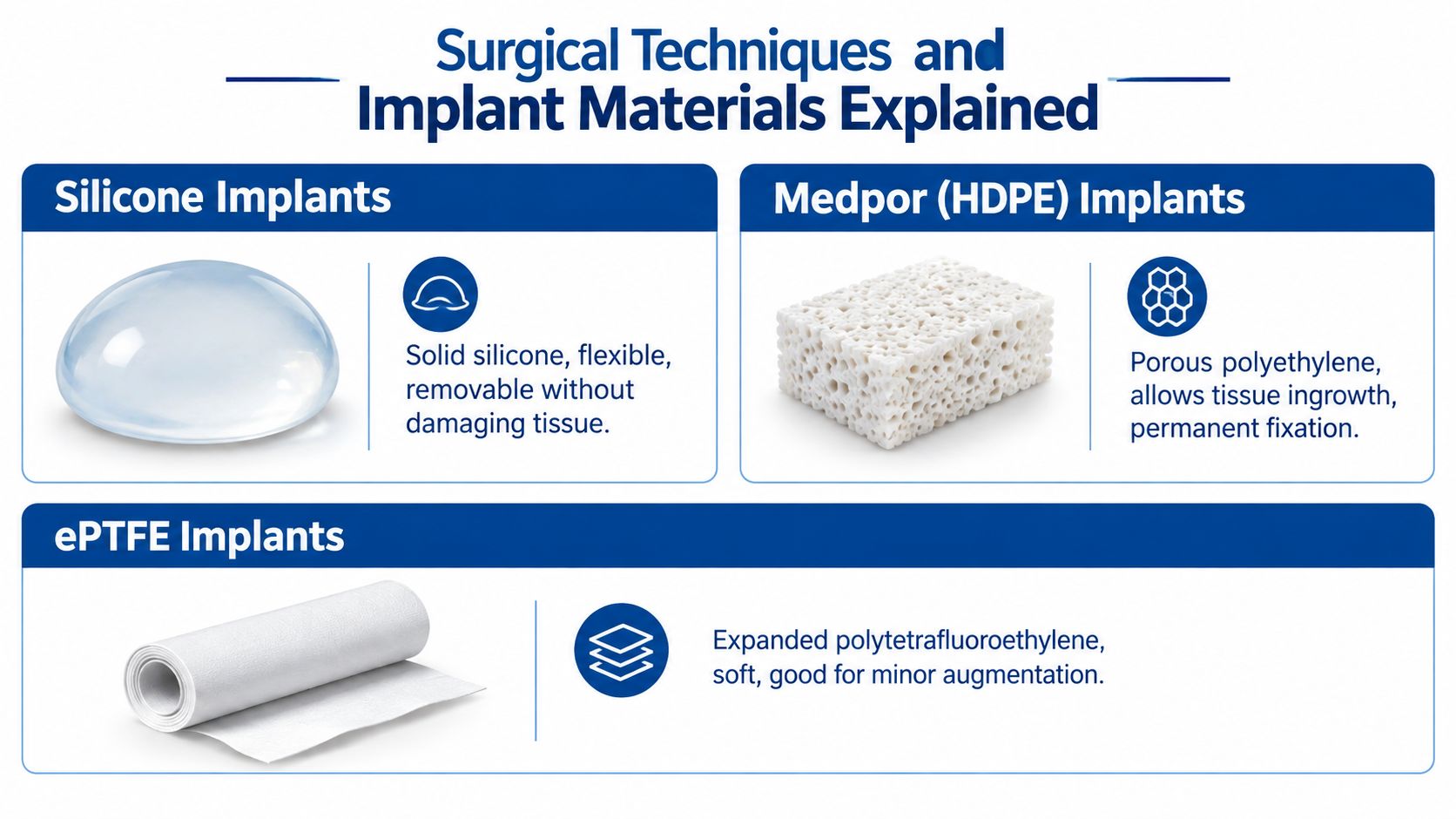
Material selection also shapes the long-term trade-offs. Silicone is solid, smooth, and generally easier to remove. Medpor, or HDPE, has a porous structure that encourages tissue ingrowth, which can make later removal more involved. ePTFE is softer and may suit a subtler contour. None is automatically appropriate for every male face, particularly when soft-tissue coverage and the desired amount of projection differ.
How the material changes the trade-off
A 2023 systematic review of chin augmentation materials and techniques included more than 3,104 patients. It reported a 0.4% paresthesia rate for silicone implants, compared with 20.1% for HDPE and 3.2% for ePTFE. Those figures require context because patient selection, operative technique, follow-up duration, and complication definitions varied among the studies.
A separate clinical review of chin augmentation outcomes reported an average total complication rate of 1.0% for silicone and 3.3% for Medpor in the analyzed series. A 2022 systematic review found that complications in primary augmentation were rare and that commonly used materials could produce comparable satisfaction and outcomes. The practical conclusion is clear: material alone does not determine the result.
Choose the implant according to mandibular shape, soft-tissue thickness, projection goals, and how much importance you place on straightforward removal versus tissue integration. A material that feels stable in one patient may be too palpable or difficult to revise in another.
Placement and fixation
Technique affects both stability and sensation. A 2023 systematic review of alloplastic chin augmentation found higher reported rates with dual-plane placement than subperiosteal placement for malposition, revision, and removal, while paresthesia was lower with dual-plane placement. The reported malposition rates were 2.8% versus 0.5%, revision rates were 4.7% versus 1.0%, and removal rates were 4.7% versus 1.1%, respectively.
Fixation deserves a direct discussion. Sutures, screws, or other methods may limit movement when anatomy or implant design increases the chance of migration. Fixation does not remove every late concern. It changes the stability equation, so the surgeon should explain why a particular method suits your bone, soft tissues, and implant rather than presenting fixation as a universal guarantee.
For background on projection selection, review high-profile versus moderate-profile implants. A stronger male chin usually comes from controlled forward projection and smooth lateral blending, not the largest available device. That restraint is what helps the result remain proportionate as swelling resolves and the tissues settle.
Before and After Case Studies in Male Patients
Before-and-after images are most useful when they're read as anatomy lessons. Two men can receive similar-looking implants and still develop very different contours because their mandibular shape, soft-tissue coverage, neck fullness, and facial proportions aren't the same.

The recessed profile with otherwise balanced features
A man with a mild horizontal deficiency may have a normal bite and a reasonably defined jaw, but his chin sits too far behind his lips and nose in profile. In this situation, a contoured silicone implant placed close to the bone may add forward projection without creating excessive lower-face length. The before image often shows a short-looking profile and a soft cervicomental angle. The after image should show a cleaner transition from lower lip to chin and a better relationship between the nose and chin.
The success of this case doesn't come from maximum size. It comes from choosing projection that fits the existing bone and allowing the soft tissue to drape smoothly over the implant.
The weak chin with submental fullness
Another common pattern combines a recessed chin with localized neck fullness. Adding an implant can improve projection, but it won't remove fat beneath the chin. If the skin has reasonable elasticity, neck contouring may be performed as an adjunct to clarify the border between the jaw and neck. The result should look like a more continuous jawline, not an isolated bump at the front of the face.
Before selecting an adjunct, the surgeon should determine whether the fullness comes mainly from fat, lax skin, muscle anatomy, skeletal deficiency, or a combination. Male chin, neck, and jawline contouring examples can help patients understand how soft-tissue treatment differs from skeletal projection.
The severe deficiency that an implant may not fully correct
A man with marked microgenia may want a substantial profile change, but an implant has limits. Increasing implant size can create edge visibility, unnatural projection, or tension on thin tissues before it produces the desired skeletal relationship. In that setting, advancement of the chin bone may provide a more thorough correction because it moves the patient's own bone rather than placing volume over it.
The before-and-after lesson is straightforward: a visible improvement isn't the same as complete correction. A responsible surgeon should show you cases with similar starting anatomy and explain where an implant may under-correct, over-project, or require an alternative.
Chin Implants Versus Genioplasty and Fillers
Men often ask which option creates the most masculine jawline. The answer depends on whether the problem is primarily a modest projection deficit, a skeletal relationship, or a need to test a temporary change.
A chin implant adds volume over the existing bone. Osseous genioplasty advances the chin segment itself. Dermal filler adds temporary soft-tissue volume and can be useful when the patient wants a reversible change or isn't ready for surgery. These approaches don't produce interchangeable results.
| Criteria | Chin Implant | Genioplasty | Dermal Filler |
|---|---|---|---|
| Main action | Adds projection over the chin bone | Advances the patient's own chin bone | Adds temporary soft-tissue volume |
| Best suited to | Mild to moderate deficiency with suitable soft tissue | More substantial skeletal deficiency or a need to reposition bone | Subtle refinement, testing, or nonsurgical treatment |
| Longevity | Intended as a durable surgical correction, but late complications can require revision | Skeletal advancement is a durable structural change | Temporary and maintenance-dependent |
| Recovery profile | Surgical swelling, tenderness, and settling | More extensive bone-healing considerations | Usually less downtime, but results and risks depend on injection technique |
| Main trade-offs | Infection, displacement, palpability, nerve symptoms, and revision | Infection, dehiscence, reoperation, and neurosensory concerns | Temporary effect, asymmetry, irritation, and injection-related risks |
| Effect on shape | Can increase forward projection and chin width depending on design | Can reposition projection and alter the bony contour | Can camouflage or refine without moving the skeleton |
The comparison is supported by a study comparing osseous genioplasty with chin implants. At follow-up, infection was significantly higher in the implant group, and dehiscence and reoperation were also more common after implants. Patient satisfaction was significantly higher after genioplasty, while neurosensory disturbance rates didn't differ significantly between the groups.
A filler consultation should focus on what filler can and can't accomplish. It may soften a small deficiency or let you preview a direction, but it won't recreate the structural movement of genioplasty or the broad contouring effect of a carefully selected implant. For an overview of different types of dermal fillers, consider how product behavior, reversibility, and treatment goals fit your situation.
The right choice is the one that solves the actual anatomical problem with an acceptable risk profile. Bigger isn't automatically more masculine, and permanent isn't automatically better.
Long-Term Risks and What Galleries Do Not Show
Before-and-after galleries usually capture an early postoperative milestone, not the full life of an implant. Swelling can hide minor irregularities, and a newly defined contour may change as tissues settle. Years later, men may notice shifting, edge visibility, palpability, asymmetry, dissatisfaction, or a different relationship between the implant and the underlying bone.
The long-term concern most often discussed is bone resorption or erosion. A 2023 narrative review of chin implant complications reported an average complication rate of 7.2%, with bone resorption or erosion the most common reported complication at 5.78%. The review also reported displacement at 0.42%, asymmetry at 0.32%, dissatisfaction and hematoma at 0.21% each, mucosal irritation at 0.21%, and pain at 0.1%.
These figures describe reported outcomes across reviewed cases, not a personal forecast. Implant design, pocket preparation, fixation, tissue thickness, facial movement, and later trauma all affect durability.
Why fixation deserves attention
An implant that shifts can alter the chin's central position, lateral width, or lower border. Pocket control, fixation, muscle forces, trauma, and device design each influence stability. A high-level review of long-term implant complications found substantially higher complication rates in nonfixated implants than in fixated implants, 23.41% versus 5.5%. Its discussion included displacement, bone changes, dissatisfaction, and revision as long-term concerns.
Fixation does not correct poor sizing or placement. A firmly secured implant can still be too wide, too prominent, or poorly suited to thin soft tissue. In another patient, a specific fixation method may create an unacceptable risk because of anatomy, bone contour, or access.
Ask directly: “How does this implant look after the swelling is gone, and what follow-up images can you show me beyond the early healing period?”
Thin tissue changes the visual equation
Thin skin and limited soft-tissue coverage make an implant easier to see or feel. Sharp edges, overcorrection, and excessive vertical height may become apparent during movement, under strong lighting, or with facial expression. Assessment should include tissue thickness, the bony contour, implant edges, and how the selected device will age with the surrounding tissues.
The systematic review cited earlier should not replace an individual assessment. A gallery shows shape at selected moments. It does not show whether the implant remained centered, whether bone changed beneath it, or whether revision was later required.
A responsible consultation includes a long-term plan. Ask which symptoms can be observed, which findings suggest migration or infection, how fixation will be performed, what follow-up is provided, and what options exist if the contour changes years later.
Candidacy and Recovery Expectations for Men
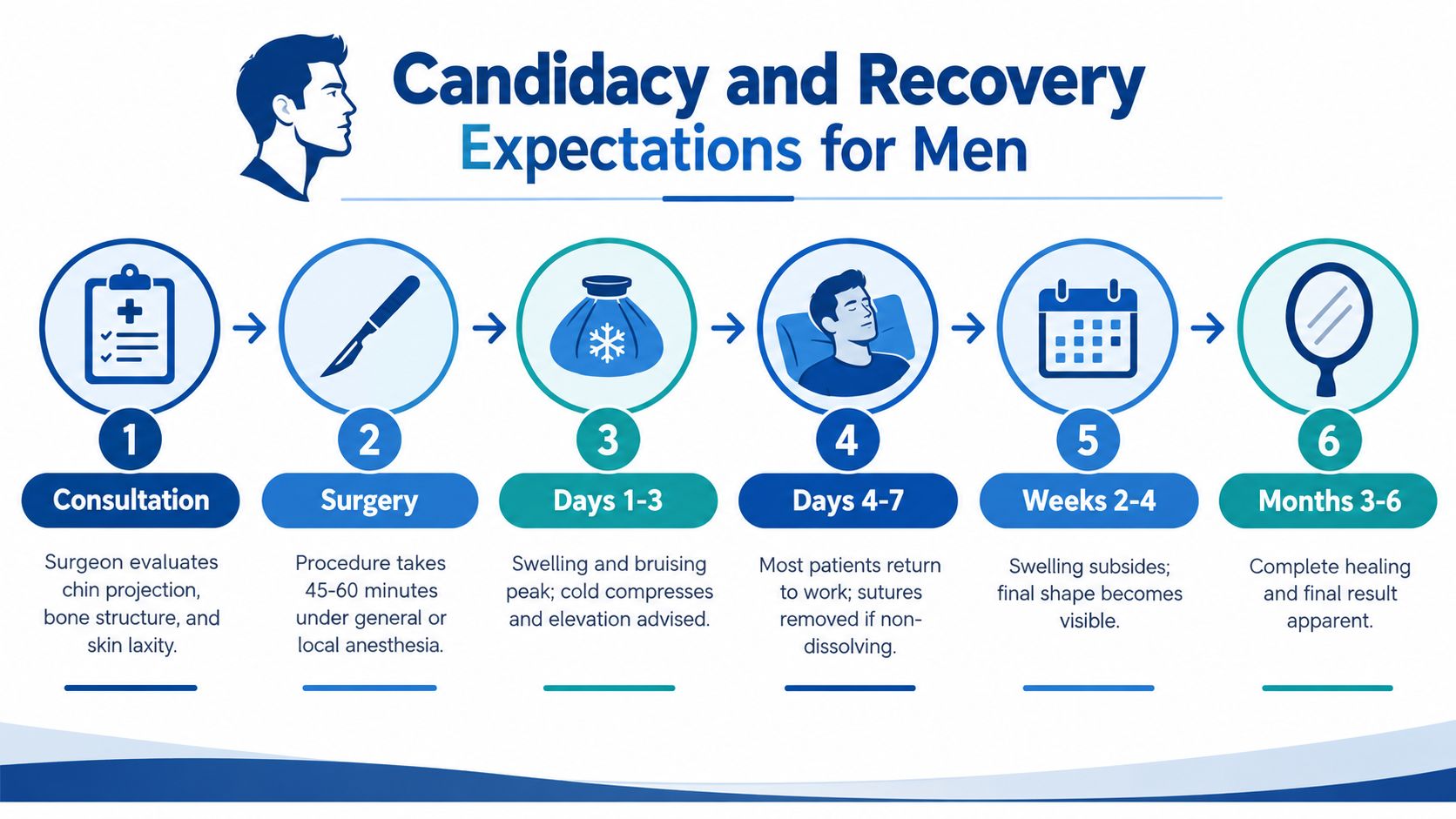
Good candidacy starts with anatomy, not a desire for a particular implant size. A surgeon should evaluate chin projection in profile, lower-face height, jaw width, bite and skeletal relationships, soft-tissue thickness, neck contour, skin quality, and your expectations. The goal is usually balanced forward support, not an exaggerated point.
You're more likely to have a predictable result when your concern is specific, your facial growth is complete, your health supports elective surgery, and you understand that photographs represent one stage of healing. Active infection, unstable weight, untreated dental or bite problems, or unrealistic expectations may require attention before augmentation.
What recovery usually feels like
Early swelling and tightness can affect the chin, lower lip, and neck. Eating, speaking, sleeping position, and facial expression may feel different temporarily. Your surgeon's instructions about wound care, compression, activity, and avoiding pressure on the implant matter because the pocket is still settling during the early period.
The visible contour improves progressively rather than appearing fully finished immediately. A photograph taken soon after surgery may show swelling, while a later photograph may reveal the true relationship between the chin and jawline.
Adjunctive contouring
An implant improves projection, but it doesn't automatically sharpen the entire neck. If localized submental fat blurs the jawline, a contouring procedure may improve the transition between the chin and neck. If lax skin or muscle bands dominate, fat removal alone may not solve the problem.
Ideal Face & Body offers facial implants and chin and neck contouring options, including awake, office-based procedures under local anesthesia. Suitability depends on the operation, anatomy, medical history, and the surgeon's assessment. The important question isn't whether an adjunct is available. It's whether it addresses the specific tissue limiting your result.
Making Your Decision with Confidence
Start with your own anatomy, not a celebrity profile or the largest result in a gallery. Bring several examples that show the degree of projection you prefer, then ask whether your bone and soft tissue can support a similar contour.
During consultation, ask:
- Follow-up timing: How long after surgery were the after photographs taken?
- Material choice: Why does the proposed material fit your tissue thickness and goals?
- Fixation: Will the implant be fixed, and what problem is that intended to prevent?
- Alternatives: Would genioplasty or filler solve the underlying concern more appropriately?
- Late risks: How do you monitor displacement, palpability, bone changes, infection, and nerve symptoms?
- Revision planning: What happens if the result changes or doesn't meet your expectations?
A useful gallery shows comparable patients in consistent views and includes healed results. Be cautious when every case looks identical, only flattering angles appear, or the practice avoids discussing complications.
The strongest decision framework is simple: choose the least aggressive approach that can correct the actual deficiency, while accepting the trade-offs. A natural male result should look integrated in profile, frontal view, and motion, not merely impressive in one carefully controlled photograph.
Ideal Face & Body provides consultations for men considering chin implants, facial balance, and chin, neck, and jawline contouring, including appropriate awake procedures performed under local anesthesia. Visit Ideal Face & Body to review relevant treatment options and request a consultation focused on your anatomy, long-term goals, and realistic before-and-after expectations.