You've made it through the procedure, gone home with your head and neck wrapped, and woken up wondering why the area looks puffier than it did before treatment. That reaction is common. Recovery from neck liposuction has two timelines running at once: you may feel capable of ordinary tasks within days, while swelling, firmness, numbness, and subtle asymmetry continue changing for weeks or months.
At Ideal Face & Body in Beverly Hills, CA, awake, office-based neck contouring under local anesthesia allows many patients to return home with a detailed aftercare plan. The early period still requires discipline. Knowing what normal healing feels like, what the compression garment can realistically accomplish, and when a late contour change deserves a call makes the process calmer and safer.
Table of Contents
- What Recovery from Neck Liposuction Really Feels Like
- Immediate Aftercare and Head and Neck Wrapping Essentials
- Swelling Bruising and Contour Refinement Timeline
- Compression Garments and What They Can and Cannot Do
- Returning to Work Exercise and Daily Activities Safely
- Follow Up Milestones and Red Flags That Need a Call
What Recovery from Neck Liposuction Really Feels Like
During the first forty-eight hours, the most noticeable features are usually tightness, puffiness, bruising, and the wrap itself. A patient may look in the mirror and see a fuller chin or uneven coloration, then worry that the procedure has made the neck look worse. Early swelling commonly peaks around days 2 to 4 before it begins to settle, so the first snapshot isn't a reliable preview of the result. Contemporary recovery guidance describes this early peak and the longer refinement period.
Awake treatment can change the immediate experience, but it doesn't eliminate the body's healing response. The small treated areas may feel numb, sensitive, firm, or mildly sore. Some patients describe a stretched sensation when turning the head, while others notice that one side looks more swollen than the other. Those sensations can be part of ordinary recovery, provided they aren't accompanied by rapidly worsening pain, expanding swelling, or breathing or swallowing difficulty.
The two-track recovery
Functional recovery often moves quickly. A widely cited neck-liposuction benchmark describes supportive chin-strap use for about 3 to 4 days, return to work within 1 week, and full activity in about 2 weeks. Selected patients in older tumescent liposuction literature returned to work in 1 to 2 days, which shows how variable early function can be by technique, treatment area, and individual healing response. These historical benchmarks are summarized by the American Board of Cosmetic Surgery.
Aesthetic recovery is slower. Bruising may fade while the neck remains dense or irregular to the touch. The skin and underlying tissues need time to redrape, fluid needs time to clear, and the contour may look different from morning to evening. If you're organizing prescriptions or checking availability before treatment, a medication locator such as the MedTrack medication locator tool can help you prepare without making a last-minute trip.
The practical expectation is simple: you may be socially and functionally comfortable before the final contour is visible. Reassurance usually comes from steady improvement, not immediate symmetry. The timeline below separates the home-care mechanics from the slower changes that follow.
Immediate Aftercare and Head and Neck Wrapping Essentials
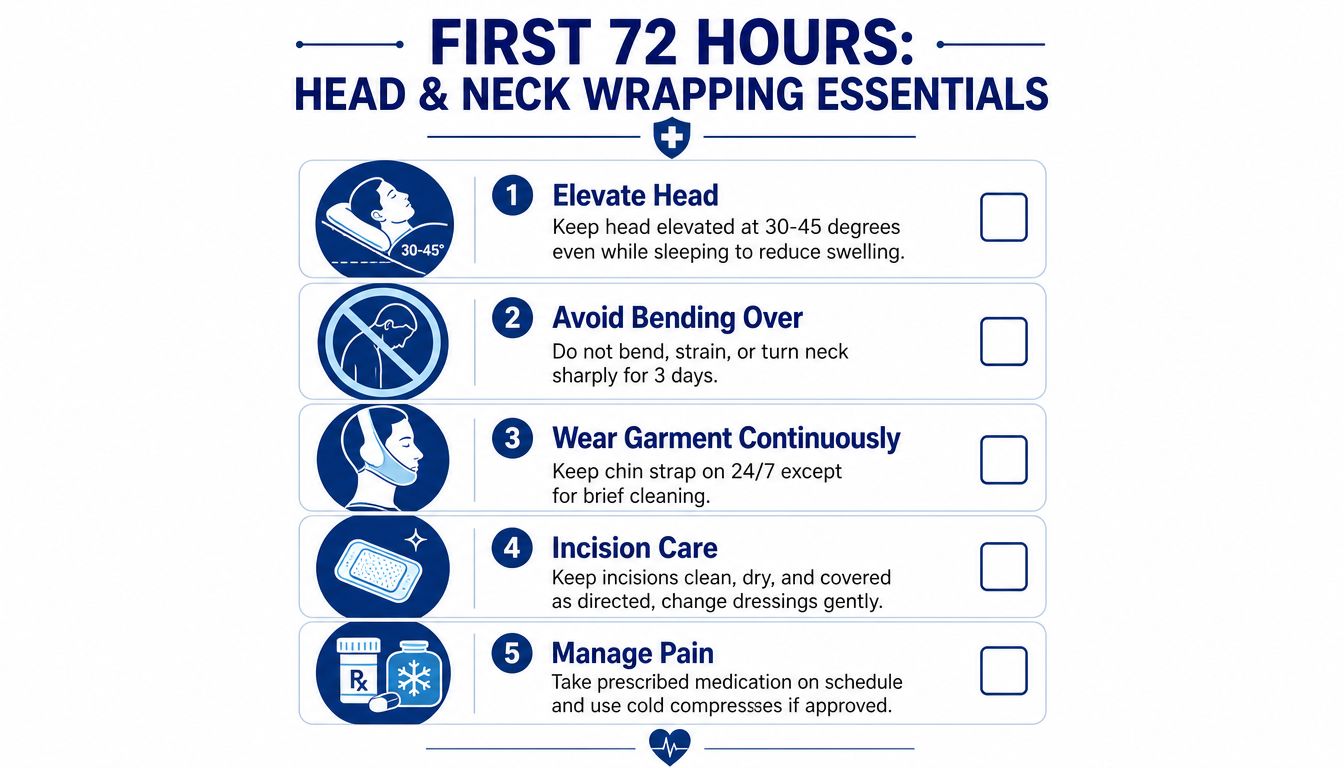
The first 72 hours should be organized around three mechanics: elevation, correct compression, and low-strain movement. Set up your recovery space before the procedure with a reclined sleeping position, clean dressings, approved cold compresses, prescribed medication, water, and easy meals. You shouldn't need to bend repeatedly, reach overhead, or search for supplies while the neck is swollen.
Position first
Keep your head raised when resting, including during sleep, unless your treating team gives you a different instruction. Raising the head helps limit dependent fluid accumulation in the chin and neck. Sleep on your back rather than placing pressure on the treated area, and avoid prolonged periods looking down at a phone or laptop.
Move gently around the home, but don't treat walking as exercise yet. Avoid bending over, straining, sharp neck turns, and heavy lifting. Standard aftercare guidance connects head elevation, avoiding bending, and avoiding heavy lifting for about 3 weeks with swelling control and protection of the healing tissues. Those limits should be individualized by the treating clinician. Detailed postoperative guidance for chin and neck contouring explains these early mechanics.
Keep the wrap purposeful
At Ideal Face & Body, a custom head and neck wrapping protocol supports the treated area immediately after contouring. The wrap should sit smoothly, provide even support, and remain clean and dry. Don't tighten it yourself if it feels uneven or creates pressure, skin discoloration, worsening numbness, or significant discomfort. Contact the office for positioning advice instead.
Follow the prescribed schedule for garment removal. In many protocols, the supportive garment is worn continuously at first, including during sleep, and removed only briefly for cleaning or as directed. Incisions should stay clean, dry, and covered according to your written instructions. Don't scrub, pick at crusting, apply unapproved products, or soak the area until cleared.
Early-care priority: Keep the head elevated, maintain the garment exactly as directed, and avoid bending or straining. These steps support comfort and swelling control, but they can't make the final contour appear immediately.
For individualized details about positioning, dressing care, and activity progression, review awake liposuction recovery guidance alongside the instructions given to you after treatment. Pain medication should be taken only as prescribed. Cold compresses may help if approved, but place them gently and never apply pressure directly to numb skin.
Swelling Bruising and Contour Refinement Timeline
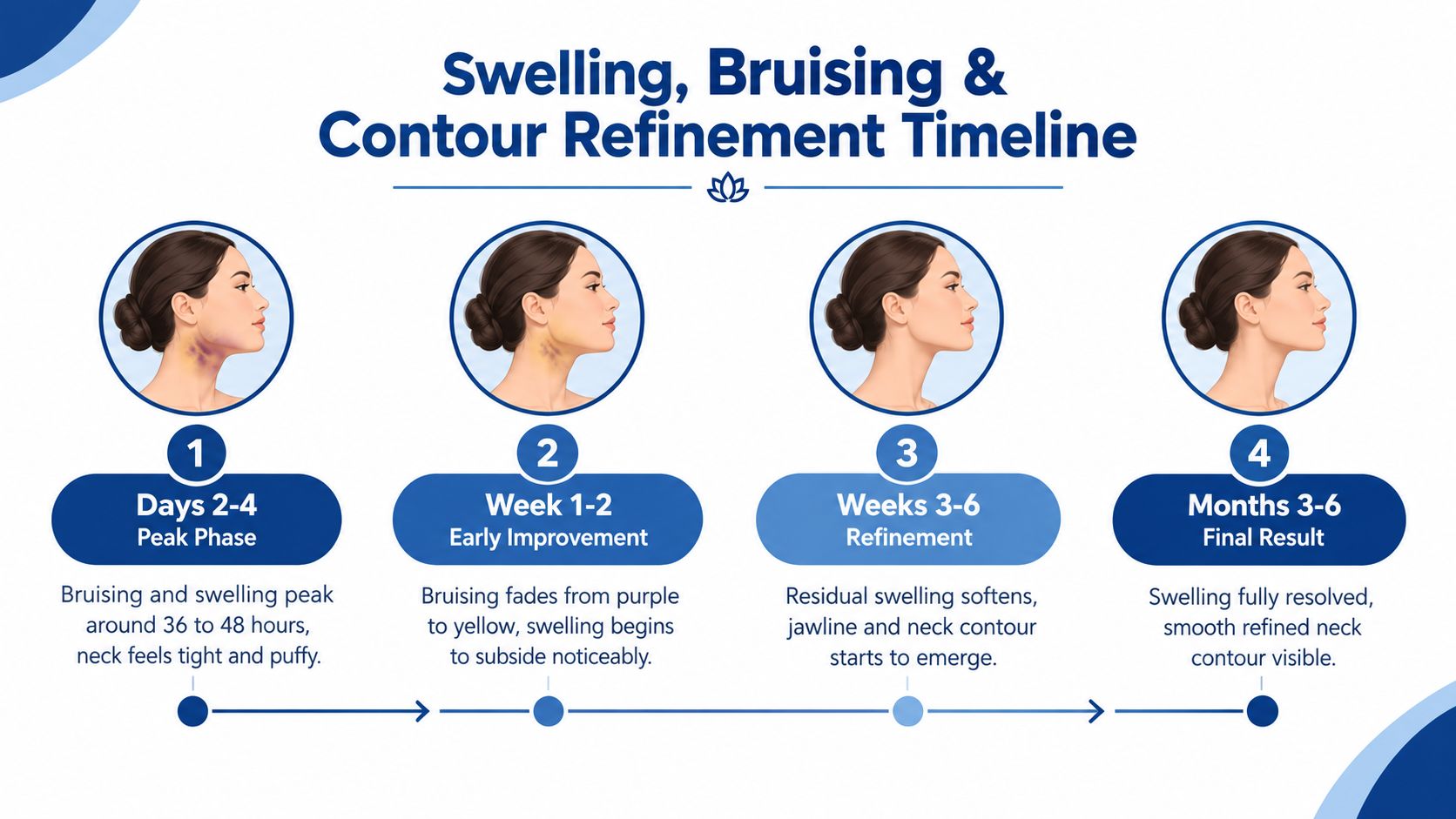
Swelling after neck liposuction doesn't decline in a straight line. It commonly rises during the first 3 to 4 days, with bruising and swelling often peaking around 36 to 48 hours or days 2 to 4, then gradually improving over 10 to 14 days. Postoperative aftercare guidance also notes that the neck may take about 6 weeks to feel soft again, which is why a firm or cordlike texture later in the process doesn't automatically indicate a poor result.
What changes week by week
Days 1 to 4: The neck may feel compressed, tight, and unusually full. Bruising can deepen before it fades. Mild numbness is common because the tissues and superficial sensory nerves have been disturbed, but rapidly escalating pain or swelling isn't something to watch passively.
Week 1: The color of bruising typically begins to soften, while visible swelling remains. The contour can look uneven because fluid doesn't distribute perfectly from side to side. Your goal isn't to judge symmetry in this phase. It's to follow the wrap, positioning, medication, and incision plan.
Weeks 2 to 6: The neck generally becomes less puffy, but firmness and sensitivity may persist. Subtle swelling can remain even when you return to work and social activities. The changing texture matters as much as the mirror, because the skin and deeper tissues are still adapting.
Months 3 to 6: Many patients reach a near-final contour during this window, although individual healing varies. Contemporary recovery guidance describes final refinement around 3 to 6 months, rather than at the end of the first week. A useful companion is this explanation of what liposuction may look like at 3 weeks post-op, when early improvement can coexist with residual swelling.
The key distinction is between stable, gradually improving irregularity and a new or worsening problem. A contour that changes slowly as swelling resolves is usually approached differently from a hard, expanding collection, sudden asymmetry, or symptoms affecting facial movement or swallowing.
Compression Garments and What They Can and Cannot Do
A chin strap is commonly recommended after neck liposuction because gentle, even support can improve comfort, limit movement, and help the skin rest against the newly contoured tissues. A widely cited benchmark describes supportive chin-strap use for about 3 to 4 days, often followed by nighttime use according to the clinician's protocol. The schedule isn't universal, and a garment that fits poorly can create more problems than it solves.
Where the evidence is limited
Compression is often presented as if it guarantees a smoother final result. That conclusion is stronger than the evidence. A 2021 critical review found no randomized controlled trials proving that consistent postoperative compression improves outcomes, and noted that much of the rationale is anecdotal or borrowed from other fields. The review of postoperative compression evidence supports a more measured conversation.
Compression can be a symptom-management and shaping aid, but it doesn't remove fluid by force, correct an underlying hematoma, or guarantee perfect symmetry. It should feel supportive rather than painful. Watch for pressure points beneath the chin, skin irritation, persistent tingling, or a strap that shifts and creates a narrow band of pressure.
Asking better garment questions
Ask your care team:
- Fit: Where should the lower edge and chin support sit?
- Schedule: When should continuous wear change to daytime or nighttime use?
- Skin checks: How often should you remove it to inspect the skin and incisions?
- Alternatives: What should you do if the garment causes rubbing, headache, or worsening numbness?
Emerging designs may change the conversation. Recent work on a novel garment with integrated silicone drainage strips reported faster edema resolution, earlier ecchymosis recovery, and improved skin redraping, but that doesn't establish that every patient needs such a device or that one design is universally superior. For practical questions about duration and fit, review how long to wear compression garments after liposuction with your clinician's plan.
Returning to Work Exercise and Daily Activities Safely
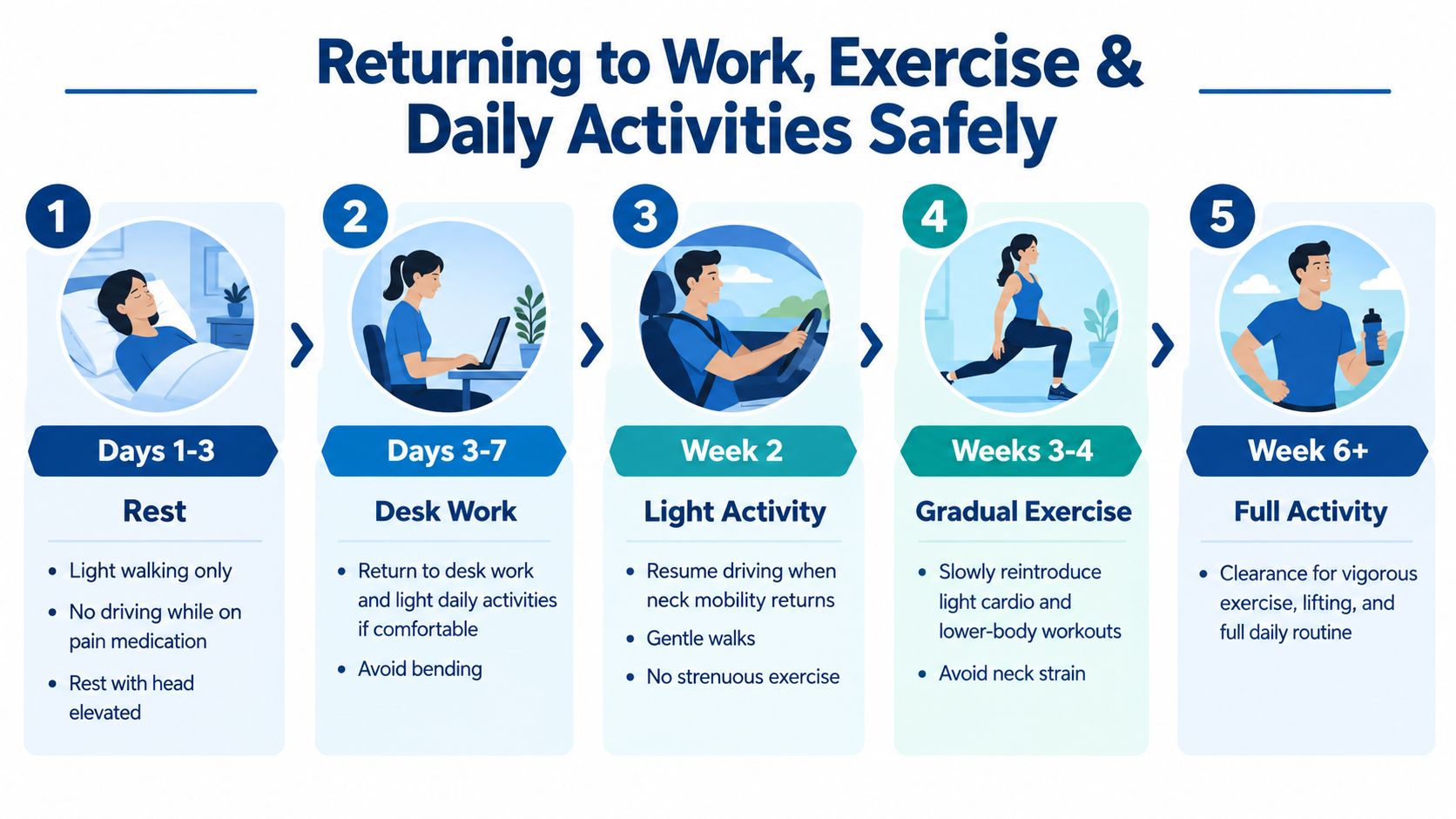
Most patients can plan for a return to work within 1 week, while full activity often resumes in about 2 weeks, according to historical recovery benchmarks summarized by the American Board of Cosmetic Surgery. Selected patients in older tumescent series returned to work in 1 to 2 days, but that faster window shouldn't be treated as a promise. Desk demands, bruising visibility, commute length, medication use, and neck mobility all matter.
A practical progression
During the first few days, rest with your head propped up and take short, easy walks. Don't drive while taking medication that can impair alertness, and don't drive if turning your head feels restricted. A passenger can help with errands, meals, and prescription pickup.
By the first week, desk work may be reasonable if you can keep your posture neutral and take breaks from looking down. Avoid bending from the waist, lifting, carrying, vigorous housework, and movements that strain the neck. If your work is public-facing, remember that bruising may still be visible even when you feel well.
During the second week, gentle walking can continue, but strenuous exercise and heavy lifting should wait for clearance. Gradual activity after that point should be based on comfort, mobility, swelling behavior, and the specific procedure performed. Patients seeking gentle mobility resources can review effective stretches for neck health, but postoperative stretching shouldn't begin until the treating team approves it.
Before increasing activity
Use this checklist rather than relying on a calendar alone:
- Mobility: Can you turn your head comfortably without pulling or guarding?
- Symptoms: Is swelling stable or improving rather than increasing after ordinary activity?
- Medication: Are you free from medicines that impair driving or coordination?
- Clearance: Has your care team approved heavier lifting or vigorous exercise?
- Environment: Can you avoid falls, contact, heat, and accidental pressure on the neck?
Travel and social events deserve the same planning. Build in time to rest, keep the garment available if prescribed, and avoid an itinerary that requires prolonged looking down or carrying luggage.
Follow Up Milestones and Red Flags That Need a Call
Recovery monitoring shouldn't end when bruising becomes less noticeable. In a 320-patient tumescent neck-liposuction series, follow-up at 8 weeks found no serious complications, while 4 patients required closer monitoring for hematoma, transient mandibular-nerve inflammation, or globus pharyngeus. The peer-reviewed series supports early surveillance followed by reassessment through the 6 to 8 week window.
Later observation matters because contour-related concerns can emerge after the first week. A 2026 systematic review of 2,085 submental aesthetic liposuction cases reported a 12.9% adverse-event rate, with 74.8% of events classified as minor. Among reported events, seromas represented 21.1%, skin irregularities or asymmetry 19.1%, and platysmal banding 18.5%. Mean onset was 1.7 months, with a median follow-up of 10 months. The systematic review is why a short return-to-work window shouldn't be confused with the end of medical follow-up.
A simple call-or-watch framework
Watch and document when firmness, mild numbness, or modest asymmetry is stable and gradually improving. Take consistent photos in similar lighting, follow the prescribed garment and activity plan, and mention changes at scheduled visits.
Call the office promptly for expanding swelling, a suspected hematoma, a persistent or enlarging fluid pocket, worsening asymmetry, new platysmal banding, increasing redness or warmth, severe pain not controlled as prescribed, or drainage that concerns you. Older neck-liposuction literature also reported mild complications and greater issues when liposuction was combined with laser resurfacing, so the exact technique and combination of treatments matter. That earlier literature reinforces the need to report a change rather than self-diagnose it.
Seek urgent medical attention for difficulty breathing, significant difficulty swallowing, sudden facial weakness, or rapidly worsening swelling. Report nerve symptoms directly to Dr. Sarah Yovino or Dr. Justin Yovino at Ideal Face & Body so the team can determine whether you need an in-office assessment, a virtual review, or immediate evaluation elsewhere.
The most useful recovery question isn't only, “When can I go back to work?” Ask, “Is this change steadily improving, and does it fit the expected phase of healing?” That approach respects the fast functional timeline while leaving room for the slower contour refinement that defines recovery from neck liposuction.
Ideal Face & Body provides awake, office-based neck and jawline contouring under local anesthesia, along with structured wrapping, recovery guidance, and follow-up with Dr. Sarah Yovino and Dr. Justin Yovino. To discuss your symptoms, healing timeline, or treatment options in Beverly Hills, CA, visit Ideal Face & Body and request a virtual or in-office consultation.