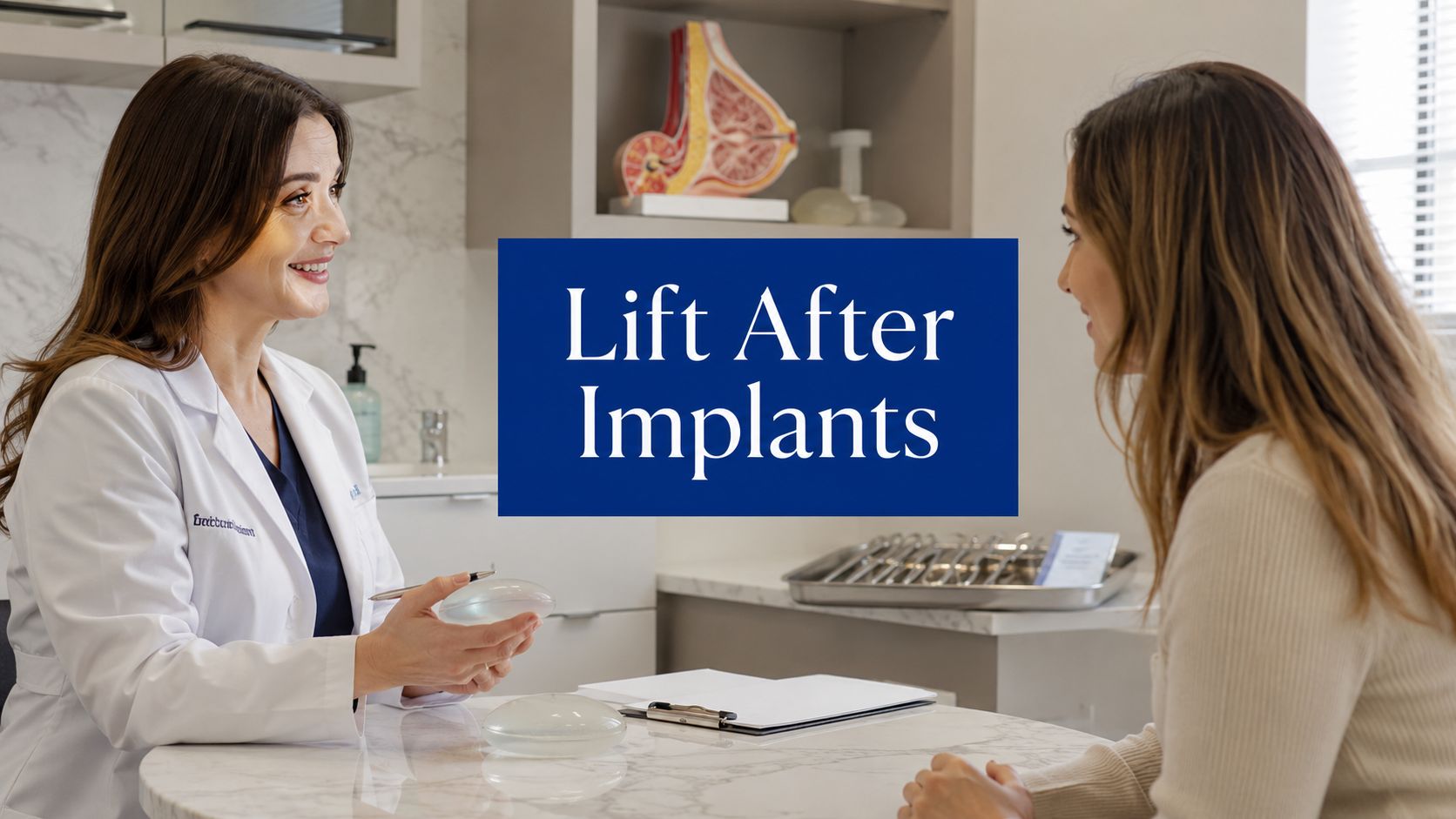
You've had your implants for years. The surgery worked, the volume looked right for a long time, and then the mirror started telling a different story. The implant may still feel fine, but the breast itself looks lower, softer, or flatter up top, and that's usually when the pertinent question shifts from “Do I need implants?” to “Do I need a lift now?”
That's the right question. A breast lift years after implants isn't about chasing a perfect breast that never changes. It's about deciding whether the issue is implant health, tissue position, or both, and choosing the fix that matches the problem.
The mistake people make is treating every change as if it means the implant failed. Sometimes the implant is still doing its job, and the breast envelope has aged around it. Other times the implant has become part of the problem, because the pocket, capsule, or shape has changed enough that lifting the tissue alone won't be enough.
Table of Contents
- Why You're Thinking About a Lift Years After Implants
- Why Breasts Sag Even With Implants Still in Place
- Who Is a Good Candidate for a Lift After Implants
- Your Four Surgical Paths After Existing Implants
- Risks Specific to Revision Surgery
- Recovery Realities for a Lift After Implants
- The Awake Breast Lift Approach in Beverly Hills
- Your Consultation Checklist
Why You're Thinking About a Lift Years After Implants
You're usually starting with a breast that looked right for a while, then slowly changed shape around an implant that may still be intact. The volume is there, but the breast sits lower, the upper pole looks emptier, or the nipple has drifted down relative to the implant. That is the usual long-term revision problem, and it needs a different fix than a first-time lift.
The timeline matters. FDA surveillance guidance for silicone implants changed in 2020, with imaging recommended at 5 to 6 years after surgery and then every 2 to 3 years after that, because implant problems do not wait politely for a decade to pass (PMC review of implant follow-up and rupture data). In that same review, the average time to rupture was 5.9 ± 4.0 years, and one monitored study found an overall rupture rate of 7%. That does not mean your implant is failing. It means long-term surveillance is normal, and revision planning should be based on real findings, not guesswork.
Many women are also reaching the point where a breast lift becomes a common request. ASPS data show breast lift procedures increased by 70% since 2000, from fewer than 53,000 cases in 2000 to 90,006 in the latest reported year in that release (ASPS breast lift stats). That pattern fits the years when pregnancy, weight change, and tissue aging start to show more clearly.
Practical rule: if the implant still looks structurally fine but the breast has descended, you are not asking for a new implant solution, you are asking for a tissue-position solution.
The decision map is simple. Keep the implant and lift the tissue. Exchange the implant and lift. Remove the implant and lift. Or use fat transfer for modest volume support. The right path depends on what has changed, not on how long it has been since the original surgery.
Why Breasts Sag Even With Implants Still in Place
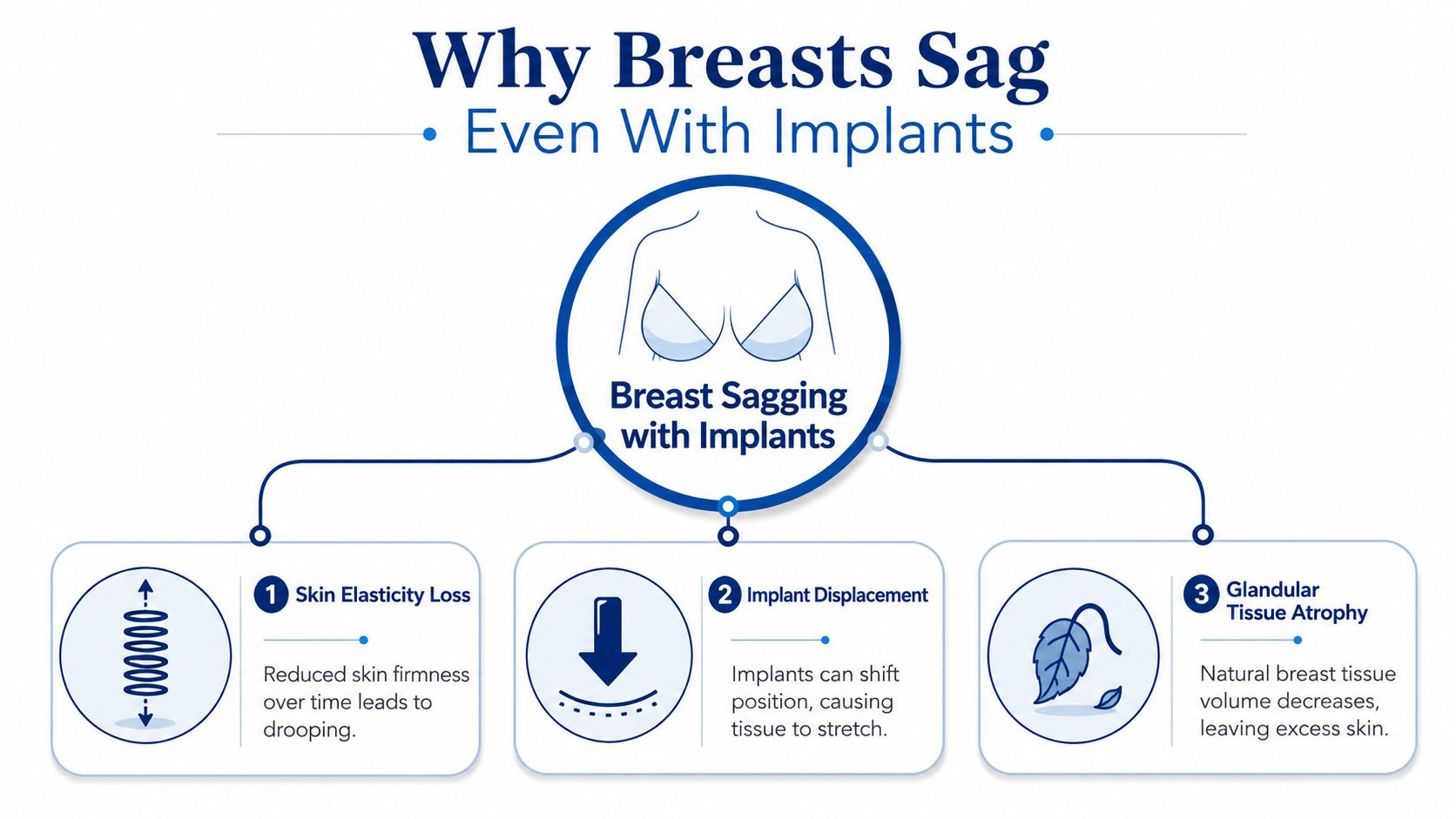
The implant can keep projecting forward while the breast around it descends. That mismatch is why someone can say, with complete honesty, “My implant still feels there, but my breast has dropped.” Both things can be true at once.
The three mechanics behind the change
First, the skin envelope stretches. Skin that once held a rounder upper pole starts behaving like old elastic, especially after pregnancy, weight fluctuation, or years of gravity. Second, the breast tissue itself descends, so the nipple and glandular mound sit lower even if the implant hasn't moved much. Third, the pocket can drift, which changes where the implant sits relative to the fold and the nipple.
The long-term photometric follow-up is useful here because it shows the pattern clearly. Over 10 years, implants increased breast projection and upper-pole projection, while the nipple level stayed unchanged and the lower-pole level dropped, and those changes were preserved at 10 years (PMC 10-year photometric follow-up). That's the exact shape problem revision patients describe. The implant still gives forward fullness, but the lower breast keeps descending, so the breast looks heavier and lower even when the implant hasn't “gone bad.”
The lift changes where the tissue sits. It doesn't erase the mechanics that made the breast change in the first place.
That's why a lift is a shape operation, not an implant repair. If the implant is still stable, a mastopexy can reposition the tissue and nipple. If the pocket has drifted or the capsule has tightened, the surgical plan has to account for both.
Who Is a Good Candidate for a Lift After Implants
A good candidate for a lift years after implants is someone whose implant status and breast shape can be separated cleanly. That means the implant is acceptable, the tissue has stretched or descended, and there isn't an active complication forcing a different operation first. If you're still sorting out pain, firmness, asymmetry, or sudden shape change, you're not in the straightforward category yet.
The clearest red flags are capsular contracture, rupture concern, malposition, and unresolved healing issues. Those problems can make a simple lift the wrong first move, because the implant itself may need to be corrected, removed, or exchanged before any tissue reshaping can hold. A lift can tighten the outer shape, but it can't fix a bad implant environment.
If you're trying to decide whether you're in the “lift only” lane or the “more complicated revision” lane, start with a proper assessment of implant condition and tissue quality. That's why a candidacy review matters before talking about scar patterns or aesthetic goals. If you haven't had that conversation yet, start with am I a breast lift candidate, then bring your implant history and current concerns to a revision-focused consultation.
What usually makes the plan straightforward
- Stable implant position. The implant hasn't clearly shifted or bottomed out.
- Acceptable implant condition. No strong signs that the shell or capsule is the main issue.
- Realistic skin assessment. Enough tissue quality to support a lift without overpromising perfection.
- Clear goal. You know whether you want to keep the implant, change it, or move away from it.
If those boxes aren't checked, the operation gets more complex fast. That doesn't mean you can't have surgery. It means the sequence has to be smarter.
Your Four Surgical Paths After Existing Implants
If you've already lived with implants for years, there are only four honest options worth comparing. Anything else is just marketing noise.
| Surgical Options Compared | What It Solves | Implant Status | Best Fit |
|---|---|---|---|
| Mastopexy alone | Lifts descended tissue, repositions the nipple, improves shape | Keeps the existing implant | Implant is acceptable, but the breast has drooped |
| Lift with implant exchange | Lifts and updates size, shape, or implant behavior | Replaces the implant | The implant no longer matches your goals or condition |
| Explant plus lift | Removes the implant and reshapes native tissue | Removes the implant | You want to leave implants behind, or implant issues outweigh the benefit |
| Lift with fat transfer | Adds modest volume while lifting | No implant required | You want some volume, but not another implant |
Mastopexy alone is the cleanest option when the implant is stable and the complaint is mostly ptosis. It doesn't solve implant aging, because it assumes the implant can stay where it is.
Lift with implant exchange is the right answer when the shape problem isn't just sagging. If the implant is old, firm, poorly positioned, or no longer fits the frame, exchange makes sense because the lift alone won't change the implant's behavior.
Explant plus lift is the most direct path away from implant dependence. It's not the same as “going flat,” because the breast still gets reshaped, but the trade-off is obvious, you give up implant volume and keep the tissue contour.
Lift with fat transfer works when you want softness and some added fullness without committing to another implant. The limitation is volume. Fat can refine shape, but it doesn't replace the projection of a substantial implant.
For patients who need to think through implant removal and tissue reshaping as one revision strategy, the internal logic is similar to the information on breast implant removal and reconstruction.
My view: if you're keeping an implant that's already causing problems, make sure you're not choosing convenience over durability.
The best path depends on what you're trying to preserve. Shape. Volume. Implant status. Or the option to stop revising the breasts every time the tissue changes again.
Risks Specific to Revision Surgery
Revision surgery isn't just “the same operation again.” The breast has already been opened, stretched, and reshaped once, and that changes how tissue behaves the second time around. The more prior surgery there is, the more you have to respect scar mechanics.
One risk that matters is sensory change. ASPS notes nipple sensory loss after augmentation in roughly 5% to 10% of cases, with variation by incision type (ASPS augmentation questions). In a revision setting, that matters more because the nerve pathways may already have been altered. I'd never promise unchanged sensation after a secondary operation.
Scar burden matters too. Revision mastopexy often requires more incision than a primary lift, because the surgeon has to manage old scars, skin excess, and a breast envelope that's already been stretched. That doesn't make the result worse. It makes the trade-off more honest.
Direct advice: don't judge revision surgery by the final scar photo alone. Judge it by whether the shape problem you hate is actually being corrected.
There's also the likelihood of future revision. A lift doesn't freeze the breast in time. Tissue keeps aging, and the breast can keep changing after surgery, especially if the implant remains in place. The right expectation is improvement, not permanence.
Recovery Realities for a Lift After Implants
Recovery after a lift years after implants is usually more deliberate than dramatic. You're not just healing skin incisions. You're healing tissue that has already been through one major operation, and that changes how swelling, tightness, and scar maturation behave.
The first week is about protection. Expect swelling, a tight chest, and the need to move carefully. Don't plan on lifting, reaching, or sleeping any way you want. The breast needs support while the skin envelope settles into its new position.
The first month is where most patients get impatient. The breast looks better, but it still feels firm and swollen, and the scars are still in their early phase. That's normal. It's also when people make the mistake of assuming they can “test” the repair with exercise or heavy lifting before the tissue is ready.
Scar patterns and what they mean
Revision mastopexy often uses one of three patterns, depending on how much extra skin has to come out and how much lift is needed.
- Periareolar. Best when the lift is modest and the nipple needs a small reset.
- Vertical. Used when more reshaping is needed below the areola.
- Anchor. Chosen when there's more excess skin and a stronger shape change is required.
The point of the scar pattern isn't decoration. It's access. If the breast has stretched substantially, the surgeon needs enough incision to remove the slack cleanly and reshape the mound without forcing the skin to do the work.
The awake approach can change the recovery feel, especially by avoiding the grogginess that comes with general anesthesia. That doesn't make it a light procedure. It means the delivery model is different, not the actual goals of the surgery.
A structured post-op follow-up system matters here, especially if you want to stay ahead of small issues before they become revisions. A solid guide to post-op follow up calls is useful because recovery after revision surgery depends on clear communication, not just the operation itself.
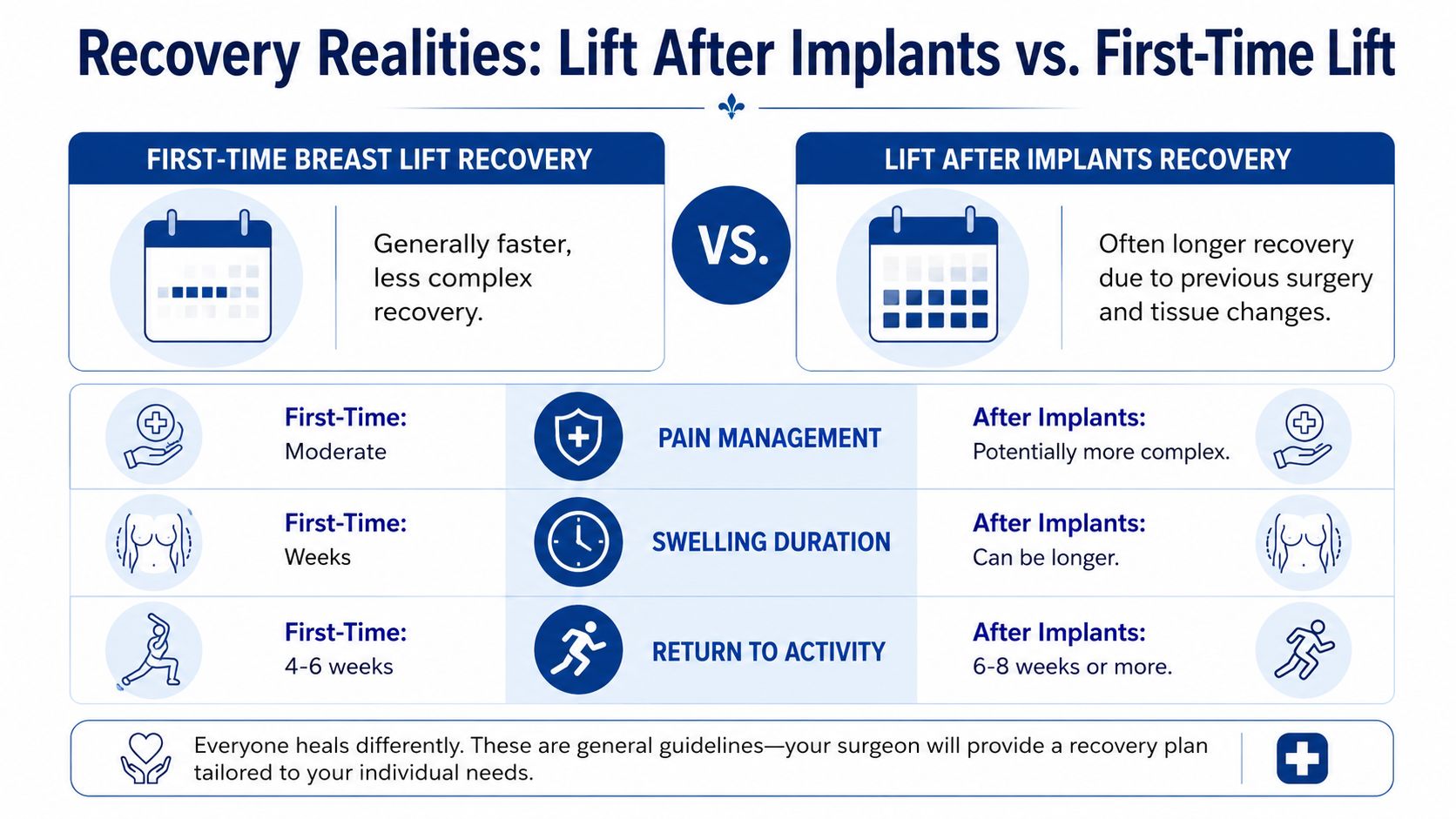
Scar fading is slow. Revision scars can behave differently from first-time scars because the tissue has already been stretched and operated on. Plan for patience, not a quick disappearance.
The Awake Breast Lift Approach in Beverly Hills
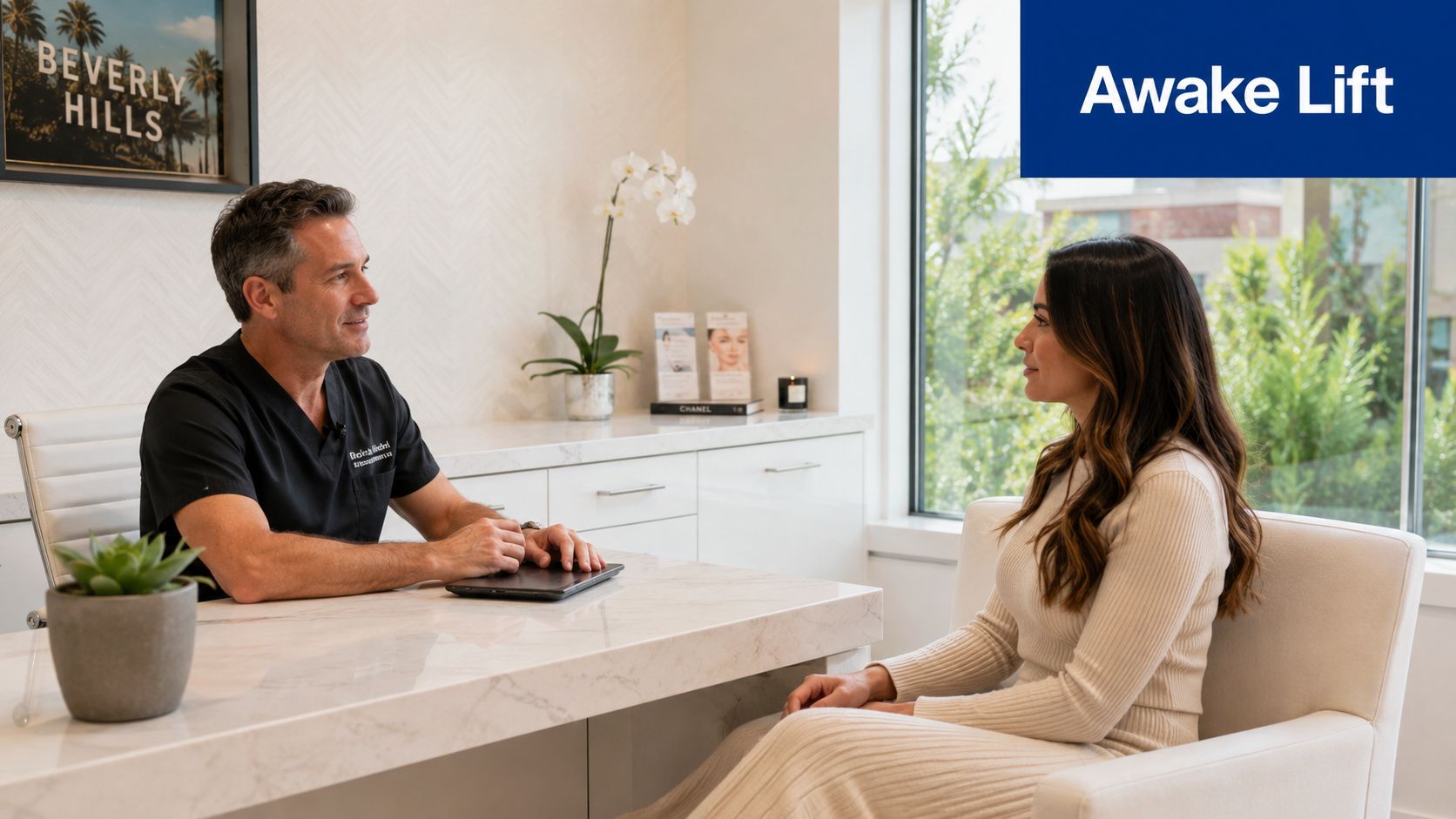
An awake breast lift is still a mastopexy. The operation does the same work, tightening and reshaping the breast, while the anesthesia plan changes the experience around it.
At Ideal Face & Body, awake, office-based procedures are performed under local anesthesia, and the Awake Breast Lift is a central offering in Beverly Hills. For the right patient, that means less anesthesia burden and a more direct surgical setting, while still addressing real sagging, nipple position, and shape.
Who tends to do well with it
Patients who want a lift without adding implant work, and who are comfortable in a local-anesthesia setting, are often a strong fit. The best candidates usually know exactly what they are buying, scar trade-offs, tissue repositioning, and a lift that does not try to redesign the implant pocket at the same time.
The incision plan does not change because the procedure is awake. If the breast needs a periareolar, vertical, or anchor pattern, that is still the pattern the surgeon uses. What changes is the setting, the anesthesia, and sometimes how the recovery feels afterward.
If you want the fuller version of that framework, the awake breast lift guide is the place to start. It lays out when an office-based lift makes sense and when revision surgery needs a different plan.
A strong awake candidate is not chasing a shortcut. She wants the same correction in a different setting.
Dr. Sarah Yovino and Dr. Justin Yovino work in that office-based model. For patients considering a lift years after implants, that matters because the discussion stays on shape, scars, and tissue position instead of turning every revision into an implant-centered conversation.
Your Consultation Checklist
A revision consultation should feel like a decision meeting, not a sales pitch. If you walk in unprepared, you'll spend the whole visit reacting instead of asking the questions that matter.
Start with implant status. Bring prior operative records, implant cards, and any recent imaging if you have it. If your implant is silicone, ask whether updated imaging is appropriate based on your timeline and symptoms. If there's any sign of firmness, asymmetry, or shape change, don't let the conversation jump straight to a lift until the implant itself has been addressed.
Then ask about the surgical plan in plain English. You want to know whether the recommendation is lift alone, exchange plus lift, explant plus lift, or lift with fat transfer. If the answer feels vague, push for specifics about what is being corrected and what is being left alone.
A good revision surgeon should also talk directly about scars. Ask which incision pattern they expect to use, where the scar will sit, and how that pattern fits your degree of ptosis. Revision scars aren't abstract. They're the trade-off that buys shape.
Use empowered questions for your next visit if you want a simple prompt list before your appointment. The value of a checklist isn't politeness. It's clarity.
Questions worth asking
- Implant condition: Is the implant itself in good shape, or am I trying to lift around a problem that should be fixed first?
- Revision experience: How often do you perform mastopexy after augmentation, not just primary lifts?
- Awake candidacy: Am I a reasonable candidate for local-anesthesia surgery in an office setting?
- Scar planning: Which incision pattern do you expect for my anatomy, and why?
- Future revision risk: What changes could make me need another surgery later?
Also ask for before-and-after photos of revision cases, not just primary lifts. Those are different operations, and the photos should reflect the kind of breast you have, not an idealized first-time patient.
The right answer for a breast lift years after implants depends on the implant, the tissue, and your tolerance for future surgery. Ideal Face & Body offers awake, office-based breast surgery in Beverly Hills, CA, including mastopexy for patients who want lift-focused revision without turning every case into implant replacement by default. If you're trying to decide whether to keep, exchange, or remove your implants, visit Ideal Face & Body and use that consultation to get a direct plan for your own anatomy.