You're standing in front of the mirror, noticing that your face looks more tired than you feel. The skin-care routine hasn't changed, but your temples seem hollow, your cheeks look flatter, and shadows beneath the eyes remain even after a good night's sleep. That pattern often reflects facial volume loss, not a skin problem.
Facial aging can involve deflation of the soft-tissue compartments, changes in underlying bone support, and skin laxity. A lifting procedure can reposition loose tissue, while surface treatments can improve skin quality. Fat transfer in the face addresses a different part of the picture by restoring volume with your own tissue.
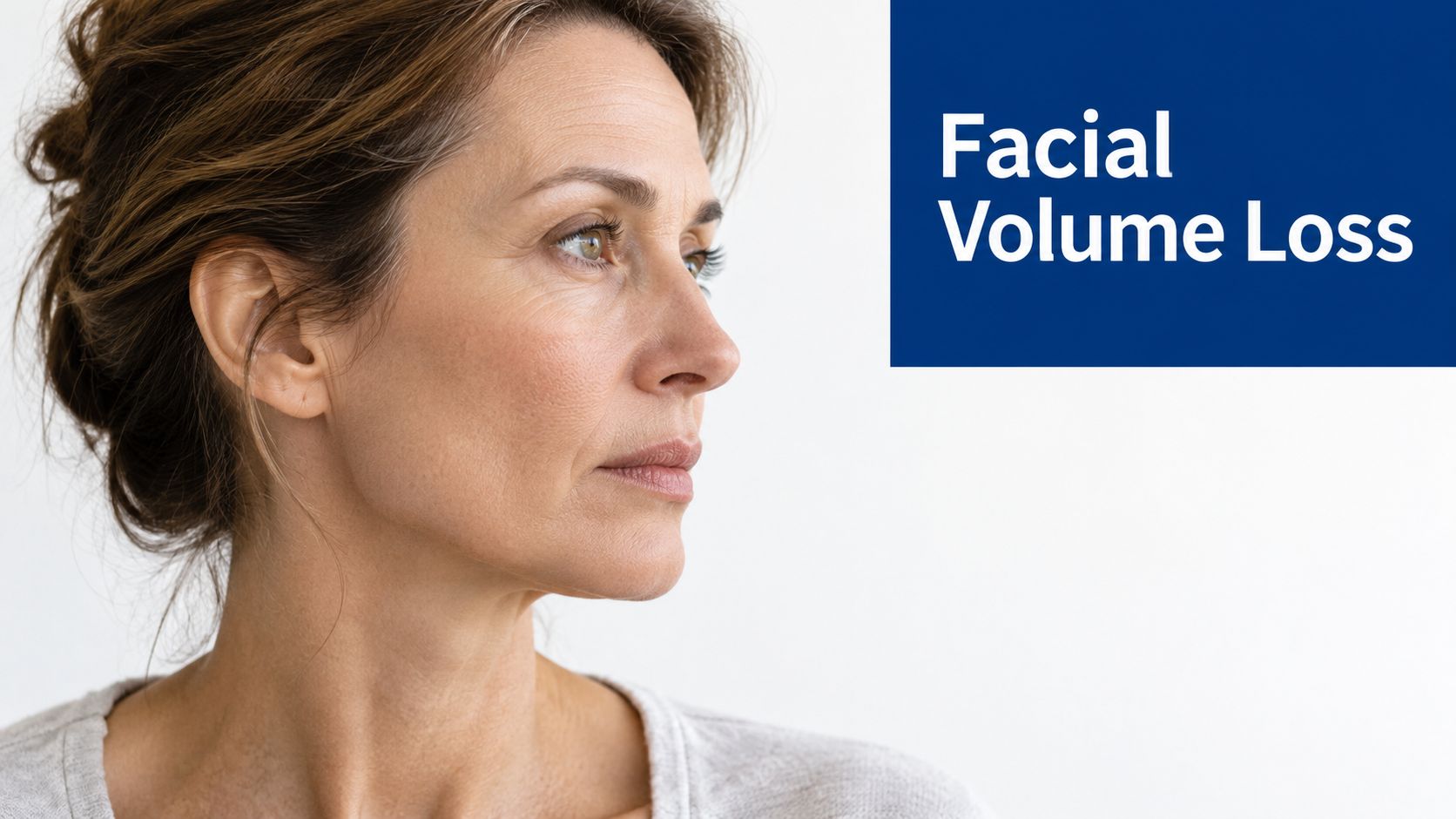
Table of Contents
- Introduction to Facial Volume Loss and Why Fat Transfer Helps
- What Fat Transfer in Face Means and Who It Helps Most
- How Facial Fat Transfer Works From Harvest to Placement
- How Long Fat Transfer in Face Lasts and When Touch Ups Help
- Fat Transfer Versus Fillers for Facial Rejuvenation
- Recovery and Downtime After Awake Facial Fat Transfer
- Risks Complications and How to Achieve Smooth Natural Results
Introduction to Facial Volume Loss and Why Fat Transfer Helps
A useful way to understand facial aging is to separate sagging from deflation. Sagging describes tissue that has descended or skin that has become lax. Deflation describes the loss of fullness that once supported the cheeks, temples, lips, and transitions around the eyes. A person can have one, the other, or both.
That distinction matters because adding volume won't tighten every area, and tightening won't replace tissue that has diminished. When the face has lost fullness, restoring a measured amount beneath the skin can soften hollows and improve the relationship between the cheeks, lower eyelids, mouth, chin, and jawline. The aim isn't to create a swollen appearance. It's to rebuild support in a way that respects the patient's original proportions.
Facial fat transfer has a long history. German plastic surgeon Gustav Neuber first described autologous fat transfer in 1893, using fat from the arm near the eye to treat scarring. The procedure became broadly popular much later, in the 1980s, alongside liposuction and more standardized fat-harvesting methods. The field has since grown substantially. The American Society of Plastic Surgeons estimated 33,877 facial fat grafting cases by its surgeons in 2022, while the International Society of Aesthetic Plastic Surgery reported 648,894 cases worldwide in 2022 and a 10% increase from 2021 to 2022. This historical and procedural review places facial fat transfer among established volume-restoration techniques.
What this guide will help you decide
The most important questions aren't just whether fat transfer can help. You also need to understand:
- What the procedure does, and which facial areas may benefit.
- Why some transferred fat survives and some is absorbed, even with careful technique.
- How awake, local-anesthesia treatment changes the experience, without implying that recovery is effortless.
- When fillers may be a better fit for a limited or reversible correction.
- Why a touch-up can be part of responsible planning, rather than evidence that the first procedure failed.
At Ideal Face & Body in Beverly Hills, CA, facial rejuvenation may be performed in an awake, office-based setting when appropriate. A thoughtful plan begins with anatomy, goals, donor tissue, and expectations. It then moves through preparation, placement, healing, and a later assessment of how the graft has matured.
What Fat Transfer in Face Means and Who It Helps Most
Autologous fat transfer means moving fat from one part of your body to another. For facial rejuvenation, a clinician may harvest fat from a suitable donor area, process it, and place small amounts into areas that have lost fullness. Because the tissue comes from you, the face receives living tissue rather than a manufactured volumizing material.
Think of each fat parcel as a small seedling being moved to new soil. Harvesting and processing should protect the viable tissue. Placement should give each small parcel contact with surrounding tissue so it can receive nourishment while a blood supply develops. A large clump has less useful contact with the recipient tissue, which is one reason meticulous distribution matters.
Areas that may benefit
Facial fat transfer can be considered for several forms of hollowing or contour imbalance:
- Temples, when lateral fullness has diminished.
- Under-eye grooves, when the transition from the lower eyelid to the cheek creates a persistent shadow.
- Cheeks, when the midface appears flat or deflated.
- Nasolabial folds and marionette lines, when surrounding volume loss contributes to their depth.
- Chin and jawline, when added structural fullness could improve balance.
- Lips, when a patient wants soft-tissue enhancement using their own tissue.
The best indication isn't a particular age. It's a combination of visible volume loss, appropriate expectations, adequate donor tissue, and facial anatomy that can accept grafted fat safely. Some patients primarily need skin treatment or lifting. Others want a small, focused correction and may prefer a reversible injectable approach.
When another option may make more sense
Fat transfer requires a harvest site and involves a healing period. It also has variable retention, so the final amount of fullness can't be guaranteed precisely in advance. Someone seeking a subtle, temporary adjustment may prefer a nonsurgical approach, while someone seeking broader restoration may value the integration of their own tissue.
Ideal Face & Body's facial work focuses on rejuvenation and contouring. The practice no longer offers breast implant placement, implant-based breast augmentation, or breast implant revision procedures. That distinction keeps this discussion centered on facial volume, facial balance, and the practical decisions surrounding grafting.
How Facial Fat Transfer Works From Harvest to Placement
The procedure follows a connected sequence. Each stage affects the next, so the quality of the final result isn't determined by injection alone.
Stage one involves gentle harvest
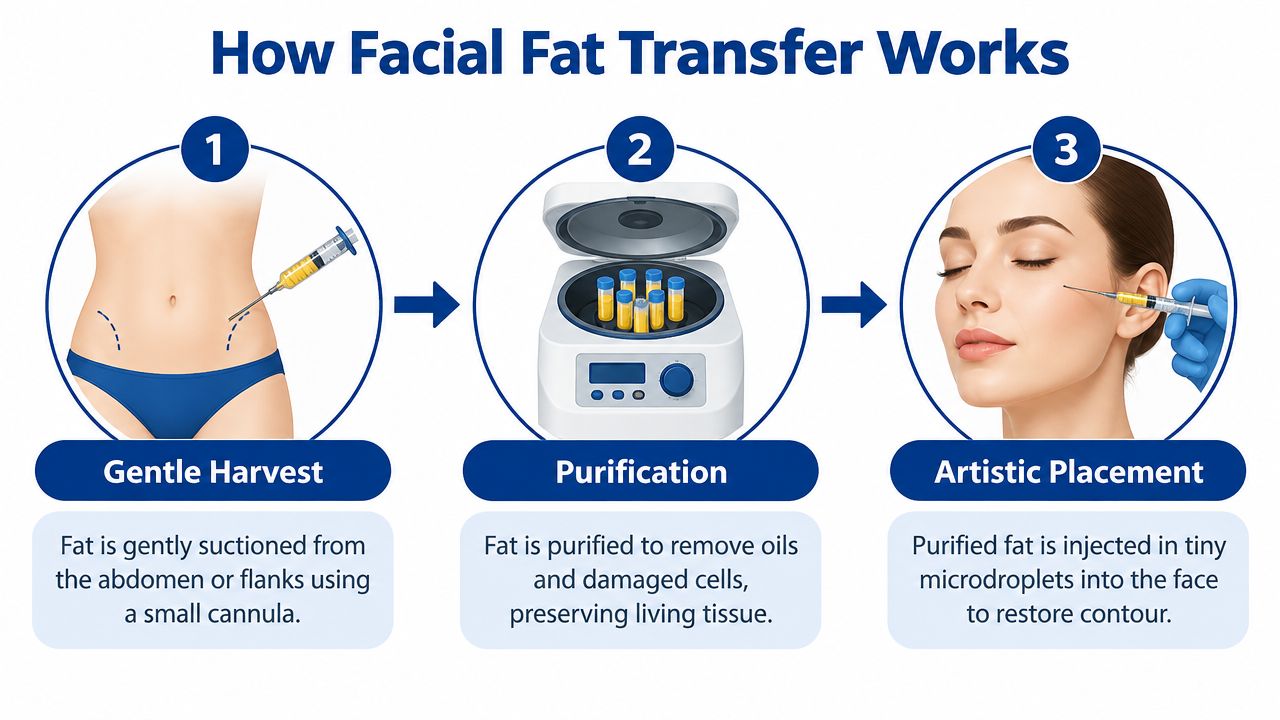
A clinician first identifies a donor area with enough usable fat and a contour that can be improved safely. Common donor areas include the abdomen or flanks. A small cannula removes fat with controlled suction rather than treating the donor site like a high-volume body-contouring procedure.
Local anesthesia is used for the treatment areas in an awake approach. You may remain aware of movement and pressure, but the goal is to keep you comfortable while avoiding general-anesthesia grogginess. Awake treatment also allows direct communication during positioning and contour assessment. That feedback can help the team evaluate facial balance as the procedure progresses.
Stage two separates usable tissue
Harvested fat contains more than intact, viable fat cells. It may also include fluid, oil, blood, and damaged cellular material. Processing separates unwanted components and concentrates tissue suitable for grafting.
This isn't a cosmetic detail. Grafted fat needs to connect with the recipient environment. If the material is handled roughly, placed in an overly large mass, or deposited where blood supply is limited, more of it may be resorbed. The awake liposuction and fat transfer approach describes the linked nature of harvesting and facial placement.
Stage three places small parcels precisely
The surgeon places purified fat in small micro-aliquots, often across carefully selected tissue planes. The purpose is to distribute the graft rather than create isolated lumps. Areas may be treated at different depths to address both contour and soft-tissue transitions.
Technique must remain conservative. Overfilling can make the face appear puffy during the early period, while undercorrection may leave a hollow that later calls for refinement. The surgeon balances the intended correction against expected early swelling and biologic resorption.
Practical rule: A natural result usually comes from restoring relationships between facial areas, not from filling every visible line independently.
Awake treatment doesn't eliminate swelling, bruising, or donor-site soreness. It changes the anesthesia experience and may allow earlier mobilization, but the graft still needs time to settle. Patients should evaluate the result after healing, not during the first days when fluid and inflammation temporarily distort facial proportions.
How Long Fat Transfer in Face Lasts and When Touch Ups Help
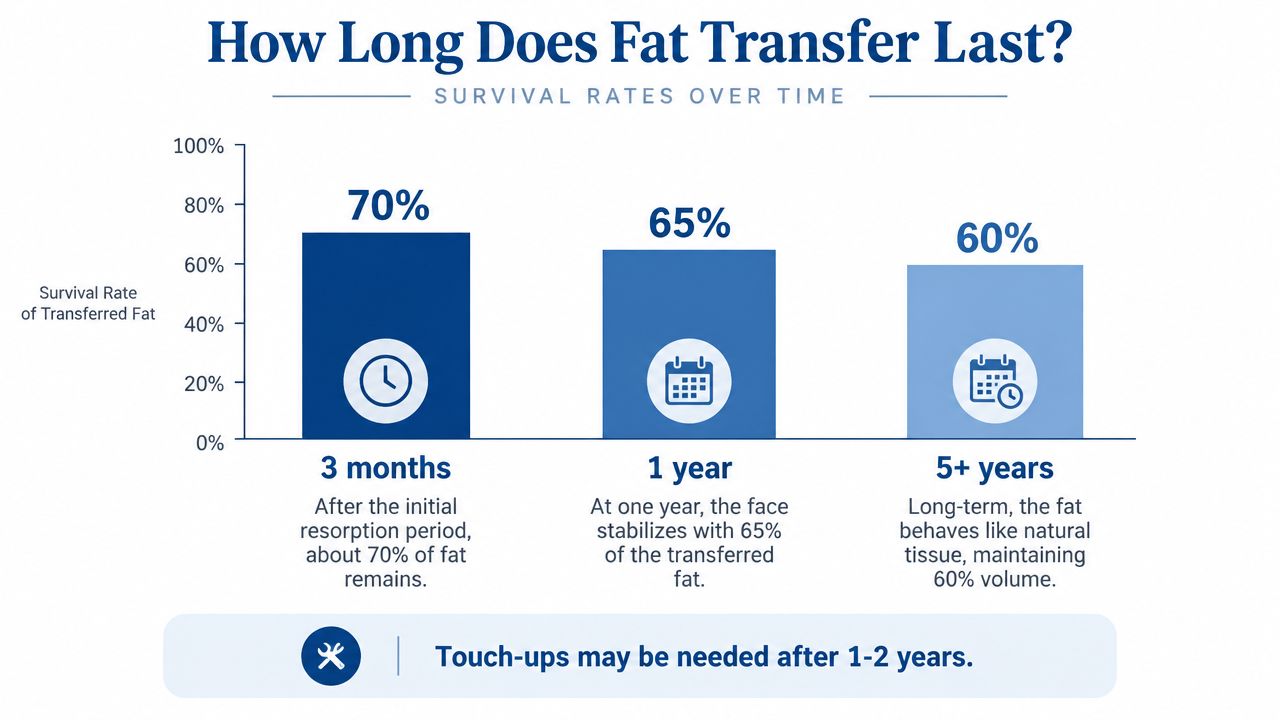
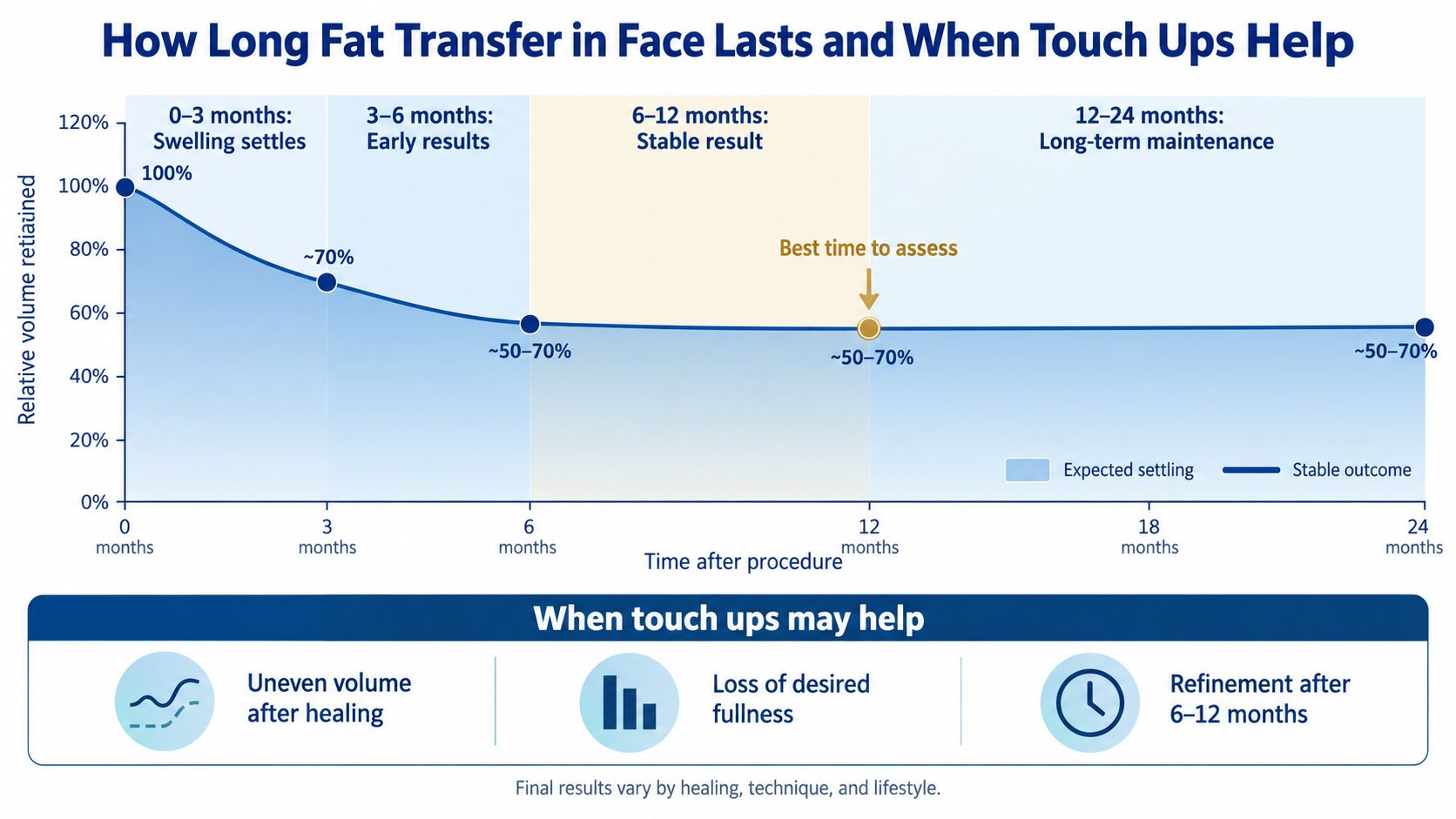
The honest answer is that not all transferred fat remains. After placement, some cells establish a blood supply and integrate with the surrounding tissue. Other cells don't survive the transfer and are gradually absorbed. Early swelling can make the face look fuller than the eventual result, so the first appearance isn't a reliable measure of permanent volume.
Published evidence shows why no responsible surgeon should promise an exact retention amount. A 2020 systematic review of 27 studies involving 1,011 patients found retention ranging from 26% to 83%, with a pooled mean of 47% over follow-up periods ranging from 3 to 24 months. Another analysis found approximately 50% to 60% of injected volume present at one year. The systematic review of long-term facial fat graft retention also emphasized that measurement methods can materially change the reported result.
The treated area changes the answer
Facial subunits don't behave identically. A long-term clinical study reported an overall facial survival rate of 53.1% at a mean follow-up of 3.11 years. In that study, retention varied from 39.4% in the nose to 59.5% in the chin, with cheeks at 48.5%, upper lips at 50.3%, and lower lips at 56.5%. The study's facial subunit data illustrate why a single face-wide percentage can mislead.
The difference may reflect tissue thickness, movement, vascularity, pressure, and the available space for placement. Your surgeon should therefore discuss each area separately rather than describing your expected outcome with one universal number.
Why staged planning is reasonable
A surgeon may intentionally plan a conservative correction, knowing that the face will change as swelling resolves and graft survival declares itself. In other cases, the initial treatment restores most of the desired contour and a later touch-up addresses a small asymmetry or remaining hollow.
At around six months, patients can often judge whether the overall architecture feels balanced, but the exact timing of a touch-up depends on the treated area, healing, weight stability, and clinical examination. By twelve months, the result is generally easier to benchmark against the original plan. The patient-facing discussion of how long fat transfer results last can help frame that conversation without turning a variable biologic process into a guarantee.
Planning insight: “Permanent” describes surviving fat, not a promise that your face will never change or that one session will provide every refinement you may eventually want.
Fat Transfer Versus Fillers for Facial Rejuvenation
Fat transfer and hyaluronic acid fillers can both restore facial fullness, but they solve the problem in different ways. Fat requires a donor site, processing, and a surgical recovery. Fillers are delivered directly and can be useful when the goal is a limited correction, a trial of added volume, or an adjustment that should remain reversible.
| Criteria | Fat Transfer | Hyaluronic Acid Fillers |
|---|---|---|
| Material | Your own processed fat, which may integrate as living tissue | A manufactured gel placed into selected facial areas |
| Treatment scope | Can support broader restoration across several facial regions | Suited to focused corrections and controlled adjustments |
| Longevity | Variable early retention, with surviving tissue capable of long-term persistence | Temporary and maintained through repeat treatment |
| Recovery | Includes swelling and bruising in the face plus soreness at the donor site | Usually involves less procedural recovery, though swelling or bruising can occur |
| Reversibility | Not easily removed once integrated | Some hyaluronic acid treatments can be adjusted or reversed clinically |
| Maintenance rhythm | May involve observation and a possible staged touch-up | Often follows a recurring maintenance pattern |
| Best fit | Patients seeking structural, natural-tissue volume restoration | Patients seeking a subtle, focal, or temporary change |
Match the tool to the goal
For example, a patient with generalized cheek and temple deflation may prefer a foundational approach using their own tissue. A patient bothered by one small contour transition may prefer the control and reversibility of an injectable treatment. Neither choice is automatically superior.
Some patients use both approaches over time. Fat can provide a base of restored volume, while an injectable may later refine a small area. The plan should account for facial movement, skin thickness, prior treatments, donor availability, and tolerance for downtime.
Dr. Sarah Yovino and Dr. Justin Yovino can help patients compare these pathways during consultation. Information about different types of dermal fillers may be useful when deciding whether a focal injectable correction or a broader fat-transfer plan better matches your priorities.
Recovery and Downtime After Awake Facial Fat Transfer
Awake facial fat transfer avoids general-anesthesia recovery, but it doesn't make healing invisible. The face may be swollen or bruised, and the donor area can feel tender. Recovery varies with the amount treated, the number of facial regions addressed, individual healing, and the aftercare plan.
The early period
During the first several days, swelling can make the face look fuller than intended. Bruising may develop around the treated areas, while the donor site may feel sore or tight. A head and neck wrap may be used when clinically appropriate, based on the treatment plan.
Use cold compresses only as directed, keeping pressure gentle and avoiding direct force over newly grafted areas. Sleep with your head raised if your clinician recommends it, and don't massage, press, or manipulate the face unless you've been specifically instructed to do so.
Returning to routine
Many patients arrange quiet time away from work and social commitments while visible swelling and bruising settle. Makeup, exercise, and more strenuous activity should resume according to the treating clinician's instructions rather than a generic calendar. The donor site can determine comfort even when the facial incisions are small.
A practical recovery checklist includes:
- Protect the grafted areas: Avoid pressure, rubbing, and unapproved facial treatments.
- Support circulation: Follow nicotine and medication instructions provided during consultation.
- Keep activity measured: Walking may be appropriate early, while strenuous exercise should wait for clearance.
- Attend follow-up visits: Early appointments assess healing, while later visits evaluate symmetry and maturation.
- Expect changes: Initial fullness can decrease as fluid resolves and some grafted fat is absorbed.
What awake treatment changes
Remaining awake can mean less post-anesthesia grogginess and earlier movement after the procedure. It also allows communication about comfort and positioning during treatment. Those advantages don't replace standard surgical planning, sterile technique, monitoring, or follow-up.
Call the practice promptly if you notice symptoms that concern you, especially rapidly worsening pain, unusual skin color changes, fever, drainage, visual changes, or neurologic symptoms. Clear instructions from your own clinical team should always take priority over general educational information.
Risks Complications and How to Achieve Smooth Natural Results
Facial fat transfer generally has a favorable safety profile, but it isn't risk-free. The most common concerns involve contour and integration, including asymmetry, irregular distribution, prolonged edema, fat necrosis, oil cysts, infection, and partial resorption.
A 2023 meta-analysis reported 95% patient satisfaction, 97% surgeon satisfaction, and a 3.4% overall complication rate. The same analysis reported 43% retention at twelve months in acquired atrophic deformities and 64% in mixed deformities, showing how strongly the indication influences the result. The pooled safety and efficacy analysis also supports counseling patients about variability rather than promising uniform survival.
A separate systematic review of facial rejuvenation cases reported a 6% overall complication rate, with hematoma or bruising at 5%, fat necrosis or oil cysts at 2%, and irregular distribution or scarring at 2%. The facial fat-transfer complication review reinforces that local contour issues deserve practical attention even when severe complications are uncommon.
The rare risk that requires serious respect
Severe vascular events, including intravascular injection or migration, have been documented. One review classified these severe events as 13.4% of reported adverse events in the analyzed literature, with potential neurologic consequences and, in some cases, permanent disability or death. This review of severe facial fat-grafting complications explains why injection technique and anatomy cannot be treated casually.
Risk reduction depends on careful patient selection, conservative micro-aliquot placement, appropriate tissue planes, controlled injection, and attentive follow-up. A touch-up may be appropriate when the surviving volume is uneven or incomplete. That isn't necessarily a failure. It reflects the biology of a living graft and the surgeon's effort to refine the result without overfilling the face at the first session.
Ideal Face & Body offers awake, local-anesthesia facial fat transfer evaluation in Beverly Hills, CA, with planning centered on facial balance, recovery expectations, and candid discussion of variability. The right consultation should leave you understanding not only what can improve, but also what cannot be predicted precisely.
Visit Ideal Face & Body to discuss facial volume loss, donor-area options, and whether an awake fat-transfer plan fits your goals. Ask for a consultation with Dr. Justin Yovino or Dr. Sarah Yovino so you can review placement areas, recovery, retention variability, and the possibility of staged refinement before making a decision.