You've been exercising consistently, eating thoughtfully, and doing nearly everything right, yet a soft layer remains across your lower abdomen, flanks, chin, or thighs. That frustration is common, and it doesn't automatically mean you need to lose more weight. Often, the issue is where fat is stored, not how much effort you're putting into your health.
So, how does body sculpting work? In simple terms, it changes specific contours by targeting localized fat, tightening selected tissue, or removing and redistributing fat surgically. It's a reshaping process, not a replacement for weight management. Understanding that distinction will help you choose a treatment based on your anatomy and goals rather than on the number you see on a scale.
Table of Contents
- What Body Sculpting Actually Changes in Your Body
- The Shared Biology Behind Every Sculpting Method
- Surgical Sculpting Methods and How They Reshape You
- Non-Surgical Sculpting Methods and How They Reach Fat Cells
- Surgical Versus Non-Surgical Sculpting Compared
- Candidacy, Downtime, Risks, and Your Consultation
- Choosing the Right Sculpting Path for Your Goals
What Body Sculpting Actually Changes in Your Body
Body sculpting is designed to reduce or reshape localized subcutaneous fat, the soft fat layer just beneath the skin. It doesn't broadly reduce your total body weight. Instead, it can make a particular area look flatter, smoother, or more defined while leaving your overall scale weight largely unchanged. The foundational explanation of this mechanism is described in the medical literature on localized fat reduction through body contouring.
Consider two people with similar body weights. One may carry more fullness around the abdomen, while the other stores fat in the hips or thighs. Body sculpting addresses that distribution. It's closer to tailoring a garment than shrinking the entire garment. A clinician evaluates the thickness of the fat layer, the shape of the surrounding areas, and the skin's ability to contract.
Shape and weight are different measurements
A successful contouring procedure may change your silhouette without producing a dramatic change on the scale. That's why body sculpting isn't intended to treat obesity or replace nutrition, movement, or medically supervised weight management. It also doesn't primarily correct loose skin or cellulite, although some energy-based procedures may improve skin texture or encourage tightening as a secondary effect.
Practical rule: Choose body sculpting when your main concern is a stubborn shape or proportion, not when your primary goal is broad weight reduction.
BMI can provide useful medical context, but it doesn't tell the whole contouring story. Two people with the same BMI may have very different fat distribution and skin elasticity. A consultation should focus on the treatment area, the amount of pinchable fat, the quality of the skin, and the result you consider worthwhile.
What remains after sculpting
The treated area can look smaller or more defined because fat has been removed or damaged and then cleared. However, the procedure doesn't prevent remaining fat cells from enlarging if you gain weight. Stable weight helps preserve the new proportions, while substantial weight change can soften or alter the result.
The most accurate expectation is localized shape change. You're not asking the procedure to transform your entire body. You're asking it to refine selected areas that have remained out of proportion despite healthy habits.
The Shared Biology Behind Every Sculpting Method
Although devices and techniques differ, most body sculpting methods follow the same biological sequence:
- Selective injury affects fat cells in a chosen area.
- Cellular targeting leaves surrounding structures relatively protected when the treatment is properly performed.
- Clearance allows the body to process and remove the damaged cellular material over time.
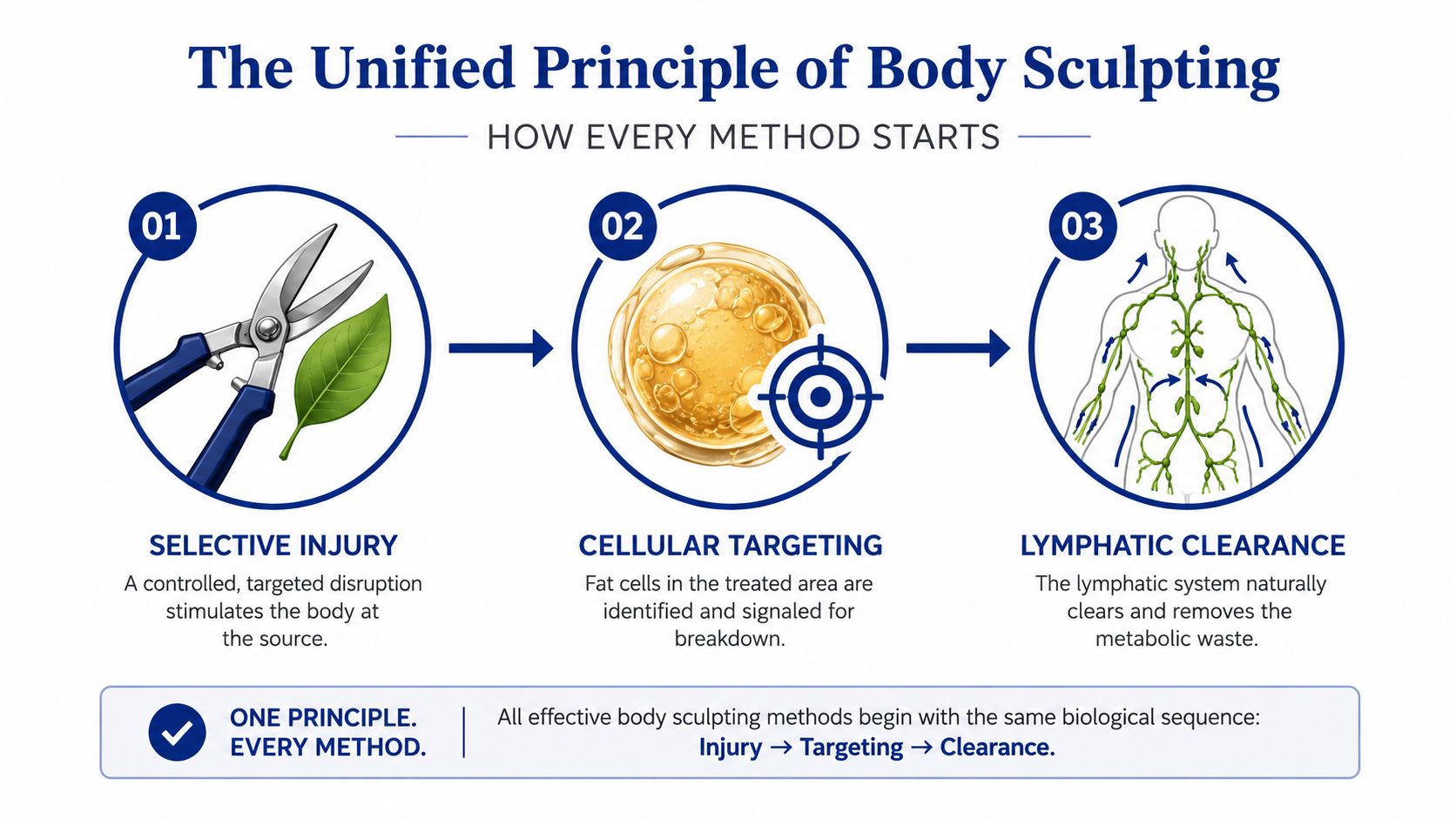
A useful analogy is pruning a garden. A gardener removes selected growth rather than disturbing every plant in the bed. In contouring, the clinician targets a specific fat pocket while preserving the skin, nerves, muscle, and surrounding contour as much as possible.
What happens to an injured fat cell
Fat cells can be damaged by controlled cold, heat, acoustic energy, chemical action, or mechanical suction. After injury, the body recognizes cellular debris as material that needs to be processed. Immune cells, including macrophages, help engulf and clear the damaged lipid material, while the lymphatic system carries waste away gradually.
That process doesn't happen instantly. Non-surgical approaches generally produce a gradual visual change because the body needs time to complete the inflammatory and clearance response. Reviews of cryolipolysis describe visible lipid elimination over roughly four months, with fat-layer reductions in treated areas commonly reported around 20% to 26% in the reviewed literature source.
Why technique still matters
The shared endpoint doesn't make every procedure interchangeable. Cold reaches fat differently from heat, ultrasound, or a cannula. A surgeon using suction can remove and sculpt fat directly, while an external device must deliver enough controlled energy through the skin to affect the intended layer.
The body's clearance pathway is only one part of the result. Target selection, depth, symmetry, skin quality, and treatment precision determine how the final contour looks. The biology explains why fat reduction can last, but the technique determines whether the shape is smooth and balanced.
Surgical Sculpting Methods and How They Reshape You
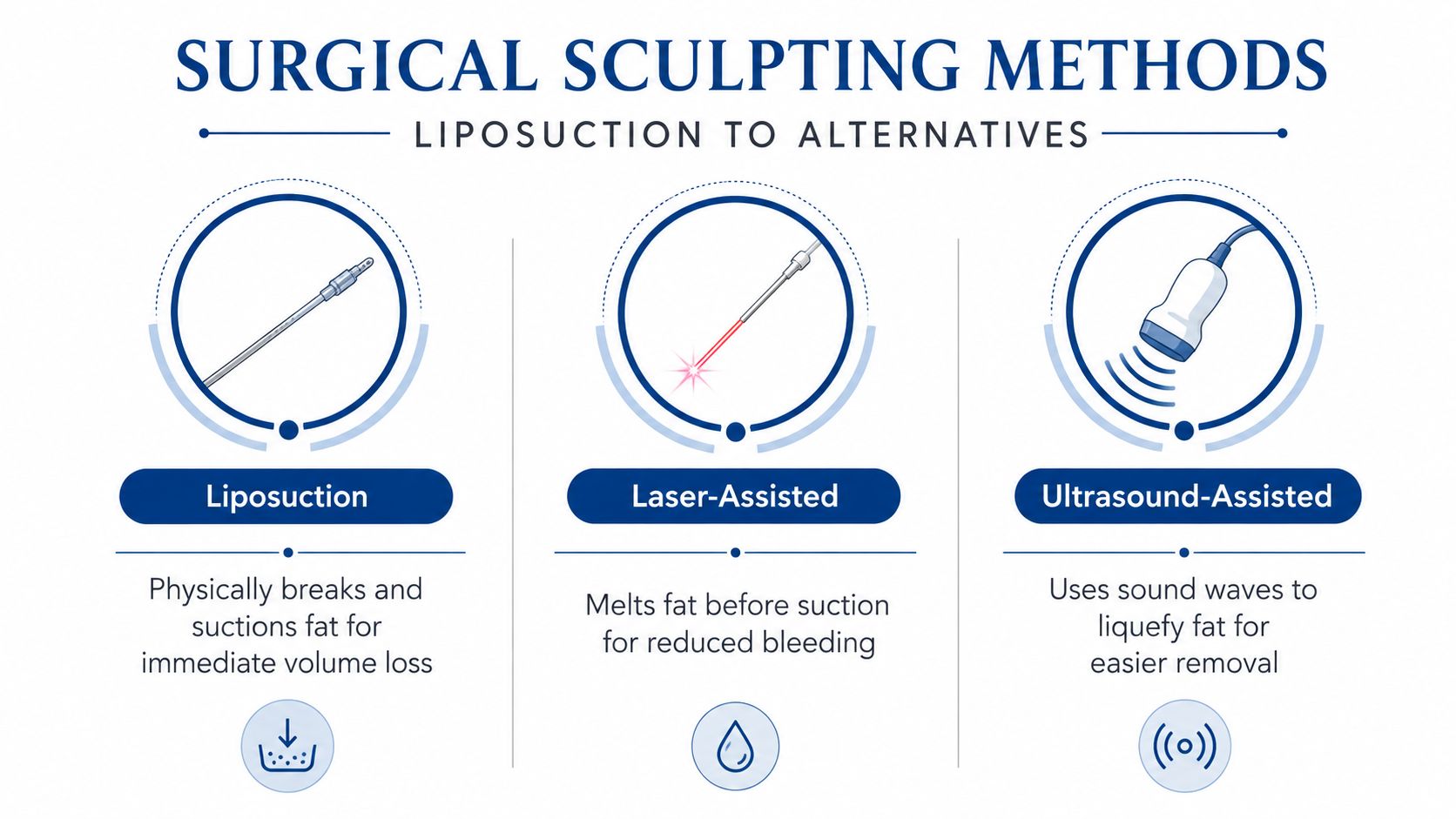
Surgical sculpting reaches the fat layer directly, so the clinician can remove specific amounts and shape selected areas with a cannula. Traditional liposuction loosens and suctions fat through small access points. The treated area loses volume during the procedure, although swelling can temporarily conceal the developing contour. As swelling settles, the result reflects both the fat removed and the precision of the sculpting.
Laser-assisted liposuction adds controlled heat before or during suction. Thermal energy can soften fat for removal and may encourage collagen remodeling in nearby tissue. That may help when fat reduction and some skin contraction are part of the plan, but the skin's elasticity still sets the limit. Heat cannot reliably tighten skin that has lost substantial recoil.
Ultrasound-assisted methods use acoustic energy to help separate fat before suction. Across these surgical approaches, the underlying biology remains familiar: fat cells are selectively disrupted or removed, and the body processes the treated tissue during healing. The difference is how the clinician reaches the fat and controls the contour.
Awake contouring in the office
Awake procedures use local anesthesia to numb the treatment area while the patient remains responsive. PRECISION SCULPT and Awake 360 Body Sculpting illustrate an office-based middle ground, with direct fat removal but without fully non-invasive treatment.
Because the patient is awake, the surgical team can assess proportions during treatment, including how the contour changes with position. That feedback can guide adjustments to symmetry and to the transitions between treated and untreated areas. Local anesthesia may avoid some general-anesthesia considerations. It does not remove the need for careful patient selection, sterile technique, monitoring, and a qualified surgical team.
Fat removal and fat transfer
Sculpting may reduce fat or redistribute it. During fat transfer, the clinician harvests fat from one area, processes it, and places it where additional volume or contour support is appropriate. Possible destinations include the face, buttocks, or hip dips, depending on anatomy and the treatment plan.
Surgical methods generally create the most substantial and immediate reshaping, with incisions, recovery, and procedure-related risks. A 2024 systematic review and meta-analysis reported an overall liposuction complication rate of 2.62%, with contour deformity the most common reported complication at 2.35%. Liposuction is established, yet the figures show why technique, planning, and follow-up still matter.
Non-Surgical Sculpting Methods and How They Reach Fat Cells
A small pocket of lower-abdominal fat may remain even when your weight is stable. Non-surgical body sculpting approaches that area through the skin, without a cannula physically removing tissue. The applicator or handpiece delivers controlled cooling, sound, heat, or a chemical agent. The fat cells are injured, then the body gradually clears or processes them.
That shared biology connects non-surgical treatment with surgical contouring. The access is different, and the degree of control is different, but both methods target fat cells rather than causing temporary water loss. Non-surgical options suit pinchable, localized deposits when the goal is refinement instead of major reshaping.
Cold, sound, heat, and injectable action
Cryolipolysis uses controlled cooling. Fat cells contain more lipid than nearby skin, nerves, and muscle, making them more vulnerable to cold injury. The affected adipocytes undergo apoptosis, a programmed cell-death process, and the body clears them over weeks to months. Clinical literature describes up to a 25% reduction in subcutaneous fat at a treated site after a single treatment, while broader reviews describe typical per-session reductions of roughly 15% to 25% clinical review.
Ultrasound-based methods send focused acoustic energy into the fat layer, creating controlled injury. Radiofrequency treatments use heat, with thermal damage followed by tissue remodeling and possible skin tightening, as described in an energy-based body contouring review. Injectable fat dissolvers use a chemical agent to break down localized fat, often in smaller areas such as fullness beneath the chin.
The experience varies by method. Cooling can feel intense before the area becomes numb. Heat-based treatment usually feels warm, while ultrasound may cause brief pulses or discomfort. Injections can produce tenderness or swelling.
Treatment selection depends on the fat layer's thickness, the amount of loose skin, the body area, and the change you are willing to trade for avoiding surgery. An awake office-based approach, such as PRECISION SCULPT or Awake 360 Body Sculpting, removes fat directly rather than using external energy, so it belongs on the surgical side of this biological comparison even though the patient remains awake.
Non-Surgical Body Sculpting Methods at a Glance
| Modality | Energy Type | Mechanism | Typical Sessions | Downtime |
|---|---|---|---|---|
| Cryolipolysis | Controlled cooling | Injures lipid-rich fat cells through cold exposure | May be performed as a series, depending on the area and goal | Usually minimal |
| Ultrasound lipolysis | Focused acoustic energy | Creates controlled injury in the fat layer | May require more than one treatment | Usually minimal |
| Radiofrequency contouring | Thermal energy | Heats tissue to encourage fat-cell injury and remodeling | Often planned as a treatment series | Usually minimal |
| Injectable fat reduction | Chemical action | Breaks down localized fat pockets | Commonly staged according to the area and response | Local swelling or tenderness may occur |
Non-surgical contouring requires patience because the body completes the clearance process after treatment. It can refine a modest pocket, yet it generally cannot provide the same volume control as direct surgical removal.
Surgical Versus Non-Surgical Sculpting Compared
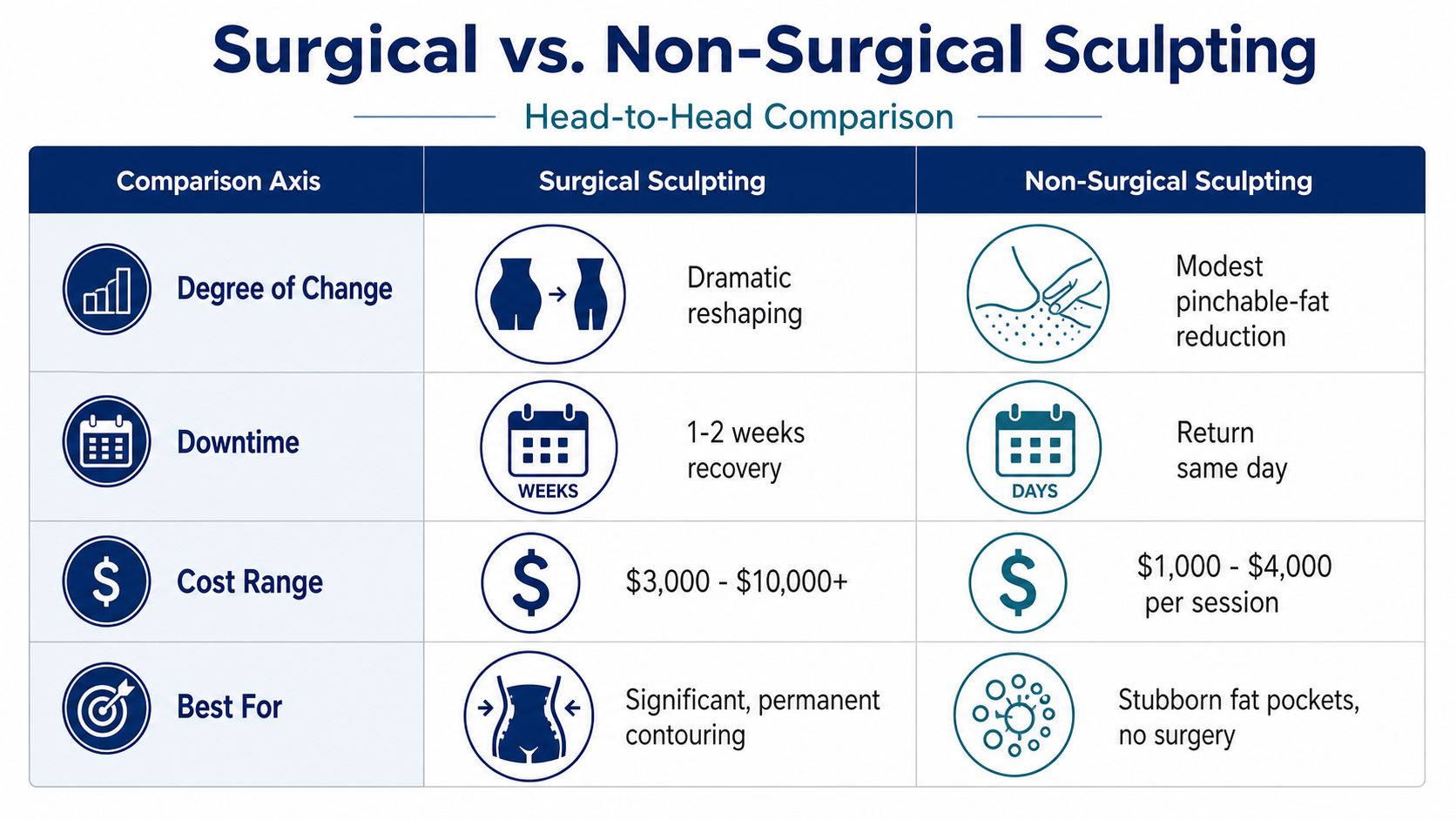
The right comparison starts with the result you want, not the label attached to the treatment. Surgical contouring directly removes fat and can create a more pronounced change in one procedure. Non-surgical contouring creates a controlled injury through the skin and usually produces a subtler result over time.
| Decision point | Surgical sculpting | Non-surgical sculpting |
|---|---|---|
| Degree of change | More substantial reshaping and direct volume removal | More modest reduction in pinchable fat |
| Access | Cannula, energy-assisted instruments, or fat-transfer techniques | External applicator or injection |
| Downtime | Recovery varies and may extend from days to weeks | Often little to no interruption, depending on the modality |
| Treatment pattern | Often planned as one procedure for the selected areas | Frequently staged or repeated for refinement |
| Longevity | Removed fat cells don't return, but remaining cells can enlarge | Damaged cells are cleared, while remaining cells respond to future weight change |
| Main tradeoff | Incisions, recovery, anesthesia or sedation considerations | Less invasiveness, but slower and usually less dramatic change |
The middle ground of awake surgery
Awake procedures such as PRECISION SCULPT and Awake 360 Body Sculpting illustrate why the choice isn't limited to major surgery or an external device. Local anesthesia can support direct fat removal while the patient remains responsive, subject to the surgeon's assessment and the procedure's safety requirements.
That approach may suit someone seeking more contour change than a non-surgical series can provide, but who wants to discuss alternatives to general anesthesia. It still involves surgical access and recovery, so “awake” doesn't mean risk-free or recovery-free.
Matching the tradeoff to the goal
Non-surgical treatment can make sense when the fat pocket is small, the skin is reasonably elastic, and downtime is a priority. Surgical treatment can make more sense when the patient wants a clear reduction in volume, needs several areas shaped together, or requires the precision that direct access provides.
Neither path guarantees perfection. A smooth result depends on anatomy, treatment planning, skin response, and the clinician's ability to preserve natural transitions.
Candidacy, Downtime, Risks, and Your Consultation
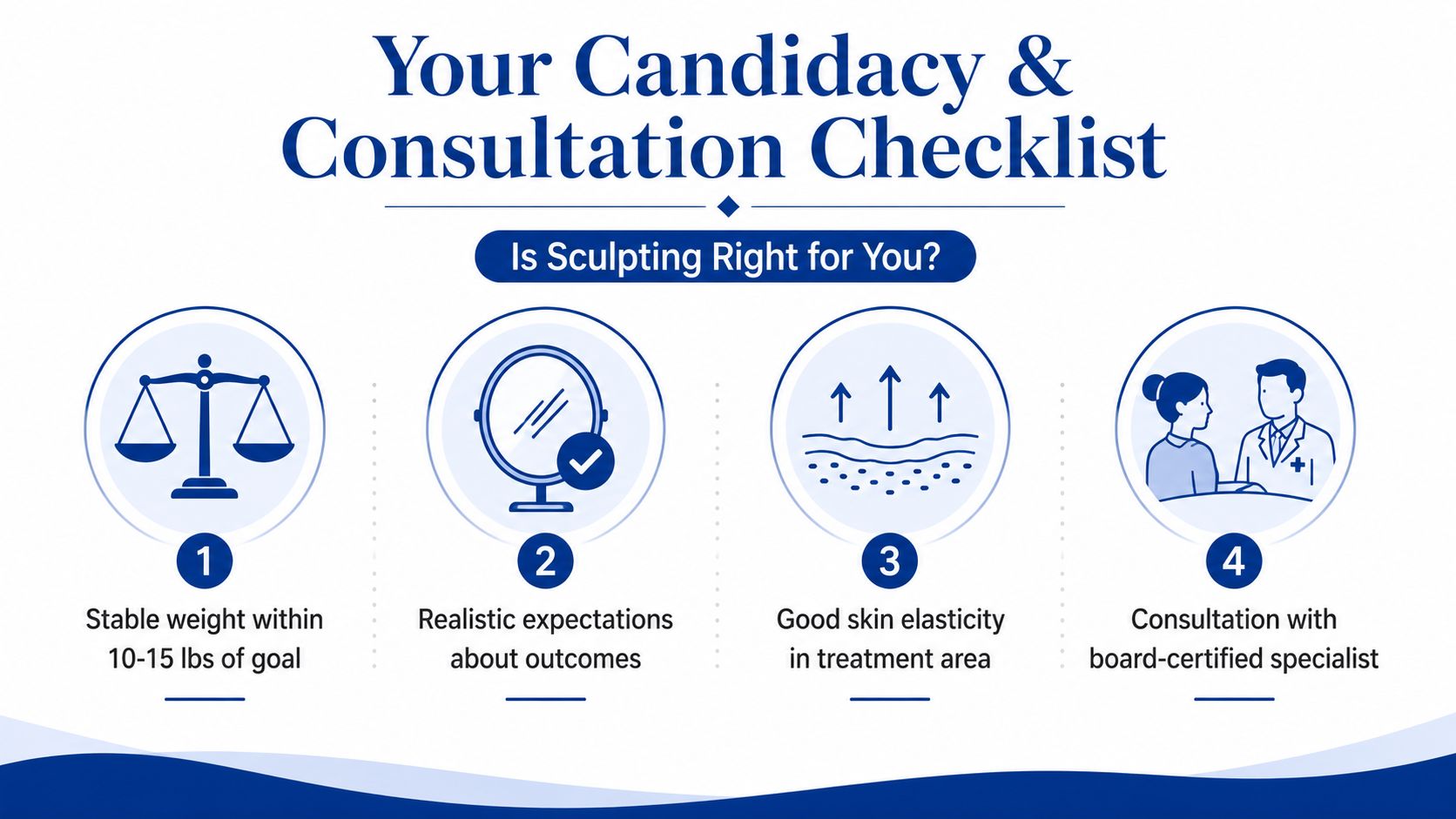
A suitable candidate may have a stable body shape, a localized concern, and expectations that match what contouring can change. Body sculpting refines selected contours. It does not replace weight management. For surgical treatment, the clinician reviews medical conditions, medications, healing capacity, smoking status, anesthesia considerations, and skin elasticity.
The method determines much of the recovery. Some non-surgical treatments may allow normal activities the same day. Awake office liposuction usually calls for a short period of reduced activity, while larger surgical cases need more recovery time. Swelling can temporarily hide the result or make the treated area appear uneven as tissue settles.
Risks deserve a direct conversation
Possible effects include swelling, bruising, temporary numbness, tenderness, contour irregularities, and fluid collections such as seromas. Energy-based treatments may cause burns when a device is misused or the tissue has not been assessed properly. Invasive procedures also carry uncommon but serious risks. Facility standards, surgeon qualifications, emergency planning, and follow-up arrangements help address those risks.
Published surgical evidence has described both minor and major complications, including seromas, which is why a consultation should cover the full range rather than focus only on expected improvement. A study series cannot predict one person's outcome. It can, however, reinforce the need to discuss what happens if healing is slower, swelling persists, or the contour needs further attention.
Questions to bring to the consultation
- Treatment rationale: Ask why the recommended method fits your fat layer, skin quality, and treatment area.
- Anesthesia plan: Clarify whether the procedure uses local anesthesia, sedation, or general anesthesia, and who administers and monitors it.
- Expected change: Ask what improvement is realistic, what will remain unchanged, and how swelling may affect early photographs.
- Provider experience: Review credentials, relevant before-and-after results, facility accreditation, and follow-up arrangements.
- Recovery details: Discuss compression garments, activity restrictions, pain control, warning signs, and scheduled checks.
- Correction policy: Ask how the practice handles contour irregularities or revisions if further treatment becomes necessary.
A careful consultation should leave you with a clearer plan, including the method's limits, recovery demands, and warning signs, without pressure to decide immediately.
Choosing the Right Sculpting Path for Your Goals
Start with three questions: How much fat reduction do you want? How much downtime can you accept? Are you comfortable completing a series of treatments? Those answers narrow the field before brand names or marketing language enter the conversation.
If your goal is a larger change across the abdomen, flanks, thighs, arms, or another defined region, direct surgical removal may offer the control you need. Laser-assisted liposuction or an awake approach such as PRECISION SCULPT or Awake 360 Body Sculpting can be discussed when local anesthesia and office-based care are priorities, provided your anatomy and medical history support that plan.
For a smaller, pinchable pocket and minimal interruption, non-surgical cooling, ultrasound, radiofrequency, or injectable treatment may be reasonable options. The compromise is usually a more gradual and modest change, with treatment planning based on the area's response rather than an immediate surgical reshaping.
A practical decision filter
- Choose direct removal when: You want a more noticeable contour shift and accept incisions and recovery.
- Consider energy-based treatment when: Your concern is localized and modest, your skin has useful elasticity, and you prefer a non-surgical route.
- Discuss fat transfer when: Your plan involves reducing one area while restoring volume or proportion elsewhere.
- Prioritize skin evaluation when: Loose skin or cellulite is your main concern, because fat reduction alone may not address the tissue issue you see.
Anatomy matters more than a device label. A clinician should assess whether the fullness is fat, loose skin, muscle, tissue laxity, or a combination. Review the evidence for the proposed method, ask about the surgeon's experience with your treatment area, and confirm that the facility and follow-up plan meet appropriate safety standards.
Ideal Face & Body offers awake, office-based options including PRECISION SCULPT laser liposculpting and Awake 360 Body Sculpting, with treatment planning led by Dr. Justin Yovino and Dr. Sarah Yovino. The practice also provides non-surgical aesthetic treatments, so a consultation can focus on whether surgical contouring, non-surgical refinement, or a combination best fits your goals.
If you're considering body sculpting in Beverly Hills, begin by identifying the areas you want changed and the amount of downtime you can accept. Visit Ideal Face & Body to learn about awake contouring options and request a consultation with Dr. Justin Yovino or Dr. Sarah Yovino.