You may be noticing several changes at once: the jawline no longer looks as sharp in photographs, loose skin gathers beneath the chin, and the midface appears tired even when you feel rested. The difficult part isn't finding a procedure with an appealing name. It's identifying which anatomical problem is driving your concern, then choosing the least extensive operation that can correct it without leaving another area visibly untreated.
A face and neck lift isn't one standardized operation. A mini-lift, isolated facelift, neck lift, combined lift, SMAS technique, deep plane technique, and awake procedure each solve different problems. The right choice depends on the relationship between your jowls, cheek descent, neck skin, platysma bands, fat distribution, skin elasticity, and tolerance for anesthesia and recovery.
Table of Contents
- What a Combined Face and Neck Lift Actually Addresses
- Comparing Combined Lift, Isolated Facelift, Neck Lift, and Mini-Lift
- Surgical Techniques From Mini-Lift to Deep Plane
- Awake Local Anesthesia Versus Sedation and General Anesthesia
- Choosing the Right Procedure for Your Specific Concern
- Recovery Timelines and What Influences Downtime
- Evaluating Candidacy and Planning Your Consultation
What a Combined Face and Neck Lift Actually Addresses
A woman in her late 50s points to three concerns during consultation: a soft jawline, loose skin along the neck, and a tired-looking midface. Treating only one area could improve part of her reflection, but it may leave the transition between her face and neck visibly uneven.
A combined face and neck lift treats the lower two-thirds of the face and the neck as one continuous anatomical unit. The surgeon can redrape the jawline, improve the cervicomental angle beneath the chin, address platysma laxity, and reposition descended cheek tissues through connected surgical planes. This differs from an isolated facelift, which may focus primarily on jowls and lower-face descent, or an isolated neck lift, which may improve the neck while leaving facial sagging untouched.
Why the face and neck are usually assessed together
The jawline and neck share a continuous skin envelope and platysma layer. When one area is lifted without considering the other, the result can show a mismatch. A sharper neck beneath a lax jawline may look incomplete. Conversely, a tightened lower face above an untreated neck can leave bands, fullness, or loose skin that still draw attention.
The procedure is most useful when several complaints overlap:
- Jowls: Descent along the mandibular border usually requires lower-face lifting and treatment of the deeper support layer, not skin removal alone.
- Marionette shadows: These often reflect lower-face descent and volume changes. A lift can reposition tissues, but it won't erase every etched line.
- Platysmal bands: Vertical neck bands come from platysma separation or tension. A neck component can address muscle position directly.
- Turkey neck: Loose skin and muscle laxity beneath the chin need a plan for both redraping and underlying support.
- Descended cheek fat: Midface descent may benefit from a deeper-plane approach that repositions cheek tissues rather than pulling the skin sideways.
The practical first step is to rank your concerns. Ask whether you're primarily bothered by the jowls, the neck, the midface, or the transition between them. A face and neck lift gallery can help you study how different starting anatomies respond, but photographs can't determine your candidacy by themselves.
Practical rule: If your main complaint sits at the junction of the jawline and neck, the consultation should evaluate both areas together, even if the final recommendation is an isolated procedure.
Comparing Combined Lift, Isolated Facelift, Neck Lift, and Mini-Lift
These procedures aren't arranged from “best” to “least effective.” They're tools matched to different patterns of aging. A combined lift makes sense when the face and neck have meaningful laxity together. It's excessive for someone with early jowling and a well-defined neck, just as a mini-lift may be inadequate for substantial neck skin and platysma descent.
Procedure selection at a glance
| Procedure | Best For | Typical Recovery | Longevity | Limitations |
|---|---|---|---|---|
| Combined face and neck lift | Jowls, lower-face descent, neck laxity, bands, and loss of definition together | More involved than an isolated or mini procedure | Designed for broader, longer-lasting correction | More dissection and recovery than a focused lift |
| Isolated facelift | Jowls and lower-face laxity with a relatively acceptable neck | Focused facial recovery | Depends on anatomy, technique, and aging | Won't fully correct loose neck skin or prominent bands |
| Isolated neck lift | Neck skin, submental fullness, or platysma bands with good cheek and jawline support | Focused neck recovery | Depends on skin quality and muscle laxity | Doesn't lift untreated jowls or descended cheek tissue |
| Mini-lift | Early jowling with relatively elastic skin and limited descent | Usually shorter than a full lift | More limited correction as aging progresses | Often leaves meaningful neck laxity untreated |
An isolated facelift is often the right answer for a patient whose neck contour remains strong but whose jowls have developed. An isolated neck lift may be more logical when the cheeks and jawline are tight but the patient sees bands, submental fullness, or loose skin below the chin. A mini-lift can provide a proportionate response to early aging, but it shouldn't be sold as a substitute for a full face and neck operation when both regions are clearly lax.
Scar placement, anesthesia, and recovery also matter. A larger operation generally requires more planning and healing, while a smaller lift may offer a simpler recovery with less ability to reposition descended tissues. The important question isn't only what the procedure improves. It's what it leaves untreated, and whether that untreated area will bother you after surgery.
Reviewing mini-facelift results can be useful when your concern is early jowling, but results should be compared with patients who have similar skin laxity and neck anatomy. Revision surgery is harder than choosing the correct match during the first operation, particularly when scarring and altered tissue planes limit later options.
Surgical Techniques From Mini-Lift to Deep Plane
Technique names describe the plane and method of tissue movement, but they don't replace anatomical judgment. The operation should be selected according to how much descent exists, where it sits, and whether the neck requires direct treatment.
The spectrum of lifting techniques
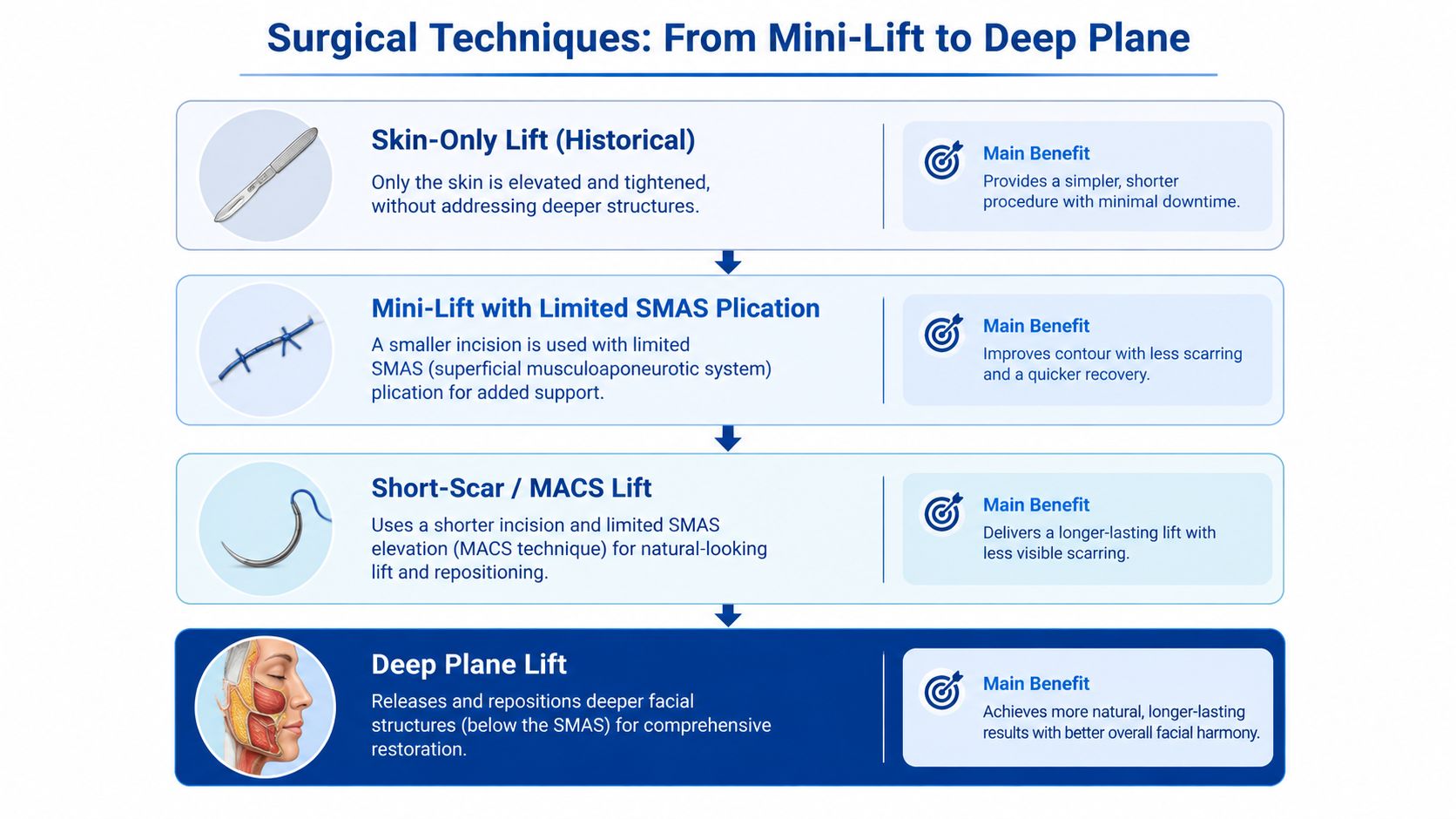
A skin-only lift relies mainly on tightening the skin. It may create an early change, but skin can stretch when it carries the full tension of facial repositioning. For that reason, skin-only lifting is largely historical rather than the preferred approach for meaningful lower-face rejuvenation.
A mini-lift with limited SMAS plication uses shorter incisions and adds tightening or folding of the superficial musculoaponeurotic system, commonly called the SMAS. It can suit a patient with early jowling, elastic skin, and modest descent. A patient in their 40s who isn't ready for a full operation may reasonably consider it, provided they understand that it won't reproduce the correction of a more extensive lift.
A short-scar or MACS lift uses a limited incision pattern and vertical suspension of facial tissues. It can improve early lower-face laxity while reducing the extent of the scar and dissection, but its ability to address substantial neck skin or midface descent is limited by the anatomy being treated.
What deeper SMAS work adds
Traditional SMASectomy removes a portion of the SMAS, while an extended SMAS approach lifts a broader layer to improve force distribution and tissue repositioning. These methods can provide stronger lower-face correction than skin tightening alone, although the exact result depends on the surgeon's design, the patient's anatomy, and the neck plan.
A deep plane facelift releases retaining ligaments and repositions the SMAS and overlying tissues as a composite unit. That deeper movement can improve the midface and create a more integrated lower-face and neck result. The trade-off is greater dissection, a longer operation, and the need for a surgeon with specific experience in the technique.
Evidence synthesis covering 10,784 patients across 45 studies reported a pooled overall complication rate of 6.6% for deep plane facelifts, with no permanent facial nerve injuries reported in the included studies. Temporary facial nerve injury was estimated at 1.2%, hematoma at 1.8%, seroma at 1.7%, infection at 0.8%, and skin necrosis at 0.1%. The review described aesthetic improvement as generally superior, while noting that outcome assessment was mostly subjective and efficacy endpoints lacked standardization. The deep plane evidence synthesis therefore supports careful technique-specific safety counseling rather than a promise that deep plane is automatically best for every patient.
Awake, office-based surgery is used most often for smaller procedures or limited neck work. Deep plane surgery demands longer dissection and complete stillness, so the anesthesia plan must match the operation rather than the marketing label.
Awake Local Anesthesia Versus Sedation and General Anesthesia
Anesthesia affects more than whether you're awake. It influences airway management, comfort, blood pressure control, nausea, the surgeon's ability to maintain a bloodless field, and how easily you can return home after the operation.
Awake local anesthesia uses carefully placed local anesthetic, often with oral medication or another limited adjunct. It can work well for a mini-lift, focused neck contouring, or selected isolated procedures. Keeping the patient responsive may help with positioning during platysma work, while avoiding general anesthesia can simplify the immediate recovery for an appropriate candidate.
IV sedation provides a middle pathway. The patient is comfortable and drowsy, but the anesthetic plan doesn't necessarily require the same airway control as general anesthesia. This option can suit selected combined face and neck lifts in healthy, well-screened patients, particularly when the surgeon expects a longer operation than a mini-lift but not the most extensive deep-plane dissection.
General anesthesia remains a reasonable choice for extensive deep plane work, revision surgery, high anxiety, or significant medical complexity. It provides complete stillness and controlled airway management, but patients must account for the effects of deeper anesthesia, including a potentially more involved immediate recovery.
Anesthesia options for face and neck lift
| Criterion | Awake Local | IV Sedation | General Anesthesia |
|---|---|---|---|
| Airway control | Patient maintains their own airway | Additional monitoring and support may be needed | Controlled airway |
| Intraoperative comfort | Strong local numbness with awareness | Deeper relaxation and reduced awareness | Complete unconsciousness |
| Blood pressure and hemostasis | Depends on patient comfort and response | More controlled for longer procedures | Most controlled for extensive surgery |
| Position changes | Patient can respond and cooperate | Limited responsiveness | Fully managed by the surgical team |
| Nausea and grogginess | Often less pronounced, though medication matters | Possible | More likely to require dedicated recovery monitoring |
| Discharge | Commonly same-day when appropriate | Commonly same-day when appropriate | Same-day or extended observation, depending on the operation and patient |
For readers who want to understand how anesthesia services are categorized for documentation, base units and modifiers for anesthesia offers general coding context. Coding information doesn't determine which anesthetic is safest for an individual patient, but it can clarify why anesthesia planning is a separate clinical decision.
A retrospective cohort of 142 facelift and neck lift patients treated with local anesthesia and oral sedation reported no major hematomas, skin necrosis, temporary facial nerve injuries, or permanent facial nerve injuries. Minor seroma occurred in 3.52%, minor hematoma in 0.70%, and localized infection in 1.40%, with all resolving conservatively. The office-based cohort provides a practical benchmark, not a guarantee for every patient or every technique.
A detailed awake facelift guide can help you understand the patient experience, but your operation still needs an individualized anesthesia recommendation.
Choosing the Right Procedure for Your Specific Concern
The most useful consultation begins with the complaint you point to, not with the procedure name you found online. Four patients can ask for a “facelift” and need four different surgical plans.
The jowl-dominant patient
One patient has a relatively smooth neck and good submental contour but sees soft tissue hanging at the corners of the mouth and along the jawline. In this situation, a facelift with SMAS work may address the problem more directly than a neck lift. Adding a neck procedure because it's part of a popular combination could create unnecessary treatment without improving the patient's main concern.
A systematic review of 27 SMAS studies involving 6,086 patients found that more than 85% of patients reported satisfaction. Reported complication rates varied by technique, from 5.75% for SMAS flap to 0.05% for composite SMAS, with temporary facial nerve injury and skin necrosis among the reported complications. The SMAS review illustrates why “SMAS facelift” isn't one uniform operation. The specific technique matters.
The neck-bands-dominant patient
Another patient has tight cheeks and a reasonably defined jawline, but the neck shows vertical platysmal bands and fullness beneath the chin. An isolated neck lift, submentoplasty, platysmaplasty, or carefully selected fat treatment may be enough. A facelift would add facial dissection without necessarily addressing a facial problem.
Neck rejuvenation has its own range of outcomes. A review describes complications from transient contour irregularities that may improve with time or conservative care to persistent irregularities that require delayed revision, as well as expanding hematomas that require immediate surgical treatment. The neck rejuvenation review is a reminder that a smaller operation still demands precise planning.
The combined-laxity patient
A patient with midface descent, jowling, loose neck skin, and platysmal bands usually benefits from a unified plan. Treating the face and neck through coordinated planes can avoid the sharp contrast between a lifted jawline and an untreated neck.
Patient satisfaction also involves more than appearing younger. One FACE-Q study reported mean satisfaction with facial appearance of 80.7, satisfaction with the decision to have surgery of 90.5, social confidence of 90.4, and psychological well-being of 92.8. A separate comparison found that open neck techniques with liposuction produced higher neck satisfaction than the comparison group, while closed techniques without liposuction scored highest for both chin and neck satisfaction. These findings support matching the operation to the exact complaint rather than assuming one technique always wins. The patient-reported outcomes evidence gives useful context for that decision.
Early aging and revision
A patient in their late 30s to early 50s with elastic skin and early jowling may be suited to a mini-lift. The operation can be proportionate when the neck remains strong, but it won't reliably correct substantial laxity.
Revision cases are different. Prior surgery creates scar tissue and changes the normal tissue planes, so a superficial repeat lift may have limited ability to reposition the remaining tissues. A deeper, carefully planned approach may be necessary, but candidacy and risk must be assessed individually.
Recovery Timelines and What Influences Downtime
Recovery follows a pattern, but it doesn't run on a fixed schedule. The extent of dissection, whether the face and neck are treated together, the anesthesia pathway, and your tissue response all influence how quickly you look and feel ready for normal activity.
The early healing phase
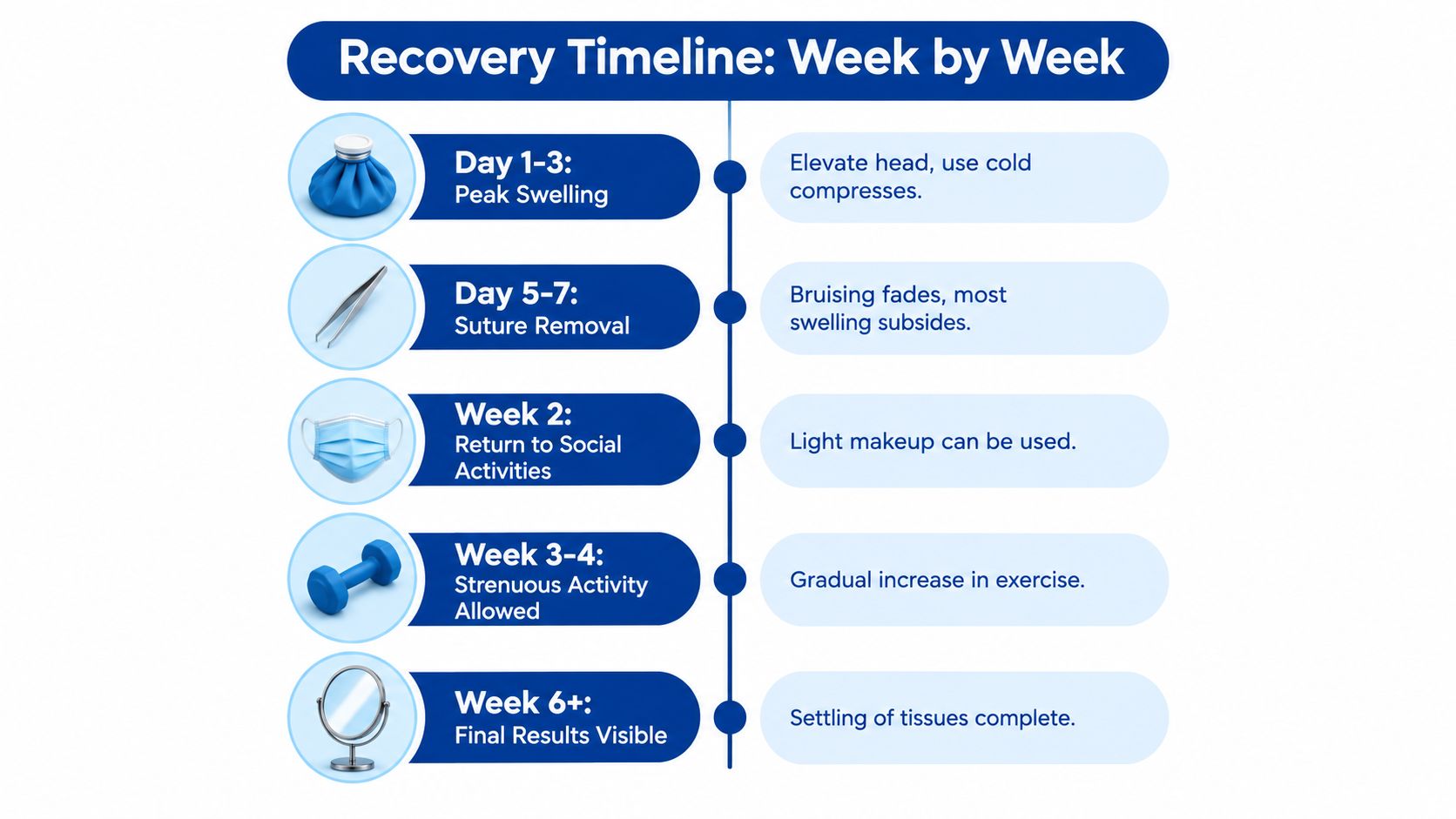
On days one through three, swelling is usually most pronounced. Keep your head elevated as instructed, use cold compresses when approved, and avoid bending, straining, or anything that increases facial pressure. Mild tightness, bruising, numbness, and uneven swelling can be part of normal healing.
By days five through seven, the team may remove sutures or assess the incision sites, depending on the surgical plan. Many patients feel comfortable with brief, light outings at this point, although visible bruising and swelling can remain.
Weeks two through six
During weeks two and three, bruising generally fades enough for social activities, and light cardio may resume once the surgeon approves it. Weeks four through six are commonly when patients return to full exercise gradually, but the actual clearance depends on incision healing, swelling, blood pressure, and the extent of the operation.
Residual firmness, numbness, and subtle swelling can settle over the following months. A combined or deep-plane lift generally creates more tissue healing than a mini-lift, while smoking, thicker skin, prior surgery, and slower lymphatic responsiveness can extend visible recovery.
Practical support can make the first days easier. Arranging meals, comfortable pillows, medication reminders, and low-effort entertainment is more useful than trying to “push through.” A simple guide to gifts for someone recovering from surgery can help family members choose supportive items without guessing.
Call the office promptly for rapidly increasing swelling on one side, expanding bruising, severe or worsening pain, fever, drainage, breathing difficulty, chest symptoms, or a sudden change in facial movement. A facelift safety review reported venous thromboembolism incidence of 0.35% for deep vein thrombosis and 0.14% for pulmonary embolism across 9,937 facelifts performed by 273 surgeons, so urgent symptoms should never be dismissed as routine recovery. The facelift safety review supports taking these rare but measurable risks seriously.
Evaluating Candidacy and Planning Your Consultation
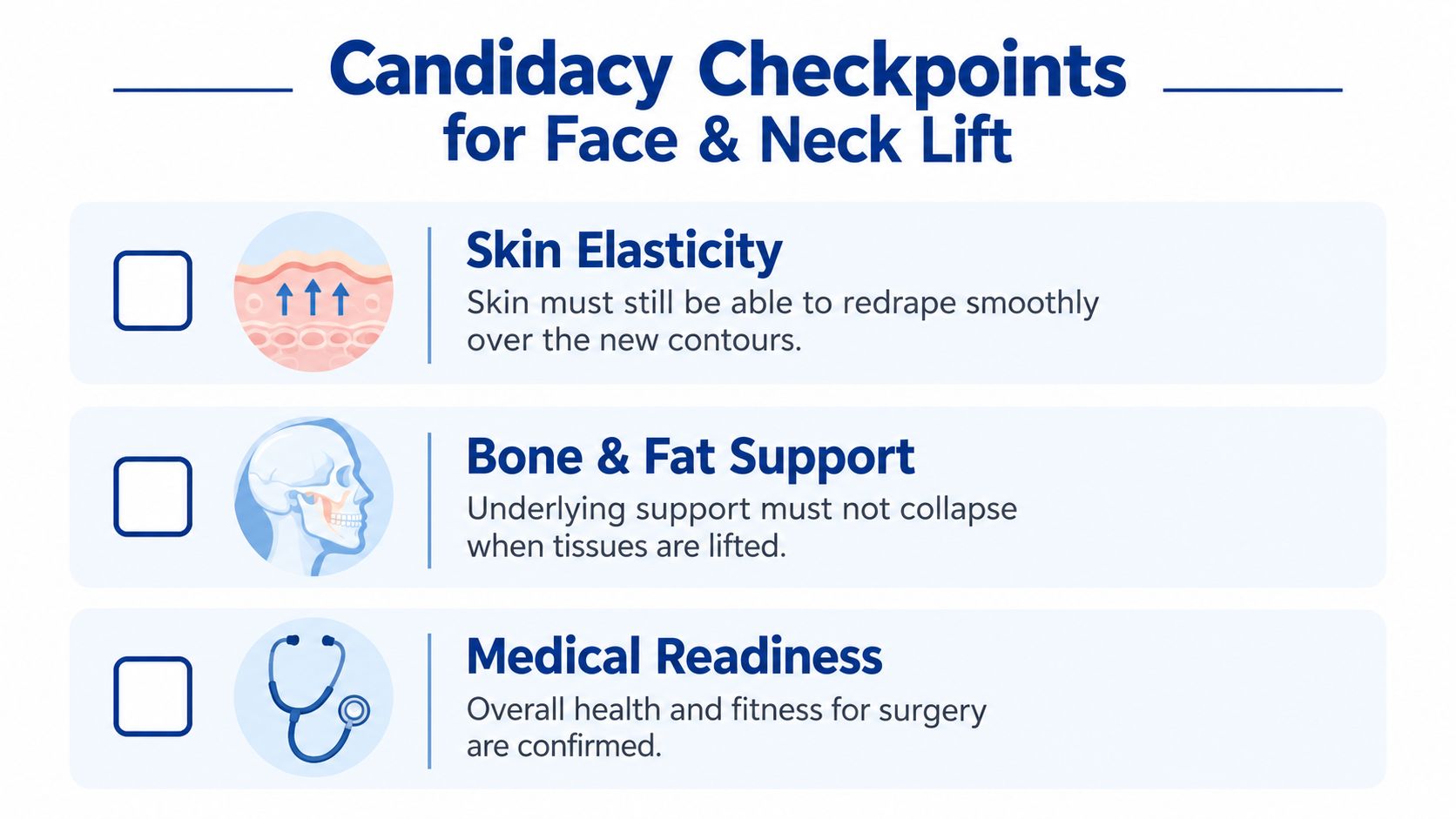
Good candidacy starts with anatomy and medical readiness, not age alone. The skin must still redrape smoothly, the underlying bone and fat must provide enough support for the new contour, and your health must be appropriate for the selected anesthesia and surgical plan.
Three checkpoints before choosing a technique
- Skin elasticity: Skin that has lost too much recoil may not redrape smoothly, even when deeper tissues are repositioned well.
- Bone and fat support: The surgeon must assess whether the underlying facial framework and volume will support the lifted tissues rather than leave a hollow or unstable contour.
- Medical readiness: Tobacco use, blood-thinning medication, hypertension, prior facial surgery, and other conditions can change both technique and anesthesia planning.
Bring a current medication list, details of previous operations, relevant medical records, and a clear description of what bothers you in photographs and daily life. Tell the surgeon whether you prioritize a sharper jawline, a smoother neck, midface support, a shorter recovery, or avoiding general anesthesia. Those priorities can conflict, and the consultation should make the trade-offs explicit.
Questions that produce a useful surgical plan
Ask how the surgeon decides between a combined face and neck lift and an isolated procedure. Ask which plane of dissection is proposed, how the platysma will be addressed, where the incisions will sit, and what the surgeon expects the procedure not to correct.
Request before-and-after photographs of patients with anatomy similar to yours, including comparable skin thickness, neck laxity, and jowl formation. Also confirm who administers anesthesia, where the procedure takes place, how postoperative monitoring works, and how revisions are handled.
For a Beverly Hills consultation, Dr. Sarah Yovino and Dr. Justin Yovino can discuss whether an awake, office-based approach is appropriate for your goals. Ideal Face & Body offers facial procedures including face and neck lift, neck lift, mini neck lift, and related contouring options, while the final recommendation should remain tied to your anatomy and primary complaint.
A written plan should identify the target structures, selected technique, anesthesia pathway, expected recovery, and limitations. That level of specificity is more valuable than a broad promise of looking refreshed.
Ideal Face & Body offers face and neck lift, neck lift, mini neck lift, and related facial contouring procedures, including selected awake procedures under local anesthesia with oral sedation. Visit Ideal Face & Body to request a consultation with Dr. Sarah Yovino or Dr. Justin Yovino and discuss which option fits your jowls, neck laxity, midface descent, and anesthesia preferences.