You can spend months caring for your face and still feel surprised when your hands give you away. A mirror can look reassuring until you notice the backs of your hands, where veins show more clearly, volume looks thinner, and the skin reads older than the rest of you. That disconnect is exactly why hand rejuvenation procedures have become such a practical part of aesthetic care, especially for patients who want improvement without a long recovery.
Table of Contents
- Why Your Hands Can Age Faster Than Your Face
- An Overview of Hand Rejuvenation Options
- Restoring Volume with Dermal Fillers
- Using Your Own Fat for Natural Rejuvenation
- Improving Skin Tone and Texture
- Creating Your Treatment Plan for Hand Rejuvenation
- Candidacy and Your Consultation in Beverly Hills
Why Your Hands Can Age Faster Than Your Face
A lot of people feel confident about their face, then one afternoon they catch a glance of their hands on a steering wheel, a coffee cup, or a phone screen and think, “Those don't match.” That reaction is common, and it usually has less to do with vanity than with how visible the hands are in daily life.
The backs of the hands have thin soft tissue, so when volume drops, tendons and veins become more obvious. They also see a lot of sun over time, which is why pigmentation and texture changes can stand out so quickly. In practice, the hand often shows a mix of volume loss, skin thinning, and surface change, and that combination is what makes aging look so pronounced there.
What patients usually notice first
Some people notice hollowing first, others notice veins, and others focus on rough or crepey skin. The problem is rarely just one thing, which is why a single treatment doesn't always solve the whole picture.
Practical rule: if the hand looks “bony,” the issue is usually volume. If it looks blotchy or textured, the issue is more about the skin surface.
That's also why the treatment conversation is useful rather than discouraging. Modern aesthetic medicine treats the hand as a structure that can be analyzed and improved, not as a feature you just have to accept. The most important shift is realizing that the goal isn't to make hands look artificial, it's to bring them back into balance with the rest of the person.
An Overview of Hand Rejuvenation Options
A patient usually asks about hand rejuvenation after noticing one or two things at once, hollowing, rough texture, or visible veins that make the hands look older than the face. The right treatment starts with identifying which change is doing most of the work, because each concern points to a different type of procedure.
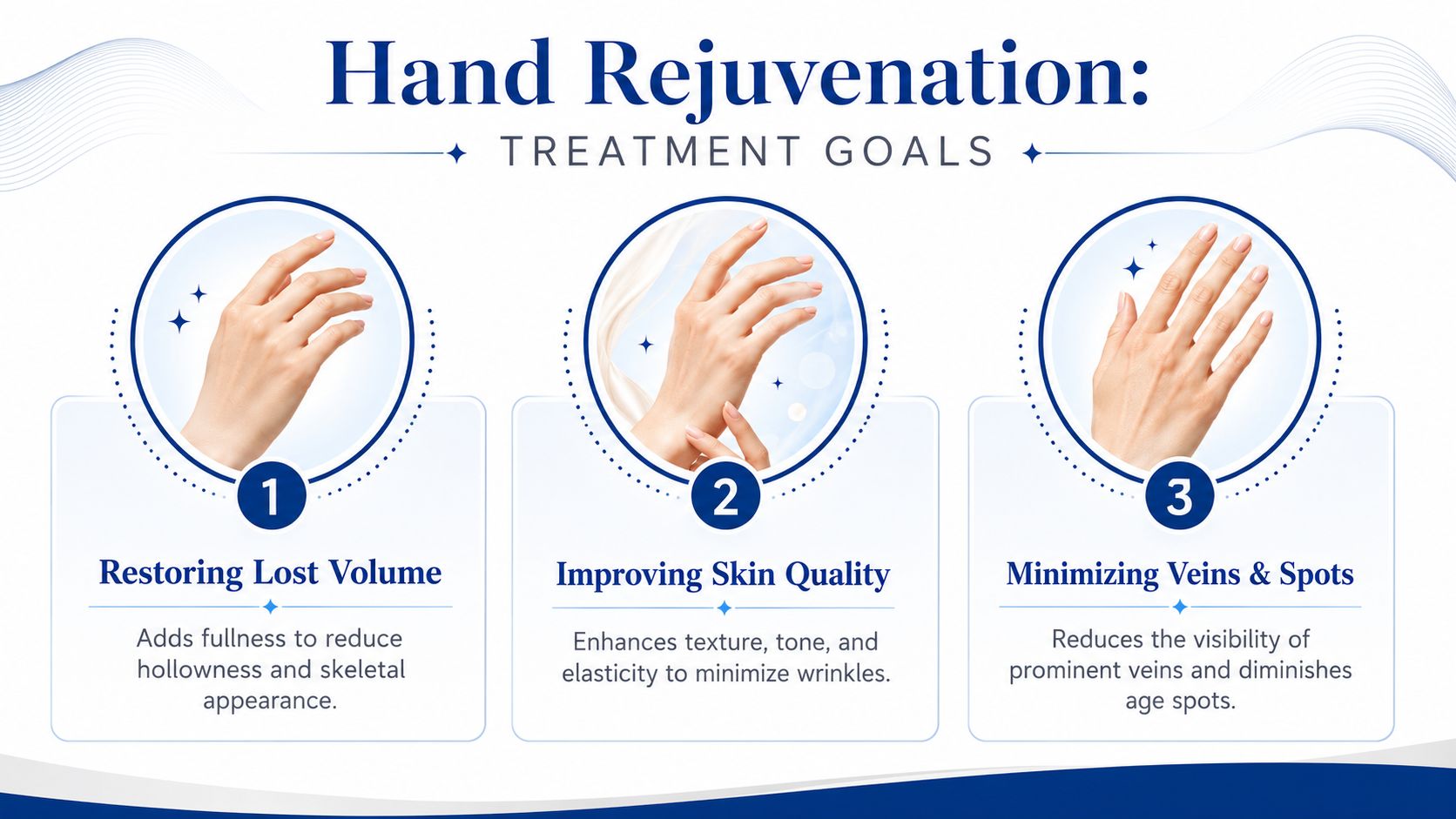
The easiest way to organize hand rejuvenation procedures is by treatment goal. One group restores lost volume. Another improves tone and texture. A third helps soften the appearance of veins or discoloration that draws attention to the backs of the hands.
The evidence base follows that same pattern. A systematic review found that the most commonly studied interventions were Radiesse at 32.2%, fat grafting at 32.2%, and Restylane at 9.7%, which shows how strongly the literature centers on volume restoration and dorsal hand hollowing. A separate review notes that the only two fillers currently FDA-approved for hand rejuvenation are Radiesse and Restylane-Lyft.
Comparing Hand Rejuvenation Procedures
| Procedure | Primary Target | Expected Longevity | Typical Downtime |
|---|---|---|---|
| Dermal fillers | Volume loss, visible tendons and veins | Temporary, with durability depending on product and technique | Usually minimal |
| Fat transfer | Volume loss and contour softening | Longer-lasting, with maintenance varying by patient | Usually short |
| Lasers and light-based treatments | Sun spots, tone, and surface texture | Often gradual and treatment-dependent | Variable, depending on device and settings |
| Chemical peels | Mild discoloration and surface dullness | Varies by peel depth and skin response | Often short |
| Vein-targeted treatments | Prominent veins | Treatment-dependent | Variable |
That table is useful because hand aging rarely shows up in one form only. A patient with hollow hands often needs a different plan than someone bothered by sun damage and fine wrinkling. In a consultation, the goal is to match the procedure to the exact concern instead of trying to make one treatment do everything.
For patients who want to understand the volume-restoring side first, a good starting point is different types of dermal fillers. The more the plan matches the problem, the more natural the result usually looks.
The awake, office-based approach matters here too. Many modern hand treatments can be done under local anesthesia in a calm setting, which helps keep discomfort low and avoids the extra recovery and logistics that come with a more involved surgical environment.
Restoring Volume with Dermal Fillers
When the back of the hands starts to look thinner, the veins and tendons stand out more. Dermal fillers address that change by restoring support beneath the skin, which helps the hand look smoother and less bony.
For patients who want to understand the filler options in more detail, a good starting point is a clear guide to filler types used in aesthetic medicine. In hand rejuvenation, the products are chosen for the kind of support they provide and for how naturally they integrate with the tissue in a delicate area.
The awake, office-based setting is a major advantage here. Many hand filler treatments can be done with local numbing in a calm room, so the experience is usually far easier than patients expect. You avoid the added anesthesia burden and the logistics that come with a more involved surgical environment, while still getting thoughtful, precise treatment.
The two FDA-approved fillers for hand rejuvenation are Radiesse and Restylane-Lyft. In a study of calcium hydroxyapatite, 68% of patients maintained at least a 1-grade improvement at 12 months after treatment, and the reported adverse events were mainly mild to moderate and resolved without sequelae (calcium hydroxyapatite study).
What the awake, office-based experience feels like
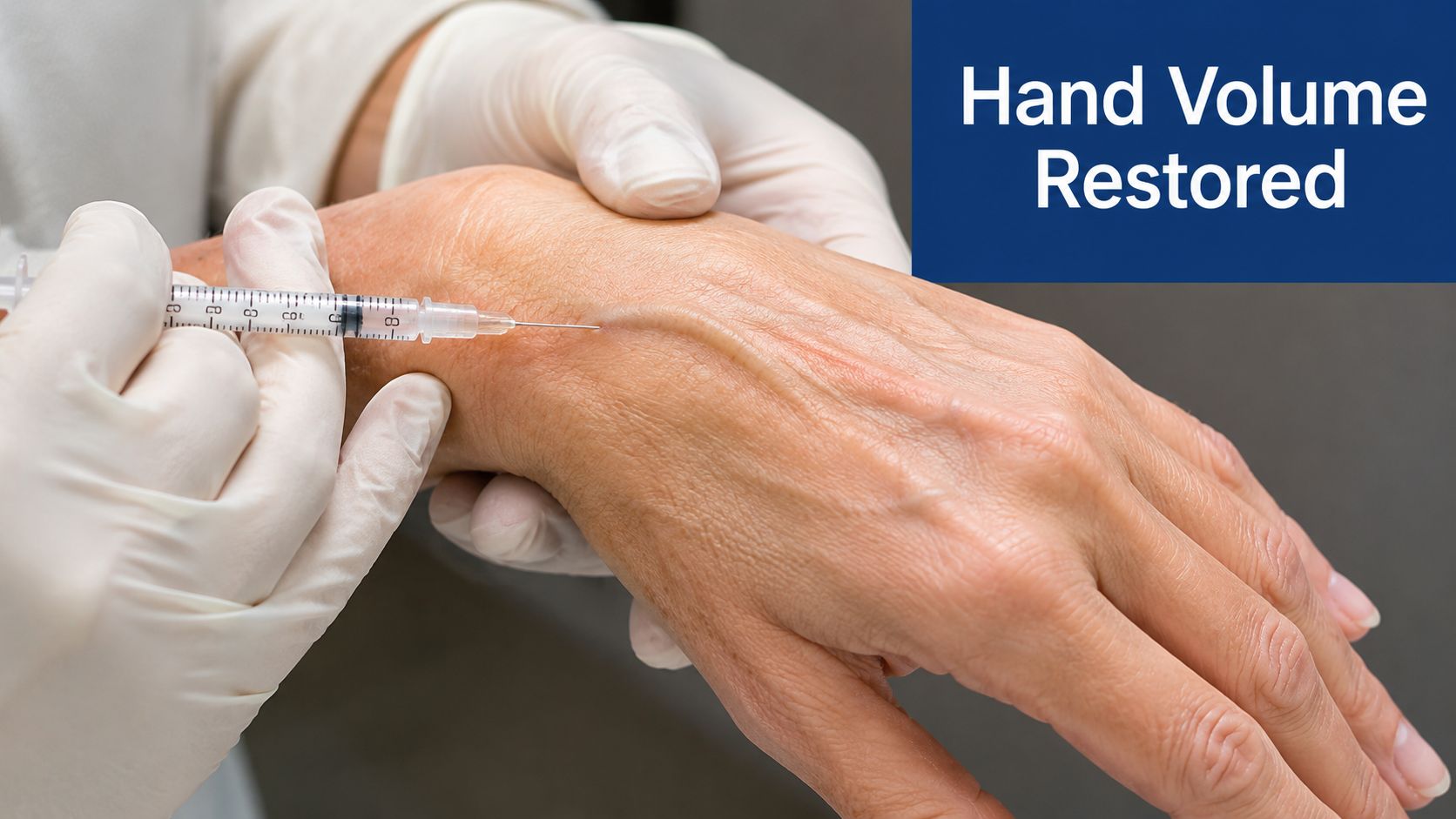
Local numbing keeps the procedure comfortable, and it also lets the injector reassess the hands as treatment progresses. A commonly described filler protocol uses about 2 cc of hyaluronic acid filler per hand, with placement divided across the dorsal web spaces in the superficial to intermediate planes while avoiding veins and extensor tendons (filler hand rejuvenation protocol).
That attention to depth matters because the hand does not hide uneven placement well. If product sits too superficially or is placed too heavily in one area, the result can look lumpy instead of refreshed. Careful technique, followed by immediate reassessment, helps keep the contour soft and balanced.
A useful consultation question is whether the goal is subtle restoration or a more noticeable correction. Fillers fit well when a patient wants lower downtime and likes the idea of seeing improvement right away, with the understanding that maintenance may be part of the plan.
Key point: filler treatment is about restoring shape, not making the hand look puffed. The best result still looks like your hand, only younger and less hollow.
Using Your Own Fat for Natural Rejuvenation
Some patients want a longer-lasting answer than filler, especially if the back of the hand looks deflated more than lined. Autologous fat grafting uses your own tissue to restore that lost fullness, which is why many people see it as the most “natural” volumizing option.
The technique is well established for dorsal hand rejuvenation and can be performed under local anesthesia. Surgeons typically inject 10-30 mL of purified fat per hand in a layered, radiating pattern to reduce the risk of contour irregularities (fat grafting review). That layered placement is important because the dorsal hand has very little soft tissue, and large or superficial deposits can create lumps.
How the process works in practical terms
First, a small amount of fat is harvested from another area of the body. Then that fat is purified and injected carefully into the hands. The point isn't to overfill, it's to restore a more youthful framework so the tendons and veins don't dominate the look of the hand.
For patients considering a body-contouring harvest at the same time, Ideal Face & Body's fat transfer approach may be part of that discussion, especially when the donor area can be shaped while preparing tissue for reinjection. In an awake, office-based setting, the appeal is simple, fewer moving parts, less anesthesia burden, and a more controlled recovery.
Technique matters more than volume. Fat has to be placed gently and evenly, or the hand can look irregular instead of refreshed.
This option tends to make sense for patients who want a more durable correction and are comfortable with a slightly more involved procedure. It's often a strong match for hands that have lost a lot of volume, because filler can improve the look, but fat can rebuild the underlying softness more fully. The tradeoff is that the planning has to be more exact, and the procedure itself is less like a quick injection and more like a mini-surgical treatment.
Improving Skin Tone and Texture
A hand can regain fuller contours and still look aged if sun spots, roughness, or crepey skin remain on the surface. Skin-focused treatments address those details, and for many patients they are the piece that makes the overall result feel complete after structure has already been restored.
A systematic review of dorsal hand rejuvenation found that outcomes were generally good and patient satisfaction was high, but satisfaction was lower for laser and light-based treatments than for other modalities, even though these procedures remained safe with minimal adverse events (systematic review). That finding helps set expectations. These treatments are often better at improving tone and surface quality than at replacing lost volume.
Choosing the right surface treatment
Different technologies address different concerns. Light-based treatments can help fade discoloration and sun damage. Resurfacing devices may improve crepey texture and fine lines. Chemical peels can soften mild dullness and uneven pigment.
Patients often expect a texture treatment to also correct hollowing. In most cases, it does not. Skin quality treatments work best once the hand already has enough structure, because they are meant to refine color, smoothness, and the look of superficial aging rather than rebuild volume.
Skin tone also matters. Devices do not behave the same way across all phototypes, so the plan has to account for pigmentation risk and healing potential. Expert guidance describes hand rejuvenation as a multistep process and stresses balancing durability, maintenance, and downtime while keeping skin type and pigmentation risk in view (multistep guidance).
Explore a radiofrequency-based skin option for texture-focused care
An awake, office-based approach makes this easier to tailor because treatment can be adjusted to the skin in front of us, not just to a preset plan. That usually starts conservatively. A patient who wants less blotchiness and a smoother surface often feels happier with a measured improvement than with an aggressive attempt to make hand skin act like facial skin, since the hands have different anatomy and face more daily wear.
Creating Your Treatment Plan for Hand Rejuvenation
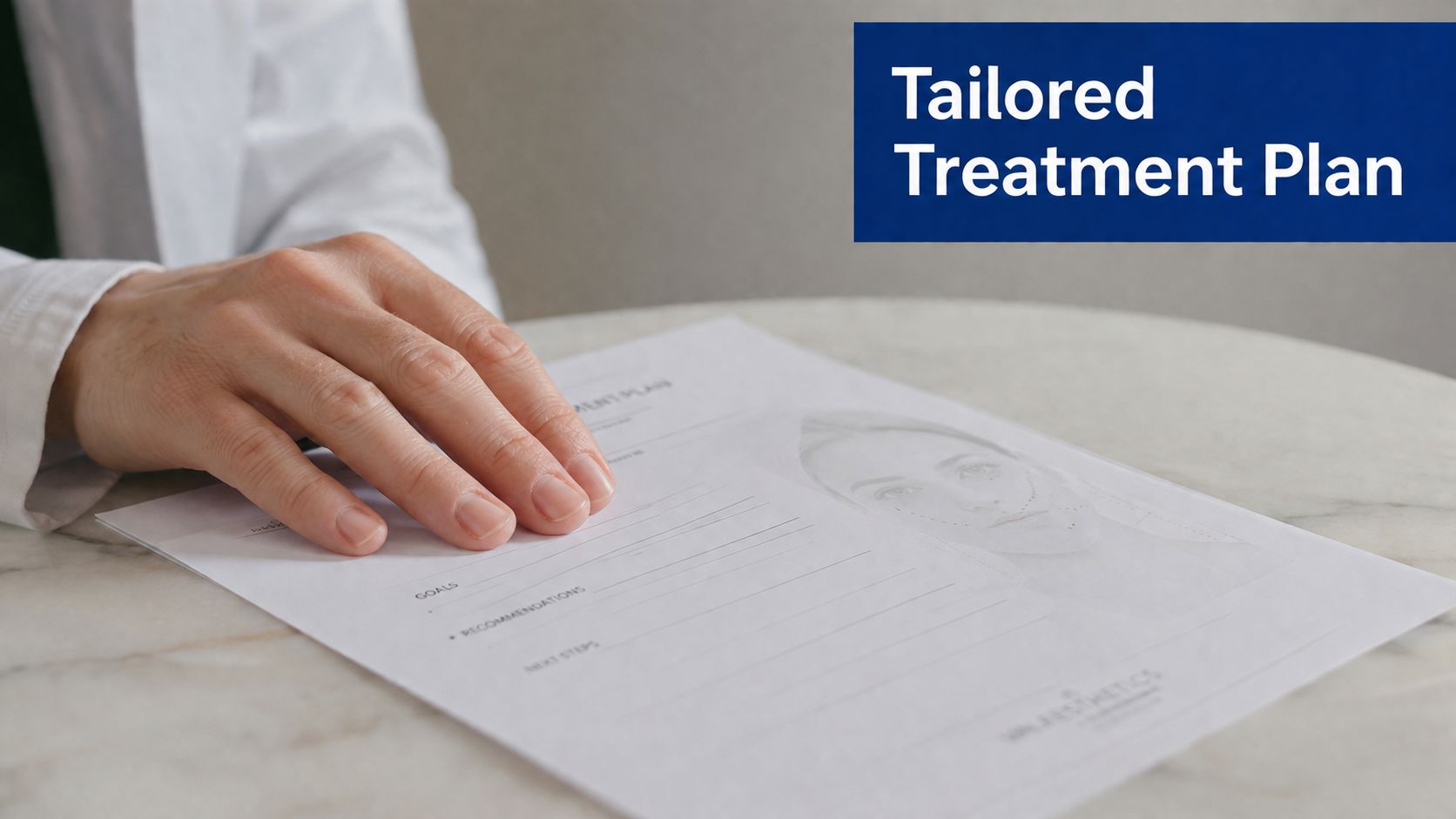
The cleanest results usually come from combining methods instead of relying on one. A hand that looks hollow and spotty needs both structure and surface attention, and trying to make a single device solve both problems often leads to compromise.
Expert guidance describes hand rejuvenation as a multistep procedure and emphasizes that long-term planning involves tradeoffs between durability, maintenance, and downtime, with careful attention to skin type and pigmentation risk. That matters even more for patients who want awake care and a quicker recovery, because the plan has to fit real life, not just a perfect treatment checklist.
How a combined plan gets built
A patient with volume loss might begin with filler or fat transfer, then add skin-directed treatment later if spots or texture remain. Someone with better volume but more sun damage might do the opposite. There is no single sequence that fits everyone, because the right order depends on what needs the most correction and how much downtime a person can realistically tolerate.
The best plan is the one you can actually complete comfortably.
The awake, office-based approach helps here because it keeps treatment more accessible. Local anesthesia, careful step-by-step planning, and short visits can make it easier to customize care without turning the experience into a major event. In an aesthetic practice that offers multiple modalities, the useful question is not “What is the strongest treatment?” It is, “What combination gives the most balanced result for this specific hand?”
A thoughtful consultation earns its value at this stage. The conversation should cover what changes bother you most, which treatment addresses each one, and how much maintenance you are willing to accept over time. When those pieces line up, the result looks more natural and usually feels more worthwhile.
Candidacy and Your Consultation in Beverly Hills
A good hand rejuvenation consultation starts with a simple question, what bothers you most when you look at your hands? Some people focus on hollowing, others notice prominent veins, spots, or a crepey surface, and many notice several changes at once. Good candidates are usually healthy adults who want a noticeable but natural improvement, not a hand that looks newly treated or overcorrected.
The most evidence-supported options for hand volume loss, dermal fillers and fat transfer, can be done safely in an office setting under local anesthesia, with studies reporting high patient satisfaction and no major complications. That matters because the awake approach keeps the visit centered on comfort, control, and recovery, rather than on the extra logistics that come with deeper anesthesia.
Think of the consultation like mapping a repair plan for a small but detailed area. Some hands need volume first, then skin treatment later if spots or texture still stand out. Others have enough volume but need more help with tone or pigmentation, so the plan starts in a different place. The right sequence depends on what needs the most correction and how much downtime you can realistically manage.
A thoughtful consultation should leave you with clear answers. Ask which concern will be treated first, how much change is realistic, how long the result is likely to last, and what recovery will feel like for your specific plan. If pigmentation or skin tone is part of the problem, ask how your skin type affects the choice of device or the timing of treatment.
For patients seeking a Beverly Hills consultation, Ideal Face & Body focuses on awake, office-based procedures under local anesthesia, which works well for the hands because the treatment area is small, visible, and easy to assess in real time. Dr. Sarah Yovino and Dr. Justin Yovino use that setting to shape the plan around your goals, comfort level, and downtime tolerance.
If your hands have started to bother you, book a consultation with Ideal Face & Body and talk through the options in a calm, educational setting. The right plan starts with understanding what your hands need, then choosing the simplest treatment, or combination of treatments, that can get you there safely.