
You're looking in the mirror, tilting your shoulders back, and still not liking what you see. The shirt fits fine everywhere else, but the chest doesn't look as firm or flat as you want, and that can make every gym day, beach day, or fitted T-shirt feel like a decision instead of a choice. The good news is that gynecomastia surgery is no longer a one-size-fits-all operation, it's a contouring procedure that should match the tissue pattern, skin quality, and your aesthetic goal.
| Technique | Best For | Incision Type | Primary Target |
|---|---|---|---|
| Liposuction alone | Chest fullness driven mainly by fat | Small access points | Fat |
| Direct gland excision | Firm glandular tissue that needs removal | Small incision near the areola | Gland |
| Combination technique | Mixed fat and gland, or more established chest fullness | Small access points plus targeted incision | Fat and gland |
Table of Contents
- Moving Beyond Self-Consciousness About Your Chest
- Are You a Candidate Understanding Gynecomastia Grades
- A Detailed Comparison of Gynecomastia Surgery Techniques
- The Modern Advantage Awake Procedures and PRECISION SCULPT
- What to Expect From Results Risks and Recovery
- Choosing Your Surgeon and Understanding the Investment
- Your Path to a Confident Chest The Consultation Process
Moving Beyond Self-Consciousness About Your Chest
If your chest has been bothering you for a while, you probably don't need another generic explanation. You need a clear answer to one question: what is effective. In men, the problem often involves glandular tissue, but some cases are characterized by mostly excess fat without the firm gland beneath the nipple. Those two patterns don't behave the same way, so the appropriate surgical method depends on what is present.
A helpful resource for the emotional side of body image is when you feel "I hate my looks", because the stress around appearance is real and often comes long before the consultation. The surgical answer, though, starts with anatomy. A chest that feels puffy but compresses easily under the fingers may lean more fatty, while a firmer disc under the areola points more toward glandular tissue.
Why the distinction matters
The distinction is practical, not academic. Fat can often be reduced with liposuction, while glandular tissue usually needs direct removal for a flatter contour. In many men, both are present, which is why combination treatment has become so common in modern surgery, especially when the goal is a natural-looking result rather than just less tissue.
The chest should be treated as a contour problem, not just a tissue-removal problem.
That shift in thinking is what separates older approaches from current practice. The modern plan is to flatten the chest, preserve masculine shape, and avoid the hollow or uneven look that can happen when one type of tissue is treated as though it were the whole story. Once you understand that, the rest of the decision becomes much easier to follow.
Are You a Candidate Understanding Gynecomastia Grades

The Simon grading system helps organize gynecomastia in plain terms. Grade 1 is the mildest form, usually small tissue fullness centered around the areola. Grade 2 is more noticeable, with a broader chest enlargement that still doesn't have major skin excess. Grade 3 is the most advanced category, where tissue buildup is larger and skin laxity can become part of the problem.
How grade guides the operation
The grade matters because it influences how much contouring, excision, and skin management are needed. A mild, limited chest can often be treated with less invasive methods, especially when the issue is mostly fat or a small amount of gland. More established cases may need a combination approach so the chest doesn't end up under-corrected or irregular.
This is why there isn't a single answer to the phrase best gynecomastia surgery. The best choice for a softer, fat-dominant chest may be very different from the best choice for a firm, projected gland with loose skin. The surgeon has to read the tissue, the skin, and the projection, then match the operation to the anatomy.
A practical way to think about it is this, the more the chest behaves like a simple fat pocket, the more likely a limited approach can work. The more it behaves like a true breast mound with skin stretch and glandular fullness, the more likely the plan needs to become layered and precise. For many patients, that means a consultation is less about picking a procedure from a menu and more about matching the right tool to the chest in front of you.
A Detailed Comparison of Gynecomastia Surgery Techniques
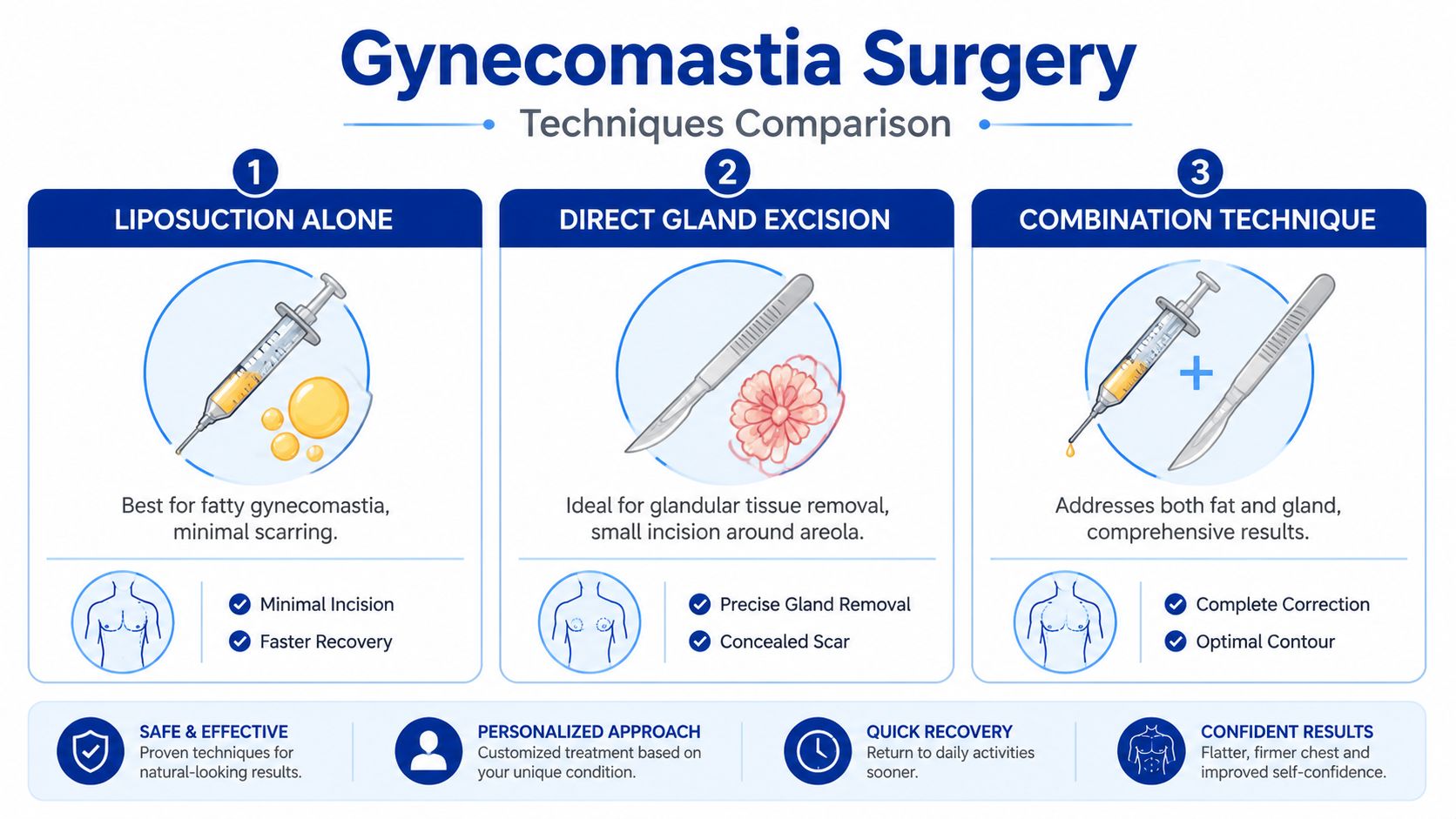
The main surgical paths are straightforward to describe, but they work very differently in the operating room. Liposuction alone removes fat, direct gland excision removes firm glandular tissue, and the combination technique addresses both. The right choice depends on whether the chest is mostly soft fullness, dense gland, or a mix of the two.
| Technique | Best For | Incision Type | Primary Target |
|---|---|---|---|
| Liposuction alone | Fat-dominant chest fullness | Small access points | Fat |
| Direct gland excision | Palpable gland beneath the areola | Small incision near the areola | Gland |
| Combination technique | Mixed tissue or more established gynecomastia | Small access points plus targeted incision | Fat and gland |
Liposuction alone can work well when the chest is mainly fatty, because it reshapes the contour without a larger scar pattern. Direct excision is more direct, but it carries a scar tradeoff and belongs in cases where glandular tissue needs to come out. Combination surgery is the most flexible option because it allows the surgeon to refine the outer chest and remove the dense tissue that liposuction cannot fully address.
Practical rule: the smallest scar is not automatically the best result, because a flatter chest with an incomplete correction can look worse than a slightly more visible but cleaner contour.
That tradeoff matters even more in advanced cases. The literature notes that less invasive methods can do very well for many patients, but severe gynecomastia with poor skin elasticity may require more extensive incisions to avoid under-correction and contour deformity, so anatomy should drive the plan, not wishful thinking PMC4621393. For a broader overview of how chest reduction surgery is typically framed, the guide on what gynecomastia surgery involves is a useful starting point.
Where the modern technique shifts
Historical evidence shows a move away from simple open excision and toward anatomy-specific surgery with better cosmetic efficiency. A review in Andrology found circumareolar subcutaneous gland resection to be well suited to mild and moderate cases because it reduces operative time and cost, and it also reported that technique choice strongly affects cosmesis, with the circumareolar approach capable of strong aesthetic outcomes. In a prospective series of 75 patients, mean operative time was 82.8 minutes, hospital stay averaged 2.22 days, and patient satisfaction reached 92.6% Andrology review.
That evolution is why modern planning usually favors a blended approach when the chest has both fat and gland. The goal is not merely removing tissue. It is shaping a chest that looks natural in motion, in clothes, and without them.
The Modern Advantage Awake Procedures and PRECISION SCULPT
A man who wants chest contouring often wants two things at the same time, a natural-looking result and a recovery that does not upend the rest of his week. Awake gynecomastia surgery addresses both goals in a practical way. By using local anesthesia in the right candidate, the procedure can stay more controlled, more comfortable, and easier to recover from. Modern minimally invasive gynecomastia operations, including targeted liposuction and direct pull-through excision, are described as safe and effective for the vast majority of patients, with fast recovery, low complication rates, and excellent cosmetic outcomes PMC4956846.
Why awake surgery appeals to many men
Many patients are not looking for a long hospital stay or a recovery that feels disruptive. They want the chest corrected while keeping the experience focused and manageable. Awake treatment fits that goal because it targets the problem directly, avoids the heavier anesthesia experience, and usually keeps the process efficient from start to finish.
That difference matters in real life. Men who work, train, or care for family often value a return to routine that feels predictable and less demanding. They also tend to prefer a procedure that feels precise rather than overly aggressive.
A modern option used in Beverly Hills is PRECISION SCULPT laser liposculpting. It is built for targeted contouring and aligns with the principle already discussed, chest reshaping should follow the anatomy instead of forcing every case into the same method. Ideal Face & Body offers this awake, office-based approach in Beverly Hills, CA, and it is one example of how contemporary chest contouring can be planned around precision and comfort.
How targeted contouring helps
Laser-assisted sculpting is useful because it can do more than reduce fat. In the right patient, it helps refine the chest surface with more control, which can improve the transition from the center chest to the surrounding torso. The goal is a chest that looks balanced in motion, in clothing, and without clothing.
It also supports a more deliberate style of sculpting. In the recent 4Dx technique, surgeons used cannula access in four directions, infraclavicular, prepectoral, axillary fold, and lateral chest wall, to contour different zones rather than treating the breast as one flat field PMC11679178. That zone-based planning reflects where the field has been heading, and it is especially useful when the chest needs shaping as much as reduction.
The best awake result is the one that removes the right tissue, respects the surrounding contours, and leaves the chest with believable shape.
What to Expect From Results Risks and Recovery
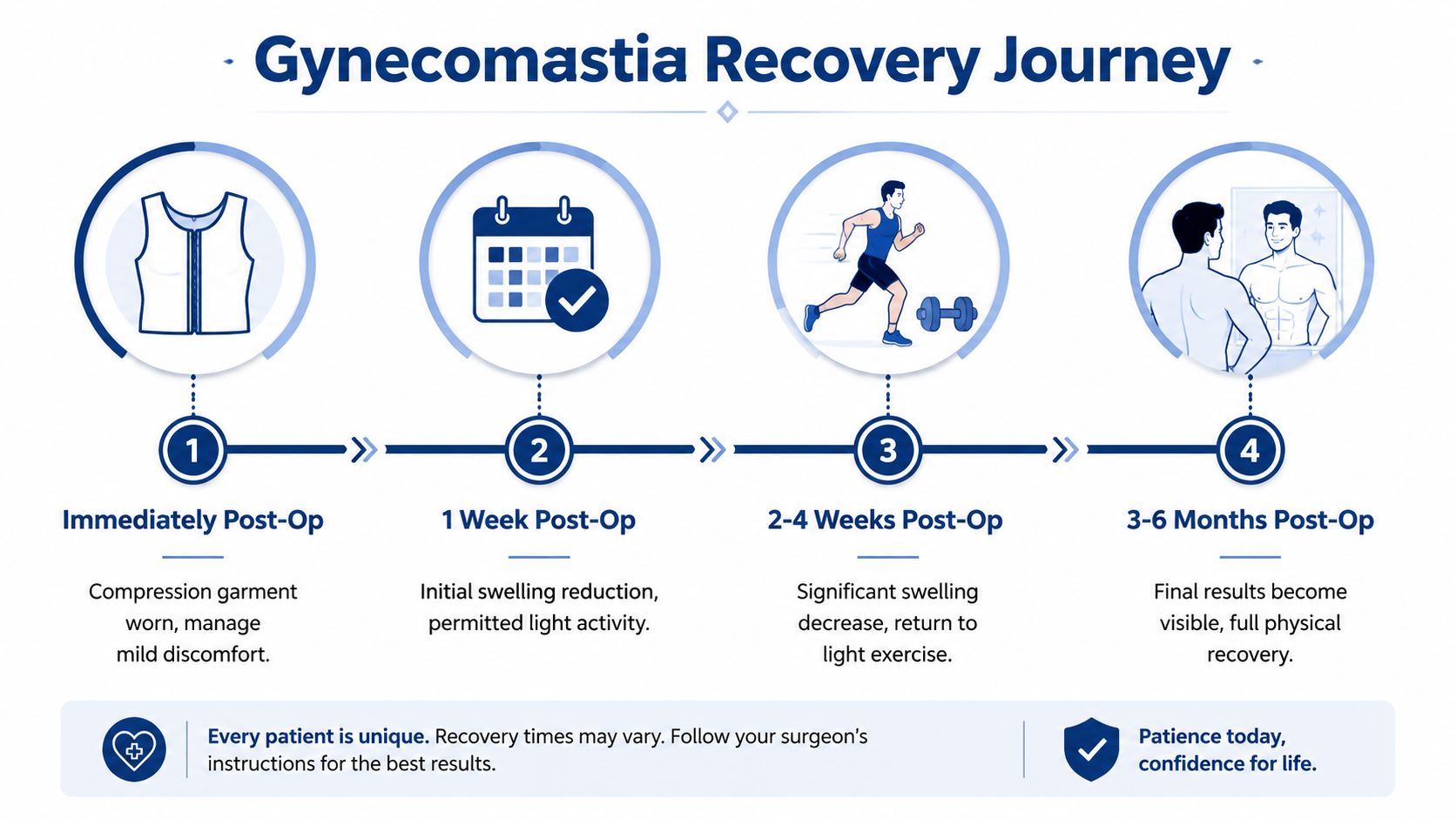
Right after surgery, the chest is usually supported with a compression garment to limit swelling and protect the healing tissue. In the first week, patients are typically focused on rest, light walking, and avoiding strain across the chest. Over the following weeks, swelling fades gradually and activity can be increased in stages.
What the recovery usually feels like
Once light activity resumes, many men notice that the chest feels less tight and the contour starts to look cleaner. Final refinement still takes time because residual swelling does not disappear all at once. The result that matters is the one seen after the tissues have settled, not the early postoperative view in the mirror.
For practical recovery guidance, the internal page on gynecomastia surgery recovery is a useful companion. The basics stay the same, wear the garment, avoid heavy chest work too early, and keep follow-up visits. That discipline helps protect the result.
Understanding the Risk Profile
The safety profile is strong, but no surgery is risk-free. A large systematic review found major complication rates ranging from 0% to 33%, with hematoma at 5.8% and seroma at 2.4% reported most often PMC7647635. A separate review of the gynecomastia literature reports the same general pattern and helps explain which complications experienced surgeons plan for most carefully PMC7635393.
What matters most: a surgeon who expects hematoma and seroma knows how to reduce the odds of both and how to respond quickly if either appears.
That same systematic review summarized outcomes from 1,112 patients and found that the most commonly used operative approach was skin-sparing mastectomy with or without liposuction, followed by mastectomy with skin reduction. That pattern shows why modern surgery is usually about combining methods thoughtfully, not forcing every patient into one operation.
Choosing Your Surgeon and Understanding the Investment
The surgeon matters as much as the method. A good consultation should make it clear whether the surgeon understands both glandular removal and contour design, because those are not the same skill. Look for double board certification, a strong before-and-after gallery focused on gynecomastia, and a practice that routinely handles awake body contouring.
What to ask before you book
Ask how the chest is evaluated for fat versus gland. Ask where scars are placed and how the surgeon avoids a hollowed or over-resected look. Ask how complications are handled and what the recovery plan includes. If the answers stay vague, that's a warning sign.
Price should be treated as a variable, not the decision point. The value sits in the surgeon's judgment, the safety of the facility, and the consistency of the result. Cheap surgery that leaves an uneven chest, a visible deformity, or a second operation is rarely a bargain.
Dr. Justin Yovino is a double board-certified plastic surgeon, and that kind of training matters when the operation is really about chest sculpture, not just tissue removal. The same is true for any surgeon you consider, the safest investment is the one made in skill, planning, and aesthetic judgment.
Your Path to a Confident Chest The Consultation Process
The consultation should feel specific, not generic. A surgeon examines the chest, feels for glandular tissue, studies skin quality, and listens closely to what bothers you most about your reflection. A man who wants a flatter profile without a conspicuous scar may need a different plan from someone whose main issue is firm gland beneath the areola.
What a strong consultation includes
- A physical exam: This determines whether the chest is mostly fat, mostly gland, or a mix.
- A goal discussion: The target should be a natural masculine contour, not just a smaller mound.
- A personalized surgical plan: The operation should match skin elasticity, tissue type, and scar tolerance.
- A recovery review: You should leave knowing what to expect, what to avoid, and when to return for follow-up.
At Ideal Face & Body in Beverly Hills, CA, that visit is built around office-based, awake body contouring, so the conversation naturally includes whether a minimally invasive approach is enough or whether more extensive correction would create the cleaner result. The right plan is the one that makes sense for your chest, your healing goals, and your comfort level.
If you've been putting off treatment because you weren't sure which surgery was right for you, the next step is simple, get a personalized exam and ask direct questions about tissue type, incision placement, and recovery. That's the fastest way to move from uncertainty to a real plan.
A CTA for Ideal Face & Body.