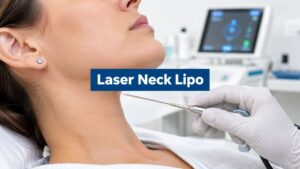
Platysma muscle tightening doesn't have one universal answer. The right approach depends on whether you have muscle-driven bands, loose or redundant skin, or both. In a 2023 review, platysma shortening appeared in 70.7% of analyzed studies and thinning in 25.2%, which helps explain why the muscle can create bands while also losing support over time.
You may notice the problem during an ordinary moment, such as reviewing a video-call recording and seeing two vertical cords beneath your chin. Perhaps your face still looks rested, but your jawline appears softer, or the neck seems older than the rest of your features. That mismatch is common because the neck can age on its own timeline.
Sun exposure, posture, weight change, and genetics all influence the skin, fat, and muscle in this area. The key question is whether the visible change comes mainly from platysma activity, stretched skin, or a combination. Tightening is a family of options, not a single fix.
Table of Contents
- When the Neck Tells a Different Story Than the Face
- The Platysma and the Three Layers of the Neck
- Bands You Can Move Versus Skin That Has Stretched
- Surgical Platysmaplasty, Mini Neck Lift, and Suture Support
- Non-Surgical Options That Quiet or Resurface the Platysma
- Recovery Timelines and What the Evidence Shows About Risks
- Choosing the Right Path for Your Anatomy
When the Neck Tells a Different Story Than the Face
Why neck aging can look disconnected
The platysma is a thin, sheet-like muscle that lies just beneath the skin of the neck. It extends upward toward the lower face and helps create the vertical bands that become noticeable when the muscle contracts. Because it's broad and superficial, even a subtle change in its position or activity can affect the appearance of the jawline.
A person may have relatively good cheek volume and facial skin quality while still seeing cords under the chin. Another person may have little visible banding but a soft fold of skin that hangs at rest. These are different anatomical problems, even though both are often described casually as a “loose neck.”
The aging pattern also varies from person to person. Weight loss may leave excess skin, while weight gain can add fullness beneath the chin. Sun exposure can weaken the skin envelope, and habitual forward-head posture can make folds and shadows more noticeable. Genetics influence the original shape of the neck, the amount of fat present, and how the platysma's borders are positioned.
Practical rule: Don't choose a treatment because it's labeled a “neck tightening” procedure. Choose it after identifying which layer is producing the visible concern.
Start with the movement, not the marketing
Look at your neck while relaxed, then gently clench your jaw, purse your lips, or tense the front of your neck. If cords suddenly become sharper, muscle activity is contributing. If the tissue remains draped and crepey without much change during movement, skin laxity may be the larger issue.
That distinction guides the rest of the decision. A treatment designed to reduce muscle activity won't remove a substantial excess of skin. A skin-resurfacing treatment can improve texture but won't reunite separated platysma borders. When both problems are present, the plan may need to address both mechanisms.
The purpose of consultation is therefore more specific than asking whether you need a neck lift. A careful examination assesses the skin, fat, platysma borders, jawline, and deeper structures before matching an intervention to the anatomy.
The Platysma and the Three Layers of the Neck
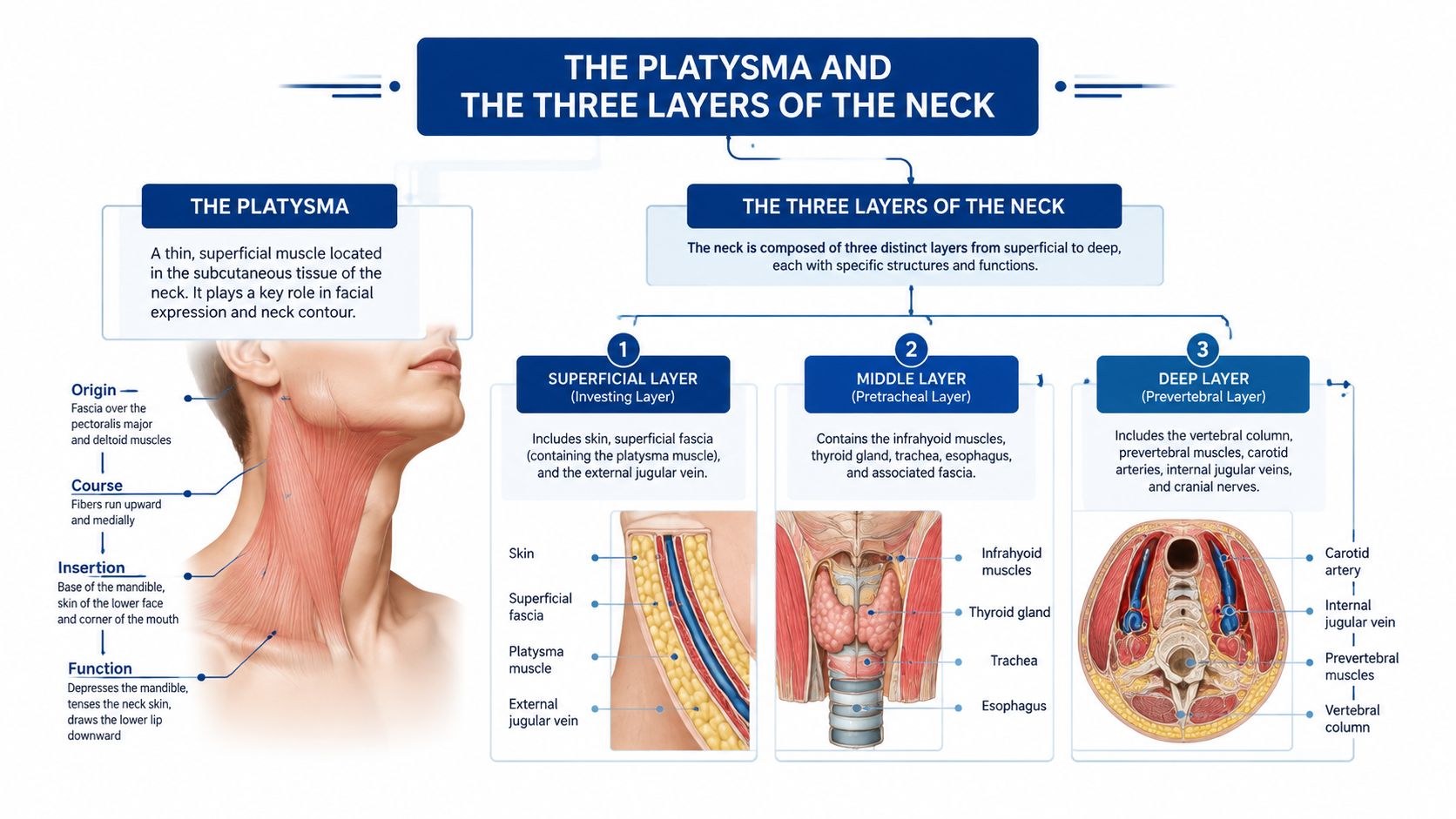
Think of the platysma as a broad, paired hammock spread from the collarbones toward the lower face. The two sides normally provide a sheet of superficial support. When the medial edges separate or the muscle becomes less supportive, the borders can appear as cords beneath the skin.
The muscle sits between the surface and deeper structures. A layered anatomy model divides the neck into superficial skin and subcutaneous fat, an intermediate plane containing the platysma and interplatysmal fat, and a deeper plane containing structures such as subplatysmal fat, the digastric muscles, the submandibular glands, and skeletal support according to this layered neck-anatomy model.
Matching the treatment to the layer
Each treatment changes something different:
- Skin-focused procedures work on the surface envelope. They can improve texture, fine wrinkling, and mild laxity, but they don't directly repair a separated muscle.
- Energy-based treatments deliver controlled heat or injury to skin and superficial supporting tissues. Their effect is gradual and limited by the amount of structural laxity.
- Botulinum toxin reduces nerve signaling to selected platysma fibers. It can soften a moving band without physically repositioning the muscle.
- Surgical sutures bring platysma borders together, layer redundant muscle, or suspend a lateral edge. These methods change the support structure more directly.
The platysma also shares a superficial fascial relationship with the lower face. That connection explains why a lower facelift may be paired with neck treatment when jowling and neck laxity are part of the same pattern. Pulling only the skin can leave the underlying muscle problem incompletely addressed.
A useful analogy is repairing a hammock. Resurfacing changes the fabric's surface, toxin reduces movement in the ropes, and surgery repositions or secures the supporting structure. Understanding the layers turns a confusing menu of procedures into a meaningful anatomical choice.
Bands You Can Move Versus Skin That Has Stretched
A dynamic platysma band behaves like a cord that becomes visible under tension. Static skin laxity behaves more like fabric that has stretched and no longer lies smoothly, even when the underlying structure is relaxed.
The mirror test
Stand in front of a mirror with your neck relaxed. Then perform three simple movements:
- Clench your jaw gently.
- Purse your lips.
- Flex the neck slightly or draw the corners of your mouth downward.
Vertical cords that sharpen during these actions suggest a dynamic muscle component. A soft fold, hanging edge, or crepey surface that remains visible at rest suggests skin redundancy. Many people have both, so the test is useful for observation, not diagnosis.
The distinction has anatomical support. In an observational study of people with unilateral facial paralysis, platysma bands appeared on the healthy side in 76% of patients but not on the paralyzed side, supporting contraction as a major driver of band formation as reported in the facial-paralysis study. More recent imaging found that muscle thickness within a platysmal band increased by 0.33 millimeters, or 37.9%, during contraction, demonstrating that the band can be a dynamic muscular event rather than only a static aging change in the newer imaging research.
| Feature | Dynamic Muscle Bands | Static Skin Laxity |
|---|---|---|
| Appearance | Vertical cords or ridges | Draped, loose, or crepey tissue |
| Change with movement | Becomes more prominent with contraction | Changes little during contraction |
| Main source | Platysma activity or separated muscle borders | Stretched skin and supporting tissues |
| Relevant treatment category | Muscle-relaxing injection or muscle repair | Skin tightening, skin removal, or lifting |
| Common overlap | May coexist with loose skin | May coexist with bands and neck fullness |
What can blur the picture
Fat beneath the chin can obscure the jawline and make a mild muscle problem look more severe. The position of the submandibular glands and the shape of deeper neck structures can also influence the cervicomental angle. Those factors aren't corrected by tightening surface skin.
A surgeon evaluates the neck at rest and during contraction, then considers the amount of skin, fat distribution, muscle separation, and deeper fullness. That examination matters more than choosing a procedure from a photograph or assuming that every visible fold is “loose skin.”
Surgical Platysmaplasty, Mini Neck Lift, and Suture Support
The platysma is a thin, paired muscle sheet extending from the collarbones toward the lower face. Its medial borders normally sit close together, but separation creates visible bands. Surgery can bring those borders together, support them from the sides, or address the overlying skin. The right choice depends on whether the main problem is dynamic banding, true skin laxity, or both.
Open repair and muscle reapproximation
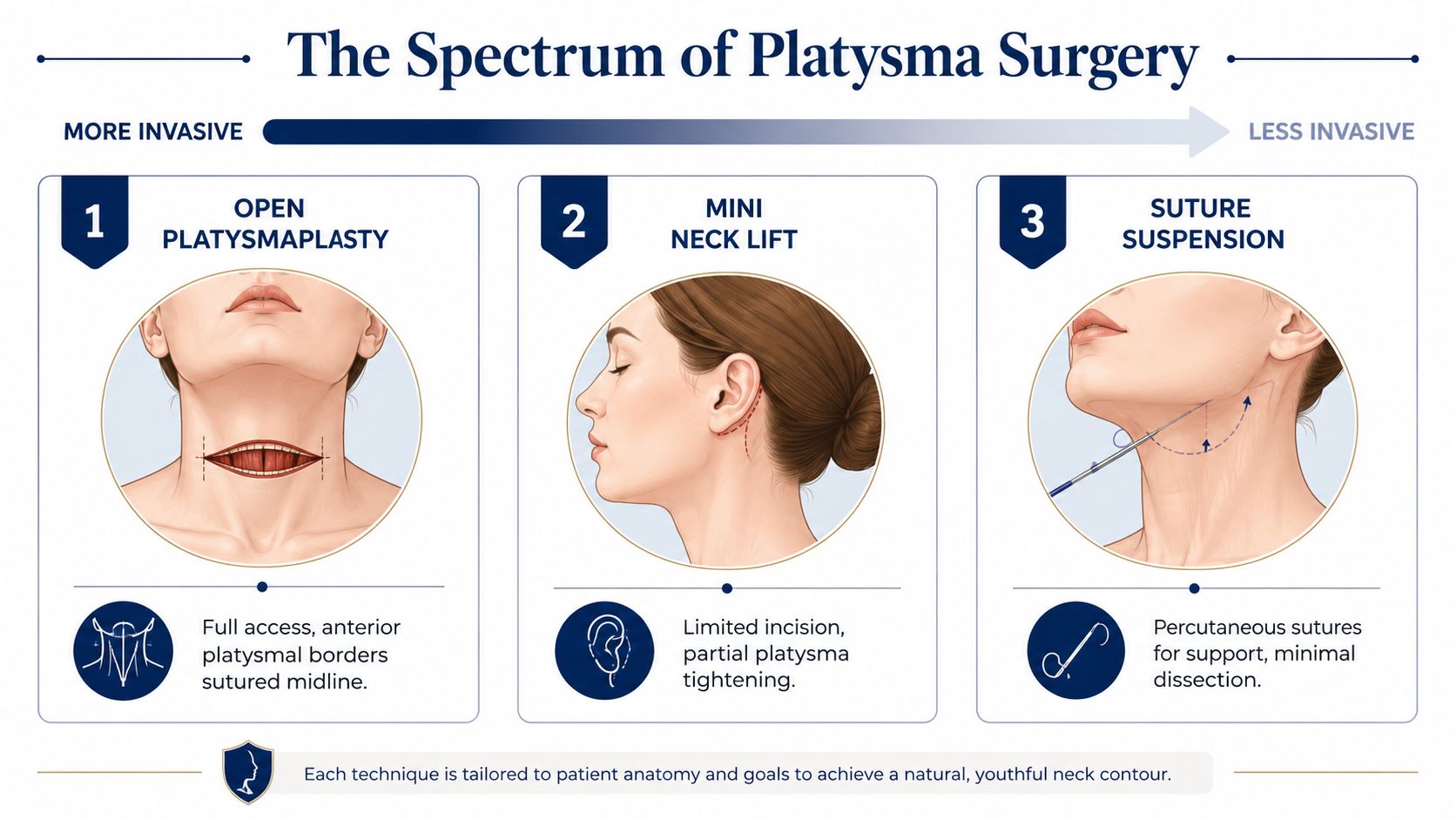
In a traditional central, or “corset,” platysmaplasty, the surgeon brings the medial platysma borders toward the midline and secures them there. This repairs separated or lax muscle edges and can sharpen the cervicomental angle. It is particularly useful when prominent bands appear in a relatively thin neck, where muscle separation is more apparent than excess fat.
A different maneuver, often combined with facelift surgery, places the platysma under tension from a lateral approach. The surgeon may overlap or layer redundant muscle, a process called imbrication or plication. This approach can improve the neck while also supporting the lower face, but it involves a broader treatment plan than central repair alone.
The published surgical evidence includes a series of 61 patients. Closed platysmotomy was performed alone in 20 patients and combined with facelift surgery and lateral platysma plication in 41 patients. The report described satisfactory aesthetic results in all patients, with 2 temporary cervical-branch neuropraxias and 1 hematoma with partial retroauricular skin necrosis during the study period, as detailed in the surgical series published in Aesthetic Plastic Surgery.
Less dissection, less correction
A mini neck lift uses smaller incisions and more limited access to tighten selected areas. It may fit early skin laxity, modest banding, or a patient who does not need correction on the scale of a full facelift. Its limits become clearer when the neck has extensive redundant skin, marked midline separation, or deeper fullness. A smaller operation cannot always reach or rearrange every layer involved.
Suture-only suspension uses even less dissection. Sutures re-anchor or support the platysma through smaller access points, without broadly undermining tissue or removing skin. This can suit early banding or serve as an adjunct, but it cannot reproduce the tissue rearrangement of open surgery and does not remove stretched skin.
A later series described 129 patients treated with composite platysmaplasty. Of these, 17 required closed percutaneous platysma myotomy, and 4 underwent secondary myotomy 2 to 8 months later. Early follow-up windows ranged from 8 to 17 months, so these findings do not establish lifelong stability.
Anesthesia, incision placement, and recovery vary with the operation and the patient. More extensive repair usually gives the surgeon greater control, while requiring more healing. Less invasive support may reduce downtime, but the visible change can be smaller and future maintenance may be needed.
Non-Surgical Options That Quiet or Resurface the Platysma
Non-surgical treatment follows two different pathways. Neuromodulators reduce muscle activity, while energy-based devices work mainly on the skin and superficial supporting tissues. Neither should be described as a substitute for the other.
Reducing a moving band
Botulinum toxin weakens selected platysma fibers by reducing nerve signaling. It's most useful when the band is clearly dynamic and the skin envelope remains reasonably elastic. The injector must place the product carefully because excessive spread or dosing can affect nearby muscles involved in lower-face movement and neck function.
A split-side comparative study found that treating only the motor-rich upper half of the platysma produced the same 2-week improvement score of 2.2 ± 0.4 as treating the full muscle, while using 50% fewer injection points and 50% lower total dose in the comparative injection study. The finding supports targeting nerve distribution rather than treating the entire visible surface.
The practical limitation is maintenance. The effect fades as nerve signaling returns, and temporary neck weakness can occur. Botulinum toxin softens contraction. It doesn't remove loose skin, reunite separated muscle borders, or correct deeper fullness.
Improving the surface envelope
Fractional radiofrequency, microneedling radiofrequency, and ultrasound-based treatments aim at the dermis and superficial supporting tissues. They may improve skin texture and create modest tightening through controlled tissue remodeling. They don't physically shorten the platysma in the way surgical sutures do.
| Modality | Mechanism | Onset of Visible Effect | Typical Duration | Best For |
|---|---|---|---|---|
| Botulinum toxin | Reduces platysma nerve activity | Gradual improvement after treatment | Temporary, with maintenance as activity returns | Dynamic bands |
| Fractional energy treatment | Stimulates dermal remodeling | Gradual | Variable | Texture and mild laxity |
| Microneedling radiofrequency | Delivers controlled energy through the skin | Gradual | Variable | Skin quality with limited laxity |
| Ultrasound-based tightening | Heats selected tissue depths | Gradual | Variable | Mild surface laxity |
The realistic ceiling is important. Non-surgical options can soften the appearance of bands or improve skin quality, but structural laxity may remain. A consultation should identify whether a modest change is the goal or whether only direct muscle repair can address the concern.
Recovery Timelines and What the Evidence Shows About Risks
Recovery after surgical platysma work depends on the technique, the extent of dissection, and whether a facelift or another neck procedure is performed. Early healing usually brings swelling, tightness, and activity limits, so the first appearance is not the final contour.
A practical recovery arc
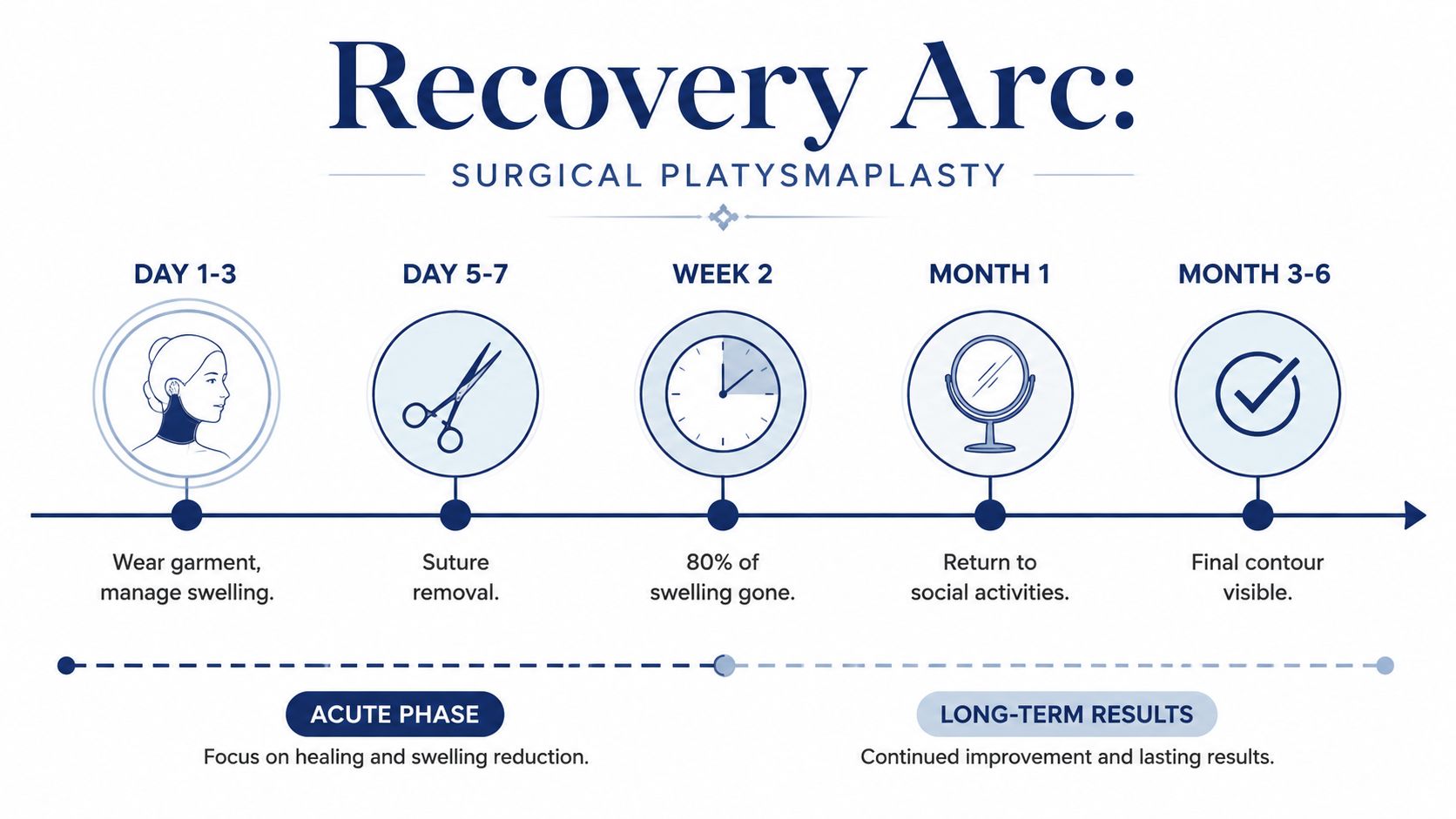
During the first 1 to 3 days, patients commonly wear a compression garment or chin support while swelling is controlled. Sutures may be removed around days 5 to 7, depending on the incision and the surgeon's protocol. By approximately week 2, many patients can return to ordinary social activity, although residual swelling and tightness may remain visible.
Exercise usually waits until around weeks 4 to 6, with timing guided by healing. The cervicomental angle continues to settle, and the final contour may take about 3 months. These points help with planning rather than promise a fixed outcome. Combined facelift surgery can increase swelling around the ears and extend the overall recovery experience.
What the pooled evidence reports
A 2025 systematic review and pooled analysis of neck lift outcomes reported a 1.4% recurrence rate for platysma bands, pooled nerve damage of 0.9%, hematoma of 1.8%, and sialoma of 0.3% in the pooled neck-lift analysis. These are pooled published outcomes, not a personal risk prediction.
The complications also vary in seriousness:
- Hematoma: A blood collection may require prompt assessment and, in some cases, drainage.
- Nerve dysfunction: Weakness may be temporary or lasting, depending on the nerve involved and the extent of injury.
- Sialoma: A collection of salivary fluid can require treatment and monitoring.
- Contour and comfort issues: Tightness, a noticeable submental scar, or temporary distortion near the hairline can be frustrating even when medically minor.
The achievable results have a practical limit. Ask which complications your surgeon sees most often, how the team monitors for them, and what happens if one develops. A sound consent discussion covers recurrence and maintenance as well as early photographs.
Choosing the Right Path for Your Anatomy
A useful decision starts with two questions: do the bands appear mainly when the platysma contracts, and how much skin has lost its recoil? The same cord-like line can need a different plan in someone with elastic skin than in someone with hanging tissue or fullness beneath the chin. Platysma muscle tightening is therefore not one procedure. It is a choice between treating movement, stretched skin, or both.
Profile one: isolated dynamic bands
The first profile shows visible cords during contraction, good skin tone, and little tissue hanging at rest. A muscle-directed option, such as carefully targeted botulinum toxin or limited suture support, may be considered first.
This approach matches the problem to the layer causing it. If the skin still contracts and recoils well, skin removal may create more scar and recovery than the concern warrants. A surface-only treatment can also miss the source, because the band comes from muscle activity rather than the skin itself.
Profile two: bands with laxity
The second profile combines dynamic banding with loose skin, a blurred jawline, or localized fullness. Surgical platysmaplasty, a mini neck lift, or a combined facial and neck approach may offer more complete correction, depending on which layers are contributing.
Botulinum toxin may suit someone who wants temporary band softening and accepts that loose skin will remain. Resurfacing alone is a poor match when the platysma borders are substantially separated. Muscle treatment can quiet movement, but it cannot remove excess skin or reposition deeper tissue.
Profile three: predominant skin redundancy
The third profile has draped skin and a crepey texture, with little visible change during contraction. A skin-directed treatment or a lift matched to the degree of redundancy may make more sense than weakening the muscle.
The most important examination is dynamic. A neck that changes dramatically with contraction calls for a different conversation than one that hangs the same way at rest.
The field continues to develop. Energy-based muscle modulation and bioabsorbable suture systems may occupy the space between temporary injection and open platysmaplasty. Each newer method still needs evaluation for durability, complications, and patient selection. Pooled trial evidence indicates that onabotulinumtoxinA can improve platysma prominence, jawline definition, satisfaction, and psychosocial impact without an increased adverse-event signal versus placebo, as summarized in the recent pooled evidence. Surgical treatment may provide longer-lasting structural change, but it also carries procedural risks.
Ideal Face & Body offers facial and neck procedures, including neck lift and mini neck lift options, along with non-surgical injectables and skin treatments. Its practice model emphasizes awake, office-based procedures under local anesthesia, with treatment selection based on the patient's anatomy and goals.
If you notice neck bands, skin laxity, or a blurred jawline, schedule an evaluation with Ideal Face & Body to determine whether the change is muscle-driven, skin-driven, or mixed. Bring photographs or describe when the bands appear. Ask for a plan that targets the layer causing the change rather than a one-size-fits-all tightening procedure.