For crow's feet, Botox results usually last about 3 to 4 months, with onset within 1 to 2 days and full effect around two weeks. Duration varies by individual.
That answer describes wrinkle improvement, not a deadline for every change around your eyes. In placebo-controlled crow's-feet studies, patient-assessed median responses reached 144 days for dynamic lines and 148 days for static lines, according to the published clinical review. Those findings help explain why your experience may not fit neatly into a calendar reminder.
The more useful question is what you're timing: the first softening, the return of visible lines, or recovery from an unwanted eye symptom. Each deserves a separate assessment.
Table of Contents
- The Short Answer and the Week-by-Week Timeline
- What the Clinical Trials Measured and Found
- What Makes Results Last Longer or Shorter
- Eye Side Effects and When to Get Them Checked
- How to Time Retreatment Without Overdoing It
- Plan Your Next Eye Treatment With a Qualified Injector
The Short Answer and the Week-by-Week Timeline
Botox Cosmetic temporarily relaxes the muscle responsible for crow's feet, clinically called lateral canthal lines. The FDA prescribing information states that chemical denervation generally begins within 1 to 2 days and strengthens during the first week.
The American Academy of Ophthalmology describes Botox's effects on facial wrinkles more broadly as lasting about 3 to 6 months. That broader range isn't a promise that a crow's-feet treatment will remain equally noticeable throughout that period.
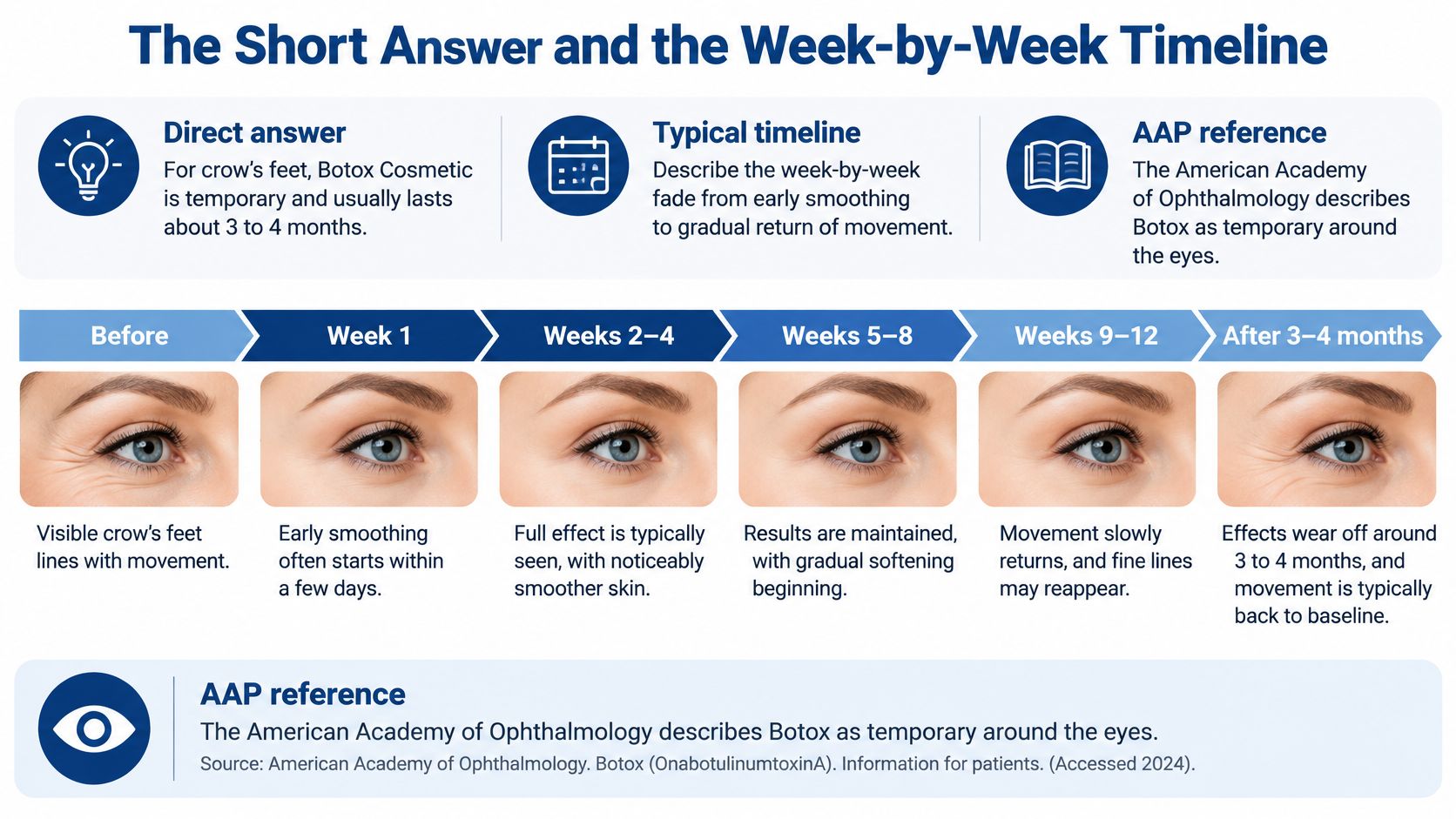
Botox around-the-eye timeline
Mount Nittany Health describes full effect within 1 to 2 weeks and typical benefits lasting 3 to 4 months. Together with the prescribing information, those benchmarks support this practical timeline, not a guaranteed progression for every patient.
| Stage | Timing | What You Notice |
|---|---|---|
| Onset | Days 1 to 2 | Muscle movement begins to soften |
| Strengthening | During the first week | Crow's feet look smoother during expression |
| Full effect | Around 2 weeks | Peak smoothness for dynamic lines |
| Stable window | Months 1 to 3 | Results generally hold while comfortable eye function should remain |
| Gradual return | Around months 3 to 4 | Lines reappear as movement returns |
| Retreatment window | After about 3 months | Reassess before any repeat dose |
Think of the effect as a dimmer lowering a light, not a switch turning it off permanently. As nerve-to-muscle communication recovers, the dimmer gradually turns upward. Movement and expression lines usually return progressively rather than all at once.
Dynamic lines appear or deepen when you smile or squint. Static lines remain when your face is relaxed, and may also reflect sun damage, repeated creasing, or reduced elasticity. Muscle relaxation can soften their appearance, but it doesn't erase every skin-related change.
Know which smile lines you mean
Crow's feet sit at the outer corners of the eyes. Other creases that appear during a smile may involve different muscles and require a different assessment. Amanda Family Dental's explanation of what smile line Botox involves offers useful context for discussing movement-related lines.
Practical rule: Judge your result by expression, resting appearance, and comfort, not by whether every crease disappears.
A return visit should follow meaningful changes in movement and wrinkle visibility, not the calendar alone. Treatment frequency also has a labeling boundary, so maintenance needs a clinical reassessment rather than an automatic repeat appointment.
What the Clinical Trials Measured and Found
Clinical trials can measure crow's-feet improvement in several ways: during a deliberate smile, with the face at rest, or through a patient's own assessment. These are separate clocks. A rating may show improvement at one point in time even as another measure has already changed.
The trials used a standardized 24 Units of onabotulinumtoxinA for lateral canthal lines and included adults with moderate-to-severe crow's feet. The findings apply to that treatment and study population, not automatically to every injection described as eye-area Botox.
Study-reported median duration at 24 Units
The clinical review cited earlier reports these median response durations. The second study's approximate range is not a separate static-line result.
| Measure | Dynamic Lines | Static Lines |
|---|---|---|
| Study 1, investigator-assessed median | 125 days | 137 days |
| Study 1, patient-assessed median | See the patient-assessed medians reported in the introduction | See the patient-assessed medians reported in the introduction |
| Second study, median response | Approximately 119 to 121 days | Separate static-line median not specified in the cited summary |
Median means the middle result, not a minimum duration or a promise. Some participants reached the study's endpoint earlier, others later. A patient may also perceive less smoothing before an investigator rates the response as finished.
Dynamic assessments evaluate lines during facial contraction. Static assessments evaluate lines at rest. A longer measured response for resting lines reflects the rating method used; it does not show that Botox repairs sun damage or restores lost elasticity.
What the findings can tell you
The studies offer a benchmark for how long improvement may remain measurable under controlled conditions. Their endpoint, however, is a defined study rating, not a guarantee that every crease will disappear in photographs.
Several limits affect how closely the results may match an individual experience:
- Standardized treatment: The results do not establish how long a much lower dose may last.
- Selected participants: Adults with moderate-to-severe crow's feet may differ from someone concerned about faint creasing or loose lower-eyelid skin.
- Specific anatomy: Findings for lateral canthal lines do not automatically apply to injection patterns elsewhere around the eye.
- Defined outcomes: A study's response endpoint is not the same as complete smoothness.
Before comparing your result with a study median, clarify what the treatment was intended to change: muscle-driven folding, skin-driven creasing, or both. That distinction helps explain why movement-related lines and resting lines may follow different measured timelines.
What Makes Results Last Longer or Shorter
Two people can receive treatment in the same general area and notice different durations. Dose, placement, muscle activity, and skin condition all influence what they see. A stronger or longer-lasting effect isn't automatically the better outcome near the eyes.
The FDA's product instructions specify 24 Units total, 12 Units per side, using 4 Units at each of three sites per side, for six injection points in the lateral orbicularis oculi. These are labeled administration details, not a reason to request extra treatment without an examination.

Factors that change how long results last
The table distinguishes factors that may change muscle relaxation from those that change your perception of smoothness. The labeled dose and placement above provide the reference point.
| Factor | How It Changes Duration | What to Ask Your Injector |
|---|---|---|
| Dose | The labeled regimen is shown above; lower doses may wear off sooner, but standardized-dose trials don't establish every lower-dose outcome | Is my dose matched to my muscle strength? |
| Injection pattern | The labeled six-point pattern targets the lateral muscle; placement affects how evenly it relaxes | How are the injection points placed for my face? |
| Muscle strength | Stronger, more active muscles may regain noticeable movement sooner | How strong is my squint and smile? |
| Age and expression habits | Frequent squinting or smiling makes dynamic folding more apparent; age alone doesn't predict duration | Which lines move most when I express? |
| Metabolism | Individuals differ in how quickly toxin activity fades | Has my response changed across past treatments? |
| Skin laxity and sun damage | Static lines can persist despite reduced muscle activity | Which lines need a different approach? |
| Product | Each toxin has its own studied duration; findings don't automatically transfer between products | Which product are you using and why? |
A shorter result isn't proof of resistance
If your result seems brief, review the treatment before assuming your body has stopped responding. A conservative dose, placement that doesn't match your expression pattern, or persistent skin creases can all create the impression that Botox has worn off. Residual wrinkles alone don't establish toxin resistance.
The same principle explains why results in other muscles aren't a useful forecast for your crow's feet. Ultra Smile DentalSpa's overview of Botox options for tight jaw muscles concerns a different treatment target. A jaw-muscle experience can't tell you how an eye-area treatment should feel or last.
For a closer look at treatment mechanics, our explanation of what makes Botox injections effective can help you prepare specific questions.
Bring past treatment dates, the product used if known, and photographs taken at rest and during a smile. Those details help your injector consider dose, placement, muscle movement, and skin quality together instead of blaming a single factor.
Eye Side Effects and When to Get Them Checked
The wrinkle clock and the safety clock are different. You shouldn't judge an eye symptom by how long the cosmetic improvement is expected to last.
The orbicularis oculi contributes to expression, blinking, and eyelid closure. Excessive weakening can therefore affect more than wrinkles. An NHS periocular botulinum toxin information leaflet describes concerns including dry eye, discomfort, blurred vision, and eyelid effects; unwanted symptoms may last weeks or up to roughly three months as toxin activity fades.
Keep separate records for appearance and function
Track the treatment's development, the visible wrinkle benefit, and any eye or eyelid symptoms independently. A smoother smile doesn't tell you whether your blinking is comfortable. Likewise, a returning crease doesn't prove that an unwanted eyelid effect has fully resolved.
Write down when a symptom began, whether it affects one or both eyes, and whether it's improving or worsening. Tell the treating clinician about contact-lens discomfort, difficulty closing the eye, or a change in vision rather than deciding on your own that it's normal.
A result that interferes with comfortable blinking or eyelid closure is not a better result because it lasts longer.
Symptoms that need prompt assessment
Don't wait for the cosmetic effect to wear off if you notice:
- Persistent or worsening eyelid drooping: Especially if it obstructs vision or changes how the eye closes.
- Double vision: Report it promptly rather than trying to adapt to it.
- Significant visual changes: Contact the treating clinician the same day for any change in vision.
- Incomplete eye closure: An eye that won't close properly needs assessment, even if the wrinkle result looks satisfactory.
Seek urgent care if sight is suddenly affected. Generalized weakness or difficulty swallowing or breathing after botulinum toxin treatment also warrants immediate medical attention.
Not every symptom will have the same cause or recovery pattern. A clinician needs to distinguish a treatment-related effect from another eye problem. At reassessment, unresolved symptoms are a reason to hold off on another dose until they've been evaluated, not just to adjust the next cosmetic appointment.
How to Time Retreatment Without Overdoing It
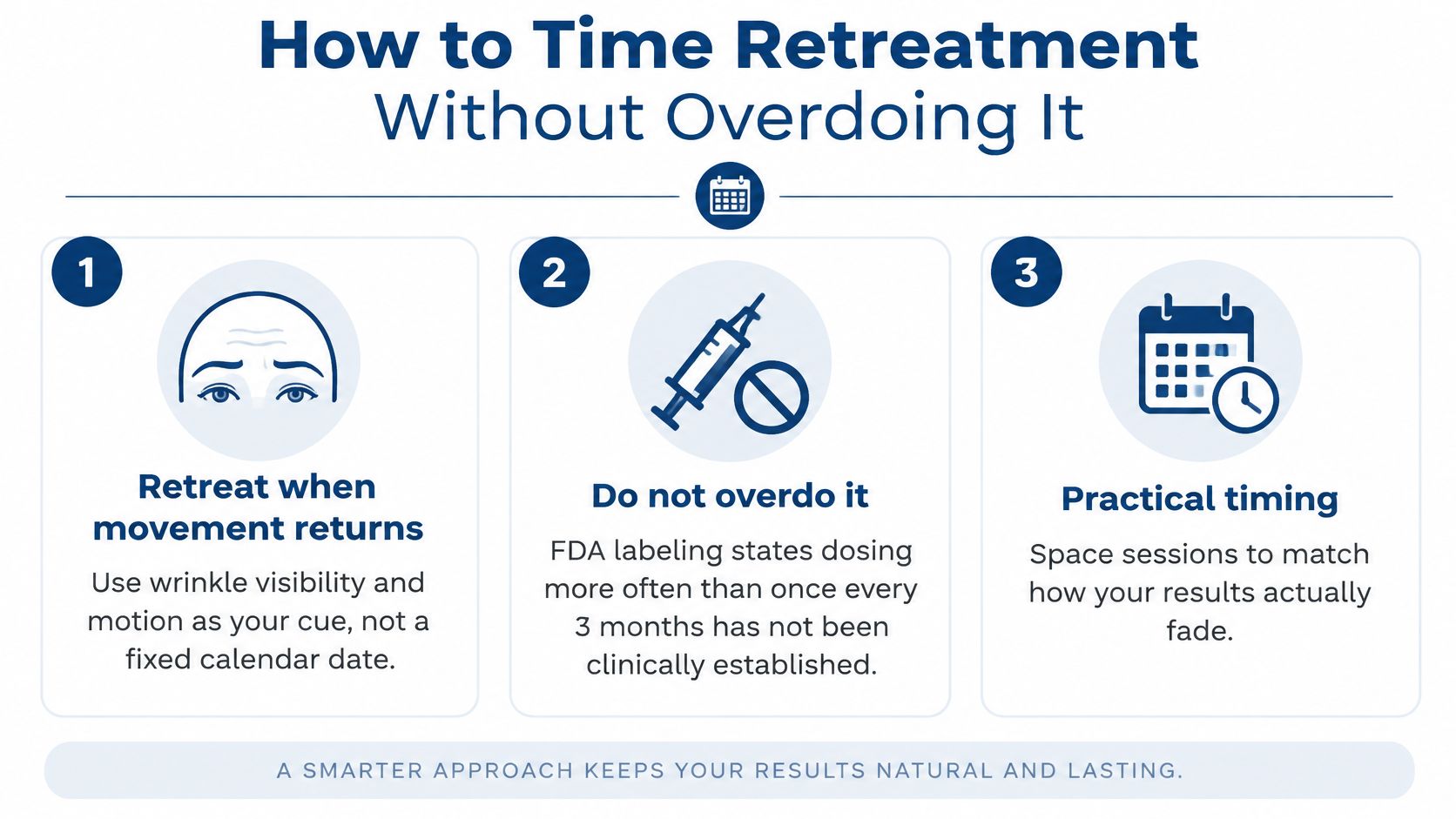
Retreat when movement and wrinkle visibility justify it, not because a reminder appears. The FDA labeling states that the safety and effectiveness of dosing more frequently than once every 3 months have not been clinically evaluated.
That threshold is not an instruction to receive treatment as soon as the interval ends. Your injector should reassess whether the benefit has meaningfully diminished, whether another dose matches your goals, and whether your eyes are comfortable.
A hypothetical reassessment
Say a patient receives treatment in January and notices lines returning around month three. That's a reason to arrange a review, not proof that another injection is immediately necessary.
During the assessment, the injector watches a smile and squint, compares the face at rest, and checks blinking comfort and eyelid closure. Skin quality matters too. A remaining crease caused mainly by laxity or surface damage may call for a separate skin-focused discussion rather than more muscle weakening.
If meaningful movement has returned, eye comfort is good, and the interval is appropriate, a repeat treatment may be planned. If movement remains reduced but the patient dislikes a resting crease, repeating the same approach sooner may not address the actual concern.
Our guide to Botox upkeep and regular sessions offers context for planning maintenance. Regular follow-up should support individualized decisions, not create an obligation to repeat treatment indefinitely.
A home checklist before your appointment
Use these observations to prepare, not to decide your own dose:
- Check resting lines. Note whether lines have returned at rest, not only when you smile. Resting lines alone aren't a signal that you need more Botox.
- Compare your squint. Has it returned toward its usual strength, or is movement still noticeably reduced?
- Review eye comfort. Any treatment-related discomfort, closure difficulty, or visual symptom should be resolved or clinically assessed before further treatment.
- Check your goal. Aim for softer crow's feet during expression, not the removal of every line around the eyes.
Maintenance principle: An appointment can end with observation rather than another injection.
Photographs taken in similar lighting, with the same expression and camera angle, can make this discussion clearer. Avoid comparing a relaxed face in flattering light with a strong smile in direct light. Professional evaluation remains essential because small muscles and nearby eye structures make placement and dosing consequential.
Plan Your Next Eye Treatment With a Qualified Injector
The best next step is a consultation when your observations raise a specific question: has movement returned, are the remaining lines mainly skin-related, or is an eye symptom still unresolved? You don't need to arrive with a treatment decision already made.
At Ideal Face & Body in Beverly Hills, CA, Dr. Sarah Yovino leads nonsurgical treatments that include Botox, facial rejuvenation with lasers and radiofrequency, microneedling, chemical peels, dermal fillers, tattoo removal, and medical weight loss. For someone whose eye-area concerns involve both expression and skin quality, a consultation can address those separate goals without assuming an injectable will solve everything.
Bring a useful treatment history
Prepare information that makes the conversation concrete:
- Past treatment details: Record treatment dates, products if known, and when you first noticed a meaningful return of movement.
- Eye symptoms: Describe dryness, discomfort, drooping, closure difficulty, or visual changes, including symptoms that have already improved.
- Your priorities: Explain whether you want softer smiling lines, improvement in resting texture, or help understanding an uneven result.
If you're considering different injectable categories, our guide to finding the right fit between Botox and Dysport can help you prepare questions. Product selection should follow an assessment, not a promise that one option will last longest for everyone.
When asking how long does Botox last around the eyes, look for an answer that includes what will be measured and when to reassess. A good consultation ends with a clear plan, realistic expectations, and room to postpone treatment. Contact a clinician promptly about any eye-function symptom, and don't wait for your next scheduled visit.
At Ideal Face & Body, we offer Botox and skin-focused facial rejuvenation treatments to address different causes of eye-area lines. Schedule a consultation to discuss your treatment history, eye comfort, and goals with Dr. Sarah Yovino, and develop a plan based on your response rather than a fixed calendar.