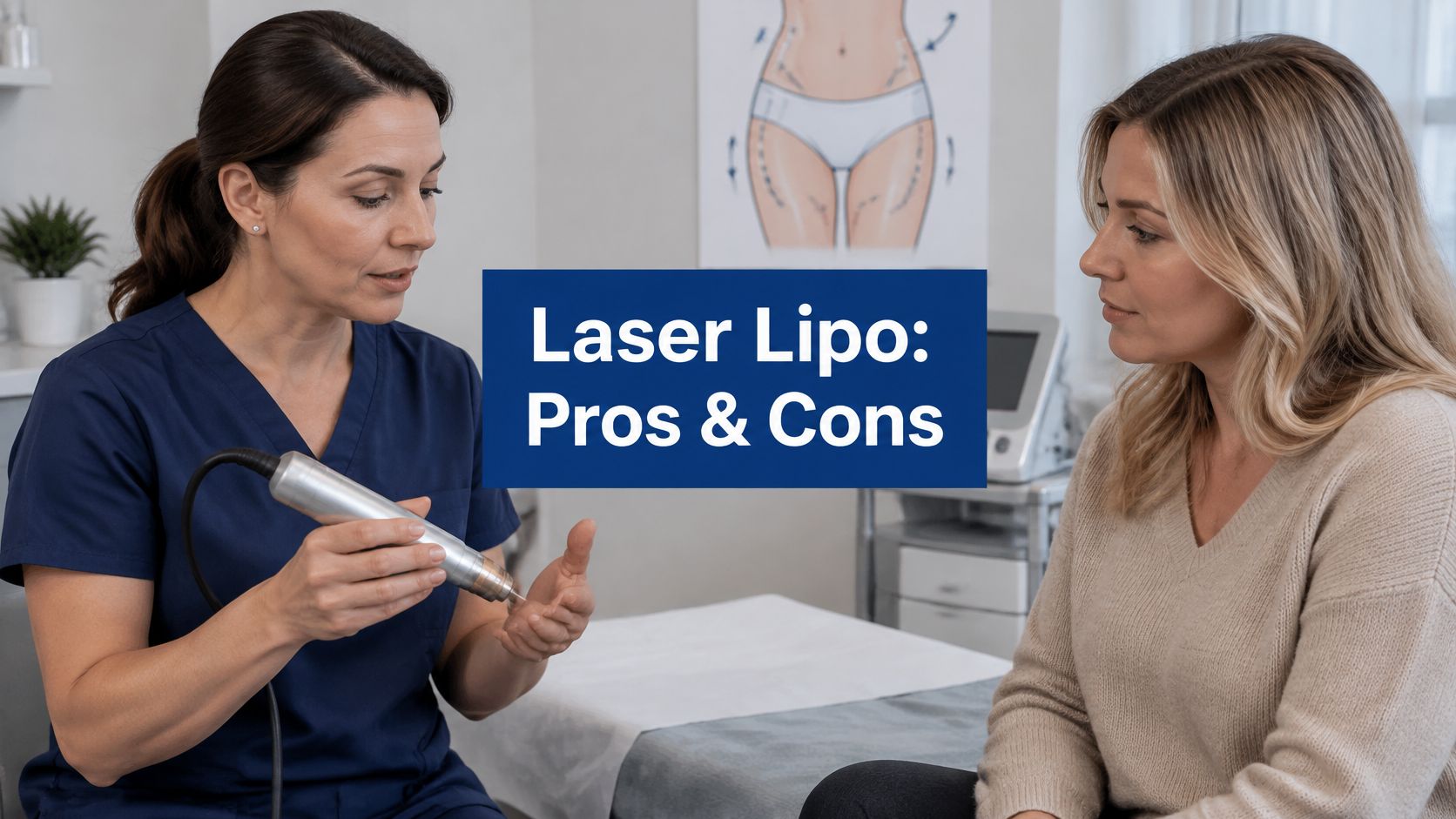
Is laser-assisted liposuction better than traditional liposuction, or is it just better marketed? That's the question to ask before getting attached to a device name, a dramatic before-and-after photograph, or a promise of easy recovery.
The laser is a tool, not a guarantee of a better result. Your treatment area, skin quality, anesthesia preference, and surgeon's technique matter more than the presence of laser energy alone. A carefully planned treatment can refine a stubborn fat pocket, but it can't reliably correct substantial loose skin, replace weight management, or eliminate surgical risk.
Understanding laser liposuction pros and cons means pairing each appealing feature with its limitation. Small incisions still leave wounds. Targeted fat removal still requires careful judgment about what to leave behind. An awake procedure can avoid general anesthesia, but it still requires medical screening, monitoring, and a recovery plan.
For someone considering awake, office-based contouring, the useful question isn't whether laser treatment sounds more advanced. It's whether this particular approach fits your anatomy and the change you want. These trade-offs should guide a consultation, especially if you're deciding between localized contouring, a procedure that removes excess skin, or postponing treatment until your weight is more stable.
Table of Contents
- 1. Smaller Incisions
- 2. Targeted Access to Treatment Areas
- 3. Possible Skin Tightening Effect
- 4. Awake Procedure Under Local Anesthesia
- 5. Recovery Time and Downtime
- 6. Bleeding Control and Heat-Related Risks
- 7. Best Suited for Localized Fat, Not Weight Loss
- 8. Longer-Term Results and Fat Redistribution
- Laser Liposuction Pros and Cons at a Glance
- Weighing the Trade-Offs Without the Hype
1. Smaller Incisions
Small access points are a practical advantage, but they don't make liposuction nonsurgical. A surgeon introduces a thin laser fiber beneath the skin to heat and disrupt fat, then removes the treated fat through a suction cannula. This differs from noninvasive treatments that apply energy from outside the body.

For chin and jawline contouring, discreet access points can help keep scars less conspicuous. Placement matters just as much as size: an incision positioned in a natural crease may be easier to conceal than one placed on an exposed surface. You should understand where each opening will be before treatment.
Small Openings Still Require Careful Technique
Traditional suction-assisted liposuction also uses small incisions, so incision size alone doesn't establish that laser treatment is better. Beneath those openings, the surgeon still treats a broader tissue area, and the skin still needs time to heal.
A review of laser-assisted lipolysis describes a dose-response relationship between delivered laser energy and fat breakdown, while finding no demonstrated advantage over tumescent liposuction. That distinction matters: the opening may look minor, but energy delivery beneath the skin remains consequential.
- Discuss placement: Have the proposed access sites explained, including how visible they may be in everyday positions.
- Disclose scar history: Mention raised scars, pigment changes, or problems healing previous wounds.
- Protect healing incisions: Follow wound-care instructions rather than applying unapproved creams or covering the sites with makeup.
The useful benefit is discreet surgical access, not an absence of scars or internal tissue healing.
2. Targeted Access to Treatment Areas
A patient may want a smoother transition between the waist and flank rather than a dramatic change in overall body size. That's a sensible contouring objective. A narrow fiber and cannula allow the surgeon to work within selected fat deposits, but precision comes from planning and controlled movement, not narrow instruments alone.
Potential treatment areas include the arms, chin, jawline, abdomen, flanks, thighs, calves, and ankles. Each presents different challenges. A flank may tolerate broader contour blending, while the ankle demands restraint because a small irregularity can be conspicuous.
A systematic review and meta-analysis of arm laser lipolysis pooled 199 patients and found an average arm-circumference reduction of 2.95 cm. That supports localized contour change in the studied patients, not a guaranteed result for every arm or another body region.
Treat the Transition, Not Just the Bulge
Removing the most prominent pocket without blending its edges can create an unnatural step-off. Similarly, trying to remove every pinchable bit of fat can leave depressions or make underlying anatomy more visible.
For abdominal and flank refinement, the surgeon should consider the front, side, and back views together. For calves and ankles, the assessment must distinguish removable fat from muscle, bone structure, or swelling that liposuction won't correct.
Practical rule: Choose an anatomical goal, such as a smoother waist transition, rather than asking for the maximum possible fat removal.
At consultation, area-specific photographs are more useful than unrelated transformations. Compare patients with similar starting contours and skin quality, and look for smooth transitions rather than size reduction alone.
3. Possible Skin Tightening Effect
Laser heat may provide modest skin contraction, but it isn't a substitute for removing substantial excess skin. Thermal effects can support collagen remodeling beneath the skin, potentially improving how the skin settles over a smaller fat layer. The response varies, and a promise of reliably tight skin goes beyond what the evidence supports.
A systematic review comparing laser-assisted and traditional liposuction retained 7 eligible studies, with 5 reporting potential advantages, but substantial risk of bias prevented a reliable conclusion that laser-assisted liposuction was superior. Possible benefit and proven superiority aren't the same thing.
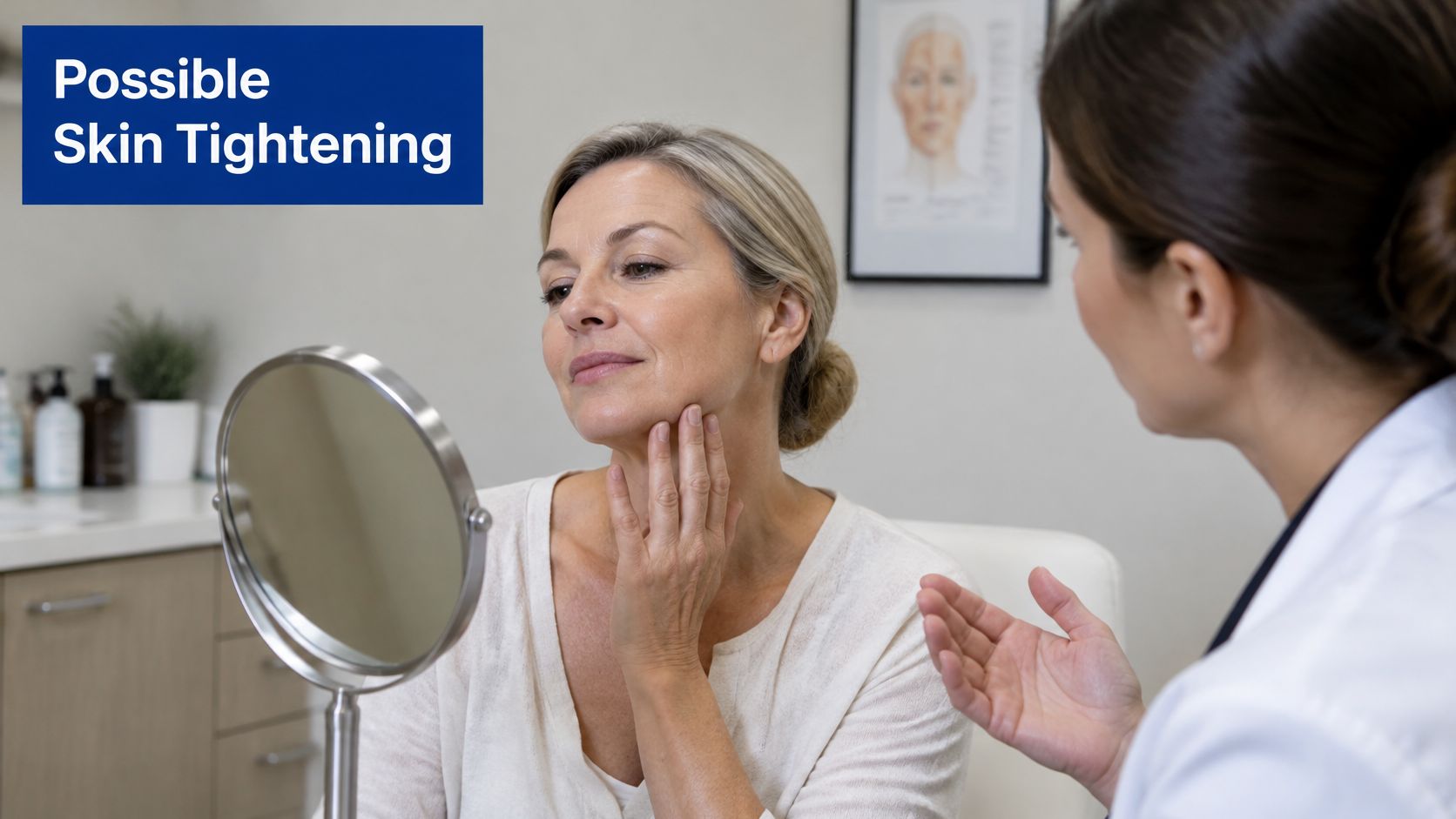
Consider a patient with a small under-chin fat pocket and mild laxity. Reducing that pocket may improve jawline definition, with some additional contraction helping the skin adapt. A patient with hanging neck skin or pronounced abdominal overhang has a different problem, and fat removal alone may leave that looseness more apparent.
Judge Skin Quality Before Choosing Treatment
Skin elasticity, existing folds, stretch-related changes, and the amount of planned fat removal all affect expectations. Our guide to skin tightening after liposuction explains why the skin response deserves its own discussion rather than being treated as an automatic bonus.
- Set a realistic target: Expect possible refinement, not the equivalent of a neck lift or tummy tuck.
- Support recovery: Keep skin comfortably moisturized where permitted and protect healing areas from sun exposure.
- Separate swelling from results: Early firmness doesn't necessarily represent durable tightening.
Good skincare supports healing, but it can't turn significant excess skin into a suitable liposuction-only problem.
4. Awake Procedure Under Local Anesthesia
For patients who want to avoid general anesthesia, awake treatment can be a meaningful advantage. Tumescent local anesthesia involves placing dilute numbing solution into the treatment tissues. A suitable patient can remain awake while the surgeon performs contouring.
Our practice emphasizes office-based procedures under local anesthesia in Beverly Hills' Golden Triangle. Many procedures can avoid general anesthesia and IV lines, but the appropriate plan depends on the treatment extent and medical assessment. “Awake” describes the anesthesia approach, not a lower standard of surgical care.
For example, someone seeking localized chin or arm contouring may prefer being awake rather than undergoing general anesthesia. Someone who becomes highly distressed during medical procedures may find that preference less compatible with their needs.
Comfortable Doesn't Mean Sensation-Free
Local anesthesia aims to control pain, but patients may still notice pressure, movement, or pulling. You should communicate discomfort rather than assuming you need to tolerate it. Anxiety, positioning tolerance, medications, and medical conditions all belong in the assessment.
The limits matter as much as the convenience:
- Treatment extent: Combining more areas isn't automatically appropriate just because general anesthesia isn't planned.
- Medication safety: Local anesthetic dosing still requires careful calculation and monitoring.
- Home support: Arrange transportation and a responsible companion for the initial recovery period, even if you expect to feel well.
Avoiding general anesthesia doesn't eliminate surgical risk, and being awake doesn't mean you should drive yourself home.
A responsible office-based plan includes medical screening, clear discharge instructions, and a way to reach the clinical team afterward. The setting should fit the patient and procedure, not merely their preference for a lighter experience.
5. Recovery Time and Downtime
Returning to desk work and being fully healed are different milestones. A patient may feel capable of answering emails while still having swelling, tenderness, bruising, and movement restrictions. Laser liposuction isn't a no-downtime treatment, even when the procedure is limited and performed awake.

A review of energy-based and traditional liposuction presented through IMCAS describes substantial differences in treatment protocols, outcome definitions, and follow-up that prevent definitive claims of consistently better recovery with laser treatment. Comparisons are particularly misleading when a small awake treatment is measured against a much larger operation.
For an arm-contouring patient, typing may become comfortable before lifting a child or carrying a heavy bag. After chin treatment, feeling well enough to work doesn't necessarily mean swelling is subtle enough for a public-facing event. Plan around both physical demands and how comfortable you'll feel being seen.
Plan for Function and Appearance
Our overview of laser liposuction recovery time can help you distinguish early recovery from the gradual settling of your contour. Your individual instructions should take precedence over someone else's online recovery diary.
- Compression: Wear the prescribed garment or wrap as directed, without tightening it excessively.
- Activity: Keep strenuous exercise and heavy lifting on hold until cleared, while following instructions about gentle movement.
- Scheduling: Leave flexibility for bruising, swelling, and follow-up rather than booking treatment immediately before an important event.
Final contour develops gradually as swelling resolves and tissues settle. Don't judge symmetry from an early photograph, but don't dismiss worsening pain or an unexpected change as ordinary swelling without contacting the clinical team.
6. Bleeding Control and Heat-Related Risks
The same heat that may help control bleeding can also injure tissue. Laser energy can coagulate small blood vessels while disrupting fat, which may reduce bleeding during treatment. Excessive energy, superficial placement, or uneven movement can cause burns and damage nearby structures.
A clinical review of laser-assisted liposuction describes heat-mediated coagulation as a proposed benefit and reports four burns among 537 patients in an observational series. That finding doesn't predict your individual risk, but it makes clear that thermal injury is a real complication rather than a theoretical concern.
A dorsocervical fat pad illustrates the trade-off. Reducing its prominence may improve the profile, but the surgeon must manage tissue depth and energy delivery carefully. Chin and neck treatment require similar attention near delicate structures, including nerves.
More Heat Isn't a Better Result
Controlled fiber movement, appropriate settings, tissue assessment, and temperature monitoring deserve discussion during informed consent. No device setting removes the need for surgical judgment, and skin tightening shouldn't be pursued by indiscriminately increasing energy.
After treatment, promptly report blistering, unusual or escalating pain, concerning skin-color changes, or new or worsening numbness. Don't apply heating pads or attempt to treat a suspected burn yourself.
Safety distinction: External laser skincare and internal laser liposuction require different aftercare.
General aftercare tips for laser hair removal concern a different procedure and shouldn't replace surgical wound-care instructions. Follow the plan for your actual treatment, particularly around compression, incisions, topical products, and when to seek assessment.
7. Best Suited for Localized Fat, Not Weight Loss
Laser liposuction changes contour; it isn't a weight-loss strategy. The strongest use case is a defined fat deposit in someone whose weight is reasonably stable and whose skin can adapt to the planned reduction. Removing more fat doesn't automatically produce a better or safer result.
A patient who wants to refine persistent flank or thigh fullness despite a consistent routine may have a suitable contouring goal. Someone seeking substantial overall weight reduction needs a different primary plan. Calf and ankle refinement likewise aims to adjust proportion, not meaningfully change body weight.
A systematic review and meta-analysis published in Aesthetic Surgery Journal reported an overall liposuction complication rate of 2.62%, with contour deformity the most common complication at 2.35%. These are broader liposuction findings, not laser-specific benchmarks, and they reinforce why contour quality deserves more attention than aggressive removal.
Match the Procedure to the Problem
Abdominal fullness can include subcutaneous fat, internal fat, loose skin, or abdominal-wall changes. Liposuction doesn't address all of those components. Removing surface fat won't reliably flatten a contour driven mainly by something deeper.
- Stabilize your routine: Establish eating and activity habits you can sustain before pursuing contouring.
- Define the concern: Identify the specific pocket or transition you want changed.
- Accept alternatives: Significant laxity may require skin removal, while broader weight concerns may warrant medical weight-management support.
Resources offering personalized weight loss workouts may help organize activity, but exercise selection should suit your health and doesn't determine surgical candidacy. After treatment, exercise must also follow your surgeon's restrictions.
The appropriate treatment is the one that addresses your anatomy without asking liposuction to accomplish something it can't.
8. Longer-Term Results and Fat Redistribution
Fat cells removed through suction are physically removed, which can produce lasting changes in the treated contour. That doesn't make the surrounding body resistant to weight gain. Remaining fat cells can enlarge, and changes in weight can alter the balance between treated and untreated areas.
Fat doesn't travel from the suctioned area to another location. Instead, future fat storage can change your proportions, with enlargement becoming more noticeable in areas that weren't treated. Aging and changes in skin quality can also affect appearance despite an initially good result.
For example, an abdominal contour may remain more defined when a patient maintains consistent nutrition and activity. If that patient gains substantial weight, both the abdomen and untreated regions can change, and the original proportions may no longer look the same.
Permanent Removal Isn't Permanent Shape
Our explanation of whether liposuction permanently removes fat separates removal of treated fat cells from the ongoing behavior of the remaining tissue. That distinction is more useful than a blanket promise of permanent results.
A touch-up may sometimes address a residual pocket or asymmetry after healing. It shouldn't be assumed necessary, promised in advance, or used as a substitute for allowing swelling to settle and assessing the original result carefully.
- Maintain weight stability: Use balanced nutrition and regular activity you can continue over time.
- Compare realistic photographs: Look for similar starting anatomy and clearly identified follow-up stages.
- Discuss revision expectations: Understand how residual fullness, asymmetry, and skin laxity would be evaluated.
Treat liposuction as a lasting anatomical change that still needs long-term weight stability, not as protection against future body changes.
The best maintenance plan is sustainable rather than extreme. Restrictive dieting followed by repeated regain makes contour preservation harder.
Laser Liposuction Pros and Cons at a Glance
Use this checklist to judge whether laser liposuction fits your goals and treatment plan. A “yes” across every item is not required, but unresolved concerns should be discussed before you choose a procedure.
| Before deciding, ask yourself | A practical sign of fit | Pause and discuss |
|---|---|---|
| Is my goal specific to a localized area? | You can identify the area you want to contour. | Your main goal is overall weight loss or a major change in body size. |
| Have I considered skin quality? | You understand that skin response affects the final contour. | You expect laser treatment to remove substantial loose skin. |
| Am I comfortable being awake? | You are prepared for a procedure using local numbing and can communicate during treatment. | The treatment plan or your preferences point toward another anesthesia approach. |
| Can I follow the recovery plan? | You can arrange transportation and support if advised, and follow activity guidance. | Work, caregiving, or other obligations make recovery arrangements difficult. |
| Do I understand the limits of fat removal? | Your expectations focus on contouring rather than maximum fat removal. | You expect treated areas to prevent future weight-related changes. |
| Have I discussed heat-related risks? | You understand that laser energy requires careful control and monitoring. | You have unanswered questions about burns, numbness, or unevenness. |
The consultation should connect your goal to a specific treatment area, technique, and recovery plan. At Ideal Face & Body, awake liposculpting is performed using only numbing, but candidacy and the proposed approach still need individual assessment.
Weighing the Trade-Offs Without the Hype
A good decision starts with a specific concern and a realistic view of what treatment can change. A localized pocket of fat with reasonably elastic skin differs from hanging skin or fullness related mainly to internal fat. Your surgeon should explain which features may improve and which will remain.
Decide What Success Would Look Like
Set a concrete goal, such as a smoother flank, less under-chin fullness, or better arm proportions. Avoid defining success as maximum fat removal or completely tight skin. Before-and-after galleries can help clarify your preferences when you compare people with similar starting points.
Awake treatment may suit patients who prefer local anesthesia, but it still calls for medical screening and careful planning. Discuss how you will communicate with the clinical team, arrange recovery support, and follow activity restrictions.
Your weight history, skin concerns, medical conditions, medications, and anesthesia preferences all matter in assessing options. Stable weight and realistic expectations help set a useful standard for judging results over time.
Take a Low-Pressure First Step
Ideal Face & Body offers a complimentary virtual surgical pre-screening with its surgical consultant to discuss your goals and options. PRECISION SCULPT laser liposculpting was developed and pioneered by Justin Yovino, MD, FACS. A pre-screening can help you discuss whether your concerns may be suited to treatment. A final recommendation requires an appropriate clinical evaluation.
Before booking, gather the details above and identify the area you want to address. Then request the complimentary virtual pre-screening and ask what a procedure could reasonably change in your case.
Ideal Face & Body offers awake, office-based laser liposculpting. Visit Ideal Face & Body to review before-and-after galleries and request a pre-screening.