How can you be back at your desk before your eyelids feel normal, yet still notice dryness months later?
Three clocks run at once after blepharoplasty: functional recovery, presentable appearance, and fully matured scars. Functional recovery covers work, reading, and daily movement without eyelid strain. Presentable appearance covers bruising and obvious swelling. Scar maturation is the slower, months-long tissue remodeling that continues after the eye looks settled.
A patient who returns to desk work early and then worries about dry eyes weeks later is reading the wrong clock. Match the question to the clock: Can I function? Can I be seen? Has the tissue finished? The answer separates expected settling from a symptom that deserves a call.
Table of Contents
- Blepharoplasty Healing Timeline at a Glance
- What Happens in the First Week
- Activity Limits and Return to Work in Weeks Two to Four
- Months One to Six and the Symptoms That Linger
- What Changes Your Recovery Timeline
- Warning Signs That Need Prompt Care
- Confirm Your Recovery Timeline With Your Surgeon
Blepharoplasty Healing Timeline at a Glance
How long does blepharoplasty take to heal? Long enough that the answer splits into three separate finish lines, and short enough that you can be back at your desk while your eyelids are still visibly settling.
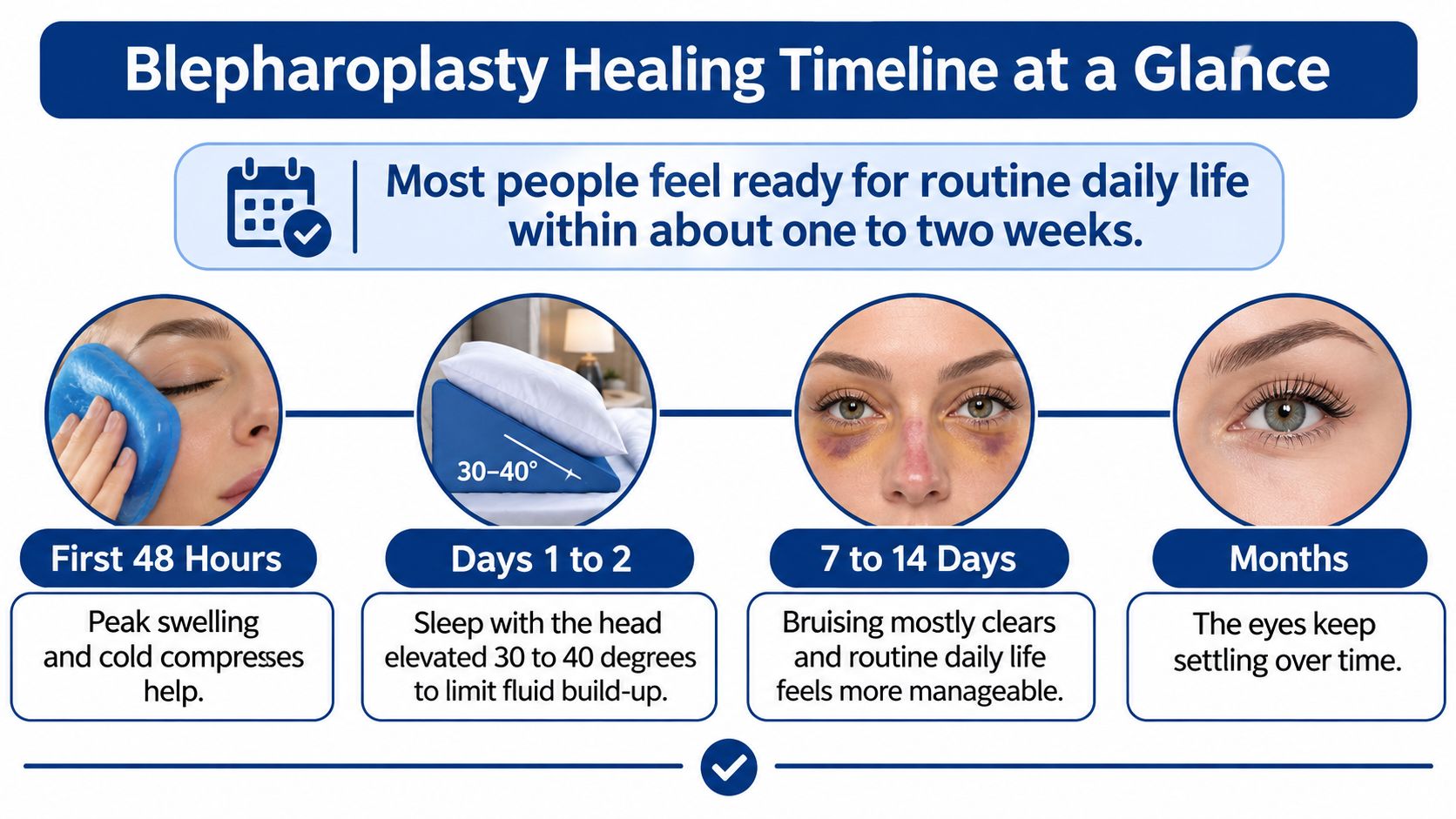
Healing runs on a staged schedule rather than a single date. Return to routine daily life usually lands in the one to two week range, bruising clears over roughly 7 to 14 days, and the lids keep changing shape for months afterward. The distance between those numbers is the story of this timeline.
The American Society of Plastic Surgeons patient guide describes the first week as the period for treating pain, swelling, and bruising while significantly limiting activity, with eye lubrication and scar measures such as massage during weeks 2 to 3 when the surgeon directs them. From week 4 onward, the same guide treats normal physical activity as generally expected to resume. It places bruising resolution at 5 to 10 days, swelling decline over 2 to 4 weeks, and the first appearance of final results at 1 to 2 months.
Two bruising windows, one event. Read the 5 to 10 day figure as the core of the bruising phase and the two-week mark as its outer edge. The deep discoloration goes first, and a faint yellowish trace can sit at the outer corners a few days longer.
How to Read the Three Clocks
Functional recovery answers the question your employer asks. Can you read, work, and move through a normal day without straining your eyelids? That clock runs in days to weeks.
Presentable appearance answers the question your mirror asks. Has enough bruising and obvious swelling faded that you would sit through dinner or stand in a photo? This clock runs slower, and it does not finish just because you feel fine.
Scar and contour maturation is the slowest clock of all. Incision lines keep softening and fading long after the bruises are gone, and subtle swelling changes how the lid sits from week to week. If you are still choosing a date, separate how long blepharoplasty takes to heal from how long the surgery itself takes, because they answer different questions on different scales.
| Phase | Timeframe | What Is Happening | Typical Milestone |
|---|---|---|---|
| Immediate postoperative | Day of surgery to day 2 | Swelling peaks and vision may blur | Cold compresses and head elevation limit swelling |
| First week | Days 1-7 | Bruising and swelling dominate | Most bruising clears within 5 to 10 days; stitches usually removed at a one-week visit |
| Weeks two to three | Days 8-21 | Swelling eases and lubrication continues | Scar care begins only when the surgeon directs |
| Weeks four to eight | Weeks 4-8 | Normal physical activity generally resumes | Final results start to show within 1-2 months |
| Three to six months | Months 3-6 | Subtle swelling, dryness and numbness settle | Swelling no longer masks the result, which is why surgeons judge the outcome here |
| Six to twelve months | Months 6-12 | Scars continue fading | Incision lines can take up to one year to refine |
Two variables shift every row. Upper-only surgery often recovers faster than combined upper and lower work, because less tissue is involved. Your own healing biology matters too, along with how closely you follow aftercare. Two people with the same surgery date can look quite different at day ten, and both can be healing normally.
Practical rule: Write your surgery date on a calendar, mark each phase, and compare those dates against your surgeon's written schedule before you commit to work, travel, or an event.
What Happens in the First Week
Say your surgery is on a Monday morning. You go home the same day, and by Monday evening your eyelids feel tight and heavy. That tight, puffy feeling isn't the final result peeking through. It's the start of the swelling phase, and it usually gets more noticeable before it gets better.
Days One and Two
The first 48 hours are when swelling peaks. Your lids may look worse on day two than they did right after surgery, and that's expected. The whites of your eyes can look pink or discolored, and your vision may feel smeary, especially if ointment is in the eye.
The University of Mississippi Medical Center aftercare guide recommends cold compresses during the first 2 days and sleeping with the head raised 30 to 40 degrees to limit swelling. The same guide notes that temporary blurred vision may occur for 2 to 3 days because of postoperative swelling, and that eyelid swelling and bruising generally fade within 7 to 10 days.
Think of cold and elevation as a pair. Cold helps calm the early swelling response, and elevation keeps fluid from pooling in loose eyelid skin overnight. Skipping one and doing the other perfectly still leaves a gap.

Days Three to Seven
Days three and four are still quiet rest days, not catch-up days. Bruising often deepens in color before it lightens, shifting through purple, green, and yellow tones. That color change looks dramatic, but color alone doesn't mean something's wrong. What matters is the direction. After the early peak, swelling should slowly trend down, even if mornings look puffier than evenings.
By days five to seven, many people feel more comfortable moving around the house and doing light tasks. Reading and screens may still tire the eyes quickly, so short sessions with breaks work better than long stretches. In many clinics, stitches come out at about a one-week visit, which gives the surgeon a first direct look at how the incisions are closing.
These care points carry you through the week:
- Keep your head raised: Sleep propped on two or three pillows so fluid drains away from the lids instead of settling there.
- Wrap cold packs in cloth: Apply them gently as directed, never pressing a bare frozen pack directly against healing skin.
- Don't rub or press the eyelids: Rubbing can stress a fresh incision and irritate the eye surface, even if the area itches.
- Use lubricating drops only as directed: Add them on the surgeon's schedule, not whenever the eye feels dry, since ointments themselves can blur vision.
- Avoid straining: Skip heavy lifting, bending low, and anything that makes you hold your breath and bear down.
So what does a normal day seven look like? You'd typically see yellowish, fading bruises rather than fresh dark ones, swelling that's clearly less than day two, and incisions that look like thin pink lines. You probably won't look finished, and you shouldn't expect to. If swelling is still climbing at day seven instead of easing, that's a different story, and it deserves a call rather than patience.
Activity Limits and Return to Work in Weeks Two to Four
Week two is where recovery splits into two clocks that stop moving together. One clock is functional: it decides when you can drive, lift a grocery bag, and sit through a full workday. The other is appearance: it decides when your eyelids stop announcing that something happened. Physical capacity usually runs ahead of appearance by a week or more, and planning around the wrong clock is how people end up back at a desk feeling fine and startled by a video call.
The NHS eyelid surgery guidance puts typical time away from work at about 2 weeks and notes that the exact figure depends on the job. That average covers very different working days. Someone writing code from a laptop can usually log back in around the two-week mark. A warehouse picker lifting cartons overhead, or a nurse repositioning patients, needs longer, because the physical load of the job sets the date rather than the calendar.
Why the Restrictions Last Longer Than You Expect
Each limit guards healing tissue against one specific problem, so the restriction lifts when that risk lifts, not when you feel ready. The rules work like scaffolding around a repair: each piece comes down only once the tissue underneath can carry its own load. Bending and lifting raise pressure inside the head, which pushes fluid into the lids and stresses incisions that are still sealing. Contact lenses are a mechanical issue, since inserting and removing one means tugging the very eyelid you need to keep still. Eye makeup is a contamination issue, and taking it off usually involves rubbing.
The Memorial Sloan Kettering Cancer Center aftercare instructions tell patients to avoid bending at the waist or lifting more than 5 pounds (2.3 kilograms) for 4 to 6 weeks unless the surgeon approves earlier progression, and to sleep with the head raised on 2 to 3 pillows for 2 weeks. Those windows explain most of the frustration in this stretch, because you can feel entirely well and still be inside a restriction.
| Activity | Typical Restriction | Typical Window |
|---|---|---|
| Rest and light activity | Limit activity | First 3 to 4 days |
| Light exercise | Resume gradually | Once swelling is settling, with surgeon approval |
| Strenuous exercise and swimming | Defer until cleared | After surgeon clearance |
| Driving | Restricted | Several days |
| Contact lenses | Avoid | At least 2 weeks |
| Sleeping with head raised | Use 2 to 3 pillows | About 2 weeks |
| Work | Time away from work | Approximately 2 weeks, longer for demanding jobs |
| Eye makeup | Delay | About 2 to 4 weeks depending on protocol |
| Bending at the waist | Avoid | 4 to 6 weeks unless surgeon authorizes earlier |
| Lifting objects over 5 pounds (2.3 kg) | Avoid | 4 to 6 weeks unless surgeon approves earlier |
Eye makeup has its own timing because it is cosmetic rather than functional, and clinics vary widely. A common window is two to four weeks, long enough for incisions to close and for the small crusting to settle, but the answer depends on what you use and how the lids look at your follow-up.
Driving sits in its own category because it depends on vision rather than on how you feel generally. You are restricted for several days, and you should not drive while vision is blurred, while ointment is clouding your sight, or while sedating medication is in your system. If you cannot check a blind spot comfortably or keep both eyes open in bright light, you are not ready, whatever the calendar says.
Working again is possible at two weeks, but your skin will still be visibly swollen.
That gap between the two clocks is what weeks two to four are about. Bruising or redness may remain visible for several weeks after you are back at your desk, and swelling often fluctuates, looking better one day and puffier the next after a salty meal or a poor night's sleep. Book important meetings and photos against the appearance clock, not against your first day back.
Check every window in the table against your own surgeon's written instructions, because protocols differ between clinics and between upper- and lower-lid procedures. If your sheet says something stricter, follow your sheet. The person who saw your eyelids in the operating room sets your limits, not a general guide.
Months One to Six and the Symptoms That Linger
By month two, the mirror becomes more useful and more misleading. Bruising has faded enough that coworkers stop asking, yet a full day at a screen can leave your eyes feeling gritty by late afternoon, as if a grain of sand is caught under the lid. That afternoon grit is a useful example of the gap between functional recovery and full healing. Your eyelids can do their job long before they feel and look completely settled.
Track three clocks instead of one: functional recovery, presentable appearance, and scar maturation. They rarely move together. Function often returns first, presentable appearance follows, and scar maturation finishes last.
Numbness, Dryness, and Blurred Vision
The American Academy of Ophthalmology upper eyelid blepharoplasty page notes that upper-eyelid numbness involving the eyelid skin and eyelashes commonly resolves over two to four months. That is far longer than the bruising window, and it is the detail people least expect. Numbness fades gradually, sometimes with tingling or odd sensitivity as sensation returns, and it rarely returns evenly on both sides at the same pace.
Dry or gritty eyes may continue for several weeks. Swelling affects how the lid moves across the eye, causing blinking to be incomplete for a time, and the tear film becomes disrupted, so the surface dries out faster than usual. Clinician-directed lubricating drops or ointment are the usual treatment. Lingering dryness affects comfort during recovery, not how long blepharoplasty results last.
Blurred vision belongs mostly to the early days, when swelling and ointment do the blurring. If blurring is new or worsening weeks later, treat it as a different problem and get it checked.
Chemosis and Scar Maturation
After lower eyelid surgery, some people develop chemosis, a jelly-like swelling on the white surface of the eye. It looks alarming, almost like a blister on the eye itself. It can last several weeks and sometimes months, and it usually settles slowly rather than disappearing overnight. Because it sits on the eye surface, it can also make the eye feel irritated and watery, which people often mistake for infection.
Scars follow the longest of the three clocks. Many surgeons describe incision lines as taking up to a year to refine, moving from pink and slightly firm to pale and flat; ask your surgeon what range they expect for your eyelid and skin type. Judging your result at three weeks is like judging a haircut while it is still wet. By six months, the subtle swelling that distorts contour has largely settled, which makes it a fair point to assess how you look.
During this stage, these habits help:
- Keep prescribed lubricants in use as directed: Stay on the schedule your surgeon set, even on days when your eyes feel comfortable.
- Protect the incision from sun exposure as directed: Healing scar tissue darkens more easily, so follow the specific sun guidance you were given and wear sunglasses outdoors.
- Begin scar massage only when cleared: Starting too early can stress the incision, so wait for explicit clearance and the technique your surgeon shows you.
- Track changes monthly with photos: Use the same light, same angle, and no makeup, so you are comparing healing rather than comparing lighting.
One limit to keep clear. Lingering numbness, mild dryness, and slow scar fading are normal parts of this phase. Difficulty fully closing your eyes, worsening pain, or vision changes are not, and they belong in a call to the surgical team.
What Changes Your Recovery Timeline
Two patients can leave surgery on the same day and still heal on different clocks. One clock is functional recovery: blinking comfortably, reading, driving, working. A second is presentable appearance: whether swelling and bruising read as “recent surgery” on camera or across a meeting table. The third is scar maturation, the slowest clock and the least useful one for planning a normal week.
The biggest variable is surgical extent. Upper eyelid work and lower eyelid work do not stress the same tissue. Lower eyelid surgery sits closer to the eye surface, so even when the incision looks tidy, surface swelling can make the eye feel watery, gritty, or easily tired. Combined surgery adds more area to settle at once, which is why its early window is usually the longest of the three.
| Scenario | Typical Recovery Window | Why It Differs |
|---|---|---|
| Upper eyelid only | Often the least disruptive to appearance once early swelling passes | Incision sits in the crease and the surgical field is smaller |
| Lower eyelid | Surface swelling can linger for weeks and occasionally longer | More ocular-surface involvement and fluid on the eye surface |
| Upper and lower combined | About 2 to 3 weeks before recovery is considered substantially complete | Greater surgical extent means more tissue is healing at once |
| Pre-existing dry eye | Individualized and may run longer | Ocular surface already compromised |
| Thyroid eye disease | Individualized and may run longer | Orbital condition affects eyelid healing |
Your Own Biology and Habits
Skin changes what healing looks like, not what healing is. Thinner skin shows bruising early; thicker skin keeps swelling longer. A faint yellow mark on delicate skin may be nearly done, while firmer swelling under thicker skin can make the same stage look slower.
Bruising tendency is partly personal. If minor bumps usually leave dramatic marks, expect the visible phase to sit nearer the long end of normal, and tell your surgeon about medicines or supplements that affect bleeding before surgery rather than afterward. Healing biology covers circulation, inflammation, and how scar tissue is laid down; it is a real reason two patients diverge even with identical procedures.
The first-week routine matters because swelling that lingers keeps both function and appearance on the slow setting. This section adds the reason: aftercare does not create speed by itself, it prevents avoidable fluid from stretching the phase people notice.
Conditions That Need an Individual Plan
If you already have dry eye, struggle with contact lenses, have thyroid eye disease, or cannot fully close your eyelids, tell your surgeon before surgery, not after. These conditions affect the eye surface and lid position, so the lubricant schedule, activity guidance, and follow-up timing may all need adjusting. Your timeline may also run longer, and knowing that in advance is far less stressful than discovering it at week three.
Plan around the clock that matters for the date on your calendar. A face can look broadly healed around two weeks while residual swelling, dryness, and scar tightness remain. If you have a wedding, a photo session, or a public-facing event within six weeks of surgery, ask how settled your eyes are likely to look on that exact date before you commit.
Warning Signs That Need Prompt Care
Most early symptoms after eyelid surgery are expected, even the dramatic-looking ones. Bruising, puffiness, watery eyes, and tightness are the normal texture of the first week. Most symptoms are normal, but a short list of signs needs a call the same day.
Recovery has three clocks: functional recovery, presentable appearance, and fully matured scars. A warning sign overrides all three, because safety comes before schedule. The Mayo Clinic blepharoplasty overview supports urgent clinical assessment for worsening swelling, severe pain, reduced vision, or any new visual disturbance, and it flags visual impairment lasting beyond 24 to 48 hours as a reason to contact the surgical team. Knowing the eyelid surgery risks in advance helps you sort a symptom into wait, call, or emergency.
| Symptom | Usually Normal If | Contact the Surgical Team If |
|---|---|---|
| Bruising | Fades over about 7 to 14 days | Darkens or spreads after the first week |
| Swelling | Peaks early and eases over 2 to 4 weeks | Keeps increasing after the first few days |
| Vision | Blurred for 2 to 3 days | Severe or lasting beyond 24 to 48 hours |
| Eyelid closure | Mild, short-lived difficulty closing | Persistent inability to close the eyes fully |
| Pain | Manageable with the prescribed comfort measures | Severe or worsening |
| Dryness or grittiness | Improves over several weeks | Persistent exposure discomfort or worsening |
| Incision | Lines fade over months | Opening, drainage or spreading redness |
| Lower lid skin | Mild pinkness near incisions | Red, hot, swollen lid with discharge |
How to Tell Normal From Not Normal
Direction matters more than intensity on any single day: bruising that darkens or spreads after the first week is moving the wrong way. The same logic applies to swelling. Puffiness that's worse in the morning and better by evening is ordinary. Swelling that keeps increasing after the first few days, especially on one side only, isn't. Pain follows the same pattern. Discomfort that your prescribed comfort measures control is expected, while pain that's severe or getting worse each day needs assessment.
Vision deserves the least patience of all. Mild blurring from swelling and ointment in the first two or three days is common. Severe blurred vision, reduced vision, or any new visual disturbance needs urgent assessment, and sudden vision loss needs immediate emergency care. Don't wait for a scheduled visit to mention it.
A red, hot lower lid with discharge is another same-day call. That combination points to infection or another problem that needs treatment. It looks different from the pink incision line that fades over months: the skin is angry, swollen, and often tender to touch. If you see it, phone the surgical team and describe the color, temperature, and drainage.
If a symptom is getting worse after it had been getting better, call. That single rule catches most problems early.
Difficulty fully closing the eyes also belongs on the call list, because an eye that stays partly open dries out and can damage its own surface. Persistent exposure discomfort, a feeling that the eye is drying out despite lubricants, tells you the surface isn't protected. A pre-existing dry eye or thyroid eye disease diagnosis makes this warning sign more likely, so your surgeon may check lid closure more often.
When you do call, be specific. Note when the symptom started, whether it's one eye or both, and what you've already tried. Photograph the area in good light so you can show change over time. Calling early with clear information gets you a useful answer faster than waiting and hoping.
Confirm Your Recovery Timeline With Your Surgeon
Bring the three clocks to your follow-up: functional recovery, presentable appearance, and fully matured scars. General phases show the usual order, while your surgeon can say which clock each instruction belongs to for your eyelids, your procedure, and your eye surface.
Arrive with a written list. Ask which phase you are in today, which activity limits still apply, and when stitches come out. Get separate dates for eye makeup, driving, and work, because being functional enough to answer email can come before looking rested in bright light. Ask which symptoms should trigger a call, then write the answers down while you are there. Swollen and tired is a bad memory aid.
At Ideal Face & Body in Beverly Hills, CA, face surgical services include Buccal Lipectomy (Cheek Reduction), Eyelid Lift, Facelift, Neck Lift, and Mini Neck Lift. Awake plastic surgery there uses only local anesthesia, so the patient stays awake and numb during surgery, and the recovery conversation can be built around instructions given after an office-based awake procedure.
If the written schedule differs from this guide, follow the written schedule. Full healing and scar maturation take months, so keep the check-in even when the mirror looks reassuring, and if a wedding, photo shoot, trip, or presentation falls within six weeks, ask one direct question before you book anything non-refundable: how presentable are my eyes likely to be on that exact date?
If you're planning an eyelid lift and want a recovery timeline built around your work, your events, and your eye health rather than a generic two-week estimate, book a consultation with Dr. Sarah Yovino or Dr. Justin Yovino to map your functional, presentable, and fully healed milestones in advance. You can review eyelid lift options and request your visit through Ideal Face & Body.